Introduction
A progressive delay in motherhood has been observed during the last decades due to socioeconomic changes (Tearne, Reference Tearne2015), mainly in industrialized countries (Sartorius & Nieschlag, Reference Sartorius and Nieschlag2009). This may be explained by increasing rates of women going onto higher education, commitment to professional career, or postponing marriage until achieving financial stability (Han et al., Reference Han, Dong, Song, Cheng, Xie, Chen and Jiang2018; Vohr et al., Reference Vohr, Tyson, Wright, Perritt, Li and Poole2009). Most studies have focused on medical complications of older pregnant women and delivery outcomes (e.g. chromosomal or congenital abnormalities, low birth weight, prematurity, stillbirth) (Brion, Leary, Lawlor, Smith, & Ness, Reference Brion, Leary, Lawlor, Smith and Ness2008; Fuligni & Brooks-Gunn, Reference Fuligni, Brooks-Gunn, Day and Lamb2004; Han et al., Reference Han, Dong, Song, Cheng, Xie, Chen and Jiang2018; Sauer, Reference Sauer2015), but less evidence exists about the maternal age effect on offspring at long term (Han et al., Reference Han, Dong, Song, Cheng, Xie, Chen and Jiang2018). A growing body of research suggests that increasing maternal age may entail higher risk of offspring's psychiatric disorders such as autism spectrum disorders (ASD) (Wu et al., Reference Wu, Wu, Ding, Hou, Bi and Zhang2017), mood disorders (Fountoulakis et al., Reference Fountoulakis, Gonda, Siamouli, Panagiotidis, Moutou, Nimatoudis and Kasper2019), or schizophrenia-spectrum disorders (Lan et al., Reference Lan, Chiang, Huang, Chiou, Hsu, Ou and Yang2020). Critically, early neurodevelopmental disturbances, in terms of both cognitive abilities (i.e. psychomotor development) and emotional traits (i.e. temperament), have been considered as early manifestations of later mental health conditions as those mentioned (Aldao, Nolen-Hoeksema, & Schweizer, Reference Aldao, Nolen-Hoeksema and Schweizer2010; Hans, Auerbach, Auerbach, & Marcus, Reference Hans, Auerbach, Auerbach and Marcus2005; Johnson, Gliga, Jones, & Charman, Reference Johnson, Gliga, Jones and Charman2015). To shed light on this topic, longitudinal prospective studies should examine the association between increasing maternal age and early neurodevelopmental alterations, considering potential age-related variables that might explain this apparent association. In this sense, to conduct preventive interventions and early offspring's problem detection, maternal age-related factors susceptible to modulation as well as early manifestations of later neuropsychiatric disorders should be, respectively, considered.
Considering age-related biopsychosocial variables, increasing maternal age has been associated with psychobiological disadvantages such as greater depressive symptoms (García-Blanco et al., Reference García-Blanco, Monferrer, Grimaldos, Hervás, Balanzá-Martínez, Diago and Cháfer-Pericás2017), greater anxiety levels (Schardt, Reference Schardt2005), and worse stress regulation (Ferrari et al., Reference Ferrari, Cravello, Muzzoni, Casaroewtti, Paltro, Solerte and Magri2001). In this context, maternal antenatal psychopathology and disbalanced stress biomarkers have been associated with higher risk of neurodevelopmental problems in offspring (Talge, Neal, & Glover, Reference Talge, Neal and Glover2007). Linkage between increasing maternal age and anxious-depressive symptoms may be explained by: (i) subjective perception of adverse outcomes risk (e.g. lower fertility, miscarriages, obstetric complications, caesarean, preterm birth, chromosomal abnormalities, etc.) (Biro, Davey, Carolan, & Kealy, Reference Biro, Davey, Carolan and Kealy2012; Cleary-Goldman et al., Reference Cleary-Goldman, Malone, Vidaver, Ball, Nyberg and Comstock2005; Heffner, Reference Heffner2004; Joseph et al., Reference Joseph, Allen, Dodds, Turner, Scott and Liston2005; Kee, Jung, Lee,& Reference Kee, Jung and Lee2000; Schardt, Reference Schardt2005); and (ii) difficulties in adjusting to pregnant life because older pregnant women may suffer from less vitality and additional familial and work burden (Mc Mahon et al., Reference Mc Mahon, Boivin, Gibson, Hammarberg, Wynter and Fisher2015; Stark, Reference Stark1997; Viau, Padula, & Eddy, Reference Viau, Padula and Eddy2002). Indeed, delayed motherhood has been associated with higher stress biomarkers levels such as cortisol (Ferrari et al., Reference Ferrari, Cravello, Muzzoni, Casaroewtti, Paltro, Solerte and Magri2001), and impairment of the hypothalamus pituitary adrenal axis regulation (Ferrari et al., Reference Ferrari, Cravello, Muzzoni, Casaroewtti, Paltro, Solerte and Magri2001; Herman et al., Reference Herman, McKlveen, Ghosal, Kopp, Wulsin, Makinson and Myers2016). Nevertheless, younger maternal age also has been associated with higher pregnancy-specific stress, especially in unmarried nulliparous mothers having an unplanned pregnancy (Glasson et al., Reference Glasson, Bower, Petterson, de Klerk, Chaney and Hallmayer2004; Ibrahim & Lobel, Reference Ibrahim and Lobel2019). In this line, delayed motherhood appears to be associated with some social advantages linked to better neurodevelopmental outcomes such as higher educational level (Sonego, Llácer, Galán, & Simón, Reference Sonego, Llácer, Galán and Simón2013) or greater social support and family functioning (García-Blanco et al., Reference García-Blanco, Monferrer, Grimaldos, Hervás, Balanzá-Martínez, Diago and Cháfer-Pericás2017; Stapleton et al., Reference Stapleton, Schetter, Westling, Rini, Glynn, Hobel and Sandman2012). Furthermore, children of older mothers usually have siblings and older fathers, which can cause a social benefit (Downey & Condron, Reference Downey and Condron2004), but an additional biological disadvantage (Saha et al., Reference Saha, Barnett, Foldi, Burne, Eyles, Buka and McGrath2009). Therefore, the question of how maternal age interacts with biological, psychological, and social factors to produce poorer offspring outcomes is unclear; thus, these variables should be considered when studying maternal age association with infant's neurodevelopment.
Concerning infant neurodevelopment, temperament research is gaining interest in recent years since certain temperament profiles have been considered as early manifestations of future neurodevelopmental disorders (Garon et al., Reference Garon, Zwaigenbaum, Bryson, Smith, Brian, Roncadin and Roberts2016; Montagna & Nosarti, Reference Montagna and Nosarti2016; Sullivan et al., Reference Sullivan, Holton, Nousen, Barling, Sullivan, Propper and Nigg2015; Zwaigenbaum et al., Reference Zwaigenbaum, Bryson, Rogers, Roberts, Brian and Szatmari2005). Temperament is defined as individual differences in emotional reactivity (i.e. biological arousability measured by reactivity threshold, response latency, intensity of reaction, and rise and recovery time in both negative and positive affectivity) and emotional self-regulation (i.e. effortful control or monitoring and modulating patterns of emotional reactivity in terms of approach, avoidance, inhibition, and attentional self-regulation) (Rothbart & Derryberry, Reference Rothbart, Derryberry, Lamb and Brown1981; Zentner & Bates, Reference Zentner and Bates2008). Then, impairments in these emotional traits – in terms of high negative affect, low positive affect, and worse emotional regulation – could lead to persistent maladaptive responses, predicting future emotional and behavioral disorders in later stages (Aldao et al., Reference Aldao, Nolen-Hoeksema and Schweizer2010; Nigg, Reference Nigg2006). It is based on the notion that temperament appears in the first months of life and shows moderate stability along time, relying on neurobiological mechanisms (Zentner & Bates, Reference Zentner and Bates2008). Although there are no studies examining the effect of maternal age on infant's temperament, research has noticed that difficult temperament is associated with prenatal symptomology inherent to older women, such as higher levels of anxiety (Austin, Hadzi-Pavlovic, Leader, Saint, & Parker, Reference Austin, Hadzi-Pavlovic, Leader, Saint and Parker2005; Davis et al,. Reference Davis, Glynn, Schetter, Hobel, Chicz-Demet and Sandman2007; Laplante, Brunet, & King, Reference Laplante, Brunet and King2015), higher depressive symptomology (Davis et al., Reference Davis, Glynn, Schetter, Hobel, Chicz-Demet and Sandman2007; McGrath, Records, & Rice, Reference McGrath, Records and Rice2008; Spry et al., Reference Spry, Moreno-Betancur, Becker, Romaniuk, Carlin, Molyneaux and Macdonald2020; Wu, Feng, Gerhardt, & Wang, Reference Wu, Feng, Gerhardt and Wang2020), and greater physiological stress (Davis et al., Reference Davis, Glynn, Schetter, Hobel, Chicz-Demet and Sandman2007; Huizink, De Medina, Mulder, Visser, & Buitelaar, Reference Huizink, De Medina, Mulder, Visser and Buitelaar2002; Prokasky et al., Reference Prokasky, Rudasill, Molfese, Putnam, Gartstein and Rothbart2017). Thus, future studies should confirm whether maternal age confers unique risks over and above the contributions of psychophysiological status, anxiety, and depression for worse emotional reactivity and emotional self-regulation traits in the offspring.
Regarding psychomotor development (Alvik, Reference Alvik2014), in a longitudinal study from pregnancy to 6 months after birth, found that increasing maternal age predicted low developmental scores in gross motor, problem solving, and personal-social skills. Another study comparing two groups of young (⩽32 years) and old (⩾37 years) mothers, concluded that impaired fine motor skills at 6 years were five times more common among children born to older mothers (Gillberg, Rasmussen, & Wahlström, Reference Gillberg, Rasmussen and Wahlström1982). Quevedo et al. (Reference Quevedo, Silva, Godoy, Jansen, Matos, Tavares Pinheiro and Pinheiro2012), who compared advanced maternal age women (⩾35 years) with younger ones (<35 years), found that children of older mothers scored lower in language scales at 12 months. Conversely, Pan, Rowe, Spier, & Tamis-Lemonda (Reference Pan, Rowe, Spier and Tamis-Lemonda2004) did not find any significant associations between maternal age and language development at 2 years. Therefore, literature on the relationship between maternal age and psychomotor development is scarce and inconclusive (Bishop, Reference Bishop2002). Note that most studies have considered maternal age as a categorical variable, establishing 35 years of age as an arbitrary cut-off value, which causes bias and potentially lower statistical power (Wainer, Gessaroli, & Verdi, Reference Wainer, Gessaroli and Verdi2006). In this sense, since the effect of maternal age on adverse outcomes is expected to change gradually over years, studies examining age as a continuous variable and considering potential covariates are needed. Furthermore, this approach would allow determining whether certain or all areas of psychomotor development are affected by maternal age.
According to previous literature, increasing maternal age may be associated with neurodevelopment difficulties beyond birth outcomes (Luke & Brown, Reference Luke and Brown2007). The main aim of this prospective cohort study is to examine maternal age effect, as a continuous variable, on offspring, considering infant neurodevelopment at cognitive (i.e. psychomotor development) and affective (i.e. temperament) dimensions at 24 months of age. We do it by attending to and controlling for maternal stress biomarkers (cortisol), social support, and anxiety and depressive symptoms during pregnancy as well as other sociodemographic variables potentially involved, remarking the utility of longitudinal clinical assessments. The hypotheses raised in the study are as follows. Firstly, based on studies on maternal age as continuous variable and psychomotor development (Alvik, Reference Alvik2014), delayed motherhood would be associated with impaired psychomotor development (gross motor, problem solving, and personal-social skills). Secondly, according to studies on temperament of children whose mothers exhibited anxious-depressive symptoms, frequently inherent to increasing maternal age (Austin et al., Reference Austin, Hadzi-Pavlovic, Leader, Saint and Parker2005; Davis et al., Reference Davis, Glynn, Schetter, Hobel, Chicz-Demet and Sandman2007; Huizink et al., Reference Huizink, De Medina, Mulder, Visser and Buitelaar2002; Laplante et al., Reference Laplante, Brunet and King2015; McGrath et al., Reference McGrath, Records and Rice2008; Prokasky et al., Reference Prokasky, Rudasill, Molfese, Putnam, Gartstein and Rothbart2017; Wu et al., Reference Wu, Feng, Gerhardt and Wang2020), we expect that infants of older mothers would show more difficult temperament in terms of high negative affect, low positive affect, and worse emotional regulation (Aldao et al., Reference Aldao, Nolen-Hoeksema and Schweizer2010; Nigg, Reference Nigg2006). Thirdly, considering age-related variables, whereas the deleterious effect of increasing maternal age on neurodevelopment would be attenuated by higher educational level (Sonego et al., Reference Sonego, Llácer, Galán and Simón2013), higher social support (García-Blanco et al., Reference García-Blanco, Monferrer, Grimaldos, Hervás, Balanzá-Martínez, Diago and Cháfer-Pericás2017; Stapleton et al., Reference Stapleton, Schetter, Westling, Rini, Glynn, Hobel and Sandman2012), or the presence of older siblings (Downey & Condron, Reference Downey and Condron2004); it can be exacerbated by greater depressive symptoms (García-Blanco et al., Reference García-Blanco, Monferrer, Grimaldos, Hervás, Balanzá-Martínez, Diago and Cháfer-Pericás2017), anxiety levels (Schardt, Reference Schardt2005), and cortisol levels (Ferrari et al., Reference Ferrari, Cravello, Muzzoni, Casaroewtti, Paltro, Solerte and Magri2001), or increasing paternal age (Saha et al., Reference Saha, Barnett, Foldi, Burne, Eyles, Buka and McGrath2009).
Method
Participants
This is a prospective cohort study of a group of pregnant women recruited in the Department of Obstetrics and Gynecology at a university referral center. Psychosocial assessment and saliva cortisol measurement was carried out at 38 weeks of pregnancy (n = 131). Neurodevelopment assessment was conducted when the infants were 24 months old (n = 101). The Ethics Committee at the Health Research Institute approved the study protocol (ref. 2015/0086) and written informed consent was obtained from all participants. Table 1 shows main demographic and clinical characteristics of the sample.
Demographic and clinical variables for the final sample

STAI-S, State-Trait Anxiety Inventory; BDI/, Beck Depression Inventory; MSPSS, Multidimensional scale of Perceived Social Support; ASQ-3, Ages & Stages Questionnaires-Third edition; ECBQ/VSF, Early Childhood Behavior Questionnaire – Very Short Form; s.d., standard deviation; IQ, first, third quartiles.
Eligible participants were pregnant women recruited at least at 37 weeks gestation, to ensure that delivery was not premature. Additionally, they need to have single pregnancies, and be older than 20 years to be included, so that the study focused on increasing maternal age and not on adolescent mothers. As exclusion criteria, women with major medical conditions (e.g. diabetes mellitus, high body pressure, asthma, HIV, Body Mass Index <17 or >35, sexually transmitted infections, thyroid disease, uterine fibroids), history of mental disorder, drug abuse, significant obstetric complications (cervical dilatation >4 cm, abruption placenta, obstructed labor, preeclampsia, and clinical infection), any form of assisted reproductive technologies, and significant language barriers were excluded from the study. Furthermore, participants should not be at risk of social exclusion according to Europe 2020 strategy (Savova, Reference Savova2012) (i.e. at risk of poverty, severe material deprivation, or jobless households), which is considered a stressful condition that may act as confounding variable. Finally, infants with congenital malformations, chromosomopathy, and severe neonatal disease were also excluded. A final sample of 101 infants was included in the study and was accessible for the 24 months assessment. For the 23 loss to follow-up participants, they did not differ from the responsive group in terms of maternal age or sociodemographic characteristics. Figure 1 shows the flow diagram of recruitment.
Flow diagram representing the recruitment process.

Procedure
During the routine prenatal visit at the low-risk obstetric unit, women at 38 weeks of pregnancy were invited by their doctors to participate in the study. It was the obstetrician who confirmed that the participant met the inclusion criteria to participate in the study. When their participation was confirmed, a psychologist conducted a detailed clinical interview, exploring paternal age, parents’ highest education level, cortisol levels, parity status, sex infant, maternal psychosocial condition in terms of anxiety, depression, and social support, which were included as covariates. Note that Spearman's correlation between maternal and paternal age was moderately positive (ρ = 0.439). The State-Trait Anxiety Inventory (STAI; Spielberger, Gorsuch, Lushene, Vagg, & Jacobs, Reference Spielberger, Gorsuch, Lushene, Vagg and Jacobs1983), the short version of the Beck Depression Inventory (BDI/SF; Beck, Rial, & Rickels, Reference Beck, Rial and Rickels1974), and the Multidimensional scale of Perceived Social Support (MSPSS; Zimet, Dahlem, Zimet, & Farley, Reference Zimet, Dahlem, Zimet and Farley1988) were used. During the interview, sociodemographic variables, relevant clinical data, and obstetric history were also documented. Data concerning pregnancy follow-up and perinatal variables were recorded prospectively.
Neurodevelopmental assessment was performed when children were 24 months old, attending both psychomotor development and temperament variables. Infants were assessed in the presence of at least one parent, in the morning. Child temperament was assessed by the Early Childhood Behavior Questionnaire – Very Short Form (ECBQ/VSF; Putnam, Gartstein, and Rothbart, Reference Putnam, Gartstein and Rothbart2006) and neurodevelopment by the Ages & Stages Questionnaires-Third edition (ASQ-3) (Squires, Bricker, & Twombly, Reference Squires, Bricker and Twombly2009). The ASQ-3 was directly administered by a trained clinical psychologist. The session was conducted at a hospital office with a calm and appropriate environment for children.
Maternal psychological and social assessment
The STAI (Spielberger et al., Reference Spielberger, Gorsuch, Lushene, Vagg and Jacobs1983) was used to assess the state of anxiety. It can be employed in clinical settings to diagnose anxiety and to distinguish it from depressive syndromes. It is composed of 20 items rated on a 4-point Likert scale. The internal consistency for the STAI-State was 0.89.
The BDI/SF questionnaire (Beck et al., Reference Beck, Rial and Rickels1974) is used to measure depressive symptoms in both psychiatric and non-psychiatric populations. It contains 13 items, which are rated on a 4-point Likert scale. The internal consistency for the BDI was 0.73.
The MSPSS questionnaire (Zimet et al., Reference Zimet, Dahlem, Zimet and Farley1988) is used to assess social support perception from three specific sources: family, friends, and significant person or partner; through 12 items rated on a 7-point Likert scale. It showed high internal consistency 0.85 for the full scale.
Child neurodevelopment assessment
The ECBQ/VSF (Putnam et al., Reference Putnam, Gartstein and Rothbart2006) is used to measure children's temperament, using the following subscales: (a) negative affect, as general state of emotional distress, characterized by aversive emotions such as nervousness, fear, disgust, and guilt, reflecting the degree to which an infant is shy and not easily calmed; (b) emotional regulation/effortful control, meaning children's ability to regulate their behavior, handling different situations, being able to inhibit undesirable dominant responses, adapting to unforeseen changes, inhibitory control, attentional focusing and perceptual sensitivity; and (c) positive affect/surgency, as an attitude of openness and interest in the environment, reflected in positive anticipation, activity level and sensation seeking, which shows the degree to which a child is happy, active, and seeks stimulation. This questionnaire contains 36 items, rated on a 7-point Likert scale. The test showed high internal consistency: negative affect 0.91, surgency-extraversion 0.92, and emotional self-control 0.91.
The ASQ-3 (Squires et al., Reference Squires, Bricker and Twombly2009) is used to assess five areas of children psychomotor development: communication (i.e. child's verbal skills, including both comprehension and expression), fine motor skills (i.e. visual-hand coordination and manipulation of small objects), gross motor skills (i.e. how the child uses arms and legs to sit, crawl, walk, run, and do other activities), problem solving (how they cope with difficulties), and personal-social (how the child plays alone, with toys and/or with other children, exploring interaction skills). ASQ is increasingly being used for developmental disturbances detection and research purposes (Richter & Janson, Reference Richter and Janson2007). This questionnaire contains 30 items, which are rated on a 3-point Likert scale, with a total score between 0 and 60 for each domain. Children are classified into three groups of psychomotor development risk based on each domain score: (1) below the normative mean, (2) in the normative mean, and (3) beyond the normative mean (Steenis, Verhoeven, Hessen, & Van Baar, Reference Steenis, Verhoeven, Hessen and Van Baar2015). The internal consistency for ASQ-3 was 0.60 to 0.85.
Biochemical determinations
Salivary cortisol was evaluated in the 38th week of pregnancy. The saliva specimens were gathered in plastic cylinders by clinicians. Samples were collected between 10a.m. and 12a.m. and minimum 1 h after breakfast, in order to obtain comparable results, based on circadian rhythm effect and expecting that sleep time among participants was similar. Women were asked to wash their mouth and refrain from drinking coffee before saliva collection. Saliva specimens were kept at 80 °C until analysis.
This sample treatment to ascertain cortisol (Sigma-Aldrich Química SA; Madrid, Spain) is based on the previous work (García-Blanco, Vento, Diago, & Cháfer-Pericás, Reference García-Blanco, Vento, Diago and Cháfer-Pericás2016). Briefly, 25 μL of saliva were subjected into liquid–liquid extraction to derive cortisol, afterwards the organic layer was dissipated to dryness and the remnants were reconstituted in a water (0.1%HCOOH, pH3): methanol (85:15 v/v) solution. In the final step, 5 μL was infused into the chromatographic system (ultra-performance liquid chromatography coupled to pair mass spectrometry). The intra-day and inter-day coefficients of variation for this analytical method were 12% (n = 3) and 13% (n = 9), respectively (at a concentration of 20 nmol L−1); cortisol obtained 0.05 nmol L−1 for limit of detection, and limit of quantification was 0.1 nmol L−1.
Statistical analysis
Data were summarized using mean (standard deviation) and median (first, third quartile) in the case of continuous variables and with absolute and relative frequencies in the case of categorical variables. Correlations among the ECBQ/VSF and ASQ-3 subscales were assessed with Spearman's correlation. Association of maternal age with the different studied variables was assessed by adjusting Bayesian ordinal regression models, which are able to leverage the information included in ordinal dependent variables such as the ECBQ/VSF and ASQ-3. As it was indicated in the introduction section, models included age-related variables that can be an association with neurodevelopment, that is, paternal age, parents’ highest education level, STAI-S, BDI/SF, MSPSS, cortisol levels, and parity status. Furthermore, infant sex was also included as covariate to avoid potential bias due to possible heterogeneous distribution of female/male infants in the sample according to maternal age, which is conceptualized as a continuous variable. The effect of maternal and parental age was modelled using splines to allow for a non-linear relationship with the responses. STAI-S, BDI/SF, social support, and parents’ highest education level were modelled as ordinal variables using monotonic effects. Since sample size was limited, all models included weakly regularizing priors to reduce model complexity and control over fitting. In the ordinal regression models, they were set as N (0, 5). 95% credibility intervals [95% confidence interval (CI)] were calculated for all estimated parameters. All statistical analyses were performed using R (version 3.5.3) and R packages brms (version 2.8.0) and clickR (version 0.4.32).
Results
Table 1 shows the main demographic and clinical characteristics of the sample. Mean maternal age was 32.84 years (s.d. 4.45). Around one-third of parents reached university studies, with uniform distribution also for primary and secondary studies among fathers and mothers of the sample. Most parents were heterosexual couples living together (>90%). As for children, the vast majority (>90%) were enrolled in nursery. Most of births correspond to vaginal deliveries (>70%). All participants completed full-term gestation, obtained positive scores in Apgar test, and were no low birth weight (>3000 g).
Correlation plots indicating dependence between the studied variables are graphically depicted (see Fig. S1 in supplementary material online). ASQ-3 subscales showed stronger correlations among them, especially between Communication, Problem Resolution, and Personal-Social subscales (all correlations >0.6), than the ECBQ/VSF subscales (all correlations <0.4 points). There was lower correlation between ASQ and ECBQ parameters.
Temperament
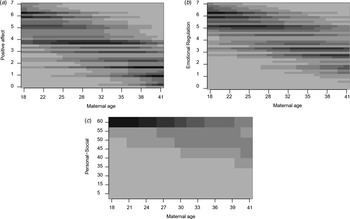
Table 2 shows statistical parameters corresponding to the ordinal regression models obtained for maternal age and temperament variables. Maternal age was negatively associated with emotional regulation scores [odds ratio (OR) −0.13, 95% CI 0.78–0.96] as well as positive affect scores (OR 0.16, 95% CI 0.75–0.95). No association was found in the case of negative affect (OR 0.04, 95%CI 0.93–1.18). Higher maternal STAI-S scores were associated with lower emotional regulation (OR −0.07, 95% CI 0.87–0.97), while higher social support values on MSPSS were related to higher emotional regulation scores (OR 0.08, 95%CI 1.01–1.16). Lower education level scores were associated with higher negative affect (OR 0.66, 95% CI 0.29–0.90). Figure 2 shows significant associations between maternal age and temperament subscales.
Conditional effects plots for maternal age. The graphs represent the probability of temperament scores (a, b) and personal-social scores (c) according to the different possible values of maternal age. Higher probability values correspond to darker grays and lower probability values to lighter grays. Overall, on the three plots there is decreasing trend when maternal age increases.

Ordinal regression models obtained for the association between maternal age and temperament scores (ECBQ/VSF), considering paternal age, education level, STAI-S, BDI/SF, social support, maternal cortisol levels, parity, and infant sex as covariates

ECBQ/VSF, Early Childhood Behavior Questionnaire – Very Short Form; MSPSS, Multidimensional scale of Perceived Social Support; STAI-S, State-Trait Anxiety Inventory; BDI/SF, Beck Depression Inventory Short Form Evidence for an effect is printed in italics (i.e., when the 95% CI does not contain the value 1").
Psychomotor development
Table 3 shows statistical parameters corresponding to the ordinal regression models obtained for maternal age and psychomotor development variables. Maternal age was negatively associated with personal-social skills (OR −0.13, 95% CI 0.77–0.99) (see Fig. 2). No association was found in the case of communication (OR −0.1, 95% CI 0.80–1.01), fine motor skills (OR −0.04, 95% CI 0.85–1.07), gross motor skills (OR −0.09, 95% CI 0.81–1.00), and problem-solving scales (OR −0.10, 95% CI 0.80–1.01). Higher maternal cortisol levels were related to lower gross motor skills scores (OR −0.36, 95% CI 0.55–0.85) and lower problem-solving scores (OR −0.36, 95% CI 0.55–0.85). Higher parental education level was associated with higher communication scores (OR 0.653; 95% CI 1.07–3.47).
Ordinal regression models obtained for the association between maternal age and psychomotor development scores (ASQ-3), including paternal age, education level, STAI-S, BDI/SF, social support, maternal cortisol levels, parity and infant sex as covariates

ASQ-3, Ages & Stages Questionnaires-Third edition; MSPSS, Multidimensional scale of Perceived Social Support; STAI-S, State-Trait Anxiety Inventory; BDI/SF, Beck Depression Inventory Short Form. Evidence for an effect is printed in italics (i.e., when the 95% CI does not contain the value 1").
Discussion
The objective of this study was to analyze the potential impact of maternal age and their biopsychological related factors, on offspring neurodevelopment, evaluating both temperament traits and psychomotor development. After considering the possible confounding age-related factors (paternal age, parental education level, parity, maternal anxiety and depressive symptoms, social support, and cortisol levels), an increase in maternal age per se was associated with difficulties on certain domains of temperament and psychomotor development. First, increasing maternal age had a negative association with child emotional regulation and positive affect. Second, increasing maternal age negatively affected child personal-social skills. Finally, as for age-related factors, whereas maternal anxiety symptoms and cortisol levels during pregnancy had a deleterious impact on infant's competences, higher maternal social support, and parental educational level had a protective effect. Thus, maternal age as a risk factor for the offspring neurodevelopment is analyzed below.
Regarding temperament, we found that increasing maternal age was associated with lower positive affect, with children showing reduced interest in the environment, limited adaptive skills to new situations, and less social smile. Furthermore, emotional regulation skills were also negatively influenced by maternal age as well as anxiety prenatal symptoms and low social support. Thus, children whose mothers were older age or showed higher anxiety or perceived lower social support were characterized by difficulties in regulating their behavior in different situations and adapting to unforeseen changes. Although no previous studies examined the effect of maternal age on temperament, our findings are congruent with those who found an association between difficult temperament in children and prenatal anxious symptomatology (more frequent in older mothers) (Austin et al., Reference Austin, Hadzi-Pavlovic, Leader, Saint and Parker2005; Laplante et al., Reference Laplante, Brunet and King2015). Of note, our findings indicated that, in addition to maternal age, emotional regulation was also negatively affected by lower perceived social support (García-Blanco et al., Reference García-Blanco, Monferrer, Grimaldos, Hervás, Balanzá-Martínez, Diago and Cháfer-Pericás2017; Stapleton et al., Reference Stapleton, Schetter, Westling, Rini, Glynn, Hobel and Sandman2012) as well as anxiety during pregnancy (Austin et al., Reference Austin, Hadzi-Pavlovic, Leader, Saint and Parker2005; Laplante et al., Reference Laplante, Brunet and King2015; Schardt, Reference Schardt2005). Likewise, lower parental educational level was a deleterious impact on child negative affect (Sonego et al., Reference Sonego, Llácer, Galán and Simón2013). Hence, our study adds to the literature that maternal age per se, over and above the contributions of psychobiological status, may affect some specific dimensions such as positive affect and emotional regulation, but not negative affect domain. Interestingly, impairments in these emotional traits may constitute a risk factor for behavioral and neuropsychiatric disorders in later developmental stages (Aldao et al., Reference Aldao, Nolen-Hoeksema and Schweizer2010; Nigg, Reference Nigg2006) such as ASD (Garon et al., Reference Garon, Zwaigenbaum, Bryson, Smith, Brian, Roncadin and Roberts2016), Attention-Deficit/Hyperactivity Disorder (ADHD) (Sullivan et al., Reference Sullivan, Holton, Nousen, Barling, Sullivan, Propper and Nigg2015), and schizophrenia-spectrum disorders (Hans et al., Reference Hans, Auerbach, Auerbach and Marcus2005; Johnson et al., Reference Johnson, Gliga, Jones and Charman2015).
Considering psychomotor development, increasing maternal age was associated with lower personal-social skills, that is, children had greater difficulties in terms of self-knowledge of personal abilities and in interactions. Westerlund and Lagerberg (Reference Westerlund and Lagerberg2008) suggest that older mothers may find themselves more tired than younger women so they may have fewer interactions with their children. Following Westerlund & Lagerberg's (Reference Westerlund and Lagerberg2008) suggestion, a lack of social interactions in older women could have repercussions on social skills of their children. This finding is consistent with Alvik's (Reference Alvik2014) study, where an association between increasing maternal age and personal-social delay was reported. Nevertheless, unlike Alvik (Reference Alvik2014), gross motor skills and problem-solving competences seem not to be influenced by maternal age in our study. That discrepancy with Alvik (Reference Alvik2014) study may be explained by methodological issues concerning time of assessment (i.e. 6 months v. 24 months of age) or consideration of biopsychosocial maternal age-related factors – note that our study included maternal psychobiopathological status during pregnancy and relevant sociodemographic factors. Therefore, our results suggest that delayed motherhood may imply an intrinsic risk factor leading to deleterious effects on infant personal-social development. Conversely, maternal cortisol levels, and parental education level were associated with other psychomotor areas. Thus, higher prenatal cortisol levels were related to lower gross motor skills and problem-solving skills according to previous research showing associations between maternal stress biomarkers and altered child psychomotor development (Davis et al., Reference Davis, Glynn, Schetter, Hobel, Chicz-Demet and Sandman2007; Huizink et al., Reference Huizink, De Medina, Mulder, Visser and Buitelaar2002). Furthermore, higher parental education level was associated with higher communication skills in offspring, in line with protective effects observed for other children behavioral and emotional problems (Sonego et al., Reference Sonego, Llácer, Galán and Simón2013). Taken together, temperament and psychomotor development difficulties could be related to each other. Low positive affect as well as poor emotional regulation could predispose to develop poor personal-social skills, since these temperament features could inhibit the infant's skill to effectively reach sources in the environment that provide interaction opportunities (Prior et al., Reference Prior, Bavin, Cini, Reilly, Bretherton, Wake and Eadie2008).
The main strength of our study is addressing the impact of maternal age on neurodevelopment outcome after controlling for potential confounders and conducting an accurate selection of the cohort. To our knowledge, there are no previous studies including psychomotor and emotional regulation combined measures. It is noteworthy that we considered maternal age as a continuous variable in the study, instead of differentiating groups according to arbitrary cut-offs. This practice causes loss of statistical power and bias because of the effect of maternal age on neurodevelopment is estimated to change gradually (Wainer et al., Reference Wainer, Gessaroli and Verdi2006). Another strength of the study is its prospective design and direct clinical assessment basis, compared to traditional epidemiologic studies. With respect to the limitations of the study, results could not be generalized to general population since women with major medical disorders, history of mental disorder, drug abuse, significant obstetric complications, assisted reproductive technology, significant language barrier, risk of social exclusion, twin delivery, infants with congenital malformations, chromosomopathy, and postnatal severe disease were excluded. However, it allowed us to examine the intrinsic effect of maternal age rather than the associated obstetric complications. In addition, due to strict inclusion criteria, the sample size was small. Another limitation is that children's neurodevelopment assessment was restricted to clinical examination with no direct observation at home, which could have made the data more reliable. Finally, despite the fact that neurodevelopment assessment at 24 months offers valuable information, a more extensive follow-up evaluation would improve the characterization of maternal age impact. Thus, new prospective long-term studies are needed to replicate these findings.
Conclusion
The increase of maternal age per se may represent a risk factor for neurodevelopmental disturbances, with infants showing deficits in both psychomotor development and emotional traits. Critically, these deficits are still detected after considering potential age-related confounders. Besides, the adverse effects on certain psychomotor domains (personal-social skills), its deleterious impact on temperament (lower positive affect and emotional regulation) is being a challenge, since this has been associated with future neurodevelopment and psychiatric disorders (Hans et al., Reference Hans, Auerbach, Auerbach and Marcus2005; Johnson et al., Reference Johnson, Gliga, Jones and Charman2015; Montagna & Nosarti, Reference Montagna and Nosarti2016; Zwaigenbaum et al., Reference Zwaigenbaum, Bryson, Rogers, Roberts, Brian and Szatmari2005). This study adds to traditional research on increasing maternal age, which is focused on obstetric and perinatal complications, the importance of considering offspring neurodevelopment. Thus, we present preliminary data which may stimulate new research in large representative cohort studies. Finally, the findings support implementation of social politics and psychoeducation on global repercussions of delaying motherhood as a preventive measure. These preventive interventions should also consider maternal age-related factors susceptible to modulation, focusing on decreasing stress and promoting education and social support. Additionally, early detection of subtle psychomotor and temperament impairments in these infants would allow early intervention programs aimed at reducing such difficulties.
Supplementary material
The supplementary material for this article can be found at https://doi.org/10.1017/S0033291721000568.
Financial support
This work was supported by the Instituto de Salud Carlos III (ISCIII; Plan Estatal de I + D + i 2013-2016) under Grant (PI18/01 352; PI17/0131) and co-financed by the European Development Regional Fund ‘A way to achieve Europe’ (ERDF). AG-B acknowledges a ‘Juan Rodés’ Grant (JR17/00003) from the ISCIII. MV acknowledges RETICS funded by the PN2018-2021 (Spain), ISCIII- Sub-Directorate General for Research Assessment and Promotion and the European Regional Development Fund (RD16/0022/0001).
Conflict of interest
The authors declare no potential conflicts of interest to disclose.