INTRODUCTION
Macroinvertebrates are a primary component of littoral food webs and play a crucial role in the functioning of intertidal ecosystems (Bacci et al., Reference Bacci, Tracucco, Marzialetti, Marusso, Lomiri, Vani and Lamberti2009; Bevilacqua et al., Reference Bevilacqua, Fraschetti, Musco and Terlizzi2009; Munari et al., Reference Munari, Manini, Pusceddu, Danovaro and Mistri2009; Wildsmith et al., Reference Wildsmith, Rose, Potter, Warwick, Clarke and Valesini2009; Díez et al., Reference Díez, Santolaria and Gorostiaga2010). With easy sampling, an extensive range of identification keys available, high tolerance to pollution, and capacity of integrating the state of the environment over the previous months, they have widely been used as robust bioindicators to assess ecological quality status in coastal and transitional waters, especially the intertidal ecosystems (Bacci et al., Reference Bacci, Tracucco, Marzialetti, Marusso, Lomiri, Vani and Lamberti2009; Bevilacqua et al., Reference Bevilacqua, Fraschetti, Musco and Terlizzi2009; Munari et al., Reference Munari, Manini, Pusceddu, Danovaro and Mistri2009; Díez et al., Reference Díez, Santolaria and Gorostiaga2010).
The development of simplification and cost-effective procedures for marine bioassessment and biological conservation has become a pressing issue for marine ecologists as anthropogenic impacts have increased rapidly and dramatically worldwide in recent years (Warwick, Reference Warwick1988a; Pagola-Carte et al., Reference Pagola-Carte, Urkiaga-Alberdi, Bustamante and Saiz-Salinas2002; Terlizzi et al., Reference Terlizzi, Bevilacqua, Fraschetti and Boero2003, Reference Terlizzi, Scuderi, Fraschetti, Guidetti and Boero2005; Puente & Juanes, Reference Puente and Juanes2008; Bacci et al., Reference Bacci, Tracucco, Marzialetti, Marusso, Lomiri, Vani and Lamberti2009; Bevilacqua et al., Reference Bevilacqua, Fraschetti, Musco and Terlizzi2009; Tataranni et al., Reference Tataranni, Maltagliati, Floris, Castelli and Lardicci2009; Díez et al., Reference Díez, Santolaria and Gorostiaga2010; Xu et al., Reference Xu, Zhang, Jiang, Min and Choi2011a, Reference Xu, Jiang, Zhang, Zhu and Al-Rasheidb). For this purpose, taxonomic sufficiency has received increasing attention in terms of its basic concept that the coarse taxonomic resolutions can be used to assess anthropogenic impacts without a significant loss of information for avoiding long and difficult precise taxonomic identifications and reducing time and costs (Ellis, Reference Ellis1985; Vanderklift et al., Reference Vanderklift, Ward and Phillips1998; Olsgard & Somerfield, Reference Olsgard and Somerfield2000; Dauvin et al., Reference Dauvin, Gesteria and Fraga2003; Mendes et al., Reference Mendes, Tavares and Soares-Gomes2007; Bertasi et al., Reference Bertasi, Colangelo, Colosio and Gregoria2009; Bevilacqua et al., Reference Bevilacqua, Fraschetti, Musco and Terlizzi2009; Xu et al., Reference Xu, Zhang, Jiang, Min and Choi2011a, Reference Xu, Jiang, Zhang, Zhu and Al-Rasheidb). The other technique is to identify a taxonomic/ecological group as a surrogate of the whole species assemblages (Olsgard & Somerfield, Reference Olsgard and Somerfield2000; Bertasi et al., Reference Bertasi, Colangelo, Colosio and Gregoria2009; Carneiro et al., Reference Carneiro, Nini and Rodrigues2010; Díez et al., Reference Díez, Santolaria and Gorostiaga2010; Xu et al., Reference Xu, Zhang, Jiang, Min and Choi2011a, Reference Xu, Jiang, Zhang, Zhu and Al-Rasheidb). Although the effectiveness of taxonomic surrogates has been reported on metazoan, planktonic and benthic assemblages, further studies are needed on littoral macroinvertebrates for marine bioassessment and biological conservation (Ellingsen et al., Reference Ellingsen, Clarke, Somerfield and Warwick2005; Bacci et al., Reference Bacci, Tracucco, Marzialetti, Marusso, Lomiri, Vani and Lamberti2009; Bertasi et al., Reference Bertasi, Colangelo, Colosio and Gregoria2009; Bevilacqua et al., Reference Bevilacqua, Fraschetti, Musco and Terlizzi2009; Munari et al., Reference Munari, Manini, Pusceddu, Danovaro and Mistri2009; Carneiro et al., Reference Carneiro, Nini and Rodrigues2010; Díez et al., Reference Díez, Santolaria and Gorostiaga2010; Xu et al., Reference Xu, Zhang, Jiang, Min and Choi2011a, Reference Xu, Jiang, Zhang, Zhu and Al-Rasheidb).
In this study, six datasets from macroinvertebrate communities, which were collected from intertidal zones of the Yellow Sea, near Qingdao, northern China during the period of 1989–1998, were analysed. Our study asks the following questions: (1) are the ordination patterns of macroinvertebrate communities independent of the taxonomic resolutions used, so that there is simplification of sample processing (aggregation to higher taxonomic levels)?; and (2) can the primary components molluscs and arthropods be a surrogate of whole macroinvertebrate communities?
MATERIALS AND METHODS
Study areas and dataset collection
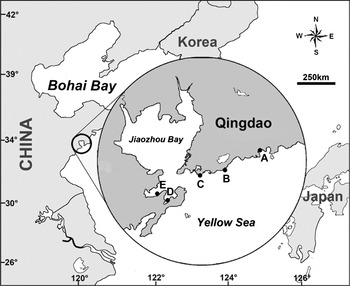
Six datasets of macroinvertebrate communities were obtained from the surveys on ecological pattern of invertebrate fauna at five stations in intertidal zones of the Yellow Sea, near Qingdao, northern China, during the period of 1989–1998 (Figure 1). Site A was located in a rocky-coast area with gravels and sands, near the Shilaoren harbour, which was polluted by organic pollutants from domestic sewage and industrial discharge. Site B was selected in the Taipingjiao area, with rocks, gravels and sands, mainly subjected to anthropogenic impact. Site C was a sandy area with gravels and rocks, near Huiquanwan Bay which was stressed by organic pollutants, nutrient from domestic sewage and disturbances from tour activities. Site D was located in a sand–muddy area with rocks and gravels near Xuejiadao, mainly with disturbance via mariculture activities. Site E was a mud–sandy area with rocks and gravels near Anzi harbour, subjected to stress from domestic sewage and mariculture activities (Figure 1).
Map of the sampling sites in intertidal zones of the Yellow Sea, near Qingdao, northern China. Site A was located in a rocky-coast area with gravels and sands, near the Shilaoren harbour; site B was selected in the Taipingpjiao area, with rocks, gravels and sands; site C was a sandy area with gravels and rocks, near Huiquanwan Bay; site D was located in a sand–muddy area with rocks and gravels near Xuejiadao; site E was a mud–sandy area with rocks and gravels near Anzi harbour.

Data were collected from different habitat types in the littoral area during the summer season (June) from 1989 to 1998. A total of 50 subsamples (with an area of 1 m2 for each) were collected at each station (total area = 50 m2) from the highest line to the lowest of intertidal zones. At each station the two or three most important habitat types were sampled, and at least 10 replicates per habitat type were collected. The samples of soft bottoms were collected by grabs, and sieved through a 1 mm mesh sieve and stored in 4% buffered formalin solution, while the rocky bottoms were sampled by hand or chisels (Sánchez-Monroya et al., Reference Sánchez-Monroya, Cidal-Abarca and Suárez2010; Basset et al., Reference Basset, Barbone, Borja, Brucet, Pinna, Quintana, Reizopoulou, Rosati and Simboura2012). Specimens were identified to the lowest possible taxonomic levels. Only presence/absence of species was recorded in each dataset.
Data analysis
For analysing the taxonomic sufficiency of the whole macroinvertebrate communities, the macroinvertebrate matrix (MacM) was constructed and subjected to aggregate to the levels of genus, family, order, class and phylum before analyses. For assessing the efficiency of the primary components as a surrogate of the whole macroinvertebrate communities, mollusc matrix (MolM), arthropod matrix (ArtM) and mollusc–arthropod matrix (MAM) were separately computed. Each of these was analysed after aggregating abundances at the levels of genus, family and order. Thus, a total of 18 data matrices were constructed. It should be noted that annelids are not significantly correlated with the whole matrix based on our data, although they were reported as a potential surrogate of macrobenthic community. Thus, we did not compute the annelid matrix.
Sørensen similarities were constructed from all matrices at various taxonomic levels (Clarke & Gorley, Reference Clarke and Gorley2006). The relationships between pairs of similarity matrices were analysed using the Spearman rank correlation coefficients (ρ values) which were computed by the submodule RELATE (Somerfield & Clarke, Reference Somerfield and Clarke1995; Clarke & Gorley, Reference Clarke and Gorley2006). The second-stage multidimensional scaling (MDS) ordinations and cluster analyses were performed to summarize the relatedness of the MacM similarity matrix for species and those for both higher taxonomic levels and the smaller assemblages (MolM, ArtM and MAM) at increasing taxonomic levels (Xu et al., Reference Xu, Zhang, Jiang, Min and Choi2011a, Reference Xu, Jiang, Zhang, Zhu and Al-Rasheidb). All multivariate analyses were carried out using the PRIMER package version 6.1 (Clarke & Gorley, Reference Clarke and Gorley2006). A ρ value of 0.75 was used as minimal level of congruency for an optimal surrogate (Lovell et al., Reference Lovell, Hamer, Slotow and Herbert2007).
A cost/benefit (C/B) ratio was calculated for each dataset in order to objectively select the taxonomic level with the minimal loss of information and the least taxonomic effort according to the equation:
 $$CB_{L} = \lpar 1 - r_{L}\rpar / \lsqb \lpar S - t_{L} \rpar / S \rsqb$$
where CB L is the cost/benefit ratio at taxonomic level L; r L , the Spearman correlation coefficient between taxonomic level L and species level; t L , the number of taxa at taxonomic level L; and S, the number of species (Karakassiss & Hatziyanni, Reference Karakassiss and Hatziyanni2000).
The C/B ratio ranges between 0 and 1. Values equal to 0 have a high correlation between the species level and any of the other groups, which means that the loss of information is the low at these values.
RESULTS
Taxonomic aggregation
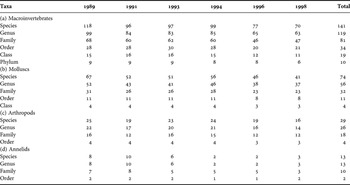
The taxonomic composition of the datasets in terms of numbers of species, genera, families, orders, classes and phylum is listed in Table 1a (for details, see Appendix). It is clear that the molluscs and arthropods are the primary contributors to the macroinvertebrate communities, accounting for 52.6% (52 versus 97 in 1993)–59.7% (46 versus 77 in 1996) and 19.8% (19 versus 96 in 1991)–24.2% (24 versus 99 in 1994) of total species number, respectively (Table 1b, c).
Number of taxa at each taxonomic resolution level of (a) all macroinvertebrates, (b) molluscs, (c) arthropods and (d) annelids in intertidal zones of the Yellow Sea, near Qingdao, northern China, for six datasets during the period 1989–1998

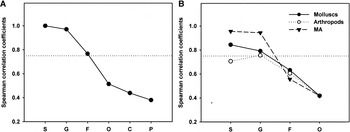
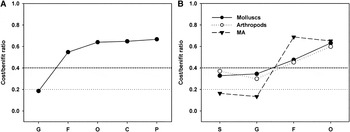
The levels of concordance between the MacM-species matrix and the matrices at higher taxonomic levels are summarized in Figure 2A. It was shown that the matching (Spearman correlation) coefficients with the species-level resolution presented higher values than 0.75 at the taxonomic resolutions up to only genus and family level (Figure 2A).
Correlations between the macroinvertebrate matrix at species-level resolution and those at higher taxonomic levels (A) as well as the matrices of molluscs and arthropods, alone and in combination, at various taxonomic levels (B). S, species; G, genus; F, family; O, order; C, class; P, phylum; horizontal dotted line, ρ = 0.75.

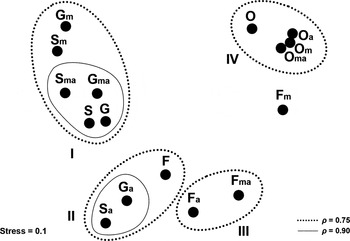
The MDS-ordination-based clustering analyses resulted in the MacM-species matrix falling into the group I with the matrices at the lower taxonomic resolutions up to only genus level at a 0.90 Spearman correlation level (Figure 3).
Second-stage multi-dimensional scaling ordinations with clustering analyses showing the relatedness of the matrices macroinvertebrate matrix (MacM: S, G, F and O) for species and those for both higher taxonomic levels as well as matrices of molluscs (MolM: Sm, Gm, Fm and Om) and arthropods (ArtM: Sa, Ga, Fa and Oa), alone and in combination (MAM: Sma, Gma, Fma and Oma). For abbreviations, see Figure 2.

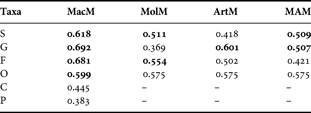
The matching correlations with the temporal seriations of macroinvertebrate community patterns at various taxonomic levels are summarized in Table 2. The results showed that the matching correlations were found to be significant among the resolutions up to order level (P < 0.05) (Table 2).
Results of matching (RELATE) analyses for temporal seriations of all macroinvertebrates (MacM), molluscs (MolM), arthropods (ArtM) and MAM (molluscs + arthropds) in intertidal zones of the Yellow Sea, near Qingdao, northern China at various taxonomic levels for six datasets during the period of 1989–1998.

S, species; G, genus; F, family; O, order; C, class; P, phylum. Values are the correlation coefficient ρ; significant tests (P < 0.05) are in bold typeface.
Molluscs and arthropods
The taxonomic composition of molluscs and arthropods in terms of the numbers of species, genera, families, orders and classes is summarized in Table 1b & c. The matching correlations between the MacM-species similarity matrices and those for MolM, ArtM and MAM at different taxonomic aggregation levels are shown in Figure 2B. The results showed that the correlation coefficients represented higher than 0.75 only up to genus-level resolutions, except for the ArtM-species matrix (Figure 2B).
The clustering analyses on the second-stage MDS plotting resulted in the MolM and MAM matrices up to genus level falling into the group I with the MacM matrices at the lower taxonomic resolutions up to genus level at a 0.75 Spearman correlation level (Figure 3). Furthermore, the MAM matrices remained high matching relationships (ρ > 0.90) to the MacM-species similarity matrix at species level (Figure 3).
However, it should be noted that of the three (MolM, ArtM and MAM) matrices, only the matching correlations of MAM matrices with the temporal seriations at various taxonomic levels were found to be significant among the resolutions at both species and genus levels (P < 0.05), while the MolM and ArtM failed to reveal the significant matching correlations with the temporal seriations at either species or genus level (P > 0.05) (Table 2).
Cost/benefit analysis
The C/B ratios for the datasets are summarized in Figure 4. The MacM at species level was compared to the matrices of the higher taxonomic levels and of three smaller assemblages (MolM, ArtM and MAM) at all taxonomic levels, respectively. The C/B ratios represented minimal values at the genus-level resolution of MacM due to the high correlation coefficients with MAM-species matrix, but the decrease of the taxon numbers was only 16% compared with the number of species (Figure 4A; Table 1a). At both species and genus levels of MAM, the C/B ratios were lower than that of MacM-genus matrix due to the high correlation coefficients and the decrease of 27% and 42% in taxon number, respectively (Figure 4B; Table 1). It should be noted that the C/B ratios remained at low levels due to low correlation coefficients although the numbers of taxa correspondingly deceased by 48%/60% and 79%/82% at species/genus levels of MolM and ArtM, respectively (Figure 4B; Table 1).
Cost/benefit ratios for different taxonomic levels for the macroinvertebrate matrix (MacM) (a), mollusc matrix (MolM), arthropod matrix (ArtM) and the matrix of mollusc in combination with arthropod (MAM) (b) at different aggregation levels. For all abbreviations, see Figure 2.

DISCUSSION
Many investigations on taxonomic sufficiency with benthic organisms have demonstrated that identification to the level of genus or family may be adequate for bioassessment and biological conservation issues (Olsgard & Somerfield, Reference Olsgard and Somerfield2000; Dauvin et al., Reference Dauvin, Gesteria and Fraga2003; Waite et al., Reference Waite, Herlihy, Larsen, Urquhart and Klemm2004; Khan, Reference Khan2006; Heino & Soininen, Reference Heino and Soininen2007; Bacci et al., Reference Bacci, Tracucco, Marzialetti, Marusso, Lomiri, Vani and Lamberti2009; Bevilacqua et al., Reference Bevilacqua, Fraschetti, Musco and Terlizzi2009; Munari et al., Reference Munari, Manini, Pusceddu, Danovaro and Mistri2009; Díez et al., Reference Díez, Santolaria and Gorostiaga2010). This approach has also been used for other taxonomic groups, e.g. vascular plants, ants, spiders, nematodes, macromycetes, phytoplankton and periphyton (Stark et al., Reference Stark, Riddle and Simpson2003; Cardoso et al., Reference Cardoso, Silva, Oliveira and Serrano2004; Heino & Soininen, Reference Heino and Soininen2007; Lovell et al., Reference Lovell, Hamer, Slotow and Herbert2007; Carneiro et al., Reference Carneiro, Nini and Rodrigues2010; Xu et al., Reference Xu, Zhang, Jiang, Min and Choi2011a, Reference Xu, Jiang, Zhang, Zhu and Al-Rasheidb).
There are many advantages using high taxonomic units (e.g. genus) as surrogates for species-level identification. High level identification can be more reliable since species-level identification is complex and laborious, and it is less time-consuming, reducing the costs of monitoring programmes, in particular the large temporal/spatial scale bioassessment and biological conservation issues (Anderson et al., Reference Anderson, Connell, Gillanders, Diebel, Blom, Saunders and Landers2005; Heino & Soininen, Reference Heino and Soininen2007; Carneiro et al., Reference Carneiro, Nini and Rodrigues2010; Xu et al., Reference Xu, Zhang, Jiang, Min and Choi2011a, Reference Xu, Jiang, Zhang, Zhu and Al-Rasheidb).
Previous investigations on the application of taxonomic sufficiency have been spread over different geographical areas and different kinds of impact studies, such as oil extraction fields (Olsgard et al., Reference Olsgard, Somerfield and Carr1977), oil spill (Gomez Gesteira et al., Reference Gomez Gesteira, Dauvin and Salvande Fraga2003), heavy metal pollution (Vanderklift et al., Reference Vanderklift, Ward and Jacoby1996), and organic enrichment (Castanedo et al., Reference Castanedo, Lopez, Weiss, Alcantara and Barba2007), using diverse sampling procedures (Ferraro & Cole, Reference Ferraro and Cole1992), the relationship between taxonomic resolution and spatial scales (Anderson et al., Reference Anderson, Connell, Gillanders, Diebel, Blom, Saunders and Landers2005) and use of datasets (Warwick, Reference Warwick1988b). Most of these studies suggest that a lower taxonomic resolution can be sufficient when studying benthic assemblages' composition and that determining the family may be satisfactory in many routine monitoring surveys. In highly disturbed areas, it is suggested that the results of multivariate analyses based on higher taxa might more closely reflect gradients of contamination or stress than those based on species data, the latter being more affected by natural environmental variables (Dauvin et al., Reference Dauvin, Gesteria and Fraga2003).
Lovell et al. (Reference Lovell, Hamer, Slotow and Herbert2007) proposed that a ρ value of 0.75 should be used as minimal level of congruency for an optimal surrogate. In the present study, the ρ values between MacM-species matrix and the matrices up to family level remained higher than 0.75. This finding was consistent with the previous reports. With regard to the other three (MolM, ArtM and MAM) matrices the genus level remained higher than 0.75 with the MacM-species matrix. However, it should be noted that despite high ρ values, the family-level resolution of MacM represented higher C/B ratios. This implies that the family-level resolution of MacM where loss of information is high compared to the resolutions up to genus level of MacM and MAM may provide sufficient information for analysing ecological patterns of macroinvertebrate communities in intertidal ecosystems of the Yellow Sea, northern China. This may be due to low species number per genus but high genus number per family in our datasets, and was consistent with the hypothesis that family is a sufficient taxonomic level, but this statement stems from too limited a number of case studies.
In the present study, although the molluscs and arthropods represented higher correlations (ρ > 0.75) with the patterns of MacM-species matrices and acceptable C/B ratios at resolutions even up to genus level, the matching correlations with their temporal seriations were not significant at either species- or genus-level resolutions. This implies that a significant loss has happened with the information for assessing temporal variations in ecological patterns of macroinvertebrate communities. Additionally, their combination (i.e. MAM) showed powerful effectiveness of surrogates, and thus we suggest that the molluscs and arthropods in combination could be also effective as a surrogate for macroinvertebrate communities in detecting their ecological patterns compared with molluscs or arthropods alone.
It should be noted that although annelids are the most representative taxa in most polluted zones (De Biasi et al., Reference De Biasi, Bianchi and Morri2003; Basset et al., Reference Basset, Barbone, Borja, Brucet, Pinna, Quintana, Reizopoulou, Rosati and Simboura2012), and have been reported as a potential surrogate of macrobenthic community, they are not significantly correlated with the whole matrix based on our data. This may be due to only presence/absence information in our datasets. Additionally, our datasets contain some information about patterns of temporal variation of assemblage that is too limited to a local context. Moreover, samples were collected on different bottom types, but no considerations were made about the context-dependency of the sufficient level of taxonomic resolution that has to be used (Terlizzi et al., Reference Terlizzi, Bevilacqua, Fraschetti and Boero2003). It is well-known that it could also vary depending on the considered habitat type or on the type of organisms involved (Terlizzi et al., Reference Terlizzi, Bevilacqua, Fraschetti and Boero2003). Otherwise, although the important role of taxonomic sufficiency is highlighted in detecting anthropogenic impacts without a significant loss of information, our dataset did not include the data of the putative multiple human pressures (i.e. domestic sewage, industrial discharge or mariculture activities). Thus, further studies on a range of marine environments and over long time-periods are needed in order to verify our conclusion.
In summary, the present study has demonstrated that: (1) the genus- and family-level resolutions maintained sufficient information to analyse the ecological patterns of the macroinvertebrate communities for assessing ecological quality status in littoral ecosystems; and (2) the mollusc assemblages, alone or in combination with arthropod assemblages, may be used as a surrogate of littoral macroinvertebrate communities, at both species- and genus-level resolutions. The results suggest that the use of simplifications in macroinvertebrate fauna at genus-level resolutions or using smaller taxonomic assemblages (e.g. molluscs and arthropods) are time-efficient and would allow improving sampling strategies of large spatial/temporal scale bioassessment programmes and biological conservation researches in littoral ecosystems.
ACKNOWLEDGEMENTS
This work was supported by ‘The Natural Science Foundation of China' (project number: 41076089), grants from Commonweal Program of State Oceanic Administration of China (No. 200805037), Program of Liaoning Province Science and Technology Commission (No. 2008203002) and Program of Liaoning Ocean and Fisheries Department (No. 200801).
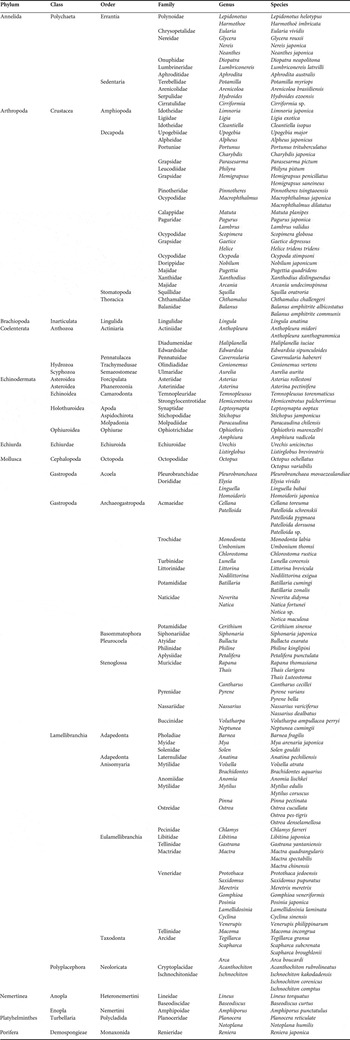
Taxonomic data of macroinvertebrates. Taxonomic composition of all macroinvertebrates in intertidal zones of the Yellow Sea, near Qingdao, northern China, for six datasets during the period 1989–1998.