Introduction
The infective juvenile (IJ) is the only free-living stage of entomopathogenic nematodes (EPNs), which occupy soil habitats and develop their life cycle by infecting a new insect host (Ehlers, Reference Ehlers2001; Goodrich-Blair et al., Reference Goodrich-Blair, Clarke, Grewal, Ciche, Stock, Vanderberg, Boemare and Glazer2009). Several species of EPNs are commercially available for the biological control of soil insect crop pests in organic farming (Sarwar & Mukhtar, Reference Sarwar, Mukhtar and LP2021). The application of commercially available EPN products based on native species is a strategy to eliminate the use of synthetic insecticides on organic crops (Ferreira et al., Reference Ferreira, Addison and Malan2016).
The industrial mass production of viable IJs at low cost (Dunn et al., Reference Dunn, Belur and Malan2021), the maintenance of infectivity and extension of shelf life (Ehlers, Reference Ehlers2001) are the main challenges for the successful commercialization of EPNs as a biopesticide product. For scaling up to a profitable industrial mass production of IJs, the submerged monoxenic culture is the most suitable technology because the yield is higher, although it is variable (Shapiro-Ilan et al., Reference Shapiro-Ilan, Han and Dolinksi2012; Cortés-Martínez & Chavarría-Hernández, Reference Cortés-Martínez and Chavarría-Hernández2020).
However, in the in vitro culture, the retention of the bacterial symbiont within the juvenile can be highly variable and the virulence of the produced IJs depends on the bacterial cell load inside them (Akhurst, Reference Akhurst1986). Furthermore, the pathogenicity can differ depending on strains within the same species of the symbiotic bacterium, while retention requires a recognition mechanism, finely tuned between the two partners (Sicard et al., Reference Sicard, Le Brun, Pages, Godelle, Boemare and Moulia2003). Sharmila & Subramanian (Reference Sharmila and Subramanian2020) found that reared Steinernema glaseri IJs on Galleria mellonella larvae were more virulent than in vitro-produced IJs. Hang et al. (Reference Hang, Choo, Lee, Lee, Kaya and Park2007) reported that 10,000 cells of Xenorhabdus poinarii from S. glaseri Dongrae strain caused 100% mortality of G. mellonella at 30°C and 35°C in a period of 48 h. This fact raises the challenge of reconciling the productivity of the in vitro culture with the virulence of the produced IJs, through proper evaluation of the nematode–bacteria complexes.
The surface culture on solid agar media allows us to study the ability of the symbiotic bacteria to colonize the IJ stage, and monitor the process of the beginning of colonization outside the insect (Akhurst & Boemare, Reference Akhurst and Boemare1988; Goodrich-Blair et al., Reference Goodrich-Blair, Clarke, Grewal, Ciche, Stock, Vanderberg, Boemare and Glazer2009), as a screening phase of virulent strains that could also be productive in the mass production process (Ravensberg, Reference Ravensberg2011).
Initially, the nematodes ingest the bacteria lawn on agar and, afterwards, they reproduce and develop. Then, the solid medium provides nutrients for developing both the symbiotic bacteria and the nematodes, which include specific nutrients for the nematode growth – for example, oil and cholesterol (Ravensberg, Reference Ravensberg2011). If the medium formulation is adequate for the growth of the bacterium and nematode, then phase I bacterial cells colonize J3 efficiently, and the productivity and virulence of IJs will be higher (Converse & Miller, Reference Converse and Miller1999).
The dehydrated egg yolk is a processed component usually used in media for in vitro culture of EPNs, which is difficult to acquire in local markets, while fresh Cl is easier to acquire and has proven to be a suitable component for the reproduction of nematodes. Therefore, this work aimed to investigate the effect of surface propagation of Steinernema sp. JAP1 on two solid media, the incubation time of bacterial lawn and the harvest time on the production of IJs and its pathogenicity in a one-on-one assay on G. mellonella.
Materials and methods
EPN
Steinernema sp. JAP1, originally isolated in the Asia district of Cañete, Lima, Peru, was kindly provided by the Entomologist J. Alcázar. The IJ pathogenicity was proved by the Koch's postulates. Following the procedure of Stock & Goodrich-Blair (Reference Stock, Goodrich-Blair and Lacey2012), IJs were reproduced in the last instar wax moth larvae (G. mellonella) and the harvested IJs were surface-sterilized with benzethonium chloride solution (0.1% (w/v)) for 10 min and rinsed three times with sterile distilled water (DW). After that, the sterilized IJs were concentrated in an aqueous suspension at a rate of 1000 IJs·mL−1 and stored at 5–9°C in 250 mL tissue culture flasks, until they were used.
Culture media
The isolation medium of Xenorhabus sp. was Nutrient blue tetrazolium agar (NBTA)-adjusted to a pH of 8.2 (Akhurst, Reference Akhurst1980): 2.3% (w/v) nutrient agar, 0.025% (w/v) bromothymol blue (Sigma, Saint Louis, Missouri, USA), 0.004% (w/v) triphenyltetrazolium chloride (Sigma, USA), dissolved in DW. Liquid media for bacterial culture comprised tryptic soy broth (TSB) 3% (w/v) and yeast extract 0.5% (w/v). In the form of solid medium, 15 mL of the following diets were deposited into sterile 6-cm Petri dishes: (1) P2 (Chavarría-Hernández & de la Torre, Reference Chavarría-Hernández and de La Torre2001) – yeast extract 2.3% (w/v), dehydrated egg yolk 1.25% (w/v), sodium chloride 0.5% (w/v), corn oil 4% (v/v) (Altea®, Guadalajara, Jalisco, Mexico) and bacteriological agar 3.6% (w/v); and (2) Cl (Moreno-Salgüero, Reference Moreno-Salgüero2017) – small pieces of fresh Cl 10% (w/v) were placed into a blender with corn oil 4% (v/v), nutrient broth 1.3% (w/v), bacteriological agar 3.6% (w/v) and DW, and processed according to McMullen & Stock (Reference McMullen and Stock2014). All solid culture media were incubated overnight at 30°C after preparation. All the culture media used were Bioxon® brand (Cuautitlán Izcalli, Estado de México, México).
Isolation of symbiont bacteria
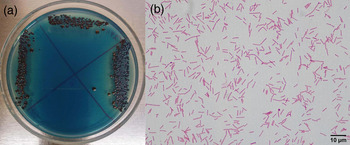
The bacterial cells were extracted from crushed surface-sterilized IJs that were suspended in 8 mL of TSB and incubated at 28°C in darkness for 44 h (Koppenhöfer, Reference Koppenhöfer, Nguyen and Hunt2007). The primary form of the expected species Xenorhabdus sp. was confirmed through the macroscopic morphological characteristics and the size of blue colonies onto NBTA plate medium (fig. 1a), according to Akhurst & Boemare (Reference Akhurst and Boemare1988), Kaya & Stock (Reference Kaya, Stock and Lacey1997) and Gaugler et al. (Reference Gaugler, Campbell, Selvan and Lewis1992). The microscopic morphological characteristics were studied by Gram staining (fig. 1b) (Thomas & Poinar, Reference Thomas and Poinar1983). A loopful of an isolated phase I bacterium colony was cultured in 50 mL of TSB medium and incubated at 28°C and 130 rpm for 38 h (Barnstead/Labline E-class; ThermoFisher Scientific, Waltham, Massachusetts, USA). The symbiotic bacteria were conserved in 2 mL vials with glycerol 20% (v/v) and cryopreserved at −170°C, till use in the experiments. After a month, samples of a Xenorhabdus sp. vial were streaked on NBTA plates and incubated in the conditions previously described. Later on, a loopful of an isolated phase I bacterium was inoculated in 50 mL of TSB and incubated at 28°C and 130 rpm for 35 h to produce the bacterial inoculum for the experiments.
Xenorhabdus sp. isolated from infective juveniles of Steinernema sp. JAP1. (a) Blue colonies on Nutrient blue tetrazolium agar plate medium. (b) Light micrograph of phase I bacterial cells at 1000× magnification. Scale bar: 10 μm.

In vitro culture of EPNs
The productivity of IJs was determined through the surface culture on P2 and Cl media and for two different incubation times post-inoculation of bacterial broth, using the following experimental procedure: (1) 0.1 mL aliquots of the 38 h-old TSB-Xenorhabus sp. culture broth were transferred to 6 cm plates of each solid medium; (2) plates were incubated in darkness at 28°C over 48 and 72 h (model Gl6; Shel Lab, Cornelius, Oregon, USA); and (3) 100 surface-sterilized IJs were inoculated on the surface of the media and stored in darkness at 23–27°C and 20–38% relative humidity (RH). Three plates of the solid medium by treatment were established and the experiment was repeated twice.
Plates were monitored daily under a stereoscope (model Z30 V; Leica®, Rockleigh, New Jersey, USA). When IJ production was detected, modified White traps were established and stored at 23–27°C and 20–38% RH in a desiccator (Scienceware®, Pequamoek, New Jersey, USA ). The harvest and counting of IJs were conducted at 14, 21, 28 and 35 days post-inoculation (dpi). The IJs were rinsed three times with sterile DW, concentrated at a rate of 1000 IJs·mL−1 and stored at 5–9°C in tissue culture flasks. The suspensions of harvested IJs from each White trap were diluted (100–102) with sterile DW and the IJ concentrations were determined by counting in five 0.02 mL samples under a stereoscope (model Z30 V; Leica®), following the procedure described by Stock & Goodrich-Blair (Reference Stock, Goodrich-Blair and Lacey2012).
Assay of pathogenicity
The in vitro-produced IJs on solid media were evaluated according to the mortality caused to G. mellonella in the one-on-one assay (Converse & Miller, Reference Converse and Miller1999; Kazimierczak et al., Reference Kazimierczak, Lis, Skrzypek and Kreft2018). A filter paper disk was placed (medium pore, 21 mm in diameter) in each well of a 12-well plate and one IJ was transferred into each well in 10 μL DW, followed by 50 μL DW. Immediately, one G. mellonella larva (previously surface-sterilized with sodium hypochlorite solution 0.5% (v/v) and rinsed twice) was added. The plates were sealed with adhesive tape to minimize evaporation and stored at 23–27°C and 20–38% RH.
The IJs evaluated in this experiment were obtained from four treatments of solid culture that combined two solid media and two incubation times of the bacterial lawn (P2-48 h, P2-72 h, Cl-48 h and Cl-72 h), one treatment using IJs reared in vivo as the positive control and a negative control without IJs but with sterile DW. The experiment was repeated three times and conducted by duplicate. This experimental procedure was carried out to evaluate IJs harvested at 14, 21, 28 and 35 dpi of 100 IJs. Thus, 1152 G. mellonella larvae were used in this bioassay. The insect mortality was recorded as 3 dpi.
Measurement of IJ length
Micrographs of alive IJs harvested from each solid medium were taken at 40× using a digital camera (model DSFi3; Nikon®, Tokyo, Japan) coupled to a light microscope (model 80i; Nikon®, Japan). The length of IJs was measured with the ‘segmented line’ tool in the software ImageJ 1.53j (https://imagej.nih.gov/ij/index.html), using the following procedure: (1) individuals with an elongated or slightly curved body were selected, (2) the initial measurement point was placed in the anterior end of the body, (3) the dimension line was extended at an approximate distance to the inflection point of the imaginary central body line (as many times as necessary until reaching the tail) and (4) the length was registered in μm. Sixteen IJs per treatment were measured in each of the four harvests carried out, for a total amount of 960 individuals.
Statistical analysis
Data are presented as the mean value ± standard error (SE). The productivity of IJs in each solid media was reported as IJs·m−2·day−1, which represent the accumulated number of IJs produced by unit area in a 6-cm Petri dish (2 × 10⁻³ m2 of internal area) by each day of the harvest time. The Shapiro–Wilk normality test (P > 0.05) was applied to the dataset of IJ production and pathogenicity to prove the assumption of normality. The treatment effects on the production of IJs by solid media (P2 and Cl), incubation time (48 and 72 h post-inoculation (hpi) of bacterial broth) and harvest time (14, 21, 28 and 35 dpi of IJs) were assessed via Kruskall–Wallis one-way analysis of variance (ANOVA) on ranks at P < 0.05, given the non-normal distribution of the data. The treatment effects on pathogenicity of IJs on G. mellonella by solid media, incubation time of bacterial lawn and harvest time were assessed via three-way ANOVA at P < 0.05, given the normal distribution of the data (P = 0.62). A Pearson correlation analysis (P < 0.05) was conducted to determine the correlation between the IJs’ length and pathogenicity. All analyses were conducted in SigmaPlot® 12 (Systat Software, Inc., San Jose, California, USA).
Results
In vitro production of IJs on solid media
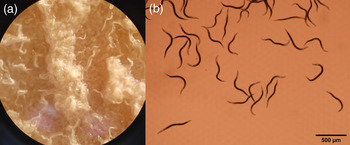
New offspring of IJs were observed 10–11 dpi (fig. 2a), and fig. 2b shows the IJs produced. The culture of nematodes Steinernema sp. JAP1 at each harvest time showed a mean production by plate of Cl medium of 46,112 IJs ± 6203 SE, while the culture on P2 medium produced 32,217 IJs ± 5595 SE. Thus, P2 produces a significantly lower amount of IJs than Cl (P = 0.016). Regarding the incubation at 30°C, the mean production was not significantly different (P = 0.7) when the bacterial lawn was incubated for 48 h (38,863 IJs ± 6410 SE) or 72 h (39,466 IJs ± 5544 SE).
In vitro culture of Steinernema sp. JAP1 on solid medium at 23–27°C and 20–38% relative humidity. (a) Development of entomopathogenic nematodes with their corresponding phase I symbiotic bacteria Xenorhabdus sp. on an egg yolk medium at 3× magnification (10-day-old culture). (b) Light micrograph captured at 40× magnification of several infective juveniles harvested. Scale bar: 500 μm.

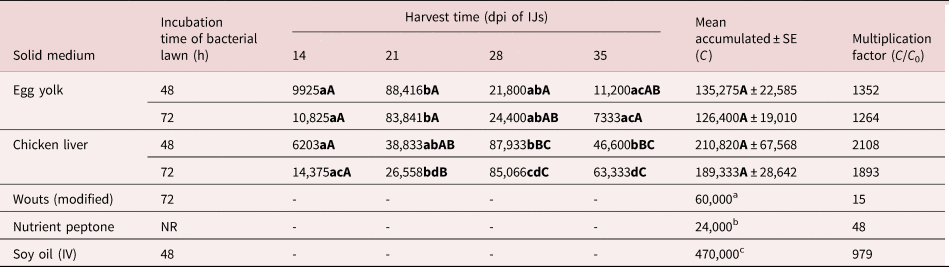
When the bacterial lawn was incubated for 48 h, the mean production in P2 was not significantly different from the production in Cl; however, the production at 14 days (8064 IJs ± 1698 SE) was significantly lower (P < 0.05) than the production at 21 days (63,625 IJs ± 12,812 SE), 28 days (54,866 IJs ± 17,911 SE) and 35 days (28,900 IJs ± 6340 SE). The production on the bacterial lawn incubated for 72 h was not significantly different when the culture was carried out on P2 or Cl, while the mean production at 14 days (12,600 IJs ± 2214 SE) was significantly lower (P < 0.05) than the production at 21 days (55,200 IJs ± 11 864 SE) and 28 days (54,733 IJs ± 12,166 SE). Table 1 shows the production data of IJs from solid media at each harvest time.
In vitro production of Steinernema sp. JAP1 infective juveniles (IJs) through the surface culture on two solid media at 21–25°C with a bacterial lawn of Xenorhabdus sp. previously incubated at 30°C for 48 and 72 h, and comparison with results from other studies. Our data are present as the mean value per 6-cm Petri dish.

Different bold lowercase letters across rows and bold uppercase letters in columns indicate a significant difference (P > 0.05). Abbreviations: SE, standard error; NR, not reported; dpi, days post-inoculation.
a According to El-Sadawy (Reference El-Sadawy2011), an initial inoculum of C 0 = 4000 IJs was placed on a bacterial lawn into five 9–10-cm Petri dishes previously incubated at 25°C for 72 h.
b According to Kondo & Ishibashi (Reference Kondo and Ishibashi1991), an initial inoculum of C 0 = 500 IJs was placed in five Petri dishes (5.5 cm in inner diameter) containing 15 mL of nutrient agar and incubated at 25°C.
c According to Neira-Monsalve et al. (Reference Neira-Monsalve, Sáenz-Aponte, Rodríguez-Bocanegra, Gutiérrez-Rojas, Terán and Quevedo-Hidalgo2019), an initial inoculum of C 0 = 480 IJs was placed on a bacterial lawn into a 5-cm Petri dish previously incubated at 28°C for 48 h. Harvesting occurred at 26–27 dpi of IJs.
After four harvests of IJs, from solid media incubated 48 hpi of TSB-Xenorhabdus sp., the mean accumulated productivities were higher in Cl (294 × 104 IJs m−2 day−1) than in P2 (189 × 104 IJs m−2 day−1), and the same tendency occurred when the incubation time was for 72 h. However, the productivity decreases up to 10% on both solid media. Statistically significant differences (P < 0.05) were observed in IJs’ productivities on P2 and Cl.
Pathogenicity of IJs produced
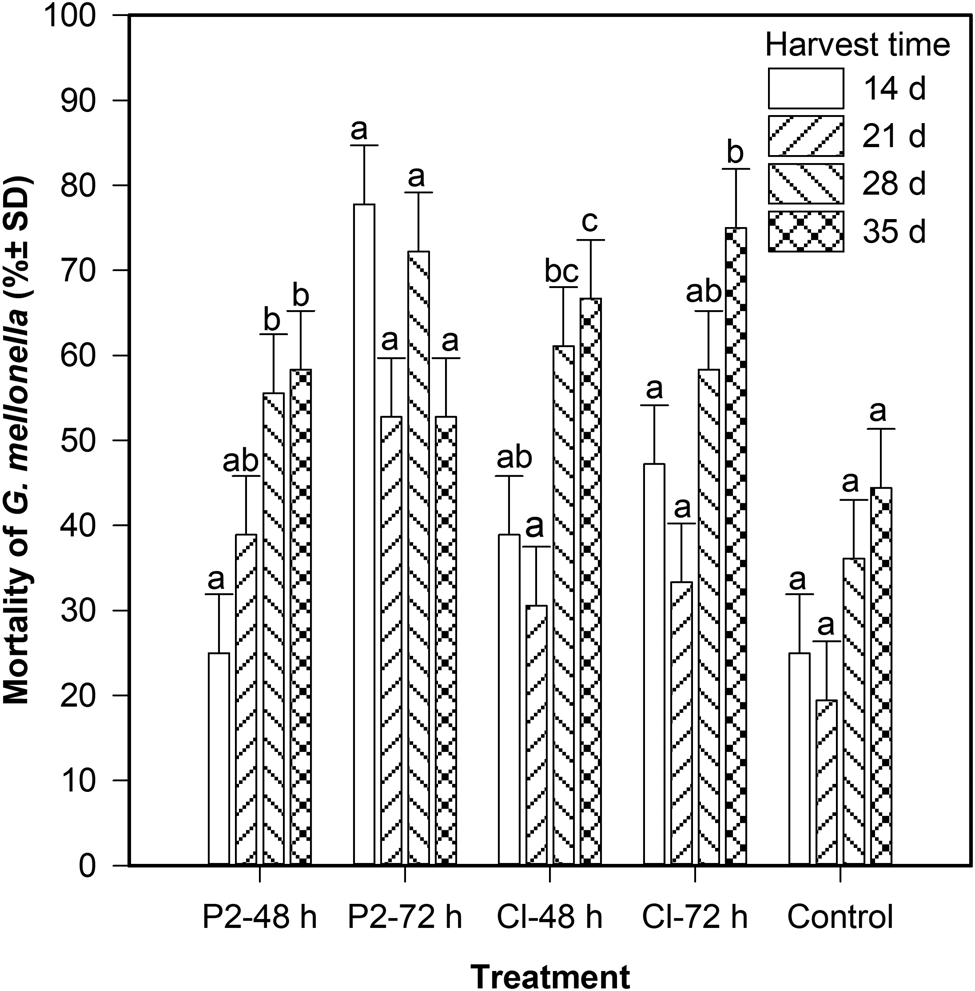
The mortality of G. mellonella by single IJs in vitro-produced and the positive control using single IJs in vivo-reared is shown in fig. 3. The maximum mortality of G. mellonella was achieved using IJs harvested at 14 days from the P2 medium (77.77% ± 10.01 SE), followed by IJs harvested at 35 days from the Cl medium (75% ± 8.33 SE); both media were incubated for 72 h. There was no mortality of G. mellonella in the negative control.
Mortality of Galleria mellonella by the confrontation of single infective juveniles harvested at 14, 21, 28 and 35 days from solid media (egg yolk (P2) or chicken liver (Cl)) stored at 23–27°C. Different letters on the bars within the same treatment indicate significant differences (P < 0.05). SD, standard deviation.

Concerning the solid medium composition factor, the higher mortality of G. mellonella was observed using IJs collected from P2 (54.16% ± 4.1 SE), followed by those harvested from Cl (51.38% ± 3.5 SE). The mortality by IJs reared in vivo was the lowest observed (31.25% ± 2.84 SE). The pathogenicity of the cultured IJs from the two treatments on solid medium (P2 and Cl) only showed a statistically significant difference (P < 0.001) when they were compared with the treatment of IJs reared in vivo. The analysis of the incubation time factor showed a minor positive effect in the pathogenicity caused by the harvested IJs, since a statistically significant difference of P = 0.043 was found in the bacterial lawn incubated 72 h instead of 48 h, of 58.68% ± 3.63 SE and 46.87% ± 3.64 SE, respectively.
In the condition where the bacterial lawn of Xenorhabdus sp. on the solid medium was incubated for 48 h before the inoculation of IJs, statistically significant differences in the pathogenicity of the IJs harvested from the P2 (44.44% ± 5.46 SE) and Cl (49.30% ± 4.96 SE) were found, only for the IJs reared in vivo (31.24% ± 4.11 SE), of P = 0.025 and P = 0.003, respectively. Regarding the pathogenicity about the harvest time, there were statistically significant differences (P < 0.05) using IJs harvested at 28 days (58.33 ± 3.72 SE) compared to those collected at 14 days (31.94% ± 3.34 SE) and 21 days (34.72% ± 7.58 SE), and similarly using IJs collected at 35 days (62.50 ± 3.56 SE) to those at 14 days (P = 0.003) and 21 days (P = 0.005). There were no statistically significant interactions between harvest time and in vivo rearing or solid medium.
Regarding the condition in which the bacterial lawn of Xenorhabdus sp. on the two solid media was incubated for 72 h before the inoculation of IJs, statistically significant differences (P < 0.05) were observed between the pathogenicities of the IJs harvested from P2 (63.88% ± 4.84 SE) and Cl (53.47% ± 5.17 SE), and among these two treatments, with the positive control of IJs reared in vivo (31.24% ± 4.11 SE). Concerning the pathogenicity by the harvest time, statistically significant differences were observed among the IJs harvested at 21 days (43.05% ± 6.6 SE), for those collected at 28 days (65.27% ± 3.97 SE) and 35 days (63.88% ± 7.02 SE), of P = 0.033 and P = 0.042, respectively.
At 72 h of incubation time, some statistically significant interactions between solid media and harvest time were observed (P = 0.02). Using IJs collected at 14 days, the statistical difference (P = 0.007) was between P2 (77.77% ± 10.01 SE) and Cl (47.22% ± 2.77 SE). Using IJs collected at 35 days, the statistical difference value was P = 0.038, between P2 (52.77% ± 7.34 SE) and Cl (75% ± 8.33 SE).
Length of IJs produced
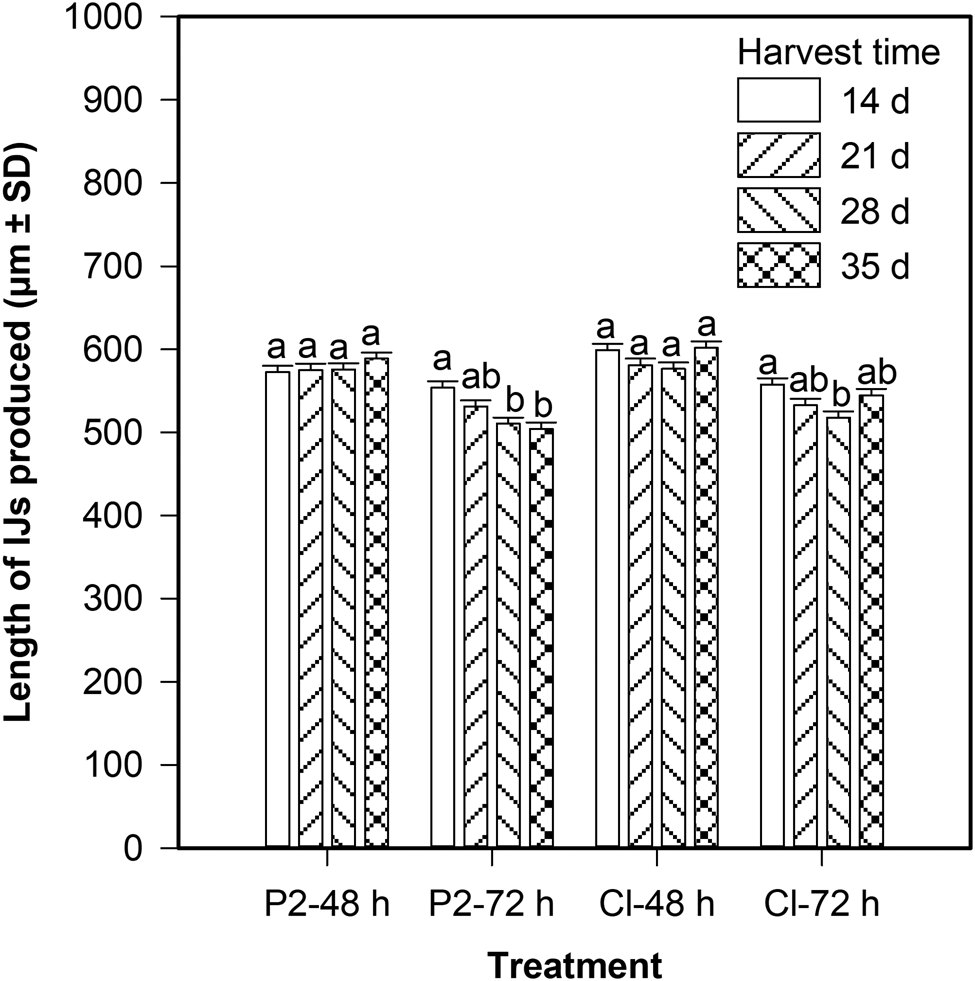
The lengths of IJs in vitro-produced from all treatments by harvest time are shown in fig. 4. The range of IJ lengths was 464–628 μm. The mean length and SE of the IJs produced on solid media were (1) 564 μm ± 4.87 from Cl and (2) 551 μm ± 5.03 from P2, and the one-way ANOVA does not show a statistically significant difference (P = 0.079) among them. However, when the bacterial lawn on solid media was incubated for 72 h instead of 48 h, the produced IJs were significantly shorter in length (P < 0.001) – around 51–53 μm less – and regardless of whether they were produced on P2 (48 h: 578 μm ± 3.5 SE; 72 h: 525 μm ± 5.48 SE) or Cl (48 h: 589 μm ± 3.91 SE; 72 h: 538 μm ± 4.93 SE), the tendency is the same. Therefore, IJs were statistically significant longer (P < 0.05) when they were harvested from P2-72 h at 14 days compared with 38 days and 35 days, and from Cl-72 h at 14 days compared to 28 days. The length of IJs produced on P2 or Cl was not correlated to their pathogenicity on G. mellonella (N = 16, P > 0.05).
Mean length of Steinernema sp. JAP1 infective juveniles (IJs) produced on the solid media chicken liver (Cl) and egg yolk (P2) with a lawn of its symbiotic bacterium incubated at 30°C for 48 and 72 h before the inoculation of 100 IJs. Different letters on the bars within the same treatment indicate a statistically significant difference (P < 0.05). SD, standard deviation.

Discussion
This study reveals a better-accumulated production of Steinernema sp. JAP1 IJs on solid media than previous studies, reporting the production of 60,000 S. glaseri IJs on modified Wouts agar (El-Sadawy, Reference El-Sadawy2011) and 24,000 IJs on nutrient peptone agar (Kondo & Ishibashi, Reference Kondo and Ishibashi1991), but minor to 470,000 IJs of H. indica, harvested at 26–27 days from medium IV with soy oil (Neira-Monsalve et al., Reference Neira-Monsalve, Sáenz-Aponte, Rodríguez-Bocanegra, Gutiérrez-Rojas, Terán and Quevedo-Hidalgo2019). Two relevant experimental differences between our study and those previous reports were: (1) we performed three additional harvests of IJs at 21, 28 and 35 days; and (2) the initial inoculum (C 0) of 100 IJs applied on the surface of solid media was less than 480–4000 IJs used.
Based on the production data reported by Neira-Monsalve et al. (Reference Neira-Monsalve, Sáenz-Aponte, Rodríguez-Bocanegra, Gutiérrez-Rojas, Terán and Quevedo-Hidalgo2019), maximum accumulated productivity of 4.7 × 10⁵ H. indica SL0708 IJs per 5-cm Petri dish can be obtained using solid medium IV at 27 dpi of 480 IJs; hence, the maximum multiplication factor in this study was 979. Our results show a maximum multiplication factor of 2108 because the accumulated productivity at 35 days was 2.1 × 10⁵, with an inoculum of 100 IJs on Cl medium, incubated 48 h after inoculation of an 0.1 mL aliquot of the 38 h-old TSB-Xenorhabus sp. culture broth. Hence, concerning the final concentration of IJs (C) obtained in each solid media shown in table 1, the best multiplication factors of IJs (C/C 0) in descending order were 2108 and 1352, for Cl and P2, respectively. Therefore, we were able to surpass the values obtained by El-Sadawy (Reference El-Sadawy2011), Kondo & Ishibashi (Reference Kondo and Ishibashi1991) and Neira-Monsalve et al. (Reference Neira-Monsalve, Sáenz-Aponte, Rodríguez-Bocanegra, Gutiérrez-Rojas, Terán and Quevedo-Hidalgo2019).
The size of inoculum for IJs is certainly a preponderant factor in the production since, when media were inoculated with greater concentrations of IJs, it would be expected to produce more IJs in less time, as Shapiro-Ilan et al. (Reference Shapiro-Ilan, Han and Dolinksi2012) suggest. However, Neira-Monsalve et al. (Reference Neira-Monsalve, Sáenz-Aponte, Rodríguez-Bocanegra, Gutiérrez-Rojas, Terán and Quevedo-Hidalgo2019) argue that the number of IJs produced depends on the nutritional quality of the media and the efficiency of the bacteria–nematode complex to assimilate the nutrients and bacteria signalling IJ recovery. The optimization of the inoculum amount for Steinernema IJs remains an objective for future study.
Media composition influences the physiological quality of EPNs (Yang et al., Reference Yang, Jian, Zhang and Zhang1997), the effectiveness of IJs (Yoo et al., Reference Yoo, Brown and Gaugler2000) and yield production (Zhen et al., Reference Zhen, Li, Hou, Gu, Zhang, Ruan and Shapiro-Ilan2018). Concerning the corn oil as a source of lipids in P2 and Cl, Neira-Monsalve et al. (Reference Neira-Monsalve, Sáenz-Aponte, Rodríguez-Bocanegra, Gutiérrez-Rojas, Terán and Quevedo-Hidalgo2019) suggest that nematodes cannot modify the fatty acid composition of lipids that are supplemented in culture media, and if the highest proportion of polyunsaturated fatty acids are present in corn oil (Zambiazi et al., Reference Zambiazi, Przybylski, Zambiazi and Mendonça2007), low production of IJs from both media could be expected. However, our experiments reveal higher productivity of Steinernema sp. JAP1 IJs on Cl than on P2.
In our study, the protein source to support the growth and development of the nematodes on the diet composition could be the most critical factor in the production of IJs, since the nutritional value of fresh Cl (Xiong et al., Reference Xiong, Gao, Zheng, Li, Xu and Zhou2017) is more significant than egg yolk in the P2 medium (Rannou et al., Reference Rannou, Queveau, Beaumal, David-Briand, Le Borgne, Meynier and Loisel2015). Cl contributes with a better source of lipids than P2 and its phospholipid components are highly unsaturated (Damien Dorman et al., Reference Damien Dorman, Deans, Noble and Surai1995).
Another important result of our study is the significant difference in IJs’ pathogenicity between in vitro cultured and in vivo reared. A necessary condition to cause the death of G. mellonella is that bacterial cells of the symbiont Xenorhabdus sp. colonize the IJ stage. This may be explained because numerous bacterial cells in phase I were available to metabolize the nutrients of solid media, and nematodes feed on the symbiont biomass at the beginning of the multiplication process, ensuring that new generations also presented the symbiont bacteria housed in their intestinal vesicle, as Boemare (Reference Boemare and Gaugler2002) suggests. For example, when the incubation time was 72 h instead of 48 h, a more significant number of bacterial cells were available to new IJs and support the pathogenicity observed, as our data suggest.
In our studies, the pathogenicity of single Steinernema IJs surface cultured on any of the two solid media evaluated was superior to the value 48.4 ± 1% reported by Converse & Miller (Reference Converse and Miller1999) using the single S. glaseri NJ43 strain produced in submerged liquid culture and higher than the 36% pathogenicity using IJs obtained on lipid agar by Dunphy et al. (Reference Dunphy, Rutherford and Webster1985). In the studies of Kazimierczak et al. (Reference Kazimierczak, Lis, Skrzypek and Kreft2018), the mortality of wax moth larvae exposed to single IJs of Steinernema carpocapsae, Steinernema feltiae and Steinernema arenarium were 50, 43 and 41%, respectively. These results are by ~4–13% lower than those achieved in our study for Steinernema sp. JAP1 IJs.
Although our produced IJs can be considered small (<1 mm), according to Akhurst (Reference Akhurst1986), it seems probable that numerous bacterial cells of its symbiont Xenorhabdus sp. were able to colonize the IJ stage during the solid culture and then support the higher pathogenicity, when compared to in vivo-reared IJs. Also, since the pathogenicity of Xenorhabdus in primary form varies between the different strains and bacterial load (Hang et al., Reference Hang, Choo, Lee, Lee, Kaya and Park2007; Ogier et al., Reference Ogier, Pages and Bisch2014), a complementary study is needed to determine the potential pathogenicity of the sole symbiotic bacterial strain.
The length values of our produced steonernematid IJs are within the range reported for S. carpocapsae IJs (Adams & Nguyen, Reference Adams, Nguyen and Gaugler2002); however, this clearly requires confirmation by molecular biological techniques. Based on our correlation analysis, it is impossible to associate the IJ length to the viability by lipid gain or virulence, as the opposite association was demonstrated for S. carpocapsae (Yang et al., Reference Yang, Jian, Zhang and Zhang1997).
Considering the price of ingredients purchased in local markets and specialized suppliers in Tulancingo de Bravo, Hidalgo, Mexico, the cost of 15 g of solid diets in every 6-cm Petri dish is the same (i.e. 0.29 USD). However, based on the mean accumulated production per Petri dish after four harvests, the highest yields were observed in Cl (14,000 IJs/g) compared with P2 (9000 IJs/g). Hence, the analysis showed that using Cl for the production of one million Steinernema sp. JAP1 IJs had a nominal cost of around 21.15 USD, while it was about 32.63 USD when using the P2 medium. The cost of 21.28 g of the medium VI with soy oil (Neira-Monsalve et al., Reference Neira-Monsalve, Sáenz-Aponte, Rodríguez-Bocanegra, Gutiérrez-Rojas, Terán and Quevedo-Hidalgo2019) to produce one million H. indica IJs is very cheap – around 2.53 USD. Nevertheless, at the industrial production scale, the costs of raw materials can be quite different.
Steinernema sp. JAP1 was well cultured on a solid medium with Cl, and the IJs produced showed better pathogenicity compared with IJs reared in G. mellonella. Its potential application as a biocontrol agent remains conditioned to evaluate efficacy and susceptibility tests against insect pests of economic importance.
In conclusion, the main contributions of this study are as follows: (1) the achieved productivity of IJs of Steinernema sp. JAP1 strain cultured on P2 agar or Cl agar at 23–27°C and ambient humidity increased the multiplication factor achieved using Wouts agar (modified), nutrient Peptone agar and IV medium; and (2) a high pathogenicity of the produced IJs against G. mellonella.
The P2 medium allowed a higher production of IJs than the Cl medium, and an additional 24 h after 48 h of incubation of the bacterial lawn did not significantly increase the production; however, higher productions were obtained from the intermediate harvest (21 days and 28 days), both from P2 and Cl.
The pathogenicity of IJs produced in vitro was higher than those reared in vivo, and increased when they were grown on a bacterial lawn with 72 h of incubation at 30°C. If the bacterial grass on the agar medium was incubated at 30°C for 48 h, the pathogenicity of the IJ harvested late (28 days and 35 days) was higher than those harvested early (14 days and 21 days), regardless of the solid medium used for the cultivation of EPNs.
When the bacterial lawn on the solid medium (P2 or Cl) was incubated at 30°C for 72 h, the IJs harvested at 28 days and 35 days were more pathogenic than those collected at 21 days. However, if the harvest of IJs is performed at 14 days in P2, the pathogenicity is higher than that from Cl, while the opposite was observed at 35 days of harvest in these same solid media.
Acknowledgements
We would like to thank the Universidad Autónoma del Estado de Hidalgo for hosting the postdoctoral research of Carlos I. Cortés-Martínez and the provision of facilities. We would also like to thank J. Alcázar for the donation of Steinernema sp. JAP1.
Financial support
This work was financially supported by Consejo Nacional de Ciencia y Tecnología (CONACyT), Mexico, through a postdoctoral scholarship (no. 769392) to Carlos I. Cortés-Martínez (CVU 178235), and grants CB 2014, no. 238359; INFRA 2014, no. 230138; INFRA 2016, no. 269805; and APYCIENCIAFRONT 2021, no. 316558. Carlos I. Cortés-Martínez appreciates the resources provided by Tecnológico Nacional de México (12765.21-P).
Conflicts of interest
None.
Ethical standards
This article does not contain any studies with human or animal subjects performed by any of the authors.