INTRODUCTION
During the last decades reptiles, such as lizards, snakes and chelonians, have became popular pets (Stahl, Reference Stahl2003; Hoppmann and Barron, Reference Hoppmann and Barron2007; Gazyağcı et al. Reference Gazyağcı, Aktaş and Sari2011; White et al. Reference White, Bourdeau, Bruet, Kass, Tell and Hawkins2011). Virtually all imported reptiles can be infested by a large number of ectoparasites, some of them having zoonotic significance. However, in most countries there is no screening for these parasites before importation (Schultz, Reference Schultz1975; Arnold, Reference Arnold1986; Goldberg and Bursey, Reference Goldberg and Bursey1991b; Harvey-Clark, Reference Harvey-Clark1995; Marano et al. Reference Marano, Arguin and Pappaioanou2007; Pasmans et al. Reference Pasmans, Blahak, Martel and Pantchev2008; Delfino et al. Reference Delfino, Ribeiro, Furtado, Anjos and Almeida2011; Hellebuyck et al. Reference Hellebuyck, Pasmans, Haesebrouck and Martel2012).
Ectoparasites may infest green iguanas (Iguana iguana), a common pet in our area, and cause skin lesions that can become secondarily infected, anaemia, and transmission of pathogens such as haemogregarins and Leishmania spp. (Mader et al. Reference Mader, Houston and Frye1986; Harvey-Clark, Reference Harvey-Clark1995; Bannert et al. Reference Bannert, Karaca and Wohltmann2000; Walter and Shaw, Reference Walter and Shaw2002; White et al. Reference White, Bourdeau, Bruet, Kass, Tell and Hawkins2011; Hellebuyck et al. Reference Hellebuyck, Pasmans, Haesebrouck and Martel2012). Suggested ectoparasiticidal treatments are empirical and some of them of low to moderate efficacy or potentially toxic (White et al. Reference White, Bourdeau, Bruet, Kass, Tell and Hawkins2011; Hellebuyck et al. Reference Hellebuyck, Pasmans, Haesebrouck and Martel2012).
Fipronil solution 0·25% is commercially available in a spray form (Frontline® spray, Merial) licensed for the treatment and prevention of flea and tick infestations in dogs and cats. However, it is commonly used as an extra-label medication for the treatment and prevention of various mite infestations in dogs, cats and horses, due to its wide acaricidal activity (Koutinas et al. Reference Koutinas, Saridomichelakis, Soubasis, Bornstein and Koutinas2001; Curtis, Reference Curtis2004; Rendle et al. Reference Rendle, Cottle, Love and Hughes2007). Although it has been proposed as an effective treatment against mites and ticks in lizards, when applied topically every 1–2 weeks (Gazyağcı et al. Reference Gazyağcı, Aktaş and Sari2011; Hellebuyck et al. Reference Hellebuyck, Pasmans, Haesebrouck and Martel2012), there are few objective data to substantiate the safety and the efficacy of this treatment modality.
The aim of this open-label study was to investigate the short-term efficacy and safety of a single application of 0·25% fipronil solution for the treatment of mites, subsequently identified as Hirstiella sp., in captive green iguanas.
MATERIALS AND METHODS
Animals
A total of 50 green iguanas (I. iguana), kept in pet shops located in Athens and Thessaloniki, Greece, were examined. They were considered healthy by pet shop owners and were kept for commercial purposes. Some of these green iguanas had been imported from Belgium (11/50 – 22%) and from Germany (5/50 – 10%), but the majority (34/50 – 68%) had been obtained from Greek breeders. They had been kept in the pet shops for 2–8 weeks (median: 2·5 weeks) in collections of 2–10 (median: 9) animals, sharing the same enclosure. They were fed on dry iguana formula and fresh vegetables. Wood shavings were used as substrate, all enclosures were clean and regularly disinfected and no ectoparasiticidal treatments had ever been applied. The age of these 50 iguanas ranged from 3·5 to 9 months (median: 7·5 months) and their body weight from 30–206 g (median: 78 g). Informed owners’ consent was obtained before their inclusion into the study.
Clinical examination, counting, collection and identification of mites
The entire skin surface of the iguanas was carefully examined under bright light, with the aid of magnifying lenses for the presence of mites. The skin folds around the head and in axillary and inguinal areas were carefully unfolded for better visualization of the mites (Hoppmann and Barron, Reference Hoppmann and Barron2007). When two or more mites were present, at least one was collected, after gentle superficial scraping with a blunted scalpel blade, transferred into a separate bottle with 90% alcohol solution and identified to the genus level. However, if more than one mite could not be found in any of the iguanas sharing the same enclosure, one of the parasitized animals was randomly selected for mite sampling.
Treatment and evaluation of safety and efficacy
All 50 iguanas, both infested and non-infested, were treated with a 0·25% fipronil solution (Frontline® spray, Merial) that was wiped over their skin with a piece of cotton, taking care to avoid eye and nostril contact; also, cotton tip applicators were used to apply the solution on the skin folds. Attention was paid not to remove the mites from the surface of the skin during fipronil application. Treatment was performed in an open space after gentle manual restraint in order to keep stress of the animals to a minimum. All treated animals were kept out of their enclosures for at least 30 min and until they were dry, to avoid alcohol inhalation. The quantity of the solution used for each iguana was measured by weighing the bottle before and after the treatment. No environmental treatment as well as any other kind of treatment on the animals was permitted for the duration of the study.
Re-examinations, scheduled for the 2nd and 7th day post-treatment, included investigation for possible adverse reactions, physical examination and counting of mites. No mites were collected at re-examinations.
Statistical analysis
The number of mites that were left before treatment (after sample collection for species identification) was compared with the number of mites found on the same animals after 2 and after 7 days using the related-samples Wilcoxon Signed rank test. The level of significance was set at 0·05 and the analysis was performed in SPSS 20.0 for Windows.
RESULTS
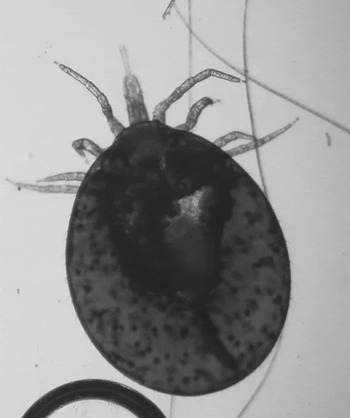
Mites were observed on 21/50 (42%) iguanas and at least one animal was found to be infested in each enclosure. Eleven (22%) lizards presented with skin lesions consisting of cutaneous hyperpigmentation and very small crusts at the site of mite attachment. The number of mites in the 21 infested iguanas ranged from 1 to 24 (median: 5) per animal. A total of 35 mites were collected from 17 animals (1–4 mites per animal; median: 2 mites per animal) and they were all identified as Hirstiella sp. (Fig. 1).
Adult Hirstiella sp. collected from a green iguana.

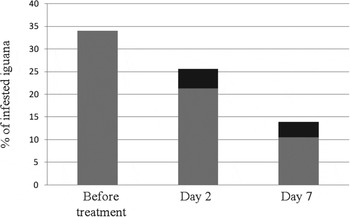
After mite collection, at least one parasite had been left on 17 iguanas (range: 1–21 mites per animal; median: 3) (Fig. 2). Quantity of the 0·25% fipronil solution that was applied to the 50 iguanas ranged from 1·5 to 12·5 g/iguana (median: 4 g), corresponding to 0·04–0·13 g/g body weight (median: 0·09 g/g body weight) or approximately to 0·1–0·325 (median: 0·225) mg of the active substance/g body weight.
Percentage of infested iguana before treatment and 2 and 7 days after a single application of 0·25% fipronil solution. Grey bars represent those animals that had been left with at least one mite after mite collection for species identification and black bars represent those iguanas without visible mites before treatment.

Forty seven iguanas were available for the first re-examination, 2 days after treatment, including 15/17 animals that had been left with parasites before treatment and 32/33 that had no obvious parasites before treatment. In the former, parasites were found in 10/15 (66·7%) with their numbers ranging from 1 to 84/iguana (median: 2 parasites), whereas in the latter only 2/32 (6·25%) harboured 1 and 8 parasites, respectively (Fig. 2). The parasitic load did not differ from that before the treatment in the whole group (P = 0·176), in the iguanas that had been left with parasites before treatment (P = 0·087) and in those with no parasites before treatment (P = 0·180).
Twenty-nine iguanas were available for the second re-examination, 7 days after treatment, including 11/17 animals that had been left with parasites before treatment and 18/33 that had no visible parasites before treatment. In the former, parasites were found in 2/11 (18·2%) animals that harboured 1 and 2 mites, respectively, whereas in the latter only 1 mite was seen in 1/18 (5·6%) iguana (Fig. 2). The parasitic burden was lower than before treatment in the whole group (P = 0·006) and in the iguanas that had been left with parasites before treatment (P = 0·005) and did not differ significantly for those with no parasites before treatment (P = 0·317).
No adverse reactions due to the use of fipronil were noticed.
DISCUSSION
Hirstiella sp. (Acari, Pterygosomatidae) is a common ectoparasite of wild and captured lizards (Hoppmann and Barron, Reference Hoppmann and Barron2007). Many species have been recognized, including H. bakeri, H. boneti, H. diolii, H. jimenezi, H. pelaezi, H. pyriformis, H. stamii and H. trombidiiformis, but only H. diolli and H. stamii have been isolated from captured or wild-caught green iguanas (Newell and Ryckman, Reference Newell and Ryckman1964; Mader et al. Reference Mader, Houston and Frye1986; Walter and Shaw, Reference Walter and Shaw2002; Paredes-León and Morales-Malacara, Reference Paredes-León and Morales-Malacara2009; Corn et al. Reference Corn, Mertins, Hanson and Snow2011). These zoonotic mites, which appear as brown, orange or red spots depending on the degree of blood engorgement, may cause dermatitis (dark-coloured plaques, erythema, swelling, ulcers), dysecdysis, anaemia and debilitation and they can transmit pathogens (Mader et al. Reference Mader, Houston and Frye1986; Harvey-Clark, Reference Harvey-Clark1995; Walter and Shaw, Reference Walter and Shaw2002; Mitchell and Colombini, Reference Mitchell, Colombini, Foster and Foil2003; Stahl, Reference Stahl2003; Hoppmann and Barron, Reference Hoppmann and Barron2007). In the present study 23/50 (46%) of the iguanas that were examined at least once and 15/29 (51·7%) that were available for all three examinations were found to be infested (data not shown). Considering that at least one infested animal was found in each enclosure and the difficulty in diagnosing mild infestations (Hoppmann and Barron, Reference Hoppmann and Barron2007) it is possible that these figures represent an underestimation of the true rate of infestation. The presence of skin lesions was not of diagnostic help because they were present in less than half of the infested iguanas.
Various antiparasitic remedies have been used in lizards, including immersion in tepid water, whole body application of olive oil, organophosphates, carbamates, pyrethrin or pyrethroid sprays and shampoos and ivermectin injections or sprays (Mader et al. Reference Mader, Houston and Frye1986; Harvey-Clark, Reference Harvey-Clark1995; Mader, Reference Mader and Mader1995; Mitchell and Colombini, Reference Mitchell, Colombini, Foster and Foil2003; Hoppmann and Barron, Reference Hoppmann and Barron2007; Hellebuyck et al. Reference Hellebuyck, Pasmans, Haesebrouck and Martel2012). However, none of these treatment protocols has been thoroughly evaluated in terms of safety and efficacy and most of them appear to be either potentially toxic, at least in some lizard species, or of low efficacy (Mader, Reference Mader and Mader1995; Széll et al. Reference Széll, Sréter and Varga2001).
Fipronil is a phenylpyrazole compound that exerts its ectoparasiticidal activity through the antagonism of gamma-aminobutyric acid-gated chloride channels thus leading to parasite hyperexcitability and death (Gant et al. Reference Gant, Chalmers, Wolff, Hoffman and Bushey1998). It has been anecdotally recommended for the treatment of mite infestations in lizards (Hellebuyck et al. Reference Hellebuyck, Pasmans, Haesebrouck and Martel2012) and there is a single report of its safety and effectiveness in a parasitized green iguana (Gazyağcı et al. Reference Gazyağcı, Aktaş and Sari2011). In our study, a single whole-body wipe with 0·25% fipronil solution resulted in a significant decrease of mite load after a 7-day period but not 2 days post-treatment. This delay may be explained by the rather slow onset of action of this compound (McCoy et al. Reference McCoy, Broce and Dryden2008). Another explanation could be the movement of moribund mites, that had not been detected before treatment because they were hiding beneath the scales of the iguanas (Delfino et al. Reference Delfino, Ribeiro, Furtado, Anjos and Almeida2011), towards the skin surface. This may account for the high number of mites (up to 84 mites) found in some iguanas on day 2 post-treatment and for the appearance of mites on two iguanas that had been considered parasite-free before treatment. Unfortunately, no mites were collected at this time point to examine their viability.
The reduced parasitic density on the 7th day post-treatment cannot be attributed to natural death or spontaneous detachment of the mites; even when wild-caught lizards were kept in isolation, another Pterygosomatid mite, Geckobiella texana, remained attached for approximately 28 days (Goldberg and Bursey, Reference Goldberg and Bursey1991a) and in infested collections, like those that have been used in the present study, Hirstiella sp. is expected to be able to continue its life cycle on a permanent basis. This is further supported by the long time period that the infested iguanas had been in their current enclosures at the beginning of the trial (up to 9 months) without addition of new animals into their groups. Unsanitary cage conditions, poor husbandry and crowding predispose lizards to heavy infestations (Mader, Reference Mader and Mader1995). However, none of the above was considered problematic at the initial visit and all these factors remained fairly constant during the study period. For this reason the reduced parasitic density cannot be explained by improved management of these animals. Therefore, the reduced number of parasites 7 days post-treatment must be attributed to the therapeutic intervention, even though a placebo group that would have been necessary to definitively prove this claim was not included in the trial.
Environmental treatment including cleansing of the enclosure, change of the substrate, removal of porous substances, and application of parasiticides such as formalin, dichlorvos, pyrethrin, pyrethroids, fipronil or injectable ivermectin diluted in water has been suggested as having a significant role in the control of ectoparasites in captive lizards (Mader et al. Reference Mader, Houston and Frye1986; Mader, Reference Mader and Mader1995; Mitchell and Colombini, Reference Mitchell, Colombini, Foster and Foil2003; Hoppmann and Barron, Reference Hoppmann and Barron2007; Pasmans et al. Reference Pasmans, Blahak, Martel and Pantchev2008; Gazyağcı et al. Reference Gazyağcı, Aktaş and Sari2011). Although exposure to some of the above ectoparasiticides may be dangerous for the health of the animals (Harvey-Clark, Reference Harvey-Clark1995; Adeyemi and Adedeji, Reference Adeyemi and Adedeji2006), simple cleaning measures are expected to be innocuous and have the potential to increase the efficacy of the treatment. However, such measures were not implemented in the current open-label study because they would interfere with the interpretation of the results. In addition, the duration of the effect of fipronil was not investigated. Anecdotal information has suggested applying fipronil every 1–2 weeks (Hellebuyck et al. Reference Hellebuyck, Pasmans, Haesebrouck and Martel2012), a much shorter interval than that usually utilized in dogs and cats. Although frequent treatment would be reasonable since iguanas lack sebaceous glands that act as the reservoir of fipronil in dogs and cats, additional studies are clearly needed to determine the optimal treatment intervals. Furthermore, it remains unknown if fipronil treatment is also effective against other mite species and ticks that may infest captive green iguanas.
As there are no published toxicological studies for fipronil in green iguanas and its use in this species is extra-label, its application should be performed with caution and after owners’ informed consent (Hellebuyck et al. Reference Hellebuyck, Pasmans, Haesebrouck and Martel2012). Fipronil has been found to be toxic for the fringe-toed lizard, Acanthodactylus dumerili, when it was ingested at a dose of 30 μg/g body weight (Peveling and Demba, Reference Peveling and Demba2003). In our study a much higher dose was applied (median: 0·09 g of the 0·25% solution/g body weight corresponding to approximately 225 μg of fipronil/g body weight) without observing side-effects. This may be explained by the different route of exposure (oral vs epicutaneous), the lack of self-grooming in iguanas and to the overestimation of the actual quantity of fipronil that was applied, since the method we used to calculate the dose does not account for the quantity that was absorbed by the cotton pad and for the quantity that evaporated during wiping. Caution is advised against the use of more concentrated fipronil solutions (i.e. the spot-on formulations) and the commercially available combination products also containing S-methoprene and amitraz.
Based on these results of the efficacy and safety of 0·25% fipronil solution, this treatment may be considered not only for those pet green iguanas with obvious parasites and/or skin lesions, but also for all green iguanas before their importation into non-native countries, in order to avoid the introduction of naïve parasites which may potentially infest wildlife animals (Oliver et al. Reference Oliver, Hayes, Keirans and Lavender1993; Ippen and Zwart, Reference Ippen and Zwart1996; Bram and George, Reference Bram and George2000; Fèvre et al. Reference Fèvre, Bronsvoort, Hamilton and Cleaveland2006; Corn et al. Reference Corn, Mertins, Hanson and Snow2011).
In summary, a single application of 0·25% fipronil solution, over the body, using cotton pads, resulted in significant reduction of Hirstiella sp. numbers in captive green iguanas after a 7-day period without drug-associated side-effects. Due to the extra-label use of fipronil in this animal species, informed owner's consent should be always obtained before use.
FINANCIAL SUPPORT
The fipronil spray used in this study was donated by Merial-Gerolymatos S. A., Athens, Greece. The sponsor had no involvement in the study design, in the collection, analysis and interpretation of the data, in the writing of the manuscript or in the decision to submit it for publication.