Implications
The rumen microorganisms can be classified into hydrogen-producing (protozoa, cellulolytic bacteria and fungi) and hydrogen-consuming microbes (methanogens and fumarate-reducers) according to their hydrogen metabolic pathway. Supplementation of disodium fumarate in the sheep diet could improve ruminal fermentation by changing the microbial communities, indicative of the decreased methanogen population and the positive effects on the population of cellulolytic microbes, Ruminococcus albus and fungi.
Introduction
Hydrogen metabolism plays a central role in regulating rumen fermentation (Hungate, Reference Hungate1967; Williams and Coleman, Reference Williams and Coleman1997). Efficient removal of hydrogen from the rumen is beneficial to increase the rate of fermentation by eliminating its inhibitory effect on the microbial degradation of plant material (Wolin, Reference Wolin1979; McAllister and Newbold, Reference McAllister and Newbold2008). There are other potential electron acceptors in rumen (Wolin, Reference Wolin1979), such as sulfate, nitrate and fumarate, etc. (Morgavi et al., Reference Morgavi, Forano, Martin and Newbold2010). Among them fumarate is non-toxic and an intermediate of the pathways of propionate formation (Russell and Wallace, Reference Russell and Wallace1997), and has been extensively studied as an alternative electron sink (Castillo et al., Reference Castillo, Benedito, Méndez, Pereira, López-Alonso, Miranda and Hernández2004). Fumarate has been associated with favorable changes in ruminal fermentation in vitro as well as in vivo (Asanuma et al., Reference Asanuma, Iwamoto and Hino1999a; Ungerfeld et al., Reference Ungerfeld, Kohn, Wallace and Newbold2007; Wood et al., Reference Wood, Wallace, Rowe, Price, Yáñez-Ruiz, Murray and Newbold2009).
Methanogens (hydrogen-utilizing microbes) and fibrolytic microorganisms (hydrogen-producing microbes) play a pivotal role in the rumen ecosystem. Interspecies hydrogen transfer has been well described in vitro, especially between cellulolytics and methanogens (Wolin et al., Reference Wolin, Miller and Stewart1997). Ruminococcus albus, Ruminococcus flavefaciens and all the rumen fungi and protozoa produce hydrogen and they interact positively with methanogens (Joblin et al., Reference Joblin, Naylor and Williams1990; Pavlostathis et al., Reference Pavlostathis, Miller and Wolin1990; Williams et al., Reference Williams, Withers and Joblin1994).
Addition of disodium fumarate (DF) in the diet might stimulate alternative pathways that use fumarate as electron acceptors other than carbon dioxide in the rumen, and might induce major effects on the population of hydrogen utilizers and producers. Fumarate tended to increase rumen microbial growth on high-forage diet, and generally the effect of fumarate on rumen fermentation depended on the nature of the incubated substrate with high-forage diets showing a greater response compared with low-forage diet (García-Martínez et al., Reference García-Martínez, Ranilla, Tejido and Carro2005).
Microbial adaptation to fumarate metabolism is important, and the whole community of hydrogen-producing microbes (cellulytic microbes, protozoa and fungi) and hydrogen-using microbes (methanogens) could be modified when fumarate is added to diet. Furthermore, the effect on rumen function and bacteria community of fumarate addition for an extended period could be different from addition during a short-term, and microbial populations in different ruminal fractions (fluid- and solid-associated microbes) could respond differently to DF addition. Thus, the objective of this study was to investigate the effects of DF on ruminal fermentation, methanogens and fibrolytic populations in ruminal fluid and solid samples when supplementing for both a short and an extended period.
Material and methods
Animals, diets and experimental designs
In Trial 1, six Hu sheep (∼45 kg BW) fitted with ruminal cannulae were randomly allocated to a 2 × 2 cross-design either or not supplemented with 20 g DF daily. Each period lasted for 15 days. Animals were maintained in individual pens with a daily basal diet consisting of 300 g concentrate and 700 g forage (concentrate/forage, 30/70) per sheep per day. The diet was presumed to meet the energy requirement for maintenance (Ministry of Agriculture of China, 2004), and contained 100 g/kg of CP, 530 g/kg of NDF and 470 g/kg of ADF. They were fed twice daily at 0830 and 1630 h with free access to water. Ruminal samples were collected from the cannulae in the morning before the morning feeding on the last day during each period. Samples for DNA extraction were stored at −80°C. Rumen fermentation parameters and microbial populations were measured.
In Trial 2, three 1.5-year-old rumen-cannulated Hu sheep (∼45 kg BW) were fed on the same basal diet as in Trial 1 continuously for 6 weeks, including 2 weeks of adaptation (without DF) and 4 weeks with DF supplementation (20 g/day). Ruminal samples were collected in the morning before feeding after the first 2 weeks of adaptation and every week thereafter. Sampling points were indicated as 0 w (no DF addition), 1 w, 2 w, 3 w and 4 w, respectively. Rumen fermentation and microbial populations were measured. Microbial diversity was analyzed using denaturing gradient gel electrophoresis (DGGE) using rumen samples taken from 0 w, 2 w and 4 w.
Ruminal fermentation parameters
The rumen samples were filtered through four layers of gauze into tubes for analysis of pH, ammonia nitrogen (N) and volatile fatty acids (VFA). The pH of rumen fluid was determined immediately using a pH meter (Model PB-20, Sartorius, Göettingen, Germany). Concentration of ammonia N was determined (Model 721/721-100, Shanghai, China) colorimetrically using a spectrometer (Searle, Reference Searle1984) with ammonium chloride solution as a standard. The VFA were determined using a gas chromatograph (GC-2010, Shimadzu, Kyoto, Japan) equipped with a Flame Ionization Detector and a capillary column (HP-INNOWAX, 1909N-133, Agilent Technologies, Santa Clara, CA, USA ), as described elsewhere (Hu et al., Reference Hu, Liu, Ye, Wu and Guo2005).
Rumen microbial populations
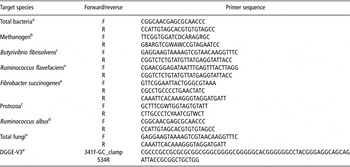
The rumen samples were strained through four layers of gauze and separated into fluid and particle parts. Total DNA was extracted from liquid- and solid-associated microbes, respectively, as described elsewhere (Chen et al., Reference Chen, Wang, Wu and Liu2007 and Reference Chen, Wang, Wu and Liu2008). Number of 16S rDNA gene copies associated with rumen methanogens and bacteria, and 18S rDNA gene copies associated with rumen protozoa and fungi were measured using real-time PCR. Primer pairs of total bacteria, fungi, protozoa, methanogen, R. albus, Fibrobacter succinogenes, Butyrivibrio fibrisolvens and R. flavefaciens are listed in Table 1. Species-specific real-time qPCR was performed using Bio-Rad iCycler iQ real-time PCR detection system (Bio-Rad laboratories Inc., Hercules, CA, USA) with fluorescence detection of SYBR Green dye, as described elsewhere (Chen et al., Reference Chen, Wang, Wu and Liu2008).
Primers for real-time PCR assay and DGGE-V3

DGGE = denaturing gradient gel electrophoresis.
aCited from Denman and McSweeney (Reference Denman and McSweeney2006).
bCited from Denman et al. (Reference Denman, Tomkins and McSweeney2007).
cCited from Arakaki et al. (Reference Arakaki, Gaggiotti, Cannillia, Valtorta, Gallardo, Conti, Gregoret, Quaino, Kudo and Takenaka2005).
dCited from Koike and Kobayashi (Reference Koike and Kobayashi2001).
eCited from Muyzer et al. (Reference Muyzer, de Waal and Uitterlinden1993).
Rumen microbial diversity
Microbial diversity was analyzed by DGGE of PCR-amplified genes coding for 16S rRNA (Muyzer et al., Reference Muyzer, de Waal and Uitterlinden1993). The V3 variable regions of the bacterial 16S rRNA gene from rumen samples (0 w, 2 w, 4 w) in Trial 2 were amplified by a touchdown PCR approach using forward primer 341F-GC clamp and 534R (Table 1). Fast silver staining of DGGE gels was used (Ji et al., Reference Ji, Qu and Cao2007). The DGGE bands of interest were cut-out. PCR products were cloned using TOPO TA cloning kit according to the manufacturer's instructions (Invitrogen Corporation, San Diego, CA, USA). All products were sequenced using the BigDye® Terminator v3.1 kit (Applied Biosystems, Foster city, CA, USA). All the DNA sequences were edited manually and trimmed for vector contamination by ContigExpress Project (Vector NTI Advance 10, Invitrogen). Sequences from excised DGGE bands were searched for homology with Basic Local Alignment Search Tool program.
Statistical analyses
Quantification for methanogens, protozoa, F. succinogenes, R. albus, R. flavefaciens, B. fibrisolvens and rumen fungi, were expressed as a proportion to total rumen bacterial 16S rDNA, according to the equation: relative quantification = 2−(ct target−ct total bacteria), where Ct represents threshold cycle. The results of Trial 1 were analyzed according to univariate analysis by GLM procedure of SPSS (SPSS, 2006) with time and group as fixed factors. Multiple comparisons among means of Trial 2 were performed using the least significant difference analysis (SPSS, 2006). Differences among means with P < 0.05 were accepted as representing statistically significant differences; differences among means with 0.05 < P < 0.10 were accepted as representing tendencies.
Results
Trial 1: fermentation parameters and microbial populations
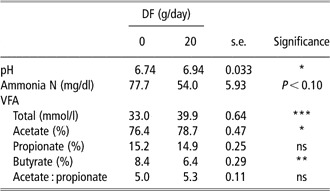
The rumen fermentation parameters in Trial 1 are presented in Table 2. Average ruminal pH increased sharply in the DF group compared with the control (P < 0.05). Ammonia N concentration did not change (P > 0.05). Total VFA concentrations increased (P < 0.001), and minor increases (P < 0.05) in acetate (2 molar percent) were at the expense of similar decreases in molar byturate proportions (P < 0.05).
Effects of DF on ruminal pH, ammonia N, and total and individual VFA expressed as molar proportions of the total (n = 3; Trial 1)

DF = disodium fumarate; N = nitrogen; VFA = volatile fatty acids.
*P < 0.05; **P < 0.01; ***P < 0.001; ns = non-significant.
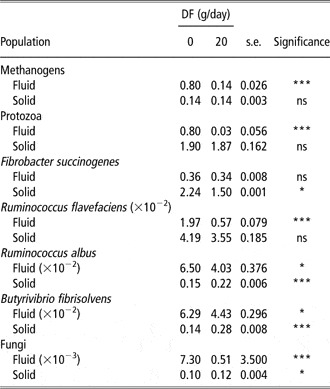
The abundance of microbial populations relative to the total bacterial 16S rDNA is shown in Table 3. Methanogens and protozoa were less abundantly represented in the total bacterial 16S rDNA of fluid samples (from 0.80% and 0.80% to 0.14% and 0.03%, respectively). R. albus represented a greater proportion of the solid bacteria, but was less predominant in the liquid bacterial population of the animals fed DF. The abundance of fungi within the microbial community decreased in the fluid (P < 0.001), but increased in the solid (P = 0.03) samples.
Effect of DF on microbial population in fluid and solid ruminal samples (% of total bacterial 16S rDNA; n = 3; Trial 1)

DF = disodium fumarate.
*P < 0.05; **P < 0.01; ***P < 0.001; ns = non-significant.
Trial 2: fermentation parameters
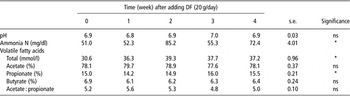
No apparent effect of DF was observed (P > 0.05) on pH value (Table 4). Addition of DF induced dynamic changes on ammonia N concentration (P = 0.0006), with an increase by 67% in 2 w compared with 0 w and a decease to the 0 w level in 3 w and 4 w. Total VFA increased during the 4 weeks when DF was added, and the concentration in 2 w, 3w and 4 w were 28%, 23% and 22% higher than that of control, respectively. Proportions of acetate and butyrate were not altered by DF addition. The proportion of propionate was not increased by the DF addition.
Dynamic change in pH and fermentation parameters with addition of DF (n = 3; Trial 2)

DF = disodium fumarate.
*P < 0.05; ns = non-significant.
Trial 2: microbial populations
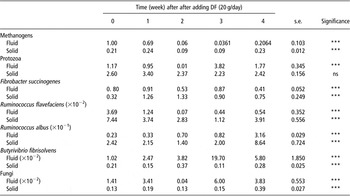
The abundance of methanogens within the microbial community in fluid samples decreased from 1.00% to 0.69% and 0.20% in 1 w and 4 w relative to total bacterial 16S rDNA, respectively (Table 5). Solid-associated methanogens increased in 1 w and then decreased in 2 w and 3 w, but again increased to 0 w levels in 4 w. The abundance of methanogens was higher in fluid than in solid samples, whereas the protozoa represented more of the solid as compared with liquid microbes (Table 5). The protozoal abundance in fluid samples was decreased to the lowest numbers at the end of 2 w, but recovered to original (0 w) values in 4 w.
Trial 2: Effect of long-term addition of DF on the dynamic changes of microbial population in fluid and solid samples (n = 3)

***P < 0.001; ns = non-significant.
The abundance of solid-associated F. succinogenes (fumarate-reducers) within the solid-associated microbial population increased four times in 1 w, remained stable in 2 w, but its importance in the microbial population decreased from 3 w. However, after 4 weeks of DF supplementation this bacterial group seemed twice as important as compared with a situation without DF supplementation (0 w). The abundance of R. albus within the fluid-associated microbial population remained stable in 1 w, increased twice and three times in 2 w and 3 w, respectively, and its importance increased 11 times after 4 weeks of DF supplementation, compared with that in 0 w. Although the abundance of R. albus within the solid-associated microbial population remained stable during the first 3 weeks, at the end of experiment it increased to four times that in 0 w. A decrease (P < 0.05) was observed on the populations of R. flavefaciens in both solid and fluid samples at the end of 4 w, compared with that at 0 w. Addition of DF increased the importance of fungi in both fluid and solid samples throughout Trial 2 (P < 0.001). The number of fungi in the microbial population of fluid and solid samples in 4 w was approximately three times that of 0 w.
Trial 2: microbial diversity
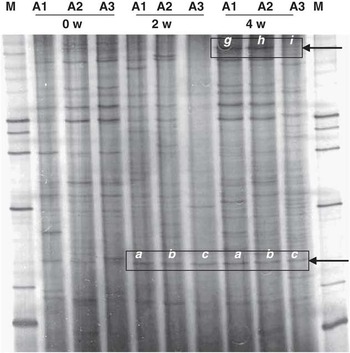
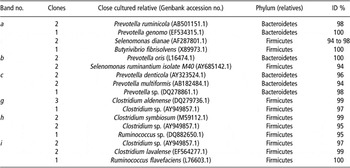
The DGGE fingerprints revealed significant changes in rumen microbiota after DF addition (Figure 1). Bands a, b and c were shown in each animal only in 2 w and 4 w, whereas bands g, h and i were only shown in 4 w. DGGE profiles were relatively consistent within three replicate animals. Cut-out of DGGE bands and sequencing results are summarized in Table 6. Ten of 15 clone sequences in the six bands, a, b and c, which were more pronounced after 2 w and 4 w, showed 94% to 100% similarity to Prevotella-like bacteria. Four sequences were related to Selenomonas dianae (95% to 98% similarity); and one was 100% similar to B. fibrisolvens. Thirteen of 15 sequences in three bands g, h and i that appeared in 4 w were 95% to 99% related to Clostridium sp., and the other two showed 95% and 100% similarity to Ruminococcus sp. A total of 17 sequences were submitted to Genbank with the accession number: HQ162700 to HQ162716.
Denaturing gradient gel electrophoresis profiles of the ruminal bacterial community with disodium fumarate (DF) addition for 4 weeks in Hu-sheep. A1, A2, A3 represent the sheep number in Trial 2; symbols a, b and c represent bands appearing in each animal through DF supplementation in both 2 w and 4 w; and g, h and i represent bands appearing in samples of animals after 4 weeks of DF supplementation (2 w and 4 w are sampling points).

Affiliation of partial 16S rDNA (V3 region) gene sequences obtained from excised bands of DGGE fingerprint with their close isolates in GenBank (sequence length = 182 to 194 bp)

Discussion
Ruminal fermentation
Addition of monosodium fumarate in vitro increased acetate, propionate and total VFA and decreased the ratio of acetate to propionate (Yu et al., Reference Yu, Chen, Cheng, Cheng, Yang and Chang2010). Carro and Ranilla (Reference Carro and Ranilla2003) showed that fumarate could beneficially affect in vitro rumen fermentation of concentrate feeds by increasing the productions of both acetate and propionate. An increase in total VFA concentration and basically no change in the proportion of the individual fatty acids were observed in this study, although a slight increase in acetate and decrease in butyrate were observed in Trial 1 (Table 2). It seems that both acetate and propionate are formed to a same extent from DF. The possibility for both acetate and propionate formation from DF was indicated before (Ungerfeld and Kohn, Reference Ungerfeld and Kohn2006). The increase of total VFA concentration in both trials indicates the positive effects of DF addition on ruminal fermentation.
Interaction between methanogens and protozoa
The abundance of methanogens within the microbial population decreased significantly in the fluid-associated samples in both trials (Tables 3 and 5). The abundance of methanogens in solid samples in Trial 1 showed no significant changes; however, particle-associated abundance in Trial 2 increased in 1 w, and decreased in 2 and 3 w compared with 0 w, respectively, and then increased to the same level as 0 w in 4 w. These results indicated that DF addition provides different effects on fluid- and solid-associated methanogens with solid abundance showing more variable changes.
It had been estimated that under ruminal conditions, fumarate reduction should be more exergonic than methanogenesis in terms of Gibbs-free energy released per pair of electrons incorporated. The ΔG (kJ/2H) for fumarate reduction and methanogenesis is −63.6 and −16.9, respectively (Ungerfeld and Kohn, Reference Ungerfeld and Kohn2006). Therefore, the decrease of fluid-associated methanogens in this study verified that the capacity of methanogens to compete for hydrogen with fumarate-reducers was weakened by fumarate addition. However, it is surprising that this is not associated with changes in propionate proportion.
Some methanogens are associated with the external surface of protozoa, and/or are endosymbionts, living free within the protozoal cytoplasm (Williams and Coleman, Reference Williams and Coleman1997). In this study, the abundance of the protozoa population within the fluid samples was decreased compared with control in Trial 1 (Table 3), whereas in Trial 2 the extended feeding of DF caused their abundance in both solid and fluid samples to recover to 0 w levels (Table 5). It is suggested that DF may cause a transient effect on protozoa. Protozoa serve not only as host for methanogens, but also produce hydrogen in large quantities in a specialized organelle (hydrogenosome; Morgavi et al., Reference Morgavi, Forano, Martin and Newbold2010). This hydrogen is metabolized by methanogens that are found inside (Finlay et al., Reference Finlay, Esteban, Clarke, Williams, Embley and Hirt1994) or in close association with protozoal cells (Stumm et al., Reference Stumm, Gijzen and Vogels1982). The interaction between methanogens and protozoa is a typical example of interspecies hydrogen transfer, which favors both of them (Hillman et al., Reference Hillman, Lloyd and Williams1988; Ushida and Jouany, Reference Ushida and Jouany1996). Both populations of methanogens and protozoa in fluid samples decreased significantly with the addition of DF, but remained relatively stable in particle samples in both trials. Krumholz et al. (Reference Krumholz, Forsberg and Veira1983) found that the methanogenic activity in the rumen fluid was highest in fractions containing large numbers of protozoa. It is also reported that the capacity of competition by methanogens for hydrogen with fumarate-reducers was increased when associated with protozoa (Finlay et al., Reference Finlay, Esteban, Clarke, Williams, Embley and Hirt1994). This is in line with good growth by methanogens and protozoa when living in symbiosis (Wolin, Reference Wolin1974), and with the fact that fumarate is more effective in reducing methane production in protozoa-depleted ruminal fluid (Asanuma et al., Reference Asanuma, Iwamoto and Hino1999b).
Interaction between methanogens and fibrolytic microorganisms
From the point of view of the syntrophy between R. albus (hydrogen-producing) and methanogens (hydrogen-consuming), the increased importance of R. albus and the decreased abundance of methanogens implied that fumarate-reducing bacteria could successfully compete with methanogens for hydrogen when enough fumarate was supplied. Addition of DF in vivo may stimulate the use of hydrogen during fermentation, and decrease the negative feed-back effect of hydrogen on microbes, which in turn improves the growth of fiber-degrading microorganisms. F. succinogenes, R. flavefaciens and R. albus are the representative cellulolytic species in the rumen (Forsberg et al., Reference Forsberg, Cheng and White1997). Moreover, several of them also might reduce fumarate. F. succinogenes are known to have high fumarate-reducing activity (Asanuma et al., Reference Asanuma, Iwamoto and Hino1999b). R. flavefaciens could hydrolyze cellulose and use fumarate as the main electron acceptor producing succinate (Stewart et al., Reference Stewart, Flint and Bryant1988). Accordingly, these bacteria were expected to be stimulated either due to their fumarate-reducing capacity or due to effective removable of hydrogen. However, changes due to fumarate addition were variable and different between fluid and solid phase as well as long- or short-term of addition.
As one of the main fumarate-reducers, the change of F. succinogenes in both solid and fluid phases was not consistent between two trials. In Trial 1, for a short-term of 15 days, a decrease in the solid phase was observed with no change in the fluid phase, whereas in Trial 2, solid-associated F. succinogenes were more abundant during the 4 weeks of DF addition compared with 0 w levels (Table 5). R. albus abundance increased in solid samples, but declined in fluid samples in Trial 1 (Table 3); whereas in Trial 2, R. albus increased in fluid samples throughout the 4 weeks of DF addition, although their abundance in solid samples did not change during the first 3 weeks and increased to nearly four times the number of 0 w in 4 w (Table 5). Stimulation of R. albus could be linked to interspecies hydrogen transfer, that is, hydrogen produced by R. albus could be consumed by fumarate-reducing bacteria resulting in little accumulation of hydrogen. The low partial pressure of hydrogen could facilitate electron disposal in R. albus and result in faster growth of R. albus.
B. fibrisolvens is one of the protein-degrading species in rumen with abilities to digest cellulose, although not as effective as Ruminococcus or Fibrobacter sp. Interestingly, some similarity can be seen in the concentration of ammonia N and the abundance of solid-associated (Tables 2, 4 and 5) or fluid-associated B. fibrisolvens (Tables 2 and 3). Nevertheless, in Trial 1, solid-associated B. fibrisolvens is inversely related with ammonia N, whereas fluid-associated bacteria are positively correlated with ammonia N concentration. B. fibrisolvens require ammonia N for optimal growth when feeding fibrous basal diets (Williams and Coleman, Reference Williams and Coleman1997). The effects of DF addition on protein degradation need further studies.
Diversity analysis revealed by DGGE
Most of the clone sequences from bands a, b and c in both 2 w and 4 w were similar with Prevotella-like bacteria and S. dianae (Figure 1; Table 6), suggesting that the addition of fumarate had a stable and stimulating effect on their growth. Two of the sequences in band a were affiliated to Prevotella ruminicola (98%; AB501151.1). Two of the sequences in band b were affiliated to Selenomonas ruminantium isolate M40 (AY685142.1; Table 6). Fumarate reduction has been reported to be catalyzed by fumarate reductase in P. ruminicola and S. ruminantium (Henderson, Reference Henderson1980). There is also evidence that S. ruminantium can utilize hydrogen produced by other rumen microorganisms (Marvin-Sikkema et al., Reference Marvin-Sikkema, Richardson, Stewart, Gottschal and Prins1990). There were 93% of the clone sequences in both 2 w and 4 w represented by Prevotella sp. and Selenomonas sp., which could indicate the involvement of Prevotella and Selenomonas-like bacteria in fumarate reduction both during the early and late stage of fumarate treatment. Nevertheless, an indirect effect of fumarate on these bacterial species cannot be excluded.
One of the sequences from band a had 100% similarity with B. fibrisolvens. The reveal of B. fibrisolvens in DGGE bands agreed with the results of real-time PCR. The abundance of B. fibrisolvens increased and their abundance in fluid samples was higher in 3 w and 4 w than during earlier samplings. P. ruminicola and B. fibrisolvens are important proteolytic bacteria in the rumen (Wallace et al., Reference Wallace, Onodera and Cotta1997), indicating that some protein-degrading bacteria responded to DF addition.
Of the10 clone sequences in bands a and b, 40% showed 95% to 98% similarity to S. dianae (AF287801.1). As discussed above, the abundance of R. albus increased significantly in both fluid and solid samples during the 4 weeks, especially in 4 w. Increased growth of R. albus through fumarate addition was reported before in co-cultures with Selenomonas lactilytica (Asanuma and Hino, Reference Asanuma and Hino2000). It is further confirmed and approved by the appearance of Selenomonassp. in DGGE analysis in 2 w and 4 w (Figure 1; Table 6). Interspecies hydrogen transfer might be the reason for their co-growth. The hydrogen produced by R. albus may be consumed by S. dianae. Asanuma and Hino (Reference Asanuma and Hino2000) indentified two strains of Selenomonas having a high capacity for fumarate reduction by using hydrogen as an electron donor. Therefore, S. dianae could be one of the potential fumarate-reducers as well.
Of the clone sequences in bands g, h and i, 87% was closely related to Clostridium sp., and the rest related to Ruminococcus sp. in 4 w. The appearance of Ruminococcus sp. in 4 w was verified by real-time PCR results, suggesting that R. albus increased throughout the experiment and reached its highest abundance in 4 w in the current experiment, but the abundance of R. flavefaciens decreased. R. flavefaciens may not compete with R. albus for the supply of hydrogen during interspecies hydrogen transfer. The 15 sequences in bands a, b and c belonged to the phylumn of bacteroidetes (67%) and firmicutes (33%), whereas all the 15 sequences in bands g, h and i belonged to the phylum of firmicutes. It is indicated that a certain group of bacteria belonging to the phylum of Bacteroidetes (Prevotella sp.) and Firmicutes (S. dianae) grows faster after adding DF and may keep their activity stable for 4 weeks. Another group of Firmicutes, such as Clostridium sp., responded to DF addition in week 4, but not at the early stage.
This DGGE study suggested that the dominant group in the microbial community composition shifted from the phylum of Bacteroidetes to Firmicutes (Clostridia Class) after addition of fumarate. Analysis of DGGE based on partial 16S rDNA sequences could capture some corresponding predominant species, but only gives a general view of community shifts (Kocherginskaya et al., Reference Kocherginskaya, Cann and Mackie2005). There is a need of more precise analysis based on functional fumarate reductase (frdA) gene or full-length of 16S rDNA gene clone libraries (Makkar and McSweeney, Reference Makkar and McSweeney2005). In their study on diverisity of frdA clones recovered from the rumen of cattle on high-forage diets (Hattori and Matsui, Reference Hattori and Matsui2008), three clusters represented by cultured isolates Proteus vulgaris, Pasteurella multocida and Shewanella putrefaciens were detected in the library from one animal; two abundant clusters were represented by S. putrefaciens and Pasteurella spp., accounting for 56% and 33% of total clones, whereas a less abundant cluster (9% of total frd clones) represented by P. vulgaris detected as their nearest neighbor. In our study, both Proteus spp. and Shewanella spp. were detected in bands a, b and c from 2 w and 4 w, but Pasteurella spp. was not found.
In summary, the DF addition improves in vivo rumen fermentation in sheep on high-forage diets as suggested from increasing total VFA concentration. Addition of DF resulted in a decreased methanogen population and positive effects on the population of cellulolytic micoorganisms, R. albus. DGGE analysis indicated that Prevotella-like bacteria, S. dianae and Clostridium sp. responded to DF addition at different stages.
Acknowledgments
This study was supported partly by grants from the National Natural Science Foundation of China (No. 30972105) and China–Australia Special Fund for Science and Technology (No. 2010DFA31040).