Over recent decades, a substantial literature has accumulated on the psychological outcomes of children adopted internationally, well summarized by van Ijzendoorn and Juffer (Reference Van Ijzendoorn and Juffer2006) on the basis of their extensive meta-analysis of findings across a range of studies. Many of these internationally adopted children suffered substantial deprivation before adoption, and some suffered from profound institutional deprivation. Despite these early adversities, the outcomes following rearing in mostly well-functioning adoptive families have been quite good. The physical catch-up after early subnutrition has usually been virtually complete with respect to weight, but not quite so complete in the case of height (possibly as a consequence of early puberty). The one striking exception in the field of anthropometric indices is head circumference. Although that also has shown catchup, often it has been less complete, suggesting lasting effects of deprivation on brain development.
Compared with nonadopted controls in the meta-analyses, international adoptees showed only slightly higher rates of both emotional and behavioral disturbance. The findings are clearly reassuring with respect to the overall psychological outcome of international adoption, but conclusions are necessarily constrained by the fact that the analyses did not deal specifically with the subgroup of international adoptees who suffered extreme institutional deprivation. That was a focus of the extensive Child Behavior Checklist (CBCL; Achenbach, Reference Achenbach1991) questionnaire survey undertaken by Gunnar, van Dulmen, and the International Adoption Project Team (Reference Gunnar and van Dulmen2007) in the United States. They found that the only CBCL subscales specifically associated with an institutional rearing were those concerned with attention problems, thought problems, and social problems. Neither anxiety/depression nor delinquent behavior/aggression were associated with an institutional rearing. Rather, they were significantly associated with adoption after the age of 2 years. In contrast with findings on nonadopted general population samples, anxiety/depression was more frequent in males than females. The study has the important strength of a large sample, but it has four key limitations. First, the data are entirely based on parent questionnaires; second, the sample spanned the very wide age range of 4 to 18 years; third, the data are entirely cross-sectional (and therefore are noncontributory to the issue of changes in problems over time); and fourth, data were missing for over one-third of the children.
The only two studies to assess within-individual change over time in children suffering institutional deprivation in early life but subsequently adopted into nondeprived families are the Canadian study (Ames, Reference Ames1997, Fisher, Ames, Chisholm, & Savoie, Reference Fisher, Ames, Chisholm and Savoie1997; Maclean, Reference Maclean2003) and our own British study (Beckett et al., Reference Beckett, Maughan, Castle, Colvert, Groothues and Kreppner2006; Castle et al., Reference Castle, Rutter, Beckett, Colvert, Groothues and Hawkins2006; Kreppner et al., Reference Kreppner, Rutter, Beckett, Castle, Colvert and Groothues2007; Rutter, Kreppner, O'Connor, & the English and Romanian Adoptees Study Team, Reference O'Connor and Rutter2001). The Canadian study compared 46 Romanian children who had spent at least 8 months in institutional care with 29 children who were adopted at an age less than 4 months, and 46 Canadian-born, nonadopted, noninstitutionalized children. All three groups were followed until the age of 9.5 years or older. Using the CBCL, it was found that 11 months after adoption the institution-reared children had higher scores on internalizing behavior than either the early-adopted or Canadian-born children. No significant group differences on externalizing behavior were found at that time. However, externalizing scores were higher in the institution-reared children.
Our own British study had a somewhat similar design to the Canadian study, but it differs in some key respects. The sample was based on random sampling across the range of age at placement in a UK adoptive family up to 42 months (which the Canadian sample was not because it included only those children experiencing at least 8 months institutional care); our sample size was much larger, with 165 adoptees from Romania, of whom 144 experienced an institutional rearing; and the comparison group comprised 52 noninstitutionalized children adopted within the United Kingdom under the age of 6 months. The main focus of the study was on the effects of early institutional deprivation within an adoptee sample, the chief interest being on the effects of a radical change for the better in the rearing environment and in the effects of variations in the duration of time the institutional deprivation lasted. The choice of a within-UK noninstitutionalized adoptee sample for whom adoption occurred before the age of 6 months was deliberate because it served the purpose of controlling for the effects of adoption, and because early adoption meant that it was likely that the circumstances predisposing to a good psychological outcome were optimal (Rutter & the English and Romanian Adoptees Study Team, Reference Rutter1998).
As Maclean (Reference Maclean2003) discussed, however, there is no single ideal comparison group. Thus, our choice meant that we were unable to study the effects of adoption per se, an important topic but one well covered by much previous research. In addition, we could not assess the effects of variations in the age at adoption in noninstitutionalized children. At the time that we collected our sample, late-adopted children in the United Kingdom comprised a very heterogeneous mix of children with special needs resulting from their own problems and/or experiences of sexual abuse or other serious adversities. Without obtaining a very large sample (which was beyond our resources), there would be no way of studying either the effects of different kinds of adverse early experiences or the effects of variations in the age at adoption. Finally, our choice of comparison group meant that we could not compare the outcome of children who left depriving institutions with those who remained there. Again, other research was consistent in showing the generally poor outcome for children who continue to be reared in depriving institutions.
The follow-up findings at age 6 years showed elevated rates of problems in four areas (disinhibited attachment, inattention/overactivity, cognitive impairment, and quasi-autism), in each case showing a “dose–response” relationship with duration of deprivation (Rutter et al., Reference Rutter, Kreppner and O'Connor2001). By contrast, there was no evidence of similarly elevated rates of emotional difficulties or conduct problems. The lack of emotional and conduct problems at age 6 might seem surprising because most previous research had suggested that the psychopathological effects of stress and adversity tends to be diagnostically nonspecific (McMahon, Grant, Compas, Thurm, & Ey, Reference McMahon, Grant, Compas, Thurm and Ey2003). The nonspecificity of sequelae, however, had not been examined in relation to institutional deprivation. When that has been studied, the evidence has been consistent in showing substantial specificity of a pattern similar to that in our own study (Gunnar et al., 2007; Maclean, Reference Maclean2003). Nevertheless, the age of 6 is too young for a valid assessment of possible effects of institutional deprivation on emotional disturbance and disruptive behavior.
Previous research evidence indicates that middle childhood may be a key time for the development of both externalizing and internalizing problems (e.g., Bohman & Sigvardsson, Reference Bohman and Sigvardsson1980; Brodzinsky, Reference Brodzinsky1993; Verhulst, Althaus, & Versluis-Den Bieman, Reference Verhulst, Althaus and Versluis-Den Bieman1990a, Reference Verhulst, Althaus and Versluis-Den Bieman1990b; Verhulst & Versluis-Den Bieman, Reference Verhulst and Versluis-Den Bieman1995). Such problems might become manifest in early adolescence simply because of the usual age of onset or because these forms of difficulties could not be assessed as adequately when the children were younger. If that were the case in the current study, then it should apply equally to the Romanian and to the within-UK adopted children. However, a second possibility is that any such age-related increase would be expected to be greater in the Romanian group because of the sensitizing effects (in relation to later stress) associated with institutional deprivation. Such sensitizing effects could reflect either the effects of early deprivation on neural structure or the neuroendocrine system (McEwen, Reference McEwen, Charney, Nestler and Bunney1999; McEwen & Lasley, Reference McEwen and Lasley2002) or effects on cognitive/emotional mental sets or attributional styles (Teasdale & Barnard, Reference Teasdale and Barnard1993). If such sensitizing effects were operative, a systematic association with duration of institutional deprivation would be expected, but one that had remained “dormant” until middle childhood. Such sleeper effects have been found occasionally in previous research (e.g., Verhulst et al., Reference Verhulst, Althaus and Versluis-Den Bieman1990a).
In addition to the notion of a sleeper effect there are a number of other possible reasons that the Romanian group might show more emotional and behavioral problems in early adolescence than the within-UK group. Such problems could arise as a later consequence of deprivation-related problems already present at age 6 (i.e., disinhibited attachment, inattention/overactivity, cognitive impairment, and quasi-autism; Rutter et al., Reference Rutter, Kreppner and O'Connor2001). If later emerging conduct and emotional problems represent heterotypic continuity of already manifest difficulties, then the onset of emotional/conduct disturbance should be found only in children with previous deprivation-related problems.
A third possibility is that emotional/conduct disturbances could develop as a consequence of difficulties in picking up social cues and in knowing how to behave appropriately in social situations (e.g., Dodge & Frame, Reference Dodge and Frame1982; Happé & Frith, Reference Happé and Frith1996). Such competence and understanding is crucial in all social situations and an area where this may be of particular importance in middle childhood is in terms of peer relations. Problems in peer relations could have repercussions for both conduct and emotional functioning (e.g., Dodge et al., Reference Dodge, Lansford, Burks, Bates, Pettit and Fontaine2003; Snyder et al., Reference Snyder, Schrepferman, Oeser, Patterson, Stoolmiller and Johnson2005). At age 6 the Romanian sample were found to show higher levels of social difficulties and poorer peer relations than the within-UK adoptee group (although the between-group difference fell short of statistical significance; Rutter et al., Reference Rutter, Kreppner and O'Connor2001). If such difficulties are related to the development of conduct and emotional problems, then the latter should occur predominantly in children with social difficulties; that is, the increase should be mediated by the social problems.
A possible underlying factor for the problems in social interaction seen in our sample is difficulties in emotional understanding or theory of mind (ToM). In addition to possibly mediating later onset of difficulties via peer and social interaction, emotional understanding has been shown to be directly linked to later emotional and conduct problems. For example, 4- to 5-year-old postinstitutionalized children showing aggressive or conduct problems have been found to have lower levels of emotional understanding and to be poorer at recognizing emotional facial expressions than those who do not show any such difficulties (Wismer Fries & Pollak, Reference Wismer Fries and Pollak2004). Older, noninstitutionalized, children showing conduct problems (aged 7–10) have been found to have lower levels of emotional understanding and competence when compared with children not showing conduct difficulties (Bohnert, Crnic, & Lim, Reference Bohnert, Crnic and Lim2003).
An additional possibility is that later onset emotional/conduct difficulties could stem from risks in the postadoption environment, rather than from deprivation preadoption. Previous research has shown that family risk factors are associated with psychopathology in childhood/adolescence (e.g., Puig-Antich et al., Reference Puig-Antich, Kaufman, Ryan, Williamson, Dahl and Lukens1993; Woodward & Fergusson, Reference Woodward and Fergusson2001). In addition to this, it is possible that adoptees might be more affected by such risks because of their already somewhat vulnerable state (Verhulst et al., Reference Verhulst, Althaus and Versluis-Den Bieman1990a). In addition, of particular importance for the group of Romanian adoptees in our sample is the possibility that the increased rate of earlier difficulties seen in this group may have had an impact on family stress, whereby negative family factors could be expected to be stronger for this group of children, and hence, the associated risks for emotional and conduct problems might also be increased. In support of this notion is the finding that in the Canadian study the parents of the Romanian adoptees were found to report higher levels of stress than the comparison group parents (Mainemer, Gilman, & Ames, Reference Mainemer, Gilman and Ames1998). If this were the case for the current study then the expectation is that any increase in emotional/conduct problems should be a function of difficulties in the adoptive family.
A final suggested mediator for the possible late onset of emotional/conduct difficulties for the Romanian adoptees concerns poor educational attainment at age 11 (Beckett, Reference Beckett2006), as this has been linked to both emotional and conduct problems, possibly partially through effects on self-esteem (e.g., Carroll, Maughan, Goodman, & Meltzer, Reference Carroll, Maughan, Goodman and Meltzer2005; Casey, Levy, Brown, & Brooks-Gunn, Reference Casey, Levy, Brown and Brooks-Gunn1992; Rutter, Reference Rutter1974; Willcutt & Pennington, Reference Willcutt and Pennington2000). The prediction in this case is that any increase in emotional/conduct problems should be mediated by scholastic difficulties.
In summary, the current study had two aims: first, to determine whether there was evidence of an onset between 6 and 11 years of emotional and conduct problems in the group of Romanian adoptees, and second, if there was, to investigate a number of possible explanations for the late onset. The following competing hypotheses have been formulated in line with this second aim.
Any increases in conduct and emotional difficulties between ages 6 and 11 in the Romanian adoptee group, relative to the within-UK adoptee group, are the following:
1. sequelae of deprivation-specific features already present at age 6 with the increases found only in children with such features;
2. evidence of a sleeper effect, whereby the increase is a function of the duration of institutional deprivation;
3. a function of poor social interaction as evidenced by peer difficulties, difficulties in facial expression recognition, and lower levels of ToM;
4. a function of stresses/difficulties in the post-adoption family environment; and
5. a function of educational attainment difficulties and lower self-esteem.
Method
Participants
The study focuses on a comparison between the Romanian group and a within-UK adoptee group. The 165 children adopted from Romania all entered the United Kingdom before 43 months of age and were drawn from the 324 children adopted into the United Kingdom between February 1990 and September 1992, with applications legally processed through the Home Office and/or the Department of Health in the United Kingdom. For the purposes of presenting key findings, the sample was stratified into three bands on the basis of age at entry into the United Kingdom, these being: under 6 months, 6 to <24 months, and 24 months and over. In all, 81% of the parents of the Romanian adoptees who were initially approached agreed to participate. Of the 165 children selected for the sample group, 144 experienced institutional care, usually from the neonatal period, whereas 21 children were adopted directly from Romanian families. This latter group represents a useful comparison group of children who were subject to the general levels of deprivation associated with living in underprivileged Romanian families during the time period in question, but who did not experience the specific risks associated with institutional care.
The within-UK adoptee comparison group was drawn from a volunteer sample of children (n = 52), recruited via local authority and voluntary adoption agencies, all of whom were placed in adoptive homes before the age of 6 months. The agencies supplied contact details only after the families had agreed to participate; therefore, it was not possible to calculate the exact rates for participation. It was estimated, however, that approximately half of the families approached agreed to take part. The adoptive families from both the Romanian and the within-UK sample groups were generally above average in terms of social class and education, although there was some spread in their educational abilities. It should be noted that six children from the sample as a whole (Romanian and within-UK groups) did not have the required data from the 11-year-old assessment (of these, three also did not have the required data from the 6-year-old assessment), and as such are not included in the current analyses. There were no significant differences between those families who declined to take part at age 11 and those who agreed, in terms of age of entry to the United Kingdom or emotional and conduct scores at age 6.
The mean age at placement for the within-UK group was 2.54 months (SD = 1.53). For the Romanian children who had experienced institutional deprivation and were brought to the United Kingdom before 6 months of age (n = 58) it was 3.98 (SD = 1.11) months, whereas for the 6 to <24 month age group (n = 59) it was 14.89 (SD = 5.14) and for the 24 months and above group (n = 48) it was 30.40 months (SD = 4.89). The group of Romanian children who did not experience institutional care had a mean age at placement of 9.10 months (SD = 10.81), with a spread of ages of placement across all three stratification groups.
Measures
A wide-ranging assessment of intellectual and behavioral outcomes was carried out at both age 6 and age 11, and the measures involved in the current analyses are outlined below.
Emotional and behavioral problems
Emotional and behavioral difficulties were measured using the revised Rutter scales (Elander & Rutter, Reference Elander and Rutter1996), with supplementary questions from Behar and Stringfield (Behar, Reference Behar1977; Hogg, Rutter, & Richman, Reference Hogg, Rutter, Richman and Sclare1997). The scales were completed by mothers, fathers, and teachers as part of both the age 6 assessment and the age 11 follow-up. The teacher questionnaires were sent out before the children made the move to secondary education, and hence, were completed by the main class teacher for each child. The completion of the questionnaires was tied to the children's birthdays rather than to a specific point in the school term. Accordingly, there were variations in the amount of time that teachers had spent with the children in the school class.
The scales consist of a set of items describing emotional and behavioral difficulties, with each item scored 0 (does not apply), 1 (applies somewhat) or 2 (certainly applies). Composite scores were calculated for three separate domains of psychopathology: emotional difficulties, conduct problems, and inattention/overactivity. The current study primarily focuses on the scores gained for emotional and conduct problems, but the scores for inattention/overactivity are included in some analyses. The items for the emotional subscale were tears on arrival at school or refusal to go into school in the past 12 months; often worried, worries about many things; often appears miserable, unhappy, tearful or distressed; tends to be fearful or afraid of new things or new situations; often complains of aches and pains; cries easily; stares into space; and gives up easily. The conduct subscale items were often destroys own or other's property; frequently fights or is extremely quarrelsome with other children; is often disobedient; often lies; has stolen things on one or more occasions in the past 12 months; bullies other children; kicks, bites other children; blames others for things; is inconsiderate of others; and disturbs others in class (the last item only on teacher scale).
Because the interest was in pervasive disturbance, and to diminish any effect of possible situational or rater bias, a composite score was produced by averaging the scores of parents and teachers. The procedure was in line with the manual recommendations for the CBCL (Achenbach, Reference Achenbach1991), a comparable questionnaire for psychopathology. Ratings were obtained from both mothers and fathers (the intercorrelations between the two being high; at age 6, r = .56 for emotional disturbance, n = 175, p < .001; and r = .65 for conduct disturbance, n = 175, p < .001, whereas at age 11 r = .72 for emotional disturbance, n = 174, p < .001; and r = .83 for conduct disturbance, n = 174, p < .001). In order not to place a disproportionate weight on ratings of behavior in the home the scores of the two parents were averaged. Then, the parental score and the teacher's score were combined in a parent–teacher composite. It should be noted that the intercorrelations between parents’ and teachers’ ratings at age 11 (the focus of the present follow-up) were substantial (r = .46 for emotional disturbance, n = 176, p < .001; and r = .56 for conduct disturbance, n = 176, p < .001). These are higher than those obtained in many studies and justify the composite score approach. The correlations at age 6 years, at a time when there had been less opportunity for disturbance to develop, were somewhat lower (r = .32 for emotional disturbance, n = 188, p < .001; r = .38 for conduct disturbance, n = 188, p < .001), in line with previous studies.
In addition to the composite mean score results, cutoff groups were established from the data for both the emotional and the conduct scales to examine markedly abnormal ratings for both problem areas. The cutoffs were calculated from the sample as a whole (the pooled Romanian and within-UK adoptees groups) at age 6, using standardized z scores for the parent and teacher composite, taking the 85th percentile as the cutoff. This approach was employed because the focus of the study was on the comparison between the two adoptee groups, and because we needed to have a method that allowed direct comparisons across the psychopathological domains we studied (Kreppner et al., 2007; Rutter et al., Reference Rutter, Kreppner and O'Connor2001) and that permitted direct comparisons across ages.
Using this method, the z score cutoff for emotional difficulties was 0.76, and any child scoring above this cutoff was placed into the marked problems category, whereas the z score cutoff for conduct problems was 0.78. To make a direct comparison of disorder at 6 and 11 years, the 6-year-old cutoffs were also used for the 11-year-old scores. This approach was necessary because it could not be assumed that the scores at 6 and 11 years had the same mean and spread. The scores as derived allow for comparison between the groups with respect to changes between 6 and 11 years.
The cutoffs chosen are based on the sample as a whole rather than on population based norms. This is important, as previous research has indicated that children who are adopted are more vulnerable to developing both externalizing and internalizing difficulties (e.g., Verhulst et al., Reference Verhulst, Althaus and Versluis-Den Bieman1990a); hence, it was vital to compare within an adopted sample, rather than against nonadopted norms. The cutoff we employed is equivalent to 1.85 standard deviations above the mean, resulting (as a result of the J-shaped distribution) with the most deviant 7.7% of the general population on the Strengths and Difficulties Questionnaire (SDQ; Goodman, Reference Goodman1997), using a measure with a major overlap in items with the scale we used.
A third method of assessing the emotional and conduct scores was also employed. Change scores were calculated, whereby the age 6 mean scores were subtracted from the age 11 mean scores. This process allowed a measure of change in mean levels of difficulty over the two time points.
Indices of deprivation prior to adoption
Much the most direct index of deprivation concerns the duration of institutional deprivation as assessed by the child's age at the time of leaving the institution to come to the United Kingdom. This was accurately assessed by contemporaneous records at the time of United Kingdom entry, and did not require reliance on retrospective recall. The same applies to the children's weight at United Kingdom entry, obtained by professional measurement at the time, as part of entry clearance process, and to head circumference, which reflects brain growth (Wickett, Vernon, & Lee, Reference Wickett, Vernon and Lee2000). The measurements were entered into the child health growth program to assess the data relative to population norms (Boyce & Cole, Reference Boyce and Cole1993, based on Buckler, Reference Buckler1990). This metric provides a continuous standardized measure of physical development in terms of standard deviations above or below the standardization mean for the age.
The fourth index was provided by developmental level at entry into the United Kingdom. This was assessed at the initial developmental visit at age 4 (or age 6 for the children adopted later) when parents were asked to provide a retrospective account of the child's developmental level at the time of arrival in the United Kingdom using the Denver Developmental Assessment (Frankenberg, Van Doornick, Lidell, & Dick, Reference Frankenberg, Van Doornick, Lidell and Dick1986). This is a screening questionnaire that categorizes achievements in a number of developmental domains: physical, fine and gross motor skills, language development, and personal social skills. From this scale, standardized developmental quotients were computed indicating the degree of delay the child was experiencing on arrival. Previously published analyses (Rutter & the English and Romanian Adoptees Study Team, Reference Rutter1998) supported the validity of the developmental quotient, but clearly, it constitutes the weakest of the four indices of preadoption deprivation.
Psychological patterns specifically related to early deprivation at age 6
Four areas of difficulty were found to be significantly and specifically related to institutional deprivation in this sample at the 6-year-old assessment, and it has been argued they might form the basis of an early institutional deprivation syndrome (Rutter et al., Reference Rutter, Kreppner and O'Connor2001). Measures of these domains taken at ages 6 and 11 were included to assess whether functioning at age 11 in the emotional and conduct domains (which at age 6 appeared unrelated to experience of deprivation) now overlapped with problems in areas shown to be specifically linked to deprivation.
1. Disinhibited attachment: This measure was taken from items included in the parental interviews carried out at ages 6 and 11. At age 6, three items focused on this area: definite lack of differentiation between adults, clear indication that the child would readily go off with a stranger, and definite lack of checking back with the parent in anxiety-provoking situations. All were scored as 0 (no abnormality), 1 (probable problem), and 2 (marked problem). Ratings were summed to produce a composite score ranging from 0 to 6, and a cutoff of 4 was established to indicate marked problems (see O'Connor, Rutter, & the English and Romanian Adoptees Study Team, Reference O'Connor and Rutter2001; Rutter et al., Reference Rutter, Kreppner and O'Connor2001). For the 11-year-old follow-up the items differed to make them more age appropriate and were wandering off, too friendly with strangers/lack of differentiation, and physical contact/lack of understanding social boundaries/personal space (see Rutter et al., Reference Rutter, Colvert, Kreppner, Beckett, Castle and Groothues2007). The items were scored in the same way as at age 6, with a cutoff of 4 established for marked problems.
2. Quasi-autistic features: At age 6 the Autism Screening Questionnaire (ASQ; Berument, Rutter, Lord, Pickles, & Bailey, Reference Berument, Rutter, Lord, Pickles and Bailey1999) was used for the entire sample, and the Autism Diagnostic Interview—Revised Version (Le Couteur et al., Reference Le Couteur, Rutter, Lord, Rios, Robertson and Holdgrafter1989; Lord, Rutter, & Le Couteur, Reference Lord, Rutter and Le Couteur1994) was used for those children who were identified either by a score above the cutoff on the ASQ or who had clinical referrals. Using this procedure, 20 children were classified as showing quasi-autistic features at age 6 (see Rutter et al., Reference Rutter, Anderson-Wood, Beckett, Berdenkamp, Castle and Groothues1999). The same assessment strategy was used at age 11, and 16 children were identified as exhibiting quasi-autistic features.
3. Cognitive impairment: Cognitive functioning at age 6 was assessed using the McCarthy scales for children's abilities (McCarthy, Reference McCarthy1972) and at age 11 using a short form of the Wechsler Intelligence Scales for Children (Wechsler, Reference Wechsler1991). To compare results on the two scales and to create cutoff scores, the general cognitive index scores were standardized against the IQ scores at age 11, using the within-UK group as the index group. This was necessary as the McCarthy scales have not been standardized for over 30 years (McCarthy, Reference McCarthy1972) and since then, it is estimated that IQ scores have increased at approximately .31 a year (Flynn, Reference Flynn1987). To correct for this and to make the two standardized scores equivalent, the McCarthy scores were reduced by 11 points for all age groups prior to analysis. Cognitive impairment at age 6 was considered to be present if children scored below the 15th percentile on the distribution of the entire sample (the Romanian and within-UK groups combined) and the same cutoff value was applied to the data for 11-year-olds.
4. Inattention/overactivity: Inattention/overactivity forms one of the subscales of the revised Rutter scales. The items were very restless; has difficulty staying seated for long; squirmy, fidgety child; cannot settle to anything for more than a few moments; and inattentive, easily distracted. The teacher questionnaire also included the following items: child makes excessive demands for the teacher's attention, fails to finish things started, and has a short attention span. The data for the parental and teacher ratings of inattention/overactivity were combined in the same way as for the emotional and conduct scales, and an 85th percentile marked problems cutoff was established from the standardized scores for the whole sample (Romanian and within-UK groups) at age 6 (which was 1.00), the same cutoff was applied to the age 11 data.
Social functioning
Peer relationship problems and bullying
Two measures were used to assess peer relationship problems at both age 6 and age 11: three items on the revised parent and teacher Rutter scales and questions on the parental interview carried out at ages 6 and 11. The peer items on the parental Rutter scales were not much liked by other children, tends to be solitary, and does not get on well with other children. The teacher scale items were not much liked by other children, tends to be on own, and cannot work in a small peer group. As with the other scales, the scores were averaged across the parents and teachers to produce one score for the peer scale. The parental interview items differed for the two time points. At age 6 the items concerned group play, differentiation between children (i.e., whether the child showed clear preferences for one or more friends), popularity, peer age preferences, harmony of peer interaction, whether the child was teased by other children, whether the child was picked on or bullied by others, whether they tease others, and whether they pick on or bully other children. Each item was scored as 0 (no abnormality), 1 (probable problem), and 2 (marked problem). The scores for the items were combined and then standardized to create a composite score.
At age 11 more age-appropriate peer relationship items were included on the parental interview and these were difficulty making friends, concerns regarding the way the child relates to other children, differentiation between friends and nonfriends, child shows overeagerness in interaction with other children, child seeks close physical contact with other children, child is bullied by others, and child bullies others. The same scoring criteria were used as at age 6.
At both ages 6 and 11 the aggregate of the parental interview peer relationship items was combined with the parental and teacher Rutter scale scores, by calculating the average across the three measures, to create a composite standardized score. Cutoffs for marked peer relationship problems at both ages were established at or above the 85th percentile of the scores for the entire sample at age 6 (Romanian and within-UK groups). In addition to the overall peer relationship score, bullying and teasing were assessed as a separate aspect of peer relationships, as this was highlighted as a potential problem area from the responses on the parental interview. Composite scores for the items relating to teasing and bullying at each time point were created, with scores of 0–2.
Social information processing
Measures available at age 11 included an assessment of ToM understanding and a measure of facial expression recognition, both of which were completed by the children themselves. The measure of ToM employed was the strange stories task (Happé, Reference Happé1994), which required the children to respond to seven ToM-related vignettes. The responses to the vignettes were scored in terms of the level of ToM understanding displayed, with 0 indicating a non-ToM related response, 1 indicating basic-level ToM understanding, and 2 indicating evidence of more sophisticated ToM understanding. Scores were combined across the seven stories, and mean scores were used in analyses. The measure of facial expression recognition was The Diagnostic Analysis of Nonverbal Accuracy 2 (Nowicki & Carton, Reference Nowicki and Carton1993), which required the children to look at photographs of 24 adult and 24 child faces in succession and decide whether the person in each photograph was showing a happy, sad, angry, or fearful expression. The responses were then scored as correct or incorrect and a total score was calculated.
Postadoption environmental risk factors
Seven aspects of postadoption environmental risk were tested for possible associations with emotional/conduct disturbance: thoughts about divorce and negative rating of the marriage (both from the parental questionnaire Dyadic Adjustment Scale [DAS]; Spainer, 1976), changes in mother's partner prior to the age 11 assessment, the Malaise Inventory (Rodgers, Pickles, Power, Collishaw, & Maughan, 1999; Rutter et al., 1981) measure of maternal depression, mother's previous mental health problems and those of the partner, and a measure of marriage evaluation taken from the age 6 parental interview measure. A cutoff was established for each of the seven areas, and risk was deemed to be present if this was exceeded.
DAS parental questionnaire
Two aspects of the DAS parental questionnaire (Spanier, Reference Spanier1976) from the age 6 assessment were included in the postadoption risk measure: thoughts about divorce and negative ratings of the marriage. Cutoffs were established for the two questions by taking the 85th percentile of the group as a whole (Romanian and within-UK adoptees combined).
Change of partner
A retrospective measure of mother's changes in partner, taken from the age 11 parental interview, was included in the assessment of postadoption risk. Any change in partner was rated as above the cutoff for the parental interview measure.
Parental mental health
Three measures of parental mental health were included in the assessment of postadoption risk: the Malaise Inventory (Rodgers et al., Reference Rodgers, Pickles, Power, Collishaw and Maughan1999; Rutter et al., 1981) measure of maternal depression, from the age 6 parental visit, and questions from the age 11 parental interview focused on mother's previous mental health problems and those of the partner. The established cutoff of 7 was used for the Malaise Inventory; for the prior mental health problems questions the cutoff was set to include only cases where contact with a medical professional was required.
Marriage evaluation
The marriage evaluation was based on a coding from the parental interviews carried out at age 4 or 6 (Quinton, Rutter, & Rowlands, Reference Quinton, Rutter and Rowlands1976). A number of questions were asked about the marriage, and parents provided an evaluation of the state of their marriage when the child first entered the family and at that current time. The marriage evaluation from the current time was used for analyses. A score from 1 to 6 reflects the quality of the marriage (1 = very good, to 6 = very poor). In the overall sample (Romanian and within United Kingdom) very few marriages were rated as above 2 on the quality measure; as such, 3 and above was set as the cutoff for risk.
As is often the case in adopting families, the overall level of possible family risks was low, with very few families showing malfunction in the seven areas. The seven indices were therefore, chosen as alternative types of family difficulty, there being no expectation that they would intercorrelate to any significant degree and it would not ordinarily be possible, therefore, to combine them into a total score. Nevertheless, given a generally low family risk sample, the fact that the measures were chosen to represent alternative scores of risk, and that it was desirable to determine if postadoption risk factors were influential, a total score was calculated by combining all seven cutoffs. A total risk cutoff point of 3 was selected, but mean risk scores were also examined. The total risk cutoff score was exceeded by 15% of the Romanian institutional group and 13% of the within-UK adoptees.
Educational attainment and self-esteem
Two aspects of educational attainment were included: reading comprehension taken from the subscale of the Wechsler Objective Reading Dimensions Test (Rust, Golombok, & Trickey, Reference Rust, Golombok and Trickey1993) and mathematics reasoning, taken from the Wechsler Objective Numerical Dimension Test (Rust, Reference Rust1996).
Reading comprehension
The reading comprehension test is a measure of the use of words in context and of the child's functional use of reading to acquire information. It comprises 38 printed passages and orally presented questions. The child reads the passage, either aloud or silently, and then responds orally to a question asked by the examiner. The reading comprehension test has a mean score of 100 and a standard deviation of 15.
Mathematical reasoning
The mathematical reasoning scale consists of a series of 50 problems assessing the ability to carry out numerical operations and to reason using mathematical skills. The text for each item is orally presented, and is in most cases also printed on the stimulus booklet page. The mathematical reasoning test has a mean score of 100 and a standard deviation of 15.
In addition to the two measures of attainment, the Rosenberg Scale (Rosenberg, Reference Rosenberg1965, Reference Rosenberg1979) was included as a self-report questionnaire measure of self-esteem. Scores for the questionnaire, which was completed by the children as part of the age 11 developmental assessment, were combined across the items, and mean scores were used in analyses.
Procedure
The assessment procedure at the two time points (ages 6 and 11) was very similar, with two separate visits for each family taking part in the study. The first visit involved an intensive interview with the primary care giver, and a set of behavioral and family relationship questionnaires, including the revised Rutter scales. The second visit involved a comprehensive assessment of the child's social, cognitive, and physical development, carried out by trained research workers. At age 11 the developmental assessment usually involved two visits and included standardized assessments: semistructured interviews and questionnaire measures. In addition to the parental and child assessments, questionnaires were also sent to each child's teacher to gain information about their behavior and functioning at school; these included the teacher version of the revised Rutter scales.
Results
Did the levels of conduct and emotional problems increase between ages 6 and 11 for the Romanian adoptees?
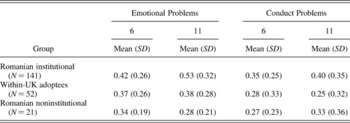
The mean scores for emotional and conduct problems at ages 6 and 11 in the three groups to be compared (i.e., Romanian institutional group, Romanian noninstitutional group, and the within-UK adoptees) are shown in Table 1.Footnote 1 To test whether there was a significant effect of institutional rearing and whether this changed between the two time points a two-way repeated-measures analysis of variance (ANOVA) was performed. For emotional problems there was a significant main effect for group, F (2, 204) = 5.86, p < .01, with post hoc comparisons indicating that the Romanian institutional group showed significantly higher mean scores than the within-UK adoptees and the Romanian noninstitutional group. The analysis also indicated a significant time point by group interaction, F (2, 204) = 4.21, p < .05. When the simple main effects of group were analyzed at the two ages separately, the differences in emotional scores were significant only for the age 11 time point, F (2, 207) = 8.60, p < .001, the difference at age 6 being nonsignificant, F (2, 211) = 1.10, p = .34.
Mean scores for emotional and conduct problems at ages 6 and 11 for the Romanian institutional and noninstitutional groups and the within-UK adoptees

For conduct problems, as with emotional problems, there was a significant main effect for group, F (2, 204) = 3.59, p < .05, with post hoc comparisons indicating that the Romanian institutional group had a higher mean score than the within-UK adoptees. Unlike emotional problems, there was no significant interaction between group and time point for conduct problems, F (2, 204) = 1.77, p = .17.
What were the rates of marked emotional and conduct problems at age 11?
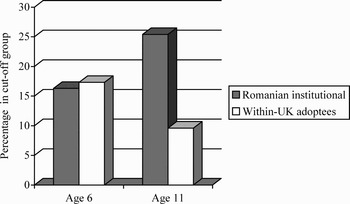
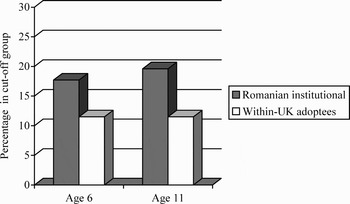
We now turn our attention to the rates of marked emotional and conduct problems in the groups; these are the cases where the scores exceeded the 85th percentile z score cutoff. Figures 1 and 2 present the rates of marked emotional and conduct problems at age 11, and a comparison with those found at age 6, for the Romanian institutional group and the within-UK adoptees. As Table 1 indicated no differences for conduct problems between the within-UK group and the Romanian noninstitutional group, they are not included in Figures 1 and 2.
The percentage of marked emotional problems at ages 6 and 11.

The percentage of marked conduct problems at ages 6 and 11.

As expected on the basis of the mean score data in Table 1, there had been an increase in the percentage of children in the Romanian institutional sample being rated above the cutoff for emotional problems at age 11. McNemar analyses for the Romanian institutional group revealed that only emotional difficulties showed a significant increase from age 6 to age 11 (emotional: McNemar, p < .05; conduct: McNemar, p = .72). McNemar analyses for the within-UK group revealed no significant differences for the two time points.
Note that there was no significant difference between the Romanian institutional sample and the within-UK group for conduct or emotional problems at age 6 (conduct: χ2 = 1.08, df = 1, p = .30; emotional: χ2 = 0.03, df = 1, p = .87). In addition, there was no significant difference between the within-UK and Romanian group for marked conduct problems at age 11 (χ2 = 1.70, df = 1, p = .19); by contrast, emotional problems showed a significant difference between the two groups at age 11 (χ2 = 5.63, df = 1, p < .05), despite there being no significant difference at age 6.
The noninstitutional-reared Romanian sample was also considered in terms of the cutoff groups. At age 6, 5% were above the cutoff for emotional problems with this increasing to 10% at age 11. Conduct problems showed a similar increase for this group rising from 10% at age 6 to 20% at age 11. McNemar analyses for the group revealed no significant differences for the two time points.
Gender was also considered when examining the cutoff group results. For the Romanian institutional sample 60% of those showing marked emotional problems at age 11 were girls, whereas at age 6 the percentage was 61%. For conduct at age 11, 44% of the above the cutoff group were girls, with 64% at age 6. Goodness of fit chi-square analyses revealed no significant gender differences for marked emotional or conduct problems at either time point: emotional: age 6, χ2 (1) = 1.13, p > .05; age 11, χ2 (1) = 1.43, p > .05; conduct: age 6, χ2 (1) = 2.00, p > .05; age 11, χ2 (1) = 0.37, p > .05.
Onset and offset of emotional and conduct problems
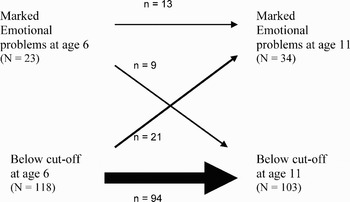
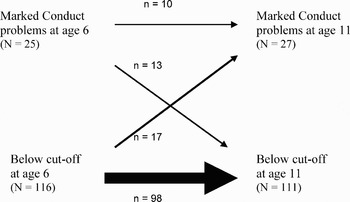
Figures 3 and 4 provide schematic representations of the movement of children showing marked problems at age 6 to age 11, in the Romanian institutional group only. For the marked emotional problems group at age 6 the majority continued to show marked problems at age 11 (56%). However, the continuing cases of marked emotional problems accounted for only 38% of the total number of marked cases at age 11, with the great majority coming from new onset cases. For the conduct problems group at age 6 less than half continued to show marked problems at age 11 (42%). As with the emotional problems, the age 11 marked conduct problems group was mainly formed by new onset cases (63%).
A schematic representation of continuity and discontinuity in marked emotional problems at ages 6 and 11 for the Romanian institutional group.

A schematic representation of continuity and discontinuity in marked conduct problems at ages 6 and 11 for the Romanian institutional group.

As Figures 3 and 4 indicated, although new-onset cases provide the majority of those with problems at age 11, whether emotional or conduct in type, the overall pattern was somewhat different. In the case of emotional difficulties, over twice as many gained new problems as had problems present at age 6, whereas for conduct disturbance the gains and losses were more equivalent.
Were the onset groups already on the cusp of problem thresholds at age 6?
To examine whether the onset groups were on the cusp of the marked problems groups at age 6, the mean scores were examined. The age 6 mean z score for the emotional problems onset group fell far below the cutoff for this age (emotional onset group mean score at age 6 = 0.12; emotional cutoff = 0.76). The same was found for the conduct problems onset group (conduct onset group mean score at age 6 = 0.16; conduct cutoff = 0.78). The findings indicate that neither of the onset groups were showing disturbance just below the threshold at age 6.
As only marked emotional problems were found to have significantly increased from age 6 to age 11, and to show differences for the within-UK group and the Romanian sample, this area will now become the focus of the current analyses.
What factors were associated with the onset of emotional problems?
In an attempt to examine why there had been an increase in emotional problems from age 6 to age 11, the children in the Romanian institutional sample were divided into those showing persistent marked emotional problems (i.e., at both age 6 and age 11), those showing onset of marked problems at age 11, that is, no marked problems at age 6 (hereafter referred to as the onset group), those showing offset at age 11, that is, those showing marked problems at age 6 but not at age 11, and those showing no marked emotional problems at either time point. Focusing on the onset and no problems groups a number of possibilities about the emergence of emotional problems at 11 years were examined, as outlined above in the introduction.
Does the onset of emotional problems represent heterotypic continuity?
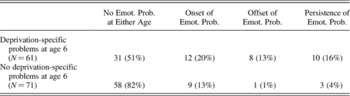
The first possibility was that the onset of emotional problems by age 11 was a function of problems of a different kind already present at age 6: heterotypic continuity. To address this we focused on the four deprivation-specific problems identified at age 6; quasi-autism, disinhibited attachment, inattention/overactivity, and cognitive impairment. The children with one or more of these features were compared with those with none, using two different analytic approaches. Table 2 summarizes the findings of a categorical approach, chosen because we wished to focus on marked problems of likely clinical significance. It is apparent that a higher proportion of children with any deprivation-specific problems at age 6 exhibited emotional disturbance at either age 6 or 11 (49 vs. 18%; Fisher's exact test, p < .001). However, it is also clear that this higher rate applied to children who developed new problems, those who lost problems between ages 6 and 11, and to those whose problems persisted. In short, there was no selective tendency for deprivation-specific problems to lead to a new onset of emotional disturbance. The difference in Table 2 between 20 and 13% fell short of statistical significance, F (2, 18) = 3.14, p = .07.
Emotional problems at 6 and 11 years of age in children with or without deprivation-specific problems at age 6 for the Romanian institutional sample only

χ 2 = 17.17, df = 3, p < .01.
As shown by Farrington and Loeber (Reference Farrington and Loeber2000), a categorical approach is preferred in many circumstances. Nevertheless, there are clear statistical advantages associated with a dimensional approach provided it is conceptually meaningful to postulate that the key variables do indeed represent dimensional features. That was likely to be the case with emotional disturbance. Accordingly, we used a multivariate dimensional analysis to compare mean emotional disturbance scores in children with and without deprivation-specific problems at age 6. The analysis showed a highly significant effect, F (2, 129) = 19.34, p < .0001). When age 6 and age 11 scores were examined separately, again there was a highly significant effect of deprivation-specific problems at age 6: age 6, F (1, 130) = 35.43, p < .001; age 11, F (1, 130) = 15.20, p < .001.
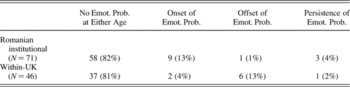
Table 3 summarizes the pattern of emotional disturbance across the 6- to 11-year age period for the within-UK adoptee sample and the subsample of adoptees from Romania without a deprivation-specific disorder at age 6. It is evident that the Romanian sample were somewhat more likely to develop later onset emotional problems (13 vs. 4%; Fisher's exact test, p = .08) and less likely to lose emotional problems already present at age 6 (1 vs. 13%; Fisher's exact test, p < .01). The same dimensional approach used for Table 2 was also applied to Table 3, except that in this case the independent group contrast was between the Romanian institutional group and the within-UK adoptees. The overall multivariate analysis showed no significant difference, F (2, 114) = 2.61, p = .08. The effect was also nonsignificant when age 6 and age 11 scores were considered separately, age 6, F (1, 115) = 0.98, p = .33; age 11, F (1, 115) = 2.75, p = .10. Equally, when the new-onset group was considered separately (i.e., focusing on the 13 vs. 4% comparison) this also fell short of statistical significance, F (2, 8) = 0.37, p = .70) A third form of analysis was employed to examine Table 3; the change scores for the two groups (Romanian institutional and within-UK adoptees) were compared. The change scores were a calculation of how much difference there was between the mean emotional scores gained at the two time points (ages 6 and 11). Using these scores a significant group difference was found, t (115) = −2.29, p < .05. Accordingly (although the cell sizes were too small for a truly satisfactory analysis), the difference between the two groups was substantial, and hence, there was a need to examine the alternative hypotheses for the emergence of these late onset emotional disturbance cases.
Emotional problems at 6 and 11 years of age in children without deprivation-specific problems at age 6 for the Romanian institutional sample and within-UK sample

χ2 = 8.72, df = 3, p < .05.
Because of the evidence of heterotypic continuity in terms of emotional problems the remainder of the analyses of the onset of problems focus only on those children who did not show any deprivation-specific difficulties at age 6.
A sleeper effect had occurred, and those showing onset had experienced more extended and severe early deprivation
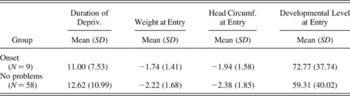
Table 4 shows the mean scores for the onset and no problems groups for the four indices of deprivation to examine whether these might mediate the increase in emotional problems between ages 6 and 11 in this sample.
Mean scores for deprivation related factors for the emotional problems onset and no problems groups

Note: There were no statistically significant between-group differences.
A series of t test comparisons were performed to assess the group differences for the deprivation-related factors, these revealed no significant differences: duration of deprivation, t (65) = 0.43, p = .67; weight at entry, t (62) = −0.82, p = .41; head circumference at entry, t (59) = 0.63, p = .53; developmental level, t (62) = −.94, p = .35, indicating no differential links to deprivation-related factors for the two groups. In addition to the analysis using continuous age of entry data, this information was also examined in a dichotomous fashion looking at those children who were above and below 6 months of age when they entered the United Kingdom. The 6-month cutoff was chosen, as previous work with this sample has shown this to be a crucial point for deprivation-related effects to become manifest (see Kreppner et al., 2007). The 6-month cutoff analysis revealed no links to the onset of emotional problems (χ2 = 0.05, df = 1, p = .83). There was also no effect of gender for the onset and no problems groups (Fisher's exact test, p = .73).
Emotional problems, peer relationship difficulties, and lower levels of facial expression recognition and ToM
The onset and no problems groups were compared in terms of scores for marked peer relationship problems at ages 6 and 11, and also in terms of bullying/teasing at both time points. Chi-square analyses indicated that the emotional onset group did not have significantly more marked peer problems at age 6 than the no problems group (Fisher's exact test, p = .25) or at age 11 (Fisher's exact test, p = .23). Bullying was assessed separately, as a specific form of peer relationship difficulties, and chi-square analyses revealed no links between bullying and the emotional onset group at either time point (age 6: χ2 = 3.43, df = 2, p = .18; age 11: χ2 = 1.43, df = 2, p = .49).
The onset and no problems groups were also compared on child-completed measures from the age 11 assessment, of ToM understanding and of facial expression recognition. The comparison of concurrent ToM difficulties for the onset group and the no problems group showed no significant difference, t (62) = 1.16, p = .25. However, there was a significant facial expression recognition difference at age 11, t (59) = 2.07, p < .05, with the onset group showing lower mean scores for this task.
Emotional problems and family stress/adversity
The onset and no problems groups were compared in terms of postadoption risk. The mean total risk scores were compared, and no significant difference was found for the two groups, t (65) = .85, p = .40. The total risk cutoff was also examined for the two groups, and again, no significant difference was found (Fisher's exact test, p = .58).
Emotional problems, educational attainment, and self-esteem
The onset and no problems groups were compared on two aspects of educational attainment: reading comprehension and mathematics reasoning. The mean standard scores gained by the onset and no problems groups were compared for the two areas of attainment, with no significant difference for either mathematics reasoning, t (62) = .98, p = .33), or reading comprehension, t (62) = 1.57, p = .12. It should be noted that the two groups also showed no significant difference on overall cognitive ability at age 6 or age 11: age 6, t (65) = −0.53, p = .60; age 11, t (62) = 1.34, p = .18.
The final factor to be assessed in terms of playing a role in the late onset of emotional problems was that of self-esteem, for which there was no significant between group difference, t (61) = −0.92, p = .36.
Change score analyses
In addition to the analyses for the onset and no problems groups a broader examination of the possible influences on changing emotional scores was also undertaken. The change scores for the Romanian institutional group without deprivation-specific problems (N = 71) were calculated, and these were then correlated with all the dimensional factors included in the analyses for the onset group (i.e., the deprivation-related factors, ToM, facial expression recognition, postadoption risk, educational attainment, and self-esteem). The change scores were also assessed using t tests for the categorical measures of peer problems and bullying. Using this broader change scores approach two significant results emerged for facial expression recognition and reading comprehension (facial expression recognition: r = −.34, n = 63, p < .01; reading comprehension: r = −.29, n = 67, p < .05).
Discussion
The first main finding was that, at age 11, in contrast to the findings at age 6, emotional disturbance was significantly more common in adoptees who experienced institutional deprivation than in those who did not. This difference was evident from the mean scores on the parent/teacher composite questionnaire measure (Table 1), and it was also apparent on a categorical comparison focusing on marked emotional disturbance. It was important to check whether this apparent rise in emotional disturbance could be an artifact of the cutoff used. In other words, did the children with new emotional disturbances at age 11 show similar disturbance at age 6 that was missed because it fell just below the threshold set. The findings were clear cut in indicating that this was not the case. Their scores at age 6 were far below the cutoff. The cutoff used meant that some 25% of the institution-reared adoptees showed emotional disturbance at age 11 compared with 10% of the adoptees who did not experience institutional deprivation (either because they were adopted from family settings in Romania or because they were adopted within the United Kingdom). Because our findings derive from questionnaire scores rather than detailed clinical evaluations, we cannot be sure of the extent to which this is equivalent to clinically significant psychopathology. Nevertheless, the statistical analyses indicate that there was a clear difference from the findings at age 6 for the Romanian institution-reared group.
The findings with respect to behavioral disturbance were more ambiguous. Both at 6 and 11 years of age, the mean scores were somewhat higher for the institution-reared children, this being statistically significant if the two ages are considered together. By contrast, however, there was no statistically significant increase between 6 and 11 years. Accordingly, there was no significant new onset of disorder to examine. Our further follow-up at age 15 (now nearly complete) will be needed to indicate whether the nonsignificant increase between ages 6 and 11 does or does not presage a rise in behavioral disturbance during middle adolescence.
The second major finding was that the higher level of emotional disturbance in the institution-reared adoptees was largely a consequence of it arising in children who had shown at least one of the four apparently deprivation-specific patterns of disturbance at age 6 (namely, disinhibited attachment, quasi-autism, inattention/overactivity, and cognitive impairment). But this higher rate of emotional disturbance did not represent heterotypic continuity in which one form of psychopathology at an earlier age led to an apparently different form at a later age (see Rutter, Kim-Cohen, & Maughan, Reference Rutter, Kim-Cohen and Maughan2006, for a discussion of this issue). It did not because the overlap (or co-occurrence) with deprivation-specific patterns applied to emotional disturbance at all ages, regardless of later offset or onset. The association is likely to be valid because of the evidence on the validity of these four patterns (see Beckett et al., Reference Beckett, Maughan, Castle, Colvert, Groothues and Kreppner2006; Rutter et al., Reference Rutter, Anderson-Wood, Beckett, Berdenkamp, Castle and Groothues1999, Reference Rutter, Colvert, Kreppner, Beckett, Castle and Groothues2007) as well as their association with a high level of service usage (Castle et al., Reference Castle, Rutter, Beckett, Colvert, Groothues and Hawkins2006; Kreppner et al., 2007).
As noted, this association with deprivation-specific patterns did not account for the onset of new emotional disturbances between 6 and 11 years. Of the children without deprivation-specific patterns at age 6, 13% developed new emotional disturbance by age 11, in contrast to just 4% in the within-UK adoptees. The absolute number of Romanian adoptees with new emotional disorders was small (n = 9), providing little scope for statistical analysis to detect mediating risk factors.
Nevertheless, the findings provide no support for a sleeper effect associated with institutional deprivation. If there had been such an effect, an association with duration of institutional deprivation should have been found, but there was not even a trend of that kind. In addition, there was no association with the two other reasonably good indices, namely, level of subnutrition and head circumference. That does not necessarily mean that institutional deprivation was irrelevant, but it clearly does imply that, if relevant, it did not operate through the same mechanisms as those associated with the four deprivation-specific patterns. Possibly, it might have a role, for example, through an effect on children's mental sets or attributional biases. We have better measures at age 15 regarding this possibility, but our age 11 findings can neither rule it in or out as a mediator.
The third possibility that we examined was that social interaction problems emerging in middle childhood might create a risk for the onset of emotional difficulties. The evidence relating to this was equivocal. Most crucially, the lack of any association with peer relationship difficulties at 6 or 11 years of age was against the hypothesis. There was a separate, but related, possibility that an impairment in emotional understanding (e.g., Wismer Fries, Ziegler, Kurian, Jacoris, & Pollak, Reference Wismer Fries, Ziegler, Kurian, Jacoris and Pollak2005) might have predisposed the group to emotional disturbance. The lack of any association with impairment in ToM runs counter to the suggestion, but we had only one measure of ToM. The finding of impaired facial expression recognition is consistent with the possibility of impaired emotional understanding, but, although this is likely to have been present from an earlier age, we had no means of measuring it at age 6 so we cannot be sure of this. The possible role of impaired facial expression recognition was also found in the broader examination of change scores for the whole sample of institution reared Romanian adoptees without deprivation-specific problems at age 6. However, this result suggests a link with change in the normal range of scores rather than in terms of an onset into marked difficulties of likely clinical significance. Therefore, we conclude that, on balance, the findings suggest that the possibility that impaired emotional understanding predisposing to new emotional disturbance, has only limited suggestive support.
The fourth possibility was that the postadoption family environment could have played a role in the onset of emotional difficulties. Previous research has noted the likely importance of family risk factors for emotional disturbance in adolescence (e.g., Puig-Antich et al., Reference Puig-Antich, Kaufman, Ryan, Williamson, Dahl and Lukens1993; Woodward & Fergusson, Reference Woodward and Fergusson2001), and, in light of the lack of association with deprivation-related indices, the postadoption environment would seem a likely candidate factor. Nevertheless, the results provide no clear support for this suggestion. As with most samples of adoptive families, they tended to be relatively well functioning, and major problems were few. Nevertheless, there was substantial variation on the composite index of family difficulties, and this was unrelated to the onset of emotional disturbance. The main caveat is that we had relatively few measures of family function.
The final possibility was that low scholastic attainment might constitute the key risk factor for emotional disturbance, possibly mediated by low self-esteem. We found no evidence that low self-esteem was relevant for this group. Moreover, the young people with an onset of emotional disturbance between 6 and 11 years did not differ from the remainder of the sample on cognitive level at age 6 or 11 or on mathematical reasoning and reading comprehension at age 11. The categorical findings therefore provide no support for the hypothesis that the late-onset emotional disturbance was a consequence of either educational failure or from low self-esteem. The change score analyses, however, suggested that educational attainment, in the form of reading comprehension, might be a relevant factor for the group of Romanian adoptees without deprivation-specific problems at age 6 as a whole. In view of the difference between the categorical and dimensional analyses, there must be substantial doubt over the mediating role of educational failure.
Limitations
The findings on emotional disturbance are entirely based on questionnaire measures (as has been the case with almost all other studies) rather than a detailed clinical assessment. The number of children (n = 9) with the onset of new emotional disturbance between ages 6 and 11 was too small for a really satisfactory analysis of possible mediators of risk, and we had relatively few measures of potential risk factors.
Conclusions
In summary, we found that marked emotional difficulties were more common in the institution-reared Romanian adoptees at age 11, although they had not been more common than in the within-UK adoptee group at age 6. Emotional disturbance at both 6 and 11 years was substantially more frequent in the children who had shown deprivation-specific disorder at age 6 (disinhibited attachment, quasi-autistic patterns, inattention/overactivity, and cognitive impairment), and it is evident that this accounts for much emotional disturbance. Nevertheless, it did not account for the rise in emotional disturbance between ages 6 and 11. Rather, it was in the subgroup of children without deprivation-specific problems that later onset emotional disturbance was a more typical feature.
The findings indicated no associations between such late-onset disturbances and indices of institutional deprivation, making it unlikely that such deprivation had a sleeper effect operating through the same mechanisms involved in the deprivation-specific patterns at age 6. There was no support for the suggestion that the new emotional disturbance was secondary to scholastic failure or to low self-esteem, and no indication that it reflected postadoption family difficulties. There was slight equivocal support for the suggestion that difficulties picking up emotional cues might constitute a risk factor for emotional disturbance, but adequate testing of the possible role of social relationship difficulties awaits the findings from ongoing later follow-up at age 15.