The economic crisis that began around 2008 and the resulting politics of austerity are considered to pose a fundamental challenge for the legitimacy of European democratic systems (Cordero and Simón Reference Cordero and Simón2016; Schäfer and Streeck Reference Schäfer and Streeck2013). In numerous countries, protests have erupted as a reaction to austerity politics (Rüdig and Karyotis Reference Rüdig and Karyotis2014; Torcal et al. Reference Torcal, Rodon and Hierro2016), incumbent parties have encountered electoral setbacks, and populist parties have gained a strong popular appeal (Della Porta Reference Della Porta2013). The economic downturn has aggravated a climate of political dissatisfaction that was already apparent before the start of the global crisis, although thus far there is no empirical evidence that this downturn would have enduring negative effects (Bermeo and Bartels Reference Bermeo and Bartels2014; Kern et al. Reference Kern, Marien and Hooghe2015). The theoretical relevance of these events is that citizens seem to react strongly to economic developments. This implies that political systems are also being held accountable for the way the economic system performs, and for the economy’s impact on citizens’ ability to reach a sufficiently high standard of living to ensure their basic social rights. This already would suggest that social considerations matter for the debate on the current state of citizenship, and democracy is not just seen as adhering to procedural and electoral rules. Apparently citizens connect considerations of economic and social equality to their political judgements.
In this article, our goal is to ascertain whether this phenomenon could be explained by the expectations citizens have towards the normative ideal of democracy and the functioning of the political system. The literature on democratic ideals suggests that citizens can have widely diverging expectations towards democracy, and that these expectations change over time (Dalton and Welzel Reference Dalton and Welzel2014; Doorenspleet Reference Doorenspleet2015; Saward Reference Saward1998). Some of the literature stresses the importance of mostly procedural norms about the functioning of legal and political institutions (Weingast Reference Weingast1997). To a large extent, this corresponds to the traditional Schumpeterian view that democracy first of all can be defined as adhering to a set of electoral rules, without too many other considerations about the quality of democracy or of social life. Other authors, however, emphasize a much broader set of democratic criteria, including considerations of community, social cohesion and shared values (Beetham Reference Beetham1999; Welzel Reference Welzel2013). Still other authors have emphasized that citizens increasingly expect to play a more active political role in established democracies, as emphasized in the republican ideal of democracy (Dalton Reference Dalton2008; Offe Reference Offe1983). Combining these various approaches, it has been claimed that while formal and procedural political rights are of crucial importance, they will remain without real consequences if citizens do not have the resources to use and develop their human capabilities (Meyer Reference Meyer2007; Nussbaum and Sen Reference Nussbaum and Sen1993). This would imply that democratic ideals also extend to social rights and opportunities and that to a large extent these social rights can be considered a prerequisite for full citizenship. This claim is important as it runs directly against the Schumpeter-inspired minimalist view on what is essential within a democratic system. Starting from a procedural view on democracy, there is indeed nothing inherently wrong about downsizing social security. If, on the other hand, we assume an interplay between social and political rights, this implies that the economic crisis might also have a spill-over effect on democratic legitimacy.
More specifically, in this article we will ascertain whether citizens’ democratic ideals indeed include legal, procedural and social considerations and how they relate to one another. In the debate on the social component of full citizenship, the work of T.H. Marshall (Reference Marshall1950) has played a seminal role, as he introduced a distinction between the political rights that define full citizenship, and the social rights that further embody this concept. Marshall assumes a historical development, from civil to political rights and subsequently expanding this notion to social rights (most notably in the twentieth century). According to Marshall, this granting of social rights can be seen as one of the major achievements of contemporary democracy as it enabled an ever-larger proportion of the population to enjoy full citizenship rights (Møller and Skaaning Reference Møller and Skaaning2010). In the current literature, various authors have further expanded this egalitarian notion of democracy (Beetham Reference Beetham1999; Walzer and Miller Reference Walzer and Miller1995).
Marshall’s theory of citizenship has had a huge impact on normative social science, and this is predominantly due to his bold move to set social rights at the heart of conceptualizing citizenship and democracy (Lister Reference Lister2005; Meyer Reference Meyer2007). Various authors have further developed the idea that democracy should not be limited to delineating purely political rights, but that it should also include an emphasis on social rights and social protection to ensure that citizens have the capabilities to enjoy their basic democratic rights. Regimes of social protection, according to Marshall, amount to ‘a general enrichment of the concrete substance of civilized life, a general reduction of risk and insecurity, an equalization between the more and the less fortunate at all levels’ (Marshall Reference Marshall1964: 102). While this insight has strongly influenced the normative debate on social policy (King and Waldron Reference King and Waldron1988), the distinction between political and social citizenship is not routinely acknowledged in empirical social science (Bulmer and Rees Reference Bulmer and Rees1996). Nevertheless, it can be argued that investigating these distinctive democratic ideals is of crucial importance if we want to understand the way citizens in the Western world have reacted to the economic crisis that began in 2008 and the contemporary politics of austerity.
There are three possible ways that conceptions of democracy may have an impact on democratic legitimacy in an era of austerity. First, if citizens predominantly stress civil and political rights, social-economic factors such as increased income inequality should not have a direct effect on the way citizens interact with the political system, as they fall outside the scope of the citizens’ democratic ideals. Alternatively, if social citizenship is an ideological construct that is espoused mainly by leftist or progressive voters and parties, we would expect that changing social-economic factors will predominantly erode the legitimacy of the political system among left-leaning citizens. If social rights are regarded as an ideological construct that is limited to leftist orientations, then growing inequality should not affect assessments of democracy among politically conservative or economically liberal groups in society that would be more inclined to operate a procedural vision of democracy. A third possibility is that social rights indeed are part of contemporary democratic ideals regardless of left–right ideology, in which case a lack of commitment of elected leaders to ensure full social rights might explain a negative trend in political legitimacy. In that situation, we would expect the emphasis on social rights to be present across the population, among both left-wing and right-wing citizens. The crucial question, therefore, is whether the distinction between political and social citizenship, or between procedural and egalitarian democratic concepts, is also present in public opinion, and if so, whether this is a general phenomenon or limited to specific groups within the population. Our goal is also to determine whether the emphasis on social citizenship is present across Europe, or whether this is concentrated among a specific group of countries. Given the fact that this is the first empirical analysis of the prevalence and the structure of these theoretical concepts among public opinion, in the current article we limit ourselves to investigating what is the latent structure of democracy concepts among public opinion. The impact this has on democratic legitimacy has to be investigated in a future analysis.
In this article, we first review the literature on citizenship concepts and democracy, with an emphasis on social citizenship. Subsequently we assess whether the distinction between political and social democratic ideals is indeed present among European citizens. Our research question is to assess whether citizens view democracy as a set of mainly civil, political and procedural rights, or whether they perceive both political and social rights to be crucial for democracy. Subsequently we also investigate how these ideals are spread across individuals and societies in Europe. To investigate these research questions we analyse the 2012 wave of the European Social Survey, which included an extensive battery of items on the elements that citizens consider as important for democracy. We investigate the structure of democratic ideals and subsequently we explore the variance between countries with regard to the distribution of these ideals. We also ascertain to what extent social and political rights acquire a different meaning for left- or right-leaning respondents.
THREE FORMS OF CITIZENSHIP
The historical development of contemporary citizenship concepts was aptly summarized in the work of T.H. Marshall, who distinguished three different conceptions of citizenship. Civil citizenship corresponds to the entitlement to basic rights, such as freedom of speech, thought, faith and the right to own property. While some of these rights date back to Magna Carta, Marshall himself considered their proliferation and generalization mainly as an eighteenth-century phenomenon, although it has to be noted that even after that period debates about the exact definition of these rights continued in various countries. Political citizenship implies the right to vote for office-holders, or to be a candidate oneself for elected positions of power. This political citizenship vastly expanded during the nineteenth century and in the early years of the twentieth century. Social citizenship, finally, was defined as the right ‘to live the life of a civilized being according to the standards prevailing in the society. The institutions most closely connected with it are the educational system and the social services’ (Marshall Reference Marshall1964: 72). According to Marshall, there is a complex interplay between these three forms of citizenship: to some extent they enable one another, but historically there have also been conflicts between these various concepts. Although Marshall’s seminal essay on citizenship and social class focused on Great Britain, he viewed this historical progression as relevant for advanced democracies more generally (Møller and Skaaning Reference Møller and Skaaning2010).
What was new in Marshall’s approach was not his sketch of this historical development, but rather the fact that he considered these three conceptions of citizenship as elements of the same process of broadening citizenship concepts. From Marshall’s perspective, once citizens are recognized as full members of society, they also receive undeniable social rights, such as protection against poverty. In his view, social rights have become an integral component of the status of citizenship in the 20th century (Marshall Reference Marshall1964: 96). Although there is a tendency to give more priority to one set of values compared to another in the literature and in policy practices (Ariely Reference Ariely2011: 243), it is clear that in Marshall’s view there is no trade-off between political and social rights, as both of these rights must be ensured simultaneously (Revi Reference Revi2014). Indeed, this might require some form of political compromise between the various forms: a basic civil right like the right to own property can be used to deny other citizens the right to enjoy a full set of social rights. The use of political rights, too, could enable the spread of social rights, but if elections lead to a politics of welfare state retrenchment, there could in fact be a conflict between both sets. So while ideally the three citizenship concepts enable one another, historically there are also examples of conflicts or trade-offs.
In this view, a fully democratic regime cannot exist without upholding both social and formal political rights (Lister Reference Lister2005). Within normative theory there seems to be a consensus that the duty of a democratic political system is to ensure all three forms of citizenship to its population. As civil rights now are mostly taken for granted, the normative discussion focuses almost exclusively on political and social rights. By highlighting the role of social rights, the writings of Marshall helped to legitimize the historically unprecedented expansion of the social and redistribution function of the state in the second half of the twentieth century. Marshall’s theory of citizenship has helped to shape twentieth-century systems of social security and redistribution, and contributed to Esping-Andersen’s well-known typology of welfare states (Arts and Gelissen Reference Arts and Gelissen2002; Lister Reference Lister2005).
Since the 1960s, the idea that the concept of democracy itself also entails a strong social component has been developed much more strongly in the literature (Dworkin Reference Dworkin2000; Meyer Reference Meyer2007). This egalitarian notion of democracy was developed in opposition to the more electoral or procedural concepts of democracy, in which it was claimed that elections are the key defining element of democracy, without paying too much attention to the substantive outcomes of the electoral process and the policies originating from it (Schumpeter Reference Schumpeter1942; Dahl Reference Dahl1956). The basic argument in this line of the literature is that democracy is based on a fundamental recognition of equality among citizens. Civil and political rights might serve as an expression of this equality, but they are not sufficient to ensure in an effective manner that this basic equality will be reached (Roemer Reference Roemer2000). A strong priority for property rights, for example, might result in a substantial part of the population being deprived of the right to enjoy full participation in social life. Throughout the twentieth century, social democratic authors and politicians have advanced the notion that redistribution is not just an ideological preference, but a form of realizing the basic democratic promise of equality among citizens (Berman Reference Berman2006). Arguably the most influential expression of this idea has been the formulation of the capabilities approach by Nussbaum and Sen (Reference Nussbaum and Sen1993). In their view, the main goal of democracy should be to allow citizens to develop their human capabilities fully, and this implies that all members of society should have access to a basic set of social rights.
It is not just in the theoretical literature, however, that we can observe a growing emphasis on social rights, but also in the policies that have been pursued throughout the twentieth century. Comprehensive welfare state arrangements became considered as a means to ensure the protection of full citizenship rights for all groups of the population (Korpi Reference Korpi1989). Marshall’s framework of rights bolstered the notion that social coverage must be universal, extending to all members of society. The distinction introduced by Marshall became a strong mobilizing concept that reframed social policy as integral to the realization of citizens’ basic rights, and no longer as an ideological preference (Berman Reference Berman2006; Connell Reference Connell2012). Welfare state expansion came to be defined as a cornerstone of a fully democratic and inclusive society.
This continuous expansion of social rights, however, was halted towards the end of the twentieth century (Korpi and Palme Reference Korpi and Palme2003). Political, ideological and economic developments led to a weakening of support for the further development of these social rights (Turner Reference Turner2001). This trend towards welfare state retrenchment has become even stronger following the 2008 financial crisis, forcing governments to cut down on spending for social affairs and redistribution. Some authors propose that these austerity politics should not be seen as an incremental policy to limit welfare programmes, but rather as a practice that leads to abandoning the goal of expanding social rights (Banting and Myles Reference Banting and Myles2013). According to these authors, the current austerity measures amount to a rejection of the entire framework on social rights (Soroka and Wlezien Reference Soroka and Wlezien2014).
In the literature, there is indeed an intensive debate about how to understand and interpret the current politics of austerity (Schäfer and Streeck Reference Schäfer and Streeck2013). Streeck and Mertens (Reference Streeck and Mertens2013) have argued that the wide-ranging cuts in social security expenditure do not just amount to a financial adjustment but will have vast repercussions on the political system’s responsibility for ensuring social rights. Structural economic transformations have greatly diminished the state’s capacity to ensure full citizenship rights. Diminishing social rights can also be thought of as an indirect means to curtail political and civil rights: if a growing proportion of the population do not have adequate access to information or schooling, they are much less qualified to use their civil and political rights. This transformation has not been a smooth and purely technocratic process, and it has led to various waves of protest (Rüdig and Karyotis Reference Rüdig and Karyotis2014). In practice, it is extremely difficult to measure the degree to which political systems actually uphold social rights and whether political systems have abandoned the ambition to reduce inequalities following the 2008 financial and economic crisis (Danforth and Stephens Reference Danforth and Stephens2013). Evidence does indicate, however, that while civil citizenship rights have been minimally affected, negative effects of austerity politics are discernible regarding political and social citizenship rights (Greer and Jarman Reference Greer and Jarman2016). This leads to the much broader question of what effect the crisis and the politics of austerity will have on the nature of democracy and the relations between citizens and the state. While throughout the twentieth century, one can observe a structural trend towards broad and multidimensional conceptions of citizenship, in the current political and economic climate a reduction of civil concepts of citizenship might seem feasible. The question of how citizens themselves define democracy and citizenship, therefore, acquires a much broader theoretical and social relevance.
While this can be considered as a broad normative and political debate, public opinion is hardly mentioned in it, as most of the observations focus on government policy and economic indicators. Although prior research has investigated citizens’ conceptions of democracy regarding process preferences (Bengtsson and Christensen Reference Bengtsson and Christensen2016), it is quite striking to observe that – as far as we know – public opinion support for social citizenship has not yet been tested empirically. Even Marshall himself hardly elaborates on the question of how the public may conceive of citizenship rights. His work departs from a functionalist perspective, focusing on the social and political institutions that were developed to implement the administration of these forms of citizenship. Marshall uses a top-down perspective, by describing how political systems allocate social and political rights to citizens and develop institutions that are in charge of administering these rights. Especially in a time of welfare state retrenchment, it becomes all the more important to determine whether this expectation of broad citizenship rights is a relevant concept for citizens. If this is not the case, one could make the claim that welfare retrenchment should not have an effect on democratic legitimacy. Furthermore, even if the concept of social citizenship is supported by the public, we have no reason to expect that it would be a universal concept, as in some societies demands for social rights have been voiced much more strongly than in others (Fraser and Gordon Reference Fraser and Gordon1992). It remains an empirical question, therefore, to ascertain whether the distinction between political and social rights can also be found in public opinion and the answer to this question is highly relevant for the current debate about the democratic consequences of welfare state retrenchment.
While the work of Marshall has been historically important, it should be noted that his distinctions are also closely related to various other conceptualizations in the current literature. Dalton (Reference Dalton2008) has introduced a distinction between more traditional, duty-based forms of citizenship and what he calls ‘engaged’ citizenship – that is, a conception of citizenship that stresses personal engagement within one’s own community. Welzel (Reference Welzel2013) argues that, as a result of the continuous expansion of higher education, current generations of citizens are much more likely to stress self-realization and personal freedom than was the case in the past. As a result, they adopt a much less allegiant attitude towards political institutions and the political elite (Dalton and Welzel Reference Dalton and Welzel2014). Van Deth (Reference Van Deth2007) finally argues that changing norms of citizenship entail a more active and critical attitude of citizens towards the political system. While these studies offer a more comprehensive understanding of contemporary conceptions of citizenship, they do not lead to specific hypotheses about the way public opinion reacts to the politics of austerity. Marshall’s distinction between political and social rights, on the other hand, allows us to assume that especially citizens who emphasize social rights will be more inclined to protest against austerity measures, and for this reason we take Marshall’s original theory as a point of departure for our empirical analysis. To a large extent, however, the work of Marshall expresses the ideas that are also found in the broader literature on egalitarian notions of democracy.
From a theoretical point of view, it is important to determine whether citizens actually expect the political system to ensure social rights. While individual attitudes towards welfare state preferences have been investigated empirically (Reeskens and van Oorschot Reference Reeskens and van Oorschot2013), little attention has been paid to the question of whether citizens consider these redistribution schemes as basic democratic ideals. It is possible that citizens may view poverty reduction or social entitlement as beyond the realm of democratic politics, and authors have argued that in some countries, reducing poverty is not necessarily considered a responsibility of the political system (Fraser and Gordon Reference Fraser and Gordon1992). In that case, citizens might still object to the politics of austerity, but they would not experience it as an infringement of the basic social rights that are inherent to modern democracy. If, on the other hand, citizens do consider social rights to be an integral and important part of democracy, one could expect that they will consider austerity and rising inequality as infringements on basic democratic rights.
In order to investigate this research question, we must determine whether citizens consider social rights as distinct from procedural or formal political rights. An important caveat was that the comparative survey we will use was not specifically designed to test these theoretical concepts, with the result that we do not have all the indicators that we ideally would like to arrive at a full measurement. It has to be noted that especially the concept of civil rights is, unfortunately, largely missing from the questionnaire. If democratic ideals related to social rights and political rights respond to a single latent structure, we would have to conclude that citizens do not make a distinction between the importance of political rights and social rights. An alternative possibility is that some citizens make a distinction between the relative importance of political and social rights, and potentially favour the importance of one set of rights over the other. First, therefore, we have to determine the structure of democratic ideals among European citizens to ascertain whether the distinctions that have been introduced in the theoretical and historical literature are also present among European public opinion. The fact that these items are now available in a major comparative survey in Europe allows us to develop a more comprehensive test, and in this way we can build on earlier research that is mostly based in other regions (Pietsch et al. Reference Pietsch, Miller and Karp2015) and had to rely on a more limited measurement of democratic concepts.
DATA AND METHODS
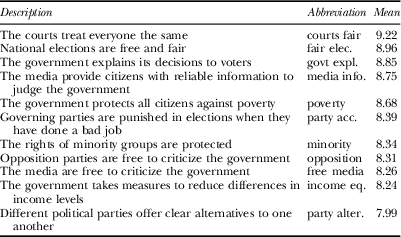
The European Social Survey (ESS) in 2012 is one of the first major comparative surveys in which respondents were asked about their expectations with regard to the ideal of democracy (ESS 2012). Data from the ESS in 2012 are a unique source of information on cross-national democratic ideals for citizens throughout Europe. The survey was conducted between 2012 and 2013 through standardized in-person interviews among representative samples of the population in 29 European countries. The 2012 wave included a special one-time module on democratic ideals in which respondents were asked how important they considered various aspects of democracy. The items included in this battery cover diverse aspects of democratic functioning ranging from free and fair elections, the protection of minority rights to protecting citizens from poverty. When we review the mean values of the items in this battery, a first striking finding is that respondents tend to consider all elements as very important (Table 1). The rule of law (expressed by the item: ‘The courts treat everyone the same’), however, is clearly considered the single most important hallmark of a democratic political system, with a score of 9.22 on the 0 to 10 scale.Footnote 1 Free and fair elections obtain an almost equally high score (8.96). It is quite notable, however, that protecting citizens from poverty also receives a high score (8.68), indicating that poverty protection is seen as an important democratic ideal. Reducing income differences receives a lower priority, but still scores higher than 8 on a scale of 0 to 10.
Average Scores on ‘Democratic Ideals’ Battery

Source: ESS (2012) (n=54,673).
Notes: Prefatory survey question: ‘Using this card, please tell me how important you think it is for democracy in general that …’. Responses coded on a 0 to 10 scale where 0 indicates ‘not at all important’ and 10 indicates ‘extremely important’.
Across Europe, citizens clearly agree with statements claiming that a democratic political system should also fight poverty, along with upholding formal and procedural political rights. Reducing poverty is not considered to be just a vague moral duty, but it is included in basic expectations of democracy.Footnote 2 These population averages show that a number of items that can be considered as intrinsic to Marshall’s definition of social citizenship are considered as highly important for democracy. In other words, social rights, on average, are not considered by European citizens to be beyond the realm of democratic politics. Rather, European citizens consider various kinds of social rights to be highly important for democracy itself.
In order to identify whether citizens hold distinctive democratic ideals in terms of the elements they consider most important, we performed a latent class analysis (LCA) that allows us to identify groups of respondents that are characterized by a similar combination of priorities. The main advantage of LCA for answering our research question is that it allows for the identification of latent structures that are not based on the separate items, but rather on how the individuals responding to the survey combine those items in distinctive patterns (Goodman Reference Goodman2007; Magidson and Vermunt Reference Magidson and Vermunt2004). Therefore it allows us to identify groups of respondents who emphasize different combinations of items as priorities (Hagenaars and McCutcheon Reference Hagenaars and McCutcheon2002). In contrast to more traditional cluster analysis, LCA allows the researcher to determine the optimal number of clusters on objective goodness of fit criteria while in cluster analysis this is usually a more arbitrary decision (Raftery Reference Raftery1995; Vermunt and Magidson Reference Vermunt and Magidson2002). In this case, an actor-centred technique like LCA is also preferable over an item-based technique like factor analysis or principal component analysis, as we are mainly interested in how (groups of) individuals make specific combinations of survey items (Collins and Lanza Reference Collins and Lanza2010). Following the identification of distinctive democratic ideals, we then use multilevel regression to investigate the individual- and country-level factors that predict respondents’ membership in latent classes.
FINDINGS
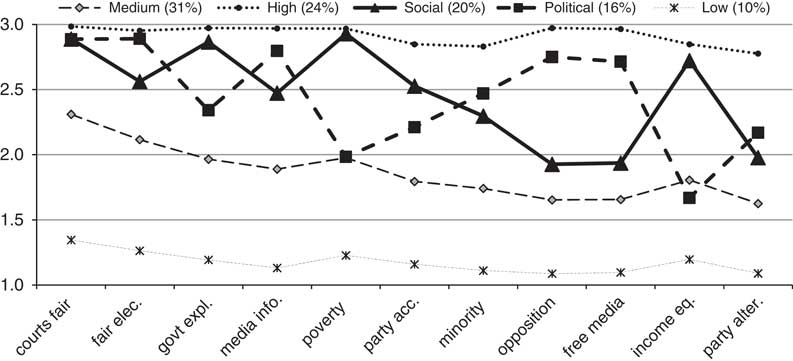
When the 11 items included in the ‘democratic ideals’ battery are analysed using latent class analysis, the goodness of fit criteria suggest that a five-class model provides the optimal fit to the data. Furthermore, this division into five groups is cross-culturally equivalent (see online AppendixFootnote 3 ). Among the five different groups of respondents that have distinctive democratic ideals, three of these groups are characterized by attributing similar levels of importance to all items and these groups, therefore, do not allow us to test directly Marshall’s theoretical distinction between political and social citizenship. The latent class labelled ‘high ideals’ (24 per cent of respondents) identifies a group of citizens who deemed all of the elements of democracy to be highly important. This group gives the maximum score to almost all of the items with no meaningful variation. Conversely, the group labelled ‘low ideals’ (10 per cent of respondents) attributed low importance to all indicators. An additional group labelled ‘medium ideals’ (31 per cent) consistently attributed moderate importance to all indicators. The uniform scores across all items for these three latent classes (high, medium or low) might suggest very general priorities, or indifference, but answering that question falls outside the scope of the current article. In sum, these findings show that almost two-thirds of the respondents (65 per cent) attribute similar levels of importance to all of the items of democratic ideals, without placing special emphasis on any particular set of items.
The two other latent classes, however, are directly relevant for our research question. The democratic ideal labelled as ‘social ideals’ (20 per cent of respondents) places high importance on economic equality (the reduction of income inequality and protection from poverty) and governmental accountability (government explaining its decisions and held accountable in elections). It can be seen that there is indeed a group of respondents that is highly motivated to emphasize social citizenship. In contrast, the ideal labelled ‘political ideals’ (16 per cent of respondents) places its emphasis on a free and fair electoral process, free media and the protection of minority rights, and these respond to the classical political rights defined by Marshall. Both these groups have clearly distinct, and to some extent even contrasting, democratic ideals, and this is visualized in Figure 1. In this figure, the five distinct groups are depicted, and for every group we show the likelihood that they consider each specific item to be highly important. Since in Figure 1 the democracy indicators are ordered on the x-axis from highest to lowest means in the general population, the contrasting emphases of these democratic ideals are visually clear in the criss-crossing of the connecting lines. The ‘social ideals’ group is likely to pay much attention to reducing poverty, while this is less of a priority for the ‘political ideals’ group.
Democratic Ideals Held by Five Groups of Citizens Source: ESS (2012) (n=54,673). Notes: Latent class analysis conditional probabilities for optimal partial equivalence model that includes country covariate and applies design weights. Y-axis: conditional probabilities that the indicator is important for democracy. Findings based on recoding of original scale: 0–7; 8–9 and 10.Footnote 4

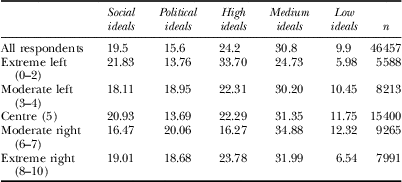
A first possible objection to the identification of these groups might be that the social ideals that are so central to one group could be seen as a specific ideological preference for more equality. Traditionally right-wing ideologies are more prone to accept economic inequality (Miller Reference Miller1999). Therefore, we should consider the possibility that the ‘social ideals’ that we identify are mainly the expression of a left-wing political ideology. The ESS questionnaire also included a left–right self-placement scale, ranging from 0 (extreme left) to 10 (extreme right). For both left- and right-wing respondents, we can identify the likelihood that they will belong to one of the latent classes (Table 2). As can be observed from the distribution, it would be wrong to consider the emphasis on social rights as merely an expression of a leftist ideology. In fact, we can observe that among the respondents who identify as right-wing, the proportion that adheres to the social ideals group is surprisingly similar to the overall mean. The relevance of this finding is that a preference to fight poverty as expressed in the social citizenship ideal is apparently not limited to left-wing respondents, but is general across the population, and as such this should be considered as a basic democracy concept, not as an ideological preference.
Left–Right Position and Democratic Ideals Typology

Source: ESS (2012).
Note: Democratic ideals based on LCA findings; left–right position based on ESS: In politics people sometimes talk of ‘left’ and ‘right’. Where would you place yourself on this scale?
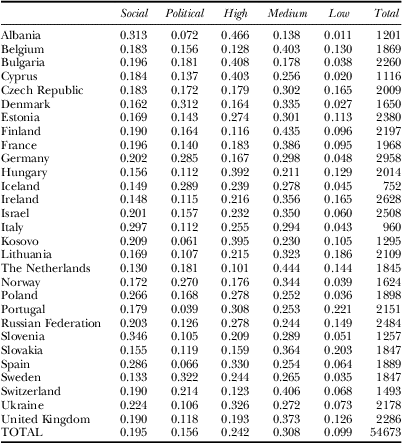
The analysis thus far has allowed us to identify distinct groups of respondents who adhere to different democratic ideals. This wave of the ESS included 29 countries, and it is important to determine how valid our findings are across these societies. We also want to ascertain to what extent the prevalence of these norms can be explained by country-level characteristics. When we compare the distribution of citizens who adhere to these distinctive ideals, we find marked differences between countries (Table 3).
Democratic Ideals, Distribution of Citizens across Countries into Five Ideals

Source: ESS (2012).
Notes: Entries are latent class analysis findings for distribution of population in each country among the five latent classes. Note that each row totals 1.0.
The social ideals group is most prevalent in Slovenia and Albania, and is least prevalent in countries such as Ireland and the Netherlands. Even in countries with the smallest proportion of the social ideals group, however, we still find 13 per cent of all respondents belong to this group. The group emphasizing political rights is largest in Denmark and Sweden, while it is only weakly represented in Portugal and Kosovo. For the high, medium and low ideals categories, we can also observe quite some variation.
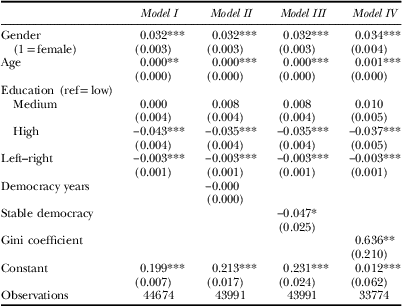
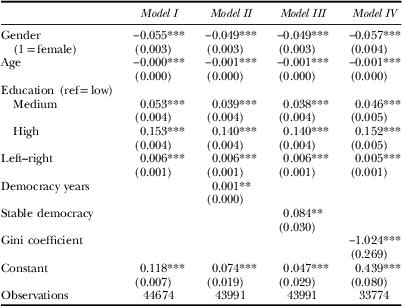
We use a multilevel linear regression to determine what kind of individual- and country-level characteristics help us to explain whether a respondent will emphasize social or political ideals. We do not report on a similar analysis for the other three latent classes, as their membership is not immediately relevant for our main research question. Among the country-level predictors, the level of inequality is of particular interest, as it might be assumed that social rights are considered as especially salient in countries with higher levels of inequality. The measure of inequality used here is the Gini index, as calculated from income surveys conducted by the Luxembourg Income Study (LIS 2015), which is available for 21 countries (Anderson and Singer Reference Anderson and Singer2008).Footnote 5
In the analysis, we include a number of control variables that are commonly used in the analysis of democratic ideals (Dalton and Welzel Reference Dalton and Welzel2014), including gender, age and education and left–right placement. At the country level, in addition to income inequality we also estimate the impact of democratic stability, as measured by the Polity IV data set (Marshall et al. Reference Marshall, Gurr and Jaggers2013). As the number of country-level observations is limited, the country-level variables are analysed one by one (see the online Appendix for descriptive statistics).
Tables 4 and 5 show that the individual-level variables generally confirm expectations. Women are more likely to adhere to social ideals, whereas men are more likely to hold political ideals. The highest level of education is negatively associated with an emphasis on social rights, whereas the relationship between political rights and education is positive. The lower-educated groups in society therefore seem especially to emphasize the role of social ideals. The effect of the left–right ideological placement is significant. As expected, there is a positive relationship between left-leaning ideology and social ideals, and between right-wing ideology and political ideals. This relationship is substantively fairly small, demonstrating that political and social ideals are by no means explained merely by the left–right ideology of the respondent.
Explaining Social Ideals

Source: ESS (2012).
Notes: Multilevel linear regression. Standard errors in parentheses. * p<0.05, **p<0.01, ***p<0.001.
Explaining Political Ideals

Source: ESS (2012).
Notes: Multilevel linear regression. Standard errors in parentheses. *p<0.05, **p<0.01, ***p<0.001.
At the country level, we measure democratic stability in two ways. First, we control for the number of democratic years. In addition, we control for stable versus weak democracies by identifying ‘weak’ democracies (lower than 8 on the Polity IV score) as countries that are not fully democratic, or have transitioned to democracy in the past 10 years. The findings in Model II show that the continuous measure of democratic years does not predict social and political ideals, whereas the measure of stable democracy in Model III does have the expected impact on democratic ideals. More stable democracies have a smaller prevalence of social ideals but a larger prevalence of political ideals. Finally, Model IV shows that even with the addition of various individual-level controls, there is a strong effect of country-level inequality measures. Higher income inequality is associated with a stronger emphasis on social rights, while lower income inequality is associated with more importance being attached to political rights. So, while we observe that there is indeed a distinction between social and political democratic ideals, it is striking that the emphasis on social ideals is most prevalent in countries that indeed are characterized by higher levels of inequality, apparently rendering the emphasis on social rights more salient.
DISCUSSION
In the literature, concern has been voiced about public reactions against the austerity politics that followed the economic crisis (Cordero and Simón Reference Cordero and Simón2016). Theoretically, this raises the question whether citizens indeed hold the political system responsible for the state of the economy and for ensuring social citizenship rights that entail redistribution. Certainly in the period following the Second World War several authors stressed the fact that democratic legitimacy cannot rest only on civil and political citizenship, but should also include the element of social citizenship by fighting poverty and by ensuring social rights to all citizens. The most seminal of these authors was T.H. Marshall, who introduced the concept of social citizenship rights. A question that thus far has been neglected in the literature is whether the distinction that was introduced by Marshall is also present among the population (Danforth and Stephens Reference Danforth and Stephens2013). The question is whether citizens indeed adhere to a broader, social definition of what democracy is. If that is the case, we can expect them to see a retrenchment of the welfare state as an attack on the heart of democracy itself. If, on the other hand, democracy is defined as merely following electoral procedures, there is no reason at all to assume that welfare state entrenchment would have a negative effect on democratic efficacy, providing of course that all the correct procedures have been followed to arrive at these decisions.
A first important research finding is that more than half of all respondents do not show a clear pattern in their priorities about what is important for a democracy. One way to interpret this finding is to observe that a large group of citizens in Europe depart from the notion that in democracy both political and social rights are equally important, as they seem to rank all items in the same manner. It is important to acknowledge, therefore, that although the theoretical literature considers there to be meaningful distinctions between social and political rights, the majority of the population makes no distinction between the relative importance of these rights. This finding could also be understood in light of previous research which suggests that concepts of democracy are not that strongly developed among the population (Zaller Reference Zaller1992). While these groups could certainly be interesting for further analysis, a conservative approach is that the methodology does not allow us to distinguish the respondents who sincerely place an equal emphasis on these rights, from those who, because of acquiescence or other motivations, tend to give all the items a similar score. Furthermore, it has to be noted that the ESS questionnaire hardly contained any references to civil rights, and in future research this should be expanded to arrive at a comprehensive test for public opinion support for the Marshall theoretical framework.
Support for social ideals was lowest in the countries that have achieved a high level of income equality. This should not be taken to imply that citizens of these countries think that equality is unimportant. Rather, the question wording suggests a further reduction in inequality. For citizens of these countries, a further reduction of income inequality does not seem to be a priority. As Marshall (Reference Marshall1964: 117) already noted: ‘We are not aiming at absolute equality. There are limits inherent in the egalitarian movement.’ This would suggest that there is a crucial distinction between political and social rights. One cannot imagine a ceiling effect for the criterion of an equal treatment before the courts. With regard to social rights, we do observe some ceiling effect as, in countries with an effective welfare state, there is less support for a further reduction in inequality. So, while the distinction introduced by Marshall clearly resonates among a substantial part of public opinion, it has to be acknowledged that it seems to be less salient for the inhabitants of countries that already have achieved a high level of income equality.
Among the groups that make a distinction between the various components of democracy, the major difference is between political and social rights. It is important to note, however, that support for social ideals is not just a leftist ideological preference as the concept can also be found among right-wing citizens. Emphasizing the fight against poverty for a large group of citizens is clearly quintessential for democracy, and this goes beyond the ideological left–right divide. This finding helps us to explain why, for a substantial part of the population, rising inequality also has an effect on the legitimacy of the democratic system itself. Even in times of neoliberal policy, therefore, there seems to be a strong form of support among the population for a more social-rights-based concept of democracy.
An important limitation of the current research is that we can offer only an analysis of cross-sectional data. The analysis does not inform us about the historical development of these concepts. As was already mentioned, the role of public opinion is almost completely neglected in the work of Marshall, who attributes the development of the modern welfare state to the activity of the state and collective actors. One could argue for some form of historical continuity, as the emphasis on reducing poverty is a strong imperative that was also already present in traditional notions of a moral economy (Thompson Reference Thompson1971). A different causal logic, however, is just as plausible. Across Europe, political systems invested heavily in the establishment of welfare state regimes during the twentieth century. This expansion of social policy is based on the notion that it is the responsibility of the state to ensure social protection to all its citizens. One might expect that the experience of more than half a century of welfare state regimes has led to the expectation that states will indeed assume responsibility for fighting poverty in economically adverse times. This welfare regime hypothesis assumes that, because of the experience with redistribution regimes, public opinion has developed specific notions of fairness and social justice (Jæger Reference Jæger2006). As we only have access to cross-sectional data, the current analysis does not allow us to make any statements on the direction of causality, but at least we can demonstrate that this notion of ‘social citizenship’ is present among the public opinion of European countries.
The findings in this article allow us to understand why the stakes are so high in the current protest against the politics of austerity. The retrenchment of the welfare state runs counter to some fundamental expectations with regard to the role of the state in fighting poverty, and the concept of democracy as a project to ensure social rights. As this expectation has become part of fundamental ideas on what democracy is all about, one can expect that protest against the politics of austerity will remain vibrant. Norms about redistribution are not just a matter of left–right political ideology; they reflect fundamental differences in concepts of democracy.
ACKNOWLEDGEMENTS
The authors would like to thank the anonymous reviewers of this journal for their very informative suggestions on the work of T.H. Marshall. We also acknowledge financial support from the European Research Council; ERC Advanced Grant 295920, ‘Democratic Linkage’.
Supplementary materials
To view the supplementary material for this article, please go to: https://doi.org/10.1017/gov.2017.11