Introduction
The genus Eriocaulon L. (Eriocaulaceae), with about 400 species (Mabberley, Reference Mabberley2008), is distributed in tropical and subtropical regions of the world. Ansari & Balakrishnan (Reference Ansari and Balakrishnan2009), in a revised edition of their 1994 book, reported 85 species in India. This list, however, does not include species described earlier by Bole & Almeida (Reference Bole and Almeida1986) and Yadav et al. (Reference Yadav, Potdar, Kumar, Otaghvari and Sonkar2008) and species recorded by Myrthong et al. (Reference Myrthong, Kumar and Rao1983). Since then, 11 more species have been described from peninsular India, namely Eriocaulon baramaticum Shimpale et al., E. belgaumensis Shimpale & S.R.Yadav, E. cheemenianum P.Biju et al., E. epedunculatum Potdar et al., E. gopalakrishnanum K.Rashmi & G.Krishnakumar, E. kannurense Sunil et al., E. madayiparense Swapna et al., E. malabaricum Pradeep & Nampy, E. pykarense Nampy & Manudev, E. vandaanamense Sunil et al. and E. wyanadense Vivek et al. (Shimpale et al., Reference Shimpale, Bhagat, Deshmukh and Yadav2009; Shimpale & Yadav, Reference Shimpale and Yadav2010; Vivek et al., Reference Vivek, Swapna and Suresh2010; Nampy et al., Reference Nampy, Manudev and Pradeep2011; Biju et al., Reference Biju, Subrahmanya Prasad, Ajith Kumar, Augustine, Raveendran and Ansari2012; Swapna et al., Reference Swapna, Rajesh, Manju and Prakashkumar2012; Sunil et al., Reference Sunil, Ratheesh Narayanan, Nandakumar, Sujana, Jayesh and Anil Kumar2013, Reference Sunil, Ratheesh Narayanan, Sivadasan, Alfarhan and Abdul Jaleel2014; Rashmi & Krishnakumar, Reference Rashmi and Krishnakumar2014).
During a recent scientific survey in the southern Western Ghats, India, material of this genus was collected by the authors that on critical examination was revealed to be a new species, which is described and illustrated here.
Species Description
Eriocaulon biappendiculatum Manudev, Robi & Nampy, sp. nov.
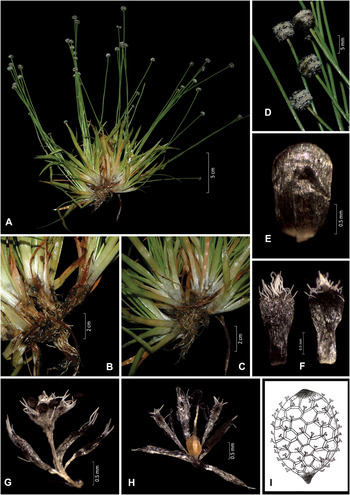
Eriocaulon biappendiculatum is close to Eriocaulon nairii Chandrab. & V.Chandras., but differs in having 5–17 peduncles, free male sepals and seeds with continuous ribbon-like and setiform appendages. – Type: India, Kerala, Idukki district, Kurinji valley, way to Pachakkad from KFDC base camp, Silent Valley, Munnar, c.1600 m, 15 xii 2012, Manudev & Robi 4364 (holo CALI!; iso CAL!, MH!). Fig. 1.
Eriocaulon biappendiculatum Manudev, Robi & Nampy. A, habit; B & C, tufted bases; D, heads – enlarged view; E, involucral bract; F, floral bracts – dorsal and ventral views; G, male flower; H, female flower; I, seed – notice the ribbon-like and setiform appendages. All from the holotype.

Tufted caulescent herbs; stems to 4 cm long. Rootstock absent. Leaves cauline, many, linear-oblong, 6–11 × 0.3–0.4 cm, entire, glabrous. Peduncles 5–17, slender, 7–13 cm long, glabrous; sheaths to 7 cm long, glabrous. Heads globose or cylindrical, 4–6 × 5–6 mm, white. Receptacles cylindrical, pilose. Involucral bracts oblong, c.1.7 × 0.8–1 mm, obtuse, glabrous, incurved. Floral bracts oblanceolate, c.2 × 0.5–0.8 mm, acuminate, hoary dorsally towards apex, black. Male flowers: Pedicels c.0.5 mm long. Sepals 3, free, subequal, oblong, 1.17–1.46 × 0.17–0.26 mm, hoary at apex, pale. Petals subequal, oblong, c.0.5 × 0.18–0.22 mm, hoary with a black gland. Anthers 6, black. Female flowers: Pedicels c.0.2 mm long. Sepals 3, free, subequal, oblong-oblanceolate, 1.5–1.7 × 0.17–0.25 mm, not keeled, pilose, hoary towards apex, pale. Petals 3, free, subequal, spathulate, c.1.75 × 0.15–0.38 mm, pilose, hoary with a black gland. Ovary sessile, c.0.6 × 0.5 mm; style 3-fid. Seeds ovoid, obtuse, pale yellow to brownish, apiculate; cells of seed coat isodiametric, not in any specific rows; appendages in the form of both continuous ribbon-like bands arising from the walls, and solitary seta arising from the angles of the cells, bifid at apex.
Distribution. Endemic to Kerala, hitherto known only from the type locality.
Habitat and ecology. In marshes near streams, growing in tufts.
Flowering and fruiting. December, probably from the onset of the monsoon.
Etymology. The specific epithet ‘biappendiculatum’ refers to the presence of both ribbon-like and setiform appendages on the seeds.
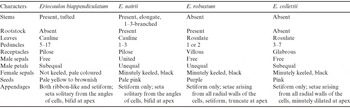
Notes. Ansari & Balakrishnan (Reference Ansari and Balakrishnan2009) in their revision of Eriocaulaceae recognised 12 informal sections to accommodate the Indian species. The present species falls into Section VIII which is characterised by free female sepals, narrow hyaline petals, black or dark brown anthers and isodiametric seed coat cells. This section consists of three species in India, namely Eriocaulon nairii Chandrab. & V.Chandras., E. robustum Steud. and E. collettii Hook.f. Among them, the former two are endemic to peninsular India while the latter occurs in Meghalaya and Myanmar (Naik, Reference Naik1974). Eriocaulon biappendiculatum is distinct from all the above species in having both continuous ribbon-like and setiform appendages on the seeds. A detailed morphological comparison of the allied species is given in Table 1.
Comparison of Eriocaulon biappendiculatum with its related species

Acknowledgements
The authors are grateful to the Head, Department of Botany, Calicut University and the Director, Kerala Forest Research Institute (KFRI) for facilities, and to Kerala Forest Development Corporation Limited and Department of Forests, Government of Kerala for permission. K.M.M. is grateful to the University Grants Commission for a Senior Research Fellowship and S.N. is grateful to the Department of Science and Technology, New Delhi (F. No. SERB/SR/SO/PS/09/2012) for financial assistance.