Introduction
English-speaking preschool children with specific language impairment (SLI) have an extraordinary deficit in the use of verb-related morphology in conversational speech (Rice, Wexler & Herschberger, Reference Rice, Wexler and Herschberger1998). Although the use of verb morphology does improve as these children get older (Goffman & Leonard, Reference Goffman and Leonard2000), the difficulties with tense and agreement morphemes are persistent and can be observed when children are placed in demanding circumstances. For instance, school-age children with SLI are less likely to use past tense in two-clause sentences than their typically developing age-matched peers (Owen & Leonard, Reference Owen and Leonard2006; Owen, Reference Owen2010). In fact, even as late as adolescence, individuals with SLI appear to be less sensitive to the omission or intrusion of tense related morphemes in sentence processing tasks than age matched peers (Leonard, Miller & Finneran, Reference Leonard, Miller and Finneran2009). The source of these difficulties has been hotly debated and hypotheses range from a specific deficit in the knowledge that tense marking is obligatory (Wexler, Reference Wexler1998) to impaired general processing (Miller, Kail, Leonard & Tomblin, Reference Miller, Kail, Leonard and Tomblin2001) or difficulty with the acquisition of a language's morphological paradigm (Leonard, Reference Leonard1989). In simple sentences, the primary errors observed are omissions. Hypotheses have been constructed based on the idea that children with SLI have difficulty controlling the use of tense and agreement morphemes. However, the majority of the studies, including my own work on complex syntax, have focused on tense provision/omission as the primary dependent measure and little attention has been given to the accuracy of these morphemes when they are used.
Recent work has focused on whether children with SLI take advantage of the same aspectual cues that typical children use to scaffold use of verb morphology (Johnson & Morris, Reference Johnson and Morris2007; Leonard et al., Reference Leonard, Deevy, Kurtz, Krantz Chorev, Owen and Polite2007; Leonard & Deevy, Reference Leonard and Deevy2009). Although verb morphology is typically thought of as reflecting tense, or how an event is situated relative to the time of speaking, these morphemes also express aspect, or the nature of time within the event.
Typical children seem sensitive to the fact that certain forms of tense and aspect tend to co-occur, leading to one morpheme expressing both tense and aspect information simultaneously. For instance the simple past (-ed) form is often used to describe completed events, leading to the conflation of past tense with telic (completed) events, even though it is possible to describe atelic (continuous/incomplete) events in the past (Bloom, Lifter & Hafitz, Reference Bloom, Lifter and Hafitz1980; Shirai & Andersen, Reference Shirai and Andersen1995). Children with SLI seem less sensitive to these co-occurrences, leading to the hypothesis that these children have difficulty ‘cracking into’ the tense system because they do not accurately represent the event properties associated with aspect or do not track the co-occurrence of tense and aspect (Leonard et al., Reference Leonard, Deevy, Kurtz, Krantz Chorev, Owen and Polite2007).
Although commission errors, such as they jumps, are generally unattested in both typical children and children with SLI, commission errors associated with control of aspect are largely unexamined. In the study that follows, the data from Owen (Reference Owen2010) are re-analyzed to address the question of whether children with SLI can maintain control of temporal information in two-clause sentences. Previous analyses of this data have shown that these children omit tense more often in sentences that contain temporal adverbial clauses and complement clauses than in coordinated sentences. Furthermore, the position of the clause interacts with the type of sentence. In temporal adverbial sentences, tense omission is more common in the first clause, and in complement sentences tense omission is more common in the second clause. These results suggest that it is possible that the relationship between the first and second clause is critical for determining how and when tense is used by children with SLI and their typically developing peers. In two-clause sentences, syntactic context interacts with the event properties and/or discourse context to determine the grammatical use of tense and aspect – event properties alone are not sufficient (Hornstein, Reference Hornstein1990). This study reanalyzes the data from Owen (Reference Owen2010) in order to report on the use of tense and aspect by school-age children with SLI and their typically developing peers. Those sentences in which children produced two overt tense markers are examined to determine whether these children eventually become sensitive to the syntactic restrictions on the use of tense and aspect in two-clause sentences. In what follows we review the properties of tense/aspect marking in different sentence types and then consider what is known about the use of these morphological forms in the language of typical children and children with language impairment.
Coordination of tense and aspect
When an utterance involves more than one clause, there are two events taking place that are related to each other in time. Therefore, the speaker must coordinate the use of tense and aspect across the clauses, taking into account both the discourse context and the syntactic frame. Consider the four sentences shown below:
(A) same tense/same aspect: Ernie jumped and Elmo smiled.
(B) same tense/different aspect: Ernie jumped and Elmo was smiling.
(C) different tense/same aspect: Ernie jumped and Elmo smiles.
(D) different tense/different aspect: Ernie jumped and Elmo is smiling.
Clauses joined by the conjunction and tend to describe two events of equal importance. These sentences are most felicitous when both tense and aspect agree (A) (Quirk, Greenbaum, Leech & Svartvik, Reference Quirk, Greenbaum, Leech and Svartvik1985, p. 947). It should be noted that felicitousness is somewhat different than grammaticality. Felicitousness refers to the acceptability of the sentence and is a more graded judgment than grammaticality. Thus we see that the first sentence is intuitively more acceptable than the other three because tense and aspect match exactly across the two clauses. Coordinated sentences in which two clauses differ on aspect (B) are less felicitous, but not especially problematic, particularly if the discourse context denotes a punctual event and an ongoing event. Two clauses that differ on tense (C) require contextual support or the addition of temporal information to be felicitous. Sentences in which tense and aspect are incongruent (D) are even less acceptable in the absence of discourse support or the addition of overt temporal information (e.g. yesterday, now). That is, they are relatively infelicitous or are less natural and require more mental effort to construct a situation in which the sentence makes sense. However, they are not ungrammatical as it is possible to construct a situation in which the sentence becomes acceptable.
Sentences linked by temporal conjunctions allow for more flexibility in the types of scenarios associated with the use of tense and aspect. Consider the same four categories with when as the conjunction:
(E) same tense/same aspect: Ernie jumped when Elmo smiled.
(F) same tense/different aspect: Ernie jumped when Elmo was smiling.
(G) different tense/same aspect: Ernie jumped when Elmo smiles.
(H) different tense/different aspect: Ernie jumped when Elmo is smiling.
In this case, sentences that match on tense are patently acceptable, regardless of the way aspect is expressed, in large part because when allows for the expression of an ongoing or iterative event that is interrupted by another event (E and F). Like the coordinated examples, sentences that differ on tense seem to sit along a continuum of acceptability, with (G) being easier to construe as acceptable than (H), but neither being particularly felicitous and both requiring additional information in order to construe these sentences as felicitous.
Sentences that take a complement clause as the second clause are quite open with regard to the types of tense and aspect combinations that are permissible.
(I) same tense/same aspect: Ernie knew that Elmo smiled.
(J) same tense/different aspect: Ernie knew that Elmo was smiling.
(K) different tense/same aspect: Ernie knew that Elmo smiles.
(L) different tense/different aspect: Ernie knew that Elmo is smiling.
Limitations are related to the permissibility of the events and the ways that the syntax maps onto event structure, and are not as strictly related to the syntactic form itself. For instance, it is infelicitous to say is knowing because of the properties of know as a stative verb, not because of the syntactic properties of complement-taking verbs in general (consider: is/was guessing). Likewise, it is problematic to say the example sentence shown in (L) because it is impossible to know something that has not yet happened (e.g. smiles in the present). However, if these are reversed (e.g. Ernie knows that Elmo was smiling), the example is much more acceptable.
In the absence of a clear discourse context or the presence of temporal adverbs, the use of tense and aspect can be evaluated in a limited way based on the syntactic context available. That is, the use of tense and aspect in the second clause can be compared to that of the first clause and judged to be generally felicitous or not for temporal adverbial and coordinate sentences. Similar conclusions are possible with complement clause sentences. However, unlike the temporal adverbial and coordinate sentences in which general conclusions can be drawn regardless of the verbs chosen, the particular complement-taking verbs employed in the main clause and the ordering of event time between the events in the main and complement clauses are much more critical. For this reason the focus of this article is on the temporal adverbial and coordinate sentences.
Development of tense and aspect
Typical children go through an early period of variable use of tense and agreement; however, they achieve and maintain high levels of accuracy much more rapidly than do children with SLI (Rice, Wexler & Herschberger, Reference Rice, Wexler and Herschberger1998). In particular, typical children appear to have access to aspectual information very early and to use this information, among other cues, to support their acquisition of tense. The Aspect before Tense hypothesis (Aksu, Reference Aksu1978) suggests that children's attention to the event structure and the inherent aspectual properties of a verb scaffolds their acquisition of the tense system. For instance, Bloom et al. (Reference Bloom, Lifter and Hafitz1980) found that children in the two-word stage tended to use the simple past tense form first with verbs expressing achievements (e.g. fall, break) and the progressive participle first with activities (e.g. run, color). This correlation between form and event structure reflects the input children receive from their parents (Shirai & Andersen, Reference Shirai and Andersen1995) and is robust cross-linguistically even in typologically distinct languages (e.g. Italian: Antinucci & Miller, Reference Antinucci and Miller1976; Polish: Weist, Wysocka, Witkowska-Stadnik, Buczowska & Konieczna, Reference Weist, Wysocka, Witkowska-Stadnik, Buczowska and Konieczna1984).
The hypothesis that typical children interpret verb morphemes as indicating aspect rather than tense was supported by a language comprehension study by Wagner (Reference Wagner2001). In one experiment, children watched a character act out events, such as filling a container with beads, at three points on a path. At the first point, the activity was clearly completed; at the second, the action was in progress; and at the third, the action had not yet begun. Children were asked to show the experimenter where the character was filling, is filling or will be filling the container. A second experiment again had a character act out multiple events, but this time the actions were either completed or incomplete in the past or incomplete in the present and children responded to filled, was filling or is filling. These experiments demonstrated that three- and four-year-olds were able to accurately link complete and incomplete actions to simple past, past progressive and present progressive statements. However, two-year-olds responded to the progressive requests as if they all referred to incomplete actions without regard for the tense marker in the utterance. Similarly, Valian (Reference Valian2006) found that two-year-olds can distinguish between past/non-past events in comprehension only when progressive markers are not included in the sentence. By three, typical children have acquired these contrasts and can also make use of adverbs to further facilitate comprehension.
Unlike typical children, preschool children with SLI are not sensitive to the relationship between tense and aspect, as is evident in both production and comprehension tasks (Leonard et al., Reference Leonard, Deevy, Kurtz, Krantz Chorev, Owen and Polite2007; Leonard & Deevy, Reference Leonard and Deevy2009). Whereas typical peers were more likely to produce simple past forms with verbs that were inherently telic (e.g. fall) than with those that were atelic (e.g. color), children with SLI were equally likely to use the simple past with both types of verbs (Leonard et al., Reference Leonard, Deevy, Kurtz, Krantz Chorev, Owen and Polite2007). Likewise, in a comprehension task designed to test aspect and tense, children with SLI relied less on the completion cues in the actions than their typical peers (Leonard & Deevy, Reference Leonard and Deevy2009; following Wagner, Reference Wagner2001). Insensitivity to the correlations between events and morphological form may impair their acquisition of verb-related morphemes (Leonard et al., Reference Leonard, Deevy, Kurtz, Krantz Chorev, Owen and Polite2007).
Are children with SLI sensitive to the ways that temporal information is used when more than one time marker is present? A better understanding of how these children handle temporal markers in two-clause sentences would shed light on whether they have difficulty with temporal information in general, with verb paradigm building specifically or with other aspects of grammar.
Although the use of verb morphology has been extensively studied in SLI, there is more limited information available about the use of temporal information when more than one time marker is present. Krantz & Leonard (Reference Krantz and Leonard2007) showed that children with SLI and their younger MLU matched peers were less likely to use past tense markers when an adverb like just or already was present in the sentence than when the adverb was absent. They speculated that young children and children with language impairment may only allow one temporal marker per sentence, and thus, once temporal information was produced with the adverb, they did not include such redundant information on the verb. The presence of an adverb had no influence on the use of tense by typical age-matched children, suggesting that typical children master the use of multiple time markers by the age of six, at least in simple sentences. Paradis & Crago (Reference Paradis and Crago2000) showed that French-speaking children with SLI were highly accurate with the use of adverbs, but were less accurate with tense markers, when both markers occurred in the same sentence, corroborating the findings of Krantz & Leonard (Reference Krantz and Leonard2007) that the weakness is realized in morphological rather than lexical items.
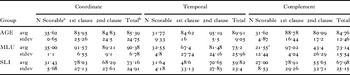
Taking a different approach, Owen (Reference Owen2010) found that school-age children with SLI were more likely to omit tense markers than their age- and MLU-matched peers in sentences consisting of two finite clauses. This general finding is consistent with previous studies. The novel contribution of the article with regard to SLI was that the pattern of omissions varied by sentence type. Two-clause sentences were elicited under three conditions: simple coordinated sentences (like (A) above), temporal adverbial sentences (E) and complement clause sentences (I). A summary of the results from Owen (Reference Owen2010) is shown in Table 1. Within each group, children generally produced past tense markers at the same rate in the first clause as in the second clause of coordinated sentences, with the age-matched group producing the most tense markers, followed by the MLU-matched group and then the SLI group. In sentences that employed a temporal adverbial clause, children were more likely to omit a past tense marker in the first clause than in the second clause, and this was particularly true for the SLI group. Conversely, complement clause constructions caused more tense omissions in the second clause than in the first, but the MLU-matched group was the least accurate group. The complement clause condition also led to the lowest rate of production of scorable (two-clause) utterances, particularly for the MLU-matched group. One possible explanation for the opposing patterns of omission locations across temporal adverbial and complement clause constructions has to do with the type of clause being employed. That is, while all children have increased difficulty using tense appropriately when the processing load increases, the adverbial clause functioned much as an adverb did in the Krantz and Leonard study, leading to a different source of difficulty in this sentence type.
The average number of scorable (two-clause) responses and percentage correct use of past tense for each group and syntactic condition in Owen (Reference Owen2010)

a The mean number of scorable (two-clause) responses for each child from Owen (Reference Owen2010)is given. Fewer utterances qualified as scorable in this article due to the need to have overtly marked tense and agreement in both clauses.
b The average percentage correct use of past tense included the use of simple past, over-regularizations and the use of past progressive forms. Present tense forms were considered incorrect for the analyses in Owen (Reference Owen2010)but were treated as codable here.
c It is worth noting that the MLU-matched group produced many fewer scorable complement clause responses as compared to the other two groups and was also much less accurate in the second clause of this condition.
To summarize, typical children experience an early development of temporal markers. Initially supported by the event structure and aspectual properties of the verb, children rapidly become proficient at using multiple markers to indicate both tense and aspect. In contrast, children with SLI have difficulty with many elements associated with temporal marking. Not only do these children omit the verb morphemes more often, they also are less sensitive to the aspectual cues that support tense acquisition. The difficulties that these children have when more than one source of temporal information is present is further evidence of their difficulties with marking time.
Whereas previous studies have examined the interaction between verb morphology and adverbs using omissions as the primary dependent measure, this study examined the relationship between the use of two verb markers in a sentence when they are both overtly realized. By more closely examining the productions that do contain overt tense and aspect information, we can ask whether these children are as sensitive as their typically developing peers to the restrictions on the way that tense and aspect are used with different sentence types. Such information will further our understanding of how these children communicate temporal information. Based on prior evidence that children with SLI are less sensitive to the relationship between tense and aspect, we would predict that these children would also fail to distinguish between coordinated and temporal adverbial clauses with regard to the use of time information and that they would be more likely than their typical peers to produce tense and aspect mismatches (types B–D; F–H) within a sentence that contains more than one clause. Because sentences with complement clauses (examples I–L) are more dependent on the particular verbs employed and the ordering of tense within the clauses, it is difficult to interpret the patterns that might be observed even in adult language. Nonetheless, one might expect to observe less control of tense and aspect marking on the part of children with SLI if the hypothesis that the problem is one of understanding when and how to produce temporal information. On the other hand, if children with SLI are sensitive to the restrictions on the use of tense and aspect, one might assume that the problem is one of automaticity, feature checking or realization in the moment according the theoretical account one choose to adopt.
Methods
Participants and dataset
The data and participants reported in this article are drawn from the dataset reported in Owen (Reference Owen2010). Data collection was completed in accordance with the ethical guidelines for human subjects research as described in the Belmont report and required by the National Institutes of Health and the Internal Review Board at the University of Iowa.
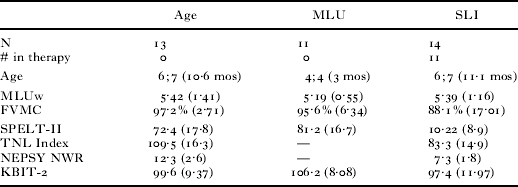
Fourteen children with SLI (5 ; 0–8 ; 1) and 24 typically-developing (TD) children participated in this study. The TD children were divided into two groups: 13 of the TD children were matched within three months of age to a child with SLI (t(26)=0·04 p=0·97); 11 of the TD children were four-year-olds who were matched within 5 raw score points on the Expressive Vocabulary Test (EVT: Williams, Reference Williams1997; (t(24)=0·42, p=0·68) and within 0·35 words on mean length of utterance (MLU) in a 100-utterance language sample to a child with SLI (t(24)=0·46, p=0·65). Being matched on both expressive vocabulary and MLU to the SLI group, the younger group provided a strong control for general language production abilities. The children with SLI scored below the typical range on a language test (below the 10th percentile on the SPELT-II (Werner & Kresheck, Reference Werner and Kresheck1974), a standard score less than 7 on the NEPSY-NWR subtest (Korkman, Kirk & Kemp, Reference Korkman, Kirk and Kemp1998) or a composite score less than 80 on the TNL (Gillam & Pearson, Reference Gillam and Pearson2004), and/or being enrolled in therapy for speech, language or reading deficits in the previous twelve months. All children with SLI (and all age-matched children) received all three assessments; qualification criteria varied given the mixed evidence in the literature on which measures are most sensitive to SLI (see Owen (Reference Owen2010) for justification of each measure). The typical children performed at or above the 16th percentile/85 standard score on all of the above measures. Table 2 shows the mean scores obtained by each group of children on each measure.
Demographic information about participants
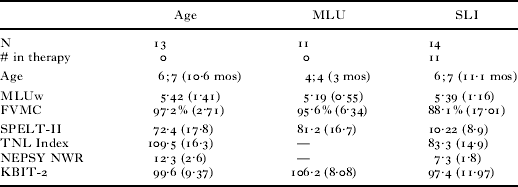
Note: The total children included from each group are listed as well as the number of children enrolled in therapy. MLUw is the average mean length of utterance in words from a conversational language sample. Finite Verb Morphology Composite (FVMC) is the percentage correct in obligatory contexts of am, is, are, regular past -ed and third person singular-s computed from the same language sample. The SPELT-II scores are reported in percentiles (average range 16–84). The Test of Narrative Language (TNL) and Kaufman Basic Intelligence 2nd edition, Matrices Subtest (KBIT-2) are reported as standard scores with a mean of 100 and SD of 15. The NEPSY Nonword Repetition (NWR) subtest has a mean of 10 and SD of 3. Standard deviations are reported in parentheses following means where this information is relevant. With the exception of the MLU-matched group, who were not administered the TNL or the NEPSY NWR, all children received all tests. The MLU group was not given these two tests because the normative data did not extend below age 5 ; 0 on these assessments.
All children met the conventional criteria for participation in a study on SLI. Each child passed a hearing screening and obtained a standard score above 83 on the Kaufman Brief Intelligence Test – II, Matrices subtest (Kaufman & Kaufman, Reference Kaufman and Kaufman2004). According to parental reports, no child had a history of frank neurological impairment or a previous diagnosis of autism or pervasive developmental disorder.
Stimuli
Stimuli used in Owen (Reference Owen2010) were three sentence types: two coordinated clauses (e.g. Ernie hopped and Elmo kicked the ball), a main clause and a temporal clause (e.g. The aliens whistled when Minnie kicked the ball) and a main clause and a complement clause (e.g. Ratty guessed that Elmo kicked the ball). Thirty-six items were constructed for each sentence type. Stimuli will be briefly described below.
All sentences consisted of a main clause made up of a subject and a verb followed by another finite clause. The first clause always involved a regular intransitive verb. The verbs used in the second clause were a mix of transitive (1/3) and intransitive (2/3) verbs. Both regular (1/2) and irregular (1/2) verbs were employed, such that there were six transitive regular verbs, six transitive irregular verbs, twelve intransitive regular verbs and twelve intransitive irregular verbs employed. The thirty-six verbs used in the first clause of the coordinate and temporal adverbial sentence types were identical and the thirty-six verbs used in the second clause were identical for all three conditions.Footnote 1 The verbs used in the first clause of the complement condition were necessarily different from the other two sentence types and consisted of ten verbs that were mental or communication verbs familiar to children. Eight of these ten verbs were each repeated three times and two of the verbs were used six times. A full list of verbs and frequency information based on CHILDES input is reported in Owen (Reference Owen2010).
Procedures
For each sentence type, children watched a short live puppet show enactment modeled after Redmond & Rice (Reference Redmond and Rice2001) and then a question prompt was posed. The experimenter provided the first word of the first clause and encouraged the child to complete the rest of the sentence. For instance, to elicit Frog stamped and Piglet hugged her doll in the coordinate condition, the following enactment would occur:
E1: Frog wants to stamp his paper.
E1 manipulates Frog: Watch me stamp!
E1: Piglet wants to hug someone.
E1 manipulates Piglet: Should I hug my duck or my doll? (child chooses and e1 acts out)
E2: I didn't see. Could you tell me about the show?
E1 prompts the child using a leading intonation: I'll help … Frog …
The temporal and coordinate conditions were highly similar. The key difference was the question asked by the second experimenter. In the temporal condition, instead of asking the child to tell her about the show, the experimenter would instead say When did the aliens stamp? The experimenter still began the sentence for the child with The aliens …, making it obligatory for the child to respond with The aliens stamped when piglet hugged her doll.
The complement clause condition was necessarily elicited differently so that the use of mental and communication verbs would be appropriate. Children were introduced to Ratty, a puppet who was afraid to watch the puppet shows and to talk to adults and to three characters who each did three different actions. The experimenter acted out three shows behind a curtain and then asked Ratty to describe what had happened to the child for each of the three shows. This was repeated twelve times such that thirty-six items were elicited in total.
E1: There are three people in this story: Shrek, Genie, and Zebra. One of them is going to hug someone, one of them is going to fall, and one of them is going to play with a friend. (E1 closes curtain/makes it clear that Ratty isn't watching.) Show's over!
(Target: Ratty guessed (that) Shrek hugged someone.)
E1: And now Ratty has to guess who did each thing. So, there was ‘hug someone’, right? Let's see what Ratty guessed.
E2 (makes Ratty whisper to the child:) Shrek
E1: What did Ratty guess?
E2: Ratty …
All of the target items were designed to be most felicitous in simple past tense and the actions were clearly over before a response was solicited from the child. However, the aspectual properties of the enactments of the elicitation scenarios (duration, iterativity) were not carefully controlled.
If a child did not respond or provided an incomplete response (e.g. a simple sentence, only the second clause or only a noun), the examiner first prompted by asking the child to say the whole sentence. If the child still did not produce a full response, the examiner provided the first clause of the sentence and asked the child to complete the second clause so that the child would remain engaged in the activity. The examiner's prompts always used the simple past tense form of the verb.
Presentation was blocked by sentence type to encourage children to use the target sentence types. The order of presentation of the lists was counterbalanced. In general, all items from a list were administered in one visit; however, lists could be broken in half to accommodate fatigue or inattention on the part of the child.
Analysis and reliability
The experimenters recorded spoken responses at the time of administering the task. All responses were also audio-recorded and transcribed, using the on-line written record as a guide. Responses were coded for the number of clauses in the response and type of morphological marking on the verb in each clause (simple past, past progressive, simple present, present progressive, omitted, other). Transcription reliability was 90% for word by word reliability (range 75–100%) and 93% for tense marking (range 81–100%). Coding reliability was above 97% for all relevant coding, with the exception of determining two-clause responses in the complement condition. These discrepancies were resolved by consensus coding as reported in Owen (Reference Owen2010).
Data reduction
Only two-clause responses were retained for analysis. This resulted in the loss of 116 responses from the coordinate condition (8% of the 1368 possible responses), 159 responses from the temporal condition (12% of responses) and 421 responses from the complement condition (31% of responses). This rate of production of one-clause sentences is consistent with previous work on complex syntax using elicited production paradigms with children between preschool and early school age (Donaldson, Reid & Murray, Reference Donaldson, Reid and Murray2007; Eisenberg, Reference Eisenberg2003; Marinellie, Reference Marinellie2004).
In addition, bare stem responses were not considered because it was not possible to evaluate tense concord when tense was not overtly marked. Dropping the responses that contained one or more bare stems resulted in the exclusion of 195 responses from the coordinate condition (14% of all possible responses), 380 responses from the temporal condition (27% of all possible responses) and 329 responses from the complement condition (24% of all possible responses).Footnote 2 In the coordinate and temporal conditions the data loss was relatively evenly distributed across groups, with 230, 264 and 335 of the temporal adverbials responses and 307, 333 and 416 of the coordinate responses being scorable for this study for the SLI-, MLU- and AGE-matched groups respectively. As would be expected, the rate of data loss was higher as language abilities declined. The rate of data loss in the complement clause condition was especially concentrated within the MLU-matched group (98 scorable items) and SLI group (211 scorable items), such that further analysis of this condition will only be undertaken descriptively.
Response coding for tense and aspect concordance
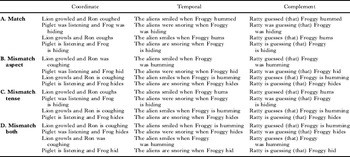
The 1057 scorable responses in the coordinate condition, 829 scorable responses in the temporal condition and 618 scorable responses in the complement condition were coded as being in one of the four categories shown in Table 3, which also shows examples of possible responses and how each response type would have been categorized. Responses were categorized with regard to how the child's productions of tense and aspect in the second clause compared to his or her productions of tense and aspect in the first clause, rather than in comparison to the discourse context. Bearing in mind that it can be grammatical for aspect to differ across clauses, we refer to cases in which tense in clause 1 was not identical to tense in clause 2 as tense mismatches and any cases in which aspect was not identical as aspect mismatches, to avoid the implication that these are errors.
Sample sentences from each condition as they would be coded with regard to mismatches on tense and aspect

Results
Table 4 shows the total number of responses coded as belonging to each one of these categories described in Table 3. Approximately 15% of the coordinate responses, 25% of the temporal responses and 16% of the complement responses contained clauses that did not match exactly on both tense and aspect. It is worth noting at this point that, overwhelmingly, children either responded to the target stimuli with responses that matched on both tense and aspect or with responses that omitted at least one tense/aspect marker. Thus, the rate of mismatches was much lower than the rate of omissions or the rate of completely matching responses.
Number of responses that could be considered to match or mismatch on tense and aspect marking divided by elicitation condition

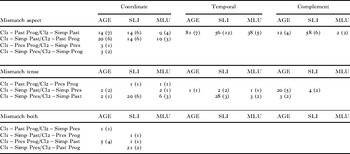
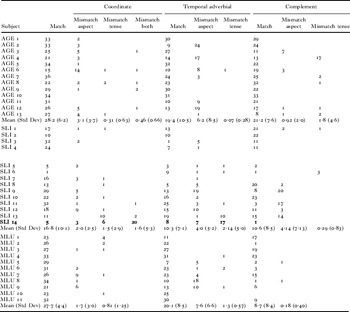
Before turning to statistical comparison, a brief summary of the types of mismatches is provided in Table 5 and the number of mismatches for each child is shown in Table 6. Three things are worth specifically highlighting. First, while nearly every possible combination of responses is attested by at least one child, many combinations were produced by very few children. For instance, mismatches of aspect only are observed in several children in every group (between four and twelve children per group) and across all three conditions. In contrast, mismatches of tense and aspect combined are exclusive to the coordinate condition and produced by very few children (between one and four children per group, with the highest number coming from the age-matched group). In combination with Table 6, which shows the number of responses fitting each category type for each child, Table 5 is meant to illustrate how systematic the children's responses were. Similar comparisons can be undertaken for the patterns of individual children within each group. For instance, the specific children Age-2 and Age-4 produce between half and two-thirds of their responses in the Temporal Adverbial condition with mixed aspectual marking. A similar pattern is observed for SLI-9 and MLU-8, indicating that this is a case of individual differences, rather than one of impairment.
Number of responses (and number of children contributing responses) that fit each combination of tense/aspect marking

Note: Cl1=the tense/aspect marking in clause 1; Cl2=the tense/aspect marking in clause 2. In addition to the combinations shown above, one child produced one future tense response in the second clause of a coordinate condition, with a past progressive form in the first clause. Empty cells and combinations not shown above were unattested responses.
The frequency of producing each category of response for each sentence type, for each subject. Means (and standard deviations) are shown below each group's responses

Note: Empty cells indicate that there were no observed cases of that type of response for that particular child. Mismatches for both tense and aspect were only observed in the coordinate condition.
Second, most of the mismatches include some form of past (past tense or past progressive) in at least one clause, which is consistent with the elicitation method. Thus it is unsurprising that there are few aspect mismatches that include present tense. Likewise, given that the examiner exclusively modeled simple past, it is not surprising that few tense mismatches using the present and past progressive occurred.
Finally, Table 5 makes it appear as if there is a very high rate of use of simple present in the first clause of the coordinate and temporal adverbial conditions by children with SLI. However, comparison with Table 6 shows that this is generally attributable to a few children (specifically SLI-13 and SLI-14), rather than typical of the profile of the entire group.
Statistical comparisons were used to confirm that there were more aspect mismatches than tense mismatches, and that this was especially true for the Temporal Adverbial Condition. Analyses were computed using percentages of responses that the children produced that fell into each category, with the total number of possible responses (that is, two-clause responses with overtly marked tense and agreement) used as the denominator. Mismatches involving tense in any fashion (Categories C and D in Table 3) were combined for the purposes of statistical comparison, given the theoretical interest in tense use by children with SLI and that the rate of mismatches was relatively low in both categories. Mismatches that involved aspect only (Category B in Table 3) were treated separately. Bonferroni corrections were employed for all post-hoc comparisons.
Arcsin transformed percentages were entered into a 3 (Group)×2 (Type of Mismatch)×2 (Sentence Type) Mixed Model ANOVA, with group as the between-subjects variable and type of mismatch and sentence type as the within-subjects variables. Children were more likely to produce mismatches involving aspect (M=8·7, SD=10·5) than tense (M=2·5, SD=4·3) in general (F(1, 32)=9·62, p=0·004, partial η2=0·23), but this effect is best understood in the context of an interaction between type of mismatch and sentence type (F(1, 32)=12·49, p=0·001, partial η2=0·28). Post-hoc comparisons demonstrated that children were much more likely to produce responses involving mismatches in aspect in the temporal adverbial condition than with any other sentence type/mismatch combination (temporal adverbial/aspect vs. temporal adverbial/tense p=0·009; temporal adverbial/aspect vs. coordinate/aspect p<0·0003; temporal adverbial/aspect vs. coordinate/tense p<0·0001). This is consistent with the descriptions of felicitousness described in the ‘Introduction’: it is more acceptable to mix aspect in two clauses joined by when than in two clauses joined by and because often these sentences consist of an ongoing event interrupted by a more punctual event.
The main effect for mismatches produced by each group was not significant (F(2, 32)=2·34, p=0·11), nor were there any other significant effects or interactions. One child with SLI (Subject 14 in Table 6) had a particularly high rate of mismatches of all types. Analyses were re-run with this child's data excluded and nearly identical findings were obtained. The primary change was that the effect of group trended even further away from significance (F(2, 31)=1·42, p=0·26), suggesting that the initial, marginal, p-value was an artifact of the inclusion of this child rather than reflective of the pattern of the group as a whole.
Given that it is unusual to find that there is no difference between groups in a study of grammatical markers and SLI, further examination of the particular items on which children produced mismatches was undertaken. In the temporal adverbial condition, aspect mismatches occurred on 35 of the 36 items. Of those, there were only 3 items on which only children with SLI produced mismatches: exercise/sleep; turn/scare; and rest/cough. For the remaining items, at least one typical child also produced a mismatch.
In the coordinate condition, all 36 items were produced at least once with an aspect mismatch. Twelve items were each only produced once as a mismatch, precluding comparison with across children with regard to the pattern of mismatches on that item (6 from a child in the AGE group, 4 from SLI, 2 from MLU). Of the remaining 24 items, 5 were produced in a pattern used only for that item by SLI children. To be fair, however, 8 items were produced using a unique mismatch pattern by the AGE group and 3 items were produced with a unique pattern by the MLU matched group. Thus children with SLI do not seem to produce more or less varied responses than their peers.
Discussion
In this study we considered children's productions of overt tense/aspect markers in two-clause sentences. Children's responses were evaluated for whether the two clauses matched on tense and aspect. All three groups of children were sensitive to syntactic properties, allowing aspect mismatches with temporal adverbial sentences to a greater degree than with coordinated sentences, as indicated by an increased use of aspect mismatches in when sentence types. All three groups of children avoided the use of tense mismatches in both sentence types and tense and aspect mismatches were exceedingly rare. In this respect, children with SLI did not differ from the typically developing comparison groups, suggesting that, by the time they reach school age, children with SLI are as proficient at maintaining concord for tense and aspect in two-clause sentences as their typically developing peers.
The conclusion that children with SLI are equally skillful at concordance for tense and aspect markers as typical children should be interpreted cautiously given that the overall rate of mismatches on tense and aspect was quite low. The duration of each puppet enactment was not carefully controlled and thus we cannot claim that either the past progressive or the simple past was a better description of each particular act. With this in mind, we compared the children's productions within the sentence, rather than to the discourse. Thus, we cannot comment on whether school-age children are now able to link aspectual information with tense-related morphemes in a manner similar to the work by Valian (Reference Valian2006) or Wagner (Reference Wagner2001).
However, the data in Table 5 and 6 do suggest that children with SLI notice the correlations within the syntactic environment and do link the permissible variations in the use of tense and aspect to the sentence structures they are using. The types of mismatches observed in the SLI group appear to be similar to the types of responses that the age-matched group produced. As seen in Table 5, with one exception, every mismatch observed in the production of an SLI child was also attested in at least one production of a typical child. In fact, the Age-matched group, not the SLI group, showed the broadest range of mismatching utterances. Thus children with SLI seem sensitive to the regularities at least, even if we cannot state conclusively that they have linked form and meaning together. A study that prospectively manipulates tense and aspect across different sentence types would provide more conclusive evidence. Complement clauses may be good candidates for further manipulation given that the main verb dictates many properties of the complement clause over and above tense and aspect (see Kidd, Lieven & Tomasello, Reference Kidd, Lieven and Tomasello2006).
That said, this result should not be taken to imply that the children with SLI did not have difficulty with the use of verb morphology. Rather, these findings reflect the fact that the primary error type was omission of tense markers (reported in Table 1 here; see also Owen, Reference Owen2010). Omissions were excluded from consideration in order to determine if any observed deficits were related to coordination of multiple temporal markers across clauses. It is also worth noting that there was a low rate of tense mismatches across all three groups. The appearance that the SLI group is different when means are examined, but not when statistical comparison is completed, is due to the fact that the child SLI-14 had an extremely high rate of tense mismatches (52% of his coordinate responses and 33% of his temporal responses; he produced only one scorable complement clause response). With this child in mind, it is possible that if sentences of this type were examined in younger children with SLI or in children who had a more severe impairment, more errors would be observed. However, the difficulty of eliciting these sorts of sentences from younger children should not be underestimated (Marinellie, Reference Marinellie2004; Owen, Reference Owen2010). Imitation may be a methodology that increases the likelihood of young children producing scorable responses (Kidd et al., Reference Kidd, Lieven and Tomasello2006), but it limits the interpretation of results in different ways.
What is remarkable is the identification of an area of grammatical morphology that is relatively preserved in most school-age children with SLI. Errors of commission are most commonly described in the literature as agreement errors (he are jumping; I eats cookies). This category could be extended to include shifting tense and aspect in ways that are inappropriate for the syntactic context. Our results reinforce previous findings that although these children do not mark tense and aspect consistently, their errors are ones of omission, rather than commission, even when a broader definition of commission errors is considered.
The finding that the errors children with SLI make are predominantly errors of omission is consistent with both the Extended Optional Infinitive/Unique Checking Constraint (EOI/EUCC) (Wexler, Reference Wexler1998) accounts and the Representational Deficit for Dependent Relations accounts (RDDR) of SLI, in that these accounts predict errors of omission only (Van der Lely & Battell, Reference Van der Lely and Battell2003). Both accounts rely heavily on feature checking and movement to explain the omissions observed in these children's language. There would be no mechanism within such an account to cause features to change from progressive to perfective or from past to present – only omissions are explicitly predicted. That said, the low rate of tense/aspect mismatches that could be considered true ‘errors’ and the relatively high rate of omissions would be consistent with either of these accounts.
An alternative explanation for these patterns of results could stem from a usage-based account of language development (Tomasello, Reference Tomasello2003), in which it is hypothesized that children learn language by reproducing memorized chunks that they have heard from their environment. These memorized chunks, called constructions, vary in the size of the linguistic unit and may be mixed and matched in a cut-and-paste approach to language use. Because children are more likely to hear a mixture of tense and aspect markers in temporal adverbial sentences than in coordinated sentences, their own language reflects this pattern. Further studies that examine the role of competition between various forms and that quantify the input to children for sentences with different clause structures would be required to test this approach rigorously. Usage-based accounts of SLI hypothesize that these children are slow to decompose large constructions into smaller units and/or are more likely to rely on memorized chunks (Fletcher, Stokes & Wong, Reference Fletcher, Stokes, Wong, Fletcher and Miller2005). This might lead one to hypothesize that children with SLI would be less variable in their use of aspect because they are limited to formulations that they have heard before or are less likely to generalize beyond the input. The uses of aspect mismatches observed across the groups of children, in which all children relied heavily on past progressive and simple past combinations, is consistent with what is observed in adult language and thus is consistent with this hypothesis. The fact that these mismatches occurred more often in temporal adverbial sentences than in other constructions further supports such a hypothesis.
The relative proficiency of the children with SLI with the coordination of tense and aspect in this study, in combination with the findings by Paradis & Crago (Reference Paradis and Crago2000) that children with SLI are relatively proficient at using temporal adverbs, suggests that these children are not confused about the concepts associated with temporal information nor are they having difficulty understanding the appropriate syntactic contexts in which the morphemes are used. Instead, this may suggest that the children fail to supply the appropriate morpheme in the moment. From a clinical standpoint, this suggests that clinical studies should assess the value of repeated practice to increase the children's familiarity with the syntactic structures and combinations of verb-related morphemes that are commonly used in two-clause sentences in comparison with direct instruction about the meaning of the morphemes, that is the ‘past-ness’ of -ed or the ongoing nature of an action associated with ‘was verb-ing’. Our findings might suggest that the former would be more effective than the latter, at least for school-age children.