Introduction
Wheat is one of the three most important food crops in the world. In the United States, it is ranked third among field crops in planted hectares and gross farm income behind corn and soybeans (USDA ERS 2019). In Idaho, wheat is second to potato (Solanum tuberosum L.) in cash revenue and more than half of wheat production in the state is soft white winter wheat exported to Asian markets (Robertson et al. 2004; USDA NASS 2018). A significant challenge for farmers in the Pacific Northwest in reaching optimum wheat yield is the control of weedy annual grasses, which constrain production, and selective control is complicated by their similar growth habit to wheat (Horton et al. Reference Horton, Asay, Glover, Young, Haws, Dewey and Evans1990; Robertson et al. 2004).
Italian ryegrass (Lolium multiflorum Lam.) is a cool-season annual grass that infests both winter- and spring-planted crops in the Palouse region of the Pacific Northwest (Hashem et al. Reference Hashem, Radosevich and Roush1998; Hulting et al. Reference Hulting, Dauer, Hinds-Cook, Curtis, Koepke-Hill and Mallory-Smith2012; Rauch et al. Reference Rauch, Thill, Gersdorf and Price2010). It competes with winter wheat for nutrients, water, space, and light, thus resulting in low harvested grain quality (Hulting et al. Reference Hulting, Dauer, Hinds-Cook, Curtis, Koepke-Hill and Mallory-Smith2012). Wheat producers in the Pacific Northwest have relied on herbicides for control of annual grasses in wheat. These herbicides include PRE herbicides, such as the very-long-chain fatty acid (VLCFA)-inhibiting herbicides flufenacet, pyroxasulfone, or their premix with other herbicides. Also included are early POST herbicides such as the acetyl CoA carboxylase (ACCase) inhibitors diclofop or pinoxaden; and the acetolactate synthase (ALS) inhibitors flucarbazone, pyroxsulam, or mesosulfuron (Lyon Reference Lyon and Peachey2017; Mallory-Smith Reference Mallory-Smith and Peachey2015). Selection pressure from consistent use of these herbicides has resulted in populations of annual grass weeds that have evolved resistance to ACCase inhibitors, ALS inhibitors, glyphosate, and VLCFA-inhibiting herbicides (e.g., flufenacet), leaving growers with few herbicide options for early-season control (Burke et al. Reference Burke, Kahl, Tautges and Young2017; Hulting et al. Reference Hulting, Dauer, Hinds-Cook, Curtis, Koepke-Hill and Mallory-Smith2012; Liu et al. Reference Liu, Hulting and Mallory-Smith2016; Rauch et al. Reference Rauch, Thill, Gersdorf and Price2010).
The VLCFA-inhibiting herbicides have been used for six decades and are effective on annual grasses and small-seeded broadleaf weeds when applied PRE (Heap Reference Heap2019). They are absorbed by shoots and roots of plants, and symptoms include failure of seedlings to emerge, unrolled leaves in emerged seedlings, and inhibition of shoot elongation in grasses; and crinkled or cupped leaves on broadleaf weeds (Fuerst Reference Fuerst1987). VLCFA-inhibiting herbicides limit the four-step reaction pathway of C2 elongation of long-chain fatty acids to VLCFAs, thus leading to plasma membrane instability and loss of function in plants (Böger Reference Böger2003). Pyroxasulfone, a more recent addition to the VLCFA inhibitors, is used at a low rate and is effective against weed populations resistant to glyphosate, ALS inhibitors, ACCase inhibitors, and triazines (Shaner Reference Shaner2014). Very few cases of weeds resistant to VLCFA-inhibiting herbicides have been reported. In the United States, Italian ryegrass, tall waterhemp [Amaranthus tuberculatus (Moq.) J.D. Sauer], or Palmer amaranth (A. palmeri S. Watson) have been reported resistant to VLCFA-inhibiting herbicides (Rauch et al. Reference Rauch, Thill, Gersdorf and Price2010; Strom et al. Reference Strom, Gonzini, Mitsdarfer, Davis, Riechers and Hager2019). Research into possible reasons why weed resistance to the VLCFA-inhibiting herbicides rarely occurs or does so at a slow rate suggests that a cysteine residue at the active sulfhydryl site of the VLCFA synthase enzyme is crucial for irreversible binding of VLCFA-inhibiting herbicides (Böger Reference Böger2003).
Despite the effectiveness of VLCFA inhibitors against several weeds, a potential problem associated with herbicides in the group is crop injury. Differential metabolism of herbicides in crop plants has resulted in the inability of some herbicides to be used in a cropping system despite their efficacy (De Carvalho et al. Reference De Carvalho, Nicolai, Ferreira, De Oliveira Figueira and Christoffoleti2009). In addition, variation in the level of tolerance of crop varieties under adverse environmental conditions or soil types could hinder the selective use of some herbicides (Rosinger Reference Rosinger2014). S-metolachlor and dimethenamid-P are potent against several weeds, including Italian ryegrass (Liu et al. Reference Liu, Hulting and Mallory-Smith2016), and are registered for use in sorghum and corn (Zea mays L.) but not in wheat, because of injury (Chauhan et al. Reference Chauhan, Gill and Preston2007). Pyroxasulfone is registered for use in wheat but could result in wheat injury at shallow planting depths (<2 cm) or under unfavorable environmental conditions such as inadequate or excess of moisture, poorly drained soils, cool and hot temperatures or widely fluctuating temperatures (Anonymous 2017).
Safeners have been used in crops to counteract injury from herbicides (Jablonkai Reference Jablonkai2013). They are applied either to the soil with a PRE herbicide, tank mixed with herbicides for POST application, or as seed treatments. They protect crops from herbicide injury by increasing the expression of gene-encoding enzymes involved in detoxification, including cytochrome P450 monooxygenases, glycosyltransferases, glutathione S-transferases (GSTs), and adenosine triphosphate–binding cassette transporters (Davies and Caseley Reference Davies and Caseley1999; Riechers et al. Reference Riechers, Kreuz and Zhang2010). Safeners influence the speed of herbicide metabolism rather than alter metabolic pathways, which are dependent on the levels of herbicide-detoxifying enzymes and upon the genes that encode the enzymes (Rosinger Reference Rosinger2014). Safeners have been reported to protect grass crops from herbicide injury by inducing the expression of GST proteins in the outer cell layers of the grass coleoptile, which is also the site of chloroacetamide herbicide uptake, thus preventing the herbicide from getting to sensitive new leaves of etiolated shoots emerging from the soil (Riechers et al. Reference Riechers, Zhang, Xu and Vaughn2003). Fluxofenim (Concep III; Syngenta Crop Protection, LLC, Greensboro, NC) is commonly used at the rate of 0.4 g ai kg−1 seed to prevent sorghum injury from the VLCFA inhibitor, S-metolachlor (Anonymous 2012). In a study evaluating weed control with pyroxasulfone in grain sorghum, fluxofenim reduced stand count injury at 210 g ha−1 pyroxasulfone, although a split application of 90/120 g ha−1 was reported to cause less injury to sorghum without compromising weed control (Goodrich et al. Reference Goodrich, Butts-Wilmsmeyer, Bollero and Riechers2018). In wheat, the level of protection conferred by fluxofenim against injury from dimethenamid herbicide was reported to vary among cultivars (Riechers et al. Reference Riechers, Yang, Irzyk, Jones and Fuerst1996b). Few studies have evaluated the protection of wheat varieties from VLCFA-inhibitor injury using a seed-treatment safener. To our knowledge, this research is the first to investigate the use of fluxofenim for protection of wheat varieties from potential pyroxasulfone injury. One advantage to a seed treatment is preventing safening of weeds in the field. With advancements in breeding techniques and release of new wheat varieties, it is possible that response to safeners would provide additional information on protection for new wheat varieties from soil-applied VLCFA-inhibiting herbicides.
The objectives of this research were to (1) evaluate soft white winter wheat varieties of the Pacific Northwest for fluxofenim-enhanced tolerance to S-metolachlor, dimethenamid-P, and pyroxasulfone; (2) investigate the response of wheat varieties to potential phytotoxicity from fluxofenim; (3) establish optimum fluxofenim doses required to mitigate VLCFA-inhibiting herbicide injury to winter wheat; and (4) assess the impact of fluxofenim doses on GST (EC 2.5.1.18) specific activity in wheat varieties.
Materials and methods
Assessment of Fluxofenim-Enhanced Tolerance in Winter Wheat Varieties to Chloroacetamide and Pyrazole Herbicides
Plant materials and greenhouse evaluation
Nineteen soft white winter wheat varieties planted in the Pacific Northwest were evaluated for tolerance to PRE herbicides, S-metolachlor, dimethenamid-P, and pyroxasulfone with or without fluxofenim seed treatment under greenhouse conditions. Fluxofenim (PESTANAL analytical standard, 34387-100MG; Sigma-Aldrich Corp., St. Louis, MO) was applied to wheat seeds by seed coating. Wheat seeds (35 g) in vials were treated with either 2 mL of 80% ethanol without safener or with 0.5 g ai kg−1 seed fluxofenim applied as a seed treatment in 2 mL of 80% ethanol (Hatzios and Hoagland Reference Hatzios and Hoagland1989; Riechers et al. Reference Riechers, Fuerst and Miller1996a). A stream of air was immediately passed into the vial with constant agitation to ensure even coverage. Seeds were dried further on blotter paper for 10 min under a fume hood. Plastic pots (8.76 cm by 8.76 cm by 8.26 cm Tech Square Pot JMCTS35; McConkey Grower Products, Summer, WA) were filled with premoistened potting mix (Sunshine Professional Growing Mix #1 with 75%–85% Canadian sphagnum peat moss, Perlite, dolomite limestone, and 0.0001% silicon dioxide; Sungro Horticulture, Agawam MA), and the mix was compressed to 1 cm from the top of the pots. Subsequently, nine seeds were planted per pot at a depth of 2 cm. S-metolachlor at 1,418 g ai ha−1 (Dual Magnum, 913 g/L S-metolachlor EC; Syngenta Crop Protection, Inc.), dimethenamid-P at 1,005 g ai ha−1 (Outlook, 719 g/L dimethenamid-P EC; BASF, Research Triangle Park, NC), or pyroxasulfone at 118 g ai ha−1 (Zidua, 500 g/L pyroxasulfone SC; BASF) was applied with a cabinet sprayer 24 h after planting (Allen Track Sprayer; Allen Machine Works, MI) that was calibrated to deliver 121.6 L ha−1 at 276 kPa. Herbicides were incorporated by delivering 0.8 L min−1 water via overhead irrigation for each pot. Pots were watered every 2 d with approximately 83 mL of water. Pots were arranged in a randomized complete block design with eight treatments (untreated control, safener only, and the three herbicides with or without safener seed treatment) and four blocks on the greenhouse benches. Greenhouse conditions were maintained at 21/10 C day/night and natural sunlight was supplemented with high-pressure sodium lights to maintain a 16/8-h photoperiod. At 21 d after treatment (DAT), emergence counts were taken and aboveground shoots were harvested. Wheat plants were dried at 60 C for 72 h and aboveground dry weight was calculated as grams plant−1. The whole experiment was repeated within 9 wk of the first experiment.
Data were analyzed with SAS, version 9.4 (SAS Institute, Inc., Cary, NC). Aboveground biomass per plant was subjected to ANOVA using a generalized linear mixed model—a normal distribution with an identity link (Stroup Reference Stroup2012). Data were analyzed separately for each variety within the two experimental runs. After model estimation, normality and homogeneity of variance assumptions were assessed on model residuals and treatment means for significant effects were separated by pairwise comparisons assuming a 95% level of confidence.
Fluxofenim Dose-Response Experiment
Six varieties, two from each of three categories based on a previous experiment—responded (UI Sparrow and LWW 15-72223), mixed (UI Magic CL+, and Brundage 96), and no response to safener (UI Castle CL+ and UI Palouse CL+)—were evaluated for their response to potential phytotoxicity from fluxofenim. The commercially formulated fluxofenim safener Concep III (Syngenta Crop Protection) was used for this study because it elicited a response in wheat similar to that of the analytical grade. According to the label, treated sorghum seeds may exhibit a slight germination reduction due to differences in sorghum lines (Anonymous 2012); therefore, the response of wheat varieties to fluxofenim was assessed.
A series of seven rates—0.0, 0.2, 0.4, 0.6, 0.8, 1.6, and 3.2 g ai kg−1 seeds—were applied to wheat seeds. For 10 g of wheat seeds with a rate of 0.4 g ai kg−1 seed Concep III, 4.17 µL Concep III was pipetted into a 1.5-mL Eppendorf tube, and 74.07 µL distilled water was then added to make up a total of 78.24 µL of slurry. The tube was agitated on a vortex mixer for 15 s. Ten grams of wheat seeds were placed in a 50-mL beaker, and the slurry was pipetted on the seeds and mixed with a spatula to ensure even coverage. Treated seeds were planted within 24 h in plastic pots containing premoistened potting mix at a 2-cm depth, as previously described.
The experimental design was a randomized complete block design with four blocks. Aboveground shoots were harvested at 21 DAT. Harvested shoots were dried in the oven at 60 C for 72 h and aboveground dry weight was calculated as grams plant−1. The whole experiment was repeated within 9 wk of the first experiment.
Relative biomass per plant was analyzed with nonlinear regression in SAS, version 9.4. For modeling, biomass per plant was expressed as a value relative to the untreated control. The two experimental runs were pooled for each variety and fit to a two-parameter log-logistic model (Equation 1) (Kniss Reference Kniss2018; Price et al. Reference Price, Shafii and Seefeldt2012):
 $${{\rm{y}}_{{\rm{ij}}}}{\rm{ = K }} \times {\rm{ }}100/\left( {{\rm{K + exp}}\left( {b\left( {{\rm{log}}\left( {{{\rm{x}}_{{\rm{ij}}}}} \right){\rm{ }} - {\rm{ log}}\left( {{\rm{E}}{{\rm{D}}_{\rm{Q}}}} \right)} \right)} \right)} \right){\rm{ }} + {{\rm{\varepsilon }}_{{\rm{ij}}}}$$
where yij is the relative biomass at the ith dose and jth block; xi is the ith fluxofenim dose; EDQ is the effective dose at which the response is 100 − Q% reduction in biomass; parameter b describes the rate of change of the dose-response curve; and
 $${{\rm{\varepsilon }}_{{\rm{ij}}}}$$
is an error term for the ith dose and jth block, assumed to be normally and independently distributed [NID(0,
 $${\sigma ^2}$$
)]. The model was modified as suggested by Schabenberger et al. (Reference Schabenberger, Tharp, Kells and Penner1999) for estimation of prespecified EDQ levels. In this form, a constant, K, was determined by taking a desired percentage response, Q, and dividing it by 100 − Q, such that K = Q/(100 − Q) (e.g., K = 9 to estimate ED90, or the dose estimated to give 90% of the control biomass, or equivalently, a 10% decrease in relative biomass).
After separate estimation and model assessment for each variety, a full dummy-variable model incorporating all varieties was constructed. On the basis of this model, estimates and SEs for variety ED90 values were obtained and contrasted through pairwise comparisons.
Fluxofenim Dose-Response With VLCFA-Inhibiting Herbicides
Three varieties (UI Sparrow, Brundage 96, and UI Castle CL+) were selected from the original six varieties (grouped into categories: responded, mixed response, and no response) to determine fluxofenim doses at which the selected varieties were protected from two rates of S-metolachlor or dimethenamid-P, and twice the recommended label rate of pyroxasulfone for use in winter wheat. Seeds were treated with fluxofenim, as previously described, at doses ranging from 0.2 to 1.6 g ai kg−1 seed, and seeds were planted in plastic pots filled with growth medium containing 4:1 mixture of sieved soil (loam soil type, pH 5.1, 3.3% organic matter content, and CEC of 13 cmol(+) kg−1) and silica sand (Lane Mountain Company, Valley, WA). Nine seeds were sown 2 cm deep.
Within 48 h, S-metolachlor was applied at 1,010 g ha−1 and 1,782 g ha−1, dimethenamid-P at 647 g ha−1 and 1,005 g ha−1, or pyroxasulfone at 236 g ha−1. The 1,010 g ha−1 rate used for S-metolachlor and the 647 g ha−1 rate for dimethenamid-P were taken from another dose-response experiment in which these doses caused 95% mortality to a population of Italian ryegrass. Herbicides were applied with a cabinet sprayer (Generation III Research Sprayer; DeVries Manufacturing, Hollandale, MN) fitted with a single 8002EVS nozzle 43 cm above the surface of the medium and calibrated to deliver 103 L ha−1 at 221 kPa.
Pots were subsequently irrigated with the cabinet sprayer delivering 7.62 mm water at 43 cm above the surface of the growth medium. Design for the study was a randomized complete block design with four blocks. Aboveground shoots were harvested at 21 DAT and dried in an oven at 60 C for 72 h. The experiment was repeated once.
Relative biomass per plant was analyzed with nonlinear regression in SAS, version 9.4. For modeling, biomass per plant was expressed as a value relative to the herbicide-only treatment. Two runs of the experiment were pooled to separately fit the data for each variety and herbicide to a two-parameter exponential function (Equation 2) (Kniss et al. Reference Kniss, Vassios, Nissen and Ritz2011):
 $${{\rm{y}}_{{\rm{ij}}}} {\rm{ = C + A }} \times {\rm{ }}\left( {1 - {\rm{exp}}\left( { - b \times {\rm{ rat}}{{\rm{e}}_{\rm{j}}}} \right)} \right){\rm{ }} + {\varepsilon _{{\rm{ij}}}}$$
where yij is the relative biomass per plant at the ith dose of the fluxofenim and jth block; ratej is the ith dose of fluxofenim; C is the lower asymptote; b is the rate of change of the dose-response curve; and A is the increase from the lower asymptote or intercept, C, to the maximum asymptote, A + C, and ϵij is an error term for the ith dose and jth block assumed to be normally and independently distributed, NID (0, σ2). The estimated fluxofenim dose required to cause ED90 at 21 DAT was estimated using Equation 3:
 $$log{\rm{ }}\left( {0{\hbox {\hbox {\hbox .}}}1{\rm{ }} \times {\rm{ }}\left( {{\rm{A + C}}} \right){\rm{/A}}} \right)/ - b$$
GST Enzyme Assay
Seeds of varieties UI Sparrow, Brundage 96, or UI Castle CL+ were treated with the commercial fluxofenim safener at 0.36, 0.91, or 1.96 g ai kg−1 seed, as previously described. Fluxofenim doses were obtained from the previous study evaluating potential fluxofenim injury and represent estimates of fluxofenim doses resulting in 4%, 10%, and 20% biomass reduction to wheat varieties, respectively. Nine seeds of each treated variety were planted 2 cm deep in potting mix (Pro-Mix BX Mycorrhizae general purpose with 75%–85% Canadian sphagnum peat moss, perlite, vermiculite, dolomite and calcitic limestone, wetting agent, and endomycorrhizal fungi; Premier Tech Horticulture, Quakertown, PA) within 24 h of seed treatment. Pots were randomized on the greenhouse bench and watered every 2 d. Plants were grown at 21/10 C day/night temperature and natural sunlight was supplemented with high-pressure sodium lights to maintain a 16/8-h photoperiod. After 7 d, plants were harvested mid-morning to lower the impact of the environment or circadian rhythm on protein levels (Burns et al. Reference Burns, Keith, Refai, Bothner and Dyer2017).
All tissue homogenization and extraction steps were carried out at 4 C. Protein extraction was performed as previously described (Riechers et al. Reference Riechers, Irzyk, Jones and Fuerst1997; Taylor et al. Reference Taylor, Cummins, Brazier-Hicks and Edwards2013). Seven-day-old wheat shoots weighing 0.4 to 0.8 g were ground with a pestle and mortar under liquid nitrogen and then extracted in 1 mL of extraction buffer containing 0.1 M Tris HCl (pH 7.5), 2 mM ethylenediaminetetraacetic acid, 1 mM dithiothreitol, and 10% polyvinylpolypyrrolidone. The homogenates were vortexed and centrifuged at 10,000g for 20 min at 4 C, followed by straining through filter columns (Thermo Scientific™ Disposable Filter Columns; Thermo Fisher Scientific, Waltham, MA). Filtrates were then recentrifuged at 10,000g for 5 min at 4 C. Supernatants were decanted and total protein concentrations determined using Quick StartTM Bradford Protein Assay (Bio-Rad Laboratories, Hercules, CA). Crude extracts were held on ice and subjected to GST enzyme activity measurement using a GST assay kit (Sigma CS0410; Sigma-Aldrich) according to the manufacturer’s instructions. Enzyme activities were determined spectrophotometrically (Nanodrop 2000C; Thermo Fisher Scientific) by measuring the conjugation of l-glutathione to 1-chloro-2,4-dinitrobenzene (CDNB) at 340 nm over 5 min at 21 C. Enzyme activity was calculated as GST-specific activity. The experiment evaluating the influence of fluxofenim doses on GST-specific activities was conducted twice, with four replications per experiment. Data were analyzed with a generalized linear mixed model pooled over experiments, with treatment as a fixed effect and experiment and replication within experiment as random effects in a completely random design (Stroup Reference Stroup2012). After model residual assessment, significant treatment-effect means were separated by pairwise comparisons. Analyses were carried out using SAS, version 9.4.
Results and Discussion
Assessment of Fluxofenim-Enhanced Tolerance in Winter Wheat Varieties to Chloroacetamide and Pyrazole Herbicides
Greenhouse results indicated that when soils were treated PRE with S-metolachlor, a fluxofenim seed treatment resulted in increased shoot biomass of varieties LWW 15-72223, LWW 14-75044, Bruneau, UI Sparrow, and Bobtail across two experimental runs when compared with untreated seeds (Supplementary Table S1). Similarly, when soils were treated PRE with dimethenamid-P, fluxofenim seed treatment resulted in increased shoot biomass of LWW 15-72223, LWW 14-75044, Bruneau, UI Sparrow, 10-08606A, and LCS Artdeco when compared with no seed treatment across two experimental runs (Supplementary Table S2). Thirteen varieties, including eight released varieties, did not respond to fluxofenim when planted in soil that was treated with pyroxasulfone PRE in either experimental run. Only LWW 15-72458 had higher shoot biomass when seeds were treated with fluxofenim with pyroxasulfone PRE application in both experimental runs (Supplementary Table S3). Even when using the maximum label rate of pyroxasulfone in wheat for screening of wheat varieties for fluxofenim-conferred protection, innate tolerance of varieties to pyroxasulfone may have masked any observable safener protection.
Overall, fluxofenim increased the aboveground plant biomass of four varieties for S-metolachlor and dimethenamid-P herbicide treatment but had no influence on the biomass of five varieties with the two herbicide treatments across two runs of the experiment. Three of the five varieties—09-15702A, UI Castle CL+, and UI Palouse CL+—had no change in biomass with fluxofenim treatment for the three herbicides, suggesting some level of tolerance to the herbicides (Table 1). Comparing untreated seed with fluxofenim-treated seed when no herbicide was applied showed no statistical difference in shoot biomass at the 5% significance level for most varieties, suggesting that fluxofenim had no effect on these varieties at the 0.5 g ai kg−1 seed rate used for varietal screening. However, biomass of untreated controls of two varieties, 09-18702A and LCS Artdeco, was significantly higher than that of their respective fluxofenim-only treatments (data not shown). On the basis of these patterns of response across two runs of the experiment, varieties were grouped into three categories: (1) varieties responding to safener, (2) varieties with mixed response to safener, and (3) varieties with no response to safener (Table 1). A smaller set of varieties thus was selected from these categories for additional study.
Shoot biomass response of 19 wheat varieties to 0.5 g ai kg−1 fluxofenim safener grown in soil treated with S-metolachlor, dimethenamid-P, and pyroxasulfone across two experimental runs.

a Abbreviations: +, increase in shoot biomass; −, no difference in shoot biomass.
b Advanced breeding lines.
A previous study evaluating the response of fluxofenim-treated wheat lines to dimethenamid showed variation in response was attributable to inherent differences in growth rate and time of emergence of varieties, thus allowing some varieties to escape herbicide-treated zones faster than others (Riechers et al. Reference Riechers, Yang, Irzyk, Jones and Fuerst1996b). The consistency in positive response of varieties LWW 15-72223, LWW 14-75044, Bruneau, and UI Sparrow to fluxofenim safener across two experimental runs was in contrast to the consistency in no response of varieties 09-15702A, UI Castle CL+, and UI Palouse CL+ to fluxofenim safener across two experimental runs, suggesting a possible difference in growth rate of the varieties. In addition, UI Castle CL+ and UI Palouse CL+ are imidazolinone herbicide–tolerant varieties produced by ethyl methanesulfonate mutagenesis, with mutations occurring in their ALS gene (Anderson et al. Reference Anderson, Matthiesen and Hegstad2004; Nakka et al. Reference Nakka, Jugulam, Peterson and Asif2019; Pozniak and Hucl Reference Pozniak and Hucl2004). The breeding techniques that produced these varieties may have resulted in the addition of traits such as increased growth rate or some tolerance mechanisms to other herbicides. Rapid metabolism of herbicides resulting from activities of detoxification enzymes such as cytochrome P450 monooxygenases, GTSs, and glucosyl transferases confer tolerance to crops against herbicides (Riechers et al. Reference Riechers, Kreuz and Zhang2010), and safeners induce the expression of several of these enzymes (Hatzios and Burgos Reference Hatzios and Burgos2004; Riechers et al. Reference Riechers, Kreuz and Zhang2010). Riechers et al. (Reference Riechers, Zhang, Xu and Vaughn2003) showed that safener remarkably induced the expression of GST proteins in Triticum tauschii (Coss.) Schmal., a diploid wheat species considered a progenitor and D-genome donor of hexaploid bread wheat. Fluxofenim, therefore, may be conferring protection to varieties with increase in biomass by inducing herbicide-detoxification enzymes in these varieties. In varieties with no response to fluxofenim, it may be that the varieties already have either higher detoxification-enzyme activities, increased levels of glutathione, or they possess some other underling mechanism conferring tolerance (Farago et al. Reference Farago, Brutwld, Kretiz, Bronoid and Kreuz1994).
Fluxofenim Dose-Response Experiment
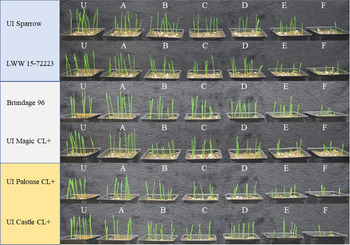
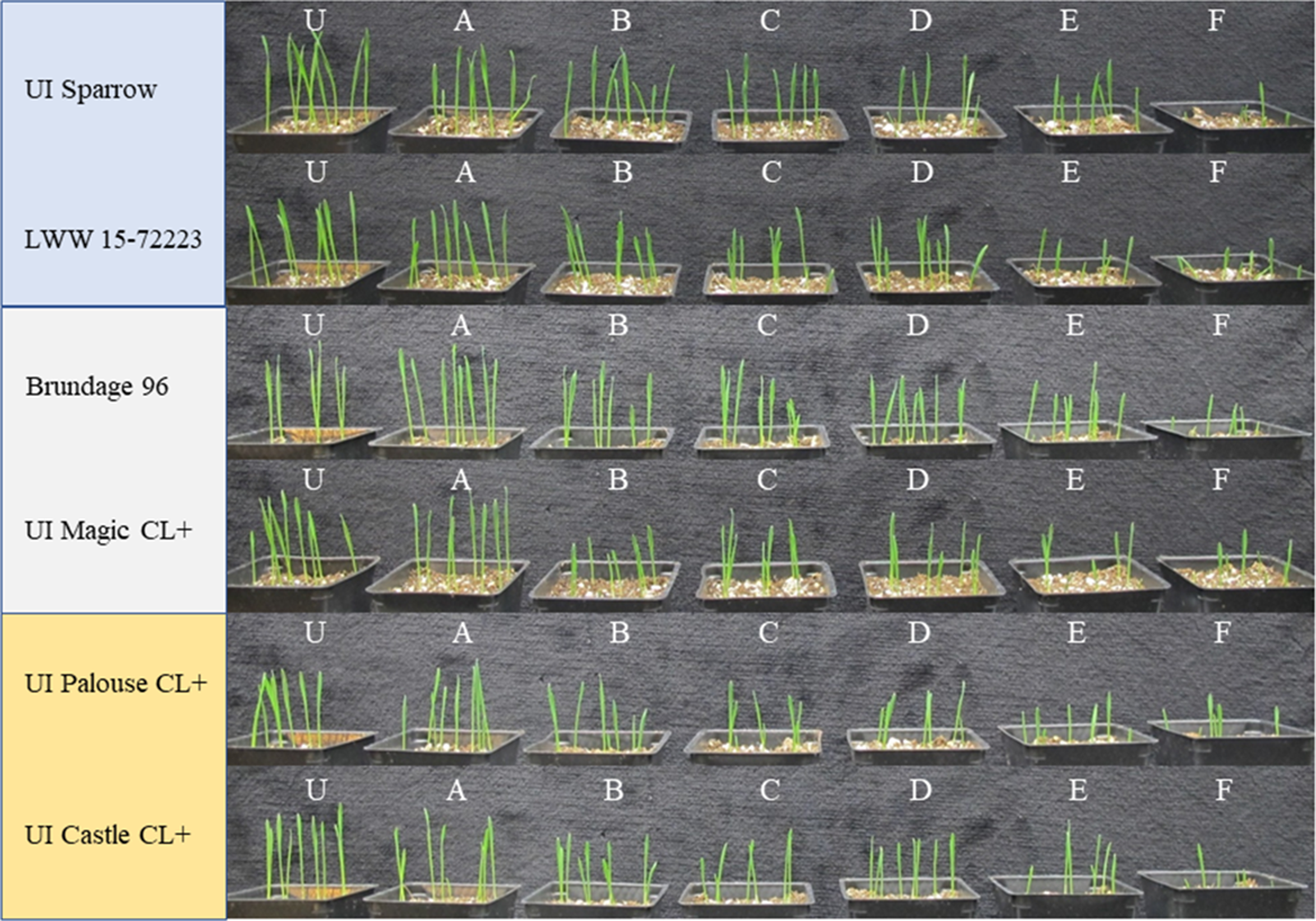
Visual observation of wheat responses to increasing doses of fluxofenim at 7 d after seed treatment showed doses of 1.6 and 3.2 g ai kg−1 seed caused observable inhibition of seedling emergence across the six varieties evaluated (Figure 1). A follow-up assessment of visual injury 14 d after seed treatment showed recovery of the varieties from this initial delay in emergence and, by 21 d after seed treatment, injury was less noticeable across the varieties (data not shown). Estimated fluxofenim dose values resulting in 10% biomass reduction at 21 DAT for the six varieties indicated that winter wheat tolerance to fluxofenim was variety dependent. Pooled ED10 estimates ranged from 0.55 (UI Magic CL+) to 1.23 (UI Palouse CL+) g ai kg−1 seed (Table 2; Figure 2). These estimates were 1.4 to 3.1 times higher than the recommended label rate for use in sorghum. Variety UI Palouse CL+ (ED10 = 1.23 g ai kg−1) and an unreleased candidate variety LWW 15-72223 (ED10 = 1.15 g ai kg−1) were more tolerant to fluxofenim compared with variety UI Magic CL+ (ED10 = 0.55 g ai kg−1). Pairwise comparison of effective doses causing 10% biomass reduction between varieties showed variety LWW 15-72223 had a higher ED10 value than UI Magic CL+ (P = 0.0202), and variety UI Palouse CL+ also had a higher ED10 value than UI Magic CL+ (P = 0.0171). These series of dose-response experiments evaluating the impact of fluxofenim on winter wheat varieties suggests that although fluxofenim caused stunted or delayed emergence at doses greater than 1.6 g ai kg−1 seed in winter wheat, the injury is transient. Corn seedlings have recovered from minor injury resulting from lower rates of metolachlor application or when metolachlor was applied with a safener, without impact on yield (Bernards et al. Reference Bernards, Simmons, Guza, Schulz, Penner and Kells2006). Therefore, recovery of wheat varieties from this early form of injury caused by fluxofenim seed treatment suggests injury may have no influence on yield at harvest.
Response of six wheat varieties to the following incremental doses of fluxofenim: (A) 0.2 g ai kg−1 seed, (B) 0.4 g ai kg−1 seed, (C) 0.6 g ai kg−1 seed, (D) 0.8 g ai kg−1 seed, (E) 1.6 g ai kg−1 seed, and (F) 3.2 g ai kg−1 seed at 7 d after treatment. U, untreated control.
Parameter estimates for log-logistic regression model for six wheat varieties.

a Abbreviations: b, rate of change for the dose-response curve; ED90, effective dose of fluxofenim resulting in 10% biomass reduction relative to untreated control at 21 d after treatment.
Fluxofenim dose response on biomass reduction of six winter wheat varieties 21 d after safener treatment. Biomass data were fitted to a two-parameter log-logistic model.

Naphthalic anhydride, an earlier seed-treatment safener was reported to cause injury such as stunting and chlorosis to corn and sorghum, with phytotoxicity to crops increasing as time of exposure of the safener to seeds increases (Jablonkai Reference Jablonkai2013). Similarly, reduction in germination rate with the earlier oxime ethers oxabetrinil and cyometrinil were reported (Abu-Qare and Duncan Reference Abu-Qare and Duncan2002; Yenne and Hatzios Reference Yenne and Hatzios1990). Delayed seedling emergence due to a high rate of safener could therefore result in increased exposure time of seedlings to the safener and, consequently, more time the seedlings spend in an herbicide-treated zone. The performance of a safener also is influenced by environmental factors such as temperature, soil moisture, soil structure, or rate of application of the safener (Abu-Qare and Duncan Reference Abu-Qare and Duncan2002). The interaction between a high dose of fluxofenim seed treatment and the corresponding herbicide will need to be further investigated.
Fluxofenim Dose-Response with VLCFA-Inhibiting Herbicides
Researchers are often interested in herbicide effective doses to assess crop tolerance to an herbicide or efficacy of an herbicide in weed control (Ritz et al. Reference Ritz, Kniss and Streibig2015). Many studies have used nonlinear regression to estimate weed-crop interaction or herbicide absorption in weeds (Cousens Reference Cousens1985; Kniss et al. Reference Kniss, Vassios, Nissen and Ritz2011). In this study, we were interested in estimates of fluxofenim doses conferring 90% protection to wheat varieties in the presence of an herbicide. A variety with an estimated low fluxofenim dose thus implies better protection of the variety from herbicide injury, compared with a variety with an estimated high fluxofenim dose for the desired level of protection. Variety UI Palouse CL+ was most tolerant to potential phytotoxicity in our previous study evaluating negative effects of fluxofenim to six wheat varieties; however, UI Castle CL+ was used in further evaluation because it is planted on more acres than UI Palouse CL+ in Northern Idaho and also was ranked most desirable on the basis of the 2019 end-use quality ranking (K. Schroeder, personal communication).
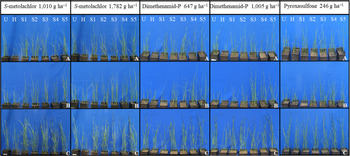
Visual observation of wheat response to increasing doses of fluxofenim in the presence of S-metolachlor, dimethenamid-P, or pyroxasulfone showed increased wheat tolerance to the herbicides with fluxofenim seed treatments (Figure 3). Estimates of fluxofenim doses showed that UI Castle CL+ required 0.07 g ai kg−1 seed of fluxofenim for a 90% biomass increase to S-metolachlor at 1,010 g ha−1, whereas Brundage 96 required 0.55 g ai kg−1 seed of fluxofenim for a 90% biomass increase to S-metolachlor at the same rate. A similar pattern was observed when the rate of S-metolachlor was increased to 1,782 g ha−1. Brundage 96 required 0.44 g ai kg−1 seed of fluxofenim for 90% increased biomass to S-metolachlor at 1,782 g ha−1, whereas UI Sparrow and UI Castle CL+ required 0.20 g ai kg−1 seed and 0.17 g ai kg−1 seed fluxofenim for 90% increased biomass, respectively (Table 3). Brundage 96, therefore, requires more safener to be protected from S-metolachlor injury at 1,010 g ha−1 compared with UI Castle CL+ or UI Sparrow.
Visual observation of wheat varieties (A) UI Sparrow, (B) Brundage 96, and (C) UI Castle CL+ to incremental dose of safener (S) in the presence of three herbicides 21 d after treatment. Abbreviations: H, herbicide treatment; S1, 0.2 g ai kg−1 seed; S2, 0.4 g ai kg−1 seed; S3, 0.6 g ai kg−1 seed; S4, 0.8 g ai kg−1 seed; S5, 1.6 g ai kg−1 seed; U untreated control.

Parameter estimates for the exponential regression model of three varieties responding to three very-long-chain fatty acid-inhibiting herbicides.

a Abbreviations: A, difference between the estimated maximum asymptote and the minimum asymptote or intercept C; b, rate of change for the dose-response curve; ED90, effective dose of fluxofenim resulting in 90% increase in biomass relative to herbicide only treatment at 21 d after treatment;.
Effective fluxofenim doses resulting in 90% increased biomass or protection against dimethenamid-P at 647 g ha−1 for Brundage 96 was 0.86 g ai kg−1 seed, whereas UI Castle CL+ and UI Sparrow doses were 0.29 g ai kg−1 seed and 0.15 g ai kg−1 seed, respectively. A similar trend of estimates was observed when the rate of dimethenamid-P was also increased to 1,005 g ha−1, with Brundage 96 having a higher fluxofenim ED90 value (0.73 g ai kg−1 seed) and UI Castle CL+ (0.10 g ai kg−1 seed) and UI Sparrow (0.09 g ai kg−1 seed) had lower fluxofenim ED90 values (Table 3). This pattern of response to dimethenamid-P herbicide suggests that Brundage 96 once again would require a high fluxofenim dose to confer 90% protection against injury from dimethenamid-P at 1,005 g ha−1. Estimates of effective doses of fluxofenim resulting in 90% protection from pyroxasulfone injury at 236 g ha−1 were similar to estimate trends obtained with S-metolachlor or dimethenamid-P, whereby Brundage 96 had a fluxofenim dose for 90% tolerance to pyroxasulfone of 1.03 g ai kg-1 seed, whereas UI Sparrow and UI Castle CL+ had fluxofenim doses for 90% protection from pyroxasulfone injury of 0.49 g ai kg−1 seed and 0.30 g ai kg−1 seed, respectively. UI Castle CL+ required less fluxofenim for 90% protection from pyroxasulfone injury at 236 g ha−1, suggesting some level of tolerance to pyroxasulfone at twice the label rate (Table 3).
Overall, increase in biomass peaked at an upper asymptote for UI Castle CL+ and UI Sparrow, and further increase in fluxofenim seed treatment did not result in additional increase in biomass. Brundage 96, on the other hand, had a continuous increase in biomass up to the highest fluxofenim rate of 1.6 g ai kg−1 seed evaluated (Figures 4–6). Increasing the rate of fluxofenim to greater than 0.5 g ai kg−1 seed for S-metolachlor, 0.9 g ai kg−1 seed for dimethenamid-P, and 1.0 g ai kg−1 seed for pyroxasulfone herbicide treatments did not confer additional visually detectable protection to the three varieties.
Estimated dose-response curves of three winter wheat varieties to incremental dose of fluxofenim safener in the presence of S-metolachlor at 1,010 g ai ha−1 and 1,782 g ai ha−1 21 d after herbicide treatment. Dry biomass data (g plant−1) are presented as percentages of the herbicide-treated control. Biomass data were fitted to an exponential model.

Estimated dose-response curves of three winter wheat varieties to incremental dose of fluxofenim safener in the presence of dimethenamid-P at 647 g ai ha−1 and 1,005 g ai ha−1 21 d after herbicide treatment. Dry biomass data (g plant−1) are presented as percentages of the herbicide-treated control. Biomass data were fitted to an exponential model.

Estimated dose-response curves of three winter wheat varieties to incremental dose of fluxofenim safener in the presence of 246 g ai ha−1 pyroxasulfone 21 d after herbicide treatment. Dry biomass data (g plant−1) are presented as percentage of herbicide-treated control. Biomass data were fitted to an exponential model.

The findings of these dose-response experiments further corroborate our earlier varietal screening in which variety UI Castle CL+ had some level of tolerance to S-metolachlor and dimethenamid-P herbicides and tolerance to potential phytotoxicity from fluxofenim treatment. Although the wheat varieties evaluated in this study differed in the amount of fluxofenim required for similar level of protection against VLCFA-inhibiting herbicide injury, increasing the dose of fluxofenim to greater than 0.5 g ai kg−1 seed did not confer additional protection to UI Castle CL+ or UI Sparrow against the herbicides.
Innate tolerance of wheat varieties to VLCFA-inhibiting herbicides may call into question the need for a safener such as fluxofenim seed treatment for pyroxasulfone herbicide, which is registered for use in wheat. However, as noted by Viger et al. (Reference Viger, Eberlein and Fuerst1991), corn subjected to severe levels of environmental stresses such as temperature extremes, drought, poor nutrition, hail, or insect damage may limit the ability of corn to recover from metolachlor injury without a yield loss. UI Castle CL+ was somewhat tolerant at the lower rates of S-metolachlor or dimethenamid-P herbicides used in this study; however, that tolerance was slightly reduced when the herbicide rates were increased. Meanwhile, similar responses in protection where fluxofenim reduced injury to the variety at low and increased rates of both S-metolachlor and dimethenamid-P herbicides were still observed. Safener applied in combination with metolachlor at high rates protected corn from metolachlor injury with no reduction in yield (Viger et al. Reference Viger, Eberlein and Fuerst1991). Protection conferred by safener to a crop has also been suggested to be relevant only under certain environmental conditions that favor reduced enzyme activity or a lower rate of herbicide metabolism in the crop (Paporisch and Rubin Reference Paporisch and Rubin2017). Therefore, the use of a safener is justifiable under conditions in which wheat varieties will suffer from herbicide injury.
GST enzyme assay
In the absence of fluxofenim, GST-specific activity was similar for plants of the three varieties UI Sparrow, Brundage 96, and UI Castle CL+, as observed in untreated controls; however, in the presence of fluxofenim seed treatments, GST-specific activity toward the standard substrate (CDNB) increased in the three varieties (Figure 7). Pairwise comparison showed differences in GST-specific activity between plants in the untreated controls and each of the three fluxofenim doses (0.36, 0.91, or 1.96 g ai kg−1 seed) for each variety. GST-specific activity for UI Sparrow with fluxofenim-seed treatment at 0.91 and 1.96 g ai kg−1 seed was greater than at 0.36 g ai kg−1 seed (P = 0.0297 and P = 0.0010, respectively). However, there was no difference in GST-specific activity between plants receiving seed treatment at 0.91 g ai kg−1 seed and 1.96 g ai kg−1 seed (P = 0.1877). There were no differences in GST-specific activity between fluxofenim doses for Brundage 96 and UI Castle CL+. Fluxofenim at 0.36 g ai kg−1 seed increased GST-specific activity of UI Sparrow by 30%, by 53% for 0.91 g ai kg−1 seed treatment, and further increased by 64% for 1.96 g ai kg−1 seed treatment. Brundage 96 had a 38%, 43%, and 38% increase in GST-specific activity for 0.36, 0.91, and 1.96 g ai kg−1 seed, respectively. UI Castle CL+ also had a similar pattern of GST-specific activity as Brundage 96, with 58%, 52%, and 53% increase at 0.36, 0.91, and 1.96 g ai kg−1 seed, respectively (Figure 7). Similarly, Scarponi et al. (Reference Scarponi, Quagliarini and Del Buono2006) reported a 75.4% increase in GST enzyme activity in wheat 72 h after treatment with fluxofenim.
Specific glutathione S-transferase (GST) activity toward 1-chloro-2,4-dinitrobenzene in wheat shoots with or without fluxofenim seed treatment at 7 DAT. Values are presented as mean ± SE (n = 4).

Previous research has shown that safeners induce the expression of herbicide detoxification enzymes in crops such as rice, corn, sorghum, and wheat (Davies Reference Davies2001; Hatzios and Burgos Reference Hatzios and Burgos2004; Jablonkai Reference Jablonkai2013), and most notable of the detoxification enzymes are the GSTs (Baek et al. Reference Baek, Goodrich, Brown, James, Moose, Lambert and Riechers2019; Cummins et al. Reference Cummins, Wortley, Sabbadin, He, Coxon, Straker, Sellars, Knight, Edwards, Hughes, Kaundun, Hutchings, Steel and Edwards2013; Hatzios Reference Hatzios1991; Riechers et al. Reference Riechers, Kreuz and Zhang2010). Few studies have assessed the relationship between GST enzyme activity and doses of safener. Taylor et al. (Reference Taylor, Cummins, Brazier-Hicks and Edwards2013) reported that higher concentrations of cloquintocet-mexyl did not result in larger induction of GST activity. Hirase and Molin (Reference Hirase and Molin2002), however, demonstrated that increasing the concentration of safeners, including fluxofenim, increased extractable cysteine synthase activity in sorghum shoots, an enzyme indirectly involved in glutathione biosynthesis. Safening efficacy of the safeners, however, was not clearly correlated with increase in cysteine activity shown in their study.
GSTs are reported to be a major group of proteins induced by safeners in phase II herbicide detoxification–related proteins, and we only investigated GST activity in this study. The expression of other proteins such as the aldo-keto reductase family, 12-oxophytodienoate reductase, cysteine synthase, γ-glutamyltranspeptidase, or multidrug resistance–associated proteins shows a complex cascade of events used by safeners in herbicide detoxification (Riechers et al. Reference Riechers, Zhang, Xu and Vaughn2003, Reference Riechers, Kreuz and Zhang2010). The regulation of these proteins in addition to GSTs could differ across varieties and, therefore, play roles in the tolerance of varieties to VLCFA-inhibiting herbicides observed in this study.
Conclusion
In sum, our studies showed that under greenhouse conditions, fluxofenim seed application protected soft white wheat varieties from injury resulting from application of S-metolachlor, dimethenamid-P, or pyroxasulfone. The results of this study further revealed wheat varieties that were tolerant to S-metolachlor, dimethenamid-P, or pyroxasulfone herbicides in the absence of fluxofenim-safener treatment. Our findings show promise for use of VLCFA-inhibiting herbicides for annual grass-weed management in winter wheat production. In the long term, wheat varieties identified as tolerant to VLCFA-inhibiting herbicides could be useful in breeding varieties that are tolerant to these herbicides. Although we did identify varieties with either innate or fluxofenim-induced tolerance to VLCFA-inhibiting herbicides, the extent of injury caused by VLCFA-inhibiting herbicides to crops depends on stress factors such as poor nutrition, soil type, extreme temperature changes, drought, hail, or insect damage. Studies are underway to evaluate the extent of fluxofenim protection of wheat varieties from VLCFA-inhibiting herbicides and potential impact of the herbicides to wheat yield under field conditions.
Acknowledgements
This research was supported by funding from the Idaho wheat growers through the Idaho Wheat Commission. No conflicts of interest have been declared. The authors thank Dr. Yueguang Wang, Dr. Jianli Chen, and David Hoadley for providing the wheat varieties used in this research.
Supplementary material
To view supplementary material for this article, please visit https://doi.org/10.1017/wet.2020.113