Internet culturale (www.internetculturale.it) is a digital portal and content aggregator whose aim is to promote and disseminate the holdings of Italian libraries, museums, archives and other cultural institutions.Footnote 1 This website was launched in 2005 by the Ministero dei beni e delle attività culturali e del turismo (Ministry of Cultural Heritage and Activities and Tourism) and is now managed by the Istituto centrale per il catalogo unico delle biblioteche italiane or ICCU (Institute for the Unified Catalogue of Italian Libraries). In its early stages, Internet culturale (henceforth IC) worked as an advanced version of the OPAC (Online Public Access Catalog) of the Servizio bibliotecario nazionale or SBN (National Library System) as well as a search tool for the digitized collections shared by the participating institutions.Footnote 2 Over time, IC has grown into one of the most important Italian online digital repositories.Footnote 3
IC features a powerful engine that allows users to search for a variety of multimedia content, including bibliographic information (by utilizing the search option Cataloghi), digitized objects (option Biblioteca digitale) and other data (options Full text and Sito web).Footnote 4 When one or more keywords are typed in the Ricerca (search) box and the option Cataloghi (catalogues) is selected, the engine returns a wide variety of results that can be refined through the categories available on the screen’s left side (Raffina la ricerca). For materials related to nineteenth-century music, these categories include Catalogo bibliografico (which identifies the catalogue from which the information was taken), Tipo di documento (which includes manuscripts, images, scores, recordings and more), Autore (which lists the composer, the librettist/s and other relevant characters associated with the work), Editore (which includes the original publisher as well as the companies that – if applicable – recorded the work), Data di pubblicazione and Lingua (which list the date of publication and language) and Dewey classification.
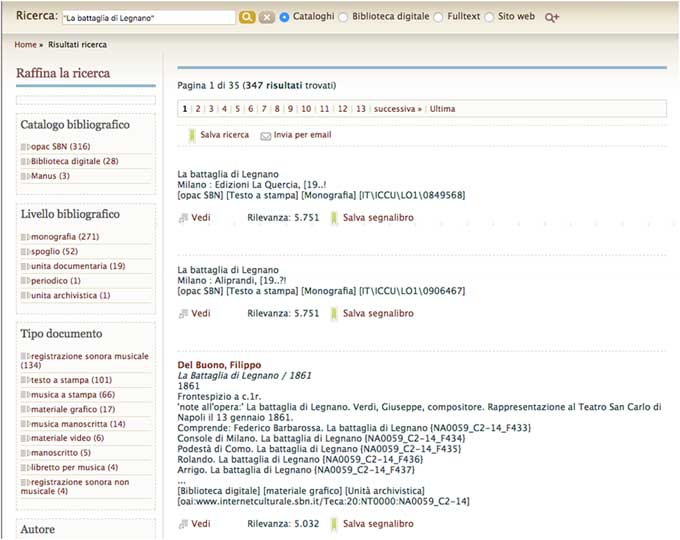
For example, a search for Giuseppe Verdi’s La battaglia di Legnano (see Fig. 1) yields 347 results.Footnote 5 Under Tipo di documento IC offers several filters to choose from, including Registrazione sonora musicale (music recordings), Testo a stampa (monographs, booklets and other printed materials related to the work), Musica a stampa (printed scores), Materiale grafico (images), Musica manoscritta (score manuscripts), Materiale video (videos), Manoscritto (non-musical manuscripts associated with the work), Libretto per musica (librettos) and Registrazione sonora non musicale (non-musical recordings).Footnote 6 Clicking on any of the filters listed above takes the user to a detailed description of each object (sometimes even a digitized image of the object itself) and where it is hosted. Five entries under Manoscritto, for example, contain references to La battaglia di Legnano: two of them are digitized letters from conductor Angelo Mariani and publisher and music critic Léon Escudier. The option Salva segnalibro (save bookmark) next to each entry allows any registered user to save (or email) the records for future reference. The search process is very intuitive, but occasionally the results are not consistent with the filters applied, as certain items appear under the wrong category. In this particular search, the items listed under Registrazione sonora non musicale contain recordings of the La battaglia di Legnano overture as well as passages from other Verdi operas.
Screenshot of Internet culturale search for material concerning La battaglia di Legnano

By choosing the search option Biblioteca digitale (digital library), the user can focus on digitized objects. One should remember, however, that digitized materials also appear in the search through Cataloghi. Although slightly confusing at first, this method makes sense: a user interested in finding any possible format can make use of the Cataloghi. Otherwise, the search option Biblioteca digitale allows one to acquire targeted results from a variety of digitized objects including, but not limited to letters, musical manuscripts and sound recordings. When searching for La Traviata, the user sees the following refinement categories (among others) in the left-hand column (Raffina la ricerca): Tipo di documento, Livello bibliografico, Autore. Two filters under Tipo di documento – Registrazione sonora di musica and Registrazione sonora musicale – seem to offer an exceptionally abundant collection of recordings. There are two major shortcomings, however, the first of which is that recordings marked as Accessibilità: Riservato (limited accessibility) play only the initial 30 seconds. (Unfortunately, the overwhelming majority of the recordings bear this mark.) The second shortcoming is that there is no apparent reason for differentiating Registrazione sonora di musica and Registrazione sonora musicale, even though, surprisingly, the former contains 109 entries and the latter only 53. Another problem is that the category Monografia, under Livello bibliografico, does not contain what one would expect – monographs concerning La Traviata – but, rather, recordings, librettos, and sketches about this opera.
Finally, the options Full text and Sito web (IC website), which are located in the Ricerca ribbon, allow the user to obtain results specifically from digitized periodicals or monographs, and from the webpages created or hosted by IC, respectively. When searching Full text, the left-hand column lists a series of refinement categories similar to those appearing in Biblioteca digitale. When searching, for instance, for Luisa Miller – the opera Verdi composed in 1849 – the filters under Livello bibliografico show three monographs and 194 digitized periodicals containing this title. Entries are sorted by relevance, but the user can select the option Data di pubblicazione to examine items for a specific year. The years of publication are arranged according to the number of times the search term appears, rather than in chronological order. Clicking on the desired year takes the user to a new page that contains the issue of the journal (or monograph) where Luisa Miller is mentioned. Clicking on 1855, for example, yields a list of five issues of the periodical Il nomade: rivista politica, scientifica, letteraria illustrata. Clicking on one of them directs the user to a new tab where the issue can be viewed in high resolution. The keywords typed in the Ricerca box (in this case ‘Luisa Miller’) are highlighted in the text of the digitized periodical or monograph, but a user wishing to look for a different term simply needs to type it in the new tab’s search box. This search will cover every page of the digitized object available in the new tab. It should be noted that the search accuracy is very high, and that IC offers the opportunity to download the digitized periodical or monograph onto the computer.
Even though the Sito web search option usually returns a relatively limited number of entries, through it a user can access one of the most original IC features: the Percorso 3D (3D path). As suggested by the name, this is a virtual, three-dimensional tour that allows the user to enjoy a more vivid experience. To access the Percorso 3D, the user should select Sito web and type the keywords ‘Percorso 3D’ in the search box or, as an alternative, click on Percorso 3D in the Mappa (IC map) webpage (more details on the Mappa webpage later in this review).Footnote 7 A variety of links will appear, each of them directing the user to a virtual 3D theme-oriented area. The most relevant for music scholars is the one titled Opera in scena: Viaggio virtuale nel teatro musicale (Opera on Stage: Virtual Journey in the Musical Theatre). By clicking on this link, the user will be brought to a ‘bridge’ page,Footnote 8 from which the user should click on Accedi al catalogo (access the catalogue) in order to be directed to a page where she can access several Ambienti virtuali (virtual rooms).Footnote 9 (Users should be aware that the Opera in scena virtual area can also be reached from the Casa della musica’s IC webpage by clicking on the link Percorsi 3D: Opera in scena located at the page’s bottom, and then on Accedi al catalogo Footnote 10 ).
Sala Verdi (Verdi room), for instance, contains digitized images of some of the most important documents connected to the composer’s life and work, including scores, posters, billboards, sketches, pictures and lithographs. On the right column, the webpage shows some sample images of the three-dimensional Sala Verdi (Alcune immagini della Sala Verdi; some images from Verdi room). In order to access the virtual 3D Sala Verdi, the user will need to click on the link to the Percorso 3D, located above Alcune immagini della Sala Verdi, and then click on Accedi al percorso (access the 3D path). In addition to the Sala Verdi, other virtual 3D areas include the Sala 1600, Sala 1700, and Sala 1800.Footnote 11 The resolution of the images displayed on each room’s virtual walls is high, but the three-dimensional areas’ resolution is not. Moreover, only about 16 per cent (24 out of 152) of the images available in Opera in scena have a description associated with them; ideally, they all should have at least a short descriptive note. Finally, it should be noted that in the spring of 2017 this virtual tool seemed to be working only intermittently. In conclusion, the Percorso 3D has the potential to become a very valuable IC feature but, as of now, considerable room remains for improvement.
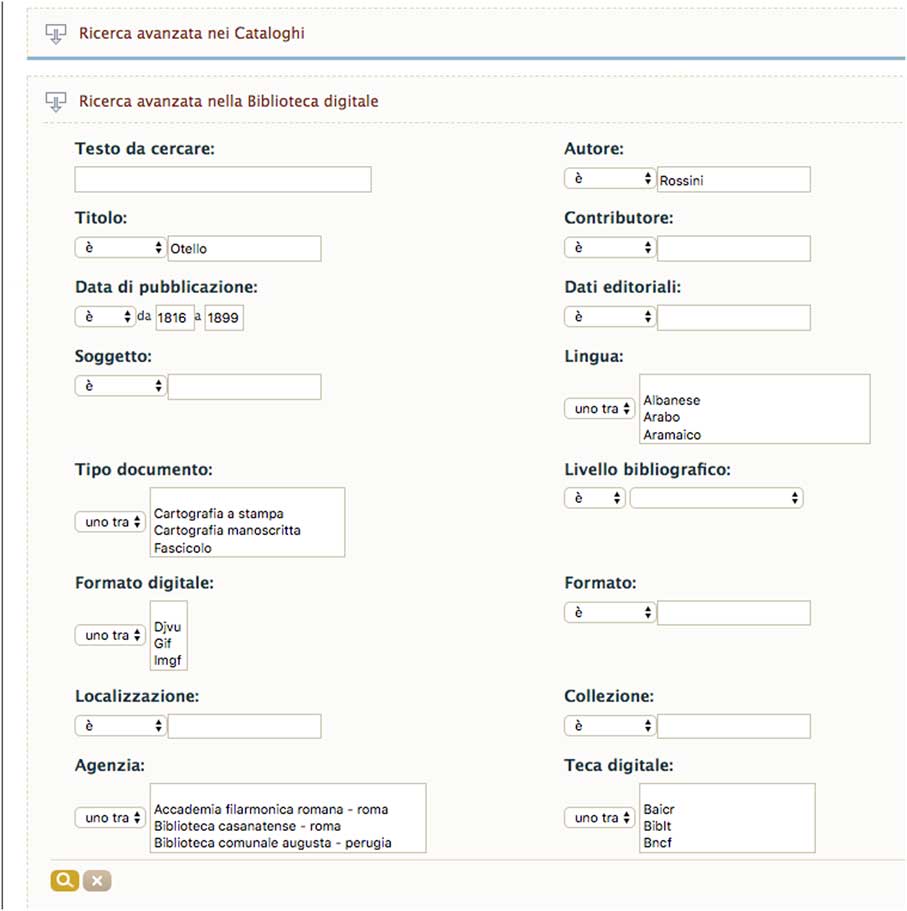
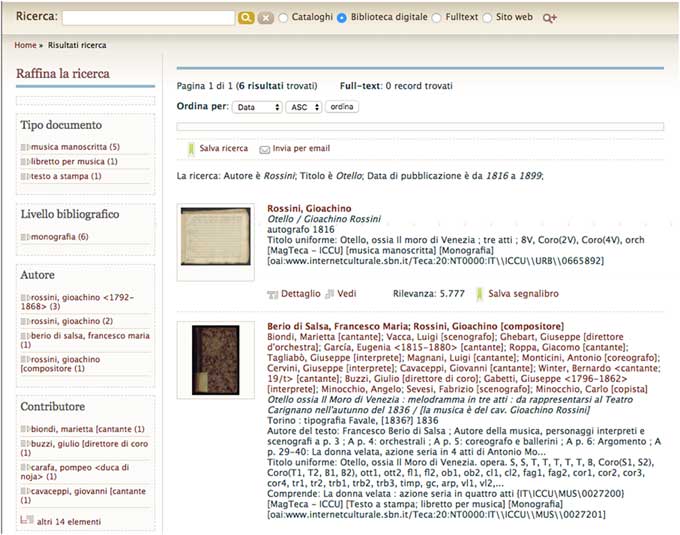
Three of the four search options mentioned so far – Cataloghi, Biblioteca digitale and Sito web – may be refined by using the Ricerca avanzata (advanced search).Footnote 12 The icon for this tool is a magnifying glass next to a plus sign (+), located to the Sito web’s right. To check the availability of the digitized sources from the nineteenth century on Gioachino Rossini’s Otello and order them chronologically, for example, the user will need to choose Ricerca avanzata nella biblioteca digitale (advanced search in the digital library), then type ‘Rossini’ in the Autore (author) box, ‘Otello’ in the Titolo (title) box, and da (from) 1816 (date of the premiere) a (to) 1899 under Data di pubblicazione (date of publication) (see Fig. 2). The user will be directed to a page where she may chronologically order (Ordina per) the obtained digitized sources by using the options Data (date) and ASC (ascending). The first document available is the manuscript of Rossini’s Otello from 1816; the second is a printed version of the libretto from 1836, used for the performance at the Teatro Carignano in Turin (see Fig. 3).
Screenshot of the webpage: Ricerca avanzata nella biblioteca digitale with the keywords ‘Rossini’, ‘Otello’, ‘1816’ and ‘1899’ in the appropriate search boxes

Screenshot of the results, chronologically ordered, obtained when searching for ‘Rossini’, ‘Otello’, ‘1816’ and ‘1899’

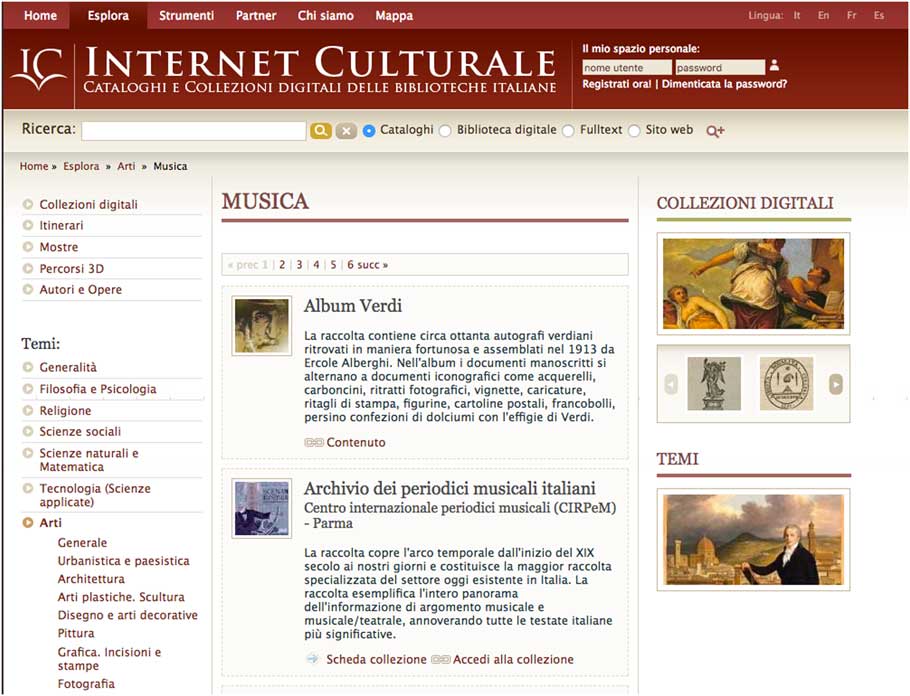
In addition to the standard search procedures described above, for more experienced users IC offers the opportunity to focus on specific subjects, institutions, collections and historical periods. In order to pursue this alternative search path, users should be aware that IC is organized in sections (Esplora, Strumenti, Partner and Mappa) and subsections.Footnote 13 For example, the section Esplora is divided into thematically organized subsections: Filosofia, Religione, Scienze sociali, Arti and so forth. Under Arti, are a variety of options including Musica; as of spring of 2017, 51 collections and exhibitions were listed under this heading (see Fig. 4). Approximately a quarter of these 51 entries focus on composers, while others address wider subjects such as musical press, libretto collections and so forth. Among the former category, the nineteenth-century opera composers’ names (Gaspare Spontini, Johann Simon Mayr, Gioachino Rossini, Giuseppe Verdi and Giacomo Puccini) appear more frequently than others.Footnote 14 Most of the links direct the users to digitized collections while others send them to virtual exhibitions. Almost all collections and exhibitions are fully accessible through IC even though, in some rare instances, one is redirected to external websites (such is the case for Album Verdi).
Screenshot of the webpage a user obtains by following the path: Esplora, Arti, Musica

The section Strumenti contains, among others, a series of links to external databases.Footnote 15 These links are organized into five categories: Biblioteche digitali dedicate (theme-oriented digital libraries), Biblioteche digitali generali (non-theme-oriented digital libraries), Metaopac internazionali (international meta-OPACs), Metaopac italiani (Italian meta-OPACs) and Altre risorse online (other online resources). Each link in the two Biblioteche digitali directs the user to a large number of diverse Italian and non-Italian sources: among the most important music-related digital libraries are the Biblioteca digitale degli archivi di teatro di Napoli and the Digital Image Archive of Medieval Music (DIAMM). Additional music-related resources listed under Altre risorse online are Clori: Archivio della cantata italiana and Cultura Italia; the latter contains a section on the performing arts. Finally, by clicking on Metaopac internazionali, one finds links to major resources such as The European Library, the Catalogue collectif de France, and the Oxford Libraries Information System, among others. Even though IC does not make specific suggestions on institutions that provide access to digitized objects not available here, this list of external websites offers the user plenty of opportunities to pursue her search elsewhere. One should also note that, in the spring of 2017, all links worked properly.Footnote 16
Of great importance is the Partner section, which contains the full list of 155 institutions that share their metadata and digitized objects with IC. This section is divided into three categories: Biblioteche (libraries and archives), Musei, istituti culturali e di ricerca (museums and research and cultural institutions) and Enti locali (local governmental organizations).Footnote 17 Each institution has its own Scheda istituto, which summarizes the basic information (physical and email address, phone number, website, history) and contains a link to the Patrimonio digitale (digital collection). For instance, clicking on Biblioteche leads to a page that lists the libraries and archives that share their metadata and digitized objects with IC.Footnote 18 To access the Archivio storico Ricordi’s IC webpage, for example, one should click on Scheda Istituto, located at the bottom of the entry.Footnote 19 The Archivio storico Ricordi’s IC webpage contains a link titled Accedi al patrimonio digitale (access the digital collection), which gives access to every document connected to Verdi and Puccini owned and made accessible by this archive.Footnote 20 Finally, the Mappa webpage offers an overview of the IC website; this webpage is extremely well organized, and the inexperienced user would benefit from turning to the Mappa first in order to gain a better sense of the IC resources.Footnote 21 As mentioned earlier, one of the Mappa entries is the Percorso 3D, which directs the user to the IC area devoted to three-dimensional tours.
Among the many archives, libraries and institutions that share their digitized collections through IC and whose main focus is the preservation and dissemination of the Italian musical heritage, one of the most important for nineteenth-century music scholars is the Centro internazionale di ricerca sui periodici musicali (International Research Centre on Music Periodicals, or CIRPeM). The CIRPeM, founded in 1984, is now part of the Casa della musica, an institution established in Parma in 2002 with the purpose of both preserving and disseminating its holdings.Footnote 22 According to the CIRPeM website, this institution is the only one in Europe exclusively devoted to music periodicals.Footnote 23 Its main focus has been on the nineteenth century, though in recent years the collections have expanded to cover twentieth-century publications for a current total of approximately 1,600 indexed periodicals. The CIRPeM collection includes some of the earliest Italian music periodicals, such as the Polinnia europea (1823) and Il censore universale dei teatri (1829–1837), as well as periodicals owned by the two most important Italian music publishers, Ricordi (Gazzetta musicale di Milano, 1842–1902) and Sonzogno (Il teatro illustrato, 1880–1892).
In addition to the standard options available on the left-hand column (Raffina la ricerca), the CIRPeM’s IC page has an Ordina per (sort by) option at the top.Footnote 24 Rather than a search option, Ordina per is a method of ordering the hits from a previous search. When selecting Data (date) and Ascendente or ASC (ascending), the first hit that appears is the inaugural issue of the Giornale delle belle arti e della incisione, antiquaria, musica e poesia (1784–1788); this is the oldest digitized issue available at CIRPeM. Other search options include Rilevanza (relevance), Autore (author) and, most important, Titolo (title). While the option Rilevanza is not particularly useful (it is unclear why a certain periodical would be more relevant than another), Titolo works as an alphabetical index that allows the user to locate the periodical more easily. (The option Autore is not very useful either, as, for some unclear reason, searches here only return one result.) Even though it would be impossible to offer the full catalogue of every periodical available for consultation, or the exact number of journals totally or partially accessible through IC, a list of some of the most important titles from the nineteenth century (in addition to the ones mentioned earlier) will give a sense of the meticulous indexing work done by the CIRPeM: L’arpa, Boccherini, Il figaro, Gazzetta dei teatri, Gazzetta musicale di Firenze, Gazzetta musicale di Napoli, L’Italia musicale, Il mondo artistico, Rivista teatrale melodrammatica, Scena illustrata, Lo staffile, Strenna teatrale europea, Teatri arti e letteratura, and Il trovatore.Footnote 25
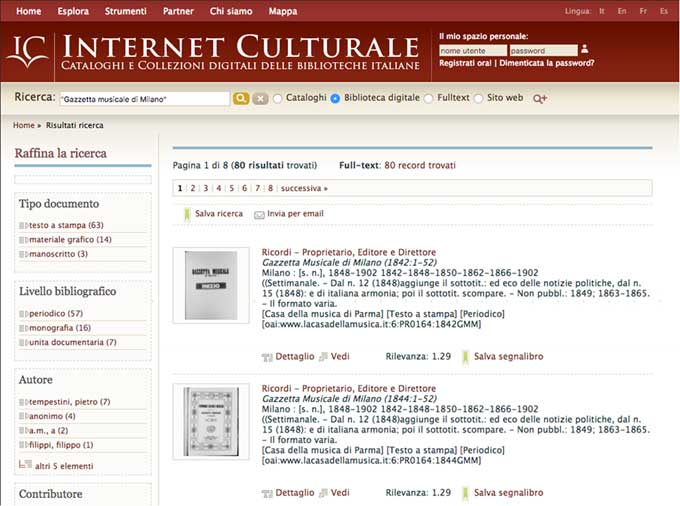
Once the user has selected the periodical she wishes to consult, IC directs her to a new tab where each digitized issue can be consulted separately. For example, in order to consult the weekly Gazzetta musicale di Milano’s inaugural issue, one has to type the journal’s name in the search box and select Biblioteca digitale. A list of chronologically ordered volumes will appear starting from the first, published in 1842 (see Fig. 5). By clicking on the periodical’s image or on the option Vedi (see) below, the user is directed to a new tab where she has the option of viewing one large page, two pages, or a series of small icons. Moreover, by clicking on the i (information) in the new tab’s left upper corner, the user can quickly access more detailed information about the periodical. By following the same procedure, any user can consult a substantial number of music journals.
Screenshot of Internet culturale search for the periodical Gazzetta musicale di Milano.

Even though scholars will probably benefit from IC more than anyone else, the section Archivio eventi e novità (archive of news and events) provides valuable information for occasional visitors who wish to learn more about exhibitions, conferences and other cultural events happening in Italy. Highlights of the Archivio’s content appear in the IC homepage’s left-hand column as well as on most of the website’s main subdivisions; a smaller link below the highlights directs the user to the full Archivio eventi e novità section.Footnote 26 One announcement that appeared in Archivio eventi e novità in the spring of 2017, for example, concerned the exhibition of Antonio Vivaldi’s manuscripts at the Biblioteca nazionale universitaria in Turin. The webpage hosted an interview with the exhibition’s curators, along with a link to the full programme of the events. This archive goes back to 2005, when IC was launched; every entry contains a detailed description of the event, but most of the older links no longer work and should probably be removed. Even so, the Archivio eventi e novità is an excellent resource to learn more about some of the most important exhibitions and events held in Italy in the past few years.
In conclusion, IC keeps the promises made in its mission statement. This website is an essential tool for scholars whose primary focus is Italian culture in its broadest terms; the ever-expanding web of libraries and cultural institutions that share their information and digitized objects with IC is the clearest evidence of its quality and growing reputation. Considering that music-related information makes up such a substantial portion of the materials available in IC, music historians will find this website exceptionally useful.Footnote 27 Two changes are necessary to improve the website’s quality, however: the first is to make IC available in languages other than Italian. An English interface would greatly facilitate the research activities of scholars whose native language is not Italian or who have a limited knowledge of this language. The other is to improve the Percorso 3D, whose interactive nature would probably be appealing to a wider array of users. While waiting for these improvements to take place, it would be advisable to add a virtual sign that indicates that the site is a ‘work in progress’.
Appendix
List of some the most important Italian cultural institutions that share a substantial amount of music-related digitized materials through Internet culturale
Archivio storico Ricordi (Milan)
Bibliomediateca dell’Accademia nazionale di Santa Cecilia (Rome)
Biblioteca civica Angelo Mai (Bergamo)
Biblioteca civica Pietro Acclavio (Taranto)
Biblioteca comunale Augusta (Perugia)
Biblioteca comunale dell’Archiginnasio (Bologna)
Biblioteca comunale Planettiana (Jesi)
Biblioteca del Castello del Buonconsiglio (Trento)
Biblioteca del Conservatorio di musica Luigi Cherubini (Florence)
Biblioteca del Conservatorio di musica San Pietro a Majella (Naples)
Biblioteca dell’Accademia nazionale dei Lincei e Corsiniana (Rome)
Biblioteca dell’Istituto musicale Luigi Boccherini (Lucca)
Biblioteca e archivio storico dell’Accademia filarmonica romana (Rome)
Biblioteca Estense universitaria (Modena)
Biblioteca Marucelliana (Florence)
Biblioteca nazionale Braidense (Milan)
Biblioteca nazionale centrale (Florence)
Biblioteca nazionale centrale Vittorio Emanuele II (Rome)
Biblioteca nazionale Marciana (Venice)
Biblioteca nazionale universitaria (Turin)
Biblioteca nazionale Vittorio Emanuele III (Naples)
Biblioteca Palatina (Parma)
Biblioteca provinciale Pasquale Albino (Campobasso)
Biblioteca Riccardiana (Florence)
Biblioteca statale (Lucca)
Biblioteca statale del Monumento nazionale di Montecassino (Cassino)
Biblioteca statale oratoriana del Monumento nazionale dei Girolamini (Naples)
Biblioteca universitaria (Pavia)
Fondazione Gioachino Rossini (Pesaro)
Istituto centrale per i beni sonori e audiovisivi (Rome)
Istituzione Casa della musica/CIRPeM (Parma)
Museo Donizettiano (Bergamo)
Museo internazionale e Biblioteca della musica (Bologna)