Perhaps one of the most remarkable facets of bilinguals' speech is their ability to separate their two languages. The two competing languages reside in one mind, and for highly proficient bilinguals, often in fully or partially overlapping brain territories (e.g., Chee, Tan, & Thiel, Reference Chee, Tan and Thiel1999; Hernandez, Dapretto, Mazziotta, & Brookheimer, Reference Hernandez, Dapretto, Mazziotta and Bookheimer2001; Illes et al., Reference Illes, Francis, Desmond, Gabrieli, Glover and Poldrack1999). While previous research has generally supported the claim that bilinguals separate their two languages effectively (e.g., Hasselmo, Reference Hasselmo and Gilbert1970), excepting cases of cerebral trauma (e.g., Perecman, Reference Perecman1984) and “slips of the tongue” (Poulisse, Reference Poulisse2000), experimentally based psycholinguistic research has demonstrated that language switching comes at a cost. Relative to nonswitched performance, language switching incurs a small temporal cost, generally in the realm of tens of milliseconds (Kolers, Reference Kolers1966). It is paradoxical that switching into the dominant language tends to incur greater switch costs than switching into the nondominant language (e.g., Meuter & Allport, Reference Meuter and Allport1999). Yet the body of research investigating language switching costs and subsequent theories that have stemmed from this line of investigation seems to have ignored a potentially crucial variable: language context (i.e., language mode).
As has been previously noted, bilinguals operate along a continuum, from monolingual performance in one language to monolingual performance in the other (e.g., Grosjean, Reference Grosjean, de Groot and Kroll1997). Along this continuum, driven by psychological, linguistic, and contextual factors, bilinguals must constantly evaluate how much of each language should be implemented in a given conversation. The result is a continuous, variable ratio of the quantity of Language A to Language B produced by bilinguals across a variety of contexts.
Given that the ratio of Language A to Language B varies with contextual and psychological factors, it is logical to posit that the relative accessibility of each language may also vary. It would seem inefficient for both languages to remain equally accessible throughout a conversation when it is clear that the discourse consists predominantly or exclusively of a single language. Yet, in a linguistically balanced discourse, in which both languages are represented equally, it may be most economical to maintain both languages equally accessible. To begin to approach the natural variation in bilingual switching patterns, the present study examines the effect of context on lexical access and language switching costs in first language (L1) dominant bilinguals.
LANGUAGE SWITCHING AND SWITCH COSTS
In one of the first studies to consider the time cost of producing language switches, Kolers (Reference Kolers1966) asked French–English bilingual subjects to perform a mixed-language read-aloud task, as well as a mixed-language free production task, and compared them to unilingual productions. The results indicated that subjects were slower when switching languages relative to monolingual, nonswitched productions. Later study confirmed this effect with language-neutral stimuli (i.e., digit naming), although subject to a moderating effect of predictability with switches in a regular pattern (i.e., ABABABAB) incurring less temporal costs than unpredictable switches (Dalyrmple-Alford, Reference Dalyrmple-Alford1985; Macnamara, Krauthammer, & Bolgar, Reference Macnamara, Krauthammer and Bolgar1968; although for predictable language and concept, see Declerck, Koch, & Philipp, Reference Declerck, Koch and Philipp2014).
While these earliest studies sought to establish the overall delays associated with switching languages, more recent work has attempted to disentangle effects of the direction of switch (L1 to second language [L2] vs. L2 to L1), proficiency, and multilingualism, as a means to provide a theoretical framework for bilingual language selection. Meuter and Allport (Reference Meuter and Allport1999), in their seminal work, employed a digit-naming task in which the background color of a given numeral corresponded to one particular language; a change in color cued a change in language. Participants, all late bilinguals, reported using frequent and “intentional” switches in everyday language use. The results for the naming task showed that subjects were significantly slower to name a numeral in a switched trial than in a nonswitched trial, a reaction time delay referred to as the switch cost. Moreover, the results indicated an asymmetry in switch costs, such that switches into the L1 were slower than switches into the L2. Note that these results also closely parallel a fairly substantial body of literature in task switching (for a review, see Koch, Gade, Schuch, & Philipp, Reference Koch, Gade, Schuch and Philipp2010).
Drawing on this work, Costa and Santesteban (Reference Costa and Santesteban2004) examined the naming latencies in a cued picture-naming study of late bilinguals, early balanced bilinguals, and trilinguals with a significantly weaker third language (L3). Their findings revealed that while the late, L1-dominant bilinguals demonstrated asymmetrical switching costs, the early, balanced bilinguals showed symmetrical switching costs. This finding extended even to early, balanced bilinguals (L1 and L2) switching into a significantly weaker L3, leading the authors to posit a distinct language switching mechanism in highly proficient bilinguals. Subsequent research, however, demonstrated that under certain conditions, such as switching between L3 and a weaker fourth language, highly proficient bilinguals can and do demonstrate asymmetrical switching costs (Costa, Santesteban, & Ivanova, Reference Costa, Santesteban and Ivanova2006; see also Linck, Schwieter, & Sunderman, Reference Linck, Schwieter and Sunderman2012). Conversely, several studies have also shown that under certain conditions, including longer interstimulus intervals (Verhoef, Roelofs, & Chwilla, Reference Verhoef, Roelofs and Chwilla2009) and voluntary noncued switching (Gollan & Ferreira, Reference Gollan and Ferreira2009), unbalanced bilinguals can show symmetrical switch costs (for a review, see Bobb & Wodniecka, Reference Bobb and Wodniecka2013). Having concluded that a variety of factors do not impact asymmetrical switch costs, including age of acquisition, language similarity, and L2 proficiency, Schwieter and Sunderman (Reference Schwieter and Sunderman2008) investigated the possibility that proficiency, as measured through “lexical robustness” (e.g., Gollan, Montoya, & Werner, Reference Gollan, Montoya and Werner2002), accounts for a shift from asymmetrical to symmetrical switch costs. They found that the degree of symmetry of switch costs is related to a measure of lexical robustness. Their conclusions broadly imply that, at a specific threshold of proficiency (i.e., lexical robustness), bilinguals may transition from asymmetrical to symmetrical switching costs.
More recent work has centered on the question of the reach of switching costs when performing language switching tasks. The results from an n-2 paradigm, in which speakers named images either in ABA or CBA language sequences (e.g., GermanA/EnglishB/German A or FrenchC/EnglishB/German A), revealed n-2 repetition effects, in which naming in an ABA sequence was slower than naming in a CBA sequence (Philipp, Gade, & Koch, Reference Philipp, Gade and Koch2007; Philipp & Koch, Reference Philipp and Koch2009). In addition, by varying the items to be named from one set to another, results indicated a more global process directly impacting the entire response language, as opposed to a smaller “response set” of target items (Experiment 2 in Philipp & Koch, Reference Philipp and Koch2009).
Taken as a whole, this body of research indicates that language switching incurs a switch cost, with switched tokens taking longer to produce than nonswitched tokens. In addition, the asymmetrical nature of such switch costs, with bilinguals incurring greater switch costs in their more dominant language than their less dominant, has been widely replicated, although balanced bilinguals have been shown to evidence symmetrical switch costs.
COGNITIVE MECHANISMS GOVERNING LANGUAGE SWITCHING
Stemming from the above-detailed series of studies investigating switching costs, there has been an ongoing theoretical debate on the nature of the language selection and switching mechanism. Although seemingly obvious, given that bilinguals rarely experience unintentional switches (Dornic, Reference Dornic1979), there must be some mechanism that allows for the separation of a bilingual's two languages. In addition, once separated, given that bilinguals are able to switch languages when necessary, the mechanism posited must allow for switching and explain the switch costs found in the above research. While intentional control of language separation is clearly the norm, equally revelatory are cases in which different patterns of unintentional language switches are produced (for brain trauma: Aglioti & Fabbro, Reference Aglioti and Fabbro1993; Alberta & Obler, Reference Alberta and Obler1978; Fabbro, Skrap, & Aglioti, Reference Fabbro, Skrap and Aglioti2000; Kutas, Moreno, & Wicha, Reference Kutas, Moreno, Wicha, Bullock and Toribio2009; Paradis, Reference Paradis, Whitaker and Whitaker1977; Paradis, Goldblum, & Abidi, Reference Paradis, Goldblum and Abidi1982; Perecman, Reference Perecman1984, Reference Perecman1985; Poulisse, Reference Poulisse2000; although for a word of caution, see Grosjean, Reference Grosjean1985; for effects of aging: Gollan, Sandoval, & Salmon, Reference Gollan, Sandoval and Salmon2011). Accounting for both normal and pathological behaviors, a language switching mechanism, separate from the languages themselves, has been proposed (e.g., Goldstein, Reference Goldstein1948). This early work represented a very categorical view of the “language switch,” with only one language able to be selected at a time (Penfield & Roberts, Reference Penfield and Roberts1959). Macnamara and Kushnir (Reference Macnamara and Kushnir1971) subsequently amended the proposal to include both an input switch and an output switch, to account for the bilingual ability of simultaneous translation.
There are two main hypotheses that have been developed more recently. The first explanation, and the framework that will be used predominantly throughout this study, relies on the use of inhibition to suppress the nonresponse language (e.g., Green, Reference Green1986, Reference Green1998). The second possibility, postulated predominantly for balanced bilingual populations, is that a language-specific selection mechanism, not suppression, is at play (e.g., Costa, Reference Costa, Kroll and de Groot2005).1
Within the inhibitory control model (ICM), the primary assertion is that when operating in a given language, other competing languages must be inhibited (Green, Reference Green1986, Reference Green1998; Kroll & Stewert, Reference Kroll and Stewart1994). The initial model was based on three principles, mainly control, activation, and resource, and sought to account for both normal and pathological bilingual performance. Functioning by means of language specifying tags attached to each lexical entry, inhibition is applied to the nontarget entries to facilitate access to the target language. Specifically, nontarget entries are inhibited to a degree that is proportional to the activation that is sent to such targets. As such, it is proposed that targets in a more dominant L1 receive stronger activation and, subsequently, will necessitate greater inhibition to allow production in the L2. This model has found support in a variety of experimental paradigms, including the language switching paradigms discussed above, as well as neurolinguistic studies analyzing bilingual brain activity during linguistic tasks (see below).
With respect to the language switching findings, the general finding of asymmetrical switching costs, with greater costs incurred when switching into the L1, has been explained within the framework of asymmetrical inhibition (e.g., Meuter & Allport, Reference Meuter and Allport1999). Greater inhibition is required on the L1, because it is stronger and receives more activation, relative to the L2, and such inhibition persists into the next trial. As such, switching into the L1 involves overcoming greater levels of inhibition relative to L2, and greater switch costs result from greater inhibition. Similarly, the effects of proficiency, with balanced bilinguals illustrating symmetrical switching costs (e.g., Costa & Santesteban, Reference Costa and Santesteban2004), can be explained by roughly equal levels of inhibition required on languages that are equally dominant. In the n-2 paradigm, for example, greater n-2 repetition effects were found for the more dominant language (Philipp et al., Reference Philipp, Gade and Koch2007), again fitting within the ICM expectations.
Additional support has been drawn from research on bilingual brain function, most notably event-related potentials (ERPs) and functional magnetic resonance imaging paradigms. ERP results have demonstrated a frontocentral negativity, associated with an N2 (Christoffels, Firk, & Schiller, Reference Christoffels, Firk and Schiller2007; Jackson, Swainson, Cunnington, & Jackson, Reference Jackson, Swainson, Cunnington and Jackson2001). The N2 response was equated with the N2 response found to be associated with no-go responses in a go/no-go paradigm (e.g., Kopp, Mattler, Goertz, & Rist, Reference Kopp, Mattler, Goertz and Rist1996). As such, language selection was correlated with the response inhibition mechanism. Guo, Liu, Misra, and Kroll (Reference Guo, Liu, Misra and Kroll2011) most recently demonstrated inhibitory effects remaining long after switching languages (for a discussion of alternative interpretations, see also Verhoef, Roelofs, & Chwilla, Reference Verhoef, Roelofs and Chwilla2010). Similarly, functional magnetic resonance imaging results have shown consistent activation of the executive control function areas of the brain (frontal cortex and left anterior cingulate cortex) in language switching tasks relative to nonswitching tasks (Abutalebi et al., Reference Abutalebi, Brambati, Annoni, Moro, Cappa and Perani2007; Hernandez, Reference Hernandez2009; Hernandez et al., Reference Hernandez, Dapretto, Mazziotta and Bookheimer2001; Price, Green, & von Studnitz, Reference Price, Green and von Studnitz1999). Furthermore, asymmetrical activation of the executive control regions have been found, with greater activation evidenced when switching into L1 relative to the L2 (Wang, Xue, Chen, Xue, & Dong, Reference Wang, Xue, Chen, Xue and Dong2007). As such, these studies not only support an inhibitory account of language selection but also indicate that the mechanisms employed in language selection are not language specific.
Another key component of the ICM is the assumption that the processes involved in language separation and selection are not specific to the domain of language (for early support, see Dalrymple-Alford, Reference Dalyrmple-Alford1985; Paradis, Reference Paradis and Herbert1980). Meuter and Allport (Reference Meuter and Allport1999) take this as a working assumption, claiming that the processes for bilingual language selection are “similar in kind to those responsible for the control of task set in other monolingual and/or nonlanguage task domains” (p. 25). This assumption is well supported by comparisons between the language switching and task switching literature (for reviews, see Kiesel et al., Reference Kiesel, Steinhauser, Wendt, Falkenstein, Jost and Philipp2010; Koch et al., Reference Koch, Gade, Schuch and Philipp2010; Monsell, Reference Monsell and Bruce1996, Reference Monsell2003). In brief, similar asymmetrical costs have been found for task switching, with greater switch costs, or shift costs, observed for more dominant tasks (i.e., easier) relative to weaker tasks (i.e., more difficult; e.g., Allport, Styles, & Hsieh, Reference Allport, Styles, Hsieh, Umilta and Moscovitch1994). While the parallel between task switching and language switching is clear, it is worth noting that a number of studies, specifically comparing task and language switching, have found mixed results or marginal correlations (Calabria, Hernández, Branzi, & Costa, Reference Calabria, Hernández, Branzi and Costa2012; Klecha, Reference Klecha2013; Prior & Gollan, Reference Prior and Gollan2013; for aging effects, see Weissberger, Wierenga, Bondi, & Gollan, Reference Weissberger, Wierenga, Bondi and Gollan2012), leading to the acknowledgment that language switching is a complex phenomenon and its governing mechanisms may only partially overlap with the task switching mechanism. Similar parallels can be made with the neurolinguistic studies, in which activation of the executive control functions in language switching tasks (i.e., Abutalebi et al., Reference Abutalebi, Brambati, Annoni, Moro, Cappa and Perani2007) is not found in language-specific brain areas.
While there has been a large body of work on switching costs, and growing support for an inhibitory framework, the experimental paradigms have yet to approach the natural variability found in bilingual language switching patterns, namely, language context or language mode.
LANGUAGE MODE AND LANGUAGE CONTEXT
In natural speech, bilinguals can operate either monolingually, speaking in one of their two languages, or bilingually, alternating between them. Yet, it is clear that such a division cannot be considered categorical. In discussing the various options available to bilinguals, Hasselmo (Reference Hasselmo and Gilbert1970) notes that Swedish–English bilinguals alternate between three different norms or “modes” of speaking, English-only, English–Swedish, and Swedish–English, depending on the audience or interlocutors. Here, Hasselmo (Reference Hasselmo and Gilbert1970) differentiates between monolingual communication and two different degrees of bilingual communication. Similar findings for Spanish–English bilinguals from the Puerto Rican community in New York have been detailed (Poplack, Reference Poplack1980), with different quantities of language switching found based on the context of the interaction (i.e., formal vs. vernacular).
The idea of various language norms, or language modes, has been further refined, most notably by the work of Grosjean (Reference Grosjean1985, Reference Grosjean, de Groot and Kroll1997, Reference Grosjean1998, Reference Grosjean and Nicol2001, Reference Grosjean2008; Soares & Grosjean, Reference Soares and Grosjean1984). In summary, bilinguals have the ability to move along a continuum from monolingual to bilingual speech production. At any given point in an interaction, driven by both psychological and linguistic factors, a bilingual must decide “which language to use, and how much of the other is needed—from not at all to a lot” (Grosjean, Reference Grosjean and Nicol2001, p. 2). Crucial for the current study, language mode has been discussed in terms of activation levels of a Language A and Language B (for parallels between activation and inhibition, and reference to the ICM, see Grosjean, Reference Grosjean2008). When operating in monolingual mode of Language A, Language B is minimally activated. Operating in a truly bilingual mode, both languages receive similar amounts of activation. The relative degrees of activation are determined by a variety of internal and external factors including, interlocutors, situation/linguistic environment, form and content of the message, and the function of the language act (Grosjean, Reference Grosjean and Nicol2001).
Placement along a bilingual continuum, with true monolingual endpoints excluded (e.g., Blumenfeld & Marian, Reference Blumenfeld and Marian2007; Kaushanskaya & Marian, Reference Kaushanskaya and Marian2007), can be manipulated by controlling other factors impacting language mode. Relevant for the current project, Soares and Grosjean (Reference Soares and Grosjean1984) note that the place of a bilingual along such a continuum may have an impact on their language production patterns, and controlling for this variable is crucial in the study of code switching (see also Grosjean, Reference Grosjean, de Groot and Kroll1997). Supporting this assertion are several studies that have indicated an effect of language mode on the frequency and types of language switching (Lanza, Reference Lanza1992; Treffers-Daller, Reference Treffers-Daller and Jacobson1998), as well as the phonetic production of code-switches (Khattab, Reference Khattab, Parkinson and Benmamoun2003, Reference Khattab, Bullock and Toribio2009; Olson, Reference Olson2012). Green (Reference Green2011) presents a roughly parallel hypothesis, relying on the notion of the ecology of a bilingual speaker. Namely, speakers from communities that favor code switching may perform language switching tasks and lexical access differently than speakers from communities in which code switching is the marked choice. While Green's (Reference Green2011) proposal focuses on a bilingual's ecology in terms of speech community or speaker background, such a proposal could extend to include notions of language mode, considering a single speaker interacting in varied speech contexts.
While language mode is concerned with both the linguistic and sociolinguistic variables, language context focuses solely on the linguistic content of a production or paradigm (Olson, Reference Olson2012). Language context, for the current study, is defined as the quantity of each language present in a given discourse or experimental paradigm. Language context can be conceptualized as falling within the overarch-ing umbrella of language mode, but with the understanding that many other factors also serve to induce differing language modes. In short, shifts in language context should result in corresponding shifts in language mode, but language context itself does not encompass all of the factors that also impact language mode. This distinction is crucial in the experimental setting, as variables such as linguistic environment, content of the message, interlocutors, and other social factors may be held constant across the different language contexts. In laboratory-based experiments, while it is possible to ask speakers to envision different interlocutors (e.g., Boston Study described in Grosjean, Reference Grosjean, de Groot and Kroll1997), some paradigms may rely solely on the linguistic content or quantity of each language in the paradigm to trigger language mode (e.g., Olson, Reference Olson2012).
Although language mode has not been explicitly examined with respect to language switching costs, a relevant parallel can be made to the concept of global language mixing costs. Several language switching studies have examined global language mixing costs, defined as the difference in performance on nonswitched trials in a mixed language block and nonswitched trials in a pure (i.e., nonmixed) language block. In a broad sense, the results have demonstrated a global cost associated with language mixing, such that nonswitched trials in a mixed language block incur greater naming latencies than nonswitched trials in a pure language block (Christoffels et al., Reference Christoffels, Firk and Schiller2007; Declerck, Philipp, & Koch, Reference Declerck, Philipp and Koch2013; Gollan & Ferreira, Reference Gollan and Ferreira2009; for differential activation, see Wang, Kuhl, Chen & Dong, Reference Wang, Kuhl, Chen and Dong2009). With respect to language mode, a pure language block may be representative of a monolingual mode while the mixed language block would be representative of a more balanced bilingual mode. Within this view, global language mixing costs may be taken as tacit support for the notion that language mode impacts lexical access.
It should be noted that studies of language switching costs (see above), have predominantly relied on a fixed switch to stay ratio (i.e., 30% of tokens are language switches, 70% are nonswitches), albeit with all stimuli randomized. Similarly, much of the work on task switching has also followed such fixed ratios, although several notable exceptions have manipulated task ratios, with varied results (Bonnin, Gaonac'h, & Bouquet, Reference Bonnin, Gaonac'h and Bouquet2011; Driesbach & Haider, Reference Dreisbach and Haider2006; Monsell & Mizon, Reference Monsell and Mizon2006). Such results suggest a potential role of context in task switching. The fixed ratio generally employed in language switching tasks, while having been proven invaluable for this line of research, seemingly ignores the potential impact of language context.
RESEARCH QUESTION
Bridging the previous research in language switching and language context, the current study seeks to investigate the impact of context on language switching costs. Specifically, do language switching costs vary, depending on the context (more monolingual vs. bilingual)? Based on notions of language context and language mode, the working hypothesis is that switching costs may be subject to an impact of language context, and switching costs will be different at opposite ends of the language context continuum.
METHODOLOGY
To investigate the above research questions, a cued picture-naming task (e.g., Costa & Santesteban, Reference Costa and Santesteban2004) was administered to L1-dominant bilingual participants. In this cued picture-naming task, participants named visually presented pictures of common objects in both English and Spanish, depending on the background color of the picture. Following methodology implemented by Olson (Reference Olson2013), to better understand the role of context, tokens were produced in both switched and nonswitched conditions in three contexts: a predominantly English context, a predominantly Spanish context, and a balanced bilingual context. Analysis was conducted on reaction times, from the presentation of the picture to the onset of naming, as well as error rates.
Participants
A total of 18 Spanish–English bilinguals participated in the cued picture-naming study. Participants were recruited on the campus of the University of Texas at Austin, and all received a stipend for their participation in the study. All subjects reported normal speech and hearing, and normal or corrected to normal vision.
To control for any potential impact of language dominance and provide a balanced approach, 9 participants were drawn from each of two language background categories: L1 English dominant or L1 Spanish dominant. Participants were grouped into these categories by means of a modified version of the Language Experience and Acquisition Questionnaire (Marian, Blumenfeld, & Kaushanskaya, Reference Marian, Blumenfeld and Kaushanskaya2007), which employs a theoretical framework incorporating both language history and self-assessed language proficiency. Self-ratings have been used as a measure of linguistic ability (Bachman & Palmar, Reference Bachman and Palmar1985; MacIntyre, Noels, & Clement, Reference MacIntyre, Noels and Clement1997; Shameem, Reference Shameem1998; Stefani, Reference Stefani1994), and have been shown to correlate reliably with linguistic performance (e.g., Flege, MacKay, & Piske, Reference Flege, Mackay and Piske2002). In addition, such findings have been extended to the study of bilinguals, with results demonstrating that bilinguals are able to self-assess language proficiency in a manner that is highly correlated with behavioral performance (Chincotta & Underwood, Reference Chincotta and Underwood1998; Flege et al., Reference Flege, Mackay and Piske2002; Flege, Yeni-Komshian, & Liu, Reference Flege, Yeni-Komshian and Liu1999; Jia, Aaronson, & Wu, Reference Jia, Aaronson and Wu2002).
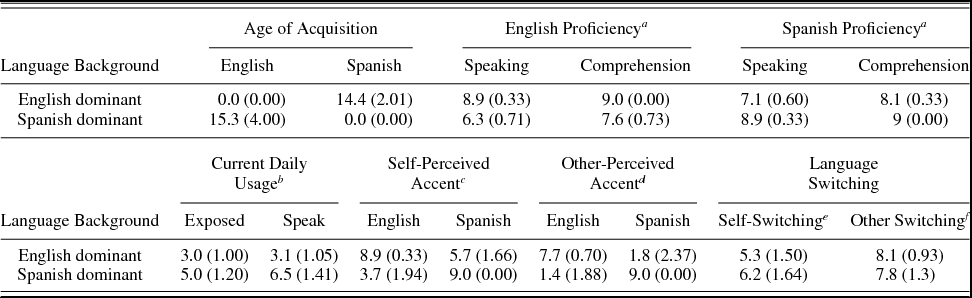
For the purposes of the current study, English-dominant participants (n = 9) are defined as those having learned English as an L1, beginning acquisition of Spanish after the age of 12 (M = 14.4, SD = 2.00), and self-rating as more dominant in English than in Spanish. Spanish-dominant participants (n = 9) are defined as those having learned Spanish as an L1, starting acquisition of English after the age of 12 (M = 15.3, SD = 4.00), and self-rating as more dominant in Spanish than in English. All English-dominant participants reported learning Spanish in the L2 classroom, as well as via immersion of various durations. All Spanish-dominant participants, although varying in L2 classroom experience, reported English-language immersion experience. Given the age of acquisition criteria, there was no potential overlap in subject categorization, with subjects not fitting these criteria eliminated in a prescreening process. Addressing language abilities, subjects were asked to self-rate their skills in English and Spanish, for both speaking and comprehension, on a Likert scale of 1 to 9 (1 = don't understand, 9 = native speaker). English-dominant participants self-rated their English as stronger than their Spanish in both speaking (English: M = 8.9, SD = 0.33; Spanish: M = 7.1, SD = 0.60) and comprehension (English: M = 9, SD = 0; Spanish: M = 8.1, SD = 0.33). Statistical analysis, employing paired two-tailed t tests, confirms that English-dominant participants self-rated their English abilities significantly greater than their Spanish abilities, speaking: t (8) = 8.00, p < .001; comprehension: t (8) = 8.00, p < .001. Correspondingly, Spanish-dominant participants rated their Spanish as stronger than their English in both speaking (English: M = 6.3, SD = 0.71; Spanish: M = 8.9, SD = 0.33) and comprehension (English: M = 7.6, SD = 0.73; Spanish: M = 9, SD = 0), with differences reaching statistical significance, speaking: t (8) = –8.69, p < .001; comprehension: t (8) = –5.96, p < .001. Similar trends were also found in reporting of current daily exposure, self-perceived accent, and other-perceived accent, as shown in Table 1.
Language Experience and Acquisition Questionnaire results

aLikert scale 1–9: 1 = don't understand, 9 = native speaker.
bLikert scale 1–9: 1 = only English, 9 = only Spanish.
cLikert scale 1–9: 1 = very heavy accent, 9 = no accent.
dLikert scale 1–9: 1 = always perceived as nonnative, 9 = never perceived as nonnative.
eLikert scale 1–9: 1 = never switch, 9 = frequently switch.
fLikert scale 1–9: 1 = confusing when others switch, 9 = seems normal when others switch.
Finally, considering that not all bilingual communities and speakers engage in language switching, participants were asked to evaluate how often they switch languages, and how comfortable they are when others switch languages. The results showed that both groups of speakers switch languages with similar frequency and are equally comfortable when others switch languages, nonpaired t test: t (33) = –0.582, p = .565. In short, all speakers are considered to be proficient Spanish–English bilinguals, dominant in their L1, and equally receptive to code switching. Given these shared backgrounds, and considering the preliminary statistical comparison by group (see Naming Latency Results section), the two groups were collapsed for analysis.
Stimuli
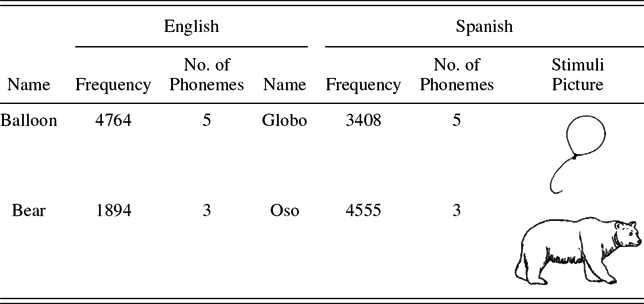
Target stimuli for the cued picture-naming study consist of 25 black-and-white line drawings of nonambiguous objects taken from Snodgrass and Vanderwart (Reference Snodgrass and Vanderwart1980). The target names have an average of 3.92 phonemes in both English (SD = 0.86) and Spanish (SD = 0.64), and statistical analysis showed that there is no significant difference in number of phonemes between the two languages, t (24) = 0.000, p = 1.00. All tokens are considered to be of high frequency, among the 5,000 most frequent words in each language, with no significant difference in frequency between the items in English (M = 1,990.7, SD = 1,544.8) and Spanish (M = 1,905.1, SD = 1,349.0), t (24) = 0.410, p = .685 (for English: Davies & Gardner, Reference Davies and Gardner2010; for Spanish: Davies, Reference Davies2005). All tokens are considered to be noncognate, lacking an opposite language counterpart with similar meaning, orthography, and phonology (e.g., de Groot, Reference de Groot, Frost and Katz1992).2 An additional 100 pictures (Snodgrass & Vanderwart, Reference Snodgrass and Vanderwart1980), also representing noncognate names to minimize any cross-linguistic activation, were used as fillers. Table 2 shows sample target pictures, with names in English and Spanish, as well as frequency and number of phonemes.
Sample stimuli
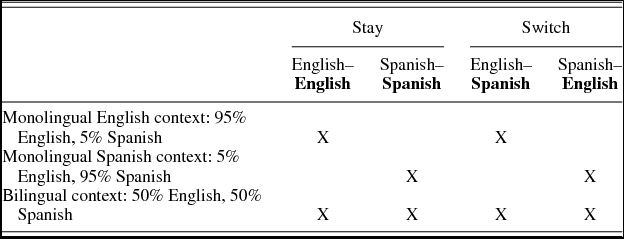
To investigate the effect of language context, each subject named the target pictures in three separate conditions. The monolingual English context consisted of 95% of tokens to be named in English and 5% to be named in Spanish. The monolingual Spanish context condition consisted of 95% of tokens to be named in Spanish and 5% to be named in English. Although not truly representative of monolingual, noncode-switched stimuli, the terms monolingual English and monolingual Spanish are used to imply that stimuli are representative of the more monolingual end of the spectrum of language contexts. To facilitate discussion, the monolingual English and monolingual Spanish contexts are referred to as the monolingual contexts. The bilingual context condition consisted of exactly 50% of tokens named in English and 50% named in Spanish.3 Stimuli presented in each of the contexts were randomized, such that the language of the following stimulus to be named was never predictable by the subject. Each condition was presented in a separate experimental session, administered on different days. The order of the sessions was counterbalanced across all participants, and all participants received a different randomized ordering.
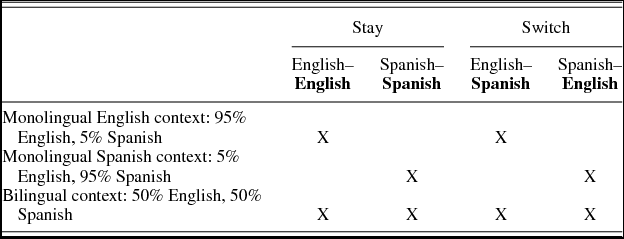
Within each condition, stimuli were presented in trials consisting of a short list of pictures, varying from 6 to 14 pictures in length (M = 10), presented visually using SuperLab Pro 4.1.2 (Cedrus Corporation, 2010) experimental software. Targets were named in English and Spanish, as both switch and stay tokens. Switch tokens are defined as those in which the language of response was different from that used in the immediately preceding token. Stay tokens are those in which the language of response was the same as that used in the immediately preceding token. The first picture in a list was always a filler, and thus never analyzed as a switch or a stay trial. In the monolingual English context, only pictures named in English as stay tokens and in Spanish as switch tokens were included for analysis. In the monolingual Spanish context, pictures named in Spanish as stay tokens and in English as switch tokens were analyzed. In the bilingual context condition, pictures named in both English and Spanish as stay and switch tokens were analyzed (e.g., Olson, Reference Olson2013). Table 3 illustrates the distribution of the target tokens analyzed, in bold, by condition. Switch costs are defined as the difference between switch and stay target tokens (ms) in either the monolingual or the bilingual contexts. For example, switch costs for Spanish in the monolingual context are calculated as the difference in the Spanish stay tokens produced in the Spanish monolingual context and the Spanish switch tokens produced in the English monolingual context. In total, there were 600 tokens per speaker and a total of 10,800 target tokens: 25 stimuli × 2 language (Spanish/English) × 2 stimuli types (stay/switch) × 2 contexts (monolingual/bilingual) × 3 repetitions × 18 subjects = 10,800 tokens.
Target tokens by condition
Procedure
The cued picture-naming study, based in part on previous research paradigms (Costa & Santesteban, Reference Costa and Santesteban2004; Costa et al., Reference Costa, Santesteban and Ivanova2006, Meuter & Allport, Reference Meuter and Allport1999; Olson, Reference Olson2013), was conducted in a quiet laboratory setting, with participants comfortably seated approximately 24 inches from a computer display. Through a series of instructional slides, participants were instructed to name pictures as “quickly and accurately” as possible, with the language of the token based on the color of the background, red or blue. The color–language pairings were counterbalanced across all participants, with half instructed that red indicated English and blue indicated Spanish. The remaining half of the participants received the inverse color–language pairing.
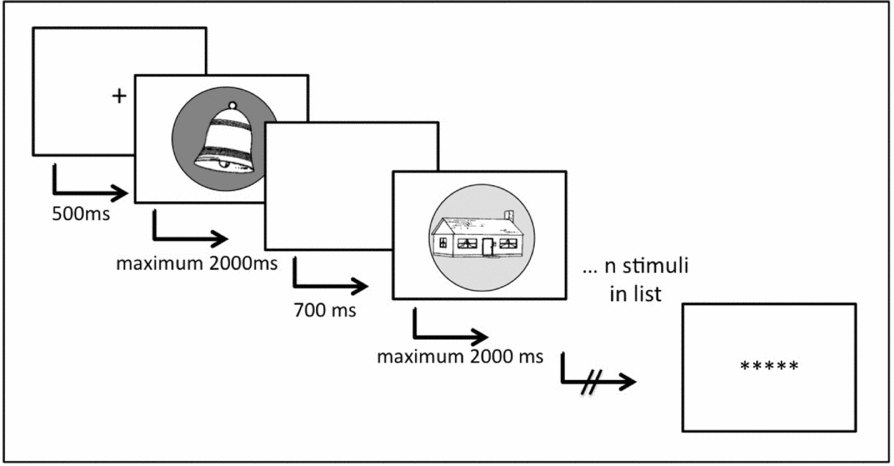
Each session began with the presentation of instructions, with the language of the instructions corresponding to the predominant language of the session. For the bilingual context, half of the instructional slides were presented in English, half in Spanish. Following the instructions, participants were presented with a set of red and blue circles with the words ENGLISH and ESPAÑOL listed in the corresponding circles. Participants underwent a brief training, and three practice lists that were discarded from the analysis, to become familiar with the procedure and the color–language pairing. The switch to stay ratio used in the practice lists was identical to that in the following naming task. Each list began with a fixation cross, presented in the center of the screen for 500 ms, followed by the first picture of the list. Each stimulus picture was presented in the center of a red or blue circle (800 × 800 pixels) and remained on the screen until triggered by onset and offset of the voice key or 2000 ms passed. A blank interval of 700 ms was then presented, followed by the next stimulus in the trial list. The end of a trial list was signaled by a series of asterisks (*****). Participants self-started the following trial list by pressing the spacebar, and the opportunity for a short break was given after every 25 lists to limit fatigue. Figure 1 presents a schema for stimulus presentation in a given list.
A schema for stimulus presentation in a given list.
Naming latencies, or reaction times, were recorded using the Cedrus SV-1 Voice Key, with a 1-ms resolution, and SuperLab Pro 4.1.2 (Cedrus Corporation, 2010). Gain levels for the voice key were set for each subject and used in all three experimental sessions.
RESULTS
A total of 10,800 tokens were initially examined and coded for three different classes of errors: production errors, voice key failures, and outliers. Production errors included responses in the opposite language, false starts, and fillers. Voice key errors consisted of responses that were not registered by the voice key, generally the result of vocal productions not surpassing the set threshold. Finally, outliers, those responses more than 3 standard deviations from the mean for each individual, were eliminated. In total, 12.46% of the responses were eliminated, with 2.55% from production errors, 8.38% from voice key failures, and 1.54% from outliers, resulting in a total of 9,454 total tokens included in the statistical analysis. The total number of tokens eliminated from each subject was similar for both the English-dominant and the Spanish-dominant groups, as demonstrated by a one-way analysis of variance (F < 1.00, p = .639).
Three main factors were considered in the initial analysis of the dependent variable of naming latency: language context (monolingual context vs. bilingual context), response type (switch vs. stay token), and response language (L1 vs. L2). Naming latency was defined as the delay between the visual presentation of the picture stimuli and the onset of vocal production of the target token, and naming latency values were subjected to a square-root transformation to normalize the distribution of raw naming latencies for statistical analysis (e.g., Baayen, Reference Baayen2008). In addition, results make reference to the switch costs, defined as the difference between naming a given token in a stay condition versus a switch condition. Subsequent statistical analysis was conducted using R statistical software, version 2.6.2 (R Foundation for Statistical Computing, 2013), and employed the LME4 statistical package. The significance criterion was set at |t| = 2. As complementary to the naming latency data, error rates are presented for the L1 and L2.
Naming latency results
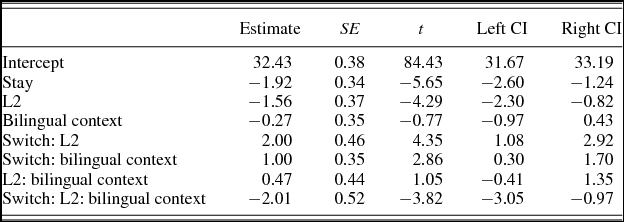
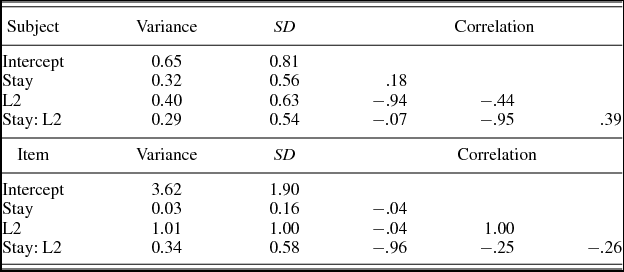
Initial statistical analysis for the combined subjects group4 was conducted using a linear mixed model with fixed factors of language context, response type, and response language, with subject and item as random factors with both random intercepts and slopes for each of the main factors and their interactions (see Barr, Levy, Scheepers, & Tily, Reference Barr, Levy, Scheepers and Tily2013). The results for all fixed effects are found in Table 4. For completeness, results for random effects are included in Appendix A. The results reveal a significant effect of response type, specifically between the intercept (switch in L1 of monolingual context) and stay (stay in L1 of monolingual context: β = –1.909, t = –5.65), with significantly slower naming latencies for switch tokens compared to stay tokens. The two-way interaction for Response Type × Language Context (β = 1.00, t = –2.86) was significant, as well as the two-way interaction for Response Type × Response Language (β = 2.002, t = 4.35). From this interaction, we can conclude that in the monolingual context, the difference between switch and stay is dependent on the L1 and L2. Finally, the three-way interaction for Response Language × Response Type × Language Context was significant (β = –2.01, t = –3.82), suggesting that the two-way Response Language × Response Type interaction may differ between the monolingual context and bilingual context.
Fixed effects of linear mixed effects model
Note: Fixed effects are response type (switch, stay), response language (first language, second language), and language context (bilingual context, monolingual context). CI, Confidence interval; L2, second language.
To assess the contribution of each of the above fixed factors, three subsequent models were conduced, each eliminating one of the fixed effects. The first model (log likelihood = –26,410) was then compared with each of the subsequent models. The results indicated that inclusion of each of the factors significantly improved the overall fit of the model: response language, log likelihood = –26,422, χ2 (1) = 23.68, p < .001; response type, log likelihood = –26,425, χ2 (1) = 29.75, p < .001; and language context, log likelihood = –26,419, χ2 (1) = 16.71, p = .002.
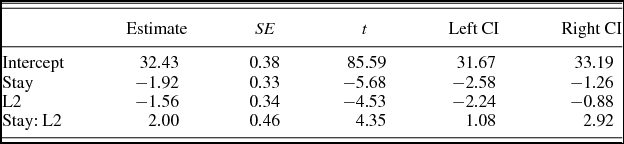
To better understand the interactions between the main factors, it is worth considering the data in the monolingual and bilingual contexts separately. As such, separate linear mixed effects models were conducted for the monolingual and bilingual context data with fixed factors of response type and response language, and subject and item as random factors with both random intercepts and slopes for each of the main effects and their interactions (Barr et al., Reference Barr, Levy, Scheepers and Tily2013).
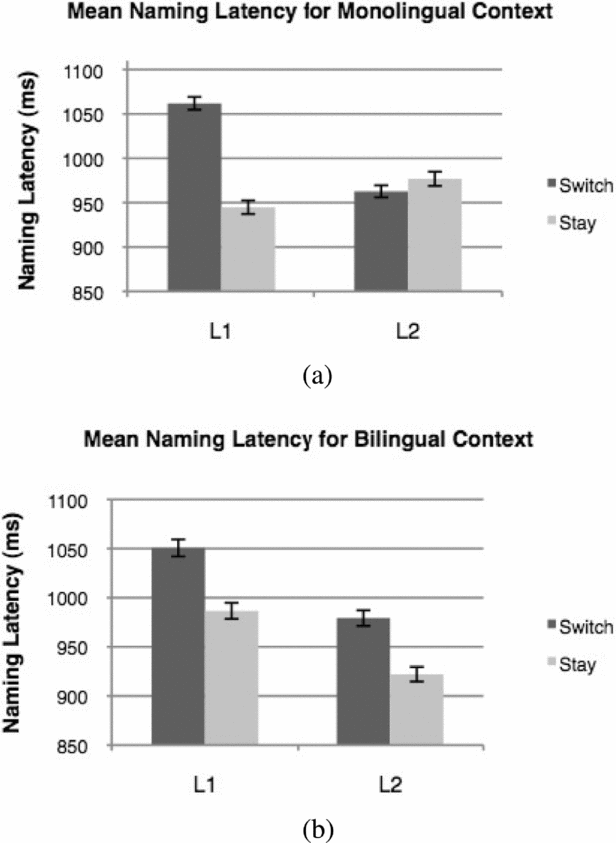
The results of the model conducted for the data in the monolingual context (Table 5) reveal a significant difference between the intercept (switch in L1) and the stay (stay in L1; β = –1.92, t = –5.86; for random effects see Appendix B). However, as demonstrated by the interaction of Response Type × Response Language (β = 2.00, t = 4.35), the effect of language switching was different in the L1 and the L2. A preliminary observation of the raw naming latencies for the monolingual context, illustrated in Figure 2a, highlights the difference in the effect of language switching between the L1 and the L2. Specifically, while there was a large difference between the switch (M = 1061 ms, SD = 249.2) and the stay (M = 945 ms, SD = 265.6) tokens in the L1, these differences were minimal in the L2 (switch: M = 963 ms, SD = 237.6; stay: M = 976 ms, SD = 279.1) Thus, in the monolingual context, switch costs were asymmetrical, with greater switch costs observed in the L1 relative to the L2. This result replicates the asymmetrical switch costs found in previous language switching paradigms (e.g., Meuter & Allport, Reference Meuter and Allport1999).
Fixed effects of linear mixed effects model for monolingual context
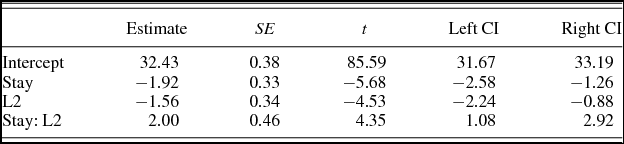
Note: Fixed effects are response type (switch, stay) and response language (first language, second language). CI, Confidence interval; L2, second language.
Raw naming latencies in the (a) monolingual context and (b) bilingual context. Error bars represent ± 1 SE.
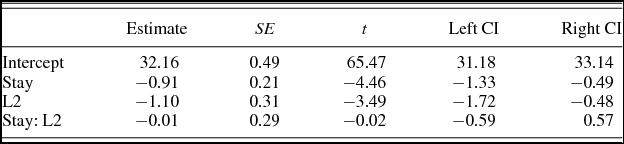
Similar analysis for the bilingual context (Table 6) reveals a different pattern (for random effects see Appendix C). While results of the linear mixed effects model revealed significant effect of both response type (β = –0.91, t = –4.46) and response language (β = –1.10, t = –3.49), there was no interaction between response type and response language (β = –0.01, t = –0.02). Figure 2b highlights these finding, showing that naming latencies were greater for switch tokens relative to stay tokens in both L1 (switch: M = 1050 ms, SD = 293.0; stay: M = 986 ms, SD = 275.9) and L2 (switch: M = 979 ms, SD = 271.1; stay: M = 922, SD = 252.6). Notably, in contrast to the monolingual context, there is no difference in the effect of language switching between the L1 and the L2.
Fixed effects of linear mixed effects model for bilingual context
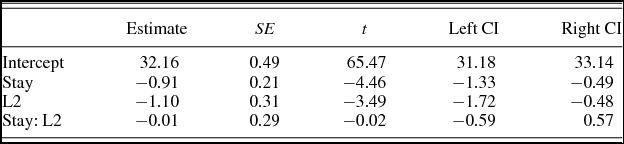
Note: Fixed effects are response type (switch, stay) and response language (first language, second language). CI, Confidence interval; L2, second language.
Analysis of switch costs
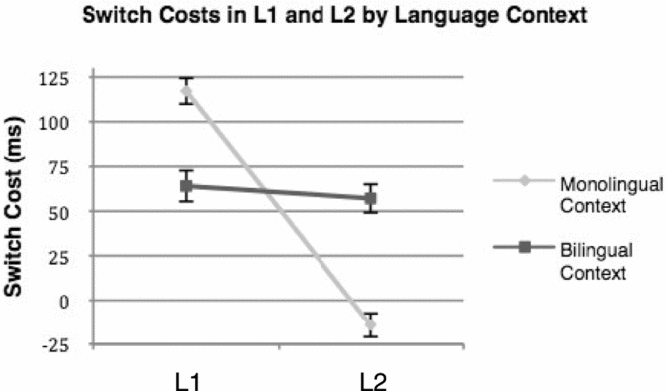
Analysis of the switch costs serves to highlight the asymmetrical differences between switch and stay tokens in the L1 and the L2 and the modulating effect of language context. Again, switch costs are defined as the difference in the naming latency between a switch token and a stay token. Specifically, in the monolingual context, subjects showed a greater switch cost for the L1 (M = 116 ms) than for the L2 (M = –13 ms). For statistical analysis, switch costs were calculated for each switch token by subtracting the mean naming latency for stay tokens in a given response language and language context from each individual switch token in the same response language and language context. Subsequently, a two-sample t test, with unequal variance, comparing L1 and L2 switch costs in the monolingual context, confirmed the statistical significance of the asymmetry, t (2,403) = 13.256, p < .001, d = 0.54. In the bilingual context, however, subjects showed much smaller differences in the switch costs between the L1 (M = 64 ms) and the L2 (M = 57 ms), with subsequent analysis showing no significant difference in the L1 and the L2 switch costs, t (2,272) = 0.588, p = .557, d = 0.02. Figure 3 highlights the asymmetrical nature of the switching costs in L1 and L2, and the effect of language context on switch costs. The difference between switch costs in L1 and L2 is greater in the monolingual context than in the bilingual context.
Effect of language context on switch costs in first language (L1) and second language (L2). Error bars represent ± 1 SE.
In summary, in the monolingual context, bilinguals showed the expected asymmetrical switching costs, with switches into the L1 incurring greater switch costs than switches into the L2. These asymmetries, however, were neutralized in the bilingual context, with similar switch costs being incurred in both L1 and L2.
Error rates
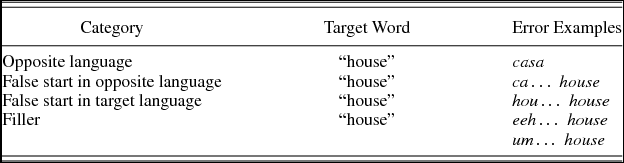
Tokens containing errors were eliminated from the analyses of the naming latencies, given that they constituted speech errors and thus are not representative of normal naming latencies, yet an examination of the pattern of errors sheds light on some of the difficulties of lexical access in a cued language switching paradigm. The analysis of error rates focuses on the production errors, accounting for 2.6% of total responses (276 tokens), because such errors most clearly correlate with subject performance. Production errors were categorized as: (1) responses in the opposite language, (2) false starts in the opposite language, (3) false starts in the target language, and (4) fillers (Table 7). Given the limited number of total tokens, the analysis centers on observation of error rates and patterns as opposed to statistical analysis.
Production error examples
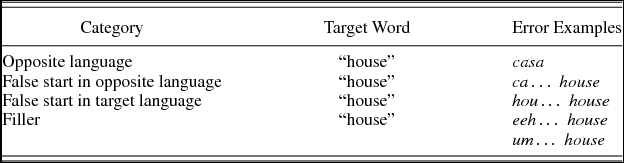
In considering the total number of errors, bilinguals made more errors on switch tokens (69.8%) relative to stay tokens (30.2%). In addition, participants made more errors in their L1 (65.8%) relative to their L2 (34.2%). It is interesting that a majority of errors consisted of productions in the opposite language (responses in the opposite language = 51.5%; false starts in the opposite language = 24.7%). However, of most interest are the asymmetries found in the error rates between L1 and L2 and the effect of language context on these asymmetries.
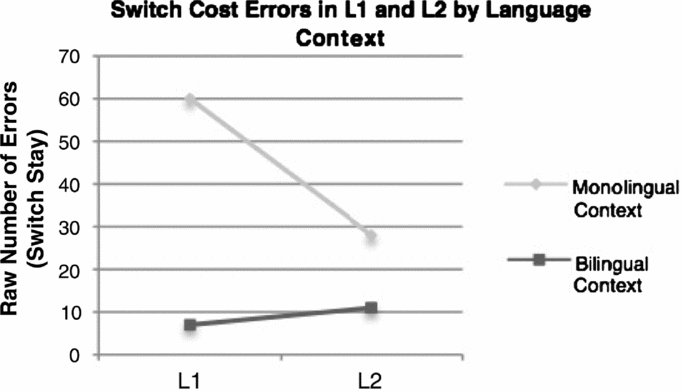
As with the reaction time data, error rates can be discussed in terms of error switch costs, here defined as the number of errors made when switching into a given language minus the number of errors made when staying in the same language. In the monolingual context, participants demonstrated a substantial asymmetry, with greater error switch costs in their L1 (cost = 60 additional errors) relative to their L2 (28 errors). In the bilingual context, in contrast, the error switch costs were much more similar between the dominant (7 errors) and the nondominant languages (11 errors). Of importance, these findings for the switch costs errors pattern with the switch costs found for the reaction time data. Figure 4 illustrates the total switch costs in errors by language context.
Switch cost errors in first language (L1) and second language (L2).
DISCUSSION
The main goal of the current study was to examine the effect of language context on language switching costs. The results, drawing primarily on naming latencies, demonstrate a significant impact of language context on switch costs. Specifically, L1-dominant bilinguals showed asymmetrical switching costs in the monolingual context, such that they incurred significantly greater costs switching into their more dominant language relative to the nondominant language. However, in the bilingual context, symmetrical switch costs were found, with no significant difference in the switch costs incurred in the dominant and nondominant languages for either of the L1-dominant bilingual groups. Error rates, assessed for general trends and taken as complementary results to the main analysis of naming latencies, patterned after the naming latency switch cost findings. In the monolingual context, both groups demonstrated greater error switch costs in their dominant language relative to their nondominant language. In the bilingual context, the switch cost in terms of errors was roughly the same in the dominant and the nondominant languages.
Stemming from these results, the remainder of the discussion will be dedicated to discussing the implications for an inhibitory control framework, drawing support from current and previous results, as well as notions of global reactivity.
The effect of language context
The results presented above, most particularly in the monolingual context, first serve to replicate previous findings, albeit with a more extreme switch to stay ratio. The findings are in line with the asymmetrical switching costs that have been reported in Spanish–Catalan (Costa & Santesteban, Reference Costa and Santesteban2004), Spanish–Korean (Costa & Santesteban, Reference Costa and Santesteban2004), and even English-dominant learners of Spanish (Schwieter & Sunderman, Reference Schwieter and Sunderman2008). In tandem with similar results found in other language pairings, the results for English-dominant and Spanish-dominant bilinguals in the current study add to the view of a universal nature of the language switching mechanism. In addition, given that they pattern closely after previous findings, the results found in the monolingual context serve to validate the methodology and stimuli used in the current experiment.
One of the key findings in the current study is the effect of language context on naming latencies and switch costs. Language mode (e.g., Grosjean, Reference Grosjean1985), akin to language context, has been described as a continuum along which bilinguals operate, extending from monolingual in Language A, through balanced bilingual, to monolingual in Language B. In experimental paradigms examining the effect of language mode, there have been several studies confirming that bilinguals' placement along the language mode or language context continuum impacts production, primarily limited to the domain of phonetics and pragmatics in code switching (Khattab, Reference Khattab, Parkinson and Benmamoun2003; Lanza, Reference Lanza1992; Olson, Reference Olson2012; Treffers-Daller, Reference Treffers-Daller and Jacobson1998; Weil, 1990, as cited in Grosjean, Reference Grosjean2008). While issues in lexical access may often be obscured in discourse, in part by utterance preplanning (Swerts & Geluykens, Reference Swerts and Geluykens1994), the cued picture-naming study employed here offers an ideal paradigm to examine the effects of language context on lexical access.
Although previous cued picture-naming studies have demonstrated asymmetrical switch costs for L1-dominant bilinguals (Costa & Santesteban, Reference Costa and Santesteban2004; Costa et al., Reference Costa, Santesteban and Ivanova2006; Meuter & Allport, Reference Meuter and Allport1999; Philipp et al., Reference Philipp, Gade and Koch2007; Philipp & Koch, Reference Philipp and Koch2009), it should be noted that all of the previously cited studies employed a fixed switch to stay ratio, generally 30% switch–70% stay. Thus, while these results have been consistent, they represent roughly similar positions along the language context continuum. The current study, varying the switch to stay ratio (5% switch–95% stay to 50% switch–50% stay), showed a clear effect of language context on both switch costs and error rates, with the asymmetrical switch costs in the monolingual context differing significantly from the symmetrical switch costs in the bilingual context for L1-dominant bilinguals. These results also reflect previous findings in the task switching literature, in which varied switch ratios led to differing shift costs (Bonnin et al., Reference Bonnin, Gaonac'h and Bouquet2011; Driesbach & Haider, Reference Dreisbach and Haider2006; Monsell & Mizon, Reference Monsell and Mizon2006), as well as findings for global language switching costs, in which naming latencies for nonswitched trials vary depending on the context (i.e., pure vs. mixed language blocks; Christoffels et al., Reference Christoffels, Firk and Schiller2007; Declerck et al., Reference Declerck, Philipp and Koch2013; Gollan & Ferreira, Reference Gollan and Ferreira2009; Wang et al., Reference Wang, Kuhl, Chen and Dong2009).
Considering the language context continuum, it is clear that when operating toward the monolingual ends of the language context continuum, subjects demonstrate asymmetrical switching costs. Toward the midpoint of the language mode continuum, however, language switching costs were symmetrical. Thus, changes in a speaker's position along the language context continuum result in changes in the temporal costs and accuracy associated with language switching and lexical access.
These results add empirically based evidence to the discussion of language context and language mode (e.g., Grosjean, Reference Grosjean1985), and expand on Green's (Reference Green2011) proposal for the role of speaker ecology in language selection. Specifically, while previous research has demonstrated an impact of language context on the type, number, and phonetic production of code switches produced in a naturalistic code-switched discourse, the current results show that language context plays an integral role in lexical access itself. When speakers are operating in a monolingual context, a language switch into the more dominant language is more costly, in terms of both reaction times and error rates, than when they are operating in a bilingual context. More specifically, language context not only impacts the language from which a given lexical item is selected but also affects the speed and accuracy with which a lexical entry is selected and produced.
In addition to adding to the discussion of language context and language mode, these results have substantial implications for ongoing research on bilingual lexical access. Specifically, the current results demonstrate an impact of language context on switch costs, and serve to illustrate the flexible nature of language switching costs and lexical access. While previous research has demonstrated asymmetrical switch costs for L1-dominant speakers (e.g., Costa & Santesteban, Reference Costa and Santesteban2004; Meuter & Allport, Reference Meuter and Allport1999), it is clear that this is not always the case. The results in the current study confirm that L1-dominant bilinguals may produce symmetrical switch costs in certain language contexts, a finding more strongly associated with balanced bilinguals (e.g., Costa et al., Reference Costa, Santesteban and Ivanova2006; for L1-dominant bilinguals, see Christoffels et al., Reference Christoffels, Firk and Schiller2007). This finding is not without precedent, as a number of studies have found specific conditions under which L1-dominant bilinguals may produce symmetrical switch costs, including long interstimulus interval (Verhoef, et al., Reference Verhoef, Roelofs and Chwilla2009) and nonforced switching (Gollan & Ferreira, Reference Gollan and Ferreira2009), yet these findings indicate that a contextual factor may serve to manipulate switch costs even in a cued-switching paradigm. Thus, switch costs are not only affected by language dominance, with speakers incurring greater switch costs in their more dominant language, but also subject to effects of language context, a previously unattested factor. As such, although current theories regarding the cognitive mechanism governing language switching have accounted for the effect of language dominance, the present findings suggest that they must also account for the effect of language context.
Language context and a gradient view of inhibition
Given the demonstrated effect of language context on lexical access, theories concerning the cognitive mechanisms governing bilingual language selection and language switching must be able to account for these effects. In early models of bilingual language selection, language selection was described in terms of a binary language switch (e.g., Penfield & Roberts, Reference Penfield and Roberts1959). In order for a bilingual to operate in Language A, Language A must be “on” while Language B remains “off.” Later models, accounting for performance in simultaneous translation tasks, proposed input and output switches that could be differentially set to on/off positions (Macnamara & Kushnir, Reference Macnamara and Kushnir1971), but the general principle remained unchanged. Within this framework, language selection occurs in a categorical manner, according to which if a language is selected, the competitor language must be nonselected.
More recently, the ICM (Green Reference Green1986, Reference Green1998) posits language selection as the product of selective inhibition. Broadly, targeting language-specific tags attached to each lexical entry, inhibition is applied to lexical entries of the nontarget language, resulting in selection of the target language. Support for the ICM has been drawn from a number of areas, including pathological switching (Alberta & Obler, Reference Alberta and Obler1978; Fabbro et al., Reference Fabbro, Skrap and Aglioti2000; Paradis, Reference Paradis, Whitaker and Whitaker1977; Paradis et al., Reference Paradis, Goldblum and Abidi1982), ERP and neuroimaging (Abutalebi et al., Reference Abutalebi, Brambati, Annoni, Moro, Cappa and Perani2007; Christoffels et al., Reference Christoffels, Firk and Schiller2007; Guo et al., Reference Guo, Liu, Misra and Kroll2011; Hernandez, Reference Hernandez2009; Hernandez et al., Reference Hernandez, Dapretto, Mazziotta and Bookheimer2001; Jackson et al., Reference Jackson, Swainson, Cunnington and Jackson2001; Price et al., Reference Price, Green and von Studnitz1999; Wang et al., Reference Wang, Xue, Chen, Xue and Dong2007), and, most relevant for the current study, cued language-switching paradigms (Costa & Santesteban, Reference Costa and Santesteban2004; Costa et al., Reference Costa, Santesteban and Ivanova2006; Linck et al., Reference Linck, Schwieter and Sunderman2012; Meuter & Allport, Reference Meuter and Allport1999; Philipp et al., Reference Philipp, Gade and Koch2007; Philipp & Koch, Reference Philipp and Koch2009). The results from the cued language-switching paradigms, particularly for L1-dominant bilinguals, have consistently evidenced asymmetrical switching costs (although see Gollan & Ferreira, Reference Gollan and Ferreira2009; Verhoef et al., Reference Verhoef, Roelofs and Chwilla2009). In accounting for the asymmetrical switch costs found in previous studies, it has been proposed that different degrees of inhibition are required on the dominant and the nondominant languages.
This interpretation certainly accounts adequately for the asymmetrical costs and impacts of language dominance found in the previous studies and may also account for the effect of language context. While previous results have pointed to inter-speaker variability in inhibition driven by proficiency, the current study suggests a gradient interpretation of inhibition as illustrated by intraspeaker variability by language context. The switch costs in the more monolingual contexts were asymmetrical, implying different levels of inhibition applied to the L1 and the L2. In contrast, the switch costs in the bilingual contexts were symmetrical, such that switching into dominant and nondominant languages incurred similar costs. If as described within the IC framework, switching costs result from the amount of inhibition on each language, then switching languages in a balanced context must entail roughly similar levels of inhibition on each competing lexical entry. Thus, the different patterns of switch costs found in the monolingual context and the bilingual context may be the product of different degrees of inhibition applied to the L1 and the L2 in the two contexts. As such, inhibition cannot be viewed as categorical, with an item being either inhibited or not. Rather, that inhibition patterns are different in the two contexts leads to a minimum of two differing levels of inhibition applied to each language.
Complementary to the analysis of the naming latencies, the error rates found in the current study parallel the findings for switching costs. Within an inhibitory approach, the asymmetrical error rates (monolingual context) may be indicative of greater inhibition on the L1 than the L2, resulting in more opportunities for unintended productions in the L2. As such, the difference in the error rate patterns between the monolingual and the bilingual contexts provides further support for, at minimum, two differing levels of inhibition applied to each language.
Drawing on the notion of language context as a continuum, it is reasonable to posit a continuum of inhibition applied to each language, resulting in a continuum of relative inhibition. Operation in a monolingual context in Language A would require maximal inhibition on Language B, with that maximum determined by a bilingual's language proficiency profile (i.e., greater inhibition on L1 relative to L2). Operation in a bilingual context, however, would require roughly equal levels of inhibition applied to Languages A and B. Intermediary points on the continuum would then evidence differing, gradient degrees of inhibition relative to their position on the continuum.
While the current results point to an effect of language context on switch costs, potentially owing to gradient degrees of inhibition, language context may be only one of many possible factors affecting the degree of inhibition. Encompassed within the notion of language mode is the assertion that there are a variety of factors that affect position along the language mode continuum, including linguistic, contextual, and psychological factors (Grosjean, Reference Grosjean1985, Reference Grosjean, de Groot and Kroll1997, Reference Grosjean1998, Reference Grosjean and Nicol2001, Reference Grosjean2008; Soares & Grosjean, Reference Soares and Grosjean1984). The current experiment manipulated only language context; however, it is reasonable to posit that language mode, not solely language context, is key for modulating the amount of inhibition applied to each language.
Local and global reactivity
While the effect of inhibition has been described as reactive, applied after activation of a given lemma (e.g., Green, Reference Green1998), the current results highlight a globally driven interpretation of reactivity, as opposed to a solely local one. Considering the cued picture-naming experiment, if inhibition were applied only after the language cue were presented (i.e., at a local level), then one would expect consistent naming latencies and switch costs, regardless of position along the language context continuum. However, if the degree of inhibition applied to a given set of lexical entries or tags were driven by the language context or the language mode, established throughout an experimental paradigm or discourse, we may expect different local switch costs in different contexts. In addition, the proposal of a global interpretation of inhibition is not without precedent in the ICM. Green (Reference Green1998) claims, “inhibition is assumed to be reactive though previous episodes of suppression may exert their effects, since it takes time for the effects of prior inhibition to be overcome” (p. 72). Given the above-demonstrated effect of language context on switch costs, there must be a process by which the preceding discourse or paradigm is assessed in order to shift local switch costs and the degree of inhibition accordingly.
A globally driven interpretation of the reactive nature of inhibition finds support in studies of global language mixing costs (Christoffels et al., Reference Christoffels, Firk and Schiller2007; Declerck et al., Reference Declerck, Philipp and Koch2013; Gollan & Ferreira, Reference Gollan and Ferreira2009; Wang et al., Reference Wang, Kuhl, Chen and Dong2009), in which longer latencies are found for nonswitch tokens in mixed language blocks relative to pure language blocks. Given that response times for stay tokens (i.e., tokens with identical local environments) change depending on the characteristics of the larger block (i.e., global), there is existent evidence for a global effect of language switching on lexical access. Furthermore, such findings can be couched within the discussion of language mode, with greater nonswitched latencies found in a more bilingual mode relative to a monolingual mode. In short, global language mixing costs, potentially subject to language mode, appear to be impacted by broader contextual factors, indicative of a globally reactive system.
In addition to accounting for global language mixing costs, the interpretation of the reactive nature of inhibition seems to account for the current results for local switch costs as well. While asymmetrical switch costs (i.e., local switch costs) were found in the monolingual context, symmetrical switch costs were found in the bilingual context. In short, the local switch costs were modulated by the global context. While this interpretation still allows for a reactive interpretation of inhibition, such that inhibition is applied after activation of a given lexical item, the degree of inhibition applied may be modulated by the global context.
Conclusion
While bilinguals are generally very proficient at separating their two languages, language switching also occurs to varying degrees, dependent on the context. As such, the mechanisms governing language switching must permit this wide range of performance. The current study, employing a cued picture-naming paradigm that varied language context, demonstrated significant effects of language context on lexical access in L1-dominant English–Spanish and Spanish–English bilinguals. These results were accounted for within a gradient interpretation of the ICM, drawing on notions of language mode (i.e., language context) and a glo-bally driven reactive nature of inhibition. Within this gradient IC framework, the degree of inhibition applied to a given lexical set is modulated by the broader language context. To accomplish this, inhibition must operate at the global level, such that the degree of inhibition to be applied to a given lexical set is determined by the preceding context. Thus, contexts consisting of a balance of L1 and L2 constituents will drive roughly equal levels of inhibition on the two languages. This gradient interpretation accounts for previous results of asymmetrical switching costs, as well as the current results for both temporal and accuracy switch costs.
Although the results from the current paradigm may be explained within an inhibitory framework, it is recognized that it may not be the only way to account for such results. Future research should address different proposals, as well as account for the performance of balanced bilinguals in cued-switching paradigms.
APPENDIX A
Random effects of linear mixed effects model
APPENDIX B
Random effects of linear mixed effects model for monolingual context
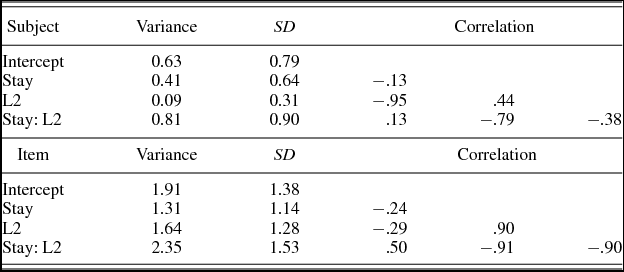
APPENDIX C
Random effects of linear mixed effects model for bilingual context
ACKNOWLEDGMENTS
This project is based on work supported by the National Science Foundation under Grant 1024320. Any opinions, findings, and conclusions or recommendations expressed in this material are those of the author and do not necessarily reflect the views of the National Science Foundation. I am indebted to the efforts of A. J. Toribio, M. Ortega-Llebaria, and the anonymous reviewers. Any errors remain my own.