Introduction
The Bruchinae is a diverse subfamily of Chrysomelidae (leaf beetles) with over 1650 valid species described in 70 genera, with its highest diversity in dry subtropical regions (Morse, Reference Morse, Leschen and Beutel2014). The members of this subfamily feed almost exclusively on seeds, a behavior unique among Chrysomelidae. Bruchinae constitutes the largest insect group to have acquired this feeding habit (Janzen, Reference Janzen1971; Morse, Reference Morse, Leschen and Beutel2014). This feeding specialization is very interesting, not only from an evolutionary perspective but also from an economic point of view. Some species can cause important losses on cultivated areas and, on the contrary, they are used as biological controllers of weed seeds. Bruchinae are known to constitute important seed controllers on seeds of wild legumes, such as Enterolobium Mart., Geoffroea Jacq., and Prosopis L., in the Monte and Chacoan regions. Economically important pest species are well known within Bruchinae, mainly including species of the genera Acanthoscelides Schilsky, Bruchus L., Callosobruchus Pic, and Zabrotes Horn, all associated with cultivated legumes (Fabaceae) (Morse, Reference Morse, Leschen and Beutel2014). Moreover, according to the latter author, around 70% of host associations for bruchines are constrained to the Fabaceae, yet, other hosts are also important, for instance, all New World Pachymerini are associated mainly with palms trees (Arecaceae).
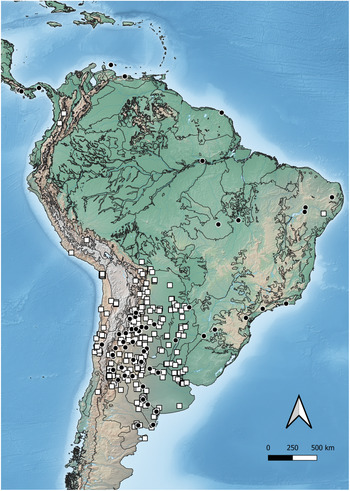
With 120 species, the genus Amblycerus Thunberg is the second largest American genus of Bruchinae after Acanthoscelides (Dos Santos and Ribeiro-Costa, Reference Dos Santos and Riberiro-Costa2019; and references therein). The genus is distributed from southern Canada to central Argentina (Romero et al., Reference Romero, Johnson and Kingsolver1996) and central Chile. The species herein studied [Amblycerus dispar (Sharp)] is currently included in the dispar species group which has been recently re-defined by Dos Santos and Ribeiro-Costa (Reference Dos Santos and Riberiro-Costa2019). These authors also provided a diagnosis, description of the adult, and a dichotomous key to the recognition of its species within the group. A. dispar is widely distributed (fig. 1) with presence records in Argentina, Brazil, Chile, Curaçao, French Guiana, Honduras, Panama, Paraguay, Peru, and the Bolivarian Republic of Venezuela.
Distribution map of A. dispar (black dots) and G. decorticans (white squares).

Although Amblycerus seems to prefer Fabaceae as hosts, the genus shows a very high plasticity when compared to other bruchine genera that are usually associated with one or a few plant families. Romero Nápoles et al. (Reference Romero Nápoles, Ayers and Johnson2002) conducted a phylogenetic analysis of Amblycerus including also the analysis of host evolution. Their results show that even if Fabaceae seems to be the ‘original’ host some species have been able to colonize others. In this regard, Dos Santos and Ribeiro-Costa (Reference Dos Santos and Riberiro-Costa2019) cite 14 plant families that have been associated with Amblycerus. According to them, the dispar species group also has a wide host association including ten plant species in eight families (Anacardiaceae, Combretaceae, Euphorbiaceae, Fabaceae, Humiriaceae, Rhamnaceae, Verbenaceae, and Rubiaceae).
Cazzaniga and Correge (Reference Cazzaniga and Correge1987), in a study analyzing the distribution of A. dispar (cited as A. caryoboriformis a junior synonym) in Argentina, conclude that this species should be considered to be specific seed parasite on Geoffroea decorticans (Gillies ex Hook. & Arn.) Burkart, as G. spinosa Jacq. [= G. striata (Willd.) J. F. Macbr.] is not recognized in their food item selection essay. G. decorticans is distributed from the north of Patagonia to the north of Argentina, Chile, south of Peru, Plurinational State of Bolivia, Paraguay, and Uruguay (Burkart, Reference Burkart1952). In Argentina, it is a familiar species commonly known by its vernacular name ‘Chañar’. The Chañar constitutes an important component of the Monte and Chacoan regions in Argentina. It is considered a valuable resource for local communities that use its bark as dye tincture and as medicine (antitussive). In addition, its fruits are edible and used to prepare a jam called ‘arrope’ (Cazzaniga and Correge, Reference Cazzaniga and Correge1987) and edible flour (Orrabalis et al., Reference Orrabalis, Gorostegui, Calandri and Guzmán2013).
Besides G. decorticans, Sarcomphalus mistol (Griseb.) Hauenschild, Ziziphus joazeiro (Rhamnaceae), and Spondias tuberosa Arruda (Anacardiaceae) also have occasionally been associated with A. dispar feeding behavior (Dos Santos and Ribeiro-Costa, Reference Dos Santos and Riberiro-Costa2019). Furthermore, González et al. (Reference González, Arretz and Campos1973) recorded the presence of A. dispar in ‘dry almonds’ in Chile without providing further information. We are now reporting it in stored almonds in Argentina (Mendoza province) for the first time.
The main goal of this study is to report the presence of A. dispar as a putatively harmful pest of stored almond seeds for the first time in Argentina. More particularly, we are interested in evaluating the potential risk of dispersion of this species to cultivated areas of the New World. The evaluation of the potential distribution of A. dispar will provide a useful hypothetical scenario to aid any future risk evaluation and to design pest management strategies. We performed species distribution models (SDMs) for A. dispar and its main natural host plant (G. decorticans). In addition, because the host shift to the Rosaceae has not been reported before, we are interested in expanding the previous phylogeny of the genus by including A. dispar as a terminal taxon, as well as to reanalyze the host evolution scenario formerly presented by the author of the mentioned phylogeny. Finally, as the taxonomy of this genus is complex and it has been changing in recent years, we provide illustrations, photographs, showing the most distinctive characters that will allow the recognition of this species.
Diagnosis of Amblycerus dispar (Sharp, Reference Sharp1885)
Note: See complete annotated synonymic list in Dos Santos and Ribeiro-Costa (Reference Dos Santos and Riberiro-Costa2019).
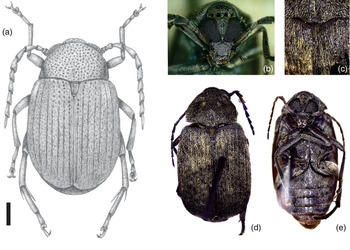
Diagnosis of adults (fig. 2a–e)
Length (average, females slightly larger): 7 mm; width 4 mm.
A. dispar: (a) illustration of dorsal habitus of adult, (b) head frontal view, (c) scutellum between the base of elytra and pronotum, (d) dorsal habitus, and (e) ventral habitus. Scale bar represents 1 mm.

Dos Santos and Ribeiro-Costa (Reference Dos Santos and Riberiro-Costa2019) provide the following diagnostic characters for A. dispar; eyes closer to each other anteriorly, ocular index: 9.5; median lobe of male genitalia about 4.5 times as long as its greatest width at apical region and internal sac at the apical region without sclerites. This species can be discriminated from related taxa of the species group by the following combination of morphological features: pronotum and elytra covered with yellowish or orange setae (fig. 2d); metepisternum with coarse punctures of smaller size (not so conspicuous) (fig. 2e); hind tibia with lateral spur about two times the length of the median spur (fig. 2a); pygidium with dense coarse punctures, pronotum with coarse punctures covering all the surface (fig. 2a, d); anterior interocular space narrow (fig. 2b). Characters from male genitalia are as follows: median lobe about 4.5× as long as its greatest width at apical region; apical region of internal sac without sclerites. However, the most useful character to separate the species of others is the armature of the internal sac of male genitalia.
Sexual dimorphism
The antennae of males are shorter, reaching the posterior region of humeral callus; antennomeres 8–11 not elongated or thinned as in females, and fifth sternum emarginate at apex of male.
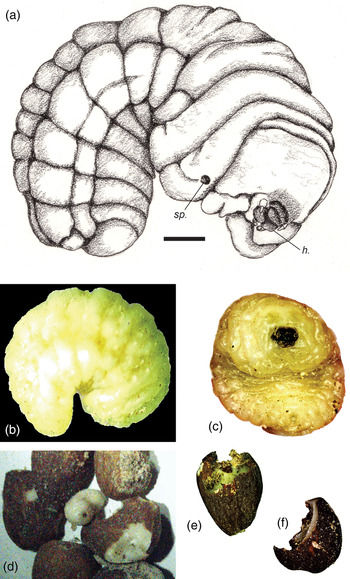
Diagnosis of mature larva (figs 3a–c) after Terán and Muruaga de L'Argentier (Reference Terán and Muruaga de l'Argentier1979). Length 7–8 mm, width 4–4.5 mm.
A. dispar mature larvae and damage caused to stored almonds: (a) mature larvae (lateral view), (b) photograph of mature larva (lateral view), (c) photograph of mature larva (frontal view), and (d–f), damage on stored almonds. Scale bar represents 1 mm.

The immature stages (egg, first instar, and mature larva) of A. dispar [=A. caryoboriformis (Pic)] were described by Terán and Muruaga de L'Argentier (Reference Terán and Muruaga de l'Argentier1979). The mature larva of A. dispar is characterized by a curved, whitish and robust body. Soft cuticle with tiny and numerous spines on anterior pronotum, prosternum, and below abdominal spiracles (fig. 3a (sp.)). The rest of the cuticle with short and fine setae, spaced, which are longer and more abundant on ventral surface of thoracic segments.
Head [(fig. 3a (h.)]: Cephalic capsule moderately sclerotized on frons (anterior half) and frontal suture (lateral sides). Clypeus most sclerotized area with one pair of setae and one pair of basal sensillae. Frons with two ocelli, three pairs of setae and one pair of sensillae. Five pairs of short setae and two pairs of sensillae (similar to deep and conical holes) behind frontal suture. Antennae with two segments, basal segment wider than first. Basal segment with one glandular sensillae; first or distal segment with two conic sensillae on apex. Antennal apex notorious, with primary setae. Mouthparts: labrum with numerous strong anterior spines and two robust setae. Maxillae with five spatulate setae and 5–7 simple setae on mala, W, X, and Y setae present; stipe and palpiger membranous area with variable number of setae. Labium with two pairs of ligular setae, two pairs of sensillae and one pair of setae on labial plate. Sclerotized area of submentum with one pair of short posterior setae.
Materials and methods
Specimens studied
Infested almonds by larvae of A. dispar were found during the selection procedure on 8 March 2020. The analyzed specimens of A. dispar were collected at Jocolí, Lavalle, Mendoza province (Argentina) (32°35′S–68°37′W). All the materials used in this study are deposited at IADIZA (CEI, Colección Entomológica del Instituto Argentino de Investigaciones de las Zonas Áridas, Mendoza, Argentina). The specimens studied consist of dried, pinned adults, and alcohol-preserved adults and larvae. Adults were obtained by rearing the larvae inside almonds on an observation plastic cage. Mature larvae were killed with hot water and preserved in 100% ethanol. Terminology for the morphological features follows Dos Santos and Ribeiro-Costa (Reference Dos Santos and Riberiro-Costa2019) for the adults, and Terán and Muruaga de L'Argentier (Reference Terán and Muruaga de l'Argentier1979) for the description of the mature larvae. All photographs were taken by the authors with a Leica EC3 digital camera, mounted on a Leica S6E stereomicroscope. The source photos were taken at multiple focal planes (at least five) and then combined into a single image (with all features in focus) using free software CombineZP. Drawings of adult and larvae were made with a camera lucida attached to a Leica S6E compound microscope by SR-J.
Occurrence data acquisition
Amblycerus dispar
We obtained a total of 64 occurrence data points by georeferencing geographic data from specimen labels at IADIZA Entomological Collection, and from the following literature sources: Cazzaniga and Correge (Reference Cazzaniga and Correge1987), Dos Santos and Riberiro Costa (Reference Dos Santos and Riberiro-Costa2019), Téran (Reference Terán1984), and Terán and Muruaga de l'Argentier (Reference Terán and Muruaga de l'Argentier1979, Reference Terán and Muruaga de l'Argentier1981). Decimal coordinates were assigned using gazetteers, Google Earth, and Geolocate (www.geo-locate.org), ignoring those geographical references that were too vague or ambiguous as to assign a precise location. All georeferenced data points are available in .csv format as Supplementary file S1. Distribution map for A. dispar and G. decorticans was made with QGIS Desktop 3.14, along with raster data from Natural Earth.
Geoffroea decorticans
We obtained a total of 510 occurrence data points by accessing the following public online data repositories: Sistema Nacional De Datos Biológicos (SNDB: www.datos.sndb.mincyt.gob.ar), the Global Biodiversity Information Facility (GBIF: www.gbif.org), and the online database of the Instituto de Botánica Darwinion (IBODA: www.darwin.edu.ar/Proyectos/FloraArgentina/BuscarEspecies.asp). All these sites were last accessed on October 2020. All georeferenced data points are available in .csv format as Supplementary file S1.
Species distribution model (SDM)
To perform the SDM, we used the Maxent algorithm due to its performance (e.g. Phillips et al., Reference Phillips, Anderson and Schapire2006; Warren and Seifert, Reference Warren and Seifert2011). The model and all the required tasks were performed in the Wallace package (Kass et al., Reference Kass, Vilela, Aiello-Lammens, Muscarella, Merow and Anderson2018) through R (R Core Team, 2020) using Maxnet (Phillips et al., Reference Phillips, Anderson, Dudík, Schapire and Blair2017). In order to reduce sampling bias, we use 25 km spatial filtering using nearest-neighbor distance (Peterson et al., Reference Peterson, Townsend Peterson, Soberón, Pearson, Anderson, Martínez-Meyer, Nakamura, Araújo, Levin and Horn2011) as implemented in Wallace using the thin function of the spThin R package (Aiello-Lammens et al., Reference Aiello-Lammens, Boria, Radosavljevic, Vilela and Anderson2015). The SDMs were conducted separately for A. dispar and G. decorticans using the parameters described below.
Environmental data
To predict the potential distribution of A. dispar and G. decorticans, we used the ENVIREM dataset v1.0 with 2.5 arc-min (~5 km resolution at the equator) resolution for the New World (current) dataset. This set of environmental rasters for ecological modeling was assembled by Title and Bemmels (Reference Title and Bemmels2017) and contains 16 climatic and two topographic variables which are considered relevant to species ecological processes. Temperature and precipitation data used to build ENVIREM come from the WorldClim, whereas the solar radiation data come from the Consortium for Spatial Information. More information about the ENVIREM dataset is available at https://envirem.github.io/#downloads.
Modeling, model evaluation, and model selection
For both taxa analyzed, the models were built using a minimum convex polygon defined by the occurrence data, considering a buffer zone of ~55 km (0.5°) to prevent the inclusion of unoccupied suitable areas (Peterson et al., Reference Peterson, Townsend Peterson, Soberón, Pearson, Anderson, Martínez-Meyer, Nakamura, Araújo, Levin and Horn2011), by means of the sp (Pebesma and Bivand, Reference Pebesma and Bivand2005; Bivand et al., Reference Bivand, Pebesma, Gómez-Rubio, Bivand, Pebesma and Gómez-Rubio2013) and rgeos packages (Bivand and Rundel, Reference Bivand and Rundel2017), both implemented in the Wallace routines. For both species, 10,000 background points were sampled, from within the minimum convex polygons, as pseudo-absence points and used in the training process of the models. In addition, within Wallace interface, we used the ENMeval package (Muscarella et al., Reference Muscarella, Galante, Soley-Guardia, Boria, Kass, Uriarte and Anderson2014) to perform the cross-validation in order to train and test the model. In order to do this, we partitioned our occurrence data using the Checkboard K = 2 spatial partition method. To avoid model overfitting, yet, maximizing proper identification of suitable areas we used models with regularization multiplier (RM) values ranging from 0.5 to 5.5 (with increments of 0.5), using five feature class (FC) combinations: L, LQ, H, LQH, and LQHP (L = linear, Q = quadratic, H = hinge, and P = product). The model evaluation was run in Wallace through the ENMeval R package considering the AICc, a modified Akaike Information Criterion that corrects for sample size (Symonds and Moussalli, Reference Symonds and Moussalli2011; Warren and Seifert, Reference Warren and Seifert2011).
The selected models were run with all thinned points using the dismo package (Hijmans et al., Reference Hijmans, Phillips, Leathwick and Elith2015) in Wallace, and projections to the New World were performed in order to detect plausible habitable areas for each taxon analyzed. For visualization of the models we use the complementary log–log to produce an estimate of occurrence probability (Phillips et al., Reference Phillips, Dudík and Schapire2020) to produce the output of the chosen model. The raster layers obtained were imported in QGIS Desktop 3.14, modifying the color range using the ‘singleband pseudocolor’ (min. value: 0.00424444, max. value: 0.913574) option as a band render, without altering the rest of the layer attributes. Ultimately, the results were compared with the areas where Prunus dulcis is produced on the basis of Rohrer (Reference Rohrer1967) and Sistema Nacional Argentino de Vigilancia y Monitoreo de plagas (2019).
Phylogenetic analysis
Incorporating A. dispar as a new terminal taxon, we performed a phylogenetic analysis using the 29 morphological characters datamatrix originally employed by Romero Nápoles et al. (Reference Romero Nápoles, Ayers and Johnson2002), without modifying any of the character codifications or scores. Thus, the complete character list, their respective states, and illustrations are provided in the study of Romero Nápoles et al. (Reference Romero Nápoles, Ayers and Johnson2002). On that matrix, we conducted a parsimony analysis with TNT 1.5 (Goloboff et al., Reference Goloboff, Farris and Nixon2008). All characters were treated as unordered. We inferred most parsimonious trees (MPTs) using a traditional heuristic search on the basis of Wagner trees, with 1000 random addition sequences (RAMs), under the tree-bisection reconnection swapping algorithm, saving up to ten trees per replicate, and collapsing trees after the search. This procedure was followed by a branch and bound search based on these trees stored from RAMs. We assessed branch support for the resulting topologies with Bremer support (Bremer, Reference Bremer1994) using up to ten suboptimal trees and 500 jackknife replicates (Lanyon, Reference Lanyon1985). Synapomorphies on the tree were mapped using the program Winclada 1.0000 (Nixon, Reference Nixon1999). We also used TNT character mapping to evaluate synapomorphies individually.
Parsimony optimization of host-plant use
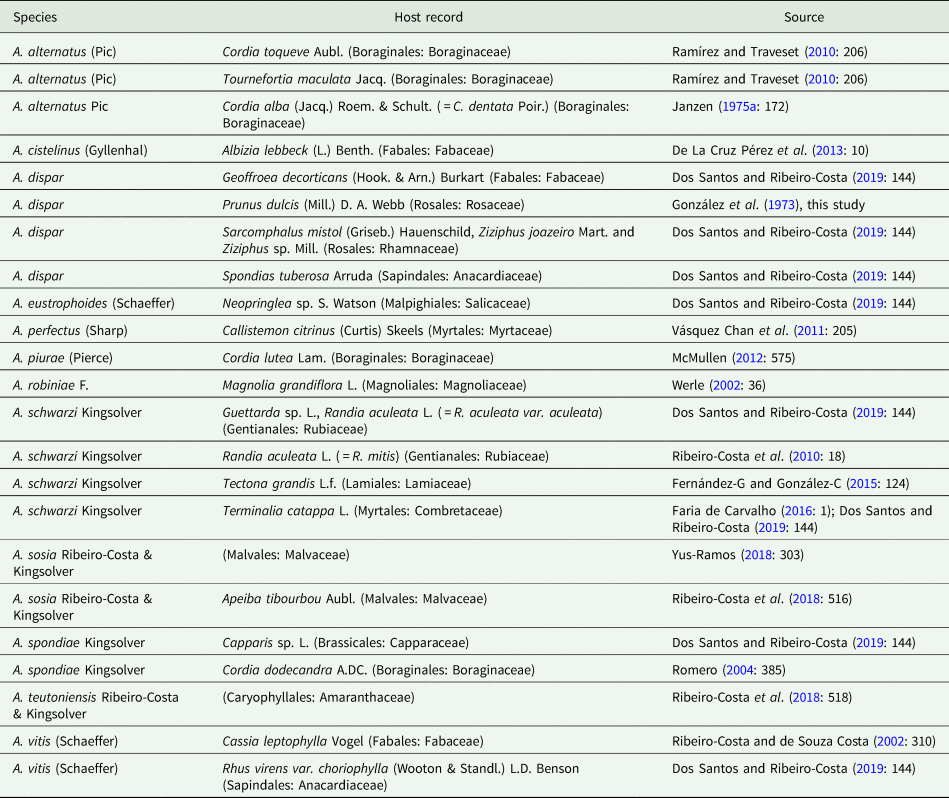
For this analysis, we used the host associations (at plant order and family levels) to all terminal taxa used by Romero Nápoles et al. (Reference Romero Nápoles, Ayers and Johnson2002), incorporating all known host families for A. dispar. We also expanded the host association matrix provided by Romero Nápoles et al. (Reference Romero Nápoles, Ayers and Johnson2002) by adding new data resulting from the search for new host records published since 2002 for each terminal taxa, considering only those records that represent new host plant associations at the order or family level. All the additions made to Romero Nápoles et al. (Reference Romero Nápoles, Ayers and Johnson2002) original dataset are given in table 1. Plant species names and classification for each host record were validated, using the online catalog (theplantlist.org) and APG (2016). Sterculiaceae and Tiliaceae are considered as subfamilies within Malvaceae since APG III (APG, 2009) therefore those host records placed under Sterculiaceae and Tiliaceae by Romero Nápoles et al. (Reference Romero Nápoles, Ayers and Johnson2002) were reassigned to Malvaceae.
Host plant records added to Romero Nápoles et al. (Reference Romero Nápoles, Ayers and Johnson2002) dataset

We performed a parsimony optimization as implemented in Mesquite program (Maddison and Maddison, Reference Maddison and Maddison2020), over the resulting phylogenetic tree of our cladistic analysis, to reconstruct the ancestral host-plant use by coding host-plant families and orders as multistate characters. The complete host association data matrix, in nexus format, along with the parsimony optimization over the MPT resulting from our analysis, can be found in Supplementary file S4. In order to visualize all state reconstructions, Supplementary file S4 must be opened in Mesquite.
Results
Life cycle, biological remarks, and observed damage on Prunus dulcis
The life cycle of Bruchinae is unique, the larvae develops entirely inside host seeds. Seed tissue penetration by larvae is aided by a toothed dorsal prothoracic plate present in the first instar larvae (Pfaffenberger and Johnson, Reference Pfaffenberger and Johnson1976). The larvae perforate the seed before pupation, starting what will constitute the proto-exit hole for the adult (Kingsolver, Reference Kingsolver2004). In general, the mature specimens complete the exit hole using their specialized mouthparts (Kingsolver, Reference Kingsolver2004). However, according to our observations on A. dispar feeding behavior on dry stored almonds, the larvae (one per almond) eats almost the complete almond (figs 3d–f), often breaking the seed and exposing the larvae which, in some cases, are forced to pupates outside the seed, situation that could lead to an increase in their mortality. These observations differ from the strategies seen on G. decorticans, that possess seeds with a ligneous endocarp covering a relatively larger seed of approximately 1 cm × 2.5 cm. When feeding on G. decorticans seeds, larvae are not exposed at any moment before reaching maturation, unless they are forced by an external interference. The larvae in our study were found on stored almond of the commercial varieties ‘Marinada’, ‘Guara’, and ‘Felicia’ that have different degrees of shell hardness. This was reported by the landlord since February–March 2017. The estimated damage produced on the productive area was reported to be less than 1% of total stored products.
Ultimately, it is interesting to remark that, according to Johnson et al. (Reference Johnson, Romero and Raimúndez-Urrutia2001), although other species within the genus Amblycerus the larvae feed on several seeds during their development, the larvae of A. dispar feed on only one during their entire development, which we corroborate by our observations on its new host (P. dulcis). Cannibalism was inferred by Terán and Muruaga de L'Argentier (Reference Terán and Muruaga de l'Argentier1979: 442) when more than one larva occupies the same seed in Chañar. We have not observed any indication of such behavior in P. dulcis, and as exposed above, seems to be clear that in some cases, a complete almond seed is unable to host even one larva.
Result of the potential distribution analysis and geographic range of treated species
Our compilation of occurrence data (fig. 1) shows that both species (A. dispar and G. decorticans) occur within the Neotropical, Andean and South American Transition Zone realms (sensu Morrone, Reference Morrone2014). Most records of both species belong to the following ecoregions (sensu Olson and Dinerstein, Reference Olson and Dinerstein2002): Dry Chaco, Low Monte, Espinal, and Humid Pampas, in accordance with their highest number of records. Other regions shared by these species are: Caatinga, Humid Chaco, Chilean Matorral, and Southern Andean Yungas but, with a lower number of occurrences. In addition, A. dispar has at least two records in the Alto Paraná Atlantic Forests, Serra Do Mar Coastal Forests, Isthmian-Pacific Moist Forests, Low Monte, and Amazon-Orinoco-Southern Caribbean Mangroves. Therefore, G. decorticans (A. dispar main host) is likely to be present in the latter ecoregions. In addition, G. decorticans has a more extended distribution range, with at least two records in the following regions where A. dispar has not been recorded: Atacama Desert, High Monte, Patagonian Steppe, Southern Andean Steppe, Chiquitano Dry Forests, Bolivian Montane Dry Forests, Central Andean Puna, Southwest Amazon Moist Forests, Central Andean Dry Puna, Paraná Flooded Savanna, Valdivian Temperate Forests, and Uruguayan Savanna.
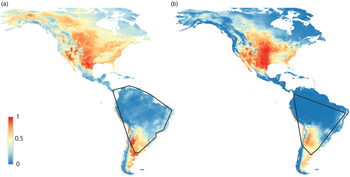
We selected the best performing SDMs according to their lowest delta AICc score (see Supplementary file S2: tables 1, 2). The chosen parameters for both species are FC = LQ, RM = 2.0. The SDMs for both species are similar to some degree (fig. 4) with the most suitable areas for both species located mainly in west-central Argentina and Chile. These regions are coincident with the northern border of the production zone of almonds of P. dulcis in these countries, being the cultivated regions to the south of Argentina and Chile less suitable for both species. In the southern hemisphere, the projections of the SMDs show that Patagonia is also a suitable location for the distribution of both A. dispar and G. decorticans. Concerning North America, the area of northern Mexico and central-west of the USA are very appropriate for both A. dispar and its natural host. The latter region has been also used for P. dulcis production, although none of these species are native to the USA. Nevertheless, this region is evidently more suitable for G. decorticans than A. dispar. Even when both species are not native to the USA, G. decorticans has been cited as an alien invasive species (Johnson, Reference Johnson1997).
Map showing the predictions of suitability for A. dispar (left) and G. decorticans (right). Based on Maxent model (0 = low, 1 = high). Areas within the polygon correspond to the model prediction, and outside the polygon to the projection.

Result of phylogenetic analysis and parsimony host optimization of host-plant use
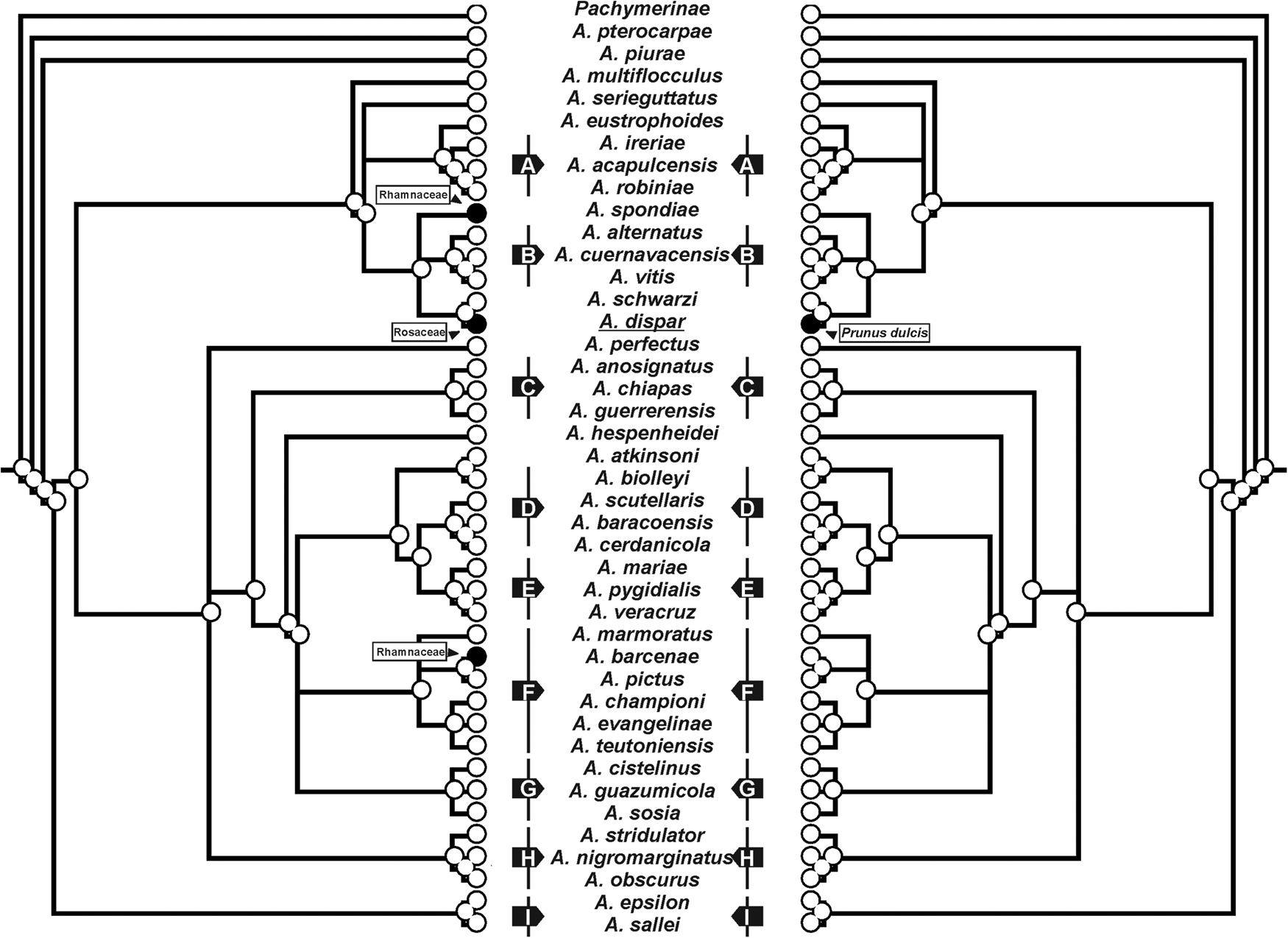
Our cladistic analysis resulted on one MPT with 62 steps (see Supplementary file S3). As expected, the internal relationships among species are most likely to the ones obtained by Romero Nápoles et al. (Reference Romero Nápoles, Ayers and Johnson2002) preserving almost all the clades as originally proposed (i.e. alternatus, anosignatus, cistelinus, epsilon, ireriae, mariae, marmoratus, and stridulator clades). The only difference found in our cladograms is that A. biolleyi (Pic) is not included within the baracoensis clade but conform a new clade with A. atkinsoni Romero, Johnson & Kingsolver as its sister species. Additionally, A. dispar conform a new clade as the sister species of A. schwarzi, which is the only species of the dispar species group included in Romero Nápoles et al. (Reference Romero Nápoles, Ayers and Johnson2002) phylogeny. Regarding hosts’ associations among the taxon sampling herein studied, there are few interesting cases of associations with magnoliids and commelinids (monocots). However, most host records were found in the superrosids linage (fabids and malvids, including Vitales), and among the superasterids, with most associations for the lamiids, and one case with Caryophyllales, but no association within the campanulids. An interesting aspect to note is that, according to our host optimization analysis (fig. 5), the association with Rosaceae is unique among the considered Amblycerus species. The only other known host association within the order Rosales occurs within the family Rhamnaceae for A. barcenae (Dugès) and A. spondiae (Romero Nápoles et al., Reference Romero Nápoles, Ayers and Johnson2002 and references therein) being both species outside the dispar group.
Host-plant association. Parsimony reconstruction for Rosales (left) and Rosaceae (right) optimized over the MPT obtained by our phylogenetic analysis. Black dots indicate positive host association at the order or family level, respectively. Letters (A–I) refer to Amblycerus clades proposed by Romero Nápoles et al. (Reference Romero Nápoles, Ayers and Johnson2002). Known host plant family association for each clade are as follows: (A) ireriae (Fabaceae, Magnoliaceae), (B) alternatus (Anacardiaceae, Boraginaceae, Fabaceae, Vitaceae), (C) anosignatus (unknown host plants), (D) baracoensis (Boraginaceae), (E) mariae (Boraginaceae), (F) marmoratus (Amaranthaceae, Arecaceae, Boraginaceae, Rhamnaceae), (G) cistelinus (Fabaceae, Malvaceae), (H) stridulator (Fabaceae), (I) epsilon (Fabaceae). See the complete host association data matrix in Supplementary file S4.

Discussion and conclusions
Even when the phylogeny proposed by Romero Nápoles et al. (Reference Romero Nápoles, Ayers and Johnson2002) is not appropriate as a valid monophyly test for the genus Amblycerus, as it forces the monophyly of the genus by using only one outgroup taxon, it is in fact useful to the study of the internal relationships among the species of the genus. A further expansion of its taxon sampling would provide a much better understanding of the relationships within the group. The inclusion of A. dispar as terminal taxon, the update of host records for each taxon, as well as the different methodological approaches for the study of host association (i.e. parsimony optimization), clearly show that the colonization of Rosaceae ( = P. dulcis) is unique to A. dispar. Therefore, the study of the genetic (e.g. possible presence of plant cell wall-degrading enzymes), behavioral, and physiological features that enabled this host shift constitute an interesting case that requires further study.
Although the presence of A. dispar on stored almonds is unusually reported in cultivated areas, with only one citation for Chile almost 50 years ago and being this the first report in Argentina, we advise the producers to monitor their production, especially if some of the known host plants for A. dispar are present nearby. This study constitutes the only known mentions of the damage produced by this species to stored almonds to date, and the producer reported only a minor impact ca. 1% of total production. However, further studies are necessary in order to assess correctly the probable economic impact that this bruchid may cause.
It is also important to remark that the presence of this parasite is easy to detect, since the effects of the larva in the infected almonds are evident during the selection process. In this regard, we hope our study to aid for proper identification of the Amblycerus specimens and affected almonds.
For other cultivated regions in the New World monitoring is also advisable. The projection of our model shows that the regions of almond production in the USA, that is currently the first producer of almonds in the world reaching 78% of the world's almond production (Sottile et al., Reference Sottile, Massaglia and Peano2020), has a high suitability for A. dispar. It is necessary to take into account that host shifts in other Bruchinae might occur, and that G. decorticans has been recorded as an alien species in the USA (Johnson, Reference Johnson1997). Therefore, this study should be taken as an early alert to all almond producers. It is also necessary to remark that the most likely restriction that prevents A. dispar from colonizing some of the projected areas with high suitability seems to be the absence of a suitable plant host. In that sense, it is important to pay special attention to potential host species for A. dispar in cultivated areas, as this might promote the proliferation of this seed beetle in not native environments. It is also important to remark that even if our SDM shows high suitability for some regions in the USA, the presence of A. dispar as parasites of stored almonds in the USA is mostly remote (or even impossible). However, host plasticity has been proven in other Amblycerus species (Dos Santos and Ribeiro-Costa, Reference Dos Santos and Riberiro-Costa2019 and references therein) and the association with Rhamnaceae (i.e. another family within Rosales) has already been described for A. spondiae, A. dispar, and A. barcenae, all three species belonging to different clades within Amblycerus. Other bruchines are already known to be capable of circumvent plant defenses, and other studies indicate that host shift should be treated with care (Center and Johnson, Reference Center and Johnson1974; Janzen, Reference Janzen1975b). Furthermore, host shift can drive to significant changes both on natural and agricultural systems (Messina and Peña, Reference Messina and Peña2012; and references therein). In this regard, Tuda (Reference Tuda2011) studied the causes that might drive the evolution of pest attacking stored dry foods, the author considered that bruchine beetles are somehow pre-adapted for the use of stored dry seeds or grains as hosts, being naturally able to retain higher percentage of water in their body as compared to beetles feeding on fresh crops. Moreover, current knowledge about bruchine beetle parasitoids is scarce and limited to local scale (Wood et al., Reference Wood, Haga, Costa and Rossi2017; and references therein).
Supplementary material
The supplementary material for this article can be found at https://doi.org/10.1017/S0007485321000262
Data
Data available on request from the authors and as supplementary files provided with this manuscript.
Acknowledgments
This study was primarily funded by CONICET (National Council of Science and Technology, Argentina). Additional support for the completion of this study was provided by ANPCyT (Agencia Nacional de Promoción Científica y Técnica, Argentina) PICT-2019-03121. We are most grateful to Engr Dardo Roberto Mur for collecting the specimens and providing us with useful information on the damage produced by A. dispar on stored P. dulcis so generously. We also thank the editors and two anonymous reviewers for their constructive comments and insights that improved the manuscript.
Author contributions
FAA and SR-J developed the ideas and study design. Adult and mature larva illustrations were made by SR-J. FAA and SHP executed SDMs and phylogenetic analysis. GPL-G assisted in laboratory rearing of the larvae on P. dulcis seeds, described the mature larvae, and helped in retrieving information. All authors contributed with their comments and corrections to successive drafts of the manuscript. All authors gave their consent for publication.