Introduction
Illicit drug use is common and problematic for individuals with schizophrenia (Dixon et al. Reference Dixon, Haas, Dulit, Weiden, Sweeney and Hien1989, Reference Dixon, Haas, Weiden, Sweeney and Frances1990; Dixon, Reference Dixon1999; Drake & Mueser, Reference Drake and Mueser2001; Kessler, Reference Kessler2004; Schiffer et al. Reference Schiffer, Bernhard, Scherbaum, Forsting, Wiltfang, Leygraf and Gizewski2010). Estimates indicate that more than 50% of adults with schizophrenia use illicit drugs (Reiger et al. Reference Reiger, Farmer, Rae, Locke, Keith, Judd and Goodwin1990; Fowler et al. Reference Fowler, Carr, Carter and Lewin1998; Degenhardt & Hall, Reference Degenhardt and Hall2001; Swartz et al. Reference Swartz, Wagner, Swanson, Stroup, McEvoy, Canive, Miller, Reimherr, McGee, Khan, Van Dorn, Rosenheck and Liberman2006a ; Volkow, Reference Volkow2009), and although using substances is known to worsen the course of the condition (Dixon et al. Reference Dixon, Haas, Weiden, Sweeney and Frances1991; Dixon, Reference Dixon1999; Kavanagh et al. Reference Kavanagh, Waghorn, Jenner, Chant, Carr and Evans2004; Swartz et al. Reference Swartz, Wagner, Swanson, Stroup, McEvoy, McGee, Miller, Reimherr, Khan, Canive and Liberman2006b ; Schiffer et al. Reference Schiffer, Bernhard, Scherbaum, Forsting, Wiltfang, Leygraf and Gizewski2010), prior reports have also shown that patients using illicit drugs exhibit superior cognitive functioning compared to their non-drug-using counterparts (Yücel et al. Reference Yücel, Bora, Lubman, Solowij, Brewer, Cotton, Conus, Takagi, Fornito, Wood, McGorry and Pantelis2010; Rabin et al. Reference Rabin, Zakzanis and George2011). Although it is known that the rates of drug use are higher among patients with schizophrenia than among adults in the general population (Reiger et al. Reference Reiger, Farmer, Rae, Locke, Keith, Judd and Goodwin1990; Degenhardt & Hall, Reference Degenhardt and Hall2001) and patients with other major mental health conditions (Reiger et al. Reference Reiger, Farmer, Rae, Locke, Keith, Judd and Goodwin1990; Vincenti et al. Reference Vincenti, Ventrigilo, Baldessarini, Talamo, Fitzmaurico and Centorrino2010), detecting drug use is a persistent barrier to improving recovery outcomes (Carey & Correia, Reference Carey and Correia1998). There is consensus that a multi-method approach to drug use assessment that relies on all available evidence is ideal (Zedonis et al. Reference Zedonis, Smelson, Rosenthal, Batki, Green, Henry, Montoya, Parks and Weiss2005; Reimherr et al. Reference Reimherr, Swartz, Olsen, Stroup and Liberman2010), yet such methods are often not available in community settings and most studies of drug abuse in schizophrenia rely largely on what the patient discloses about their use (Carey & Correia, Reference Carey and Correia1998; Zedonis et al. Reference Zedonis, Smelson, Rosenthal, Batki, Green, Henry, Montoya, Parks and Weiss2005). Even rigorous interviews, such as the Structured Clinical Interview for DSM-IV (SCID; First et al. Reference First, Spitzer, Gibbon and Williams1996), rely in part on what the interviewer is able to glean from discussions with the patient. Indeed, researchers recently investigating the assessment of drug abuse in schizophrenia found greater convergence between the SCID and clinician-rated assessments than between the SCID and laboratory drug tests (Van Dorn et al. Reference Van Dorn, Desmarais, Young, Sellers and Swartz2012). Regardless of widespread use, few studies have evaluated measures that rely on what patients disclose about their illicit behaviors, which could have implications for the assessment of drug abuse and the treatment of this population.
Research on drug abuse and schizophrenia suggests that measures that rely on what patients disclose about their drug use could considerably underestimate actual rates of use. For example, researchers have found that adults with schizophrenia under-reported their drug use during an acute crisis, but not when their symptoms were stabilized (Stone et al. Reference Stone, Greenstein, Gamble and McLellan1993). Similar research has found that one out of seven adults who entered an early intervention program for psychosis under-reported their use of drugs on measures that relied on self-rated use (Møller & Linaker, Reference Møller and Linaker2010). Studies of in-patients and out-patients with schizophrenia have documented considerable under-reporting of cocaine use, which was revealed when reports that relied on what patients self-rated about their drug use were compared with positive urine tests (Shaner et al. Reference Shaner, Khalsa, Roberts, Wilkins and Hsieh1993), and similar research showed that none of the patients with positive urine tests disclosed their use of drugs (Galletly et al. Reference Galletly, Field and Prior1993). By contrast, a study of non-psychotic, dually diagnosed patients (e.g. patients with bipolar disorder without psychosis and post-traumatic stress disorder) reported that measures of self-rated drug use were highly valid, and found that only 4.7% of the sample under-reported using drugs compared to positive urine drug tests (Weiss et al. Reference Weiss, Najavits, Greenfield, Soto, Shaw and Wyner1998). Nevertheless, it is clear that reliance on self-rated assessments of drug use has the potential to underestimate use in individuals with schizophrenia, yet the magnitude of this underestimation and the factors associated with patients' disclosure of their illicit behaviors is seemingly unknown.
This study sought to examine the rates of drug use disclosure within a large, heterogeneous sample of patients with schizophrenia, when compared with laboratory assays, and to identify the demographic and clinical characteristics that may predict the under-reporting of drug use in this population. For this investigation, 1042 patients with schizophrenia who participated in the screening and/or baseline procedures for the Clinical Antipsychotic Trials of Intervention Effectiveness (CATIE) project (Liberman et al. Reference Lieberman, Stroup, McEvoy, Swartz, Rosenheck, Perkins, Keefe, Davis, Davis, Lebowitz, Severe and Hsiao2005), which carried out laboratory and self-report substance use assessments, were examined to determine (1) the concordance between laboratory drug tests and self-rated assessments of drug use and (2) the predictive correlates that were associated with the under-reporting of drug use in this sample.
Method
Respondents
Data were collected as part of the CATIE project; the design, method and results of the larger study are presented elsewhere (Stroup et al. Reference Stroup, McEvoy, Swartz, Byerly, Blick, Canive, McGee, Simpson, Stevens and Liberman2003; Liberman et al. Reference Lieberman, Stroup, McEvoy, Swartz, Rosenheck, Perkins, Keefe, Davis, Davis, Lebowitz, Severe and Hsiao2005). The CATIE project was designed to compare the effectiveness of first- and second-generation antipsychotic medications in persons with schizophrenia (Stroup et al. Reference Stroup, McEvoy, Swartz, Byerly, Blick, Canive, McGee, Simpson, Stevens and Liberman2003). Inclusion criteria consisted of a diagnosis of schizophrenia, as confirmed by the SCID (First et al. Reference First, Spitzer, Gibbon and Williams1996); the ability to receive oral antipsychotic medication, as determined by a study physician; and 18 to 65 years of age (Stroup et al. Reference Stroup, McEvoy, Swartz, Byerly, Blick, Canive, McGee, Simpson, Stevens and Liberman2003). Patients were excluded if they: had a diagnosis of schizo-affective disorder, mental retardation or other cognitive disorder; had well-documented histories of a failure to respond to any of the study treatment assignments; had serious and/or acutely unstable medical condition(s); were in their first episode of schizophrenia; and/or were pregnant or breastfeeding (Stroup et al. Reference Stroup, McEvoy, Swartz, Byerly, Blick, Canive, McGee, Simpson, Stevens and Liberman2003; Liberman et al. Reference Lieberman, Stroup, McEvoy, Swartz, Rosenheck, Perkins, Keefe, Davis, Davis, Lebowitz, Severe and Hsiao2005). Eligibility criteria were assessed during the screening phase of the CATIE, and patients who did not qualify for enrollment were excluded preceding treatment assignment (Stroup et al. Reference Stroup, McEvoy, Swartz, Byerly, Blick, Canive, McGee, Simpson, Stevens and Liberman2003). Eligible patients were randomly assigned to one of five treatments initially, under conditions that were double-blinded, and followed for up to 18 months (phase 1) (Liberman et al. Reference Lieberman, Stroup, McEvoy, Swartz, Rosenheck, Perkins, Keefe, Davis, Davis, Lebowitz, Severe and Hsiao2005).
Substance use was examined in multiple ways for the CATIE project, including urine drug tests, radioimmunoassay (RIA) of hair, clinician-rated assessments of substance use, collateral reports, and self-rated assessments of drug use (Stroup et al. Reference Stroup, McEvoy, Swartz, Byerly, Blick, Canive, McGee, Simpson, Stevens and Liberman2003), the methods and outcomes of which have been described in detail elsewhere (Reimherr et al. Reference Reimherr, Swartz, Olsen, Stroup and Liberman2010). For the present study, we investigated the rates of under-reported drug use in 1042 patients who completed laboratory drug tests and the self-rated assessments. Of the 1042 participants examined, 38.1% (n = 397) showed positive results for the drugs that were assayed during screening procedures, which included cannabis (26.9%), cocaine (20.4%) and methamphetamine (6.9%). Most positive (67.3%) laboratory results were uniquely attributable to RIA, whereas less positive results (32.7%) were attributable to urine drug screens. Most patients who were screened for the CATIE project were male (74.9%), the majority were (68.8%) white and the average age was 40 (s.d. = 10.99) years. Additionally, most patients who were screened for CATIE were not employed (92.8%) and the majority were (90.8%) not married.
Instruments
Laboratory drug assays
Laboratory tests were used to detect cannabis, cocaine and methamphetamine use, which included RIA and urine drug screens. Cannabis, cocaine and methamphetamine were assayed using RIA. Cannabis and cocaine were also assayed using urine drug screens. RIA evaluates drug metabolites that deposit onto the hair shaft, where each 0.5-inch segment provides a 30-day surveillance window for detecting drug use (Baumgartner et al. Reference Baumgartner, Hill and Blahd1989). Hair specimens (1.5 in/38 mm), measured from the scalp, were procured from participants and used to detect drugs that were ingested for the 90 days preceding the test. Positive RIA was confirmed using gas chromatography/mass spectrometry, which has been used to detect drugs of abuse in human hair with a high degree of accuracy (Welch et al. Reference Welch, Sniegoski, Allgood and Habram1993; Pragst & Balikova, Reference Pragst and Balikova2006). Detection windows are shorter for the urine drug screens; limits for cocaine are 2–3 days (Galletly et al. Reference Galletly, Field and Prior1993; Verstraete, Reference Verstraete2004) and 7–10 days for cannabis (Verstraete, Reference Verstraete2004). For the CATIE study, RIA was conducted by a commercial laboratory, and positive results were defined as values greater than 3 s.d. above the mean of a comparison sample of drug-free individuals (Stroup et al. Reference Stroup, McEvoy, Swartz, Byerly, Blick, Canive, McGee, Simpson, Stevens and Liberman2003).
Self-rated drug use
Patients completed a self-rated assessment of their drug use, during a general self-rated assessment of their clinical status (Reimherr et al. Reference Reimherr, Swartz, Olsen, Stroup and Liberman2010). During this assessment, patients were asked to self-rate their use of five different types of illicit drugs [cannabis, cocaine, phencyclidine (PCP), opiates, amphetamines], alcohol and tobacco by indicating (‘Yes’ = use; ‘No’ = no use) whether or not they had used the designated drug within the 3 months (e.g. 90 days) that preceded the assessment date.
Psychiatric symptomatology and cognitive function
Psychiatric symptoms were measured by the Positive and Negative Syndrome Scale (PANSS; Kay et al. Reference Kay, Fiszbein and Opler1987), insight was assessed by the Insight and Treatment Attitude Questionnaire (ITAQ; McEvoy et al. Reference McEvoy, Apperson, Appelbaum, Ortlip, Brecosky, Hammill, Geller and Roth1989), and cognitive deficits were assessed with a neurocognitive battery, which is described elsewhere (Keefe et al. Reference Keefe, Mohs, Bilder, Harvey, Green, Meltzer, Gold and Sano2003). The neurocognitive battery selected for the CATIE project measured cognitive domains consistent with the Measurement and Treatment Research to Improve Cognition in Schizophrenia (MATRICS) Consensus Cognitive Battery (Green et al. Reference Green, Kern and Heaton2004b ; Nuechterlein et al. Reference Nuechterlein, Green, Kern, Baade, Barch, Cohen, Essock, Fenton, Frese, Gold, Goldberg, Heaton, Keefe, Kraemer, Mesholam-Gately, Seidman, Stover, Weinberger, Young, Zalcman and Marder2008). PANSS has been used in numerous studies of psychosis, and has demonstrated good inter-rater reliability for assessments of psychopathology across diverse patient groups (Bell et al. Reference Bell, Milstein, Beam-Goulet, Lysaker and Cicchetti1992). The ITAQ included 11 items (five items for illness recognition; six items for treatment attitudes) that are rated from 0 (poor insight) to 2 (good insight), and lower scores indicate poorer insight (0 = minimum; 22 = maximum).
Procedure
The 1042 patients examined in the present study had completed laboratory drug testing during screening, and were subsequently assessed by staff trained in administering the aforementioned clinical and neurocognitive assessments at baseline. For this research, we included patients who had complete RIA and/or urine drug test results from their screening visit. Thus, patients were included if they had one complete laboratory test that showed positive or negative results, regardless of whether the result was from RIA or from a urine drug test, and patients who had (100.0%) missing laboratory test data were excluded from further analyses. All of the 1042 patients included in the present study had at least one complete RIA test result (for cannabis, cocaine or methamphetamine) and 789 (75.7%) participants had at least one complete urine drug test (for cannabis or cocaine) for analysis. Participants with less than 1.5 in/38 mm of hair (n = 35; 3.2%) were excluded from our analyses to maximize concordance for the 90-day drug use detection periods between self-rated assessments and RIA respectively. Baseline visits were scheduled within 21 days of screening for eligible patients, where individuals completed the self-rated assessment of drug use and indicated whether or not they had used any illicit drugs within the past 3 months. The CATIE was approved and reviewed annually by local Institutional Review Boards, and all patients provided written informed consent.
Analysis
The analytic approach for this research sought to examine (1) the concordance between the laboratory tests and self-rated assessments of drug use and (2) the correlates that predict the under-reporting of drug use for the sample. First, we assessed the concordance between laboratory tests and self-rated assessments for the overall sample. For subsequent analyses, we selected only patients who had positive laboratory test results. Two comparison groups were created from this subsample; the first group included patients who under-reported drug use, and the second group included patients who accurately reported drug use. Next, the differences between these groups were assessed using χ 2 and independent-sample t tests for categorical and continuous variables respectively. Then, logistic regression models were used to examine the correlates that predict the under-reporting of drug use on self-rated assessments. Each predictor was examined for any drug use, cannabis and cocaine, with regard to its potential effect on under-reported drug use on the self-rated assessments. Predictors were chosen for analysis because prior research has signaled the variable as potentially related to drug abuse or the variable was significant in the univariable analyses conducted previously. Of the predictors, only ITAQ was non-significant, and thus excluded from the logistic models. Age, racial status and gender were used as covariates for all logistic models, and illness duration was excluded because of multicollinearity with age. All covariates and predictors remained in their original continuous distribution, and statistical tests assessed for any drug use, cannabis and cocaine; sample size limitations precluded the use of methamphetamine from logistic models. Composites for ‘any drug’ use were created for both self-rated assessments and laboratory tests, which included all drugs. All drug use variables were coded dichotomously. Pharmacologic treatments were coded into six mutually exclusive categories, comprising: first-generation antipsychotics; second-generation antipsychotics; first- and second-generation peridone; both first- and second-generation antipsychotics, antidepressants, anxiolytics and anti-epileptics. The dosages of each antipsychotic medication were converted to chlorpromazine (CPZ) equivalent dosages (Lehman & Steinwachs, Reference Lehman and Steinwachs1998; Woods, Reference Woods2003).
Results
Concordance between self-rated and laboratory assessments in screening for drug use in schizophrenia
The concordance between self-rated assessments and laboratory drug tests was evaluated to test the accuracy of measures that consider exclusively what patients disclose about their drug use. As shown in Table 1, more than a third of patients tested positive for any drug use, with 397 (38.0%) of the 1042 screening positive for urine and RIA analyses respectively. Cannabis yielded the largest number of positive laboratory results, with 280 (26.9%) patients screening positive, followed by cocaine, with 213 (20.4%) patients screening positive. A small proportion of patients used methamphetamine, with 72 (6.9%) patients screening positive. Of those who tested positive, 229 (57.7%) did not indicate that they had used drugs on the self-rated assessments, and 168 (42.3%) of the 397 indicated drug use that was consistent with their laboratory tests. This same pattern of large rates of under-reporting was observed for cannabis (62.1%), cocaine (67.6%) and methamphetamine (73.6%). Consequently, the sensitivity of the self-rated assessments was unacceptably low for any drug use, cocaine, cannabis and methamphetamine use (Table 1).
Concordance between laboratory drug tests and self-rated assessments of drug use in schizophrenia patients (n = 1042)

NPV, Negative predictive value: probability of (−) laboratory drug tests and (−) self-rated assessments; PPV, positive predictive value: probability of (+) laboratory drug tests and (+) self-rated assessments; SENS, sensitivity: proportion of (+) laboratory drug tests and (+) self-rated assessments; SPEC, specificity: proportion of (−) laboratory drug tests and (−) self-rated assessments; ‘Any use’ indicates the use of cocaine, cannabis or methamphetamine; laboratory drug test (+/−) includes concurrent urine drug test results and radioimmunoassay of (RIA) hair test results.
Demographic and clinical predictors of drug use under-reporting in schizophrenia
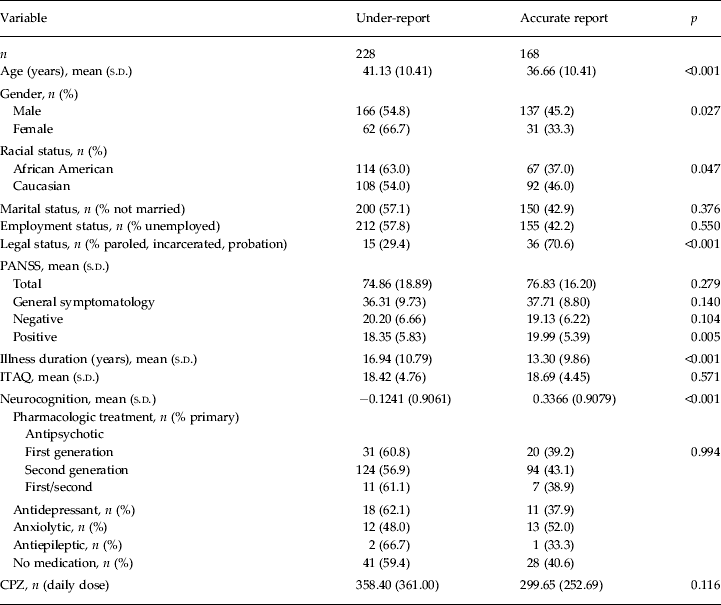
Having found that many patients with schizophrenia under-report their use of drugs, potential demographic and clinical predictors of this under-reporting were examined. As shown in Table 2, a greater proportion of women and African Americans under-reported their drug use. Patients who under-reported drug use also tended to be older, had experienced a longer duration of illness, and exhibited significantly greater neurocognitive deficits. Patients who accurately reported drug use were more likely to exhibit severe positive symptomatology, and were significantly more likely to have incurred serious legal problems. No significant differences were observed between groups with regard to antipsychotic medication type or dosage, or insight into the need for antipsychotic treatment.
Comparative characteristics of schizophrenia patients who under-reported and accurately reported their illicit drug use

PANSS, Positive and Negative Syndrome Scale; ITAQ, Insight and Treatment Attitudes Questionnaire; s.d., standard deviation; CPZ, chlorpromazine equivalent dose (CPZ daily dose equivalents were computed based on prescribed typical and/or atypical antipsychotic medications).
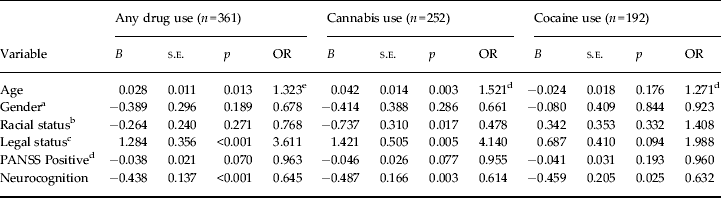
Logistic regression models were used to examine the clinical and demographic predictors of drug use under-reporting, controlling for the potentially confounding effects of age, racial status and gender. As shown in Table 3, greater neurocognitive impairment was the most consistent predictor of under-reported drug use for patients who tested positive for any drugs, cannabis and cocaine (all p < 0.05), with patients with better (>1 s.d.) neurocognitive function being 1.55 times more likely to report their use accurately. The effects of racial status only persisted for the under-reporting of cannabis, and older patients were significantly more likely to under-report using any drugs or cannabis. The effects of legal involvement were maintained for those who accurately reported using any drugs or cannabis, but the effects of positive symptomatology were not maintained.
Predictors of under-reporting of illicit drug use among schizophrenia patients (n = 805)

PANSS, Positive and Negative Syndrome Scale; s.e., standard error; OR, odds ratio.
a Reference category is male.
b Reference category is Caucasian.
c Legal status (yes/no) = paroled, placed on probation or incarcerated within 30 days of completing screening/baseline assessments. Reference category is no legal involvement.
d PANSS Positive subscale total score.
e OR represents a 10-year change in age.
Discussion
Many persons with schizophrenia use illicit drugs (Reiger et al. Reference Reiger, Farmer, Rae, Locke, Keith, Judd and Goodwin1990; Fowler et al. Reference Fowler, Carr, Carter and Lewin1998; Degenhardt & Hall, Reference Degenhardt and Hall2001; Volkow, Reference Volkow2009), yet measures that rely on what patients disclose about their use have been suspected to underestimate actual consumption rates (Carey & Correia, Reference Carey and Correia1998; Zedonis et al. Reference Zedonis, Smelson, Rosenthal, Batki, Green, Henry, Montoya, Parks and Weiss2005), and much remains to be learned about the under-reporting of drug use in this population. In this study we examined the rates of drug use disclosure in a large heterogeneous sample of patients with schizophrenia, used laboratory assays to confirm drug use, and identified the predictors of under-reporting cannabis, cocaine and methamphetamine use. Our results reveal, as suspected, that the overall rates of under-reported drug use were substantial. Of note, the most consistent predictor of under-reported of drug use was neurocognitive impairment, which potentially signifies an additional need for cognitive remediation treatments that address these deficits in schizophrenia, and may explain the puzzling results of studies demonstrating improved cognitive function among patients who use drugs, or at least report using drugs (Yücel et al. Reference Yücel, Bora, Lubman, Solowij, Brewer, Cotton, Conus, Takagi, Fornito, Wood, McGorry and Pantelis2010; Rabin et al. Reference Rabin, Zakzanis and George2011).
Our results also show, somewhat unexpectedly, that patients who had accurately reported their drug use tended to have greater involvement with the criminal justice system. Perhaps those with prior legal involvements had already been desensitized to disclosing their drug use, were less fearful of disclosing their use, and were thus more likely to accurately report their use of drugs. Contrary to our expectations, psychiatric symptoms and insight had no effect on whether patients disclosed drug use. This finding shows that the level of psychopathology and insight into the need for antipsychotic treatment may not preclude patients with schizophrenia from accurately reporting their use of drugs.
This research has several implications for future investigations of drug use detection in individuals with schizophrenia and the treatment of such patients who under-report their use on self-rated assessments. First, neurocognition is one of the strongest predictors of functional outcomes in schizophrenia (Green et al. 2004a), and our results indicate that neurocognitive deficits are associated with drug use under-reporting by individuals with the condition, which suggests that this group of patients may be at risk of being overlooked and unidentified as needing help by both the mental health and addiction treatment systems. Such individuals who under-report drug use may potentially benefit from the novel therapeutics of cognitive remediation (Eack et al. Reference Eack, Greenwald, Hogarty, Cooley, DiBarry, Montrose and Keshavan2009), which could not only improve their cognitive function but also serve as a gateway for engaging them into starting treatment that would eventually address their substance use problems. Second, many patients with schizophrenia exhibit impaired insight and severe degrees of psychopathology (Dixon et al. Reference Dixon, Haas, Weiden, Sweeney and Frances1991; Gregg et al. Reference Gregg, Barrowclough and Haddock2006), yet our results did not suggest that either is associated with disclosure rates, and investigations may need to further parse the relationships between the pathology of addiction and pathologies particular to those who under-report their use of drugs to further explore this issue. Moreover, our findings show that younger patients under-reported using drugs that carry somewhat less stigma (cannabis) at the same rates as the more stigmatized drugs (cocaine and methamphetamine). Alternatively, our findings revealed that older patients under-reported the less stigmatized drugs (cannabis) significantly more compared to the drugs that carry perhaps the most stigma (cocaine and methamphetamine). Regardless of these differences, our findings are seemingly inconsistent with studies that have documented the reliability of self-rated assessments among patients with schizophrenia and substance use disorders (Hjorthøj et al. Reference Hjorthøj, Hjorthøj and Nordentoft2012). Thus, it will be crucial for future investigations to focus on identifying the potential differences between patients with schizophrenia using drugs with and without co-morbid substance use disorders, and consider the proclivity that these subgroups have toward under-reporting their use of illicit drugs. Furthermore, establishing a positive therapeutic alliance before asking patients to complete self-rated assessments of their drug use may additionally help to increase overall disclosure rates in this population.
Several important limitations to this study should be noted and these implications should be interpreted with caution until confirmatory studies have been completed. The use of laboratory drug tests largely restricted our ability to examine drugs other than cannabis, cocaine and methamphetamine, as most other illicit drugs (opiates, PCP and stimulants) were excluded because of low base rates of use. As prior investigations have shown a high prevalence of cannabis and cocaine use among patients with schizophrenia (Dixon et al. Reference Dixon, Haas, Dulit, Weiden, Sweeney and Hien1989; Carey & Correia, Reference Carey and Correia1998; Swartz et al. Reference Swartz, Swanson and Hannon2003, Reference Swartz, Wagner, Swanson, Stroup, McEvoy, McGee, Miller, Reimherr, Khan, Canive and Liberman2006b ; Volkow, Reference Volkow2009; Reimherr et al. Reference Reimherr, Swartz, Olsen, Stroup and Liberman2010), we do not consider that restricting our analyses to these drugs has substantially limited the current applicability of our results. Furthermore, urine drug tests detect cocaine within 1 week of use and cannabis within 2 weeks of use (Mieczkowski et al. Reference Mieczkowski, Barzelay and Gropper1991; Mieczkowski & Newel, Reference Mieczkowski and Newel1993; Verstraete, Reference Verstraete2004), and although RIA allows for detection over longer time intervals, this technique has been shown to slightly overestimate the use of cocaine (4.0–1.2%) and to underestimate the use of cannabis (5.2–9.6%) (Mieczkowski & Newel, Reference Mieczkowski and Newel1993; Kline et al. Reference Kline, Stphen, Schittini, Levin and Susser1997). Regarding the present study, our findings showed that 77 (10.1%) patients with negative laboratory results reported using cannabis on self-rated assessments (Table 1). However, fewer false positives were discernible in terms of cocaine (n = 77; 10.1%) and methamphetamine (n = 8; 0.8%). Additionally, RIA has shown some bias when used with African Americans (Ledgerwood et al. Reference Ledgerwood, Goldberger, Risk, Lewis and Rumi2008), which may have contributed to our findings of significant under-reporting by African Americans for cannabis use. However, research showing bias of RIA tests in African Americans found that those with positive self-report and negative RIA were more likely to provide short (<3 cm/<30 mm) hair samples (Ledgerwood et al. Reference Ledgerwood, Goldberger, Risk, Lewis and Rumi2008), and we took adequate care to ensure that only patients who provided sufficient samples were selected (e.g. 1.5 in/38 mm) for the present study, and thus the degree of bias for these tests is considerably smaller than the large rate of under-reported drug use observed. Despite these problems, prior research has endorsed RIA as a promising method for improving the assessment of drug use in persons with schizophrenia (Swartz et al. Reference Swartz, Swanson and Hannon2003), and it is not likely that these limitations have restricted the applicability of our findings. Moreover, studies have shown that RIA has detected drug use not found by urine drug tests (Mieczkowski et al. Reference Mieczkowski, Barzelay and Gropper1991; Magura et al. Reference Magura, Freeman, Siddiqi and Lipton1992; Kline et al. Reference Kline, Stphen, Schittini, Levin and Susser1997), suggesting that combining the results of these laboratory tests may increase the overall accuracy of drug use detection by such methods. It should be noted that our use of dichotomously coded substance use variables and cross-sectional design additionally restricts our ability to interpret these data. However, because we focused on ascertaining the accuracy of self-rated assessments rather than on quantifying drug use or recall of last use, we consider that the coding structure used here was the most consistent with our study aims. Consequently, we can only comment on the predictors that were significantly associated with the under-reporting of drug use for this sample of patients with schizophrenia, and future investigations are needed to investigate the degree to which these relationships are causally related. Thus, the findings we report call for longitudinal investigations to further examine the causal impact of under-reported drug use on cognitive outcomes in individuals with schizophrenia. It should also be noted that the use of a 90-day retrospective index for self-report substance use may not be the best measure to use in samples of patients with neurocognitive impairment, who may be particularly vulnerable to poor recall. Furthermore, because of the low representation of racial and ethnic minorities, our racial status variable is composed of Caucasians and African Americans only. Cultural factors could impact drug use disclosure levels, and future investigations should focus on testing the contributory effects of under-reported drug use across more diverse samples.
Although more research is required to replicate these findings within different populations and across different types of drugs, our results do suggest that many individuals with schizophrenia under-report their use of illicit drugs when compared to laboratory assessments, and those who are least likely to report their use may be at risk of poor cognitive outcomes. On account of the high rates of under-reported drug use that we observed for this sample of patients with schizophrenia, the exclusive reliance upon self-rated assessments of substance use should be used with caution, particularly when engaging individuals in treatment and developing service plans. We acknowledge that the obvious advantage of self-rated assessments makes such measures desirable for widespread use, yet it is paramount to incorporate additional methods of detection when assessing substance use in this population.
Acknowledgments
This research was based on results from the CATIE study, which was supported by National Institute of Mental Health (NIMH) grant NO1-MH90001. The CATIE study sought to examine the comparative effectiveness of antipsychotic drugs in conditions for which their use is indicated, which included schizophrenia and Alzheimer's disease. This research was also supported by National Institutes of Health (NIH) grants DA-30763 and RR-24154 (to S.M.E.).
Declaration of Interest
None.