Introduction
Anxiety and depression are common disorders that frequently co-occur (Kessler et al. Reference Kessler, Nelson, Mcgonagle, Liu, Swartz and Blazer1996; Kvaal et al. Reference Kvaal, McDougall, Brayne, Matthews and Dewey2008), overlap in terms of risk factors (Vink et al. Reference Vink, Aartsen and Schoevers2008; Blanco et al. Reference Blanco, Rubio, Wall, Wang, Jiu and Kendler2014), phenomenology (Watson et al. Reference Watson, Clark, Weber, Assenheimer, Strauss and Mccormick1995), and genetic factors (Kendler et al. Reference Kendler, Gardner, Gatz and Pedersen2007; Craske, Reference Craske2012). In older adults, the co-occurrence of anxiety and depression is associated with worse outcomes than either disorder alone, including increased risk of cognitive decline and dementia (DeLuca et al. Reference Deluca, Lenze, Mulsant, Butters, Karp, Dew, Pollock, Shear, Houck and Reynolds2005), more severe depression, chronic course, disability and increased suicide rates (Lenze et al. Reference Lenze, Mulsant, Shear, Schulberg, Dew, Begley, Pollock and Reynolds2000; Cohen et al. Reference Cohen, Gilman, Houck, Szanto and Reynolds2009; Almeida et al. Reference Almeida, Draper, Pirkis, Snowdon, Lautenschlager, Byrne, Sim, Stocks, Kerse, Flicker and Pfaff2012; Prina et al. Reference Prina, Ferri, Guerra, Brayne and Prince2011), and extensively higher healthcare costs than for anxiety or mood disorders alone (Vasiliadis et al. Reference Vasiliadis, Dionne, Preville, Gentil, Berbiche and Latimer2012).
Co-morbidity is widely associated with poorer treatment outcomes. In older populations co-morbid anxiety has been shown to delay and reduce treatment response for depression using various interventions including antidepressants (Cohen et al. Reference Cohen, Gilman, Houck, Szanto and Reynolds2009), stepped-care approaches that combine psychological and pharmacological therapies (Hegel et al. Reference Hegel, Unutzer, Tang, Arean, Katon, Noel, Williams and Lin2005), clinical case management, group cognitive behavioral therapy (CBT), and clinical case management plus group CBT (Gum et al. Reference Gum, Arean and Bostrom2007). Importantly, these treatments for primary depression do not produce significant reductions in co-morbid anxiety symptomatology at post-treatment (Gum et al. Reference Gum, Arean and Bostrom2007; Serfaty et al. Reference Serfaty, Haworth, Blanchard, Buszewicz and King2009). In contrast, trials focused on treating geriatric anxiety typically report reductions in post-treatment depression symptom severity, although changes in the diagnostic severity of co-morbid mood disorders have not been reported. (Barrowclough et al. Reference Barrowclough, King, Colville, Russell, Burns and Tarrier2001; Stanley et al. Reference Stanley, Beck, Novy, Averill, Swann, Diefenbach and Hopko2003a , Reference Stanley, Hopko, Diefenbach, Bourland, Rodriguez and Wagener b ; Wetherell et al. Reference Wetherell, Gatz and Craske2003; Gorenstein et al. Reference Gorenstein, Kleber, Mohlmann, Dejesus, Gorman and Papp2005). Hence, the impact of therapy for anxiety disorders on mood disorder recovery has yet to be fully determined. Given that co-morbidity reduces the effectiveness of treatments targeting the primary disorder and is associated with worse long-term health and wellbeing, a program that addresses the core features of both disorders might be more efficacious. In line with this, recent research in younger adults suggests that targeting co-morbidity using transdiagnostic approaches might improve treatment outcomes for anxiety disorders (Norton et al. Reference Norton, Barrera, Mathew, Chamberlain, Szafranski, Reddy and Smith2013).
Despite the clear need to target co-morbidity, most research has targeted the treatment of single disorders, with more trials of transdiagnostic treatments needed. Reviews of psychological treatments for depression in older adults indicate that CBT is as effective as in younger adults and is superior to waitlist, care-as-usual, placebo and other control groups, with moderate to large effect sizes (mean d = 0.72) (Mackin & Arean, Reference Mackin and Arean2005; Cuijpers et al. Reference Cuijpers, Van Straten and Smit2006; Serfaty et al. Reference Serfaty, Haworth, Blanchard, Buszewicz and King2009), although a recent meta-analysis of depressed older adults found CBT was superior to non-active, but not active treatments (Gould et al. Reference Gould, Coulson and Howard2012a ). Meta-analyses of psychological treatments for anxiety disorders in older adults have been mixed. One found CBT was superior to waitlist and active control conditions for anxiety with co-morbid depression symptoms, but was equivalent to active control for reducing worry severity (Hendriks et al. Reference Hendriks, Oude Voshaar, Keijsers, Hoogduin and Van Balkom2008). More recently, CBT was found to be only marginally more effective than active controls, and the authors suggested that targeting co-morbidity might increase therapeutic outcomes (Gould et al. Reference Gould, Coulson and Howard2012b ).
In one of the few transdiagnostic studies in older adults, Wuthrich & Rapee (Reference Wuthrich and Rapee2013) recently found in a randomized controlled trial (RCT) that group CBT was efficacious compared to a waitlist condition for older adults with both anxiety and depression, and that the improvements were maintained at 3 months follow-up. However, as this study compared group CBT to a waitlist condition, it is unclear whether the improvements were due to CBT skills training or to non-specific therapy effects such as sharing with others, companionship, support from a caring therapist or intellectual stimulation. Given existing research that demonstrates that CBT for anxiety and depression may not be superior to supportive therapy or discussion groups (Wetherell et al. Reference Wetherell, Gatz and Craske2003; Gould et al. Reference Gould, Coulson and Howard2012a , Reference Gould, Coulson and Howard b ) it is important to test if CBT is superior to non-specific treatments for co-morbid anxiety and depression.
Large differences exist in the literature between the types of non-specific or active therapies used in RCTs. An optimal test of CBT would be to compare its efficacy against a non-directive therapy that maximizes the utilization of generic psychotherapy skills (such as warm, positive regard; reflective listening and empathy), as well as a control for group processes, notably, supportive peer interactions, intellectual and social stimulation. Recently, in an RCT for older adults with depression, Serfaty et al. (Reference Serfaty, Haworth, Blanchard, Buszewicz and King2009) compared CBT to treatment as usual and to a non-specific talking therapy condition, and found that CBT was superior relative to the other conditions. However, in the talking control condition, therapists were instructed to talk about neutral topics only and not emotional topics. Therefore it is unclear whether discussion and support of emotional issues would be equivalent to CBT. In an earlier RCT, Wetherell et al. (Reference Wetherell, Gatz and Craske2003) compared group CBT to a discussion group and waitlist control in older adults with generalized anxiety disorder and found that both CBT and the discussion group were superior to waitlist; although there were no differences between CBT and the discussion group. In this study, the discussion group focused on discussion of worry topics, and included journaling worries for homework, suggesting that discussing emotional topics in a group setting may be beneficial for anxious older adults. Therefore a comparison of a transdiagnostic CBT program to a discussion group, which encouraged discussion of both emotional issues and stimulating neutral topics, in older adults with co-morbid anxiety and depression that examines changes in both anxiety and depressive disorders is needed.
The specific aim of the current study was to conduct an RCT to evaluate the efficacy of group CBT compared to an active control (non-directive discussion group), to treat co-morbid anxiety and depression in older adults. On the basis of the existent literature, it was expected that both treatment conditions would result in significant improvements on diagnostic severity and symptom measures over time but that group CBT would result in greater reductions in both anxiety and depression diagnostic severity compared to the discussion group condition over time. A further prediction was that the improvements from group CBT would be maintained over a 6-month follow-up period.
Method
Participants
One hundred and seventy-five community-dwelling participants attended a university centre clinic for assessment and a total of 133 ultimately participated in the trial. Eligible participants were aged ⩾60 years (age range 60–88, mean = 67.35, s.d. = 5.44, male = 59) and were recruited via advertisements in local newspapers (2011–2013). Eligible participants met DSM-IV criteria for both an anxiety and a unipolar mood disorder, with either anxiety or mood being the primary (most interfering) problem, and stabilized on psychotropic medication for 4 weeks. Exclusion criteria were: Mini-Mental State Examination Score <26, unable to read an English-language newspaper, current self-harm, active suicidal intent, psychosis, or bipolar disorder. All participants were asked to refrain from engaging in additional treatment from a therapist or making changes to their medication status during the course of the trial, and this was monitored at post-treatment and follow-up. The flow of participants through the study is presented in Fig. 1.
Consort diagram of participants through the study.

Measures
Diagnostic clinical interview
Participants completed the Anxiety Disorders Interview Schedule for DSM-IV (ADIS; Di Nardo et al. Reference Di Nardo, Brown and Barlow1994), a semi-structured interview for diagnosing anxiety and related disorders including mood disorders according to DSM-IV criteria on a 0–8 severity rating scale where ratings of ⩾4 are considered of clinical severity and meet diagnostic status. This interview was administered by graduate students in clinical psychology formally trained on the ADIS and given regular supervision to discuss diagnostic decisions. The primary disorder was defined as the most interfering disorder. Participants with clinical severity ratings of ⩾4 for an anxiety disorder and a mood disorder were included in the study. The most common primary disorder was generalized anxiety disorder (33.1%) followed by major depressive disorder (27.8%). The interviews were videotaped for reliability purposes and 25% were recoded after the study's completion for the purpose of reliability coding. Inter-rater reliability (k) for agreement on the presence of a disorder in the diagnostic profile was k = 0.82 (90.5% agreement) for major depressive disorder, k = 0.88 (97.5% agreement) for dysthymia, k = 0.72 (94% agreement) for generalized anxiety disorder and k = 1.00 (100% agreement) for social phobia.
Cognitive assessment
The Mini Mental State Examination – Revised (MMSE; Folstein et al. Reference Folstein, Folstein and Mchugh1975), is a widely used brief cognitive screener for identifying dementia. The cut-off score of 26 has been recommended for identifying cognitive ability in the normal range (sensitivity = 0.80, specificity = 0.87) (Kukull et al. Reference Kukull, Larson, Teri, Bowen, Mccormick and Pfanschmidt1994). Participants scoring <26 were excluded from this study (n = 3).
Self-report measures
Geriatric Depression Scale (GDS)
The GDS (Yesavage et al. Reference Yesavage, Brink, Rose, Lum, Huang, Adley and Leirer1983), is a 30-item self-report measure of depression symptoms developed for older adults. It has high internal consistency, reliability, sensitivity and specificity in older adults with zero to moderate cognitive impairment (Yesavage et al. Reference Yesavage, Brink, Rose, Lum, Huang, Adley and Leirer1983; Keiffer & Reeses, Reference Keiffer and Reeses2002; Jongenelis et al. Reference Jongenelis, Pot, Eisses, Gerritsen, Derksen, Beekman, Kluiter and Ribbe2005). Internal consistency in the current sample was α = 0.78.
Geriatric Anxiety Inventory (GAI)
The GAI (Pachana et al. Reference Pachana, Byrne, Siddle, Koloski, Harley and Arnold2007), is a 20-item measure of anxiety symptoms developed for older adults. It has been shown to have adequate internal consistency, test–retest reliability and concurrent validity (Pachana et al. Reference Pachana, Byrne, Siddle, Koloski, Harley and Arnold2007). Internal consistency in the current sample was α = 0.83.
World Health Organization quality of life measure brief (WHOQOL-BRE)
The WHOQOL-BRE (WHOQOL Group, 1995), is a multidimensional measure of quality of life which assesses the following domains: physical health, psychological, social relationships, and environment. The scales had adequate internal consistency in this sample, physical α = 0.72, psychological α = 0.67, environmental α = 0.71, with the internal consistency of the social relationships subscale marginally adequate (α = 0.55).
Group programs
Both programs consisted of 11 × 2-h sessions conducted over 12 weeks (with a break between sessions 10 and 11). The sessions were conducted by graduate students in clinical psychology with 6–8 group members. Therapists ran both types of treatment programs so that treatment type was not confounded with the skills of an individual therapist.
The Ageing Wisely CBT manualized group program was based on cognitive behavioral skills for depression and anxiety. Participants were taught the following skills: psychoeducation, activity scheduling, problem-solving, cognitive restructuring and coping statements, graded exposure, assertiveness training, and sleep hygiene. Specific application of these skills were applied to topics associated with anxiety and depression in older adults such as dealing with loss and bereavement, social isolation, dementia and low motivation. The program included a structured participant workbook. Skills were taught with a mixture of didactic teaching, group discussions and role play, and there was a large emphasis on home practice of the skills taught in sessions.
The Discussion Group program was focused on increasing peer support, socialization and mental stimulation by encouraging group discussion about personal issues over the week (for the first half of each session), followed by discussion of stimulating set neutral topics such as hobbies, life experiences, and current affairs. Therapists followed a therapeutic manual which provided a direction on the non-specific therapy skills to be used (and directive skills not to be used) as well as the stimulating topics to be discussed.
Treatment adherence and integrity
To ensure adherence to treatment protocols, therapists attended group supervision with the study authors (who are all clinical psychologists) once a fortnight for an hour. All group therapy sessions were video-recorded. To check for treatment integrity a random 25% of sessions were rated by an expert independent of the research team and unaware of the study hypotheses, using a checklist based on recommendations by Waltz et al. (Reference Waltz, Addis, Koerner and Jacobson1993). There was one minor breach of protocol in an early discussion group session (that was not confounded with CBT skills). This breach was clarified and discussed in supervision, and training was provided to assist the therapist to apply the treatment protocol more rigorously in future sessions. All clinicians administered both types of intervention.
Treatment credibility
In order to check that the treatments (CBT and discussion groups) were equally credible, a 3-item measure based on the one developed by Devilly & Borkovec, (Reference Devilly and Borkovec2000) was adapted for this study. Items asked about individuals’ confidence that the program would be beneficial and were rated on a 10-point scale (1 = not at all, 10+ extremely), (e.g. How confident are you that this overall treatment program will be successful in reducing your anxiety and low mood?). The items were summed for pre- and post-treatment analysis between groups, and had good internal consistency (pre: α = 0.82; post: α = 0.87).
Group cohesion measure
The Group Cohesion Questionnaire – Revised (Treadwell et al. Reference Treadwell, Lavertue, Kumar and Veeraraghavan2001) is a 25-item measure that asked whether participants thought the group worked well together and whether they felt like part of the group. Items were rated on a Likert scale (1 = strongly disagree, 4 = strongly agree). The total score had good internal consistency in this sample (α = 0.83).
Therapist alliance measure
The Helping Alliance Questionnaire – II (Luborsky et al. Reference Luborsky, Barber, Siqueland, Johnson, Najavits, Frank and Daley1996) patient version, was administered at the beginning of session 10. It is a 19-item questionnaire that measures therapeutic alliance from the patient's perspective, and items are rated on a 6-point Likert scale (1 = strongly disagree, 6 = strongly agree). The total score had adequate internal consistency in this sample (α = 0.85).
Procedure
Ethics approval from the University Human Ethics Committee was obtained. Participants were recruited via advertisements, local General Practitioners and social clubs. Following written consent, participants completed the face-to-face ADIS interview, cognitive examination, and self-report measures including demographics. Computerized random numbers were used to allocate participants to one of two treatment groups (CBT or discussion). The randomization sequence was created at the beginning of the study by the first author using a computer-generated randomizer. Participants were randomly assigned in blocks of 6–8 participants by the research assistant, blind to the randomization sequence. At the beginning of session 2 of group treatment, all participants completed the treatment credibility questionnaire, and at the beginning of session 10 all participants completed the therapist alliance, group cohesion and also the treatment credibility measure for a second time. At the end of the 12-week program and again at 6-months follow-up, participants completed the self-report questionnaires, ADIS and cognitive assessments (rated by clinicians unaware of condition allocation). Participants who had not demonstrated significant improvement and were in need of further help at 6 months follow-up were either offered CBT group treatment or referral for further assistance.
Data analysis
All analyses were conducted as intent-to-treat and as such all participants were analyzed in the group to which they were randomized. Differences in diagnostic severity was the primary outcome measure. Differences between groups on continuous measures (pre, post, follow-up) were examined using hierarchical mixed models containing random intercept and random slope terms as well as fixed effects for treatment received controlling for baseline cognitive ability, WHOQOL psychological domain and group therapist. Differences between groups on diagnostic status were examined using the χ2 statistic to report recovery rates from pre- to post-treatment to follow-up assessment.
Power
Power calculations were based on χ2 tests using diagnostic status as the primary outcome measure. It was calculated that a sample size of 135 participants would provide power of 0.88 to detect a small effect size of 0.3, at an alpha of 0.05.
Results
Demographic measures
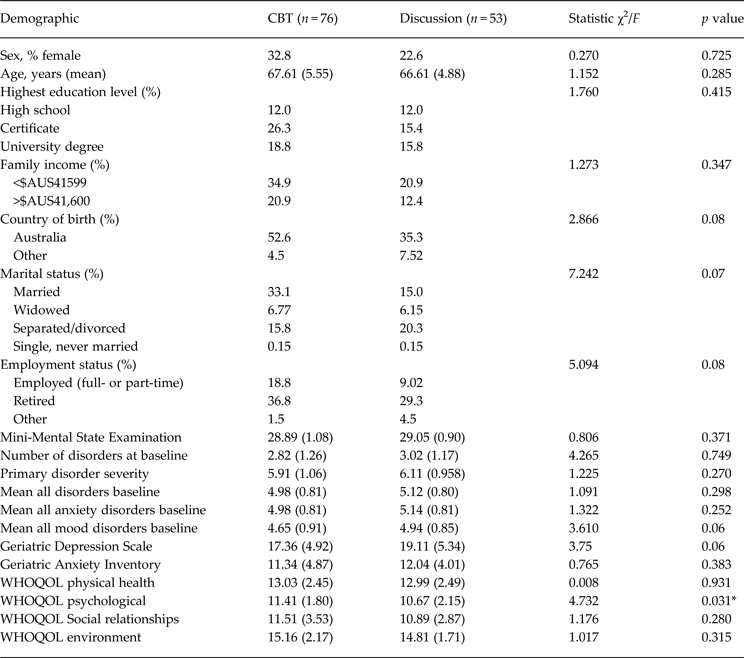
The groups did not differ significantly on baseline demographic features (i.e. age, gender, marital status, income, education, employment, country of birth, anxiolytic or antidepressant medication status) or number or type of chronic illnesses, or number of medications (p > 0.05). There were no significant differences on pre-assessment ADIS severity of the primary problem, MMSE or self-report questionnaire measures apart from the CBT group scoring significantly higher on the WHOQOL psychological domain (F 1,132 = 4.73, p = 0.031, mean = 11.41 v. 10.67) (see Table 1 for more details). Although there was no statistical difference between the means of the total MMSE scores for the two treatment groups (F 1,132 = 0.812, p = 0.371), because pre-treatment cognition may be important for the ability to learn and implement CBT (Johnco et al. Reference Johnco, Wuthrich and Rapee2014), pre-assessment cognition was statistically controlled in all further analyses. There were no significant differences between groups in terms of changes in medications, or consulting with an external psychologist at post- or follow-up assessment (p > 0.05).
Demographic data across conditions intent-to-treat (s.d. in parentheses)

*p < 0.05.
Drop-outs, treatment credibility, group cohesion, and therapist alliance
The two groups did not differ significantly on the number of drop-outs [χ 2(1, N = 133) = 1.471, p = 0.246], mean number of sessions attended [χ 2(10, N = 133) = 6.870, p = 0.689], treatment credibility assessed in session 2 [χ 2(20, N = 117) = 23.235, p = 0.277], or session 10 [χ 2(21, N = 108) = 30.090, p = 0.090], group cohesion [χ 2(29, N = 106) = 37.266, p = 0.140], or therapist alliance [χ 2(37, N = 104) = 51.671, p = 0.055].
Diagnostic severity across time and condition
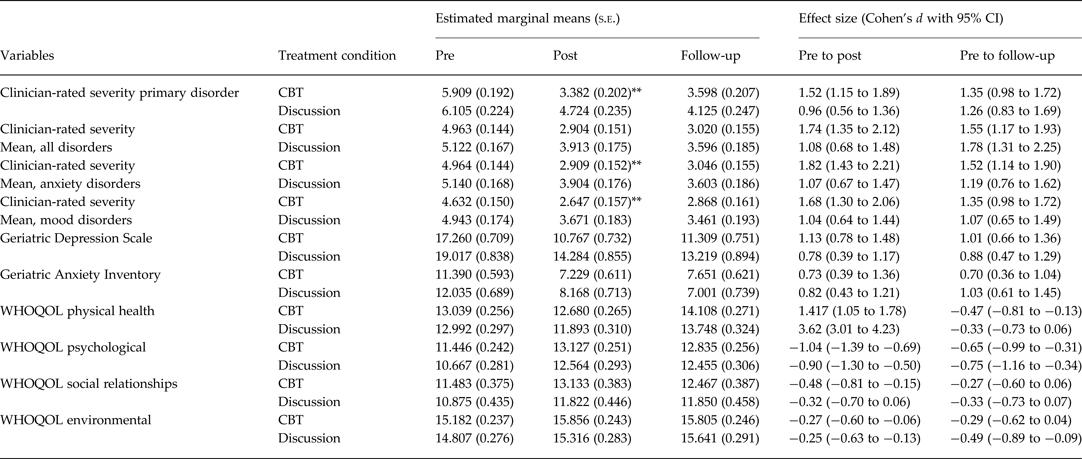
Mixed-model analyses were conducted to examine changes in severity of the primary disorder, mean of all disorders, and the mean of anxiety and mood disorders separately based on the ADIS scores. In all analyses MMSE scores (pre-treatment cognitive ability), WHOQOL psychological domain scores and group therapist were included as covariates. For the primary disorder, there was a significant effect of time (pre, post, 6 months follow-up) (F 2,243.030 = 90.737, p < 0.001), as well as a significant time (pre, post, 6 months follow-up) × group (CBT, discussion group) interaction (F 2,243.030 = 5.584, p = 0.004). Post-hoc follow-up tests indicated that this was due to a significant improvement for CBT compared to the discussion group (t 118 = −3.549, p < 0.001), but no group differences emerged at 6 months follow-up (t 108= −1.151, p = 0.252). The same pattern was found for the mean severity of all disorders, with a significant effect for time (F 2,242.864 = 106.819, p < 0.001), and significant group × time interaction (F 2,242.864 = 5.140, p = 0.007), with CBT being superior at post-treatment (t 120 = −3.686, p < 0.001), but not follow-up, although there was a trend for CBT to be superior (t 108 = −1.871, p = 0.064). Estimated marginal means, standard errors and within-group effect sizes for all mixed-model analyses are presented in Table 2.
Estimated marginal means, standard errors and effect sizes for diagnostic severity over time

CI, Confidence interval; WHOQOL, World Health Organization Quality of Life Assessment.
Effect size expressed as Cohen's d, on the basis of pre-/post-treatment change within conditions. 95% confidence intervals for effect sizes were computed using procedures delineated by Odgaard & Fowler (Reference Odgaard and Fowler2010). In addition, the same pattern of results was found when baseline Geriatric Depression Scale scores were controlled for in all analyses.
** Post-hoc t test p < 0.001.
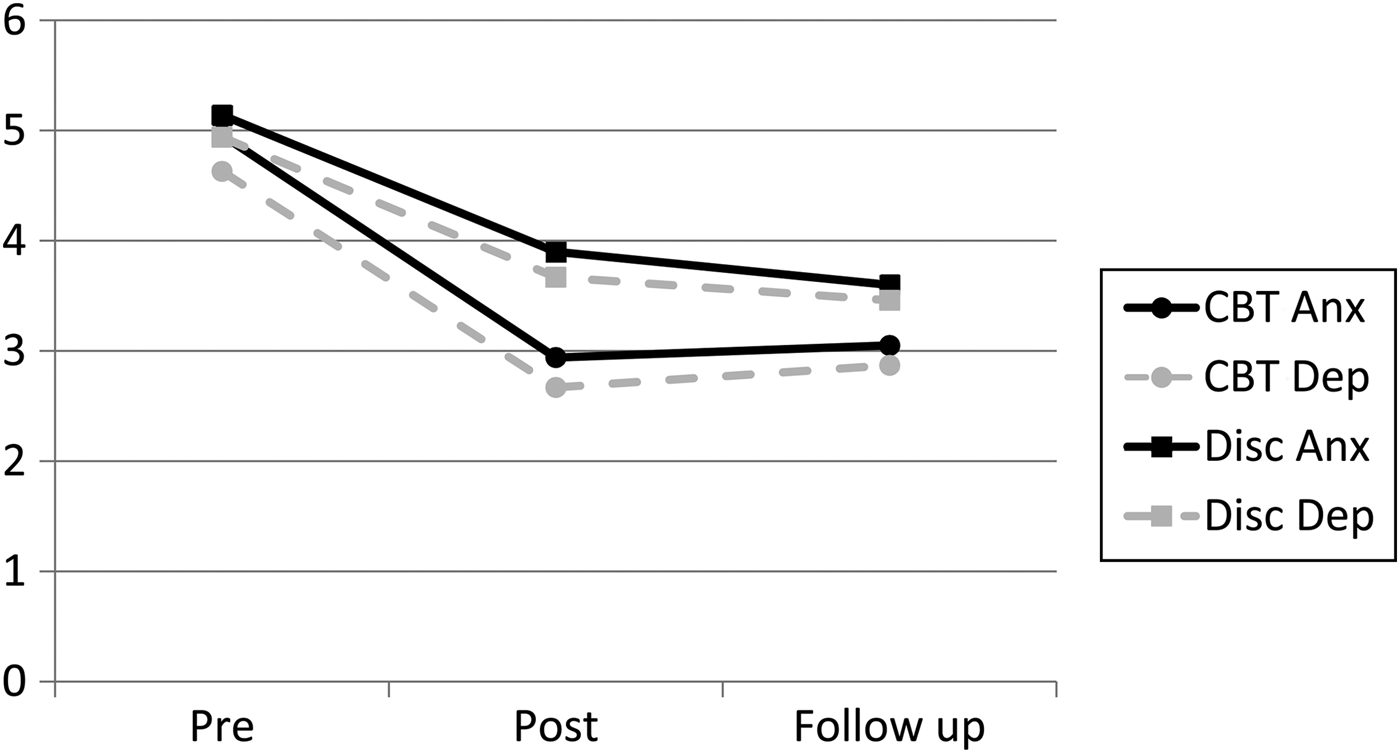
We further compared the efficacy of the two programs by comparing the mean severity for all anxiety disorders and mood disorders separately. For the mean severity of the anxiety disorders, analysis indicated a significant effect of time (F 2,242.769 = 105.777, p ⩽ 0.001), and a significant time × group interaction (F 2,242.769 = 4.722, p = 0.010), with CBT being superior at post-treatment (t 120 = −3.622, p < 0.001). The same pattern was found for the mean severity of the mood disorders with a significant effect of time (F 2,241.570 = 93.347, p < 0.001), and a significant time × group interaction (F 2,241.570 = 3.412, p = 0.035), again with a significant benefit for CBT at post-treatment (t 120 = −3.601, p < 0.001) (see Fig. 2).
Mean severity of all anxiety disorders and depressive disorders by treatment across time. CBT, Cognitive behavioral therapy; Disc, discussion group; Anx, anxiety disorders; Dep, depressive disorders.

Recovery rates
Recovery rate analyses were determined based on the presence or absence of an anxiety or mood disorder (reflected by a severity score ⩾4 on the ADIS) at post and follow-up assessments. CBT resulted in a significantly higher recovery rate of primary disorder diagnosis at post-treatment [χ 2(1, N = 122) = 11.038, p = 0.001], with 54% of participants in the CBT group no longer meeting criteria for their primary disorder compared to 24% of participants in the discussion group. At 6 months follow-up the recovery rate for CBT was maintained (46% recovered), while the recovery rate for the discussion group improved (36% recovered) such that the difference between conditions was no longer significant [χ 2(1, N = 110) = 1.228, p =0 .327].
Second, we compared changes in the total number of disorders present at post and follow-up assessments. CBT resulted in significantly higher recovery for all disorders at post-treatment [χ 2(5, N = 122) = 12.559, p = 0.028], with 38% participants from the CBT group no longer meeting criteria for any disorder compared to 12% of participants in the discussion group. At 6 months follow-up this rate of recovery was maintained for the CBT group (35% recovered), while the rate of recovery increased for the discussion group (27% recovered) to result in a non-significant difference between the groups at 6 months follow-up [χ 2(5, N = 110) = 5.469, p = 0.361].
Reliable change
The extent to which change on the primary disorder severity was statistically reliable and clinically relevant was examined by calculating the Reliable Change Index according to Evans et al. (Reference Evans, Margison and Barkham1998) using the following formula where SD1 is the standard deviation of the baseline observation and r is the reliability of the measure, SEdiff = sd1[√2 √(1 – r)]. For this purpose, the standard deviation and reliability score were taken from the current sample. Reliable change was seen for 63% of CBT participants from baseline to post-treatment, and for 59% from baseline to 6 months follow-up. Reliable change for the discussion group condition from baseline to post-treatment was 41%, and 51% at 6 months follow-up. The difference between groups from pre- to post-treatment was significant [χ2(1, N = 122) = 5.893, p < 0.05], but not from pre-treatment to follow-up [χ2(1, N = 110) = 0.582, p = 0.559]. There was, however, one participant from the discussion group, whose symptoms substantially deteriorated from baseline to the 6-month follow-up assessment.
Symptom and quality of life measures across time and condition
Mixed-model analyses indicated that there was a significant main effect of time on all symptom and quality of life measures showing that both treatments resulted in improvements over time controlling for baseline cognitive ability, WHOQOL psychological domain scores and group therapist: GDS (F 2,233.125 = 80.881, p < 0.001); GAI (F 2,236.762 = 66.945, p < 0.001), WHOQOL physical health (F 2,233.341 = 28.365, p < 0.001); WHOQOL psychological domain (F 2,235.833 = 52.314, p < 0.001), WHOQOL social relationships domain (F 2,232.331 = 19.292, p < 0.001), and WHOQOL environment domain (F 2,233.996= 14.085, p < 001). However, there were no-significant group × time interactions on any of the self-report measures (see Table 2).
Discussion
This study compared the efficacy of transdiagnostic group CBT to an active control for older adults with co-morbid anxiety and unipolar mood disorder. Both conditions resulted in significant improvements in diagnostic severity, self-reported anxiety and depressive symptoms and quality of life over time, pointing to the value of general group therapeutic processes in this population. However, participants who received CBT experienced significantly greater improvements in the diagnostic severity of their primary disorder, mean severity of all disorders, and anxiety and depressive disorders separately immediately following completion of treatment compared to participants in the discussion group. In the CBT condition 54% demonstrated recovery from their primary disorder; while 38% had recovered from all anxiety and mood disorders at post-treatment (compared to 24% and 12% in the discussion group, respectively). These results are consistent with previous research among separately depressed and anxious older adults (Cuijpers et al. Reference Cuijpers, Van Straten and Smit2006; Gould et al. Reference Gould, Coulson and Howard2012a , Reference Gould, Coulson and Howard b ), and suggests that CBT confers some specific benefits over general, non-specific aspects of therapy. Significant differences between groups over time was limited to changes in clinician ratings for both mood and anxiety disorders, rather than for self-report measures which may be less sensitive to diagnostic criteria, mirroring previous findings for treatments for depression (Cuijpers et al. Reference Cuijpers, Li, Hofmann and Andersson2010; Gould et al. Reference Gould, Coulson and Howard2012 a).
Although these improvements were maintained for the CBT group at 6 months follow-up, the superiority of CBT over the discussion group was no longer significant at this final assessment. Interestingly, this was not due to a significant worsening in the CBT group, nor a significant improvement in the discussion group from post to follow-up. This finding is perhaps similar to the findings for geriatric anxiety in which CBT has been found to be only marginally superior to active control treatments (Gould et al. Reference Gould, Coulson and Howard2012 b). The pattern of results for changes in mean severity of all disorders, and recovery from primary and all anxiety and mood disorders, although non-significant, favored CBT at 6 months follow-up, so perhaps more power is needed to detect differences between groups 6 months after treatment.
These results also emphasize the therapeutic value for older adults of non-specific therapeutic components such as social connection, sharing experiences with others, and engaging in stimulating discussion. Participants in this group rated similar treatment expectancies, therapeutic alliance and group cohesion to the CBT participants, although reasons for drop-outs included ‘personality clashes’ which appeared more problematic in this condition. Although group discussion reduced anxiety and depression, clinically significant gains took longer to achieve than among those receiving CBT. Without direction from therapists training in concrete skills, participants may have required longer to implement changes in their life. As we did not track changes in anxiety and depression symptoms throughout the 6-month follow-up period we do not know whether changes were slow and linear or if this group rapidly made gains shortly after treatment was terminated. Understanding the trajectory of improvements and evaluation of cost-effectiveness of CBT compared to a discussion group are potentially fruitful future research directions.
Limitations of this study were that longer term maintenance of benefits was not assessed. Previous research has shown maintenance of treatment gains for specific disorders among older adults up to 12 months (Stanley et al. Reference Stanley, Beck, Novy, Averill, Swann, Diefenbach and Hopko2003 a) so it is unlikely that the effects reported here would dissipate with time, but demonstration of this maintenance within a co-morbid population would be valuable. Moreover, the mean age of the sample was relatively young, and group differences in executive functioning were not controlled for.
In summary, this research indicates the efficacy and superior efficiency of group CBT compared to non-specific discussion at producing improvements in anxiety and depression among older adults immediately following treatment and builds on previous studies validating the usefulness of transdiagnostic CBT for older adults.
Acknowledgements
This project was funded by a National Health and Medical Research Council project grant and was registered with the Australian New Zealand Clinical Trials Registry and allocated the ACTRN number: ACTRN12611000527965.
Declaration of Interest
None.