Introduction
Being able to retrieve the origin of our memories is a fundamental everyday cognitive function. To this end, Mitchell and Johnson (Reference Mitchell, Johnson, Tulving and Craik2000) posit that individuals engage in a series of resource-demanding processes (e.g. evaluation of the quantity and quality of source-specifying details) that help them discriminate between potential sources in order to attribute the origin to a corresponding mental experience. Johnson et al. (Reference Johnson, Hashtroudi and Lindsay1993) call this ability “source monitoring” (SM), and define “source” as the variety of characteristics that, collectively, specify a given memory. Characteristics may include, for example, the modes and modalities through which the source was perceived or the thought processes required during imagining as well as perceptive characteristics of mental imagery and evidence from the source, as originally experienced, which is preserved in memory and can later serve as cues to discriminate one memory from another because monitoring decisions are based on the qualities of retrieved memories, together with judgment processes that evaluate the different features of different memories (Johnson et al., Reference Johnson, Hashtroudi and Lindsay1993). Accordingly, in SM tasks, individuals are typically presented with a series of events that occur under different source conditions and are later required to remember the source associated with each given event. For example, participants can be presented with single items (e.g. words) in two or more locations (e.g. left or right side of the screen), times (e.g. first vs. second study list), formats (e.g. red vs. blue letters, female vs. male speaker), or modalities (e.g. auditory vs. visual, perceived vs. imagined), and later asked to indicate where, when, or how the word was presented. Moreover, since source information is a collection of different features, source attribution may require different degrees of systematic processes, depend on different neural correlates, and be differentially affected by aging (e.g. Cabeza, Reference Cabeza, Zimmer, Mecklinger and Lindenberger2006; Mammarella and Fairfield, Reference Mammarella and Fairfield2008).
More specifically, according to the Source Monitoring Framework (SMF; Mitchell and Johnson, Reference Mitchell, Johnson, Tulving and Craik2000), two broad categories of information are used when discriminating the origin of our memories. The first includes the qualitative characteristics of remembered information such as perceptual and contextual detail and associated cognitive operations. When remembering, the quantity and quality of these different features can be used to distinguish one source from another. In this case, the presence of abundant perceptual information may indicate an actually perceived event since this type of event typically includes more perceptual and contextual details than imagined events. Using this type of information, source attributions can be made rapidly and in a relatively automatic manner. The second type of information used during source attribution includes more conceptual types of information such as beliefs and general knowledge. These processes make source attributions typically slower and more controlled. In line with this, the ability to identify the source of a memory correctly depends on the type, the quantity, and the quality of activated feature information, and the efficiency of the judgment processes used to evaluate these features.
A considerable number of studies has shown how SM is generally negatively affected by aging (e.g. Henkel et al., Reference Henkel, Johnson and Leonardis1998; Mitchell et al., Reference Mitchell, Raye, Johnson and Greene2006), although many of these studies have suggested that the difficulties that healthy older adults show in SM tasks may be specific in nature and therefore cannot be extended to all types of SM tasks (May et al., Reference May, Rahhal, Berry and Leighton2005). For example, Hashtroudi et al. (Reference Hashtroudi, Johnson and Chrosniak1990) found that older adults have greater difficulties in distinguishing between two internal sources (e.g. thinking and saying: self vs. self) because many features tend to overlap, than between an internal and external source (e.g. thinking and listening: self vs. other) where features are more distinctive and unique. A meta-analysis conducted by Spencer and Raz (Reference Spencer and Raz1995) highlighted that spatial and temporal details show greater age-related declines than other perceptual details such as colors (Old and Naveh-Benjamin, Reference Old and Naveh-Benjamin2008). A recent line of research has also suggested that difficulties in SM tasks observed in healthy older adults may stem from associative memory deficits (see, for a review, Mammarella and Fairfield, Reference Mammarella and Fairfield2008). In fact, SM requires individuals to correctly bind and later remember bound features in order to correctly retrieve the origin of a memory. With regards to Alzheimer's disease (AD), several studies have shown that patients with dementia of Alzheimer's type (DAT) generally show SM deficits (e.g. Budson et al., Reference Budson, Sullivan, Mayer, Daffner, Black and Schacter2002) and have particularly poor performance in reality-monitoring tasks. For example, Dalla Barba et al. (Reference Dalla Barba, Nedjam and Dubois1999) asked a group of healthy older adults and a group of DAT older adults to remember whether a word had been presented as a picture (seen) or imagined (imagined) and found lower performance in the DAT group than in the control group. Again, associative memory deficits may also cause these SM difficulties as DAT patients perform very poorly with tasks that require contextual feature integration. For example, Fowler et al. (Reference Fowler, Saling, Conway, Semples and Louis2002) and O'Connell et al. (Reference O'Connell, Coen, Kidd, Warsi, Chin and Lawlor2004) found that, using the CANTAB paired associates learning test, associative memory was affected in DAT patients to a greater extent than non-associative memory.
In sum, our first aim was to directly compare SM for different types of source information in two groups of healthy older adults and in a group of AD patients in order to better clarify how aging affects memory for different types of source attributes. More specifically, the majority of mentioned studies has been based on cross-study comparisons rather than on direct comparisons of different types of source details. Here, we directly compared source memory for perceptual/contextual information (e.g. color, spatial, and temporal information) and semantic, social, and affective details across the three groups of older adults. In particular, we selected a group of high versus low cognitive function as control group in order to evaluate the influence of a general cognitive slow-down on SM performance. In this way, we would better highlight whether any observed SM deficit is specific to dementia or is linked to a general age-related cognitive decline. A second aim was to further clarify the nature of SM deficits. In fact, SM deficits may be related to the nature of the processing involved according to the specific type of detail (more automatic vs. more controlled processing). For example, with regards to spatial details, many studies have shown that older adults are strongly impaired in remembering the locations of words on the screen (e.g. Park et al., Reference Park, Puglisi and Lutz1982) compared to source memory for color information. Accordingly, it may be possible to distinguish between source attributes, which rely on more automatic processing and are familiarity-based, and other types of attributes that require, instead, a greater degree of conscious attention and are recollection-based (Moscovitch, Reference Moscovitch1992; Troyer and Craik, Reference Troyer and Craik2000). Since source attribution depends on the average difference between different types of attributes (e.g. more perceptual vs. more conceptual in nature), together with evaluation and judgment criteria used to weight these types of information (e.g. familiarity vs. recollection), AD may particularly affect those details that require more effortful processing both at encoding and at retrieval (e.g. spatial information), while sparing source-specifying features that are more automatically processed. In fact, older adults with AD have increased difficulties in tasks that reflect frontal functioning and therefore should be particularly affected in SM tasks that strongly rely on control processes (Budson et al., Reference Budson, Mather and Chong2006).
Our study was ultimately guided by the critical assumption that we can obtain different source memory outcomes depending on the interaction between the nature of the to-be-remembered attributes, the type of criteria used when retrieving them, and the degree of intervention of monitoring processes. In order to clarify this assumption, we also added a social and affective source memory condition in this study. In the light of the growing interest in source memory for social and emotional details (e.g. May et al., Reference May, Rahhal, Berry and Leighton2005; Mather et al., Reference Mather, Mitchell, Raye, Novak, Greene and Johnson2006), we considered it relevant to test whether being able to attribute an event to the corresponding affective category (e.g. happiness or sadness) or to the corresponding social stereotype (e.g. male vs. female) undergoes an age-related decline. Our hypothesis is that source memory attributes that rely strongly on general-knowledge processes or are assumed to be more conceptually driven should be relatively spared. Again, the introduction of these types of attributes may better highlight the different and multifaceted nature of source memory attributes, the different processes involved in SM, and corresponding age-related deficits.
Methods
Participants
We tested three groups of older adults from a total of 60 participants: 20 older patients with clinically diagnosed DAT in mild-to-moderate stages and 40 healthy older adults as controls. Of these 40 participants, 20 had high cognitive functions (HC) and a higher level of education and 20 had low cognitive functions (LC) but matched to the DAT group in terms of level of education. In particular, we categorized healthy older adults as either above or below the median on a composite cognitive measure from the Brief Neuropsychological Exam (ENB) by Mondini et al. (Reference Mondini, Mapelli, Vestri. and Bisiacchi2003). This test also showed that reading and comprehension skills were not affected. It is also important to note that the experimental task adopted in this study only required participants to read single medium- to high-frequency words and to remember perceptual details (e.g. right vs. left, red vs. blue) or their category (e.g. social, emotional) – a task that does not require particularly high literacy levels.
DAT patients were recruited from different Alzheimer centers in southern Italy, while healthy community-dwelling older adults were recruited from different southern Italian towns.
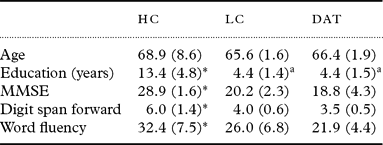
In addition to the experimental task, all participants performed the forward version of the digit span (maximum score 8) and the word fluency test (maximum score 34) in which they were required to name as many words as possible beginning with a specified letter (c or p) in 60 seconds interval (Mondini et al., Reference Mondini, Mapelli, Vestri. and Bisiacchi2003). The mean values and t-test results for these tests coupled with demographic information are presented in Table 1.
Demographic information for the high cognitive group (HC, n = 20) and low cognitive group (LC, n = 20) of older adults and DAT patients who participated in the study (standard deviations are in parentheses)
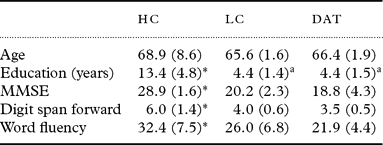
* Shows statistically significant results (p < 0.05).
a Level of education denotes the years of formal education received by participants but all participants had a literacy level sufficient to perform the experimental task.
MMSE = Mini-Mental State Examination; DAT = dementia of Alzheimer's type.
All healthy older adults reported being in good health, with no history of stroke, heart disease, or primary degenerative neurological disorder. Participants were excluded if characterized by clinically significant depression or alcohol or drug use, cerebrovascular disease, or traumatic brain damage as verified by clinical and research records. All participants had normal, or corrected to normal, vision and hearing. None of the participants was paid for their participation. Written consent was obtained from all participants or from their caregiver where appropriate.
Procedure
A total of 180 four- to seven-letter words were used in this study. Of these, 30 words were used in each source memory task. The 30 words were divided into three sets, A, B, and C. For example, in the perceptual source memory task, Set A was presented in red (ten words), Set B was presented in blue (ten words), while Set C was presented as a set of new words (ten words). The assignation of words to sets was repeated four times, leading to the creation of four study lists that were used five times across participants. In the test, participants randomly viewed all 30 words (20 old + 10 new). The same test list was used across all participants. The same procedure was applied to the remaining source memory tasks.
For the perceptual, spatial, temporal, and social source memory task, medium- to high-frequency (mean range of use: 6.622) words were selected from an Italian word database (Laudanna et al., Reference Laudanna, Thorton, Brown, Burani, Marconi, Bolasco, Nebart and Salem1995). For the semantic task, medium- to high-frequency (mean frequency = 138, SD = 150 out of 1,500,000) words and their associates were selected from Tabossi and Laghi (Reference Tabossi and Laghi1992).
For the affective task, positive and negative words were selected from a corpus of affective Italian words developed in our laboratory and rated by an independent group of 100 younger participants on a nine-point scale in terms of valence and arousal. Positive words scored higher (more positive; M = 8.2, SD = 0.24) than negative words (M = 2.16, SD = 0.55). Negative and positive words had equivalent arousal ratings, t(9) = 1.05, p = 0.32.
Each participant was tested individually for about 40 minutes. After completing the MMSE (Folstein et al., Reference Folstein, Folstein and McHugh1975), the digit span, and the word fluency test, the general experimental procedure (study and test phase) was briefly explained. Participants sat facing a computer screen and were verbally informed that they would be presented with a series of words. Their task was to memorize each word for a later source memory test. Consequently, learning occurred intentionally. Three practice trials were presented to ensure that participants were able to see clearly and to read the words. Before viewing each study block, participants were informed about the type of attribute that would be presented. For example, the word “color” appeared on the computer screen and the experimenter informed the participant that he/she would see words in blue or red. Once the experimenter was sure that the participant understood the type of source attribute that would be presented, the participant was invited to press the space bar and immediately a series of red and blue words was presented. Each word stayed on the screen for 2 seconds. At the end of the list, the word “test” appeared on the screen and participants were informed that for each of the following words they were to remember the color if the word had been studied or to recognize it as a new word (never studied). Again, once the experimenter was sure that the participant understood the task, he/she pressed the space bar to launch the testing phase. The experimenter noted participants’ verbal responses on a pre-prepared answer grid.
To reduce forgetting of task instructions and to avoid interference effects from the previous block, the experimental procedure was explained every time a new block began. This gave all the participants the opportunity to rest for a brief period.
In the temporal source memory task, participants were informed that they would be presented with two lists of words, List 1 and List 2, and were asked to remember whether each test word had appeared in the first or second list or whether it was new.
In the spatial source memory task, participants were informed that they would be presented with words appearing on the left or right side of the screen and were asked to remember whether each word had appeared on the left, on the right, or was new.
In the semantic source memory task, participants were informed that they would be presented with a pair of semantically associated words (e.g. dog and cat) or single words and were asked to remember whether each word at test had appeared as a pair, as a single word, or was new.
In the social source memory task, participants were informed that they would be presented with words typically associated with males (e.g. tie) and others typically associated with females (e.g. lipstick) and were asked to remember whether each word belonged to the studied male or female dimensions or whether it was new.
In the affective source memory task, participants were informed that they would be presented with a series of positive and negative words and were asked to remember whether each test word belonged to the studied positive (e.g. joy), negative valence (e.g. funeral) or whether it was new.
All test words were presented in black in the center of the screen. The six source memory tasks were randomly intermixed across participants.
Data analysis
The experiment adopted a 3 × 6 mixed design in which the independent within-subject variable was type of source attribute (perceptual, spatial, temporal, semantic, social, and affective) and the independent between-subject variable was group (HC vs. LC, healthy older adults vs. DAT patients). Dependent variables were source accuracy scores and recognition scores measured as dʹ. In line with numerous previous studies on SM (e.g. Hashtroudi et al., Reference Hashtroudi, Johnson and Chrosniak1990; Kensinger et al., Reference Kensinger, O'Brien, Swanberg, Garoff-Eaton and Schacter2007; Mammarella et al., Reference Mammarella, Fairfield and Cornoldi2007), we used conditionalized source identification scores (CSIM) as a SM measure. More specifically, two proportions were calculated for each subject for each type of source. For example, in the case of the perceptual source (red vs. blue), the formula for red items was: R|R/(R|R + B|R), corresponding to the number of red items correctly identified as red divided by the sum of the number of red items correctly recognized and the number of red items recognized as being old but identified as blue. The same formula applied to blue items, B|B/(B|B + R|B), and to the other source attributes. To provide an integrated analysis of the entire recognition performance, a signal detection analysis based on all responses was carried out. First, the hit rate and false alarm rate for each participant were calculated and a standard correction was applied when these rates were 0 or 1 (Snodgrass and Corwin, Reference Snodgrass and Corwin1988). Next, measures of discrimination (d) and bias (C) were calculated. Higher values on the discrimination (d) measure indicate that a participant was able to discriminate between old and new items better. Positive values on the bias (C) measure indicate a conservative bias of rejecting doubtful information as incorrect, while negative values indicate a liberal bias of accepting information as correct.
Results
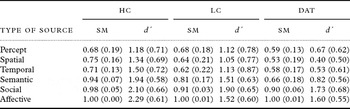
The results for SM and recognition data are presented in Table 2.
Mean proportion of SM accuracy scores and recognition performance in d’ as a function of type of source and group (HC, LC, and DAT patients; standard deviations are in parentheses)

Source monitoring
A 3 × 6 mixed ANOVA on source accuracy scores with type of source (perceptual, spatial, temporal, semantic, social, and affective) as a within-subjects factor, and group (HC vs. LC vs. DAT patients) as a between-subjects factor, showed a main effect of group, F(2,57) = 12.93, p < 0.001, MSE = 0.042, as the mean source accuracy level was 0.84 in the HC group, 0.78 in the LC group, and 0.71 in the DAT group. A Tukey post hoc test confirmed a significant difference across the three groups (p < 0.05).
There was a significant main effect of type of source, F(5,285) = 97.49, p < 0.001, MSE = 0.016. The mean source accuracy score was 0.65 for perceptual details, 0.64 for spatial, 0.63 for temporal, 0.80 for semantic, and 0.93 for social. The performance was at ceiling for affective details (0.99).
Planned comparisons showed that memory for semantic sources significantly differed from memory for all other source details. Perceptual did not differ from spatial and temporal sources. Source memory for social and affective attributes significantly differed from all the other types of source details and there was also a significant difference between social and affective details. This data, however, should be taken with caution due to ceiling effects.
Finally, the interaction between group and type of source was significant, F(5,285) = 3.48, p < 0.01. The major decrement for source memory in DAT was obtained with perceptual (0.59), spatial (0.53), and temporal details (0.58), whereas source memory for semantic information was 0.66, social 0.90, and affective at ceiling. A one-way repeated measure ANOVA with type of source as a main factor was, in fact, significant (p < 0.001). A similar pattern of performance was obtained in both control groups.
In general, healthy older adults and DAT patients perform poorer in SM tasks when perceptual, spatial, and temporal attributes are included. When we observe the differences between HC, LC, and DAT participants for these three features, source memory for spatial attributes seems to be more sensitive to dementia. In fact, while DAT patients and LC group had similar performances in perceptual and temporal conditions to the HC group, DAT performance for spatial attributes was particularly poor compared to the HC control group (p < 0.05). In addition, when we considered source memory for semantic information, DAT participants showed poor performance compared to the HC group (p < 0.05).
Recognition
A 3 × 6 ANOVA with type of source (perceptual, spatial, temporal, semantic, social, and affective) as a within-subjects factor, and group (HC vs. LC vs. DAT patients) as a between-subjects factor, showed a main effect of group, F(2,57) = 14.61, p < .01, MSE = 1.225, as the mean dʹ score was 1.73 in the HC group, 1.37 in the LC group, and 0.95 in the DAT group. A Tukey post hoc test confirmed a significant difference across the three groups (p < 0.05).
There was a significant main effect of type of source, F(5,285) = 39.63, p < 0.001, MSE = 0.279. Recognition memory was 0.99 for perceptual details, 0.93 for spatial, 1.05 for temporal, 1.42 for semantic, 1.91 for social, and 1.80 for affective details.
Planned comparisons showed that recognition memory for semantic details significantly differed from all the other types of source details. Perceptual recognition memory did not differ from spatial and temporal details. Recognition memory for social and affective attributes significantly differed from perceptual, spatial, temporal, and semantic details. Recognition memory for social and affective details, instead, did not differ. Finally, the two-way interaction between group and type of source was significant, F(5,285) = 2.78, p < 0.01, reflecting the same pattern obtained with the SM analysis.
Criterion scores
The analysis showed no effect of group (F < 1) as all groups showed the utilization of same criterion across different sources. There was an effect of type of source F(5,285) = 29.26, p < 0.001, MSE = 0.12. Participants were, in fact, conservative across all types of sources except affective (which, conversely, showed a more liberal criterion that they were biased to say “yes,” –0.03). Finally, the interaction was significant, F(5,285) = 4.65, p < 0.001. Here the critical conditions were the social and affective source conditions. LC older adults, in fact, tended to be more liberal for both types of sources, whereas DAT patients were liberal only towards affective source.
Discussion
This study aimed to compare memory for different types of source-specifying features in aging. Our results support the hypothesis that the ability to process source information depends on the type of the to-be-remembered source attributes and a repertoire of evaluation criteria involved, and is not generally affected by aging. Most important, a general cognitive slowdown does not seem to be responsible for the different patterns of SM performance obtained in these tasks (but see Siedlecki et al., Reference Siedlecki, Salthouse and Berish2005, for a different result).
In particular, DAT patients were particularly prone to source memory errors compared to all healthy controls, but we noted a larger deficit with spatial and semantic attributes. This finding indicates that these attributes tend to be elaborated with more systematic and controlled processes (Parkin et al., Reference Parkin, Walter and Hunkin1995). In particular, remembering the location in which a target word appeared or whether a target word was presented alone or coupled with an associated item required a greater degree of conscious attention. Given the well-known control processes deficit that DAT patients show due to their frontal lobe dysfunction (Budson et al., Reference Budson, Sullivan, Mayer, Daffner, Black and Schacter2002), these SM errors may mainly reflect problems regarding the evaluation/attribution of specific feature information necessary for making source judgments.
With respect to the social and affective source information, our data show ceiling effects in all three groups of older adults. On the one hand, this may have been because our stimuli may have simply tested taxonomic or thematic organization (e.g. the ability of grouping objects according to a specified category) rather than purely social and affective source information. Studies on categorization processes in older adults, in fact, do not show age-related deficits (Pennequin et al., Reference Pennequin, Fontaine, Bonthoux, Scheuner and Blaye2006). That is, the ability to judge, for example, dog and cat as belonging to the category “animals” remains stable across age. If superior source memory for social and affective detail is a robust finding in aging, we should be able to replicate this data also with other types of social and affective stimuli such as faces with different emotions (sad vs. happy). This type of stimuli may prevent the use of semantic information to a greater extent and allow a purer measure for social and affective source information.
However, the fact that participants were not only asked to indicate which category the target word belonged but also to distinguish between old and new words highlights the involvement of source memory processes in this task. The finding that DAT patients were still able to remember the category to which each word belonged and to distinguish between old and new items for these types of source details is noteworthy. A complementary hypothesis is that older adults showed superior memory for social and affective details because, in contrast to the other source details, social and affective words maintained the same source format at test. That is, while the format of presentation for colored, spatial, temporal, and semantic words changed between study and test phase (e.g. colored word at study vs. black word at test; right and left location at study vs. center of the screen at test, etc.), it was the same for social and affective words. Consequently, judging whether a word belonged to the male or female dimension or to the positive and negative valence was more automatically driven. A study currently in progress in our lab is trying to replicate this finding by representing all the target words with the same source study format. For example, in this study in progress participants are shown words in the color they were presented, and participants are asked if each word was presented in red or blue, or if it was new. This control condition may help us to clarify whether memory for perceptual and contextual details were particularly deficient because of a source mismatch between study and test phase.
Finally, strengths of the present investigation include a pre-clinical diagnosis of AD. Clinicians may find some types of source memory tasks (e.g. spatial) informative in assessing clinical memory function. Our results suggest that clinicians may look to the complexity of source memory as an important indicator of clinical memory function. In particular, developing new cognitive screening procedures that include spatial or semantic source information may help in assessing for the presence and severity of memory deficits in Alzheimer's dementia.
Conflict of interest
None.
Description of authors' roles
N. Mammarella designed the study, supervised the data collection, and wrote the paper. B. Fairfield collected the data and assisted with writing the paper. A. Di Domenico was responsible for the statistical design of the study and for carrying out the statistical analysis.