There have been two moments in contemporary history when women’s citizenship in the form of political rights expanded globally. The first was the extension of full suffrage to women, which started in the late nineteenth century, and the second was a major increase in women’s legislative representation, starting in the mid-1990s. Footnote 1 While both moments were influenced by international and domestic events, most crossnational studies explaining the large jump in women’s descriptive representation in Africa (including North Africa) between 1990 and 2015 (from 7.7 to 28.4%) have focused on the role of foreign donors, transnational advocacy networks, and global events like the 1995 United Nations (UN) Fourth World Conference on Women in Beijing. Footnote 2 Most crossnational studies have focused on the international dimension, in part, because it is easier to quantify using data produced by international actors. Footnote 3
We show how the domestic and international dimensions worked in tandem in African countries after the 1990s to improve women’s political representation, however, we draw on new evidence to focus on the role of women’s coalitions in these processes. Our findings take us beyond the work of Margaret Keck and Kathryn Sikkink, who show how domestic actors bring international pressure to bear on reluctant states to advance women’s rights. Footnote 4 While this has been a tactic employed by some social movements, we show that without significant pressure from within a country in the form of a coalition, quota laws are rarely adopted. Spreading in three waves, by 2016 at least 54 countries legally required party quotas and another 23 adopted reserved seats for women, but not all countries have introduced such reforms. Footnote 5
Bridging the interest group, public policy, and social movement literatures on collective action among organizations, we theorize that coalitions of organizations at the national level play an important role in multiple ways: (1) by identifying policy gaps, (2) by proposing specific policy solutions, (3) by adapting proposals to the national context, (4) by signaling domestic support, and (5) by signaling broad-based (e.g., multiethnic) support. Much of the literature on gender quotas to date has recognized the role of domestic factors in bringing about change, but not on coalitions as we do. Footnote 6
Theories of coalitions of organizations have been developed and tested to better understand education, environmental, civil rights, regulatory, and social welfare policy mostly in the United States and Europe. Footnote 7 Scholars have compiled information about women’s collective action through the Research Network on Gender Politics and the State (RNGS), and S. Laurel Weldon’s earlier work and subsequent study with Mala Htun developed comparative measures of women’s movements, focusing primarily on established democracies. Footnote 8 Yet the role of women’s organizing largely remains untested in the global South, where gender quota laws first emerged.
Addressing these gaps, we provide a first test of the hypothesis that when women’s organizations form a coalition for gender quotas, their countries are more likely to adopt them and do so at a faster pace. Inspired by work on women’s movements in the United States, Footnote 9 we use a dataset that we created of pro-quota women’s coalitions from 1989 to 2014 in 50 countries in Africa, where scholars expect international influences to be strong. We hope this Africa-based measure will inspire further work on domestic organizations and political change in the global South.
Using event history models, we conduct a two-step analysis. First, we ask where coalitions are likely to form to examine the possibility that they are endogenous. To help minimize bias in our findings about coalitions, we then include variables that might correlate with the rise of coalitions in our statistical analysis of the adoption of quotas. We include a measure of postconflict status, which is found to be important in Africa, in part because of the role disruptions in gender relations during conflict. Footnote 10 We also control for the type of electoral system and level of economic development. Ultimately, we find that domestic women’s coalitions correlate with the adoption of gender quotas in addition to having a postconflict context and connections to the international women’s movement.
Our study makes three contributions. First, we call attention to the formation and role of domestic women’s coalitions—occupying a middle ground between individual policy entrepreneurs and transnational advocacy networks—in the spread of major innovations concerning women’s rights. Second, we suggest that women’s movements in the case of gender quotas take a particular form of coalition building across ethnic and political cleavages. Third, by examining how domestic pressures influence political reform, our study has implications for similar movements around climate change and other environmental issues, children’s rights, human rights, and many other concerns.
The first section outlines our theory of domestic coalitions, followed by quantitative analyses of their rise and role relative to other influences. We compare Benin and Senegal to examine the nuances of our theory, and then discuss the importance of coalitions based on the statistical evidence and case studies. In the last section, we point to women’s coalitions as a direction for future research on the implementation of women’s rights reforms and substantive representation of women. Our conclusion further discusses the implications of our study for understanding major change in other policy areas, and for studies outside of Africa.
Domestic Women’s Coalitions and Gender Quotas: A Meso-Level Theory
Coalitions are the temporary, decision-oriented, joint use of resources by two or more social units. Coalitions work toward a decision (or what William Gamson calls “a selection among alternatives”), which if realized, produces a payoff for the participants. Footnote 11 Since the advocacy explosion of the 1960s in the United States, scholars of interest groups, public policy, and social movements have shared an interest in the emergence and impact of collective action among social organizations, which is our focus. Footnote 12
Much of the literature on gender quotas has recognized the role of women’s activism in bringing about these reforms, but few have sought to explicitly develop a theory of coalitions as we do. Some accounts focus on grassroots women’s organizations, Footnote 13 cross-partisan networks, Footnote 14 women’s organizations within parties, Footnote 15 and individuals within the national women’s machinery. Footnote 16 The literature on Africa has also examined the role of women’s mobilization in these various fora. Footnote 17
Why focus on coalitions of organizations and not policy entrepreneurs, social movements, or transnational networks? We suggest that coalitions are in a distinct position to help name problems, propose and adapt specific policy solutions, and help signal domestic and broad-based support for change. While noting that countries may adopt major reforms in the absence of women’s coalitions, we observe that in Africa it has been the case that coalitions are involved in quota adoption.
Coalitions Identify Problems
When organizations come together, they can help identify and prioritize unequal representation as a problem of national import. Naming is critical for policy action. Without the perception that something is wrong, policymakers may see no need for innovation. Individual policy entrepreneurs may be the first to identify a policy gap, but to put an issue on the national agenda, they require coalitions that pool human and financial resources. The joint use of resources is needed to disseminate pamphlets, issue press releases, speak on the radio and television, hold public meetings and workshops, and protest in the streets, as we will see in the case of Senegal. Sarah Soule and Brayden King’s study of women’s movements in the United States finds that women’s organizations exert the most leverage over policymaking at this agenda-setting stage. Footnote 18 Scholars of women’s movements in semi-authoritarian and authoritarian contexts such as Uganda find that women’s groups help bring new issues to the national arena. Footnote 19 Thus we expect domestic coalitions (and social movements) to play an agenda-setting role in democracies and at times in autocracies.
How do women’s organizations come by the idea to name underrepresentation as a public problem? Women’s organizations can become inspired to identify new public problems through their participation in global conferences, by reading international treaties and declarations, or by hearing about women’s successes or reform in other countries. Nevertheless, prior to the heightened efforts by the United Nations and other international entities to increase women’s representation, it was often women on the ground in countries such as Tanzania and Uganda that articulated to domestic audiences the need to include more women in positions of power. For instance, the issue of women’s underrepresentation became a national agenda item in the Republic of Niger only after leaders of women’s organizations organized a massive protest in 1991. Footnote 20
Coalitions Propose Specific Solutions
Coalitions advocate for a decision. This makes them distinct from social movements, which are broader and may internally disagree over what kind of change is necessary. Footnote 21 Coalitions, as Kevin Hula writes, “serve as institutional mediators reconciling potentially disparate policy positions, in effect ‘predigesting’ policy proposals before they are served to the legislature.” Footnote 22 By articulating a preference for a specific policy, coalitions can help policymakers who are amenable to backing gender quotas for self-interested reasons but are faced with a surfeit of options. International statements such as the Beijing Platform of Action and Inter-Parliamentary Union’s (IPU) Plan of Action provide a large menu of choices for improving women’s descriptive representation, of which the adoption of a gender quota is only one. Footnote 23 Women on the ground, while not the only national-level actor that can propose specific policies, can and do suggest content for nascent quota legislation, as was the case in Uganda during the constitution making process. Footnote 24
In the literature on African politics, scholars note that party systems in many countries are fragmented, making it a challenge for parties to coalesce interests. Footnote 25 One recent study finds that in the 2000s, civil society actors were more likely to stake out policy positions in the media than were political parties or candidates in seven African countries, except for Ghana and Kenya. Footnote 26 This suggests that coalitions of organizations may be influential not just in wealthy democracies in the global North but also in new democracies in the global South.
Coalitions Adapt Solutions to the National Context
Sally Engle Merry argues that for internationally circulated ideas to be effective at home, they “need to be translated into local terms and situated within local contexts of power and meaning.” Footnote 27 Much of the existing qualitative scholarship on the adoption of quotas shows that women’s organizations use locally relevant frames that fit with pre-existing discourses to advocate for quotas. Footnote 28 Moreover, the translation of norms into policy is not a smooth process, but one often marked with setbacks. Coalitions, working toward a common end, can help shepherd a policy through expected and unexpected roadblocks, as we will explore in our case study of Senegal. This persistent fine-tuning of new policy solutions is what sociologist Holly McCammon calls “strategic adaptation.” Footnote 29
Coalitions Signal Domestic Support
Domestic coalitions can help signal to policymakers that demand for change is not only international. Policymakers, in the absence of clear domestic support, may not perceive new proposals as worth the investment of scarce resources. When asked about the role of the international community and the state in adopting quotas in Algeria, the lawyer and head of the local organization Le Centre d’information sur les droits de l’enfant et de la femme (CIDDEF) Nadia Ait-Zai responded:
We have been helped by the international communities. But the first work was done here in Algeria. When we wanted more representativeness of women in politics, the work was first made in Algeria and it is we who did it. Indeed, CIDDEF launched a partnership advocacy campaign with political parties and with associations to tell the president we wanted a quota for women in parliament and not less than 30 percent. Footnote 30
Today at 32%, Algeria has the highest rate of representation of women in the Middle East and North Africa.
Coalitions Signal Broad-based Support
Coalitions can help signal mass support for major reform. Since the beginning of the 1990s, women’s activists moved away from the post-independence phenomenon in which mobilization at the national level fell under one large national association that was often tied to the ruling party or the state. These organizations were not autonomous (e.g., Ghana’s 31st December Women’s Movement, Kenya’s Maendeleo ya Wanawake, Nigeria’s Better Life for Rural Women Programme). Footnote 31 With democratization in the 1990s, statist associations of this type declined in prominence, and newer and smaller women’s organizations proliferated. Footnote 32 In this contemporary political landscape, women’s groups have sought to form coalitions. Footnote 33
To be clear, not all groups need to agree that quotas ought to be a priority. In Algeria, women’s groups agreed that increasing women’s parliamentary representation was necessary, but some saw quotas as an elitist aspiration that could wait. Others thought the women elected would not be qualified, and there were divisions over quota adoption for this reason. But a coalition for gender quotas was formed nevertheless.
In societies where ethnic difference is politicized, coalitions that cut across salient cleavages can help demonstrate wide-ranging support for reform. Kenya’s quota adoption process is a case in point. From the outset, women activists played a central role in the convoluted, acrimonious, and lengthy constitution-making process in Kenya. Footnote 34 As Jill Cottrell and Yash Ghai (the first head of the Constitution of Kenya Review Commission) wrote, “They made full and skillful use of the opportunities opened up by the review for women in particular . . . . The group which came out best from the process were women, who were able to present a united and coordinated position, transcending ethnic or religious distinctions.” Footnote 35 The activists not only advanced a women’s rights agenda, but they also played an important role in moving the overall constitutional process forward and finding common ground between competing groups. Bridging across difference has taken place in other polarized contexts. In Somalia, women’s activists created a Rainbow Coalition cutting across clan differences to press for a quota in the constitution-making process, with some degree of success. Similar multiethnic initiatives took place in other countries, in peace talks (e.g., Burundi), Footnote 36 constitutional-reform processes (e.g., Zimbabwe), and legislative reform (e.g., Senegal).
Indeed, the politicization of ethnic difference may propel women to form coalitions. In patronage-based systems, women are often excluded from what Linda Beck calls a “hidden public.” Footnote 37 This is the case in countries such as Kenya, South Africa (particularly until 1994), and the United States (particularly until 1920) where a colonial state favored men over women and a postcolonial state perpetuated the political salience of ethnicity and race. Footnote 38 Further, scholars have found that ethnic-minority parties in proportional representation systems are more likely than others to exclude women. Footnote 39 Multiethnic mobilization especially among women often occurs in the context of conflict as women build cross-cleavage coalitions to fight for peace and advance a women’s-rights agenda that often includes quotas. Footnote 40 Given that quotas ostensibly benefit all women, it should not be surprising that, for strategic reasons, women’s organizations would draw multiethnic support for quotas among other demands.
In sum, while there is no question that individual policy entrepreneurs and the diffusion of ideas from one country to the next are important in understanding domestic policy change, the adoption of gender quotas is not self-executing. We hypothesize that when women’s organizations form a coalition for gender quotas, countries are more likely to make the change and to do so at a faster pace.
Gender Quota Adoption in Africa: A Quantitative Analysis
In seeking to explain how major change occurs in women’s rights, we examine whether, when controlling for a variety of factors, domestic women’s coalitions for gender quotas correlates with the likelihood and pace of adoption of quota laws. Because the formation of coalitions may not be exogenous, we first consider where they are likely to emerge. We then include the same variables in the analysis of quota adoption to avoid producing spurious findings. Footnote 41
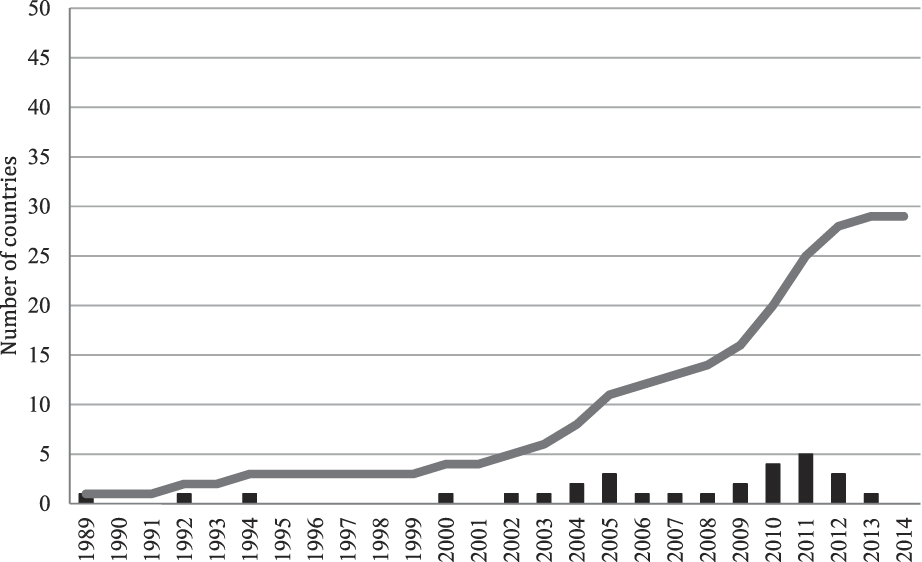
We use discrete time event history models with the complementary log-log (clog-log) link function. Discrete time models are appropriate due to the interval nature of our data and the presence of tied event times, as shown in figure 1. Footnote 42 The complementary log-log transformation is analogous to the popular Cox continuous time hazard model. It, however, requires the analyst to choose a representation of the underlying hazard function and test for violations of the proportional hazards assumption. Footnote 43 For these purposes, we use a linear variable for time, with which we interact select variables. Footnote 44
The adoption of gender quotas in Africa, 1989-2014
Note: The line shows the cumulative number of countries with gender quotas laws or reserved seats for women in the lower-house or unicameral legislature that meet a 10 percent minimum threshold. Bars refer to the number of adoptions in the given year.

We consider the risk of adoption to begin with Uganda’s introduction of a reserved seat system in 1989. Countries enter the data set in this year, except for Eritrea and Namibia, which gained independence in 1993 and 1990 respectively, and exit when they experience the event in interest or reach the year 2014. The number of countries in the models varies from 41 to 50.
Our central dependent variable is the likelihood that a country will adopt a gender quota, given that it has not done so. By gender quotas, we mean constitutional provisions or legislation mandating a minimum 10% women’s share of seats in the lower house or unicameral legislature. Footnote 45 Twenty-seven countries in our sample adopted gender quotas between 1989 and 2014: Algeria (2012), Angola (2005), Burkina Faso (2009), Burundi (2004), Cape Verde (2010), Democratic Republic of Congo (2011), Republic of Congo (2007), Djibouti (2002), Egypt (2009), Eritrea (1994), Guinea (2010), Kenya (2010), Lesotho (2011), Liberia (2005), Footnote 46 Libya (2012), Mauritania (2006), Morocco (2011), Niger (2000), Rwanda (2003), Senegal (2010), Sudan (2008), Swaziland (2005), Tanzania (1992), Togo (2012), Tunisia (2011), Uganda (1989), and Zimbabwe (2013). Somalia and South Sudan, excluded from the statistical tests, adopted a gender quota in 2004 and 2011 respectively. Footnote 47
Women’s coalitions equals zero as a default and takes a value of one if two or more domestic social organizations work collectively around the adoption of a party candidate law or reserved seat system for women in the lower house or unicameral legislature. Social organizations are often women’s organizations, led by women and concerned with women’s gendered experiences, but they can include others such as human rights associations. To code coalitions, we used a combination of secondary sources and news stories from more than 100 national newspapers, national wires, and international wires, conducting searches in Arabic, French, Portuguese, and Spanish, in addition to English. This method is similar to Alice Kang’s work on civil society representation of women and the ratification of the African Union Protocol to the African Charter on Human and Peoples’ Rights on the Rights of Women in Africa, also known as the Maputo Protocol. Ours differs in that we include secondary sources and code specifically for coalitions. Footnote 48 As some coalitions may be less visible, and to check that we do not overlook unsuccessful ones, we corroborated our coding with country experts for countries where it was not apparent that a coalition had formed.
What does and does not count as a pro-quota coalition? We include formal (e.g., the Libyan Women’s Platform for Peace) and informal coalitions (e.g., of the Association des femmes tunisiennes pour la recherché sur le développement and the Ligue tunisienne des droits de l’homme, among others, in Tunisia). Because the pursuit of a shared and specific goal is central to the concept of coalitions, organizations that do not make an explicit call for candidate quota laws or reserved seats are not coded as such. For instance, in Mali, women’s organizations came together in a coalition, along with government allies, to advocate for a reform to the electoral code to include a gender quota for party lists. Footnote 49 (Mali has yet to adopt a gender quota.) By contrast, in Malawi, women’s organizations have united around the issue of campaign finance. Footnote 50 We also looked for signs of cooperation among organizations (e.g., the issuing of a collective declaration, a joint meeting with a policymaker). In Botswana, we have not seen indications of coordination among multiple women’s organizations for quotas. In Swaziland, one, but not multiple, organization called for a gender quota. Footnote 51 (Swaziland adopted a quota.)
Our models include controls for international or transnational influences. The growth (or decline) in the International women’s movement may encourage domestic coalitions to form and countries to adopt quotas. Footnote 52 Countries where women are more embedded in the global women’s movement may be more likely to have coalitions and quotas. To measure embeddedness, we use Log women’s NGOs at Beijing per 1 million, the natural log of the number of women’s NGOs that attended the UN World Conference on Women in Beijing in 1995 scaled by population size. Footnote 53 We include an interaction term for the international women’s movement and a country’s embeddedness in the movement. Footnote 54 Countries may respond to incentives from established democracies to adopt gender quotas. Footnote 55 Log DAC aid per capita (t-1) is the natural log of official development aid per capita disbursed by members of the Organisation for Economic Co-operation and Development’s (OECD) Development Assistance Committee (DAC) to country i in current US dollars, lagged one year. Footnote 56 This excludes aid from autocracies and semi-autocracies. Footnote 57 In models not reported here, we control for the presence of a liberalizing UN peacekeeping operation, which may transmit new ideas about what is beneficial for the country’s reputation abroad and push for quotas. Footnote 58
We also include controls for the domestic political context. The end of war may be an opportune time for the formation of coalitions and adoption of gender quotas. Footnote 59 Postconflict equals one if country i was in its last year of major armed conflict after 1986 and through the first postconflict election; it is zero otherwise. Footnote 60 Level of democracy, based on Polity IV, varies from -10 to 10. Footnote 61 Transitions to democracy ostensibly create new opportunities for coalition formation and institutional reform, though not all new democracies adopt gender equality policies. Footnote 62 Democratic transition equals one if country i experienced a transition from autocracy (equal to or less than -6 on the Polity IV scale) to anocracy or a hybrid regime (-5 to 5); from anocracy to democracy (equal to or greater than 6); or from autocracy to democracy in the previous three years.
Other domestic political variables include the Ethnic Power Relations’ Number of ethnopolitical groups, the number of politically relevant ethnic groups in country i in year t. Footnote 63 The politicization of ethnic difference may encourage women to form pro-quota coalitions, as discussed in the previous section. It may be easier to adopt quota laws in proportional representation than in first-past-the-post systems. Footnote 64 Plurality electoral system equals one if country i uses a majoritarian electoral system for the lower house or unicameral legislature as of or close to January 1; it is zero otherwise. Footnote 65 If the legislature is suspended, we carry over the previous system. If the country is under one or no party rule, or if indirect elections are used, the variable is coded as missing, which makes plurality highly left-censored. Footnote 66 Left-leaning rule equals one if the party of the country’s executive or largest party in year t is communist, socialist, or social democratic; it is zero otherwise. Footnote 67 Women in parliament, % is the percentage of women in the lower house or unicameral legislature in country i as of or near January 1 in year t. Footnote 68
Finally, we include controls for socioeconomic and cultural conditions. Modernization theory suggests poorer countries and predominantly Muslim countries may be slower to form coalitions or adopt gender quotas. Footnote 69 Log GNI per capita (t-1) is the natural log of gross national income per capita (Atlas method) for country i in current US dollars, lagged one year. Footnote 70 Muslim majority is one if 50.1% or more of the country’s population is Muslim; it is zero otherwise. Footnote 71 Female labor force (t-1), % is the percentage of the formal labor force comprised of women in country i, lagged one year. Footnote 72
The Formation of Coalitions
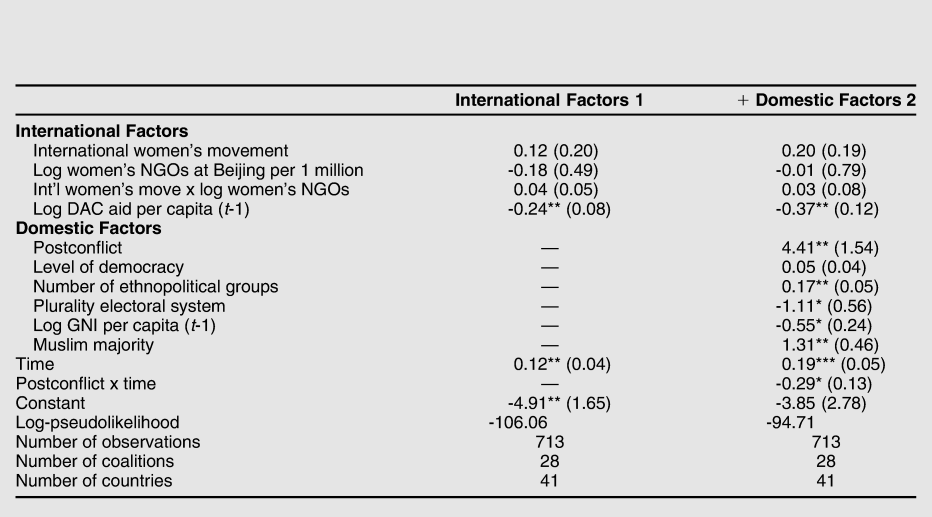
Table 1 reports results from models in which coalition formation is the dependent variable. Countries that adopted quotas prior to 1995 are omitted from the analysis (Eritrea, Tanzania, Uganda). A positive coefficient indicates that the variable correlates with a higher likelihood of formation and that a coalition is likely to form sooner. Model 1 includes international variables. Model 2 adds domestic political and socioeconomic controls.
Correlates of the emergence of coalitions, 1989–2014 (discrete time complementary log-log event history models)

Notes: Coefficients are reported with standard errors clustered on country in parentheses. + p<0.1; * p<0.05; ** p<0.01; *** p<0.001; two-tailed tests.
As the first quantitative study of the rise of coalitions for gender quotas, our results are preliminary but nonetheless suggestive. Starting with international factors, the variable for international women’s movement is positive but does not attain statistical significance. We note, however, that the global movement and time, which is positive and statistically significant, has a correlation of 0.88. If we omit time from the model, the variable for international women’s movement becomes significant. Our interpretation is that if coalitions are more likely to form with every new year, it is because of the activity of the international movement. The variable for embeddedness and the interaction term are not statistically significant. Countries with higher levels of foreign aid from established democracies appear less likely and slower to see the rise of coalitions; in a few of our robustness checks, this negative relationship does not hold.
Turning to model 2, coalitions appear to form more quickly in postconflict countries, but the relationship changes over time. Footnote 73 Coalitions do not appear to be more likely or faster to form the more democratic the country is. The variable for the number of politically relevant ethnic groups is positive and statistically significant, although in our robustness check, an alternative measure that does not change over time and covers fewer countries, Daniel Posner’s Politically Relevant Ethnic Groups (PREG), does not attain statistical significance. Footnote 74 Coalitions are significantly faster and more likely to form in poorer and majority Muslim countries and significantly slower to form in countries with plurality electoral systems.
Thus far, our results suggest that women’s coalitions are more likely to form as time progresses and mixed evidence that women’s coalitions are more likely to emerge where there are more politicized ethnic groups. We now explore whether countries with women’s coalitions are more likely to adopt gender quotas, controlling for these factors.
The Adoption of Gender Quotas
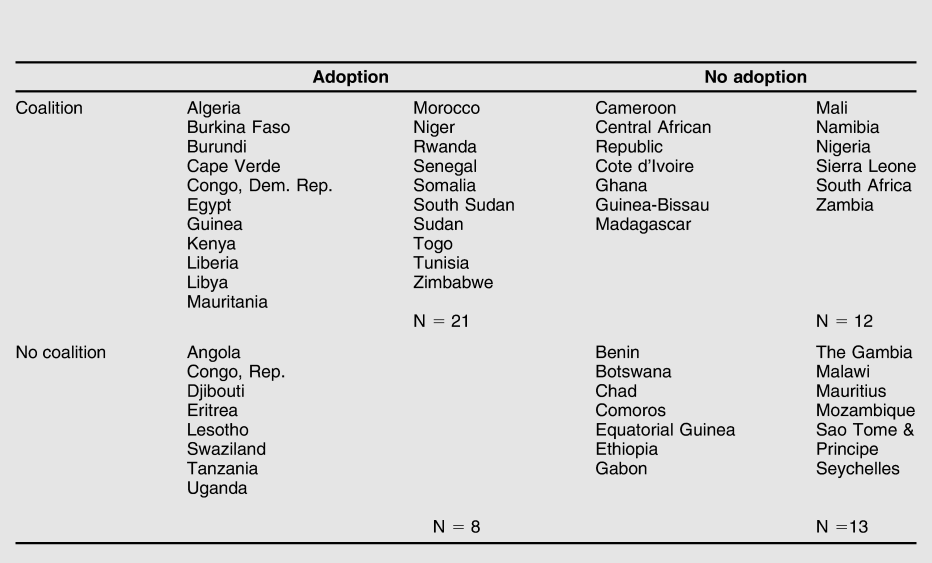
A simple cross tabulation presented in table 2 suggests that there is a relationship between coalitions and the adoption of quotas. Coalitions for gender quotas emerged in 33 countries, of which 21 adopted a gender quota law or reserved seat system (63.6%). Of the 21 countries with no coalition, eight adopted a gender quota law or reserved seat system (38.1%). That some countries with coalitions did not adopt quotas and that others with quotas did not have coalitions suggest that our coding of coalitions is independent of whether they were successful.
Coalitions and the Adoption of Gender Quotas, 1989–2014

Notes: Gender quotas refer to laws or reserved seats systems. In the statistical analyses, Sao Tome and Principe, Seychelles, Somalia, and South Sudan are excluded due to missing data or late independence.
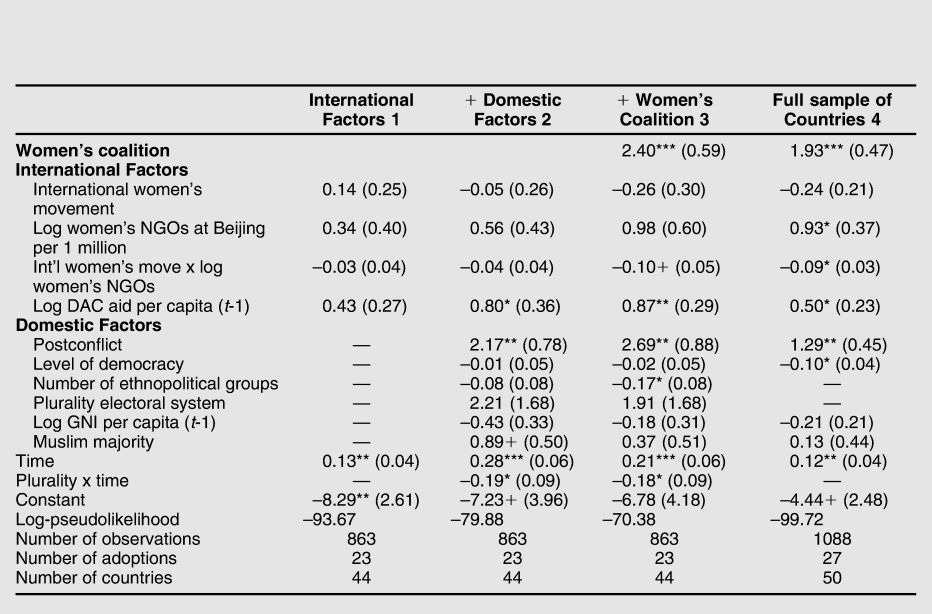
Table 3 reports results that support our hypothesis that countries with domestic women’s coalitions are more likely to adopt gender quotas and to do so faster than countries with no coalitions. Models 1 and 2 reflect the state of the quantitative scholarship. In model 3, we add our measure of women’s coalitions, and in model 4, we exclude two variables with missing data to use the full sample of 50 countries.
Correlates of the adoption of gender quotas, 1989–2014 (discrete time complementary log-log event history models)

Notes: Coefficients are reported with standard errors clustered on country in parentheses. + p<0.1; * p<0.05; ** p<0.01; *** p<0.001; two-tailed tests.
The variable for coalition is positive and statistically significant in both models. The international women’s movement does not correlate with adoption, but the variable for time is positive and statistically significant. A country’s embeddedness in the international women’s movement is positively associated with adoption, and in model 4 the variable attains a conventional level of significance. The interaction term has a negative sign and is variably significant. The sign for the variable of aid from democracies is positive, and in three models the variable attains conventional levels of significance.
As expected, the variable for postconflict is positive and statistically significant. There is mixed evidence that adoption is more likely in countries with lower levels of democracy. Using the Ethnic Power Relations’ count of the number of politicized ethnic groups, we find a negative and significant relationship; when we employ Posner’s measure, the correlation does not hold. The relationship between the introduction of quotas and electoral system varies over time, with plurality systems being less likely to adopt. The variable for wealth is not significant, while the variable for Muslim-majority changes in sign (in robustness checks) and level of significance.
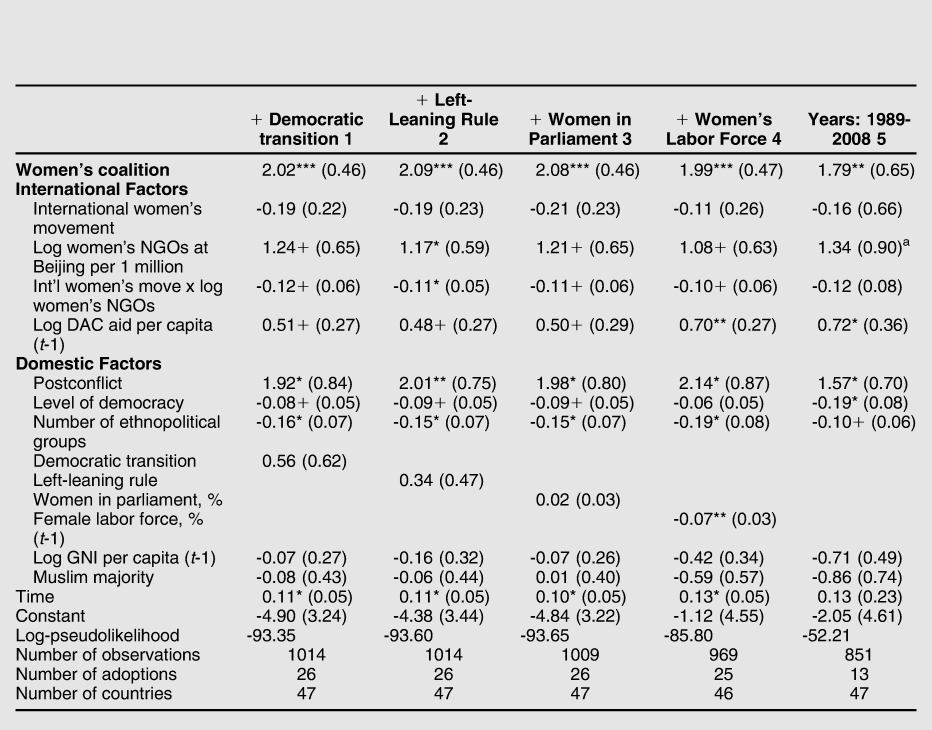
In table 4, we add four control variables and continue to find that women’s coalitions are significantly and positively associated with the adoption of gender quotas. Model 1 suggests that countries that recently experienced a democratic transition are not more likely or faster to adopt gender quotas. Leftist countries and countries with higher percentages of women in parliament do not appear to be more likely or faster to adopt. The variable for women in the labor force is negative and attains significance, but the result is not robust in alternative models. When we end the study period in 2008, using Melanie Hughes and her colleagues’ measure of embeddedness, coalitions continue to be related to adoption.
Correlates of the adoption of gender quotas, alternative control variables (discrete time complementary log-log event history models)

Notes: Coefficients are reported with standard errors clustered on country in parentheses. + p<0.1; * p<0.05; ** p<0.01; *** p<0.001; two-tailed tests.
a Share of total women’s INGOs in country i.
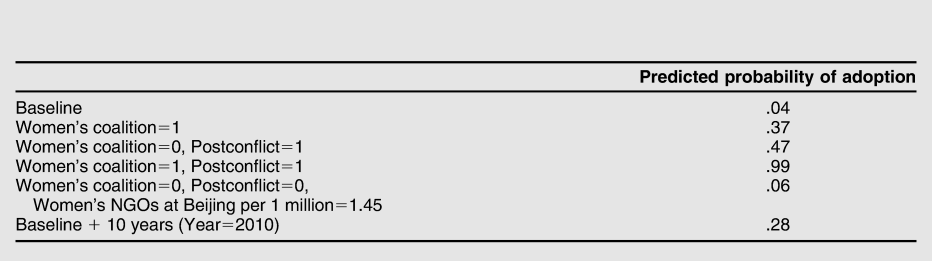
To examine the substantive impact of domestic coalitions on the adoption of gender quotas, we predict the probability of adopting a gender quota for a baseline group, as reported in table 5. We use results from model 3 in table 3 to calculate the probabilities, and because likelihood of adoption changes over time, we choose 2000 as the year. For an average country that is not postconflict and does not have a women’s coalition, the probability of adopting a quota in 2000 is .04. If a women’s coalition exists, the probability jumps to .37. If the country is postconflict and there is no coalition, the probability is higher, at .47. When we change the number of women’s NGOs at Beijing from the 50th to the 90th percentile (from .37 to 1.45 NGOs per 1 million inhabitants), the probability of adoption is .06. Using the baseline and changing the year to 2010, the probability of adoption is .28. The connection between coalitions and the adoption of gender quotas comes near or surpasses that of other major explanatory factors.
Predicted probabilities of the adoption of gender quotas by the end of 2000

Notes: The mean predicted probability of adoption is calculated using the coefficients from model 3 in table 3. In the baseline prediction, women’s coalition and postconflict is 0. For all rows, the international women’s movement is 7.75 (the 2000 value). We report the anti-log of Log women’s NGOs at Beijing per 1 million at the 50th percentile (top four and sixth rows) and 90th percentile (fifth row). Log DAC aid per capita (t-1) and log GNI per capita (t-1) are set at the mean. Level of democracy is 0 and the number of ethnopolitical groups is 5 (the median values). Plurality electoral system and Muslim majority are 0.
In results not reported here, we include more controls, and women’s coalitions correlate with the adoption of gender quotas in all these models. Whether countries have an official state religion does not correlate with the adoption of gender quotas while the percentage of the population that is Catholic does. Footnote 75 The year in which country i ratified CEDAW does not correlate with adoption. Footnote 76 We do not include a variable for whether a country ratified CEDAW because only three countries had not ratified CEDAW or ratified CEDAW during the study period: Mauritania (2001), Sudan (not ratified), and Swaziland (2004). As a final robustness check, we exclude potentially influential countries.
In all, we find clear support for the proposition that domestic women’s coalitions are associated with the adoption of gender quotas. Coalitions for quotas do not appear to be endogenous to foreign aid from established democracies or to country ties to the international women’s movement but do seem to be connected to the march of time. We find mixed support for our claim that coalitions are more likely to emerge in contexts where ethnicity is highly politicized. Yet, controlling for all these factors, coalitions are strongly and positively related to quota adoption. Whether a country is postconflict, the amount of aid it receives from established democracies, and the year also correlate with adoption.
Comparative Case Study: Benin and Senegal
Our large-scale analysis shows that between 1989 and 2014, women’s coalitions correlate with the adoption of gender quotas. A most-similar comparison of the passage of a parity law in Senegal and non-adoption in Benin helps us examine the nuances of our main finding.
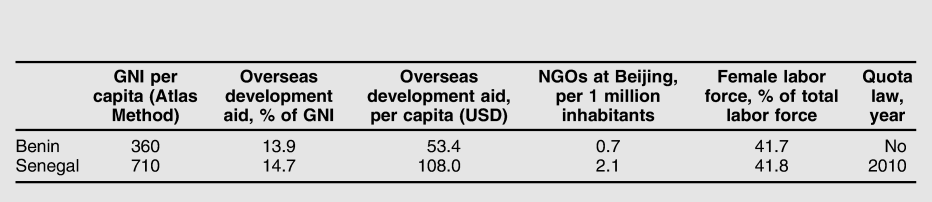
The cases of Benin and Senegal can be generalized to non-postconflict democracies that use a mixed or PR electoral system. (Benin employs proportional representation, and Senegal has had a parallel system since 1983.) Compared to the region, Benin and Senegal received average levels of foreign aid, had average levels of GNI per capita, and had average numbers of politicized ethnic groups (4 and 5, respectively; refer to table 6). Footnote 77

Domestic women’s organizations in Senegal jointly used resources to name underrepresentation as a major problem, to propose and adapt new policies, and to signal domestic and broad support for a parity law, which they won in 2010. After the passage of the law, the number of female parliamentary representatives nearly doubled, jumping from 23 to 43 percent of the seats with the 2012 elections.
In Senegal, the problem of women’s underrepresentation and the call for gender quotas was spearheaded by the umbrella group Conseil sénégalais des femmes (the Senegalese Council of Women, COSEF). In 1998, COSEF began raising the issue of quotas with various political parties, which promised to voluntarily implement them. After the 1998 elections, however, it was evident that moral commitment by the country’s leaders was insufficient, and COSEF decided it needed a legal means to bring about parity. Meanwhile, Abdoulaye Wade, who became president of Senegal in 2000, had made campaign promises regarding gender parity. In 2004 under Wade, Senegal ratified the African Union Maputo Protocol which includes a provision around gender parity. Senegal also added the protocol to its constitution. COSEF seized on this moment to advance the issue. Footnote 78
Adapting its policy goals toward a gender quota law, in 2005 COSEF launched the “Together, let’s strengthen democracy with gender parity!” campaign. It received input from various legal and constitutional experts and worked with the Ministry of Women’s Affairs, Children, and Female Entrepreneurship in a strategic alliance to get parity introduced into parliamentary elections. The coalition, however, maintained their independence from the ministry. They worked with women from political parties and, on March 23, 2007, held a demonstration signaling domestic and mass support in which women dressed in white and got the parties to support their campaign.
The National Assembly of Senegal passed a parity law on March 27, 2007, which was quickly followed on April 2 by a complaint by a dozen members of parliament against the law to Senegal’s Constitutional Council. On April 27, the council declared the law unconstitutional, on the grounds of discrimination based on sex. Footnote 79
Following the council’s ruling on the unconstitutionality of the parity law, COSEF and its allies strategically adapted and pursued a new policy proposal: amend the country’s constitution. Women’s organizations met with President Wade on October 24, 2007, with Minister of Women Awa Ndiaye attending. Footnote 80 Fatou Kiné Diop, along with leaders of the Fédération des associations féminines du Sénégal (FAFS), Fédération nationale des groupements de promotion féminine (FNGPF), and Réseau Africain de soutien à l’entreprenariat féminin (RASEF) called upon Wade to make the principle of parity part of the constitution. On December 13 and 26, the National Assembly and Senate, respectively, voted in favor of a bill to amend the constitution to state that the law promotes women’s and men’s equal access to public offices and positions. The parliament ratified the constitutional amendment on July 23, 2008. Senegal’s gender parity law was adopted on May 28, 2010, mandating the alternation of party lists between male and female candidates. Since Senegal has a parallel electoral system, these provisions apply to proportional representation party lists and the seats contested through the plurality system in multimember constituencies. Thus, in a constituency with five seats, two would have to be filled by women.
To be clear, the international context mattered as did the strategic calculations of the political elite. Women’s organizations had the support of foreign donors and were connected to the international women’s movement. Women formed COSEF in the lead-up to the 1995 World Conference on Women in Beijing. After Senegal ratified the Maputo Protocol and added the treaty to its constitution, women launched the “Together, let’s strengthen democracy with gender parity!” campaign. External donors such as Friedrich Ebert Stiftung (FES), United Nations Development Fund for Women (UNIFEM), among others supported the domestic actors by providing financial and technical support. Footnote 81 Women’s organizations did not do it all on their own. Getting the political elite, the women’s ministry, and parties on board was key to their success. Nevertheless, the impetus for the gender parity law, strategic adaptations to the national context, and demonstration of domestic support came from a coalition of women’s organizations at the national level.
In contrast, Benin has not had a women’s coalition for gender quotas. In the 2011 and 2015 elections, women won 10 (7%) of the legislative seats, respectively. Individual women’s activists advocated for a gender quota law in Benin, but women’s organizations were either unable or uninterested in forming a pro-quota coalition. In 2004, a female parliamentarian, Justine Achadé, proposed a parity law. Footnote 82 The Ministry of Family at the time also supported the idea of a gender quota law, as well as the president of the National Assembly. In 2006 and 2008, Alice Kang conducted interviews with women’s activists and representatives of international donors and found that the quota was not a priority for women leaders and organizations.
On August 24, 2010, the National Assembly voted in favor of a bill that would raise the number of seats in the legislature from 83 to 99 and install a 20% gender quota. Shortly thereafter, several individuals including a president of a women’s association, Marie-Elise Gbedo, inadmissibly filed a request with the Constitutional Court to examine the constitutionality of the bill. Two members of parliament also filed a request with the court. In September, the court invalidated both parts of the bill. The court ruled that the size of the assembly could only expand if there were sufficient financial resources, and that the quota violated the constitutional principle of equality between the sexes as well as the African Union’s Charter on Human and People’s Rights. Footnote 83
Unlike women’s organizations in Senegal, women’s activists in Benin did not adapt a new quota proposal after the ruling despite external support for the quota from FES and USAID. One women’s organization, RIFONGA-Benin has since called for the adoption of a parity law, holding workshops with the media in January 2013. Footnote 84 Other women’s organizations, however, have shied away from calling for parity legislation. To date and to the best of our knowledge, no pro-quota coalition has emerged in Benin.
As the case studies show, a meso-level attention to domestic coalitions contributes to micro-level explanations that center on strategic elites and macro-level explanations that focus on global norms and networks. Political leaders in Benin and Senegal strategically supported the adoption of gender quotas. In the 2000s, the international consensus was clear: women and men ought to be equally represented in public office. Women in Benin and Senegal were attuned to changes occurring at the global level and connected to transnational women’s networks. In Senegal, domestic organizations were at the helm of the campaign and made key adjustments when obstacles were presented. Foreign donors were willing to help women’s organizations push for quotas in both countries, but women’s organizations in Benin did not come together. Without domestic mobilization in the form of a coalition, external efforts were for naught in Benin, while in Senegal the coalition succeeded in introducing a quota.
The Importance of Domestic Coalitions
We have found through statistical analysis and a comparative case study that without domestic coalitions, it is significantly less likely that quota laws are adopted to increase female legislative representation. These coalitions are constituted by multiple women’s organizations that seek to name new public problems, identify and adopt policy solutions, and signal domestic and broad-based support. The coalitions tend to be expansive, cutting across ethnic, religious, party, and other differences, particularly when it comes to issues that challenge societal beliefs and expectations because of the importance of showing widespread support of the reform from key sectors of society.
Although prior work has pointed to the role of women’s movements in advancing such reforms, we contend that it is, in fact, a specific form of mobilization, i.e., coalitions, that are critical in bringing about such legislative change. Broader movements are nonetheless important, in part, because coalitions can emerge out of them, and we would not be surprised to see women’s coalitions for quotas in countries with vibrant women’s movements. To explore this possibility, it is instructive to turn to Mala Htun and S. Laurel Weldon’s dataset on women’s movements, in which four of nine African countries were coded as having a strong or very strong autonomous feminist movement prior to quota adoption (Botswana, Kenya, Morocco, South Africa). In Kenya and Morocco, a pro-quota women’s coalition emerged, but not in Botswana. Footnote 85 In South Africa, which had a women’s coalition, the dominant African National Congress adopted a voluntary party quota. We do not assume that all women’s movements will engender coalitions for quotas, as the case of Benin illustrates.
We find that domestic women’s groups play a role in the adoption of quotas, above and beyond the efforts of international actors and pressures on governments. Still, we concur with previous studies that the international women’s movement, a country’s embeddedness in the movement, and foreign aid from democracies is important. We do not think it is a coincidence that Senegal, which adopted a quota, had twice as many women’s organizations per capita attending the UN World Conference in Beijing than that of Benin. Yet the importance of transnational networking should not be exaggerated. In our analysis of coalition formation, embeddedness in the international women’s movement does not predict whether or how quickly women’s coalitions emerged. Foreign aid from democracies does not explain the rise of women’s coalitions for quotas. Therefore our preliminary analysis provides an empirical challenge to the claim that women’s coalitions in Africa are Western-driven and import foreign values, a charge that is often articulated by critics and observers.
To be clear, we do not argue that coalitions are the only factor driving major women’s rights reform. We find that countries that came out of major armed conflict since the mid-1980s, but especially after 2000 are more likely to adopt gender quotas than countries that had not. Thus, postconflict countries have higher levels of women’s descriptive representation, where women claim on average 32% of the legislative seats compared with non-conflict countries, where women claimed 16% of the seats. In results not reported here, having women’s rights provisions in peace accords also significantly correlate with quota adoption. Our results, not surprisingly, also support the claim that a country’s type of electoral system matters. Countries with plurality electoral systems appear less likely and slower to form domestic women’s coalitions and adopt gender quota laws than are countries with mixed or proportional representation systems. Different electoral institutions encourage women’s advocates to pursue different measures for improving women’s descriptive representation.
Strikingly, women’s coalitions appear to matter more than other domestic factors that are conventionally seen as important. We find that authoritarian regimes in Africa are just as likely as democracies to have coalitions for quota adoption and to adopt gender quotas, perhaps to gain greater control of the legislature or to gain greater legitimacy in the global hierarchy of modern market democracies. Footnote 86 We find no significant difference in adoption between countries under left-leaning rule and countries under centrist or right-leaning rule, although our null finding may reflect the fact that we examine the post-Cold War period. Melanie Hughes and Aili Mari Tripp find that left-party rule had a significant impact on women’s numerical representation in the 1980s; after the fall of the Soviet Union, the relationship disappears. Footnote 87 Our focus on candidate quota laws and reserved seat systems, as opposed to voluntary party quotas, may also mask the impact of leftist ideology. Footnote 88 There does not appear to be a relationship between the percentage of women in parliament and the adoption of quotas. We draw from this null finding that it may take only one or a handful of motivated female MPs working together or allied with women’s coalitions to effectively push for reform, affirming the importance of having critical actors rather than a critical mass of women in office. Footnote 89
Women’s coalitions for quotas are forming and appear to be having an impact in Muslim-majority countries. In fact, our models suggest that coalitions are more likely to form in Muslim countries than in non-Muslim countries, challenging conventional notions about Islam. In our comparative case study, a pro-quota women’s coalition emerged in predominantly Muslim Senegal, which adopted a parity law, but not in Benin, where only 24% of the population is Muslim. We also note that by the end of 2014, 72% of Muslim-majority countries in Africa had adopted gender quotas, compared to 52% of Christian-majority and 31% of mixed religion countries. For proponents of the Islamic barrier hypothesis, these patterns may be surprising. On the other hand, the earliest adopters of reserved seat systems in the world were Bangladesh, Egypt, Pakistan, and Sudan.
We have posited here that women’s coalitions may be more likely to form in contexts where ethnicity or race is a dominant cleavage. Depending on the measure, we found support for the idea that pro-quota coalitions are more likely to emerge in countries where the politicization of ethnic difference is stronger. We also find mixed support that countries are slower and less likely to adopt quotas in contexts where ethnicity is more politicized. More theoretical consideration and empirical work needs to be done to examine how cleavages on one dimension that generally favor men present special opportunities and challenges for coalition building among women’s organizations.
Thus, we argue that coalitions formed specifically to increase female legislative representation through the introduction of quota legislation are essential to bringing about such reforms. We find that international pressures are important, but without domestic collective action they are insufficient. Our study confirms the importance of postconflict factors and the electoral system. Our findings regarding the politicization of ethnic difference and the role of ideology are inconclusive. We find that the percentage of women in parliament does not influence the adoption of quotas, further suggesting that coalitions play a greater role than individual women in parliament.
Implications for Future Research
We show how women’s collective action at the national level is critical in an era of globalization. Nearly every quantitative study of international influence and quota adoption mentions activism by women on the ground. Up until now, however, few crossnational analyses have incorporated the national dimension satisfactorily because of the lack of data. International influences on women’s rights adoption have been easier to quantify, and empirical work has focused accordingly. Using a new data set, we found that the formation of domestic coalitions corresponds with the adoption of gender quotas in Africa, even when controlling for connections to the international women’s movement, the strength of the global women’s movement, and international aid from established democracies.
A broader implication of our study is that theories of transnational activism do not fully consider the politics behind policymaking. In the boomerang and spiral models that explore these dynamics, domestic groups facing a repressive government reach out to other countries and international bodies to put pressure on unresponsive states. Footnote 90 Yet as many governments have liberalized or have adopted pro-women’s rights policies as part of their modernizing posture, the assumption of the obstructive state may be less relevant today. The models provide a useful but incomplete understanding of politics at the national level, leaving open questions about whether women’s organizations matter because of international forces or for reasons that go above and beyond them. This study proposed that domestic women’s organizations perform significant advocacy work in naming public problems, identifying and adapting policy proposals, and signaling domestic and broad-based support. A more integrative theory of political change considers the preferences and collective action of domestic actors outside the state.
Moreover, looking primarily at the impact of international pressures on domestic politics makes it difficult to appreciate the ways in which domestic actors themselves influence global norms. African women’s rights activists, for example, have influenced global discussions regarding quota adoption, gender budgeting, peacebuilding, micro-credit, and many other concerns. Footnote 91
Our study points to important new directions for scholarship on women, gender, and politics. Scholars should examine whether coalitions have an impact in the same way around other women’s rights concerns, and why coalitions sometimes fail to influence policy. Country studies should examine further in depth the role of domestic allies in women’s policy agencies, political parties, and women’s parliamentary groups in bringing about reform. Scholars and policymakers also need more nuanced, issue-specific measures of aid (e.g., foreign aid to women’s organizations) to assess whether shifts in funding priorities affect the efficacy of group-level collective action. Peace Medie finds that women’s organizations play a crucial role in enforcing domestic violence laws in Liberia, raising the question of whether coalitions influence policy implementation. Footnote 92
Our study has clear implications for understanding major change in other types of reform. To understand how reform occurs on issues related to the environment, health, human rights, and labor it is necessary to look not just at social movements but also at the specific coalitions that emerge around particular issues. These coalitions are often inspired or aided by treaties and external pressures, but without such coalitions the agreements, especially around controversial issues, are not necessarily enforced. Future comparative work should extend this study to other areas to see whether there are differences in the impact of coalitions on other issues such as environmental concerns, human rights, or labor issues.
Women around the world are entering public office in greater numbers than ever before. As such, researchers are seeking to understand the policy impact of female elected officials. Thus far, the existing scholarship finds that there are limits to descriptive representation; increasing the number of women in office alone does not automatically translate into women’s substantive representation. Footnote 93 Our work, combined with previous scholarship on women’s movements, suggests that coalitions of organizations can help make elected officials act for the interests of marginalized groups such as women, serving as a missing link between individual voters and those in power. Whether in Benin, Senegal, or the United States, the challenges and potential of building domestic coalitions endure. We call for more attention to the power of collective action among organizations, not just across, but also within national borders.
Supplementary Material
To view supplementary material for this article, please visit https://doi.org/10.1017/S1537592717002225