1 Introduction
Emphasis, or pharyngealization,Footnote 1 is a contrastive feature in Arabic that distinguishes a group of coronal obstruents with a secondary constriction in the posterior area of the vocal tract. Thus, in Standard Arabic and some spoken dialects of Arabic plain (non-emphatic) dental/alveolar obstruents /t d s Ð/ have four emphatic counterparts /ṭ ḍ ṣ Ð̣/. In other spoken dialects (e.g. Arabic dialects of the Gulf, including Qatari Arabic), only three coronal obstruents /t s Ð/ have emphatic counterparts /ṭ ṣ Ð̣/ as a result of merger of the voiced emphatic stop with a voiced emphatic fricative (Feghali Reference Feghali2008). Previous studies of emphasis (Ghazeli Reference Ghazeli1977; McCarthy Reference McCarthy and Keating1994; Yeou Reference Yeou1997; Zawaydeh Reference Zawaydeh1999; Zawaydeh & de Jong Reference Zawaydeh and de Jong2002, Reference Zawaydeh and de Jong2011; Jongman et al. Reference Jongman, Herd, Al-Masri, Sereno and Combest2011) have shown that retraction of the tongue is crucial in creating a posterior constriction, although the precise location of the posterior constriction in the pharyngeal or uvular areas is still a matter of debate (Shosted, Fu & Hermes Reference Shosted, Fu, Hermes, Benmamoun and Bassiouney2018).
Emphatic obstruents produce a strong co-articulatory effect on preceding and following segments, known as ‘emphasis spread’ (McCarthy Reference McCarthy and Keating1994, Davis Reference Davis1995, Watson Reference Watson1999). Emphasis spread in Arabic dialects differs both in the direction and scope of coarticulatory effect. While in some dialects, such as southern Palestinian (Watson Reference Watson1999) or southern Saudi Arabian (Younes Reference Younes, Eid and Holes1993) the spread is rightward and it predominantly affects only the following vowel, in other dialects, e.g. northern Palestinian Arabic (Watson Reference Watson1999) or urban Jordanian Arabic (Jongman et al. Reference Jongman, Herd, Al-Masri, Sereno and Combest2011), leftward spread affects all segments preceding the emphatic consonant, but rightward spread affects only the following vowel. Some dialects, for example, Qatari Arabic (Bukshaisha Reference Bukshaisha1985) and Cairene Arabic (Watson Reference Watson2002), demonstrate emphasis spread across the entire word. Leftward spread is shown to have a stronger effect and to be less restrictive than rightward spread. Even in the dialects with both types of emphasis spread, leftward spread typically invariably affects all segments (Zawaydeh & de Jong Reference Zawaydeh and de Jong2002), but rightward spread can be blocked by some categories of segments, for example, high segments [i j ʃ] (Davis Reference Davis1995).
Sharing the emphatic gesture with the adjacent vowel causes subsequent lowering of F2 and raising of F1 (Bukshaisha Reference Bukshaisha1985, Yeou Reference Yeou1997). In dialects where emphasis is realized as uvularization, tongue movement toward the uvula also causes F3 raising in the adjacent vowel (Jongman et al. Reference Jongman, Herd, Al-Masri, Sereno and Combest2011). In addition, the proximity between F1 and F2 can also be characteristic of emphasis (Yeou Reference Yeou1997). The F2–F1 difference is particularly helpful when locus of the secondary constriction is above the pharyngeal area and F1 raising alone may not reach significance level (Jongman et al. Reference Jongman, Herd, Al-Masri, Sereno and Combest2011). In consonants, the typical acoustic correlate of emphasis is lowering of the spectral centre of gravity (SCG) (Jongman et al. Reference Jongman, Herd, Al-Masri, Sereno and Combest2011). Most of the abovementioned acoustic studies of Arabic emphasis, however, focused only on changes in spectral characteristics of sounds (mostly vowels) affected by emphasis spread. Very few studies investigated effects of emphasis spread on temporal acoustic properties of emphatic consonants, such as voice onset time (VOT) in stops.
Although VOT is typically assumed to be an acoustic correlate to stop voicing (Lisker & Abramson Reference Lisker and Abramson1964), it also intersects with emphasis in Arabic. Previous acoustic studies (Mitleb Reference Mitleb2001, AlDahri Reference AlDahri2013, Khattab, Al-Tamimi & Heselwood Reference Khattab, Al-Tamimi, Heselwood and Boudela2006) showed that VOT is consistently shorter in emphatic stops than in plain stops. AlDahri (Reference AlDahri2013) in his study of emphaticness in Saudi Arabic reports that VOT in emphatic /ṭ ḍ/ is almost twice as short as in plain /t d/. Kulikov (published online 18 January Reference Kulikov2021) reports that emphatic /ṭ/ is produced with very short positive VOT but plain /t/ has long-lag VOT in the Arabic dialect of Qatar. The two categories of stops in this dialect fall into two distinct VOT categories: plain coronal stop /t/ is voiceless aspirated, with long-lag VOT, whereas emphatic stop /ṭ/ is voiceless unaspirated, with short-lag VOT. Due to absence of the voiced emphatic stop /ḍ/, VOT in this dialect is an important cue to distinguish the phonological contrast between plain /t/ and emphatic /ṭ/.
Previous research suggests at least two explanations for VOT shortening in emphatic stops.Footnote 2 Under one scenario, shorter VOT values in Arabic emphatic consonants could be a mechanical aftermath of suppression in the laryngeal area. Pharyngeal articulation of emphatic consonants in different dialects involves modification of the pharynx than would cause larynx raising (Esling Reference Esling1999, Al-Tamimi & Heselwood Reference Al-Tamimi and Heselwood2011) or larynx lowering (Hassan & Esling Reference Hassan and Esling2011), but production of long-lag VOT involves active glottal spreading (Kim Reference Kim1970, Löfqvist & McGowan Reference Löfqvist and McGowan1992). Both pharyngeal gestures are more consistent with tenseness or voicing rather than aspiration. As a result, it might be hard to maintain constriction of the larynx during pharyngealization over the entire syllable while spreading the vocal folds. Under another scenario, shorter VOT in emphatic stops may result from impeded glottal airflow in a constricted pharynx. Aspiration on a pharyngealized vowel might not be as audible as aspiration on a plain vowel. Khattab et al. (Reference Khattab, Al-Tamimi, Heselwood and Boudela2006) examined an ongoing loss of emphasis in the speech of female speakers of the Jordanian Arabic. The results showed that lower degree of emphasis in emphatic /ṭ/ correlated with longer VOT values in those stops. Therefore, it is not unreasonable to assume that similar link might be found in the phonological process of emphasis spread. When a plain stop occurs at the emphatic environment, emphasis spread might not only change its spectral characteristics but also reduce its VOT value.
Research on VOT in various languages also suggests that VOT is sensitive to articulation of the following vowel in general. While retraction of the tongue back in emphatic stops reduces VOT, more front position of the tongue produces the opposite effect. Stops have been shown to have longer VOT before front vowels in English (Klatt Reference Klatt1975, Nearey & Rochet Reference Nearey and Rochet1994), French (Yeni-Komshian, Caramazza & Preston Reference Yeni-Komshian, Caramazza and Preston1977), and Russian (Kochetov Reference Kochetov2006) among other languages. In Russian, a language with contrastive palatalization in consonants, palatalized coronal /t/ has consistently longer VOT than non-palatalized (or velarized) /t/. It is of note, that non-palatalized, or velarized /t/ in Russian is typically realized as a voiceless unaspirated stop with VOT averaging at 20 ms (Ringen & Kulikov Reference Ringen and Kulikov2012). But palatalization of /t/ before /i/ increases mean VOT to 47 ms (Kochetov Reference Kochetov2006). Moreover, longer VOT before /i/ often leads to affrication in Russian, so that the stop phoneme /t/ is optionally realized as a dental affricate [ts] in casual speech (Knyazev Reference Knyazev2016).
These examples suggest that VOT can be a salient phonetic correlate of a phonological contrast of a language when contrastive categories of stops are consistently produced with either short-lag or long-lag VOT. In Arabic, VOT values of the voiceless category also change as a function of front or back articulation of the following vowel due to emphatic articulation of a stop. Qatari Arabic allows us to study a possible effect of tongue retraction on VOT. It provides a convenient situation to explore variation in VOT as a function of emphasis spread and to investigate the temporal properties of emphatic co-articulation. VOTs in plain and emphatic /t/ in this dialect fall into two distinct categories: plain /t/ is produced with long-lag VOT; emphatic /ṭ/ is produced with short-lag VOT. When emphasis spread changes emphaticness of the plain stop, it may also reduce its VOT. Whether this change, if at all, is gradient or categorical, is an empirical question.
The aim of this study is to investigate whether VOT of a syllable initial plain /t/ in СVС syllables is affected by leftward emphasis spread triggered by a syllable final emphatic obstruent. To accomplish this goal, we collected and analyzed recordings of Arabic syllables with plain and emphatic consonants. This data might reveal two scenarios. Under the first scenario, leftward emphasis spread may affect all the acoustic properties of the initial plain stop /t/. Hence, /t/ will become more emphatic in the emphatic environment, which may include production of shorter VOT similar to short-lag VOT of emphatic /ṭ/. Under the second scenario, early tongue retraction during leftward emphasis spread may affect only spectral acoustic properties of the syllable, including spectral characteristics of a vowel and a stop, but not temporal acoustic properties such as VOT.
2 Method
Sixteen female native speakers of the Qatari dialect participated in this study. All participants were students at Qatar University. Their age ranged between 20 and 25 years old, and none of them reported speech or hearing disorders. The participants were not informed about the aim of the experiment. They received a bonus point for participation in one of the registered classes.
The materials included CVC syllables (non-words) with plain and emphatic initialFootnote 3 target stops /t/ and /ṭ/ and final plain and emphatic obstruents /t s Ð ṭ ṣ Ð̣/. Four types of syllable frames were used: (i) /taC/ syllables with initial plain /t/ and final non-emphatic /t/, /s/, and /Ð/; (ii) /taC̣/ syllables with initial plain /t/ and final emphatic /ṭ/, /ṣ/, and /Ð̣/; (iii) /ṭaC/ syllables with initial emphatic /ṭ/ and final plain /t/, /s/, and /Ð/; and (iv) /ṭaC̣/ syllables with initial emphatic stop /ṭ/ and final emphatic /ṭ/, /ṣ/, and /Ð̣/. Non-words were used to ensure control of experimental conditions due to lexical limitations. Arabic plain /t/ is often produced in the prefix ta- that is attached to verbal and nominal roots containing plain or emphatic consonants, for example,  taḍḥaariis ‘terrain’,
 taṣmiim ‘design’. Words with initial emphatic /ṭ/ in the two environments are less common. In addition, using non-words allowed for control of word and syllable length that might affect duration of VOT.
The two target stops differed in terms of predictions about changes in VOT in the plain and emphatic context. We predicted that VOT of the emphatic stop [ṭ] would not vary in any contexts and would be realized as short-lag positive. VOT of the plain stop, in contrast, could be affected by emphasis in the syllable with final emphatic consonants and thus might be produced with shorter VOT.
All syllable frames were pronounced with long low vowel /aː/ and short low vowel /a/. Although phonological descriptions of Arabic point to length as the only difference between the two vowels, short [a] is usually realized as a more front segment than long [aː] in many Arabic dialects of the Gulf, including Qatari Arabic (Bukshaisha Reference Bukshaisha1985). As front vowels are known to increase VOT in stops, especially in coronal stops across languages, we wanted to evaluate potential difference in VOT before front and back low vowels.Footnote 4 In addition, vowel duration was used to test whether distance from an emphatic constriction affected emphatic realization of a target stop.
The stimuli were presented to the participants in standard Arabic orthography, in which plain /t/ and emphatic /ṭ/ are distinguished phonemically. The target syllables were recorded in a meaningful carrier sentence Aḥmed gaal …. ‘Ahmed said …’. Each target syllable was pronounced two times. The total of 768 syllables (24 syllables * 2 times *16 participants) were prepared for acoustic analysis.
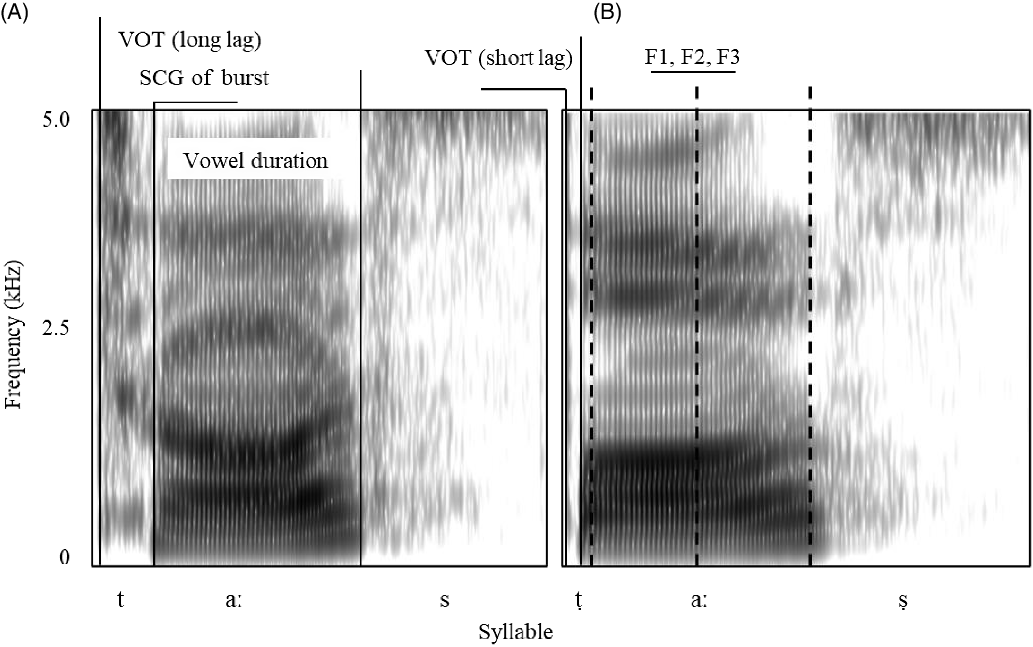
Acoustic measurements are exemplified in Figure 1. The vowel and stop VOT boundaries were determined manually in PRAAT (Boersma & Weenink Reference Boersma and Weenink2018). VOT was measured as an interval between the release point of the stop and the beginning of the vocal fold vibration. Both the waveform and spectrogram were used to identify the beginning of the glottal pulses. Vowel onset was marked at the point where a periodic pattern was clearly identified on the basis of the waveform and spectrogram, and vowel offset was marked at the point where the periodic pattern of vibration of the vocal folds stopped. To evaluate the degree of emphasis spread, first, second, and third formant frequencies (F1, F2, and F3) were measured at the onset, midpoint, and offset of each vowel. The measurements were taken from LPC spectra calculated over a 25 ms Hamming window. In addition, the emphaticness index was calculated as a difference between F2 and F1 at the same points. The spectral centre of gravity (SCG) of stop burst was measured to evaluate the degree of emphasis in stop articulation during the release. Following Jongman, Wayland & Wong (Reference Jongman, Wayland and Wong2000), the full Hamming window was centered over the stop burst. The windowed segment was pre-emphasized with a factor 0.98; the spectrum was filtered to the range between 100 Hz and 20,000 Hz (the frequency response of the microphone).
The spectrograms of the syllables (A) /taːs/ and (B) /ṭaːṣ/ showing acoustic measurements in syllable-initial stops and in vowels.

Statistical analysis of the acoustical measurements included several stages. First, we analyzed duration and formant frequencies of the vowel to ensure that speakers differentiated between long and short vowels as they read non-word stimuli. Next, we evaluated three formant frequencies of the vowels at vowel onset, midpoint, and offset and calculated the F2–F1 difference to ensure emphasis spread to the left from the syllable final consonant through the vowel. Then, we evaluated SCG of burst of the syllable initial target stop to ensure that it was affected by emphasis spread. Finally, we evaluated differences in VOT of the syllable initial target stop in the two contexts to determine to what extent it was affected by emphasis spread.
Dependent variables in each analysis were evaluated using linear mixed-effects models in the lme4 package (Bates et al. Reference Bates, Mächler, Bolker and Walker2015) in R (R Core Team 2019) with speaker and item as random factors with random intercepts for each factor. Although it was plausible to adjust for speaker and item variation in production of the acoustic correlates in different context by using the model with both random slopes and random intercepts (Barr et al. Reference Barr, Levy, Scheepers and Tily2013), the maximal models did not improve performance as compared to the models with random intercept only (p-values in the range between .2 and .06). Therefore, the simpler model was selected in each analysis (Matuschek et al. Reference Matuschek, Kliegl, Vasishth, Baayen and Bates2017). P-values for factor levels were calculated using the lmerTest package (Kuznetsova, Brockhoff & Christensen Reference Kuznetsova, Brockhoff and Christensen2017) in R.
3 Results
3.1 Vowel formants and duration
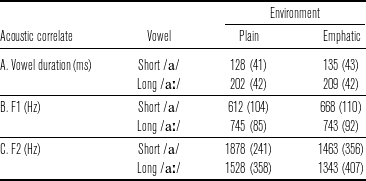
To ensure that speakers produced intended vowels as they read non-word stimuli, the short and long vowels were evaluated in the unambiguous plain context, when the vowel was flanked by two plain consonants, and in the unambiguous emphatic context, in which it was flanked by two emphatic consonants, i.e. plain /t__C/ and emphatic /ṭ__C̣/. Table 1 summarizes the three acoustic correlates (vowel duration, F1, and F2 at vowel midpoint) in the plain and emphatic environments.
Summary of means and standard deviations (in brackets) for vowel duration, F1 and F2 of long and short vowels in plain and emphatic environments.

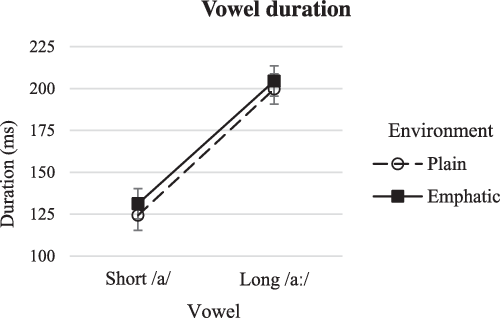
Effects of vowel length and environment on vowel duration of short /a/ and long /aː/.

Long /aː/ (M = 202 ms) was produced with longer duration than short /a/ (M = 128 ms). The ratio of short to long vowel duration was 0.63. In the emphatic environment, the vowels were 7 ms longer than in the plain environment, with a negligible 3
 $\%$
difference (Figure 2).
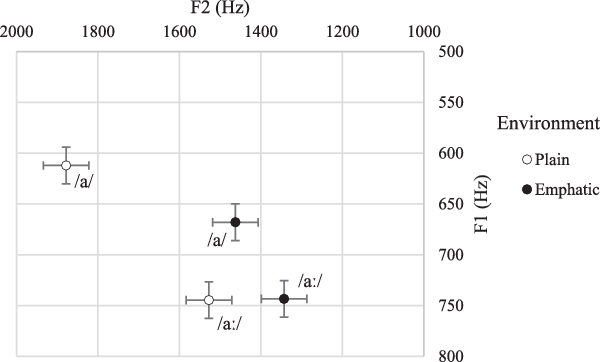
Effects of vowel length and environment on F1 and F2 of short /a/ and long /aː/.

F1 was higher for long /aː/ than for short /a/ suggesting a more low articulation of the long vowel (Figure 3). F1 was higher in the emphatic context, but only short /a/ revealed a 56 Hz difference between the plain and emphatic environments. F2 was lower for long /aː/ than for short /a/ suggesting a more back articulation of the long vowel in the plain environment (Figure 3). Crucially, F2 was consistently lower in the emphatic context, suggesting the tongue was retracted when the vowel was produced with emphasis. The magnitude of F2 decrease was greater in the short vowel than in the long vowel.
As expected, speakers produced the vowels in two environments differently. Importantly, these results are consistent with the results for real words in Qatari Arabic in Bukshaisha (Reference Bukshaisha1985), who also reported that short /a/ in monosyllables was on average 0.53 shorter than long /aː/ (pp. 351–352) and had higher F2 (M = 1500 Hz) than long /aː/ (M = 1250 Hz) in the plain environment (p. 51). In the emphatic environment, the vowels were also slightly longer (ratio = 1.04; p.384) and had lower F2 (M = 1100 Hz; pp. 234–236). Thus, we conclude that the performance of speakers on non-words in the current study was very similar to speakers’ performance in real speech.
3.2 Emphasis spread: Vowel formants
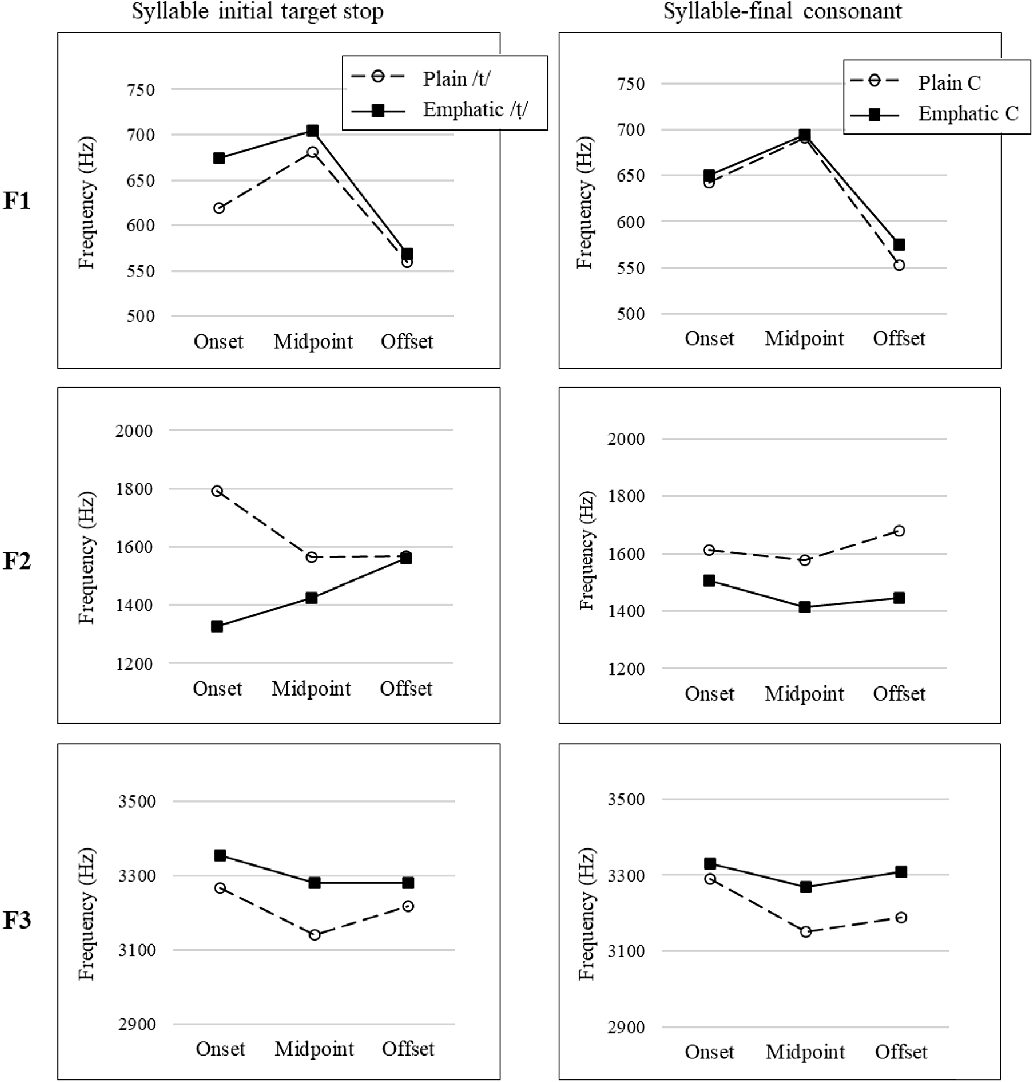
Next, we measured F1, F2 and F3 frequencies at the beginning, middle, and end of the vowel to evaluate the degree of emphasis spread across the syllable. Each acoustic correlate was evaluated in a separate mixed effects linear model with syllable-initial target stop (plain, emphatic), syllable-final consonant (plain, emphatic), and vowel length (short, long) as fixed effects at each of the three locations. Figure 4 summarizes the results.
Changes in formant frequency values (F1 in the upper row, F2 in the middle row, and F3 in the lower row) at vowel onset, mid and end points as a function of emphasis in syllable-initial target stop (left column) and syllable-final consonant (right column).

3.2.1 Target stop
As shown in Figure 4 (left column), the vowels following the initial emphatic /ṭ/ had a higher F1, lower F2, and higher F3 than the vowels following the initial plain /t/. F1 was significantly higher following emphatic /ṭ/ at vowel onset (β = 73 Hz, t = 5.03, p < .001) and vowel midpoint (β = 51 Hz, t = 3.33, p < .01), but it did not reach significance level at vowel offset (β = 8 Hz, t = .46, p = .652). F2 was significantly lower following emphatic /ṭ/ at vowel onset (β = –493 Hz, t = –8.21, p < .0001), vowel midpoint (β = –327 Hz, t = –7.21, p < .0001), and vowel offset (β = –157 Hz, t = –2.93, p < .01). F3 was significantly higher following emphatic /ṭ/ at vowel onset (β = 150 Hz, t = 2.90, p < .05), vowel midpoint (β = 136 Hz, t = 3.58, p < .001), but only marginally significant at vowel offset (β = 82 Hz, t = 1.79, p = .09).
3.2.2 Syllable-final consonant
As shown in Figure 4 (right column), the vowels preceding the final emphatic consonant had a lower F2, and higher F3 than the vowels preceding the final plain consonant. F2 was significantly lower preceding emphatic C̣ throughout the entire vowel at vowel onset (β = –225 Hz, t = –3.76, p < .01), vowel midpoint (β = –372 Hz, t = –8.19, p < .0001), and vowel offset (β = –336 Hz, t = –6.27, p < .0001). F3 was significantly higher preceding emphatic С̣ at vowel offset (β = 175 Hz, t = 3.84, p < .01), vowel midpoint (β = 110 Hz, t = 2.89, p < .01), but not at vowel onset (β = 66 Hz, t = 127, p = .221). Slightly higher F1 values before emphatic C̣ did not reach significance level (p > .05).
Interactions between emphatic context and initial target stop in F2 at vowel midpoint (β = 284 Hz, t = 4.42, p < .001) and vowel offset (β = 160 Hz, t = 2.12, p = .05) revealed that emphasis spread was gradient. The F2 values were lower closer to the emphatic consonant.
3.2.3 Vowel length
A main effect of vowel length was found for F1 and F2. Long /aː/ had significantly higher F1 (β values ranging from 133 Hz to 31 Hz, p-values ranging from .05 to .0001) and lower F2 (β values ranging from 207 Hz to 351 Hz, p-values ranging from .01 to .0001) throughout the entire vowel than short /a/. Significant vowel length by context interactions for F1 (β = –54 Hz, t = –2.51, p < .05) and F2 (β = 189 Hz, t = 2.94, p < .01) at vowel midpoint suggested that emphasis spread was more prominent in long vowels.
3.3 Emphasis spread: F2–F1
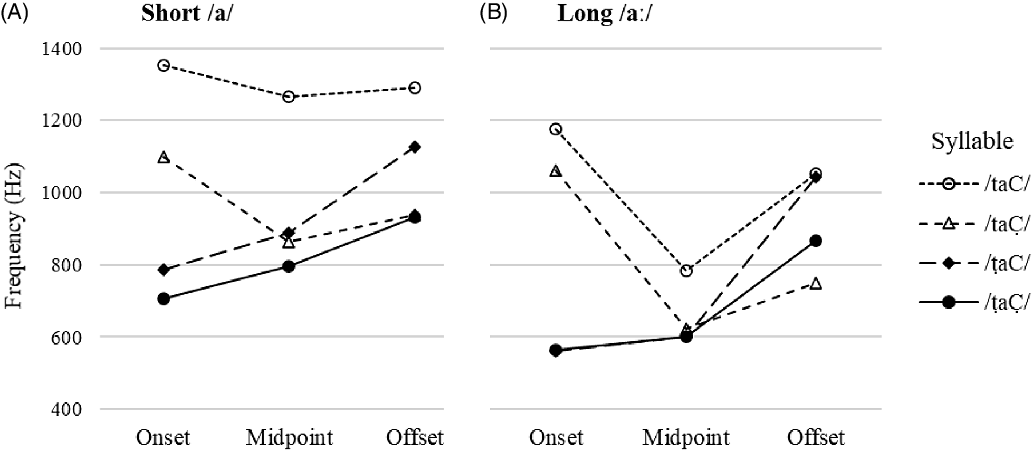
Next, we calculated differences between F2 and F1 at vowel onset, midpoint, and offset in order to evaluate changes in emphatic articulation throughout a vowel. Emphasis lowers F2 and raises F1 of a vowel, making values of the two formants closer to one another. Therefore, a smaller F2–F1 difference will indicate an emphatic vowel, whereas a greater F2–F1 difference will indicate a plain vowel (Yeou Reference Yeou1997). F2–F1 difference at each of the three measurement points was evaluated in a mixed effects linear model with syllable-initial target stop (plain, emphatic), syllable-final consonant (plain, emphatic) and vowel length (short, long) as fixed factors. Figure 5 summarizes the results.
F2–F1 difference in the four syllable frames measured at onset, midpoint and offset of (A) short and (B) long vowels.

The category of initial target stop significantly affected vowel quality at vowel onset (β = –566 Hz, t = –8.54, p < .0001), midpoint (β = –378 Hz, t = –7.92, p < .0001), and offset (β = –164 Hz, t = –283, p < .05). Category of the syllable-final consonant also significantly affected vowel quality at each of the three locations (onset: β = –252 Hz, t = –3.79, p < .01; midpoint: β = –404 Hz, t = –8.46, p < .0001; offset: β = –352 Hz, t = –6.05, p < .0001), revealing that emphaticness of the syllable final consonant prevailed throughout the entire syllable.
Significant interaction between syllable-initial target stop and syllable-final consonant was obtained at vowel onset (β = 146 Hz, t = 2.13, p < .05), midpoint (β = 234 Hz, t = 3.50, p < .01), and offset (β = 142 Hz, t = 2.37, p < .05). F2–F1 was significantly higher in non-emphatic /t_C/ syllables than in syllables with an initial and/or final emphatic consonant.
Finally, vowel length affected F2–F1 of vowel at each point (β values ranging between –143 Hz and –483 Hz, p-values ranging between .001 and .0001), indicating that F2–F1 was smaller in a long vowel. Vowel length interacted with initial target stop (β = 198 Hz, t = 2.93, p < .01) and final consonant (β = 243 Hz, t = 3.60, p < .01) at vowel midpoint, indicating that differences between emphatic and plain categories were greater in syllables with a short vowel.
3.4 Emphasis spread: Interim summary
The analysis of the vowel formants revealed that vowel articulation was affected by emphaticness of the adjacent consonant. As expected (e.g. Bukshaisha Reference Bukshaisha1985), both leftward and rightward emphasis spread were observed in Qatari Arabic. Emphatic articulation of the vowel was observed next to a syllable-initial or syllable-final emphatic consonant. Noticeable drop of F2 in the emphatic syllable revealed that the major articulatory change was tongue retraction, which caused back articulation of the emphatic vowel. The results also revealed that the co-articulatory effect was gradient. The strongest effect of emphasis on the vowel was found closer to an emphatic consonant; the effect of emphasis was weaker closer to a plain consonant.
3.5 Emphasis spread: SCG of burst
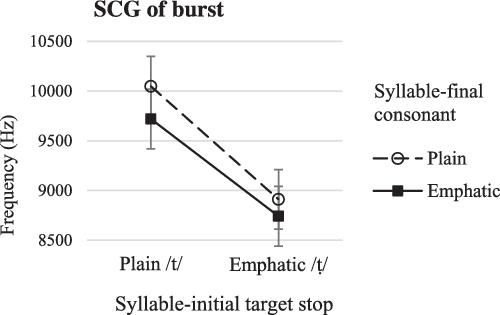
Next, we examined how spectral characteristics of an initial stop are affected by emphasis spread from the final emphatic consonant. The spectral centre of gravity (SCG) of stop burst values were fitted to the mixed effects model with target stop, context, and vowel length as fixed effects for. Figure 6 summarizes the results.
Effect of emphasis spread on SCG of burst in initial plain /t/ and emphatic /ṭ/.

The results show that the effect of emphasis spread on the initial consonant was gradient. Burst frequency changed as a function of emphaticness of target stop (Emphatic: β = –1024 Hz, t = –4.60, p < .0001), and vowel length (Long: β = –630 Hz, t = –4.0, p < .001). Initial target stop * syllable-final consonant interaction revealed the SCG of burst of plain /t/ was lower in the emphatic context (β = –328 Hz, t = –2.22, p < .05) than in the plain context.
3.6 Emphasis spread: VOT
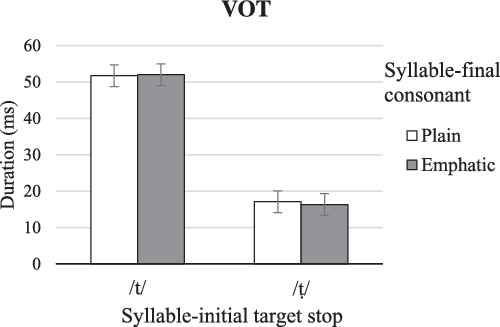
Finally, the effect of emphasis spread on VOT in initial alveolar stops was evaluated in a mixed effects linear model with initial target stop (plain, emphatic), syllable-final consonant (plain, emphatic), and vowel length (short, long) as fixed factors. The results are summarized in Figure 7. Plain /t/ was produced with long-lag VOT averaging at 53 ms, whereas emphatic /ṭ/ was produced with significantly shorter VOT (β = –33 ms, t = –10.44, p < .0001). The analysis did not reveal significant effects of syllable-final consonant (p = .399) or vowel length (p = .150) on VOT. Crucially, VOT of plain /t/ was not reduced in the emphatic context.
Effect of emphasis spread on VOT in initial plain /t/ and emphatic /ṭ/.

4 Discussion and conclusion
The goal of this study was to investigate whether syllable initial plain stop /t/ is affected by leftward emphasis spread in Qatari Arabic and whether emphasis spread affects stop VOT. Specifically, we asked if VOT becomes shorter, and thus more similar to VOT of emphatic /ṭ/ when plain /t/ is produced in the emphatic context. In addition, we investigated to what extent emphasis spread affects neighboring segments within a syllable. Acoustic analysis of segments affected by emphasis spread focused on F1–F3 of the vowel and on spectral mean of burst in initial stops.
Some results of the study replicated results of the previous studies of emphasis spread (e.g. Jongman et al. Reference Jongman, Herd, Al-Masri, Sereno and Combest2011, Zawaydeh & de Jong Reference Zawaydeh and de Jong2002), and some were new. As it was previously reported in the literature (e.g. Watson Reference Watson1999), Qatari Arabic showed both leftward and rightward emphasis spread, which affected the adjacent vowel. The results showed that F2 of the vowel produced in the emphatic context was considerably lowered, which was consistent with results reported earlier (Yeou Reference Yeou1997, Zawaydeh Reference Zawaydeh1999, Zawaydeh & de Jong Reference Zawaydeh and de Jong2002, Jongman et al. Reference Jongman, Herd, Al-Masri, Sereno and Combest2011). In addition, our results showed that F1 and F3 were higher next to emphatic consonants. These findings in part replicate the results in Jongman et al. (Reference Jongman, Herd, Al-Masri, Sereno and Combest2011), who also found significant raising of these formants in Jordanian Arabic arguing for uvularization of emphatic sounds in this dialect. However, the results of the current study show that raising of F1 in Qatari Arabic was not as robust as in Jordanian Arabic. It was most prominent immediately after the emphatic stop, but in the portion of the vowel next to the final emphatic consonant this difference was small. Weaker effect of emphasis on F1 and considerable raising of F3 in Qatari Arabic was also reported in Kulikov (published online 18 January Reference Kulikov2021), suggesting emphasis in this dialect may be mainly realized as uvularization, or tongue movement toward the uvula in the upper pharynx, rather than pharyngealization per se with the constriction in the lower pharynx. The latter should have caused F3 lowering and more prominent F1 raising (Jongman et al. Reference Jongman, Herd, Al-Masri, Sereno and Combest2011).
The results showed that both long and short vowels were affected by emphasis spread, but the magnitude of the effect was different for short /a/ and long /aː/ The effect size of emphasis was greater on the short vowel: it showed greater F2 lowering and F1 raising than the long vowel, in which F1 did not raise significantly and F2 had smaller magnitude of lowering. However, it does not mean that long vowels are more resilient to emphasis spread due to longer distance from emphatic constriction. The smaller degree of tongue retraction in long vowels may be a mere consequence of its more back articulation in the plain context. The tongue retraction simply does not have to be substantial because the long vowel already has back quality. The short vowel in Qatari Arabic, in contrast, has front articulation and thus, has to be retracted more in the emphatic context.
The results revealed that emphatic articulation also influenced spectral characteristics of the initial stops. SCG of burst of plain /t/ was lowered in the emphatic context. These results have not been previously reported in acoustic studies of emphasis, but they are consistent with Jongman et al.’s (Reference Jongman, Herd, Al-Masri, Sereno and Combest2011) findings that leftward emphasis spread is more prominent in (voiced) stops than in fricatives. Therefore, the influence of an emphatic consonant on burst frequency of the preceding stop was not unexpected.
Finally, we found that underlying plain /t/ and emphatic /ṭ/ in Qatari Arabic belong to two different VOT categories, replicating the results in Kulikov (published online 18 January Reference Kulikov2021): plain /t/ has long-lag VOT, emphatic /ṭ/ has short-lag VOT. Shorter VOT in emphatic /ṭ/ was also consistent with the results of previous studies of emphatic stops in various Arabic dialects (Mitleb Reference Mitleb2001, Khattab et al. Reference Khattab, Al-Tamimi, Heselwood and Boudela2006, AlDahri Reference AlDahri2013). Consistent realization of underlying voiceless emphatic stops with short-lag VOT may indicate that phonetic relation between pharyngeal constriction and tensed or lowered larynx (Esling Reference Esling1999, Hassan & Esling Reference Hassan and Esling2011) is encoded in Arabic phonology. However, our results demonstrate that this relation affects only underlying emphatic /ṭ/. Counter to our expectations, long-lag VOT in initial plain /t/ stop did not indicate any influence from emphatic articulation in a syllable. The contrastive difference in VOT between plain /t/ and emphatic /ṭ/ was not reduced in both plain context and emphatic context. Our findings suggest that there is no mechanical low-level relationship between emphasis and VOT due to mere presence of emphatic articulation in a syllable in Qatari Arabic. Short-lag VOT is a phonological property of emphatic stop /ṭ/, but VOT shortening does not emerge in plain /t/ as an automatic aftermath of tongue retraction when emphasis spreads through adjacent segments. Emphatic constriction did not impede glottal airflow in plain /t/ when it was produced in the emphatic environment.
These results suggest that emphasis may be more resilient to coarticulatory effects than palatalization, which causes both phonetic and phonological changes in stop articulation as a result of VOT lengthening and optional affrication. A similar explanation was suggested by Yeou (Reference Yeou1997), who compared locus equations of emphatic (pharyngealized) and non-emphatic obstruents in Morroccan Arabic. He argued that emphatic coronals are more resistant to coarticulation because they impose high requirement on the tongue body in their articulation. The tongue front and tongue back have to produce two places of articulation in the front and back areas of the vocal tract, leaving no room for additional gestures. Palatalization in coronal stops, in contrast, is produced by the same front part of the tongue as the primary constriction, which may allow for more variation in production of VOT.
The results of the current study do not suggest that relation between vowel frontness/backness and VOT is dynamic in Qatari Arabic. We hypothesized that shortening of VOT as a result of tongue retraction might be found when emphatic co-articulation spreads onto a plain stop within a syllable, simultaneously triggering back articulation of an adjacent vowel. Yet the findings did not support this scenario. Long-lag VOT in plain stops did not necessarily entail front articulation of an adjacent vowel. Stops were equally aspirated before short /a/, which had relatively front articulation, and before long /aː/, which had back articulation. Nor did back articulation of a vowel entail short-lag VOT; in contrast, we found that the spread of emphasis within a syllable did not reduce VOT in underlying plain stops. This relation between VOT and vowel backness was different from what was reported for Jordanian Arabic in Khattab et al. (Reference Khattab, Al-Tamimi, Heselwood and Boudela2006). Loss of emphasis in female speech in this dialect ultimately resulted in a larger number of plain realizations of emphatic /ṭ/, which reduced emphatic co-articulation in the syllable and enhanced front articulation of the vowel. Such discrepancy suggests an asymmetric relation between VOT and vowel quality next to plain and emphatic stops. VOT may be more sensitive to vowel articulation in plain context but less sensitive to it in emphatic context. In cases when contrastive emphasis is being lost (e.g. in Jordanian Arabic), plain articulation of a vowel makes it more front, thus triggering phonetic palatalization and subsequent lengthening of VOT in a coronal stop. But the opposite process, i.e. spread of emphatic co-articulation through the vowel, does not have an effect on VOT in plain stops. Further research should provide more details to our understanding of dynamic relation between emphasis and VOT.
In conclusion, this study investigated the effect of emphasis spread on VOT in non-emphatic (plain) /t/ in emphatic context in Qatari Arabic. Although emphasis co-articulation influenced the vowel formants (F1–F3) and spectral mean of the stop, no effect of emphasis was found for VOT. Emphasis spread in Qatari Arabic seems be a phonetic rather than phonological process as it does not lead to shortening of VOT and categorical change of plain [t] to emphatic [ṭ].
Acknowledgements
This study was in part supported by the Qatar University grant QUST-CAS-FALL-14\15-34. The authors are thankful to two anonymous reviewers for their insightful comments and suggestions, and to all anonymous participants without whom this study would not be possible.