Adult attachment representation has been recognized as an important predictor of parenting behavior (Main, Kaplan, & Cassidy, Reference Main, Kaplan and Cassidy1985; van IJzendoorn, Reference van IJzendoorn1995). Mothers with an unresolved state of mind toward attachment-related trauma show more anomalous behavior in interaction with their children than other mothers (Madigan et al., Reference Madigan, Bakermans-Kranenburg, van IJzendoorn, Moran, Pederson and Benoit2006; Main & Hesse, Reference Main, Hesse, Greenberg, Cicchetti and Cummings1990). Findings from a limited number of studies suggest that unresolved attachment is also overrepresented in maltreating parents (e.g., Adshead & Bluglass, Reference Adshead and Bluglass2005), but additional evidence from case-control studies with a comprehensive operationalization of child maltreatment is needed. Therefore, in this study we assessed attachment representation in a sample of maltreating mothers for whom emotional and physical neglect and abuse were substantiated and a comparison group of nonmaltreating mothers. Attachment-related autonomic regulation has been associated with both attachment representations (Roisman, Tsai, & Chiang, Reference Roisman, Tsai and Chiang2004) and parenting behavior (Sturge-Apple, Skibo, Rogosch, Ignjatovic, & Heinzelman, Reference Sturge-Apple, Skibo, Rogosch, Ignjatovic and Heinzelman2011). We examined whether autonomic regulation during a comfort paradigm differed according to mothers’ attachment representation and according to their maltreatment status.
State of Mind Toward Attachment
Child maltreatment has a wide variety of etiological risk factors, including low socioeconomic status, single parenthood, parental psychopathology, low social support, and parents’ negative experiences with caregivers in their own childhood (Cicchetti & Valentino, Reference Cicchetti, Valentino, Cicchetti and Cohen2006; Euser et al., Reference Euser, Alink, Pannebakker, Vogels, Bakermans-Kranenburg and van IJzendoorn2013; Stith et al., Reference Stith, Ting Liu, Davies, Boykin, Alder, Harris and Dees2009). In addition to actual childhood caregiving experiences, a possibly more proximal factor to be considered in the etiology of child maltreatment is parents’ mental representations of childhood experiences (Morton & Browne, Reference Morton and Browne1998). The foremost instrument to assess adult attachment representations is the Adult Attachment Interview (AAI; George, Kaplan, & Main, Reference George, Kaplan and Main1985; Hesse, Reference Hesse, Cassidy and Shaver2008), a semistructured interview in which individuals are asked to describe their early and ongoing relationship with their caregivers. Their narrative is coded using classifications of state of mind with respect to attachment (Main, Goldwyn, & Hesse, Reference Main, Goldwyn and Hesse2003). Typically, one out of three possible main classifications is assigned to the state of mind most prominent throughout the interview as a whole: secure/autonomous, insecure/dismissing, or insecure/preoccupied, of which secure/autonomous is considered the most beneficial (see the Method section for further details). Furthermore, when present, discussions of experiences of loss, abuse, or other potential trauma are scored for disorientation in reasoning or discourse, and when sufficiently marked may lead to a primary classification of an unresolved/disoriented state of mind. In such a case a secondary (organized) classification of secure/autonomous, insecure/dismissing, or insecure/preoccupied is assigned for the remaining narrative. Finally, interviews in which a singular organized state of mind cannot be identified (e.g., because marked indications of several states of mind are present) are coded as unclassifiable (cannot classify). Unresolved/disoriented and cannot classify classifications are overrepresented in clinical samples (Bakermans-Kranenburg & van IJzendoorn, Reference Bakermans-Kranenburg and van IJzendoorn2009; van IJzendoorn & Bakermans-Kranenburg, Reference van IJzendoorn and Bakermans-Kranenburg1996).
Unresolved Attachment and Dissociative Parenting
Unresolved and unclassifiable states of mind regarding attachment have been conceptually related to the clinical phenomenon of dissociation (e.g., Liotti, Reference Liotti2004; Main & Morgan, Reference Main, Morgan, Michelson and Ray1996), and there is evidence to support this contended link. In clinical samples, unresolved/disoriented–cannot classify attachment classifications were associated with pathological dissociative processes (Riggs et al., Reference Riggs, Paulson, Tunnell, Sahl, Atkison and Ross2007; Steele, Reference Steele2003) and with posttraumatic stress disorder (PTSD) symptomatology (Harari et al., Reference Harari, Bakermans-Kranenburg, De Kloet, Geuze, Vermetten, Westenberg and van IJzendoorn2009; Stovall-McClough & Cloitre, Reference Stovall-McClough and Cloitre2006), which share core features with dissociation. In nonclinical samples, adults with an unresolved/disoriented–cannot classify state of mind showed elevated levels of pathological dissociation and nonpathological absorption tendencies (Hesse & van IJzendoorn, Reference Hesse and van IJzendoorn1999; Thomson & Jaque, Reference Thomson and Jaque2014). Generically speaking, dissociation involves a lack of integration of psychological processes such as memory, consciousness, and perception, for example, characterized by intrusive, uncontrolled disruptions of awareness, an inability to recall personal memories, and/or experiential disengagement (Cardeña & Carlson, Reference Cardeña and Carlson2011; Spiegel et al., Reference Spiegel, Loewenstein, Lewis-Fernández, Sar, Simeon, Vermetten and Dell2011). This seems similar to what occurs during the AAI for people with an unresolved state of mind. During discussion of loss or trauma, they may display anomalous ideation (e.g., speaking of a dead person as if they were alive) or disoriented discourse (e.g., visual-sensory images intrude the discourse while an episode of childhood abuse is recounted), both unremarked upon by the interviewee. This suggests a lack of integration of specific memories with the current sense of self, and absorption in the event under discussion, as speech is no longer successfully monitored.
It has been suggested that if parents display such lapses of a dissociative nature during the AAI, similar behavior is likely to intrude on their parenting behavior during interactions with their children (Hesse & Main, Reference Hesse and Main2006). An unresolved/disoriented classification on the AAI was found to be related to various expressions of anomalous parenting behavior (Schuengel, Bakermans-Kranenburg, & van IJzendoorn, Reference Schuengel, Bakermans-Kranenburg and van IJzendoorn1999), some of which are dissociative or contain dissociative elements, in that they suggest an alteration in psychological state disconnected from current interactive context (Hesse & Main, Reference Hesse and Main2006). Anomalous parenting behaviors can be observed with validated coding systems (AMBIANCE in Lyons-Ruth, Bronfman, & Parsons, Reference Lyons-Ruth, Bronfman and Parsons1999; DIP in Out, Bakermans-Kranenburg, & van IJzendoorn, Reference Out, Bakermans-Kranenburg and van IJzendoorn2009), which include more subtle forms of disrupted parenting. A meta-analysis has shown an association between an unresolved/disoriented classification on the AAI and both frightening and disrupted parenting behavior (Madigan et al., Reference Madigan, Bakermans-Kranenburg, van IJzendoorn, Moran, Pederson and Benoit2006).
From Anomalous Parenting to Child Maltreatment
The boundaries between anomalous or disrupted parenting and child maltreatment seem nebulous. Although the former two may occur in nonmaltreating parents (see Hesse & Main, Reference Hesse and Main1999; Schuengel et al., Reference Schuengel, Bakermans-Kranenburg and van IJzendoorn1999), higher levels of affective errors and negative behaviors have been observed in maltreating mothers (Skowron, Cipriano-Essel, Benjamin, Pincus, & van Ryzin, 2013; Skowron et al., Reference Skowron, Loken, Gatzke-Kopp, Cipriano-Essel, Woehrle, Van Epps and Ammerman2011). Beyond their correlation, pervasive forms of intrusive/negative behavior and withdrawal could themselves be conceived as child emotional abuse and neglect, respectively (Barnett, Manly, & Cicchetti, Reference Barnett, Manly, Cicchetti, Cicchetti and Toth1993). A small, heterogeneous body of research seems to further point to a link between an AAI unresolved/disoriented classification and substantiated perpetration of child maltreatment. In a sample of mothers clinically referred for Münchausen syndrome by proxy, 60% were assigned an unresolved/disoriented classification on the AAI (Adshead & Bluglass, Reference Adshead and Bluglass2005), while 18% is the normative rate in nonclinical mothers (Bakermans-Kranenburg & van IJzendoorn, Reference Bakermans-Kranenburg and van IJzendoorn2009). In a subgroup of mothers under surveillance from the public social services for the protection of juveniles, average continuous unresolved/disoriented scores were significantly higher than in a comparison group of mothers living in poverty and a low-risk control group (Frigerio, Costantino, Ceppi, & Barone, Reference Frigerio, Costantino, Ceppi and Barone2013). On an extreme level, more mothers who had killed their children had an unresolved/disoriented classification (61%) than both mentally ill mothers and mothers from the normative population (Barone, Bramante, Lionetti, & Pastore, Reference Barone, Bramante, Lionetti and Pastore2014). However, no elevated prevalence of unresolved/disoriented (12%) was found in mothers with substantiated child neglect (Lindhiem, Bernard, & Dozier, Reference Lindhiem, Bernard and Dozier2011). Thus far, studies on AAI classifications of maltreating parents are relatively scarce and the results have not been unequivocal.
Attachment and Autonomic Regulation
Adult attachment dimensions have been related to different responses of the autonomic nervous system (ANS) during the AAI. The ANS is part of the peripheral nervous system, which connects the central nervous system (i.e., the brain and spinal cord) with the rest of the body (Kiernan & Rajakumar, Reference Kiernan and Rajakumar2014). The ANS innervates the internal organs through the sympathetic and parasympathetic subsystems (Larsen, Schneiderman, & DeCarlo Pasin, Reference Larsen, Schneiderman, DeCarlo Pasin, Coles, Donchin and Porges1986). Generally, the sympathetic branch mobilizes the body to deal with environmental demands, while the parasympathetic system restores energy during rest. Skin conductance levels (SCL; electrodermal activity of the skin) and vagal tone (heart rate variability associated with respiration; Porges, Reference Porges, Garber and Dodge1991) are examples of frequently used autonomic parameters (Kreibig, Reference Kreibig2010). Integrated with its role in behavioral preparation, the interest in ANS response patterns as reflective of emotion has increased over recent decades (for an overview, see Kreibig, Reference Kreibig2010). For instance, stress or anxiety has been quite unequivocally associated with increases in SCL and a decrease in parasympathetic indices such as vagal tone.
During the AAI, individuals using a deactivating strategy toward attachment memories (associated with a dismissing state of mind) showed increased SCL reactivity to attachment-related questions as compared to hyperactivating interviewees (pertinent mostly to preoccupied classifications; Dozier & Kobak, Reference Dozier and Kobak1992). This validated the notion that a person with a dismissing state of mind copes by suppression of negative emotions. The finding was replicated in a study that further suggested the association to be unique to electrodermal activity, as no effects were found for cardiovascular measures (Roisman et al., Reference Roisman, Tsai and Chiang2004). Preoccupied individuals showed no change in SCL during the interview, which seems incongruent with the “involving/preoccupying anger” inferred from their answers (i.e., abundant, apparently angry discussions of negative experiences with caregivers, indicative of current mental entanglement with caregiving experiences; the most common subtype of AAI preoccupation). Studies that have examined autonomic regulation in relation to an unresolved state of mind are lacking, probably in part because the rate of unresolved/disoriented classifications in community samples is such that substantial subgroup sizes are hard to obtain. One study that did test the association with an unresolved state of mind found no differential autonomic regulation during the AAI for adopted adolescents (Beijersbergen, Bakermans-Kranenburg, van IJzendoorn, & Juffer, Reference Beijersbergen, Bakermans-Kranenburg, van IJzendoorn and Juffer2008), which, as the authors noted, may have been partly due to their focus on ANS arousal during questions regarding loss or trauma. Unresolved/disoriented indices may occur outside of the context of these questions, and furthermore tend to be brief. It may therefore be worthwhile to measure autonomic regulation associated with unresolved attachment outside of the direct AAI context.
Although it remains unclear to what extent the potentially traumatic experiences discussed during the AAI are the direct causes of the unresolved state of mind (Lyons-Ruth, Yellin, Melnick, & Atwood, Reference Lyons-Ruth, Yellin, Melnick and Atwood2003), early experiences of maltreatment have commonly been associated with unresolved attachment, either directly (Bailey, Moran, & Pederson, Reference Bailey, Moran and Pederson2007) or, as postulated by Riggs and Jacobvitz (Reference Riggs and Jacobvitz2002), indirectly by heightening vulnerability to subsequent adversity. Early trauma such as childhood abuse and neglect has mainly been associated with subsequent increased ANS reactivity (e.g., Heim et al., Reference Heim, Newport, Heit, Graham, Wilcox, Bonsall and Nemeroff2000; Oosterman, De Schipper, Fisher, Dozier, & Schuengel, Reference Oosterman, De Schipper, Fisher, Dozier and Schuengel2010). However, differential autonomic response patterns may be discerned according to state of mind toward the trauma. For instance, traumatized individuals with a dissociative coping strategy may show a dampened autonomic response during trauma-related confrontation (Griffin, Resick, & Mechanic, Reference Griffin, Resick and Mechanic1997). A neurobiological model was proposed in which certain manifestations of dissociation were associated with inhibition of the amygdala by the medial prefrontal cortex, resulting in dampened autonomic output and emotional experience (Sierra & Berrios, Reference Sierra and Berrios1998). More recently, evidence was presented for a dissociative subtype of PTSD, following a similar model of excessive prefrontal inhibition of limbic regions (Lanius et al., Reference Lanius, Vermetten, Loewenstein, Brand, Schmahl, Bremner and Spiegel2010). Consistent with this line of findings, PTSD and an unresolved state of mind toward attachment were highly associated in a sample of war veterans, probably due to their commonality of an inherently dissociative lack of integration (Harari et al., Reference Harari, Bakermans-Kranenburg, De Kloet, Geuze, Vermetten, Westenberg and van IJzendoorn2009). Indirect evidence thus suggests that individuals with an unresolved state of mind, through their dissociative features, may show autonomic hyporeactivity to trauma-related stimuli.
Autonomic Regulation and Parenting
Maternal autonomic dysregulation within attachment-related settings has also been related to inappropriate parenting behavior. Mothers with ANS hyperarousal during the Strange Situation procedure displayed more harsh/intrusive caregiving behavior, while mothers with an autonomic hypoarousal pattern scored highest on maternal insensitivity, disengaged and intrusive parenting as compared to a normative group (Sturge-Apple et al., Reference Sturge-Apple, Skibo, Rogosch, Ignjatovic and Heinzelman2011). Several studies have looked at decreases in vagal tone (labeled vagal withdrawal and taken as a sign of active and flexible emotion regulation) in relation to parenting. Mothers of infants with an avoidant attachment strategy showed less vagal withdrawal than mothers of securely attached infants during the final reunion episode of the Strange Situation procedure (Hill-Soderlund et al., Reference Hill-Soderlund, Mills-Koonce, Propper, Calkins, Granger, Gariepy and Cox2008). Mothers of avoidant dyads have been characterized by, among other things, consistently low responsiveness to negative child signals (Ainsworth, Blehar, Waters, & Wall, Reference Ainsworth, Blehar, Waters and Wall1978; Belsky, Rovine, & Taylor, Reference Belsky, Rovine and Taylor1984; Raval et al., Reference Raval, Goldberg, Atkinson, Benoit, Myhal, Poulton and Zwiers2001). In mothers of avoidant children, low vagal withdrawal predicted decreased maternal sensitivity during episodes of child negative affect (Mills-Koonce et al., Reference Mills-Koonce, Gariépy, Propper, Sutton, Calkins, Moore and Cox2007). Low vagal withdrawal in combination with high cortisol was associated with maternal negative intrusiveness during the reunion of the Still Face paradigm (Mills-Koonce et al., Reference Mills-Koonce, Propper, Gariépy, Barnett, Moore, Calkins and Cox2009). Finally, more vagal withdrawal was associated with episodes of increased positive parenting in abusive and neglectful mothers during a joint teaching task with their children (Skowron et al., Reference Skowron, Cipriano-Essel, Benjamin, Pincus and Van Ryzin2013). These results combined point to an association between diminished autonomic regulation and less optimal caregiving.
The Current Study
In the current study we assessed state of mind with regard to attachment in a sample of maltreating and demographically matched nonmaltreating mothers. For the maltreating group physical and emotional child abuse and neglect were substantiated, which provides an important addition to the existing literature. We evaluated the association between the three constructs outlined above: between attachment and child maltreatment perpetration; between attachment and autonomic regulation; and between autonomic regulation and child maltreatment. With an exploratory aim, we tested whether autonomic regulation mediated the relationship between attachment and child maltreatment. SCL and vagal tone (root mean square of successive differences [RMSSD]) were measured during standardized attachment-based video clips. The clips displayed a separation between abstract animated representations of a caregiver and infant, followed by a responsive caregiver and an unresponsive caregiver outcome scenario, shown alternately (Johnson, Dweck, & Chen, Reference Johnson, Dweck and Chen2007).
First, we hypothesized that more maltreating mothers than nonmaltreating mothers would have an unresolved state of mind toward attachment, and more maltreating mothers would be assigned an insecure (insecure/dismissing, insecure/preoccupied, or unresolved/disoriented–cannot classify) classification. Second, we expected that maltreating mothers as well as mothers with unresolved and insecure attachment representations would show autonomic dysregulation during the attachment-based videos.
Method
Participants
We recruited 45 maltreating and 45 nonmaltreating mothers from a mental health clinic. Mothers in the maltreating group received therapy that revolved around their parenting problems and received a brochure about the study from their therapists at the beginning of treatment. The clinic kept family records for all mothers, which included child protective services referrals and life histories of family members. We coded these records to substantiate recent or ongoing abuse and neglect perpetrated by the mother using the Maltreatment Classification System (MCS; Barnett et al., Reference Barnett, Manly, Cicchetti, Cicchetti and Toth1993). When records were inconclusive, we interviewed the mother's psychiatrist about her parenting problems using a semistandardized interview. For three mothers, neither their records nor their psychiatrists provided proof of maternal maltreatment. In these cases, we conducted a Dutch adaptation of the Maternal Maltreatment Classification Interview (MMCI; Cicchetti, Toth, & Manly, Reference Cicchetti, Toth and Manly2003), which verified absence of maltreatment in two mothers. We considered them as nonmaltreating in the analyses. One mother could not be reached for a follow-up MMCI and was excluded from analyses because of her inconclusive current maltreatment status.
Nonmaltreating mothers were recruited by research assistants in a clinical subdivision of the facility, where their child was in therapy for developmental or learning problems. Because having a child with these types of problems may constitute a specific challenge for caregiving, we also coded the family files of maltreating mothers for their children's clinical diagnoses to ensure the two groups were comparable in this respect. To verify the absence of maltreatment in the nonmaltreating group, the MMCI (Cicchetti et al., Reference Cicchetti, Toth and Manly2003) was used. For three mothers incidents of maltreatment were coded from the interview. All of these incidents had taken place less than 5 years ago, so that the recency of the problems matched these mothers to the maltreating group. Therefore, they were excluded from the nonmaltreating group and transferred to the maltreating group. For 16 participants physiological and/or AAI data were missing due to technical problems or because the participant's psychiatrist had advised against conducting the AAI. In addition, one interview could not be scored because of the participant's language difficulties. The final sample consisted therefore of 38 maltreating mothers and 35 nonmaltreating mothers. The 17 excluded mothers did not differ on maltreatment status from the mothers with complete data (p = .55). Excluded mothers and those included in the final sample were also similar on number of children, maternal mean age, children's mean age, and education (ps > .18). They differed on ethnicity (p = .01): 96% of included mothers were of Caucasian ethnicity, compared to 77% (n = 13) in the excluded group.
In the final sample, 45% had completed secondary school, and 34% had finished elementary school or a short track of secondary school. The mean age of the mothers was 41.32 years (SD = 7.15), and on average they had 2.41 children (SD = 1.19).
The study was approved by the Medical Ethics Review Committee for Mental Health Care (METiGG). All mothers gave informed consent for participation and, in the maltreating group, for researchers’ access to the family files. As a compensation for participation, mothers received 40 Euros and traveling expenses.
Procedure
Two individual appointments took place at the facility, on average no more than about a week apart. All mothers were tested by young, female research assistants who had memorized a structured script to standardize the procedure as much as possible. The first session took place in the morning to prevent the influence of diurnal fluctuations in ANS activity. Mothers completed three computer tasks, including a comfort paradigm (Johnson et al., Reference Johnson, Dweck and Chen2007), during which electrocardiogram (ECG) and impedance cardiogram (ICG) signals were recorded. Afterward, mothers completed a questionnaire on health-related issues, such as smoking and exercising prior to the session, and on their family situation, including educational level, number of children, and children's ages. Furthermore, we administered the MMCI to the nonmaltreating group. During the second appointment we conducted the Adult Attachment Interview (George et al., Reference George, Kaplan and Main1985).
Measures
MCS
We used the MCS (Barnett et al., Reference Barnett, Manly, Cicchetti, Cicchetti and Toth1993), which has been found a reliable and valid system to code incidents of maltreatment (e.g., English et al., Reference English, Upadhyaya, Litrownik, Marshall, Runyan, Graham and Dubowitz2005). The MCS may be applied to all available documents from families’ Department of Human Services records, thereby maintaining independent criteria that comprehend more than legally recognized cases of maltreatment (Cicchetti, Rogosch, Gunnar, & Toth, Reference Cicchetti, Rogosch, Gunnar and Toth2010). In accordance with operational definitions, we coded abuse (physical and emotional) and neglect (physical and emotional). That certain types of maltreatment were recorded in the files suggests them to be of a chronic rather than incidental nature. Only incidents of maternal maltreatment were considered. Coding was done by trained research assistants. Interrater reliability for maltreatment type on 15 files was excellent, with κ = 0.82 for abuse and κ = 1.00 for neglect. For the presence versus absence of maltreatment there was full agreement (κ = 1.00). Subsequently, all records were coded by two different research assistants, and discrepancies were resolved through discussion. We found that all mothers in the maltreatment group had been neglectful toward their children, either physically or emotionally, and 55% (n = 21) of the maltreating mothers had also abused their child(ren) physically or emotionally.
MMCI
The MMCI (Cicchetti et al., Reference Cicchetti, Toth and Manly2003) is a semistructured interview that evaluates whether the mother has maltreated any of her children recently and during their lifetime. Mothers are asked about incidents of physical and emotional abuse and neglect, as well as sexual abuse, and about any contact the family may have had with child protective services. We translated the interview into Dutch for this study. Coding was done by trained research assistants. Interrater reliability on 12 interviews was excellent, with full agreement for the presence versus absence of maltreatment, incidents of neglect versus abuse, and severity of the incidents (for all κ = 1.00). Interviews were coded by two different research assistants, and discrepancies were resolved through discussion.
Comfort paradigm
The comfort paradigm (Johnson et al., Reference Johnson, Dweck and Chen2007) consists of two different video clips showing two animated ellipses, one larger (the “caregiver”) and one smaller (the “child”). Both started with a 10-s introductory clip in which caregiver and child enter the scene together. When the ground slopes upward, the caregiver continues unto a midslope plateau, whereas the child is held back and starts to cry. This is conveyed using the sound of a human infant cry, visually emphasized by the pulsation and change of color of the child ellipse (see Figure 1a,b). In the 8-s responsive caregiver outcome clip, the caregiver then returns to the child, as the infant cry sound continues but diminishes toward the end (Figure 1c). In the other outcome, the 8-s unresponsive caregiver clip, the caregiver ellipse continues higher up the slope, leaving the child behind (Figure 1d). The crying sound continues but eventually fades just as in the responsive clip.
(Color online) Stills from the comfort paradigm. (a,b) The introductory clip of the comfort paradigm, in which (a) the caregiver oval and the child oval enter the scene and (b) the caregiver mounts the slope, leaving the child behind, who starts to cry; (c) the responsive clip, in which the caregiver returns to the crying child; and (d) the unresponsive clip, in which the caregiver leaves the crying child behind (Johnson, Dweck, & Chen, Reference Johnson, Dweck and Chen2007). (c,d) Participants watched in counterbalanced order.

The paradigm has previously been used with infants (Biro, Alink, van IJzendoorn, & Bakermans-Kranenburg; Johnson et al., Reference Johnson, Dweck and Chen2007, Reference Johnson, Dweck, Chen, Stern, Ok and Barth2010). Based on the infant working model of attachment, the authors of the paradigm hypothesized that infants with secure attachment would spend more time looking at the unresponsive caregiver scenario (contrary to their expectation), while insecurely attached infants would look longer at the responsive caregiver outcome, and this was the case (Johnson et al., Reference Johnson, Dweck and Chen2007, Reference Johnson, Dweck, Chen, Stern, Ok and Barth2010). This shows that people may respond differently to the paradigm's caregiving outcomes according to their mental representation of attachment. This is the first study to use the paradigm with adult participants.
The comfort paradigm was presented on a laptop with E-prime software. We started the task with a 4-min baseline of neutral images. We then showed the introductory clip, immediately followed by either the responsive or the unresponsive clip (counterbalanced). The same combination of introductory and outcome clip was repeated four times. A second baseline of neutral images lasting 2 min was shown, after which we presented the introductory clip combined with the other outcome scenario (responsive when the first series were unresponsive, or unresponsive when the first series were responsive), four times in a row. The order of the responsive and unresponsive clips was counterbalanced. The task was finalized with a 2-min recovery segment of neutral images.
SCL and RMSSD
During the cry paradigm, SCL, an ECG, and an ICG were measured using an ambulatory monitoring system (VU-AMS5fs; TD-FPP, Vrije Universiteit, Amsterdam). Before the assessment of SCL, mothers washed their hands with a mild soap. Then two Ag/AgCl electrodes, filled with isotonic GEL101 electrode paste, were placed on the middle and index fingers of mothers’ nondominant hand. For the ECG, three disposable pregelled Ag/AgCI electrodes (ConMed, New York) were placed slightly below the right collar bone 4 cm to the right of the sternum, between the two lower ribs on the right side, and under the left breast (4 cm under the nipple). For the ICG, four electrodes were attached at the top end of the sternum between the tips of the collarbones, on the spine (at least 3 cm above the previous one), at the low end of the sternum where the ribs meet, and again on the spine (at least 3 cm under the previous one). E-prime had been programmed so that markers were sent to the ECG and SCL recording during baseline, the display of each video clip, and recovery. We labeled the data according to these markers.
Out of the various autonomic measures assessed during the paradigm, we focused on SCL and RMSSD in our analyses to reduce the number of statistical tests. These two measures were selected over other indices for several reasons. First, they allowed us to separately evaluate both sympathetic (SCL) and parasympathetic (RMSSD) nervous system activity (whereas heart rate, for instance, is a mixed index). Second, in previous studies on autonomic functioning in an attachment-related context, SCL and vagal tone have each been used as singular measures of the ANS (e.g., respectively, Dozier & Kobak, Reference Dozier and Kobak1992; Mills-Koonce et al., Reference Mills-Koonce, Gariépy, Propper, Sutton, Calkins, Moore and Cox2007). In other studies, SCL was measured in addition to salivary alpha-amylase, and vagal tone in addition to cardiovascular measures such as interbeat intervals, and effects were found only for SCL and vagal tone, respectively (Hill-Soderlund et al., Reference Hill-Soderlund, Mills-Koonce, Propper, Calkins, Granger, Gariepy and Cox2008; Roisman et al., Reference Roisman, Tsai and Chiang2004). Average SCL and RMSSD were derived per labeled segment, after which the mean over the segments was calculated per clip content (introductory, responsive, or unresponsive) in SPSS. We checked for outliers (using standardized scores of –3.29 and 3.29 as cutoff) per labeled segment as well as per aggregated episode. For SCL two participants and for RMSSD six participants showed outliers for individual segments, which were winsorized (Tabachnik & Fidell, Reference Tabachnik and Fidell2001), so that the least extreme outlier was replaced with a value 0.10 above the highest nonoutlying score; and for the next more extreme outlier, 0.10 was added to the preceding value, thus preserving the original order. For RMSSD the combined episodes further showed four outliers, which were winsorized as well. Combined episodes showed no further outliers.
AAI
The AAI (George et al., Reference George, Kaplan and Main1985) is a semistructured interview aimed at assessing the interviewee's state of mind regarding attachment. The protocol includes questions about participants’ relationship with their parents in childhood, important losses during their lifetime, and other potentially traumatic experiences, as well as how each of these affects their current functioning (for a detailed discussion of the AAI, see Hesse, Reference Hesse, Cassidy and Shaver2008). Each interview was transcribed verbatim by a trained research assistant, after which the transcript was checked by another trained research assistant.
Attachment classifications are coded based on discourse coherence (rather than on content), and a continuous score for coherence of mind is assigned. Three organized or resolved (i.e., “definitive and singular”; Hesse, Reference Hesse, Cassidy and Shaver2008, p. 563) classifications are distinguished. Generally, the secure/autonomous classification is assigned when the interviewee openly values attachment, yet discusses relationships with certain objectivity, and is associated with high coherence of mind; the dismissing classification reflects a dismissal or devaluing of attachment; preoccupied speakers appear overly involved with attachment experiences. The latter two correspond to low coherence of mind scores. Apart from the three organized classifications, the unresolved/disoriented classification may be primarily assigned when during discussion of loss or a potentially traumatic experience, the speaker displays a clear lapse in the monitoring of discourse or reasoning (e.g., talking about a dead person as if they were still alive, or expressing the belief of having caused one's own childhood abuse). This lapse is indicative of a disoriented state of mind with regard to the event under discussion, and when sufficiently unequivocal results in a high unresolved/disoriented score and a pertinent primary unresolved/disoriented classification. Finally, cannot classify is a rare, unorganized classification that mostly involves clear indications of two contradictory representations for different stretches of the same interview. Unresolved/disoriented and cannot classify share the lack of a single, organized attachment representation and in research have been pragmatically combined to form one category (e.g., Harari et al., Reference Harari, Bakermans-Kranenburg, De Kloet, Geuze, Vermetten, Westenberg and van IJzendoorn2009). AAI classifications were dichotomized into unresolved/disoriented–cannot classify versus nonunresolved/disoriented (insecure/dismissing, secure/autonomous, or insecure preoccupied) as well as secure/autonomous versus nonsecure/autonomous (insecure/dismissing, insecure/preoccupied, unresolved/disoriented–cannot classify) groups. Transcripts contained no identifying information and were coded by two certified coders using the standard AAI classification system (Main et al., Reference Main, Goldwyn and Hesse2003). The coders were unaware of the participants’ maltreatment status or physiological data. Interrater reliability (n = 16) was satisfactory for the three-way classification insecure/dismissing, secure/autonomous, insecure/preoccupied 75%, for the four-way classification insecure/dismissing, secure/autonomous, insecure/preoccupied, unresolved/disoriented 69%, for secure/autonomous versus nonsecure/autonomous 88%, for unresolved/disoriented versus nonunresolved/disoriented 75%. In the case of disagreement, the scores of the expert coder (M.J.B.-K.) were used.
Data analysis
For the preliminary analyses, we performed t tests to compare insecure/dismissing and insecure/preoccupied mothers on their autonomic levels, in order to assess whether they could be grouped into one insecure category. Once attachment groupings were established, we performed Pearson's chi-square tests to compare maltreating versus nonmaltreating, unresolved/disoriented versus nonunresolved/disoriented (insecure/dismissing, secure/autonomous, insecure/preoccupied), and secure/autonomous versus nonsecure/autonomous (insecure/dismissing, insecure/preoccupied, unresolved/disoriented–cannot classify) mothers on ethnicity, educational level, medication, hearing problems, exercise, and smoking, and whether their children had a clinical diagnosis. We performed t tests to check for differences in maternal age, children's mean age, and number of children. We calculated Pearson's correlation coefficients for the relation between the continuous background variables and baseline levels of the autonomic measures. We performed t tests to evaluate whether exercise and smoking had an effect on baseline levels of the physiological variables. Univariate analyses of covariance, with maternal age as covariate (see below), were done to compare maltreating and nonmaltreating mothers on baseline levels of SCL and RMSSD.
Next, we tested the associations between attachment, autonomic regulation, and child maltreatment perpetration with a series of regression analyses. The association between state of mind toward attachment and child maltreatment was tested using logistic regression. Two attachment constructs were entered as predictor variable in separate regressions: unresolved versus resolved attachment, and insecure (insecure/dismissing, insecure/preoccupied, or unresolved/disoriented–cannot classify) versus autonomous attachment. Next, we tested whether attachment representation was associated with autonomic regulation during the comfort paradigm with a series of hierarchical multiple regressions. Again, the attachment constructs mentioned above were entered as a predictor variable in separate regressions with SCL and RMSSD during the responsive and unresponsive outcome scenario of the comfort paradigm as dependent variables. With an exploratory aim, the same set of logistic and multiple regressions were done using a continuous approach to the unresolved and autonomous attachment constructs, entering the unresolved score and coherence of mind score as predictors, respectively. The results can be found in the online-only Supplementary Materials. To test whether autonomic regulation during the comfort paradigm predicted maltreatment status, we performed two logistic regressions, one for the responsive clips and one for the unresponsive clips, with child maltreatment as the dichotomous dependent variable and SCL and RMSSD as predictor variables. Finally, we did exploratory analyses to test whether autonomic regulation mediated the association between state of mind toward attachment and child maltreatment, using the Preacher and Hayes (Reference Preacher and Hayes2008) SPSS macro for indirect effects. The macro includes a bootstrapping procedure, and the number of bootstrap resamples k was set at 1,000.
Missing data
To test the associations between attachment, autonomic responses, and child maltreatment, the series of logistic and multiple regressions were performed both in the group of participants with complete data (N = 73) and on an imputed data set (N = 90). Multiple imputation was carried out with the mice package in R (van Buuren & Groothuis-Oudshoorn, Reference van Buuren and Groothuis-Oudshoorn2011), using predictive mean matching (van Buuren, Reference van Buuren2012; van Buuren, Brand, Groothuis-Oudhoorn & Rubin, Reference van Buuren, Brand, Groothuis-Oudshoorn and Rubin2006). In total, missing data were imputed 100 times, and the analyses were pooled in SPSS, using Rubin's (Reference Rubin1987) combination rules. Analyses performed on imputed and nonimputed data gave the same results. The results based on the nonimputed data are reported below.
Covariates
For the logistic regression predicting child maltreatment from attachment, demographics on which the maltreating and nonmaltreating group differed (i.e., maternal age and children's mean age) were initially entered as covariates in the first block. Neither was significant, so they were excluded.
For the association between attachment and autonomic regulation, hierarchical multiple regressions were initially done to identify significant covariates. In the first block we entered (a) demographics on which maltreating and nonmaltreating mothers differed (i.e., maternal age and children's mean age), (b) circumstantial factors/habits (i.e., whether mothers smoked and whether they had exercise in the week prior to participation), and (c) testing characteristics (i.e., the order in which responsive/unresponsive clips were presented and autonomic baseline levels). A second block was created for the predictor variable of interest (i.e., attachment representation). Smoking, order of clip presentation, and autonomic baseline levels emerged as significant covariates. The results presented below are therefore based on hierarchical multiple regressions with smoking, clip presentation order, and autonomic baseline levels in the first block, and attachment in the second block.
For the logistic regressions predicting child maltreatment from autonomic regulation, we repeated the procedure described above. Smoking and exercise emerged as significant covariates, and were therefore retained in the first block of the logistic regression, with autonomic regulation added in the second block.
Finally, for the mediation analyses, maternal age, children's mean age, smoking, exercise, order of clip presentation, and autonomic baseline levels were initially defined as covariates in the SPSS macro. Smoking and exercise were significant and retained in the analyses.
Results
Preliminary analyses
Our t tests showed insecure/dismissing and insecure/preoccupied mothers did not differ on SCL and vagal tone values at baseline, nor during the responsive and unresponsive clips of the paradigms (ps ≥ .10), and could therefore be jointly compared to unresolved/disoriented and secure/autonomous mothers. With regard to demographics and background information, maltreating and nonmaltreating mothers did not differ on ethnicity, educational level, medication affecting heart rate, number of children, or whether their children had been clinically diagnosed (ps > .14). However, mothers and children in the maltreating group were significantly younger (38.16 years, SD = 7.36 and 9.52 years, SD = 5.21) than their counterparts in the nonmaltreating group (44.74 years, SD = 5.11 and 14.04 years, SD = 3.73), t (66.17) = 4.47, p < .001 and t (67.04) = 4.28, p < .001, respectively. Furthermore, fewer maltreating mothers than nonmaltreating mothers had exercised in the week prior to the research appointment, χ2 (1, N = 73) = 5.51, p = .02, and more maltreating mothers than nonmaltreating mothers had smoked on the morning of the assessment, χ2 (1, N = 73) = 8.02, p = .01. There were no other significant group differences (ps > .06).
Maternal age and children's mean age were negatively correlated with baseline SCL (r = –.27, p = .02 and r = –.30, p = .01, respectively), and maternal age also correlated with baseline RMSSD (r = –.26, p = .03). There were no significant associations between having exercised or smoked and baseline levels of SCL or RMSSD (ps > .06). For the maltreating group, the number of days in therapy before participating in the study was not related to baseline levels of the autonomic measures or to mothers’ attachment representation (ps ≥ .32). No differences were found between maltreating and nonmaltreating mothers for baseline levels of any of the physiological variables, when controlling for maternal and children's age (ps > .83).
Attachment representation and child maltreatment
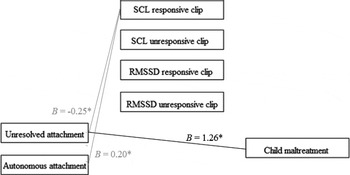
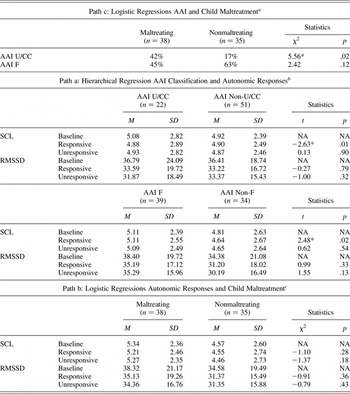
AAI classifications and scores for maltreating and nonmaltreating mothers are displayed in Table 1. Logistic regression showed that the unresolved/disoriented–cannot classify classification significantly increased the likelihood of being classified as a maltreating mother, χ2 (1, N = 73) = 5.56, p = .02. For one nonmaltreating mother, her unresolved/disoriented classification was based on a recent loss. Excluding her from the analyses did not affect the reported results. Autonomous attachment did not significantly decrease the odds of being classified as a maltreating mother, χ2 (1, N = 73) = 2.42, p = .12 (see Table 1 and Figure 2).
Summary of results. SCL, Skin conductance levels; RMSSD, root mean square of successive differences (an index of vagal tone). Absence of a drawn pathway means regression analyses were not significant (ps > .05). *p < .05.

Summary of regression analyses
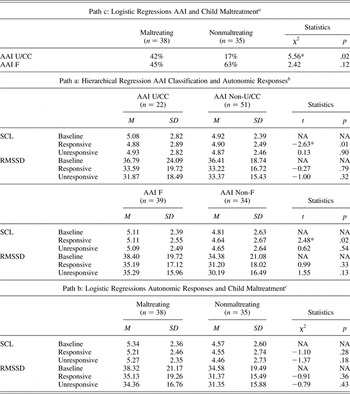
Note: AAI, Adult Attachment Interview; U/CC, unresolved or cannot classify classification; AAI F, secure-autonomous classification; SCL, skin conductance level; RMSSD, root mean square of successive differences (vagal tone); NA, not applicable (SCL and RMSSD baseline levels were entered as covariates in the regressions).
a No covariates were included in the logistic regressions for Path c.
b Smoking, order of video clips, and autonomic baseline levels were entered as covariates in the regression analyses for Path a.
c Smoking and exercise were included as covariates in the logistic regressions for Path b.
*p < .05.
Attachment representation and autonomic regulation
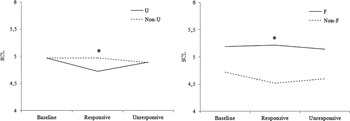
A series of multiple hierarchical regressions showed that having an unresolved/disoriented–cannot classify classification was associated with lower SCL during the responsive outcome scenario of the comfort paradigm, significantly adding to the predictive value of the covariates, F change (1, 68) = 6.76, p = .01 (see Figure 3). In the same direction, an autonomous attachment representation significantly predicted higher SCL during the responsive clip, F change (1, 68) = 5.48, p = .02. Neither unresolved/disoriented–cannot classify nor secure/autonomous status predicted SCL during the unresponsive clips or vagal regulation during the comfort paradigm (ps ≥ .16; see Table 1 and Figure 2).
Skin conductance level (SCL) response per Adult Attachment Interview (AAI) status. SCL responses from baseline to the responsive clip differed (left) between unresolved and organized mothers and (right) between autonomous and nonautonomous mothers. U, Unresolved AAI classification; F, secure-autonomous AAI classification *p < .05.

Autonomic regulation and maltreatment status
In two separate logistic regressions, neither SCL nor RMSSD during either outcome scenario of the comfort paradigm were related to maltreatment status (ps ≥ .24).
Mediation
Preacher and Hayes (Reference Preacher and Hayes2004) have argued that the separate testing of the c, a, and b paths may be compromised by low statistical power and that the only a priori condition for testing a mediation effect should be the association between the independent and the dependent variable. For the significant c path (i.e., the total effects of unresolved/disoriented attachment), we therefore tested with an exploratory aim whether autonomic regulation during the comfort paradigm mediated the association between attachment and child maltreatment. The c′ paths (i.e., direct effect of attachment on child maltreatment, after controlling for autonomic regulation) were significant (ps < .05). The 95% confidence intervals for the indirect effect of attachment on child maltreatment, the ab paths, all contained zero. In sum, no mediating effects were found.
Discussion
In line with our expectations, an unresolved state of mind toward attachment was associated with child maltreatment perpetration. Although a robust link between an unresolved state of mind and anomalous parenting behavior had already been established (Madigan et al., Reference Madigan, Bakermans-Kranenburg, van IJzendoorn, Moran, Pederson and Benoit2006), our finding is an important addition to the small body of research that has identified an unresolved state of mind in maltreating parents (e.g., Adshead & Bluglass, Reference Adshead and Bluglass2005; Barone et al., Reference Barone, Bramante, Lionetti and Pastore2014). Whereas some of these studies were marked by homogeneity in (relatively rare) maltreatment types (Münchausen by proxy in Adshead & Bluglass, Reference Adshead and Bluglass2005; filicide in Barone et al., Reference Barone, Bramante, Lionetti and Pastore2014), for the mothers in our sample a wide range of maltreatment incidents were substantiated, including emotional and physical child abuse and neglect, which renders them more representative of the population of maltreating mothers. Contrary to our expectations, maltreating and nonmaltreating mothers did not differ on the distinction between autonomous and insecure states of mind. This seems in contrast with studies that have associated insecure states of mind with less optimal caregiving (van IJzendoorn, Reference van IJzendoorn1995; Verhage et al., Reference Verhage, Schuengel, Madigan, Fearon, Oosterman, Cassiba and van IJzendoorn2016). It is relevant to reiterate here that due to the clinical nature of our sample we only performed four-way analyses on the AAI classifications, which resulted in an overlap between our unresolved/disoriented versus nonunresolved/disoriented and our secure/autonomous versus nonsecure/autonomous comparisons. The difference between the two comparisons resided in a subgroup of n = 12 (maltreating n = 5) who had neither an unresolved/disoriented nor a secure/autonomous classification, hence a primary insecure/dismissing or insecure/preoccupied classification. The similarity in insecure/organized classification rates between maltreating and nonmaltreating mothers therefore rendered the secure/autonomous versus nonsecure/autonomous comparison nonsignificant. The low insecure/dismissing–insecure/preoccupied prevalence further underscores the clinical relevance of the unresolved/disoriented state of mind.
Unresolved and nonautonomous attachment were associated with decreased SCLs during the comfort paradigm, particularly during the reunion between “caregiver” and “child.” It may be that for these mothers, watching a reunion episode is especially poignant because of the contrast with their own attachment experiences. An overview of the literature on autonomic responses and their relation to emotions has shown that SCL decreases are relatively uniquely indicative of a deactivating response of (noncrying) sadness (Kreibig, Reference Kreibig2010). We tentatively suggest that mothers’ deactivating, rather than activating, response may indicate a passive, disengaging coping strategy, which seems congruent particularly with the dissociative nature of the unresolved state of mind. It may seem surprising that the reunion clip evoked such a response, but relevant studies (on parenting quality and children's attachment) have also found autonomic distinctions between mothers solely during the reunion episodes of the Strange Situation paradigm (Hill-Soderlund et al., Reference Hill-Soderlund, Mills-Koonce, Propper, Calkins, Granger, Gariepy and Cox2008) and the Still Face paradigm (Mills-Koonce et al., Reference Mills-Koonce, Propper, Gariépy, Barnett, Moore, Calkins and Cox2009), suggesting its emotional salience. No associations with AAI state of mind were found for RMSSD. On the one hand, this is congruent with research that has found attachment-related regulation for electrodermal but not for cardiovascular measures (Roisman et al., Reference Roisman, Tsai and Chiang2004). On the other hand, it may be due to our stimulus; the comfort paradigm may have been too mild to evoke a more complete autonomic response. However, the results suggest that incoherent and unresolved mothers were more affected by the comfort paradigm than organized mothers were. They thereby highlight how even short and subtle attachment-related stimuli are able to evoke an autonomic response that distinguished unresolved from organized mothers, also out of the direct AAI context. This makes attachment-related autonomic regulation a promising area for future research, considering that stimuli of a longer duration and with real-life verisimilitude may reveal more clearly the differences in autonomic regulation inherent to attachment representation that our findings touched upon.
Maltreating and nonmaltreating mothers did not differ in their autonomic responsiveness to the comfort paradigm, and no mediating effect of autonomic regulation was found. The lack of differential autonomic regulation may be due to the high level of comparability between the maltreating and nonmaltreating group, particularly in terms of the caregiving challenges they faced having clinically diagnosed children. Previous findings for the current sample have shown that another paradigm of infant cry sounds did elicit different autonomic responses for maltreating and nonmaltreating mothers (Reijman et al., Reference Reijman, Alink, Compier-de Block, Werner, Maras, Rijnberk and Bakermans-Kranenburg2014), so the lack of autonomic differences may also be task related. In the comfort paradigm, the visual presentation of the dyad gave meaning to the “child's” cry sounds, which may have evoked attachment-related emotions in mothers. In the previously used cry paradigm, cry sounds of different pitches were presented without any visual accompaniment, leaving the interpretation of the cries open, which may have resulted in a stronger activation of mothers’ caregiving system. Our findings converge with those of Riem, Bakermans-Kranenburg, van IJzendoorn, Out, and Rombouts (Reference Riem, Bakermans-Kranenburg, van IJzendoorn, Out and Rombouts2012), who found no mediating role for amygdala reactivity in the association between attachment security and participants’ behavioral responses to infant cry sounds, as measured by force used when squeezing a handgrip dynamometer. However, as indicated by the authors, their sample was small and consisted of women without children of their own. The absence of neurobiological mediation found so far may then have methodological explanations, which future studies could try to rule out before firm conclusions are drawn.
Our study had several limitations. The sample was small, which may have led to insufficient statistical power to detect differences in attachment representations between maltreating and nonmaltreating mothers. It also precluded the comparison of neglectful versus neglectful and abusive mothers. As mentioned, the comfort paradigm may have been too mild to evoke a pronounced pattern of autonomic regulation. Furthermore, as with any standardized task, it challenges the external validity of the findings, which need to be replicated in more natural settings. Although the arguably high-risk status of our nonmaltreating group may have limited the differences found between maltreating and nonmaltreating mothers, we ultimately consider this a strong point: it means that the differences we did find can be plausibly attributed to mothers’ maltreatment status. Studies using more than one comparison group may shed light on attachment representation and autonomic regulation associated with different levels of caregiving quality. Finally, the unresolved state of mind toward attachment is only one way in which disorientation toward traumatic experiences may manifest. As described in previous sections, it is coded in the presence of narrations of loss or childhood abuse. Expanding on the unresolved/disoriented scale, the helpless–hostile scale was developed to code additional indications of an unintegrated state of mind throughout the AAI (Lyons-Ruth et al., Reference Lyons-Ruth, Yellin, Melnick and Atwood2003; Lyons-Ruth, Yellin, Melnick, & Atwood, Reference Lyons-Ruth, Yellin, Melnick and Atwood2005). Such indications include, for example, the devaluation of a caregiver in combination with unconscious identification with same caregiver, and they have been associated with maternal disrupted communication as coded by the AMBIANCE system (Lyons-Ruth et al., Reference Lyons-Ruth, Bronfman and Parsons1999, Reference Lyons-Ruth, Yellin, Melnick and Atwood2005). Future studies might assess the helpless–hostile state of mind as an additional potential risk factor for child maltreatment.
Our finding of an unresolved state of mind in maltreating mothers supports the possible utility of attachment-based interventions. Although short, maternal behavior-focused interventions have overall been most effective (when sensitive parenting or infant attachment was the outcome measure; Bakermans-Kranenburg, van IJzendoorn, & Juffer, Reference Bakermans-Kranenburg, van IJzendoorn and Juffer2003), intervention effectiveness may diminish with at-risk parents (Bakermans-Kranenburg, van IJzendoorn, & Juffer, Reference Bakermans-Kranenburg, van IJzendoorn and Juffer2005). A short-term parenting-focused intervention improved parental sensitivity and child attachment quality in a sample of maltreating parents (Moss et al., Reference Moss, Dubois-Comtois, Cyr, Tarabulsy, St-Laurent and Bernier2011). However, in a systematic comparison of a behavior-focused program and an attachment-informed psychotherapeutic intervention in maltreating mothers and their preschool children, the latter was found more effective (at improving children's self and other representations; Toth, Maughan, Manly, Spagnola, & Cicchetti, Reference Toth, Maughan, Manly, Spagnola and Cicchetti2002). Although both types of intervention programs were equally effective in maltreating families with younger infants (Cicchetti, Rogosch, & Toth, Reference Cicchetti, Rogosch and Toth2006), a 12-month follow-up showed that the beneficial effects of the psychotherapeutic intervention on child attachment security held up better than those of the parenting-focused program (Pickreign Stronach, Toth, Rogosch, & Cicchetti, Reference Pickreign Stronach, Toth, Rogosch and Cicchetti2013). Furthermore, unresolved attachment in parents may sometimes impede the effectiveness of brief, behavior-focused interventions, as in an intervention study with adolescent mothers, especially when it obstructs fruitful dyadic interactions (Moran, Pederson, & Krupka, Reference Moran, Pederson and Krupka2005). Trauma processing focused on integrating traumatic experiences within one organized state of mind toward attachment may therefore be a prerequisite for effective interaction-focused intervention with unresolved maltreating mothers. The inclusion of ANS measurements pre- and postintervention could further show whether a shift from an unresolved to an organized state of mind entails changes in attachment-related autonomic regulation.
Supplementary Material
To view the supplementary material for this article, please visit https://doi.org/10.1017/S0954579416001036.