

Introduction
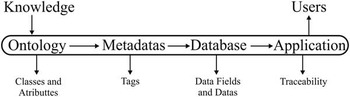
Computerized farming solutions began to be developed in Brazil, always aiming to solve particular problems, like production and financial management, accountancy, and human resources. These solutions, even if for the same segment, follow different criteria, therefore different data structures and management. This variety of data structures in each farming solution tends to create gaps in the integration of management systems. Generally the problem is in the specificities of these solutions, currently, database integration in applications like business intelligence, data warehouse and ERP (Enterprise resource planning) illustrate this problem (Santana, Reference Santana2008). The research is carried out based on context of cotton production, both in the agricultural and commercial scope, later steps relate to particularities of the most important byproduct, the fiber. The processes in the fiber cotton production are formalized using flowcharts, the flows are then used as reference for identifying data generated in the process, leading to the identification of data classes and finally the ontology’s formalization. The research’s contribution lies in improving the cotton production data exchange, the idea is to provide a vertical metadata standard to refine the standardization of the shared data in different processes of this segment. The research’s starting point was the formal model of representing the information. The model used to display the information in the agricultural industry through the formal data classes requires some characteristics adequate for sharing. In this case, the ontology based model meets the requirements with satisfying results, without detailing technical specifications, restricting the formal representation of the data in a higher abstract level. Ontology offers sharing and reusing the information of a certain domain, this model has been used in many areas, such as Semantic Web, e-commerce, medical and auto industry, financial management and other areas related to managing information (Li, Reference Li, Du and Wang2005). Ontology also defines the terms used to describe and label the information where as people, databases, and specific applications are able to share them. Ontology has also been used to detail data structures in a hierarchical form (Cruz, Reference Cruz, Huiyon and Hsu2004), in the research’s context ontology will be the tool used to represent the data classes in the production chain of the cotton fiber. After defining the ontology the next step involves identifying the technical details of each data class, like: attributes, attribute domains, and among others. This step is crucial for establishing rules for a better data exchange. This step is carried out through the proposal of a metadata standard to provide the communication interface between processes. The use of metadata in agriculture is an important point of the research, specifically in the steps of cotton production related to planting, harvesting and processing. Metadata refers to ‘data about data’. An item in metadata specifies the meaning of certain data, usually it represents information comprehendible by the operating system. According to the National Information Standards Organization (2004) metadata simplifies the understanding of relationships and use of information data. The use of specific metadata standards provided efficient results due to meeting the particularities of the agricultural sector. Common standards may hinder the exchange and retrieval of data, as there isn’t a specific technical approach related to the requirements of this segment. Another crucial point is in the representation of elements that specify the metadata standard, XML is usually used, due to its flexibility in creating tags. XML is a robust and well defined format for representing data, providing power and flexibility to local or web applications. XML was developed by the World Web Consortium to provide a simple way of overcoming the limitations of HTML allowing for new types of local and internet applications. An important step for the standardization and interoperability of data in agriculture is consistency in metadata descriptions; this provides benefits in the use of metadata standards, like: standardization of dataset labels, quality datasets and interoperability between distinct processes and devices. The use of ontologies is a viable alternative for modeling knowledge in any area, the objective in the agricultural context in this research is to identify the processes used in the cotton production and after to use this ontology to create key elements in the implementation of traceability systems, through these systems it is possible to identify eventual problems occurring in specific stages in the productive chain and consequently those responsible for these processes bilaterally. Figure 1 shows an overview of the use of ontology in this context.
Overview of the use of ontology in the scenario for agriculture traceability.

Researches associated with agriculture ontology can be found in papers such as (Aqeel-ur-Rehman 2014) and (Lauser Reference Lauser, Sini, Liang, Keizer and Katz2007), the first being related as an approach to the technological use in agricultural areas and the second regarding the creation of metadata or data dictionary of Specific data for agriculture.
Materials and methods
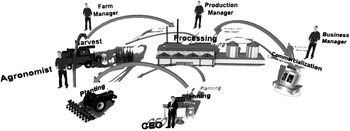
As shown by (Urs, Reference Urs2007) the ontology’s formalization follows hierarchical criteria, from the least to most significant element, according to (Inan, Reference Inan2010) the data display in agriculture for this domain does not follow a top-down or bottom-up, it follows a horizontal hierarchal procedure as (Richetti et al., Reference Richetti2003) presents in his research, the processes’ patterns are defined according to the tasks to be executed and their respective dependencies or sub processes. According to (Sheth, Reference Sheth1999) the way data is structured or stored digitally can be a determining factor for the integration of heterogeneous data sources. Computerized solutions usually aren’t designed for sharing data to its application domain with external applications. The absence of a specific standard for representing data in the cotton production processes hinders the development of technological solutions to meet the demand in this segment, a solution is in creating data specifications to support projects related to specifics solutions. The starting point in creating a metadata standard should be in the understanding of the embraced processes, then identifying data generated in these processes and finally the formalization of the standard. The model used for this appeal is an ontology that represents data in a hierarchical form, as suggested by (Gruber, Reference Gruber1993) ontologies are particularly useful to assist people in the sharing and understanding of information and knowledge. The ontology composed in this research aims to represent information related to cotton production. Other by-products are generated from this template, in this case, a specific metadata standard for this agricultural segment. The cotton crop agriculture, as any other agricultural process, is composed of processes that generate various types of data in each stage, as shown in the research conducted by (Sofiatti, Reference Sofiatti2009). A considerable point of the research is in determining the classes of greater importance in this context. Therefore an initial work, developed by the EMBRAPA and documented by (Richetii et al., Reference Richetti2003), was used as reference, the above study was also used to establish the degree of granularity needed for consistent representation of data classes. Additionally other sources were used, such as, academic institutions, certifiers, commercial firms, government institutions, and tech companies in agriculture. Computational data modeling, according to (Pressman, Reference Pressman2009) and (Sommerville, 2009) can be laid out in seven models: the class based model, the scenery based model, the behavioral model, the Class-Responsibility-Collaboration or CRC model, the data model, the control specification model, and the data flow oriented model. The use of each model depends on the scope in which it purports to represent. In this case, the class based model was used, the choice being justified by its adherence to the type of scenario that will be represented, allowing for the detailing of: data classes, hierarchies, domains and properties. The establishment of the classes began from identifying the processes involved in cotton production, this step was formalized using flowcharts, figure 2 illustrates a general view of the processes mapped according to technical information and additional data obtained in technical visits. The flowchart in this context is used as reference for identifying data generated in the processes, enabling the ontology’s formalization.
Overview of the processes mapped.

Results and discussion
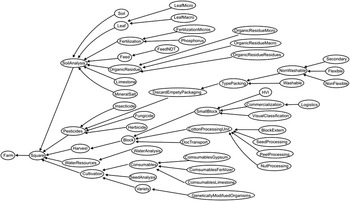
The formalization follows a chronological sequence according to the identification of the processes previously identified, from the macro logic unit (Farm) up to the micro logic unit if this segment (small blocks) as suggested by (Richetti et al., Reference Richetti2003). The data class mapping’s purpose is identify the requirements for creating the model that represents the knowledge of this segment and will provide a better understanding of the overall process, serving as an assistance for creating the metadata standard. Figure 3 presents the main classes for formalizing the data model.
Ontology main classes.

The resulting metadata standard will contribute in the creation of interfaces used as intermediate layers in the data exchange, for that, XML proved to be an adequate language for the application, due to its versatility both in representation and in multiplatform transparency. The choice of XML to formalize the metadata standard is justified by its technical viability and extensibility, both in data management tools and ontology formalization (Nikkilä, 2010).
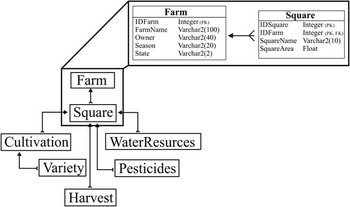
Starting from formalization of the ontology was created a metadata standard using the data classes as references to define a set of tags. The goal of the metadata standard in cotton production is to improve data exchange, the lack of rules to regulate it hinder the communication of the same. Computational Solutions for agriculture involve processing data to generate information in applications such as: traceability, knowledge-discovery in databases or KDD, business intelligence and Web services for data integration. According to (COUGHLIN, Reference Coughlin and Linfoot2010), using standards to track and describe the essence of data improves data exchange among processes, some specific segments make use of their own standards, such as agroxml, agxml, and among others. In addition a research was conducted in 19 farms in Mato Grosso, verifying what computer systems they used. The result shows the use of at least three distinct systems without any data integration, directly contributing to the heterogeneity of data, as different systems have different data structures, hindering the data exchange. After identifying the processes, the next step is formalizing the ontology, the resulting data model focuses in the key data generated in the cotton fiber production chain. The goal is to define the structure in a hierarchical manner with their relationships. Fig. 3 shows the main classes for the formalization of the data model. The construction of the tags set related to the standard was made using a ExR model to formalize classes of data logic. The ExR model enabled the construction of a physical model in the database to fill with real data and allowing comparative analysis. The data classes used were farm and square, and farm blocks representing respectively the result of the model ExR are two tables for data storage, as shown in figure 4.
Formalization of the data model.

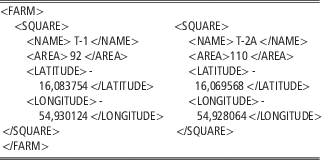
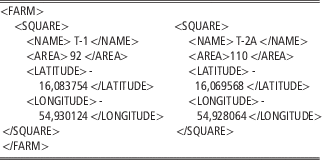
The resulting standard of formalization of the ontology is shown in table 1, this representation of the metadata standard is used to structure the data blocks (square) on a farm (farm), the fragment formalizes data such as name, area in hectares, latitude and longitude to provide the location of each square area.
Formalized data using standard XML metadata. <?xml version="1.0" encoding="UTF-8"?>
Some metrics to qualify the data were not used in the research because not meet the requirements necessary for using matadados in this context were used: accessibility, completeness, compliance, data specification, ease of use and maintainability, source, objectivity and quality of presentation. And were excluded: data coverage, consistency and synchronization, duplication, impoverishment of data, data integrity, timeless, relevance and confidence, access security, translatability and validity. The following are the dimensions on data without mapping with the proposed metadata standard, the data are compared with the use of the standard to check the efficiency of its use in this context.
Conclusion
The results presented offered an objective view about the improvement in data exchange for the scenario covered, completeness and readability improvements as are some of the most important dimensions observed. The contribution is to foster the adoption of a standard for the cotton fiber production segment, which is an important starting point for future research related to standardization of data in Brazil to provide identification of responsibilities on this segment. The responsibility for each step in the cotton production process becomes clearer with the use of the ontology for the mapping of the knowledge used in the productive chain. From the ontology it is possible to define a solid and consistent metadata standard that can be used as interface for several different computational systems like BIs and ERPs. The metadata standard derived from the ontology provides a broad view about each System checkpoint and consequently those responsible for each one, making it possible to delegate responsibilities to specific sub processes in this scenario.