




No CrossRef data available.
Article contents
- Abstract
- INTRODUCTION
- FOREIGN INFLUENCES IN THE COUNTRY
- PARTICIPANTS AND METHOD
- THE SOCIAL STATUS OF FRENCH, ARABIC, AND ENGLISH
- FRENCH, ARABIC, AND ENGLISH LOANS IN THE POLITICAL, CULTURAL, AND RELIGIOUS REGISTERS
- LEXICAL BORROWINGS ACROSS AGE GROUPS
- LEXICAL BORROWINGS AND GENDER
- LINGUISTIC ADAPTATION PROCESSES OF LOANWORDS
- CONCLUSION
- APPENDIX: SOCIOLINGUISTIC INTERVIEW
- References
The social status of Arabic, French, and English in the Senegalese speech community
Published online by Cambridge University Press: 17 March 2004
Article contents
- Abstract
- INTRODUCTION
- FOREIGN INFLUENCES IN THE COUNTRY
- PARTICIPANTS AND METHOD
- THE SOCIAL STATUS OF FRENCH, ARABIC, AND ENGLISH
- FRENCH, ARABIC, AND ENGLISH LOANS IN THE POLITICAL, CULTURAL, AND RELIGIOUS REGISTERS
- LEXICAL BORROWINGS ACROSS AGE GROUPS
- LEXICAL BORROWINGS AND GENDER
- LINGUISTIC ADAPTATION PROCESSES OF LOANWORDS
- CONCLUSION
- APPENDIX: SOCIOLINGUISTIC INTERVIEW
- References
Abstract
This study is part of a larger unpublished work. The data collection is based on the Labovian sociolinguistic interview: 200 randomly selected Wolof speakers were interviewed and recorded for 20 minutes in Senegal. They were divided into two groups: 100 subjects over 50 years old and 100 subjects between 20 and 30 years old. Each group comprised 50 males and 50 females. The number of loanwords from Arabic, French, and English in subjects' vernacular was statistically analyzed using the Wilcoxon (rank sums) test across three registers (cultural, political, and religious), age groups, and gender. The study argues that loanwords in Wolof reflect the social groups in Senegal and the prestige of lender-languages. First, the article discusses the influence of foreign languages in Senegal. Second, it examines the social status of loanwords from these languages. Third, it shows the relationships between loanwords, registers, age group, and gender in Senegal.
Information
- Type
- Research Article
- Information
- Copyright
- © 2003 Cambridge University Press
INTRODUCTION
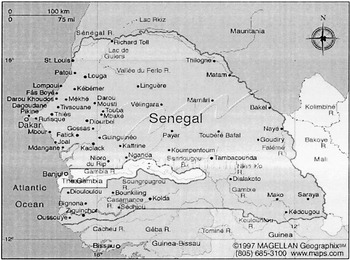
Senegal is located in West Africa between the 11th and 17th parallels west and the 12th and 16th parallels north. The country spreads 400 kilometers from north to south, and 600 kilometers from east to west, covering a surface of about 200,000 square kilometers. It borders Mauritania in the north, Mali in the east, Guinea Conakry in the southeast, and Guinea-Bissau in the south. The republic of the Gambia is wedged into the south of Senegal, dividing the latter into two parts. In the west, Senegal borders the Atlantic Ocean with 500 kilometers of coastline (Diallo, 1983:4).
The country is divided into 11 administrative regions: Rufisque, where Dakar (the national capital) is located, Thiès, Kaolack, Diourbel, Saint-Louis, Ziguinchor, Tambacounda, Louga, Fatick, Matam, and Kolda. Each of these regions represents the domain of particular ethnic groups with their own languages. Several ethnic groups are found in different regions of the country, among which the major ones are: the Wolof (who comprise about 44% of the Senegalese population and who are found everywhere, especially in major cities), Seereer (about 15%, mainly found in Thiès, Kaolack, and Fatick), Pulaar (about 24%, mainly found in Saint-Louis, Matam and Kolda), Mandinka (about 3%) and Joola (about 4%) (both found in the regions of Ziguinchor and Kolda), Soninke (about 2%, found especially in Tambacounda), Europeans and Lebanese (about 1%, mainly found in major cities), and other ethnic groups from neighboring countries comprise about 7% of the population.

Map of Senegal.
Besides French (the official language), the most prominent languages spoken in the country are Wolof, Pulaar, Seereer, Mandinka, Joola, and Soninke. The government recognizes these languages as the six national languages of the country, Wolof being the first and most widely spoken lingua franca. Although these six languages are recognized by the government as national languages, there are many more minority ethnic groups and languages across the nation, especially in the former region of Casamance, which corresponds to the present regions of Ziguinchor and Kolda, located in the south (between The Gambia and Guinea Bissau). These languages and cultures have made Senegal a country with a degree of multilingualism uncommon to the Western world.
The population of the country is roughly 10,000,000. The country is very unevenly populated, because poor farmers and jobless people move to big cities in search of jobs and a better standard of living. Dakar, the capital, comprises about two-thirds of the population. The religions of the country are: 92% Muslim, 6% indigenous beliefs, and 2% Christian (mostly Roman Catholic).
FOREIGN INFLUENCES IN THE COUNTRY
The high percentage of Muslims in the country comes from the early Islamization of the country. It dates back to the Islamization of West Africa, between the 11th and the 16th century, prior to the French colonization. According to Gellar (1995), sahelian (northern) Senegal's long involvement in the trans-Saharan trade exposed it to Islamic currents from North Africa. The people inhabiting the banks of Senegal were among the first in West Africa to embrace Islam. Gellar (1995) argued that Senegal's geography has brought its people into close contact with North Africa and the West, and has made Senegal a crossroad where the black African, Islamic, and European civilizations have met, clashed, and blended.
Thus, the early Islamization of the country (especially in the northern part) accounts for the strong linguistic influence of classical Arabic found in Wolof today. It is important to note, however, that the Arabic language has never been used as a medium of communication in the daily life of the Senegalese people. Its use was and is still primarily restricted to religious spheres. For this reason, classical Arabic is respected and is granted a holy status, as it is the language of the Koran, the Islamic holy book of over 90% of the Senegalese population.
As for the French influence in the country, it first started with the contact between Senegal and France in the early 17th century, when the French commercial companies started trading at the mouth of the Senegal River in the region of Saint-Louis, first entered by Europeans (Portuguese) in 1445 (Crowder, 1962).
Today, lexical borrowing from French into Wolof is common in Senegalese cities. The extensive number of lexical borrowings from French comes from the fact that Senegal occupied a central place in the colonization of West Africa, since the capital of A.O.F (Afrique Occidentale Française, ‘French West Africa’) was established in Saint-Louis, Senegal by the decree of June 1895, which created a Government-General of French West Africa (Clark & Phillips, 1994:45). The territory that the French occupied in Senegal was divided administratively into a colony, which consisted of the four historic communes of Dakar, Saint-Louis, Gorée, and Rufisque, and a protectorate, which included all the rest (Eades, 1994).
The people of the communes, whether they were Europeans, mulattos, or Africans, were French citizens and enjoyed full political rights, as the policy was one of direct assimilation to French culture and citizenship (Eades, 1994). The implicit assumption was that French culture was the highest ideal for everyone (Clark & Phillips, 1994:65). Thus, French colonialists believed that Senegalese people should be educated to assimilate French culture and become “black Frenchmen.” In this way, Senegal became the first experimentation place for the direct assimilation policy in French West Africa.
The French assimilation process was mainly implemented through the introduction of French as the sole language of education. Ultimately, the process was designed to make local people use only French as their major means of communication. Thus, the French Governor General Faidherbe (1852–1870), based in Saint-Louis, created some schools for assimilation purposes (Crowder, 1962). The major program was called l’école des fils de chefs ‘the school for the children of chiefs', also referred to as l’école des hotages ‘the school for hostages'.
The long contact between French and Wolof has created two major varieties of Wolof: urban Wolof, used especially in cities, and Kajoor Wolof, ‘pure’ Wolof, spoken mostly in rural areas. According to Swigart (1994), urban Wolof refers to a wide range of linguistic forms that are commonly used in major urban areas, such as Dakar, Saint-Louis, Thiès, Kaolack, Ziguinchor, to name only a few. Although urban Wolof differs from “pure” Wolof in phonology and structure, the major differences between these varieties are found in the lexicon (as a result of extensive borrowings from French in urban Wolof). French lexical borrowings in Wolof come from the fact that, although some lexical units were coined in Wolof and other local languages to cover new concepts brought by the French in the country, many lexical items were borrowed from French to express the constructs that came along with the introduction of the French culture, political system, and religion in urban areas in Senegal, or for purely prestigious reasons.
It is important to note that many older French-illiterates and religious men (especially from the Mourid religious brotherhood) find urban Wolof to be improper, and consider it to be a symbol of an on-going acculturation they disapprove of. Most of these older illiterates seem to favor the use of Arabic words in their Wolof because of its religious prestige. Besides, although they do not use Arabic for oral communication purposes, they do use the Arabic script (called Wolofal1
Wolofal refers to the adaptation of the Arabic script to transliterate Wolof. It involves the addition of new diacritics (mostly dots, called ‘tomb’ in Wolof) on some Arabic letters to transcribe Wolof sounds that do not exist in Arabic. This system is widely used among older Senegalese Muslims.
As for the English influence in the country today, it is argued that it may result from the fact that Senegal and the Gambia had been under British domination for sometime in the 18th and 19th centuries. Some researchers (Keke & Mbokolo, 1988; Lewis & Foy, 1971) have argued that when the British first arrived in Senegambia, their goals were to evangelize, explore, and trade in Senegal and the Gambia during the 17th and 18th centuries. To enlarge this new kind of trade, they created and imposed the union of the Gambia and Senegal. Consequently, many Senegalese families moved to the Gambia to take jobs in British infrastructures (Diop, 1995).
The union between the Gambia and Senegal under the British resulted from a fight over the control of the coastal trade and settlements. Given that the control of the coastal trade and the settlements depended largely on the balance of power in Europe, the main staging post for the slave trade in the Senegambia (on the island of Gorée, founded by the Dutch in 1588) was taken over by the French in 1679, and then fought over with the British (Eades, 1994). Eades (1994) argued that during the Seven Years' War the British briefly took control of both Gorée and Saint-Louis, and that Saint-Louis was returned to France in 1778, but was occupied once more by the British in 1809. The treaties of Paris and Vienna finally established French control over both settlements in 1815 (Eades, 1994).
Furthermore, another possible source of the English influence in Senegal is believed to be the presence of American troops in Senegal during World War II. Although no significant records were found for the presence of American troops in Dakar during World War II,2
The only information found about the presence of American troops in Senegal is from the website: http://members.aol.com/troopship/ssstamar.htm. It is indicated in the website that 250 American troops left New York on May 23, 1943 and arrived in Dakar on June 12, 1943 on board the SS Santa Margarita (C2-S-B1). However, the duration of their stay in Dakar, and whether all the troops were stationed only in Dakar, is still unknown.
PARTICIPANTS AND METHOD
Two hundred participants consisting of two distinct age groups were interviewed in the city of Saint-Louis in Senegal: (1) People over 50 years old and (2) people between 20 and 30 years old. Each age group consisted of 100 participants (50 males and 50 females). Subjects were sampled randomly from houses on each of the major 20 streets and meeting places (where people from all over the island meet to spend time together) in the island of Saint-Louis. In so doing, every participant had an equal chance of being selected. All subjects speak Wolof as their primary language of communication (either as a first language or as a second language). The subjects were selected so that the data collected from their vernacular are able to show (appropriately) the statistical difference of the number of borrowings between young and old Wolof speakers. The interviews were conducted entirely in Wolof, and were designed to trigger speakers' use of the vernacular style. They consisted of six modules that involve questions that trigger participants' use of the vernacular in three main registers: (1) political, (2) religious, and (3) cultural.
These three registers were specifically chosen to elicit borrowings from French, English, and Arabic in each of the three registers, due to the assumption that loans may affect registers differently. For example, while French borrowings are likely to be more numerous in the political register than in the religious one, Arabic loans are likely to be the majority in the religious register and the minority in the political register, and English loans might be found exclusively in the cultural register (especially among the urban youth). To elicit borrowings in the three registers in the vernacular, each subject was interviewed and recorded for 20 minutes. The interviews involved the following modules: (1) formality, (2) subjects' biography, (3) warm-up, (4) political register, (5) religious register, and (6) cultural register. The warm-up module and each of the three registers was allotted five minutes in the interview. Thus, to make sure that each register was roughly the same duration, subjects were cut-off and asked questions in a different register after five minutes.
Because this study focuses on the exchanges of lexical items between languages, the construct of borrowing is construed in this work as an umbrella term for any linguistic unit that a language gives to another (be it phonological, lexical, morphological, or syntactic). Thus, loanwords encompass two types of loans in this study: unassimilated loans, which are recognized as foreign words and somewhat cited by native speakers as peregrinisms or xenisms, and assimilated loans or true loans (i.e., naturalized loans), which have been used in a speech community for so long that they have become part of monolingual speakers' linguistic competence (Deroy, 1956).
THE SOCIAL STATUS OF FRENCH, ARABIC, AND ENGLISH
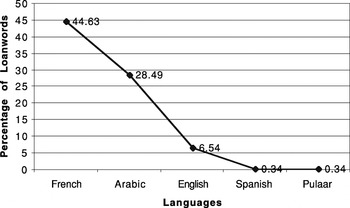
The prestige of French in the country results from the fact that colonization introduced French in the country to create a prestigious minority, French-speaking group to govern and impose the law on the nonfrancophone majority (Calvet, 1974:118). This role of French as an instrument of domination, power, and assimilation is reproduced and promoted today in the country by the French educational system, the government, and the media. Figure 1, based on the 1,162 loanwords collected from Senegal, illustrates this unequal distribution of power and prestige of French, Arabic, and English as expressed through lexical borrowing.

Words borrowed into Wolof found in data.
Figure 1 indicates that the 200 subjects interviewed primarily borrow from three major languages: French, Arabic, and English. Spanish and Pulaar have contributed to the sample of Wolof used in this study less than 1% of the words. For this reason, this article will not focus on their influence in the country. The numeric discrepancies between the rates of borrowing from these languages into Wolof are indicative of the distinct social status of each language in the Senegalese speech community. The following section examines the social status of French, Arabic, and English in the political, cultural, and religious registers in Senegal.
FRENCH, ARABIC, AND ENGLISH LOANS IN THE POLITICAL, CULTURAL, AND RELIGIOUS REGISTERS
In the Senegalese speech community, French loans are prestigious in the political register, Arabic borrowings in the religious register, and English loans (especially among the urban youth) in the cultural register. While the power and prestige of French result from its role as the language of social mobility and economic success in the country (as it is the language of the education system, government, formal business, and the language that ensures employment), Arabic has a holy status, because it is the language of the Koran, the holy book of the overwhelming majority of the Senegalese people. Consequently, speakers who use Arabic borrowings are de facto socially marked as being knowledgeable in Islam, and are highly regarded. The “holy prestige” and power of Arabic is preserved and promoted by Koranic schools, mosques, religious sermons (on regional and national radios and TV stations), and the five major religious brotherhoods (Murid, Tijaan, Xadr, Layeen, and Njaseen). Disciples of these brotherhoods study both the Koran and classical Arabic poems written by their spiritual leaders for meditation or prayer purposes.
In most of these religious organizations, the Arabic language is not generally studied as a subject, but rather it is used as a tool for religious and mystical investigation, practice, or prayer. Today, although Arabic has been introduced into some schools (middle schools, high schools, and universities) as an optional second language beside European languages, it still remains that it is one of the least popular foreign languages among young people in the country. This is partly because, although Arabic carries ‘holy prestige’ in the country, it is believed that it does not ensure economic success as compared to French. This might account for the significantly smaller number of Arabic loans in the data (28.49%) compared to French (43.63%), as indicated in Figure 1.
Loanwords from French and Arabic in Senegal are used to identify, characterize, and construct stereotypes about social groups in the speech community, thus creating social ideologies based on linguistic differences. A similar view was supported by Gal and Irvine (1995:972–973). They argued that the social prestige and power associated with languages or linguistic varieties are pivotal in the creation, spreading, or elimination of ideologies of social differentiations. Similarly, Bourdieu (1982:649) claimed that linguistic differences are often “ideologized” to create sub/supercategories worthy or unworthy of imitation or rejection in speech communities. Following this line of thinking, loanwords in Senegal can be considered to be ideologized, as they are used to indicate social groups worthy or unworthy of imitation or rejection in the speech community.
Two statistical tests were used to analyze the data. (1) the Wilcoxon (rank sums) test and (2) the Test of Contingency Tables. While the Wilcoxon (rank sums) test compares the number of French, English, and Arabic lexical borrowings between the three registers (political, cultural, and religious), gender, and the two age groups, the Test of Contingency Tables was used to see whether or not effects of register, age group, and gender on linguistic processes that accompany lexical borrowings are also present. The Wilcoxon (rank sums) test is used to see the central tendency of lexical borrowings from French, English, and Arabic found in the two age groups, for the following reasons: (1) a strong assumption of the normal distribution of the 200 speakers' data of lexical borrowing could not be made with certainty, and (2) given the likelihood of outliers in the data (subjects with extremely high or extremely low scores), the median appears to be the best measure of central tendency.
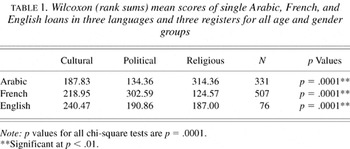
Wilcoxon (rank sums) mean scores of single Arabic, French, and English loans in three languages and three registers for all age and gender groups

Results also indicate that the number of French loans are significantly different across the three registers (chi-square = 134.60, df = 2, p = .0001), and that they are primarily found in the political and cultural registers, as indicated by the mean scores in Table 1. As for English loans, results show that they are also statistically different across the three registers (chi-square = 59.73, df = 2, p = .0001), and that they are predominantly found in the cultural register. Given that English is considered to be the language of “modernity and fashion” among the urban youth today, its influence is typically found in cultural contexts as the result of the young people's continuous exposure to the American youth culture, through movies, fashion, hip-hop, rap, and reggae music.
The presence of English loans in the political and religious register, as indicated by the mean values (Political Register: 190.86 and Religious Register: 187.00), results from the number of incorporated English words and hybrid structures with English elements found in the data. English loans used to generate the statistical results in Table 1 consist of: (1) incorporated English loans (such as [rum] ‘Wolof: the center of the room’ from

‘English: room’), [pantere] ‘Wolof: small sleeping room’ from [pæntri] ‘English: pantry’, [rab] ‘Wolof: to fold or wrap’ from [ræp] ‘English: wrap’), (2) recent English loans (such as ‘boy-town, boy-jump’, used to refer to the ‘in-fashioned’ city boys, ‘woriman’ used to refer to someone not serious, or ‘jungle’ which refers to a brand of American-made pants), and (3) hybrid structures with English elements (such as [kuulmã] ‘Wolof: nicely’ from [kuul] ‘English: cool + French: -ment = -ly’, [najsmã] ‘Wolof: nicely’ from [nais] ‘English: nice + French: ‘-ment’ = ‘-ly’).
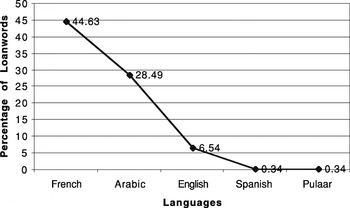
The fact these three types of English loans were used to generate Table 1 accounts for the unexpected higher number of English loans in the religious register compared to French. The occurrence of English loans in the political and religious registers might be a result of the British occupation of Senegambia. Figure 2 shows the major domains of influence of loans from French, Arabic, and English in Senegal today, in a more descriptive manner.

Domains of influence of loans from French, Arabic, and English.
To examine the major domains of influence of each language, the data used to generate this figure are based solely on lexical items from French, English, and Arabic (taken separately) and do not include hybrid lexical units used to generate Table 1. This accounts for the small presence of English loans in the political register (0.94%) and religious register (0%) in this figure, as many hybrid English structures fall in these two domains.
LEXICAL BORROWINGS ACROSS AGE GROUPS
Although both age groups in Senegal equally understand loans from French, Arabic, and English, speakers use them differently because of the distinct social status associated with each language, as indicated by the following statistical results based on the data.
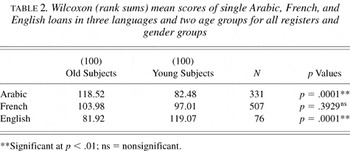
Table 2 shows that the number of Arabic loans in the sample is statistically very different in the two age groups (chi-square = 20.04, df = 1, p = .0001). It also demonstrates that English loans are statistically very different in the two age groups, as indicated by the two probability values (chi-square = 36.72, df = 1, p = .0001). Furthermore, Table 2 shows that the number of French loans is not statistically different in the two age groups (chi-square = 0.72, df = 1, p = .3929).
Wilcoxon (rank sums) mean scores of single Arabic, French, and English loans in three languages and two age groups for all registers and gender groups

Although English loans are used as markers of modernity among younger subjects, it is important to note that they are stigmatized by other social groups (especially the older people's age group) and are perceived as a sign of rebellion of the urban youth against the pre-established traditional Senegalese values. Such social stigmatization of English words in the Senegalese urban youth's speech is reported by Swigart (1994). This is consonant with Lodge's (1996:27) claim that, although there may be strong forces (political, religious, or moral) promoting the maintenance of the standard prestigious language varieties, there are likely to be equally strong challenging forces inhibiting the dominance of linguistic performance in speech communities. Thus, according to Lodge (1996), given that linguistic norms develop among any type of social groups and that they are tied with questions of identity, smaller groups (such as the youth) tend to use nonstandard forms as a marker of group loyalty and solidarity.
Following this line of thinking, it can be argued that the urban youth's preference of stigmatized English words is indicative of their rejection of the overt prestige for French and Arabic, and their acceptance of the covert prestige of English as sign of group solidarity and membership. Thus, unlike the overt prestige of French and Arabic (which are imposed and promoted by political and religious structures), the covert prestige (the prestige within the group) is linked to younger speakers' ability to conform to the stigmatized linguistic and behavioral norms of their group.
Swigart (1994:181) indicated that young men's dialect of urban Wolof is negatively viewed (by older people) in Senegal, being associated with a whole gamut of characteristics that exemplify the worst aspects of urban life (dropping out of school, pretensions of leading the high urban life, a life of scamming or wiliness in business transactions, even pickpocketing and delinquency). Consequently, the inclusion of English words in urban Wolof is a trademark of young men, and it has become directly associated with the talk of the jeunes bandits ‘the young low-lifes’ (Swigart, 1994).
The numerical superiority of Arabic loans in the older people's age group is related to the “holy prestige” of Arabic and the social status that older people hold in the Senegalese society, which is an age-set society. Foley (2000:313–315) defines an age-set society as a society in which features that are relevant to social stratification are generally biological such as age and sex. Foley (2000:313–315) argued that in such societies, people are assigned hierarchical groupings (age grades) and move from one to another as they age. The elder age grades hold the power to determine the running of the society (Foley, 2000:313). Consequently, because power accrues to older members of such societies, so does the great bulk of prestige entitlements; the younger must defer to the older in various patterns of behavior (Foley, 2000:313).
All subjects in the older people's age group are referred to as Kilifas, that is, honorable and respected men (from Arabic: qalifa: spiritual ruler or leader) and Soxnas (from Wolof: honorable and respected women). Being a Kilifa or Soxna is a special social status in Senegal that one only acquires with age. In fact, the title of Kilifa or Soxna can only be acquired when one is retired, or when one is over 50 years of age and decides to devote his/her remaining lifetime to spiritual, moral, and cultural matters.
Thus, given the strength of oral tradition in the Senegalese society, Kilifas and Soxnas are considered to be reservoirs of knowledge and wisdom designed to assist and advise younger generations in spiritual, cultural, or moral issues. The belief that one must take advantage of their wisdom and rich life experiences while they are still alive is strongly established in the psyche of the average Senegalese. As a result, most Senegalese highly regard Kilifas and Soxnas, and wish to grow old and wise to acquire the honor and respect associated with these titles.
Membership to this age group is equated with extensive use of Arabic loans in one's vernacular Wolof, because Arabic is associated with wisdom and religious erudition. Consequently, the prominent use of Arabic loans among older subjects (compared to younger subjects) found in the data can be construed as social pointers utilized to mark one's membership to the respected and supposedly knowledgeable older people's age group.
On the contrary, when older people borrow extensively from English, they appear ridiculous because of the social stigma associated with such linguistic practices that characterize the “the wanna-be American urban youth talk.” Such older speakers would be perceived as people who attempt to behave like “city boys,” which is in strong violation of the social and linguistic expectations of their age group.
LEXICAL BORROWINGS AND GENDER
Gender as a sociolinguistic variable has been popularized in sociolinguistics in the work of Labov and Lakoff. Labov (1972:243) found that, in careful speech, women in New York City used fewer stigmatized forms and were more sensitive to prestigious variants than men. Lakoff (1975) argued that women's speech (‘women talk’) is devised by society and taught to girls through socialization to prevent the expression of ideas that increase women's status. She claimed that women's frequent use of tag questions is evidence of their hesitance to express themselves with force compared to men. Foley (2000:289) argued that the ideology of gender categorization is typically enacted in linguistic practices, and that it is, indeed, through language that the individual cultural understanding of gender categories are learned, and the coordination of gender roles achieved.
Using the usual stereotype that women talk more than men, when in reality, some quantitative studies (Swacker, 1975; Woods, 1988) show the opposite, Foley (2000) argued that male dominance is expressed and constructed through language. Drawing from Indonesian examples, he argued that linguistic practices differ between males and women within the family, wherein wives typically use a more polite form of speech to their husbands than their husbands do to them, reflecting and declaring a somewhat higher status of the man (Foley, 2000:291). This view is consistent with social practices found in the Senegalese speech community, in which a wife may call her husband by Nijaay (Wolof: uncle), but the husband will call her by her first name or by a nickname. Foley (2000) argued that such a difference is emblematic of the difference in social status between men and women in these speech communities.
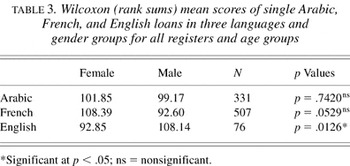
Thus, as indicated by Labov (2001:262), gender is a powerful differentiating factor in almost every use of stable stratification in speech communities. He argued that gender effects take different forms for different sociolinguistic variables (Labov, 2001:263). Table 3 shows the relationship between lexical borrowings from French, English, and Arabic, across males and females.
Wilcoxon (rank sums) mean scores of single Arabic, French, and English loans in three languages and gender groups for all registers and age groups

With respect to the number of Arabic loans, Table 3 shows that there is not a statistically significant difference between male and female subjects (chi-square = 0.10, df = 1, p = .7420). With respect to the number of English loans, Table 3 shows that there is a statistically significant difference between males and females (chi-square = 6.22, df = 1, p = .0126). Table 3 also shows that French loans are almost statistically significant across genders (chi-square = 3.74, df = 1, p = .0529). This may be a result of the “linguistic conservatism” of women compared to men discussed in the sociolinguistic literature.
Labov (2001:364) indicated that women deviate less than men from linguistic norms when the deviations are overtly proscribed, but more so than men when the deviations are not proscribed. Furthermore, Foley (2000:302) argued that women tend to use speech forms that are less innovative than those of men, because these forms tend to be more prestigious and more standard. He argued that, to claim connection with the wider world and to function effectively within it, prestigious and standard linguistic features are generally chosen by women, as they are more valued. In this respect, given the social prestige of Arabic and French in Senegal, the unexpected high occurrence of loans from these languages among women (see Table 3, as indicated by the mean values) indicates the degree of “linguistic conservatism” of women in Senegal.
Following this line of thinking, it can be argued that this linguistic behavior of Senegalese women (borrowing relatively more from the two prestigious varieties: French and Arabic) is tolerated, because other social groups (especially older speakers) also use similar linguistic behaviors as a means of borrowing the prestige associated with the language of socioeconomic mobility (French) or the language of religious erudition (Arabic), as indicated in Table 2. This view is consistent with Labov's (2001) claim that women usually display greater linguistic investment in social advancement and accumulation of symbolic power. This may be ascribable to the fact that they are relatively less educated in French and Arabic compared to their male counterparts in Senegal.
Furthermore, Table 3 shows that there is a statistically significant difference between the number of English words across gender (chi-square = 6.22, df = 1, p = .0126). It shows that women use fewer English words than men, as indicated by the mean values (males: 108.14, females: 92.85). This suggests that gender is indeed a sociolinguistic variable in Senegal. The superiority of English loans among male subjects is due to female subjects' avoidance of the social stigma associated with English words, as other social groups in the speech community (especially the older people) overtly proscribe them. Thus, because of this social stigma associated with English, female subjects tend to avoid them for fear of transgressing prescribed social norms, which could endanger their attempt to promote their social status in the speech community compared to men. As indicated earlier, English words are almost exclusively used by the urban youth (especially males) and are perceived by other social groups as a sign of rebellion against the pre-established linguistic and social norms in the speech community. This view is consonant with Labov's (2001:321) claim that women usually react more sharply against the use of stigmatized forms.
LINGUISTIC ADAPTATION PROCESSES OF LOANWORDS
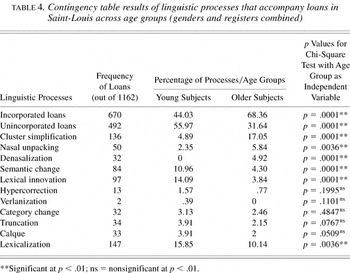
Although this study does not focus on linguistic adaptation processes of loanwords to Wolof grammar and phonology per se, there is a significant statistical difference between the number of linguistic incorporation processes of the two age groups, as shown in Table 4.
Contingency table results of linguistic processes that accompany loans in Saint-Louis across age groups (genders and registers combined)

The results in Table 4 also indicate that the number of incorporated loans, unincorporated loans, loans with cluster simplification (e.g., the [pr] and [gr] units in the French word ‘progrès’ are broken), denasalization, semantic change, lexical innovations, lexicalizations (merger of two lexical units to form one lexical unit, as in Wolof ‘dute’ from French ‘du thé’), and nasal unpackings are statistically different between the younger subjects and older subjects (both genders and all registers combined). Because Wolof does not have nasal vowels, French nasal vowels at word initial and medial position preceding a stop consonant typically become an oral vowel followed by a nasal consonant as in [sandel] (Wolof: candle) from

(French: candle). Paradis and Prunet (2000) referred to this process as “nasal unpacking.”
These results show that linguistic processes that accompany loans reflect the age stratification of the community. Table 4 shows that the number of incorporated loans in the data is statistically different between the two age groups (chi-square = 69.38, df = 1, p = .0001), and that they are mostly found among older subjects (68.36%) compared to younger subjects (44.03%). Thus, incorporated loans seem to be markers of the older people's age group. In contrast, the number of unincorporated loans is statistically significant between the two age groups (chi-square = 69.39, df = 1, p = .0001), and such loans are primarily found among younger speakers (55.97%) compared to older people (31.64%). Thus, unincorporated loans seem to mark the younger subjects' age group.
With respect to the number of loans with cluster simplification, the results indicate that there is a significant statistical difference between younger subjects and older subjects (chi-square = 40.95, df = 1, p = .0001). As Table 4 shows, loans with cluster simplification are mostly used by older speakers (17.05% compared to 4.89%). This demonstrates that cluster simplification is also a marker of the older subjects' age group. Similarly, the results also show that the number of loans with denasalization are statistically different between the two age groups (chi-square = 25.82, df = 1, p = .0001), and that they are primarily used by older subjects (4.92%) compared to younger subjects (0%), thus showing that denasalization also serves as an index of the older people's age group. Table 4 also shows that the number of loans with nasal unpacking is statistically different between the two age groups (chi-square = 8.46, df = 1, p = .0036). It also shows that older subjects unpack more nasal vowels (5.84%) than younger subjects (2.35%), indicating that nasal unpacking is also indexical of the older people's age group.
With respect to the number of loans with semantic change, our results indicate that there is a significant statistical difference between younger subjects and older subjects (chi-square = 18.92, df = 1, p = .0001). The results also demonstrate that younger subjects use more loans with semantic change (10.96%) than older subjects (4.30%), thus suggesting that loans with semantic change are also markers of the younger people's age group. Similarly, our results show that the number of lexical innovations is statistically different between the two age groups (chi-square = 39.31, df = 1, p = .0001). Table 4 also shows that lexical innovations are primarily used by younger subjects (14.09%) compared to older subjects (3.84%), thus demonstrating that lexical innovation is a characteristic of the younger subjects' age group.
As for the number of calques found in the data, Table 4 shows that there is a statistically significant difference (at the p = .05 level) between younger subjects and older subjects. The table indicates that calques are relatively more utilized by younger subjects (3.91%) than older subjects (2%). Our results also show that the number of lexicalizations is statistically different (at the p = .01 level) between the two age groups, and that younger subjects use more lexicalizations (15.85%) than older subjects (10.14%). The higher rate of lexicalizations among younger subjects results from the fact that while older subjects usually use old lexicalized forms (with French and Arabic elements), younger subjects use both old and new lexicalized forms (with French, English, and Arabic elements). These results demonstrate that some linguistic adaptation processes of loanwords are sociolinguistic variables, as they serve as markers of particular age groups in the speech community.
CONCLUSION
This work has focused on a multilingual community in which various languages (carrying different prestige) operate side-by-side, and where the use of linguistic borrowing is usually socially motivated. It has also shown that loanwords are used as indexes of group membership or markers of social status in the Senegalese speech community.
The study has provided evidence that lexical borrowings reflect social stratification patterns, the unequal distribution of power, and speakers' linguistic efforts and strategies to acquire social prestige in the Senegalese speech community. In addition, these loanwords usually reflect current sociocultural changes in the speech community, as French is gradually losing its position as the language of “social mobility,” whereas American English is perceived as the “language to be had” for socioeconomic success among the youth. As rightly indicated by Foley (2000:383), as a society undergoes changes, the linguistic forms and the social meanings they enact may also undergo changes, as attested to in the Senegalese speech community wherein speakers' linguistic behaviors often mirror the past and sociocultural changes in the community.
This study has shown that in multilingual francophone countries such as Senegal (where several languages and cultures with different levels of prestige coexist and interact), speakers' use of loanwords from French, Arabic, or English are determined by various social factors, such as social identity, social prestige, group loyalty, or group membership. Consequently, this study provides a window on the abiding theoretical problem of the study of lexical borrowings as sociolinguistic variables in multilingual communities in general.
APPENDIX: SOCIOLINGUISTIC INTERVIEW

References
REFERENCES
Bourdieu, P.
(1982).
The economics of linguistic exchanges.
Social Science Information
16(6):645–688.Google Scholar
Calvet, L-J.
(1974).
Linguistique et colonialisme.
Paris:
Payot.
Clark, F., &
Phillips, L. Colvin.
(1994).
Historical dictionary of Senegal (
2nd ed.).
London:
Scarecrow Press.
Crowder, Michael.
(1962).
Senegal: A study in the French assimilation policy.
London:
Oxford University Press.
Deroy, L.
(1956).
Les emprunts linguistiques.
Paris:
Belles Lettres.
Diallo, Amadou.
(1983).
Eléments systématiques du wolof contemporain.
Dakar:
Centre de Linguistique Appliquée de Dakar.
Diop, Astou.
(1995).
Wolof borrowings from English: A phonetic and semantic analysis.
Unpublished Masters thesis,
Department of English, University of St.-Louis,
Senegal.
Eades, Jeremy.
(1994).
Senegal.
World Bibliographical Series
166:xxiv–xxxi.
Foley, William A.
(2000).
Anthropological linguistics: An introduction.
Cambridge:
Blackwell.
Gal, S., &
Irvine, J.
(1995).
The boundaries of languages and disciplines: How ideologies
construct differences.
Social Research
62(4):967–1001.Google Scholar
Gellar, S.
(1995).
Senegal: An African nation between Islam and the West.
Colorado-Boulder:
Westview Press.
Keke, I. B., &
Mbokolo, E.
(1988).
Histoire générale de l'Afrique des missionnaires
aux explorateurs.
France:
Présence Africaine.
Labov, W.
(1972).
Language in the inner city: Studies in Black English Vernacular.
Philadelphia:
University of Pennsylvania Press.
Labov, W.
(2001).
Principles of linguistic change: Social factors.
Cambridge:
Blackwell.
Lakoff, R.
(1975).
Language and women's place.
New York:
Harper Colophon.
Lewis, R., &
Foy, Y.
(1971).
The British in Africa.
London:
Weidenfeld and Nicolson.
Lodge, R.
(1996).
French: From dialect to standard.
New York:
Routledge.
Mansour, Gerda.
(1993).
Multilingualism and nation building.
Clevedon, UK/Philadelphia:
Multilingual Matters.
Paradis, J. F., &
Prunet, C.
(2000).
Nasal vowels as two segments: Evidence from borrowings.
Language
76(2):325–357.Google Scholar
Queffélec, A.,
Dubois, C., &
Kasbarian J.-M.
(2000).
L'expansion du français dans les suds (XV-XX
siècles).
Aix-en-Provence:
Publications de l'Université de Provence.
Swacker, M.
(1975).
The sex of speaker as a sociolinguistic variable. In
B. Thorne &
N. Henley (Eds.),
Language and sex: Difference and dominance (pp.
76–83).
Swigart, Leigh.
(1994).
Cultural creolization and language use in post-colonial Africa: The
case of Senegal.
Africa
64(2):177–189.Google Scholar
Taylor & Francis Group.
(2000).
Africa south of the Sahara: Senegal
(30th ed.).
New York:
Europa Publications.
Treffgarne, Carew.
(1986).
Language policy in francophone Africa: Scapegoat or panacea?
Language in education in Africa: Proceedings of a seminar held in
the Centre of African Studies.
Edinburgh:
Centre of African Studies, University of Edinburgh.
141–170.
Woods, N.
(1988).
Talking shop: sex and status as determinants of floor apportionment
in a work setting. In
J. Coates, &
D. Cameron (Eds.),
Women in their speech communities (pp.
141–157).
London:
Longman.
Map of Senegal.
Words borrowed into Wolof found in data.
Wilcoxon (rank sums) mean scores of single Arabic, French, and English loans in three languages and three registers for all age and gender groups
Domains of influence of loans from French, Arabic, and English.
Wilcoxon (rank sums) mean scores of single Arabic, French, and English loans in three languages and two age groups for all registers and gender groups
Wilcoxon (rank sums) mean scores of single Arabic, French, and English loans in three languages and gender groups for all registers and age groups
Contingency table results of linguistic processes that accompany loans in Saint-Louis across age groups (genders and registers combined)
 You have
Access
- 18
- Cited by