Introduction
Coconut palm (Cocos nucifera Linn.) is a perennial oil seed crop with high commercial value. This palm has a pivotal role in domestic, industrial, constructional, medicinal and religious purposes. The leaf-eating caterpillar Opisina arenosella Walker (Lepidoptera: Oecophoridae) is the most important lepidopteran pest of coconut palm in India, Sri Lanka and Myanmar (Rao, Reference Rao1924; Jayaratnam, Reference Jayaratnam1941; Alam, Reference Alam1962; CIE, 1966; Cock and Perera, Reference Cock and Perera1987).
Opisina arenosella attacks coconut palms during its growth phase from seedling stage to maturity.The caterpillars weave silken webs reinforced with leaf bits and excreta on the lower surface of leaflets and devour the chlorophyll-containing abaxial leaf surface tissues, causing dryness of leaf. Severe damage results in drying of the outer and middle whorl of leaves, reduction in rate of production of flower spikes, increased premature nut fall and retarded growth (Lever, Reference Lever1969). Damage to the leaves renders them unsuitable for thatching and for other purposes. The pest infests coconut palms throughout the year and the maximum pest population is observed in the field during summer. The pest population periodically assumes epizootic proportions on coconut palms in coastal and backwater tracts in South India. In severe outbreaks, all the fronds are affected and the plantation presents a burnt appearance. Information on the yield loss in coconut due to this pest attack is very meagre. Assessment of crop loss is essential for a realistic planning for research and developmental policies. Hence the present study was undertaken to quantify the crop loss in terms of nut yield due to infestation by O. arenosella.
Materials and methods
The investigation was carried out in Kannur District of Kerala State, India (11°86′N and 75°22′E), where a severe outbreak of the pest occurred on coconut palms during 2002. The plantations are rainfed coconut monocrop with West Coast Tall variety falling under the age group of 30–35 years. During 2002, 150 palms infested with O. arenosella were selected from the severely infested area and were labelled for observations. Observations were recorded on total number of leaves and pest-infested leaves. Pest incidence symptom in more than 10% leaflets/leaf is considered as infested leaf. The bunch-wise number of nuts available on the crown from fully opened inflorescence to the last mature bunch was counted during the month of May in each year during the 4-year study. One hundred and twenty-five healthy (pest-free) palms having identical conditions in the same locality were selected and labelled as pest-free palms. Similar observations on number of leaves and bunch-wise yield were recorded from these palms for comparison of yield with the pest-infested palms. Data on pest incidence on leaf and bunch-wise nut yield were collected in the month of May during 4 years starting from 2002 from all the observational palms by climbing the palm.
The population of O. arenosella was periodically checked by random sampling and larval parasitoids namely Goniozus nephantidis Muesebeck (Hymenoptera: Bethylidae) and Bracon brevicornis Wesmael (Hymenoptera: Braconidae) were released for suppression of the pest by the Department of Agriculture, Kerala State, during 2002. Each of the parasitoids was released at the rate of 20 parasitoids for the presence of every 100 O. arenosella larvae estimated to be present on the palm.
To get an idea about the bunch production in infested and healthy palms, the palms under observation were categorized as: (i) palms with < 10 bunches, (ii) palms with 10–15 bunches and (iii) palms with >15 bunches depending on the frequency of bunch production. Annual nut yield per coconut palm was estimated as per the equation developed by Mathew et al. (1991, 2001).
Student's t statistics was used for separation of means for nut yield, leaf and spadix production. χ2 test was carried out to establish association between bunch yield categories and infested/healthy palms. Coefficient of correlation was calculated between nut yields for 4 years with percentage of infestation for 2002.
Results
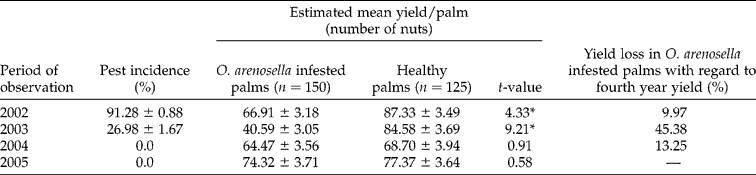
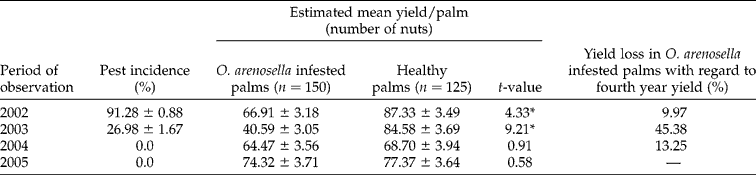
Percentage of pest infestation was highest during the first year of observation (91.3%) and was subsequently reduced to zero (complete recovery) during the third and fourth year of the study mainly due to parasitoid releases. During the second year, the pest incidence declined significantly to 27%. Likewise, the average yield of nuts in infested palms decreased from 66.9 nuts/palm in the first year to 40.6 nuts/palm in the following year. Thereafter, nut yield increased to 64.5 and 74.32 nuts/palm in the third and fourth year, respectively (Table 1).
Percentage pest incidence and comparison of estimated number of nuts/palm (mean yield and standard error) of Opisina arenosella infested and non-infested coconut palms during 2002–2005 at Kannur, India
Sample size in parenthesis.
* Significant at 1% level (P < 0.01).
The loss in yield was calculated based on the yield of the fourth year, which was assumed to reflect the normal potential yield as during the fourth year and the previous year; the percentage of pest incidence was nil. The yield loss due to pest infestation was 10, 45.4 and 13.2% for the first, second and third year of pest attack, respectively.
The average yield of nuts in two categories viz. pest-infested and pest-free palms, differed significantly in 2002 (t = 4.33, P < 0.01) and 2003 (t = 9.21, P < 0.01) but not in 2004 and 2005 (Table 1). Pest infestations by O. arenosella were high in 2002 and 2003, whereas the pests were virtually absent in 2004 and 2005.
The rate of production of leaves per palm per year in infested and healthy palms was significantly different in 2003 (t = 6.82, P < 0.01), but not in 2004 and 2005 (Table 2).
Comparison of number of leaves produced and variation in bunch (spadix) production (mean and standard error)/palm in Opisina arenosella infested and non-infested coconut palms during 2002–2005 at Kannur, India

* Significant at 5 % (P < 0.05);
** significant at 1 % (P < 0.01).
The average number of spadices produced per infested and healthy palms differed significantly in 2002 (t = 2.20, P < 0.05), 2003 (t = 5.93, P < 0.01) and 2004 (t = 4.62, P < 0.01) (Table 2).
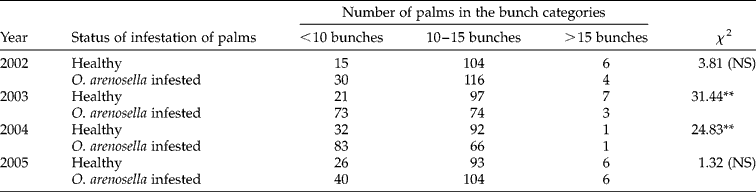
During 2002, 77% of the infested palms were producing 10–15 bunches, which is the normal yielding potential. As a consequence of the pest outbreak, the production ability of palms was reduced in 2003 and 2004 with only 49.3 and 44% of the palms in the 10–15 bunch category, respectively. Thereafter, the production increased in the subsequent year. By 2005, the palms regained normal bunch production and 69.3% of palms were categorized in the 10–15 bunch group. For the non-infested palms, throughout the 4 years of observation, the majority of these palms (>70%) were in the 10–15-bunch category. Significant associations between bunch yield categories and infested/healthy palms were recorded in 2003 (χ2 = 31.44, df 2, N = 275, P < 0.01) and 2004 (χ2 = 24.83, df 2, N = 275, P < 0.01) (Table 3).
Frequency of palms in various bunch categories in Opisina arenosella infested and non-infested coconut palms during 2002 to 2005 at Kannur, India
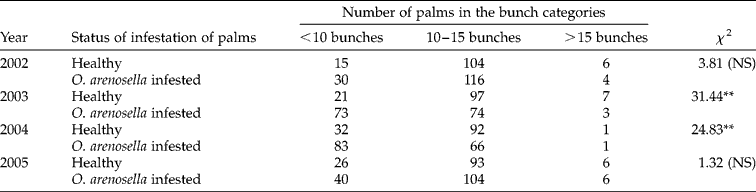
NS, non-significant. Hypothesis: independence between the status of the infestation and classification of the bunches/palm.
** Significant at P < 0.01.
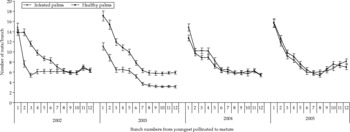
Average number of nuts/bunch available on the palm crown from the youngest pollinated to the mature bunch (for 12 bunches) at the time of observation (annually in May for 4 years) was plotted. Mean number of nuts/bunch in 2002 showed a decline in the number of nuts in infested palms towards the younger bunches. In 2003, infested palms recorded significantly less number of nuts in all bunches compared with the non-infested palms. During 2004 and 2005, the nut retention in infested and non-infested palms was on par (Fig. 1). From the fourth year onwards, previously infested palms regained levels of nut retention comparable with those of non-infested, healthy palms.
Mean number of nuts/bunch during 2002–2005 in Opisina arenosella infested and non-infested coconut palms at Kannur, India. Vertical bars indicate the mean and standard error.

To better understand the relationship between yield and percentage of infestation, correlation coefficients were calculated. A significant negative correlation between percentage leaf infestation by the pest and nut yield of the palm in the following year was established (Table 4). The number of leaves available on the palm crown correlated positively with nut yield.
Coefficient of correlation between nut yield and percentage leaf infestation by Opisina arenosella in coconut palms (n=150)

Discussion
Information on yield loss due to O. arenosella in coconut is very scarce. Perera (Reference Perera1993) reported heavy occurrence of pests causing over 40% damage to the leaves during an outbreak. Joy and Joseph (Reference Joy and Joseph1973) reported reduction in yield from 1875 to 964 nuts (63%) per acre due to O. arenosella attack. In the present study, the average yield of nuts in two categories viz. infested and non-infested palms, showed significant reductions in yield for infested trees in 2002 and 2003, but not in 2004 and 2005. In May 2002, when the observation started, 91.3% of the palms in the infested category showed incidence of an O. arenosella attack, and consequently these palms recorded a lower yield than those in the non-infested category. In the following year, we recorded a drastic decline in yield in the infested palms than in the preceding year, whereas the non-infested ones maintained a similar yield. The complete recovery of the palms in the infested category during 2004 and 2005 was manifest in the absence of pests, and comparable yield levels as in the non-infested category. This was probably due to the control effect of mass releases of the two larval parasitoids in 2002.
The number of leaves produced per palm per year determines the possible number of inflorescence production in coconut (Ohler, Reference Ohler1984). The results of a trial of artificial defoliation of coconut palms in Papua New Guinea showed a linear response of yield to severity of defoliation. Ohler (Reference Ohler1984) suggested that treatment of defoliating insects should be aimed at least at preventing a reduction in leaf area by more than 40%.
In the present study, we observed a significant reduction in the leaf production in 2003, the year following the O. arenosella outbreak. During 2003, there was only 26.9% leaf infestation and consequently it did not influence the leaf production in the following 2 years.
In a healthy yielding coconut palm with stabilized yield, there will be one spadix production per month, 11.4–13.4 spadices produced per year and a minimum of 12 bunches in the palm crown (Menon and Pandalai, Reference Menon and Pandalai1960). Lever (Reference Lever1969) recorded that in the year following a severe pest outbreak, the crop may be reduced to half and severe damage to the leaves may result in reduced rate of production of flower spikes. Our results corroborate these observations. In the first year of our study, there was an average of 11.4 and 12 spadices/palm in the infested and non-infested categories. The severe defoliation during 2002 resulted in production of fewer spadices during 2003 and 2004 (9 and 9.3 spadices/palm, respectively). In the absence of further pest outbreaks, the palms regained normal spadix production during 2005.
Mohan and Sujatha (Reference Mohan and Sujatha2006) reported 52.6 and 94.7% reduction in O. arenosella populations after 1 and 2 years, respectively, in a parasitoids released plot in Kerala, India. Similarly, in the present study, the O. arenosella outbreak was brought under control within 1 year following the parasitoid releases.
Nirula et al. (Reference Nirula, Antony, Sahasranaman and Menon1954) studied the indirect effect of foliage consumption by the slug caterpillar Mambarilla (syn. Contheyla) rotunda Hampson (Lepidoptera: Limacodidae) on coconut and reported 75% loss in coconut production. Infestation by O. arenosella also presents a similar condition. Soekarjoto et al. (Reference Soekarjoto, Sudasrip and Davis1980) investigated the effects of removing the infested coconut fronds by the limacodid Setora nitens Walker, a major pest of palms, and reported that severe pruning of fronds resulted in 76% reduction of fruits in the year following pruning. Palms that are severely infested with S. nitens, but not mechanically pruned, suffered a 14.3% reduction in fruits. Desmier de Chenon (Reference Desmier de Chenon1982) observed a marked reduction in nut production of coconut palm during the first 6 months following a severe defoliation by the slug caterpillar Parasa lepida Cram. (Lepidoptera: Limacodidae). The palms produced no coconuts in the ensuing 18 months and did not fully recover production until after 40 months following defoliation.
The mean reduction in coconut production in areas with defoliation by the leaf-mining beetle Promecotheca coeruleipennis Blanchard (Coleoptera: Chrysomelidae) was estimated to be 50% (Taylor, Reference Taylor1937). Gresseti (Reference Gresseti1959) observed that with 80% of the fronds under attack by P. coeruleipennis, the palms produced no flowers or fruits. Coconut production losses due to the coconut hispid beetle Brontispa longissima Gestro (Coleoptera: Chrysomelidae) have been recorded to be 50–70% in Samoa (Voegele, Reference Voegele1989).
In the present study, the data on all recorded yield parameters indicate that O. arenosella attack results in heavy yield loss and the infested palms return to the normal yield potential in the fourth year following the pest attack, provided the pest infestation is brought under control, preferably through mass releases of its larval parasitoids.
Acknowledgements
The authors are grateful to Mr Jacob Mathew, Principal Scientist, Statistics (Retd.), CPCRI, Kayamkulam, for statistical design of the experiment and suggestions rendered for analysis of data.