Introduction
Health cost containment refers to “limiting or slowing the rate of health care spending” (Rapoport et al., Reference Rapoport, Jonsson and Jacobs2009), and it is highly relevant in a time of ageing populations and insatiable demands for health services. The politicians face a constant dilemma between users’ interest in the optimal vs the achievable solution given the financial costs. For health care services, the dilemma is further intensified by the fact that these services are typically produced by occupations with specialised, theoretical knowledge and firm intra-occupational norms (professions).
The literature traditionally differentiates between cost containment measures designed to affect demand and supply (Abel-Smith and Mossialos, Reference Abel-Smith and Mossialos1994), but this article argues in favour of including the underlying logic of the measures in the classification. Distinguishing between measures based on bureaucracy, market and professionalism enables us to form expectations concerning the use of cost containment measures for different services, thereby shedding light on a neglected issue: Why do different countries use different cost containment measures to regulate specific services? The literature has convincingly shown that the total level of health care spending depends on structural factors, including demographic structure and technological development (Kanavos and Yfantopoulus, Reference Kanavos and Yfantopoulus1999), but there is little systematic evidence of country-level differences in service-specific cost containment measures (Mossialos and Le Grand, Reference Mossialos and Le Grand1999; Kravitz, Reference Kravitz2008). Inter-professional relationships might be relevant for this variation.
Health care policies in general and cost containment measures in particular are formed in multiple arenas, making it relevant to consider inter-professional games, bargaining between professions and other interests (political parties, labour unions, industrial interests, etc.), and bargaining between these multiple interests (Moran, Reference Moran1999: 1–4). This article focuses on inter-professional relationships, because professions are important pressure groups with a special relationship to the state (Moran, Reference Moran1999: 7) and the focus is on the variation between services produced by different professions.
The central question is whether cost containment measures differ between countries where health care professions have different relative professional status. The relative professional status is expected to influence how much professions other than the one producing a given service can affect the cost containment measures chosen for this service. Especially the neo-Weberian approach to professions emphasises the constant struggle for power between the professions (Johnson, Reference Johnson1972); and for health care professions, this struggle is also about securing resources for one's own service. Health professions are hardly just power maximisers, given that professionals are motivated by altruistic as well as selfish concerns (Le Grand, Reference Le Grand2003; Andersen, Reference Andersen2009), but both types of concerns imply that they prefer to have no cost containment measures at all for the services they produce. If cost containment measures cannot be avoided, health professions are expected to prefer less intrusive measures. To ensure resources for their own services, they may support cost containment measures for services produced by other professions, implying that relative professional status is important for the use of cost containment measures.
This article focuses on the status of the medical profession relative to different non-medical professions, because physicians have been recognised as historically dominant, both in the hierarchies of the health care system and in the sphere of professional politics, meaning that they have traditionally had an important say regarding the greater part of all health care spending decisions (Moran, Reference Moran1999: 7–8). Although the medical profession still holds dominant positions in all Western countries, its status relative to other health care professions varies from country to country and over time (Heaney, Reference Heaney2006: 900–901). Greater plurality of health professions contributes to a renegotiation of medical hegemony, as it must be legitimised against the interests of other health professions (Kuhlmann et al., Reference Kuhlmann, Allsop and Saks2009: 524).
Very high relative professional status for the physicians would imply that the costs of medical services would only be contained by self-regulation, physicians would be allowed regulate other services (through referrals), and/or the cost of other services would be contained by bureaucratic and economic measures. The medical profession is neither omnipotent nor totally equal to other professions in any Western country. Rather, the relative professional status varies between countries and is expected to affect the chosen cost containment measures. Factors other than relative professional status are also important, and cost containment measures in Norway and Denmark are compared, because these countries are rather similar concerning both the institutional set-up of their respective health care systems and the demographic profiles of the populations, whereas the relative status of the medical profession differs. The next section discusses why professional status is important.
Theoretical framework: cost containment measures and relative professional status
Cost containment is closely related to health care regulation, and the literature differentiates between independent self-regulation, state-sanctioned self-regulation and direct state regulation (Moran and Wood, Reference Moran and Wood1993: 21–23). This typology is adapted to the study of cost containment measures in three ways.
First, while state-sanctioned self-regulation (where an occupation regulates its own arrangements under powers delegated by the state) is highly relevant, independent self-regulation (activity to solve regulatory tasks independent of the state) is less relevant. As Moran and Wood (Reference Moran and Wood1993: 21) argue, “the modern state is seldom content to leave regulation totally in private hands”. Especially independent self-regulation of costs is unrealistic, as professions will hardly contain the costs of their own services unless required by the state; independent self-regulation is therefore not part of the typology used in this article.
Second, the typology was originally developed to analyse the regulation of doctors, who were traditionally either regulated by themselves or by the state. But the cost of services provided by non-medical professions (and potentially also services produced by physicians) can also be contained by a profession other than the one providing the services. A typical example is the demand for referrals from a physician to receive publicly subsidised physiotherapy. Therefore, a category entitled ‘regulation by another profession’ is added to the typology when adapted to analyse cost containment measures.
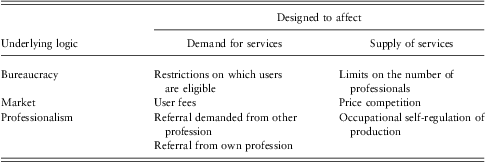
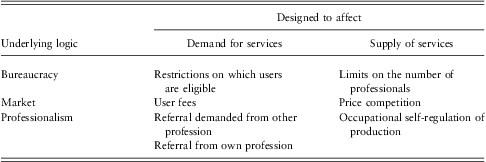
Third, direct state regulation refers to regulation whereby the authority to regulate rests on legislation, and public servants (typically public employees) make the rules and implement them (Moran and Wood, Reference Moran and Wood1993: 23). It need not, however, be a hierarchical command implemented through the bureaucracy (the traditional bureaucratic cost containment); state regulation may also use a price mechanism (economic cost containment). A user fee is very different from limitations in producer licences administrated by the bureaucracy. The authority rests on legislation in both cases but is based on different logics. If categorising state-sanctioned self-regulation and regulation by another profession as based on a professional logic, the relevant distinction is between the logics of market, bureaucracy and professionalism. This distinction is well known from the literature (e.g. Freidson, Reference Freidson2001) but has primarily been used to analyse related concepts, such as the governance of medical performance. Table 1 provides examples of cost containment measures classified according to (1) the logic behind them and (2) the intent behind them in terms of effects on supply or demand.
Examples of types of cost containment measures after their intended effect and underlying logic
The question is why the use of these types of cost containment measures varies between countries in similar structural situations. The choice of cost containment can be seen as a bargaining process, reflecting the fact that politicians need electoral support to be re-elected (Downs, Reference Downs1960; Horn, Reference Horn1995: 10). Furthermore, politicians cannot be fully informed about health care services, because producing them requires specialised, theoretical knowledge which can seldom be codified and is therefore very difficult to control (Freidson, Reference Freidson2001). This makes for an information and knowledge asymmetry between the relevant profession and the rest of society.
Given that health care provision is difficult to control, the public (and the politicians) may make an implicit bargain with the relevant profession in which the profession promises to keep its house in order by upholding certain standards and, accordingly, is granted higher status and pecuniary rewards (Roberts and Dietrich, Reference Roberts and Dietrich1999: 989). In line with this, Donabedian (Reference Donabedian1995) sees society's use of professional self-regulation as a way to handle situations with a high specificity of human capital (knowledge and skills). The problem is, however, that a person outside the profession does not know exactly how high this specificity is and how it relates to the knowledge and skills of other professions. Health care jurisdictions (the authority to make decisions and deliver services within a defined area of responsibility) are therefore often handled by the professions themselves (Freidson, Reference Freidson2001: 56). Professionalisation can be seen as “a strategy pursued to defend occupational interests, involving the ‘closure’ of the occupation from market competition” (Moran, Reference Moran1999: 7), although professionals are hardly only self-interested power maximisers (Le Grand, Reference Le Grand2003; Andersen, Reference Andersen2009). In any case, they are expected to try to avoid cost containment measures for the profession's own services (if necessary, by having the costs of other services contained).
Professional status is highly relevant in this connection because it is an asset in negotiations between professions and between a profession and the state. It can be seen as the degree to which the public perceives an occupation to have theoretical, specialised knowledge and intra-occupational standards (i.e. professional norms) (Andersen, Reference Andersen2009: 82). According to the neo-Weberian approach, the professions have historically used their status to establish a market shelter and gain status, privilege and legal protection (Johnson, Reference Johnson1972; Larson, Reference Larson1977), and the role of the professions has been shaped by “the particular configuration of countervailing institutional powers” (Hafferty and Light, Reference Hafferty and Light1995: 135). The institutional sociology of professions (Burrage and Thorstendahl, Reference Burrage and Torstendahl1990; Johnson et al., Reference Johnson, Larkin and Saks1995; Hellberg et al., Reference Hellberg, Saks and Benoit1999; DeVries et al., Reference DeVries, Benoit, Van Teijlingen and Wrede2001) in particular emphasises the need to analyse how power is distributed among actors in specific and often uneven ways, and the relative professional status of the professions in question is central here, given that different professions must split the ‘health care pie’. A profession can ensure that other services do not squeeze out their own service if they obtain the right to control the other professions’ services. Professional power, state-profession relations and trust between the state and profession may be seen as antecedents of an occupation's professional status relative to other health occupations in the country. A higher absolute professional power, good state-profession relations and a high level of trust for a given profession thus contribute to a high relative professional status. In this sense, the article also draws upon existing literature on cost containment and state-profession relations (Kuhlmann and Allsop, Reference Kuhlmann and Allsop2008; Kuhlmann et al., Reference Kuhlmann, Allsop and Saks2009).
Few cost containment measures are expected for a profession with high status relative to other health occupations in the same country because the public recognises the profession's norms and knowledge as a resource in relation to both politicians and other professions. It can simply use its credibility to argue that bureaucratic and economic cost containment is harmful and that no other profession should regulate the services. If, on the other hand, a service is produced by a profession with low relative status, higher ranking professions can contradict its claim about the harmfulness of cost containment measures. Furthermore, on the question of another profession acting as a gatekeeper, this will also be more acceptable for the public if they see this profession as having more specialised knowledge and stricter norms. The main expectation is therefore that the costs of services produced by professions with high relative professional status are less contained by bureaucratic and economic cost containment measures and less regulated by other professions compared to services produced by professions with lower relative professional status. After a short description of the health care systems in Denmark and Norway, relative professional status and cost containment measures are compared, allowing us to analyse whether the expectation holds for the occupations in these two countries.
Health care in Denmark and Norway
Denmark and Norway are compared for two reasons. First, the relative professional status of the health professions differs between the countries due to the different positions of their medical professions. Second, most of the other relevant variables influencing cost containment measures do not vary.
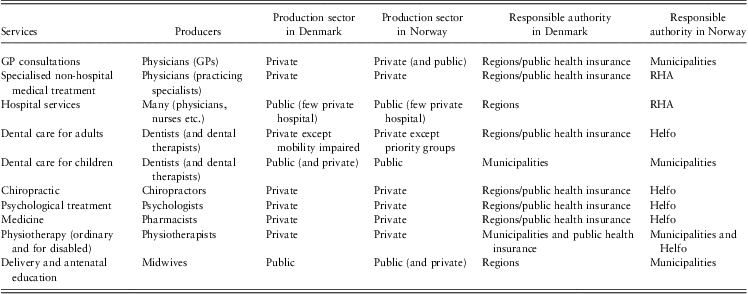
In both Norway and Denmark, health care began with health insurance associations for ‘persons with limited means’ (Hansen, Reference Hansen1974; Erichsen, Reference Erichsen1996a: 231), and in both countries, membership gradually became obligatory for the whole population until it was finally transformed into public health insurance. Norway was the first country to introduce obligatory health insurance (in 1909), but the two countries are now very similar, both in terms of structural factors and health care systems. Both systems are based on the principle of universal, free and equal access to health services, and the health care system is organised at the national, regional and local levels. The health care sectors in both countries are dominated by the public sector and primarily financed by local and state taxes. The percentages spent on health are approximately the same, and health care spending has gradually increased in both countries since 1998 (Johnsen, Reference Johnsen2006: 32–34; Strandberg-Larsen et al., Reference Strandberg-Larsen, Nielsen, Vallgårda, Krasnik and Vrangbæk2007: 65–67). The technological development and demographic structures are also very similar, although Norway has a higher GDP per capita than Denmark due to its petroleum revenue (International Monetary Fund, 2010), but much of this revenue is placed in the Government Petroleum Fund. The age profiles in the two countries are also almost identical (City and Guilds Centre for Skills Development, 2010). The formal structure of the health care systems is also very similar (Hagen and Vrangbæk, Reference Hagen and Vrangbæk2009: 107). Private, for-profit agencies play a subordinate role in both health care systems, although their significance is increasing (Grimmeisen and Rothgang, Reference Grimmeisen and Rothgang2004). Overviews of the responsible authorities, the production sector and the producers of health care services in the two countries can be found in Table 2.
Services in the Danish and Norwegian Health Care Systems

RHA = Regional Health Authorities; Helfo = Norwegian Health Economics Administration.
Note: The municipalities are responsible for physiotherapy for disabled patients, while regions (via the public health insurance) are responsible for ordinary physiotherapy patients.
Relative professional status in Denmark and Norway
‘Absolute professional status’ is seen as the degree to which the general public perceive an occupation to have strict professional norms and highly specialised, theoretical knowledge. ‘Relative professional status’ is this recognition of norms and knowledge relative to other professions with bordering jurisdictions. Both concepts can be difficult to separate empirically from the organisation of health care in general and cost containment measures in particular, and the concepts are dynamically associated over time. For example, when medical authority was eroded in most Western countries in the 1980s (Starr, Reference Starr1982: 383), the organisation of health care changed, and health care policy shifted from concerns of access to cost control, shaking the professional power (Light, Reference Light1993: 283). Because of these dynamics over time, the study draws on both existing studies of the longitudinal development in cost containment measures and professional status and provides a snapshot of professional status and cost containment measures at a given time (2009–2010) using an alternative methodology to supplement the existing studies.
The diversity (and diverging interests) within different professions could be argued to be greater than between professions. For example, physicians in particular specialties could be more interested in good conditions for their specialty area than in general conditions for their own profession. In Denmark and Norway, the only within-profession differences in cost containment related to specialty are found between hospitals and practitioners and between general practitioners (GPs) and all other specialties. Hospital physicians, GPs and specialists are therefore investigated separately. Still, given that physicians are together in one interest organisation in both Denmark and Norway, they are expected to work together in relation to cost containment.
The snapshot of professional status is taken by analysing the media coverage of psychologists, pharmacists, dentists, physiotherapists, chiropractors, midwives and the mentioned groups of physicians. The criterion for the selection of articles was that they had to be part of LexisNexis, an international supplier of media searches. We sampled 20 articles in each country for each of the nine professions, simply selecting the most recent articles before 1 February 2009 if they included the name of the relevant profession and were not totally irrelevant to the public's perception of this occupation (meaning that the articles should be about the profession or the services it produces). The total number of coded articles was thus 360. The articles were categorised as (1) strongly presuming norms and/or specialised knowledge, (2) presuming norms and/or specialised knowledge, but not unambiguously, (3) neutral, (4) presuming (but not unambiguously) that neither norms nor specialised, theoretical knowledge existed for the profession in question, and (5) strongly presuming that neither norms nor specialised, theoretical knowledge existed for the relevant profession. In other words, we measured perceptions of norms and specialised occupational knowledge by coding how actors outside the occupation write about them. A strong assumption about the existence of either norm or knowledge (if the other was not mentioned) was enough to categorise the news article as indicating high professional status. We did not find any articles which assumed specialised knowledge while at the same time assuming that no professional norms existed (or the opposite). All articles were coded separately by three persons (two students and the author), and the final coding (if the coding was dissimilar) was determined on the basis of a weighted average, considering the arguments that were behind the chosen coding. At least two coders agreed with the final code for 90.6% of the articles. The media articles and the three persons’ coding of them are available on request (827 pages).
Physicians
Physicians have traditionally exercised “authority over patients, their fellow workers in health care, and even the public at large” (Starr, Reference Starr1982: 5), and this has also been the case in Denmark and Norway, especially in the mid-1900s (Byrkjeflot and Neby, Reference Byrkjeflot and Neby2008: 337). In both countries, the period with very strong medical dominance ended around 1970, when both countries experienced rising costs and public criticism of the medical profession (Jespersen and Wrede, Reference Jespersen and Wrede2009: 170–171). The developments in the two countries in the 1970s and 1980s were parallel; both countries left the problems with prioritisation and efficiency to the counties, and the medical profession in both countries had to share management with nurses and general managers in the late 1980s (Jespersen and Wrede, Reference Jespersen and Wrede2009: 171). The introduction of a managerial logic has generally been slower in Denmark than in Norway (Byrkjeflot and Neby, Reference Byrkjeflot and Neby2004: 13; Jespersen and Wrede, Reference Jespersen and Wrede2009: 172). Concerning medical practitioners, the Danish GPs and specialists are private in the sense that their clinics are privately owned and they are not part of a public hierarchy (although, as shown later, their services are almost 100% publicly financed). The lower degree of urbanisation in Norway has meant that public employment was (and still is) necessary to ensure the income of some Norwegian medical practitioners. While Danes have long had a personal GP, this was first introduced in 2001 in Norway as part of the GP scheme whereby many (but not all) Norwegian GPs became self-employed contractors (Häkkinen and Jonsson, Reference Häkkinen and Jonsson2009: 210). This might be one of the reasons why the literature (Vrangbæk and Christiansen, Reference Vrangbæk and Christiansen2005: 35; Strandberg-Larsen et al., Reference Strandberg-Larsen, Nielsen, Vallgårda, Krasnik and Vrangbæk2007: 23, 92; Jespersen and Wrede, Reference Jespersen and Wrede2009) suggests that physicians’ relative status is higher in Denmark.
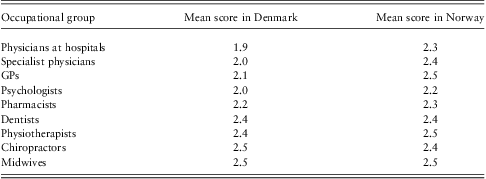
This is consistent with the snapshot of professional status (based on media articles). On a five-point scale, 1 denoting the maximum professional status and 5 the minimum professional status, Danish hospital physicians for example receive an average of 1.9, while the corresponding average for their Norwegian peers is 2.3 (see Table 3). It can be discussed whether this is a substantially interesting difference or whether it could be coincidental. The difference is consistent for all three types of investigated physicians and large compared to the differences between occupations within the two countries, but the coding of the articles is necessarily subjective. Still, both the existing literature and the media coverage indicate that the medical profession holds a stronger position in Denmark than in Norway.
Professional status of Danish and Norwegian health professions and sub-professions
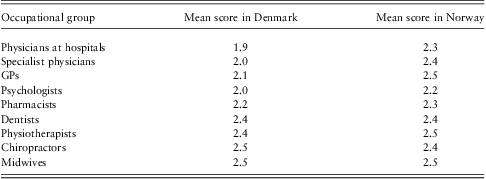
Note: The coding was based on 20 articles about each occupation in each country, i.e., 360 articles. 1 denotes maximum professional status, 5 denotes minimum professional status.
Non-medical professions
Historically, Danish and Norwegian physiotherapists have followed rather similar paths. In Denmark, a so-called massage committee with physicians (who had the majority) and physiotherapists decided how the two occupations should work together (Danske Fysioterapeuter, 1993: 11). This collaboration with (or rather subjection to) the physicians bore fruit; agreements with health insurance associations were signed in 1922 (Hansen, Reference Hansen1974: 163–164), and a collective agreement with all of the health insurance associations was signed in 1940 (Danske Fysioterapeuter, 1993: 13). While Danish physiotherapists were initially seen as mere masseurs (Hansen, Reference Hansen1974), they now enjoy medium professional status (Diepeveen, Reference Diepeveen1998). In Norway, physiotherapy has also historically been subordinate to the medical profession (Berg, Reference Berg1987), and the only important difference from Denmark is that the Norwegian physiotherapists have succeeded in receiving recognition for a supplementary education (manuellterapeut). Still, given that physiotherapy has also become an academic discipline in Denmark, the professional status cannot be said to vary between the countries. This is confirmed by the media analysis (Table 3).
The Danish and Norwegian midwives formed organisations in the first decade of the 20th century (Cliff, Reference Cliff2002: 66), and their primary objective was for maternal care to be free for everyone and to improve working conditions and salary. In both countries, the midwives obtained an agreement to share the field of childbirth with the physicians because the physicians benefitted from delegating normal births to the midwives, but the midwives’ professional status still suffered from the fact that their knowledge was seen as less specialised than obstetricians and gynaecologists (Kjølsrød, Reference Kjølsrød1993: 127–129, 136–137; Cliff, Reference Cliff2002: 194). The midwives accepted being subordinate to the physicians and received their own niche. Kjølsrød (Reference Kjølsrød1993: 274) concludes that Norwegian midwives have lost status over time but that this happened equally to physicians, indicating that the relative professional status has been constant over time.
When chiropractic was first introduced in Denmark in the beginning of the 20th century, the chiropractors would not submit to the physicians, who therefore resisted the subsidisation of chiropractic services (Fohlmann, Reference Fohlmann1970: 29, 39–40; Gaarde, Reference Gaarde1995: 13–14). The chiropractic profession was established slightly later in Norway, and they were not as confrontational as their Danish peers, resulting in acceptance into the public health insurance system in 1974 under the authority of the physicians (Norsk Kiropraktorforening, 2010). The Norwegian chiropractors were regulated by the so-called quack legislation until 1979, and they had lower professional status than their Danish peers in this period. Now, they seem to have approximately the same status, as also reflected in the media analysis (Table 3).
In both Norway and Denmark, the dental profession was established outside the medical profession in the late 19th century, and the dentists succeeded in establishing clear borders to the physicians and avoid becoming their subordinates (Erichsen, Reference Erichsen1996a: 228, 235–236; Mikkelsen and Østergaard, Reference Mikkelsen and Østergaard1998). The dentists in both countries have historically had similarly high professional status, and the media analysis (Table 3) indicates that this is still the case.
The pharmacists formed associations in Denmark in 1844 (Kruse and Møller, Reference Kruse and Møller2001: 51) and Norway in 1881. During the first half of the 20th century, the pharmacists enjoyed high professional status in both countries, possibly because of their exclusive right to prepare and sell medicine (Sverre, Reference Sverre1982; Kruse and Møller, Reference Kruse and Møller2001: 30–33). Nevertheless, the recognition of their knowledge and norms was lower than that of physicians, and it has gradually fallen further in both countries, possibly because medicine is now produced in factories. Additionally, the pharmacy system was liberalised in both Norway and Denmark in 2001 (Martinussen and Magnussen, Reference Martinussen and Magnussen2009: 28, 30). The liberalisation was more drastic in Norway than in Denmark, as Danish pharmacies continue to hold a monopoly except for basic non-prescription drugs (Hamran, Reference Hamran2010).
One of the most recent health care professions in both countries is psychologists. They were not organised until 1934 in Norway (Hofgaard, Reference Hofgaard2009) and 1947 in Denmark (Bratbo, Reference Bratbo1997). Furthermore, the relationship between psychologists and physicians has been characterised by demarcation disputes, and psychologists have traditionally had lower professional status than psychiatrists, especially until 1970 (Berntsen, Reference Berntsen1982; Florander, Reference Florander1982; Hernes, Reference Hernes1996: 154, 163; Bratbo, Reference Bratbo1997; Kringlen, Reference Kringlen2007). The establishment of the Norwegian–Danish Association of Psychoanalysts in 1934 was the starting point of a more offensive strategy (Hernes, Reference Hernes1996: 154), and other important junctions were when the psychiatrists and psychologists in both countries agreed in the 1950s on a division of labour according to which psychologists were allowed to provide services under the authority of psychiatrists (Berntsen, Reference Berntsen1982; Hernes, Reference Hernes1996: 163). The psychologists in both countries challenged the psychiatrists in the late 1970s and began increasing their professional status relative to the medical profession (Bratbo, Reference Bratbo1997; Kringlen, Reference Kringlen2007). There is no indication of a difference in status between the countries, and the media analysis reveals a surprisingly high level of status in both countries (Table 3). This may be because the education is university based and demands high grade point averages or because people generally do not differentiate between psychologists and psychiatrists.
Relative professional status is more equal in Norway than Denmark, because Danish physicians have a higher status than the other Danish professions (except psychologists). Following the theoretical argument in the article, this implies that Danish physicians (compared to their Norwegian peers) should be better able to (1) avoid cost containment measures for their own services, (2) obtain the right to regulate other professions than themselves, and (3) ensure that the costs of services produced by others are contained by bureaucratic and economic measures. The expectations are as follows:
• Services produced by physicians (and psychologists) are less regulated by economic and bureaucratic cost containment measures and less regulated by other professions in Denmark than in Norway.
• Services produced by professions other than physicians (and psychologists) are less regulated by economic and bureaucratic cost containment measures and less regulated by the medical profession in Norway than in Denmark.
The next two sections discuss empirical evidence regarding the existing cost containment measures in Denmark and Norway and the relationship between relative professional status and cost containment measures, combining the overview of existing cost containment measures with historical evidence on cost containment measures and relative professional status.
Contemporary cost containment measures in Denmark and Norway
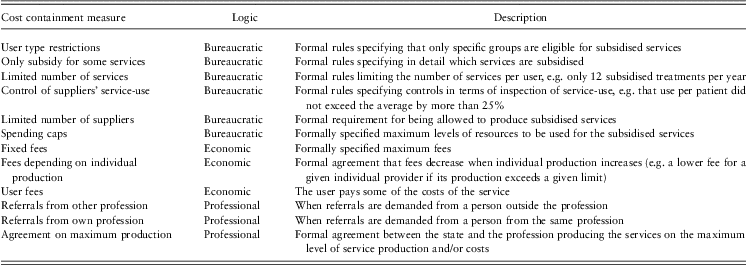
Before going into detail with the different types of cost containment measures (described in Table 4), it should be noted that while cost containment measures normally target individual professionals (or small practices), it can be up to organisations (e.g. hospital management) to determine how cost containment measures are translated into regulation of organisational units – and ultimately individual professionals. This can be important for the mechanisms behind the way professional status affects cost containment (as discussed below), but the net effects are expected to be similar for direct and indirect cost containment. In this article, it is unproblematic, given that at least one service type per occupation is delivered by individual professionals/small practices.
Investigated cost containment measures
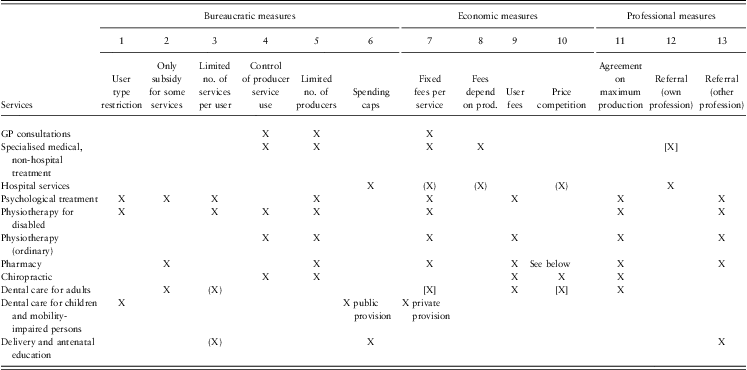
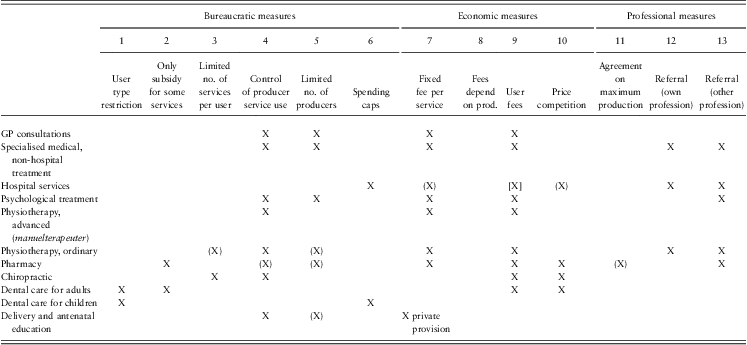
The use of bureaucratic cost containment measures (columns 1–6 in Tables 5 and 6) for physicians (rows 1–3) is very similar for the two countries, but they differ when it comes to economic measures (columns 7–10 in Tables 5 and 6). The Danish users are not charged for physician services, whereas Norwegians must pay for GP consultations, specialised medical treatment outside hospitals and some hospital services (column 9 in Tables 5 and 6). The user fees are not high, but having to pay at all can make a difference. On the other hand, the Danish payments to specialists (and hospitals in two of the five regions) depend on how many health services they produce. This runs contrary to the expectation, whereas the difference in user fees for physician services is consistent with the expectation, given the lower relative professional status of physicians in Norway. For both countries, hierarchical and especially economic cost containment measures are more indirect for hospital physicians than for GPs and practicing specialists. It takes place at the hospital level, not via the regulation of each physician, creating a more complex situation with interaction across governance levels and negotiations between hospitals and regional administrations as the basis for determining cost containment. Many hospitals also operate under a scheme according to which the reimbursement rate is reduced once a given threshold level is reached. Occupations with high relative status (especially physicians) are represented in the hospital management in both countries, deciding the allocation of resources to different types of hospital services, and although the relationship between relative professional status and cost containment is more complex for hospitals than the other investigated services, this applies to both countries.
Cost containment measures for Danish services
Notes: The shaded services are (dominantly) produced in the public sector. An X indicates that the cost containment measure is used for the service. (X) indicates very limited use. [X] indicates that the measure is used for some subservices but not all of them. There is price competition on the production of medicine, but not the distribution (for pharmacies). Bureaucratic measures are hierarchical command/rules implemented through the bureaucracy; economic measures use the price mechanism, and professional measures are self-regulation, state-sanctioned self-regulation and regulation by another profession.
Cost containment measures for Norwegian services
Notes: The shaded services are (dominantly) produced in the public sector. An X indicates that the cost containment measure is used for the service. (X) indicates very limited use. [X] indicates that the measure is used for some subservices but not all of them. Bureaucratic measures are hierarchical command/rules implemented through the bureaucracy; economic measures use the price mechanism, and professional measures are self-regulation, state-sanctioned self-regulation and regulation by another profession.
When it comes to regulation from other professions (column 13 in Tables 5 and 6), Norwegian physicians also have more cost containment measures than their Danish peers. In Norway, two other professions (chiropractors and advanced physiotherapists) have the right to make referrals to medical services (specialists and hospitals), and chiropractors and manual therapists can issue sick notes for 12-week periods. Although other physicians can also refer to these services (column 12 in Table 6), cost containment for the Norwegian medical profession relies less on state-sanctioned self-regulation than in Denmark. Taken together, evidence, as expected, shows that fewer and weaker economic and bureaucratic cost containment measures exist for services produced by physicians in Denmark than in Norway.
The expectations concerning the psychologists were, as mentioned, uncertain because their relative professional status has increased, and it was unclear whether cost containment measures had changed accordingly. Tables 5 and 6 (row 4) indicate that they are regulated as much as the other non-medical professions and that Danish psychologists are regulated more than Norwegian psychologists.
Bureaucratic cost containment measures (columns 1–6 in Tables 5 and 6) for the rest of the non-medical health care professions (rows 5–11) do not differ systematically between Norway and Denmark. The same is true for economic cost containment measures, which are almost similar in the two countries for non-medical professions (columns 7–10 in Tables 5 and 6). When it comes to regulation from the medical profession, there is a difference. Fewer services in Norway demand referrals from physicians, and advanced physiotherapists (manuellterapeuter) have the right to make referrals to other physiotherapists (columns 12–13 in Tables 5 and 6). Contrary to Denmark, delivery and antenatal education does not require a referral in Norway, nor does physiotherapy if the provider has the additional education as a manual therapist. The most striking difference in professional cost containment of services produced by non-medical professions is, however, that Denmark uses agreements between the state and non-medical professions concerning the maximum costs of all services much more than Norway (column 11 in Tables 5 and 6). Except for the publicly produced services (and physician-produced services), all Danish health care professions have had to agree to collectively uphold a maximum spending limit. Otherwise, the fees will decrease. These agreements are written as protocols in the formal agreements between the relevant professional associations and the committee representing the sponsor bodies. For example, the wording in the agreement with the physiotherapists is as follows (author's translation):
The parties [of the agreement] agree that the annual costs must be held at DKK 295,989,000 (2006 levels)…The cost development is monitored by the parties annually…[and if costs exceed this amount] the cooperation committee must evaluate whether this is due to the changed patient characteristics or changes in physiotherapist behaviour…if costs exceed the specified amount, the fees for all services are reduced, unless the parties agree to something else (Regionernes Lønnings- og Takstnævn and Danske Fysioterapeuter, 2008).
The fact that so many non-medical health professions had to agree to contain their own costs very rigidly in Denmark while only the pharmacists in Norway had to do so is consistent with the expectations. Although the findings confirm that non-medical health care professions are less regulated by the medical profession in Norway than in Denmark, there is no systematic difference in the use of economic and bureaucratic cost containment measures. The most striking difference is the consistent use of strict agreements between the state and the relevant non-medical profession (with economic consequences) concerning the collective use of services. Although this is (formally) state-sanctioned self-regulation, it is very close to being direct state regulation.
Discussion: relative professional status and cost containment measures
The comparison of contemporary cost containment measures in Denmark and Norway raises at least two questions. First, can the differences between cost containment measures between the countries be linked to differences in relative professional status, or are these differences historically due to other factors? Second, what does the development of a new profession with high professional status (the psychologists) teach us about the relationship between relative professional status and cost containment measures? The four main differences between Norway and Denmark (identified above) are all consistent with a relationship between relative professional status and cost containment measures:
• Two non-medical professions have the right to make referrals to medical services in Norway, while this is not found in Denmark.
• Fewer services in Norway demand referrals from physicians, and advanced physiotherapists have the right to make referrals to other physiotherapists.
• Denmark, to a much higher degree than Norway, uses agreements between the state and non-medical professions concerning the maximum costs of all services produced by the profession.
• User fees are imposed on services produced by physicians in Norway but not in Denmark.
Historically, the requirement for physician referrals for manual therapists and chiropractors was recently removed in Norway (as an experiment in 1998 and permanently in 2006), and the committee hearing stated then, among other things, that the chiropractors’ education makes them the most highly specialised occupation concerning muscular and skeletal maladies, and the committee majority found that this resource should have an opportunity to function without referrals from physicians (the proposal, debate and final legislation can be seen at: http://www.stortinget.no/no/Saker-og-publikasjoner/Saker/Sak/?p=16719). Similarly, the debates concerning the right of Norwegian non-medical professions to make referrals to medical services also indicate that the professions’ absolute and relative professional status played a key role. The proposers justified that chiropractors should have the right to refer to physicians (specialists) in the following way (author's translation):
As a consequence of the professional competence of the chiropractors…we ought to establish an experimental arrangement according to which they can be given the opportunity to…refer to medical specialists (Stortinget, 1999).
Concerning agreements between the state and non-medical professions about maximum total production, the fact that physicians in Denmark do not have these arrangements while they can be found for all Danish non-medical professions (but not for Danish services produced by physicians) is consistent with an association with professional status. The decision making concerning these cost containment measures are less open, but available sources indicate that non-medical professions (especially physiotherapists) have tried to change these arrangements without succeeding, and media coverage suggests that they might have succeeded if they had had a higher relative professional status. A typical news article says that “the agreement ensures that the patients are not over-treated. If this happens, the fees are adjusted” (dknyt, 2009, author's translation). The physiotherapists are not seen as experts who ensure that patients receive the professionally correct treatment.
Another question is whether the less strict cost containment measures in Norway could be due to differences between Denmark and Norway other than different relative professional status. GDP per capita is, as mentioned, higher in Norway due to its petroleum revenue, but cost containment is actually stricter in Norway than in Denmark concerning the user fees for services produced by physicians. Norwegian user fees were part of the National Insurance Act from 1967 and the Local Health Care Act from 1984 (Rikstrygdeverket Prosjektgruppen for Ny folketrygdlov, 1997; European Observatory on Health Care Systems, 2000: 22–23). The Norwegian physicians, as mentioned, had a close relationship with the state until the 1970s, and the system was very hospital centred (Erichsen, Reference Erichsen1996b: 91–92), but these bonds were loosened around 1980. The physicians generally played a reactive role during the transformation, hindering restrictions on private practices rather than suggesting new solutions (Erichsen, Reference Erichsen1996b: 99–101). In Denmark, the physicians succeeded in obtaining a state subsidy for specialist services in 1963, making these services free of user charge (Hansen, Reference Hansen1974: 199, 228), and in the debate concerning the Danish National Insurance Act from 1971, nobody seriously questioned that medical services should be fully financed by the state even though GP and specialist services were produced in the private sector (F.a.y.L.'s praksisudvalg, 1971). User fees for medical services have been discussed in Denmark from time to time but have always been rejected.
Conclusion
The existing literature indicates that the medical profession in Norway has a lower relative professional status than in Denmark. Accordingly, weaker cost containment measures were expected for services produced by Danish physicians than services produced by Norwegian physicians, while, on the other hand, the expectation was weaker cost containment measures for Norwegian non-medical professions than for their Danish equivalents.
Although there are exceptions, most of the empirical evidence supports the expectations. In Norway, the users are charged for services produced by physicians, but this is not the case in Denmark, and Danish physicians have had more of a monopoly on the right to make referrals both to their own services and to services produced by non-medical professions. Danish non-medical professions also differ from their Norwegian peers in being much more firmly regulated by occupational agreements about maximum production. Although this is (formally) state-sanctioned self-regulation, it is close to state-regulation because the (fixed) fees are reduced if total costs exceed a given limit. The major exception from the tendency to relatively greater cost containment for Norwegian physicians and relatively less cost containment for Norwegian non-medical professions is that, in Denmark, the fees for medical non-hospital specialists depend on production.
These findings are based on historical evidence, formal rules, existing studies and a systematic coding of media articles. The last mentioned data source involves some uncertainty related to happenstance in what occupations the media focused on in the investigated period, and it would be relevant for future research to supplement with other methods for assessing the relative professional status and to follow the occupations more systematically over time to relate changes in their professional status to future changes in cost containment.
It would be useful to bring in more cases with different health care systems. Both Denmark and Norway are universal welfare states, and their structural situations are similar, limiting the generalisability. Politicians outside Scandinavia may also trust the professions less than Danish and Norwegian politicians (and the public in these countries) do, meaning that the absolute professional status is lower. This may mean that relative professional status is less important than the other determinants of cost containment measures. Future research may especially benefit from including countries with social and private health insurance and National Health Service systems. Still, some of the identified theoretical relationships in this article can be relevant for other health care systems. First, the Danish case shows that state-sanctioned self-regulation can be harsh and backed up on the aggregate level by the threat of economic cost containment. Second, the choice between (1) spending caps, (2) fixed fees and bureaucratic cost containment and (3) market-style cost containment with high user fees and price competition can be seen as the difference between a public integrated solution, a private bureaucratically controlled solution, and a private market-based solution relying on the price mechanism. Third, relative professional status seems to be relevant for the use of service-specific cost containment measures.
Acknowledgements
The author would like to express my gratitude towards participants in EGPA study group III and members of the Public Administration at the Department of Political Science, Aarhus University for their comments and suggestions which contributed greatly to this project.