Introduction
Conscription was implemented in Japan in 1873, and the Japanese army treated people as a consumable resource for the war machine and aimed to prepare enough “stock” to supply skilled privates for the war effort.Footnote 1 An inevitable and visible byproduct of conscription was the families of deceased soldiers and disabled veterans and their families. However, until the Second Sino-Japanese War, the government provided little support for those with post-war injuries or disease. This was due to two main factors. First, because conscription was a type of tax, the government believed they were under no obligation to compensate deceased soldiers' families or disabled veterans and their families. Second, the government relied on the Japanese ideal of goodwill and community spirit to support bereaved kin and disabled veterans and their families.Footnote 2
However, by the start of the Second Sino-Japanese War, which was the first stage of World War II (WWII) for Japan, the government and the people could no longer neglect the problem of support for deceased soldiers' families and disabled veterans and their families.Footnote 3
This paper aimed to determine whether the support scheme implemented in 1938 was adequate for improving the living standards of disabled veterans and their families during a prolonged large-scale war. Pennington has carried out a comprehensive study of support, rehabilitation, and vocational training provided to disabled veterans in Japan during WWII.Footnote 4 This study builds on Pennington's study by using official documents to trace the lives of disabled veterans and their families in a village over time, and to examine more deeply how military aid supported their lives.
Materials and methods
This study investigated the histories of disabled veterans and their families living in a small village in Japan by reviewing historical documents, which are administrative documents Hi Shōwa 13 Nen Yori Shōwa 15 Nen ni Itaru Shōi Gunjin Kankei Tsuzuri Gōmura Yakuba 秘自昭和13 年至昭和15 年傷痍軍人関係綴郷村役場 (Confidential: File concerning disabled veterans from 1938 to 1940, Public Office of Gōmura) and Hi Shōwa 16 Nen Yori Shōi Gunjin Kankei Ikken Gōmura Yakuba 秘自昭和 16 年傷痍軍人関係一件郷村役場 (Confidential: Cases concerning disabled veterans from 1941, Public Office of Gōmura) concerning disabled veterans in a village in order to determine how disabled veterans and their families used support within an organized military support.Footnote 5 Gōmura 郷村 was located in the northern part of Kyoto Prefecture. In 1935, the total population of Gōmura was 2,048, of whom 1,042 were men, and the townspeople earned their incomes primarily from farming and weaving.Footnote 6 Although this is a case study, as many active frontline soldiers came from farming towns, it can be assumed to apply to the lives of many disabled veterans and their families in wartime Japan.
Both documents mainly consist of various types of documents that the disabled veterans of Gōmura submitted to the village office in order to receive military support, as well as the surveys conducted by the village office on the lives and employment of the disabled veterans. Disabled veterans submitted applications for public assistance to municipal public offices where they were legally domiciled. Most applications were for pensions and various kinds of assistance, likely coming from thirty-eight disabled veterans of Gōmura. Applications were received at the public office between 1938 and 1945. According to the circumstances in question, the documents also describe exchanges between the mayor of Gōmura, Kyoto Prefecture, and the regimental headquarters in Kyoto, which had both permit and license rights until each applicant received assistance. Pension applications included certificates signed by the director of a military hospital, an application form addressed to Naikaku Onkyūkyoku 内閣恩給局 (the Cabinet Pension Bureau), adjudication notifications and pension certificates prepared by the Cabinet Pension Bureau, and a history of departure from active service, evidence of injury, and evidence of discharge from hospital. These documents revealed the interval between hospital discharge and pension receipt, the type and degree of disability, and the grade and amount of pension received. Documents concerning public assistance revealed the type of assistance that each person applied for, employment after demobilization, and the state of life in his household, in chronological order. The degree of details varied between people, and the amount of information decreased over time. However, the documents indicated general trends in the lives of disabled veterans and their families in Gōmura during war.
From home to war
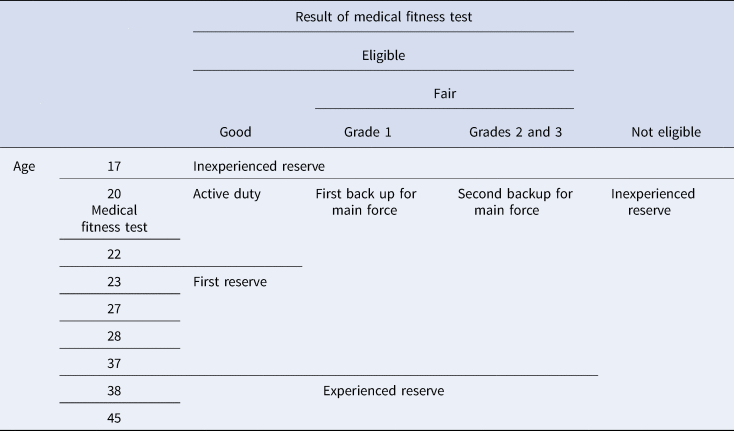
Table 1 shows conscription data until the end of 1943. At the age of 17, all Japanese men were placed in inexperienced reserves, which were under the control of the government and the last pool of personnel. Men who were 20 years old underwent the medical fitness test, which screened men's eligibility for military service, and were evaluated to determine whether they were “suitable” for service. Eligible men were classified in three categories based on their condition: “good” and two levels of “fair.” Men who were classified as “good” joined the army immediately and served for 2 years. After demobilization, they remained as the first reserve and could be returned to duty at any time. This group of men “on call” was one of the main forces of the army and was viewed the same as active soldiers in wartime. After that, they stayed in the second reserve and could be returned to duty until the age of 37, if necessary. Men between 38 and 40 years old were placed in the experienced reserve.
System of conscription in WWII (army, the end of 1943)

Source: Katō Reference Katō1996, pp. 211–62; Ōhama and Ozawa Reference Ōhama and Ozawa1984, pp. 24–45; Kuwata Reference Kuwata1940, pp. 2–3.
Men classified as grade 1 of “fair” were the first back up reserve for the main force, whereas those classified as grade 2 were the secondary reserve during wartime. Finally, men “unfit” for service were placed in the inexperienced reserve.
However, this system needed to be modified. The army, which was already at risk of enduring a prolonged war against China, had to also prepare for an imminent battle against the Soviet Union.Footnote 7 As such, out of necessity, they stretched the age brackets and loosened the definition of “fair” in March and November, 1939.Footnote 8 First, the army extended the term of duty of the “fair” category from 12 years to 17 years and put men in grade 2 in the experienced reserve. Then, grade 3 of “fair” was added and many “unfit” men according to previous standards became “fit” to become privates under the new rules.
After dismantling the second reserve and lengthening the first reserve to the age of 37 to increase the main core in February, 1941,Footnote 9 the age of retirement was pushed back from 40 to 45 in November, 1943.Footnote 10 The government implemented the medical fitness test not only for 20-year-olds, but also for 19-year-olds to obtain more recruits in 1944, and in 1945, the age for the medical fitness test was lowered from 20 to 19.Footnote 11 The army continued to extend and expand the conscription system to adapt to the war, which was rapidly worsening.
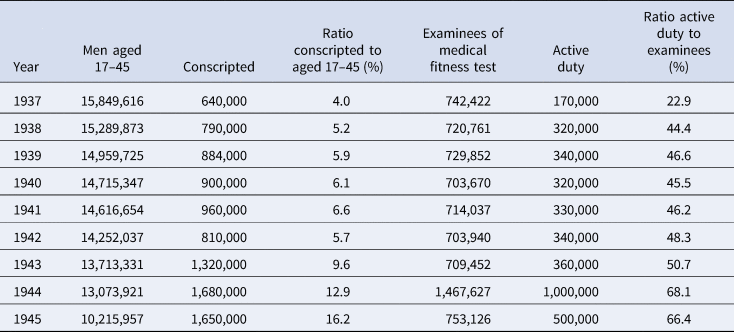
Table 2 shows the number of men fit for conscription and the number conscripted during WWII. The population of men aged 17–45 living in Japan in 1937 was 15,849,616; however, this shrank every year until 1945. Conversely, the number of conscripted men increased annually, growing from 5.7% in 1942 to 16.2% in 1945. The number of men on active duty, which was the core group of soldiers, also continued to increase. Moreover, the ratio of men on active duty rose dramatically from around 20% in 1937 to almost 70% in 1944 and 1945.
Number of men liable for conscription and number conscripted

Note: With regard to “Examinees of medical fitness test,” the age for taking the medical fitness test was the age of 20 until 1943. However, in 1944, males aged 19 and 20 both took it, and finally, in 1945, the age of examinees was lowered from 20 to 19 years.
Source: Ōe Reference Ōe1988, pp. 248–65.
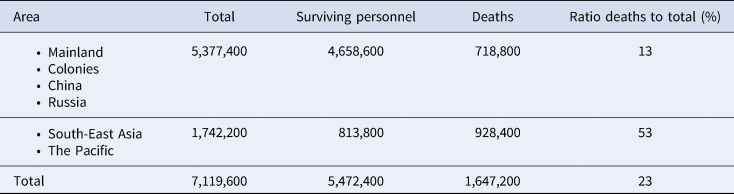
Table 3 indicates the results of mobilization, demonstrating that the army carried out root-and-branch mobilization through a scheme. However, this scheme was one reason why Japan continued to fight a hopeless war until its defeat. The army mobilized an estimated 7,119,600 men during WWII, with 5,377,400 deployed on the mainland and in the colonies, China, and Russia and 1,742,200 deployed to Southeast Asia and the Pacific arena. The proportion of deaths in 9 years represented 23% of the Japanese military force. In Southeast Asia and the Pacific, where many regiments were under fierce attack from U.S. forces until complete destruction, one in two servicemen died in battle, from disease, or from starvation.
Result of mobilization (army)

Note: (1) The number of the second column “Total” is estimated by adding the third “Surviving personnel” to the fourth “Deaths.”
(2) The third column shows the numbers at 15/8/1945, the fourth indicates the total number in WWII.
Source: Kuwata and Maehara Reference Kuwata and Maehara1982, p. 21 (Part 2: Materials of modern Japanese military history).
Findings of the advisory council on protection measures for disabled veterans
Before WWII, public relief for the bereaved kin of deceased soldiers and wounded soldiers and their families consisted mainly of (1) the payment of pensions and subsidies to ameliorate the economic loss resulting from the death of a breadwinner or war-related injuries and diseases, (2) standard of living assistance for family members left at home and bereaved kin, (3) publicly funded medical treatment for wounded or sick soldiers, (4) conferment of medals to wounded soldiers and bereaved kin to provide recognition, and (5) job guarantees during enlistment and after demobilization. However, this relief was insufficient. Furthermore, although the government was aware of dissatisfaction with existing policies, other than using the Pension Act of 1923 to increase benefits following the increase in prices of goods after World War I, no significant improvements were made to relief measures.Footnote 12 In addition, the government promoted mutual aid based on goodwill in regional communities, calling it “world-class Japanese morality,” and attempted to shift from public relief to voluntary military relief in regional communities.Footnote 13 The government assumed that the Japanese Citizens should voluntarily provide relief to families of soldiers who died in the war and to disabled veterans and their families.
However, during the Second Sino-Japanese War and the prolonged war that followed, the number of casualties increased drastically, making relief for bereaved kin and wounded soldiers and their families a pressing issue. In November 1937, the government created Rinjigunjiengobu 臨時軍事援護部 (the Provisional Military Support Division) in the Social Affairs Bureau of the Home Ministry as the first body with specific jurisdiction over relief projects.Footnote 14 This was the first time that the government considered a comprehensive relief program.
On January 11, 1938, the Ministry of Health and Welfare was established, and the Provisional Military Support Division was transferred from the Home Ministry to the Ministry of Health and Welfare. Shōigunjin hogo taisaku shingikai 傷痍軍人保護対策審議会 (the Advisory Council on Protection Measures for Disabled Veterans), which was organized on January 14, 1938 and consisted of government officials and professionals involved in disabled veterans affairs, debated a plan to support disabled veterans under the counsel of Health and Welfare Minister Kido Kōichi木戸幸一.Footnote 15 Kido argued that, due to the many deaths, injuries, and illnesses that occurred since the start of the Second Sino-Japanese War, it was particularly urgent to establish support measures for the numerous disabled veterans who would return to Japan. However, he noted that, as the issues were complex and wide-ranging, the council should establish support measures for disabled veterans that would be suitable for the future as well. Based on this advice, on January 17, the committee discussed principles under which the government should provide assistance to disabled veterans. A task force was established to discuss living support, including medical care and employment, as well as moral suasion campaigns that would improve the views of disabled veterans held by society and by disabled veterans themselves.Footnote 16
The committee members emphasized that the support was a mercy from the emperor's sovereign state, and that disabled veterans should be grateful for it and repay it. They believed that if the disabled veterans came to believe that it was their right to receive support, they would become overly dependent on it, and would not make an effort to regain independence. The committee's idea of disabled veteran assistance was to regard disabled veterans as Saiki 再起, who would return to work with gratitude for the nation after healing, and Hōkō 奉公, willingly devoting themselves to the home front again.Footnote 17
The committee suggested that the government should support the activities of the Dainippon Shōigunjinkai 大日本傷痍軍人会 (The Great Japan Disabled Veterans Association) as a form to encourage disabled veterans' Saiki hōkō.Footnote 18 The association was founded in November 1936. In September 1938, it became an incorporated foundation with the help of a grant from the Imperial Family, and was operated under the supervision of the Ministry of Health and Welfare, the Army, and the Navy. The head of the organization was a former army lieutenant general, Kaba Atsushi 蒲穆, who was himself a disabled veteran and a member of the task force of the committee.Footnote 19 The aim of the association was to maintain Gunjin Seishin 軍人精神 (a military spirit of overcoming hardships and fighting for the nation) and to renew the strong will to serve the home front again. The association conducted several programs, including support for bereaved kin and disabled veterans and their families and consultation with disabled veterans regarding their problems. Gunjin Seishin was essential for making them Saiki hōkō.
In addition, the stabilization of the lives of disabled veterans and their families through financial support from government was necessary to make them Saiki hōkō. The Ministry of Health and Welfare insisted on the compatibility of pensions and support programs and establishment of a government body with centralized jurisdiction over military relief. As long as pensions and support were traded off as they had been, disabled veterans who were hesitant to stop receiving pensions would not use support that they needed, impeding the functioning of the system. The Shōheiin 傷兵院 (the Wounded Soldiers Institute) was an example given by the Ministry of Health and Welfare.Footnote 20 When disabled veterans were admitted to the Shōheiin, their pensions were suspended, as government funds guaranteed their livelihood during their period of stay. However, as they worried about impoverishing their families if their pension was suspended, the number of admissions was much lower than the capacity. The Ministry of Health and Welfare worried that support may be ineffective. On the other hand, the Pension Bureau argued that suspension of pensions was justified, even if it impoverishes families of disabled veterans, as long as beneficiaries were taken care of by the government for the duration of assistance. The Pension Bureau proposed a large increase in the number of pensions and the creation of a financial institution for families of deceased soldiers and disabled veterans and their families. Furthermore, all committee members agreed with establishing state-led military relief, as war of unforeseen scale may have continued for a prolonged time period and the irregular voluntary relief by regional communities and private groups would be insufficient. The Ministry of Health and Welfare advocated positioning military assistance as a part of war expenditures.
Ultimately, these suggestions were incorporated into a report, and the bill was ratified at the 73rd Diet. First, the report specified that measures for disabled veterans were to be carried out separately from pension payments. Moreover, the number of pensions was also greatly increased, reducing the economic burden on the subjects of military relief. Second, the Ministry of Health and Welfare submitted a proposal for establishing a government body for providing relief. In April 1938, Shōhei Hogoin 傷兵保護院 (the Wounded Soldiers Protection Agency) was established as an organization under the direct jurisdiction of the Ministry of Health and Welfare to carry out long-term relief projects using the government budget. The following year, the Wounded Soldiers Protection Agency was renamed Gunji Hogoin 軍事保護院 (the Military Protection Agency) and started to handle standard of living subsidies in addition to medical and occupational support for disabled veterans and their families, families left at home, and bereaved kin, serving as the body that executed wartime military relief. In the early stages of WWII, a mechanism of Saiki hōkō 再起奉公 was established to encourage soldiers who were injured or contracted illnesses to further contribute to the state.
Daily lives of disabled veterans and their families
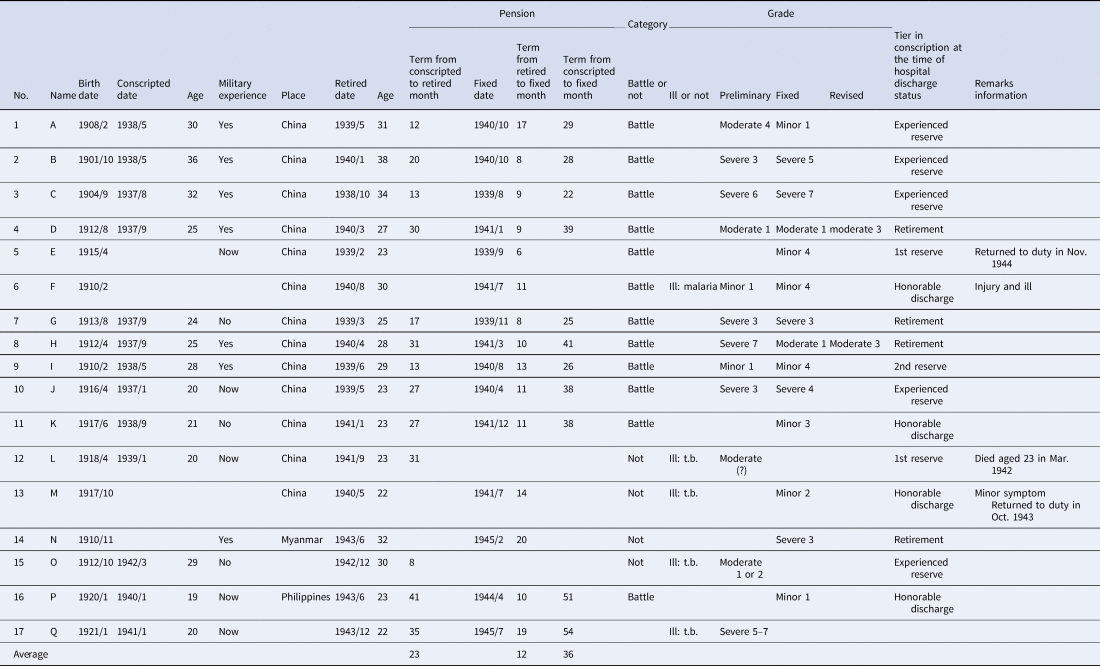
Table 4 shows the histories of seventeen of thirty-eight disabled veterans from Gōmura that can be analyzed in more detail.Footnote 21 Among the active frontline soldiers from Gōmura, E, J, L, P, and Q were active-duty soldiers, A, B, C, D, H, I, and N were on active duty in the past and were in the first or second reserves, whereas G, K, and O were in the “fair” category and had no military experience. This shows that A, B, and C, who, despite past military service, were older and less physically vigorous, were in the second reserve. Furthermore, G, K, and O, who were weaker physically than active-duty soldiers and had no military experience, were considered grade 2 “fair.” High-volume mobilization was already carried out from the beginning of the Second Sino-Japanese War.Footnote 22
History of disabled veterans from Gōmura

Note: To protect personal information, anonymity is used.
Source: Prepared by the author from Gōmura yakuba (a); Gōmura yakuba (b).
Active frontline soldiers were either injured or ill after an average of 12 months in the army and were transported back to Japan from frontline hospitals. They received treatment in an army hospital for an average of 12 months before discharge. Hospitals tentatively judged the severity of each soldier's injury or illness. In cases where hospitals judged that the severity had reached the level that entitled the soldier to a pension, they issued Onkyū mikomi shōmeisho 恩給見込証明書 (Certificate of prospective reception of a pension) signed by the director of the hospital when the patient was discharged. Furthermore, a Gennin shōmeisho 現認証明書 (On site confirmation certificate), validating the situation in which the soldier was wounded or fell ill, was prepared by the commander of the soldier's regiment. Finally, the pension was confirmed by a decision of the Cabinet Pension Bureau. A disabled veteran who received a certificate of prospective reception of a pension received his pension an average of 12 months after the date of his discharge from the hospital, or about 3 years after constriction.
A person who received the certificate at the time of discharge from the hospital was qualified to apply for government military assistance. Based on the pension decision, the person was officially declared a disabled veteran, which meant that he qualified as a disabled veteran under Pension Law. In many cases, the higher the level of injury or illness, the lower the likelihood of his recall to active duty. On the other hand, soldiers who were not issued a certificate of prospective reception of a pension, or who were issued the certificate but had mild symptoms at the time of discharge from hospital, were called honorably discharged people.Footnote 23
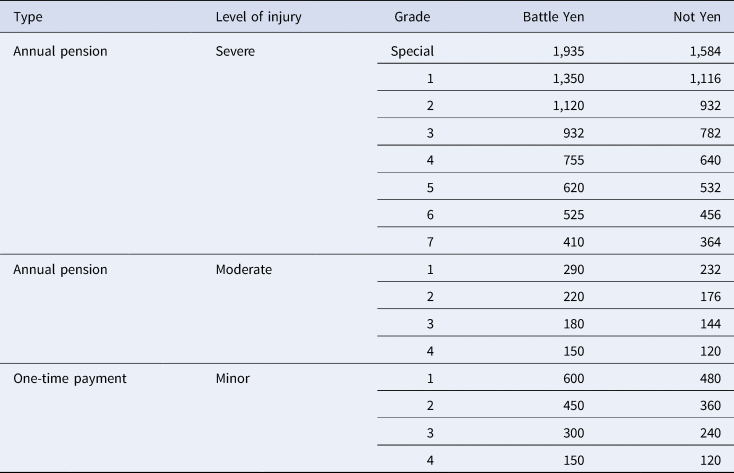
Table 5 shows the degree of injury or illness categories and the amount of pensions. There were two tracks based on the time of occurrence of the injury or illness. Thus, the benefits for injuries and illnesses suffered as a result of combat were higher than the benefits provided for injuries and illnesses that were not directly connected with combat, even if both were equally serious. Injuries and illnesses were categorized as “severe,” “moderate,” and “minor” based on their seriousness. Each category was further divided into seven levels, four levels, and four levels, respectively. “Severe” and “moderate” injuries and illnesses qualified a soldier for an annual pension, whereas “minor” injuries or illnesses qualified soldiers for one-time payments.
Pension payments to disabled veterans, 1938–1945

Note: The amount of every type changes by the rank, this table shows the case of lower rank soldier which conscripted men belonged to usually.
Source: Sōrifu onkyūkyoku 1964, pp. 465–85, 509–16, 518–24.
The government was also aware that the greatest source of worry for active frontline soldiers was the safety and lives of their families while they were absent and if they were disabled or killed.Footnote 24 The seriousness of the injury or illness suffered by disabled veterans determined the amount of benefits and was thus an important issue for their futures. However, the tentative seriousness of their injury or illness when they were discharged from the hospital almost always fell by at least one level at the time of adjudication. For instance, the fall from an annual pension to a one-time payment for A in Table 4 was presumably due to his family's finances. Furthermore, the seriousness of the injury or illness was reexamined every 5 years. When it was confirmed that the person's symptoms had decreased in intensity, the seriousness of the injury or illness was considered lower, as seen in the cases of D and H.
Those who had tuberculosis (“t.b.” in Table 4) or malaria were almost all honorably discharged; however, the possibility of their recall to active service was not reduced. However, the army was extremely fearful of the mass outbreak of tuberculosis and malaria in their regiments; therefore, patients with communicable diseases were not recalled to the frontlines for active duty until a hospital confirmed that they had recovered completely. However, M, who was designated as having a “minor” disability due to tuberculosis, was returned to duty in October 1943. This was likely because he was considered completely cured after his symptoms lightened. E was returned to duty in November 1944. The possibility of recall was higher for “minor” disabled veterans than for those with higher-level injuries or illnesses. However, E, who had perforating bullet wounds in both legs and was diagnosed as being unable to walk easily, was considered a “minor” level disabled veteran. Despite being injured or falling ill in combat, the state demanded that these veterans contribute to the frontlines again instead of at the home front.
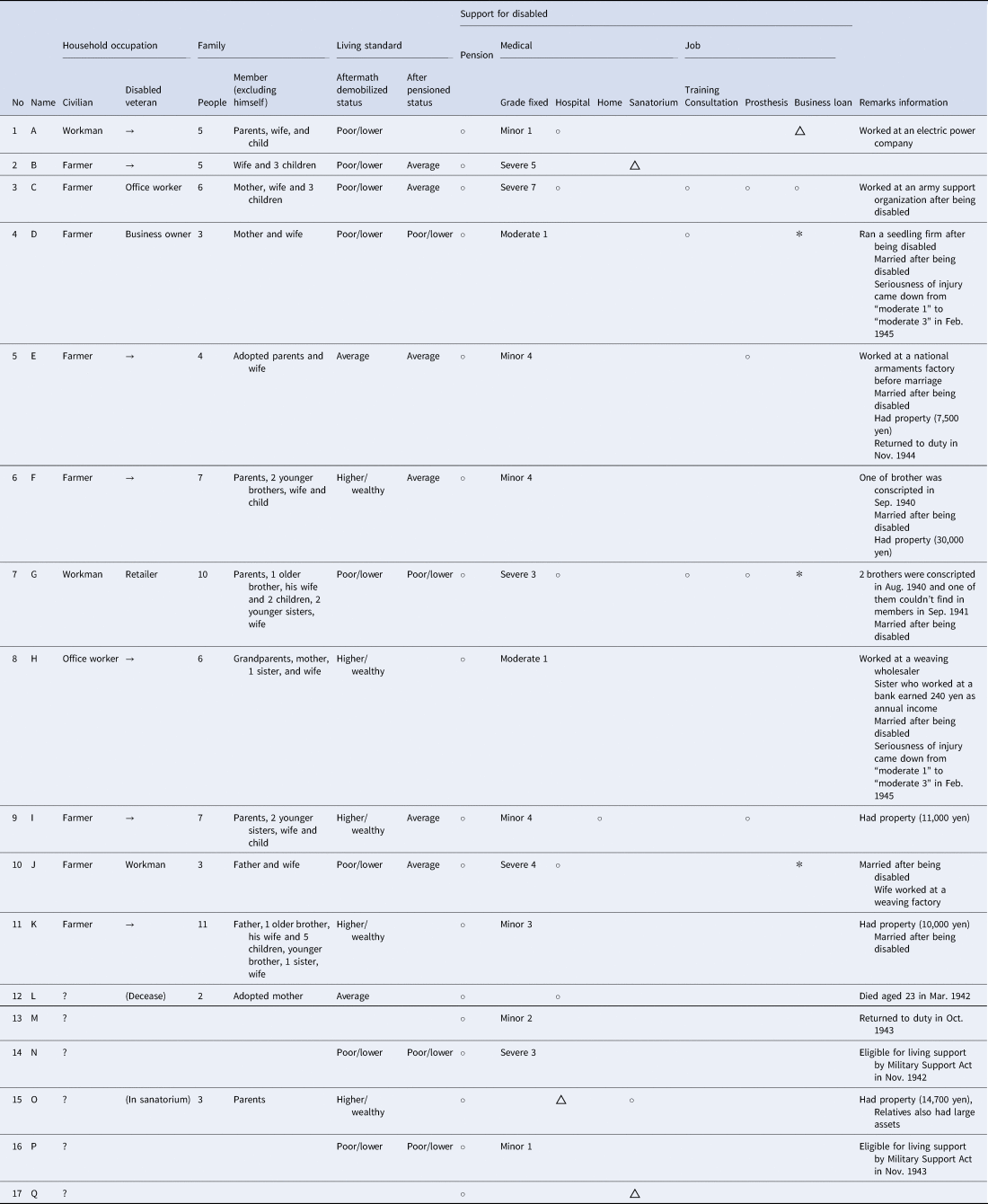
Table 6 shows the standard of living in households of the disabled veterans listed in Table 4, including the way they took advantage of military assistance for a period immediately after demobilization. Many active frontline soldiers were farmers prior to their conscription. Some, such as G, worked in the weaving industry, which was a major industry in Gōmura. The compositions of their families indicated that many of them lived in large households. Co-resident families consisting of two or more generations were widespread in farming towns throughout Japan and were not restricted to Gōmura. The standard of living analysis presumed that active frontline soldiers and their families worked to maintain their means of livelihood.
Living standard of disabled veterans and their families in Gōmura

Note: To protect personal information, anonymity is used. With regard to “support for disabled”
(1) In columns of “medical,” “○” indicates an applicant took advantage of support, “△” shows he canceled it after applying to authorities.
(2) “Loan” In columns of “job” is business loan assistance, “○” indicates an applicant took advantage of it, “△” means he applied for authorities to borrow but did not receive financial support, “*” indicates he was considered as a borrower in the future by the Village office.
Source: Prepared by the author from Gōmura yakuba (a); Gōmura yakuba (b).
Of the thirteen veterans in Table 6 whose family structure is known, all were married except for L, who died in March 1942, and O, who was in the sanatorium. However, seven of the eleven veterans got married after they became wounded. The Japanese government focused on the issue of marriage for unmarried disabled veterans, as the number of wounded soldiers increased rapidly due to the prolonged Second Sino-Japanese War.Footnote 25 The government tried to solve the problem through marriage mediation services conducted by the Greater Japan Disabled Veterans Association and Aikoku fujinkai 愛国婦人会 (the Patriotic Women's Association), which aimed to introduce potential brides to disabled veterans and create independent households.Footnote 26 However, the program did not spread due to a lack of public interest in the service and hesitation of unmarried women and their families to marry disabled veterans, causing the government tried to increase promotion through local governments.Footnote 27 Gōmura documents indicate that notifications of the introduction of spouses to unmarried disabled veterans were issued four times from 1940 to 1943 by Kyoto Prefecture. The documents contained reports on the number of unmarried disabled veterans and the number of marriages in each town. In addition, they included the prefecture's orders to municipal mayors and school principals to aggressively encourage marriages between disabled veterans and women of a marriageable age. They issued orders to municipalities and schools to conduct ideological education to encourage women of a marriageable age to become the wives of disabled veterans.Footnote 28 This was equivalent to ordering municipalities and schools to strive to recruit “wives” to provide unpaid care to their disabled husbands and make a living on their husbands' behalf, in other words, support their Saiki hōkō.Footnote 29 In Gōmura, seven disabled veterans, D, E, F, G, H, J, and K, got married about a year after retirement. Their marriages were not arranged through the mediation project; rather, they married their relatives and acquaintances. As fathers who were the household heads had the power to decide who their children would marry under Japan's prewar Civil Code,Footnote 30 it was possible for them to select disabled veterans as husbands for their daughters of marriageable age. In fact, in two of the seven cases where the ages are known, the women were older than the average marriageable age at the time.Footnote 31 Marriage to a disabled veteran was a way for a woman and her family to show patriotism; however, such marriage was sometimes seen as Taiin-iwai 退院祝い (a discharge gift) for disabled veterans.Footnote 32 It may be possible that marriages with disabled veterans during wartime Japan were influenced by the low social status of women.
The standard of living immediately after demobilized was categorized into three levels: “poor/lower,” “average,” and “higher/wealthy,” based on a survey by the municipal public office. This survey found data on fifteen families and their standards of living, listed in Table 6. A, B, C, D, G, J, N, and P families had a “poor/lower” standard of living, E and L families had an “average” level of standard of living, and F, H, I, K, and O families had “higher/wealthy” standards of living. The mayor of Gōmura, addressing the government of Kyoto Prefecture on June 25, 1941, stated that an “average” level of the standard of living can be maintained at an annual income ranging from 800 to 900 yen.Footnote 33 Looking at the income in the “living standards after demobilization” with this amount as the standard, the annual income of a household with “poor/lower” standards of living was less than 800 yen. It was 900 yen or higher for a household with an “average” level of standard of living. Many families categorized as “average” or “higher/wealthy” owned upland fields or forests.
However, the living standards of most families decreased when a major worker was called to active military service. Furthermore, sometimes several family members were mobilized at the same time, such as in the families of F and G. The government supported the livelihoods of households that were seriously impoverished by workers being sent to the frontlines by providing them with assistance under Gunji fujohō 軍事扶助法 (the Military Assistance Law). Families submitted applications for livelihood assistance to Kyoto Prefecture accompanied by a military assistance record that was prepared by the public office of the town and a certificate of prospective reception of a pension. Families of B, C, D, G, and J were evaluated in the records as having a standard of living that was lower than that of other families,Footnote 34 and reapplied for an increase in the assistance paid to them.
Many disabled veterans returned to being civilians while receiving military assistance. The type of government assistance they took the most advantage was medical care assistance, which was paid for by the national budget. Of the seventeen disabled veterans from Gōmura, A, B, C, G, I, J, L, O, and Q were admitted to a public or private hospital near their homes for period of 1 or 2 months, recuperated at home while under the care and treatment of a physician, recuperated at a hot spring in the prefecture, or were admitted to a disabled veterans' sanatorium directly under the jurisdiction of Gunji hogoin 軍事保護院. B and Q applied for admission to a disabled veterans' sanatorium. Although B applied for admission to a hot spring sanatorium, he withdrew this application for two reasons: first, the arrival of spring raised the temperature and his condition improved and, second, the busy season for farmers was approaching. Q went home the day after he was moved to Kyoto Sanatorium because his mother became seriously ill. However, he went home without authorization. His father promised the director of the sanatorium that he would return; however, as Q ultimately did not, he was compulsorily discharged. B and Q had severe disabilities. However, they prioritized their livelihoods and personal reasons and either refused admission or withdrew again.
The disabled veterans of Gōmura returned to the occupations they held before they were conscripted. However, after retirement, C, D, and G attempted to take advantage of employment assistance. C and G applied for consultations concerning their occupations, and D applied for occupational training to change occupations. Funds were loaned to those who changed their occupations. C was the only one who actually borrowed funds; however, Gōmura, which surveyed the state of employment of disabled veterans, clearly showed that others who changed occupations may have needed to borrow funds in the future. C could no longer work on a farm, as he had difficulty walking, and wanted to become a mechanic. He became an employee of a disabled veterans' assistance organization. G worked as a mechanic in his father's weaving plant; however, he lost his right hand in combat, which forced him to use a prosthesis. Unable to return to his former occupation, he sought employment, and finally found work in the retail business after 2 years.
D applied for occupational training. Unable to continue with farm work due to his injury and damage to his right hand during battle, he requested admission to a prefectural occupational retraining facility to learn photographic technology and open a photography shop in Kyoto City. However, although it is not clear whether he actually received occupational training, he operated his own tree nursery instead of opening a photography shop.
The mayor of Gōmura put D in touch with a person introduced by Kyoto Prefecture. D managed to set up a garden with the supplies he received from the prefectural forestry association. He also consulted with the public office of the town concerning management methods and handling customers. The town mayor responded by asking the forestry association to give him guidance on management and introduce customers to him,Footnote 35 who then found D a permanent customer.Footnote 36 D changed his occupation successfully while still taking advantage of the ongoing support he received. In addition, the wartime government promoted the policy of occupational change among medium and small companies in an effort to strengthen the mobilization of workers in industries that supplied the military.Footnote 37 Under such conditions, it may have been difficult for D to open and operate a photography shop.
C also took advantage of debt reduction and exemption measures and sought subsidies to reduce educational expenditure. He used assistance more aggressively than anybody else in Gōmura. Although he was severely injured in combat, he embodied the idea Saiki hōkō 再起奉公 that the government desired by doing his utmost for the nation while taking advantage of assistance of various kinds. C reported that he was able to avail assistance with educational costs with the help of the mayor. He asked the prefecture for assistance with the expenses he incurred for his son's education in the prefecture industrial high school. C submitted his request with a record of his family's financial situation. After screening, the prefecture could not decide whether to provide educational assistance for his son, deferring to the mayor regarding whether educational assistance was necessary. In response, the mayor stated that:
• C worked enthusiastically as an employee of an army support organization and continued to contribute to the state.
• His son was a talented resident of the town, and C wanted him to graduate.
• As pointed out by the prefecture, C's total salary and pension (860 yen) was equal to the annual income of a middle-class household in a local farm village. However, as it was the household of a disabled veteran and incurred expenses that were higher than those of ordinary households, educational expenses were a heavy burden on household finances.
The mayor requested the prefecture to authorize educational expense assistance for C's son.Footnote 38
How did the living standards of each disabled veteran's family change over time after demobilization? The standard of living clearly declined in the household of L, who died during the recuperation period. L's household was evaluated as having an “average” standard of living while he was recuperating; however, the death of the family's only adult men had a significant negative impact. E and M returned to duty. E's household, which had maintained an “average” standard of living until then, suffered after he was recalled to the frontlines. It was difficult to assess F and I, whose standards of living fell from “higher/wealthy” to “average,” and H, K, and O, whose standards of living after demobilization were “higher/wealthy.” The first two were the most lightly injured disabled veterans according to pension standards and returned to their former occupation. F experienced an increase in net income after receiving a pension. I returned to work 1 year after his discharge from the hospital to earn an annual income at the same level as he earned before he went to war. All five were disabled veterans who had clearly experienced a decline in the quality of their lives. However, from an economic perspective alone, there were no significant changes in the standards of living of their households.
In contrast to the above households, some households, such as those of B, C, and J, experienced higher standards of living in economic terms after demobilization. They either returned to their original occupation or changed their occupation shortly after demobilization, increasing their annual income, which was boosted by the pension. J's household also received the income of his wife, who he married after becoming a disabled veteran. These three people's injuries were the most battlefield serious. Thus, it is difficult to measure the difficulties faced by them and their families based on financial data alone. On the other hand, although they were disabled, they worked and maintained their annual incomes, while receiving pensions as an economic compensation for their disabilities. As such, their families gained economic leeway.
Conclusions
Immediately after the start of the Second Sino-Japanese War, the government was resigned to a long conflict that would result in many deaths, injuries, and illnesses. It expanded the conscription system to achieve large-scale mobilization while simultaneously providing comprehensive military support. An advisory council led by the Ministry of Welfare established a system that simultaneously permitted pension and support provisions while establishing a government organization to provide comprehensive support. However, the advisory committee's top priority was to create the mechanisms of Saiki hōkō 再起奉公.
Soldiers from Gōmura in Kyoto Prefecture were sent to the frontlines in China and the Pacific, where they were injured or suffered illnesses and were treated in army hospitals before returning to Gōmura. Their first concern after becoming disabled veterans was whether they would receive pensions. This was followed by whether the seriousness of their injuries or illnesses would qualify them for annual pensions. Qualifying for a pension was their “passport” to access public support. An annual pension was a better way to ensure livelihood stability than a one-time payment. Although, higher pensions indicated that they had incurred more severe losses of bodily function, pension may have been the best way to live next to restoring bodily function.
It was common for several adult men in a farming town family to be conscripted. The family standard of living decreased, and the effectiveness of livelihood assistance was limited. Disabled veterans who qualified to receive pensions returned to their prior occupations after convalescing through medical care assistance. Thus, they continued their daily lives with support from their own income and pensions. Among those who were unable to receive pensions, tuberculosis and malaria sufferers requested admission to sanatoriums at the government's expense. In Gōmura, disabled veterans who prioritized life with their families often chose not to enter these institutions.
The government emphasized that few people used occupational support in farming towns, as many veterans returned to agricultural employment, which was also seen in Gōmura. However, the severely disabled and those who could not easily resume their prior occupations due to specific injuries asked for certain forms of occupational support. In some cases, the mayor acted as a medium to obtain such support. Other disabled veterans actively took advantage of scholarships, debt-disposal offers, and other available forms of support. Disabled veterans could independently use these forms of public support to restore their livelihoods.
Comparing standards of living for disabled veterans immediately after their demobilization and later showed that it was difficult for many to recover their previous living standards. In particular, households with disabled veterans who were unable to obtain public support never returned to prewar living standards, as many such veterans received lengthy medical treatments for their illnesses. Others returned to duty while still attempting to recover their livelihoods. However, other households economically exceeded their prewar living standards, as veterans were back to work while also receiving pensions.
There is no doubt that luck or bad luck on the battlefield had a significant impact on the lives of the disabled veterans and their families after retirement. However, although enduring the unreasonable conditions created by the conscription system, they tried to get back to their daily lives using military support provided by the government. It appears that, regardless of the intentions of disabled veterans and their families, the system of Saiki hoko 再起奉公 functioned to some extent as the government had envisioned.
This study was unable to investigate differences in the daily lives of disabled veterans and their families in Gōmura compared to other locations. This is an issue for future discussion.
Acknowledgements
I would like to thank Mototaka Koyama of the Commerce and Industry Promotion Division of Kyōtango City Hall for his help in reading historical documents possessed by Kyōtango City Board of Education. This work was supported by Grant-in-Aid for Scientific Research (KAKENHI) (B) 15H03235.
Conflict of interest
None.