Introduction
Depressive disorders are common, with community point prevalence in Western Europe of about 9% (Ayuso-Mateos et al. Reference Akaike2001). Depression can have a profound impact on personal and family life and tends to increase the use of health care resources (Simon et al. Reference Simon, Ormel, VonKorff and Barlow1995). Fortunately, many people who experience depression recover. In psychiatric populations between one-third and half of patients experience no further episodes of depression, although in up to 20% of cases it may persist (Keller et al. Reference Keller, Lavori, Mueller, Endicott, Coryell, Hirschfeld and Shea1992; Thornicroft & Sartorius, Reference Thornicroft and Sartorius1993) Studies in community and primary care populations indicate somewhat higher rates of recovery, at around 60% (van Weel-Baumgarten et al. Reference van Weel-Baumgarten, Schers, van den Bosch, van den Hoogen and Zitman2000; Mattisson et al. Reference Mattisson, Bogren, Horstmann, Munk-Jörgensen and Nettelbladt2007).
It is important for clinicians and patients to know what factors are associated with recovery from depression, in order to improve treatment decisions. Rubenstein and colleagues proposed a Depression Prognosis Index, which predicts 6 month recovery on the basis of severity of symptoms at baseline, social support, common physical symptoms and antidepressant medication. This explained 40% of variance in recovery in a development sample of primary care attender patients screened for depression, but only 27% of variance in a validation sample (Rubenstein et al. Reference Rubenstein, Rayburn, Keeler, Ford, Rost and Sherbourne2007). Amongst primary care consulters involved in a trial of psychological therapy, Conradi et al. (Reference Conradi, de Jonge and Ormel2008) found that the proportion of time without recurrence of depressive disorder at 3 years was predicted by baseline severity of depression and anxiety and by levels of social and physical function. In the ODIN study, baseline social function, severity of depression and presence of personality disorder were modestly predictive of 12-month outcome in community settings (Casey et al. Reference Casey, Birbeck, McDonagh, Dalgard, Lehtinen, Britta, Ayuso-Mateos and Dowrick2004).
These studies are useful, but they do not adequately account for the effects of social adversity or physical symptoms and conditions. The samples were collected in people not necessarily presenting to the general practitioner (GP) for help with depression or receiving help from other health professionals. King and colleagues are developing comprehensive risk estimation for the onset of depression in general practice populations (King et al. Reference King, Weich, Torres-González, Svab, Maaroos, Neeleman, Xavier, Morris, Walker, Bellón-Saameño, Moreno-Küstner, Rotar, Rifel, Aluoja, Kalda, Geerlings, Carraça, de Almeida, Vicente, Saldivia, Rioseco and Nazareth2006). This may become relevant, but does not currently inform the busy primary care clinician, charged with the task of assessing and managing the patient with depression, identifying which patients presenting with depression are more or less likely to recover and negotiating management options.
The THREAD study was an open randomized controlled trial to test the clinical and cost-effectiveness of selective serotonin reuptake inhibitors (SSRIs) plus supportive care versus supportive care alone delivered by GPs, for mild to moderate depression in primary care (Kendrick et al. Reference Kendrick, Chatwin, Dowrick, Tylee, Morriss, Peveler, Leese, McCrone, Harris, Moore, Byng, Brown, Barthel, Mander, Ring, Kelly, Wallace, Gabbay, Craig and Mann2009). We collected data on a wide range of psychological, physical and social factors believed to have an impact on the outcome of depression. Analyses of longitudinal data gathered at two time points, 12 and 26 weeks, showed that out of all the potential predictors examined, employment status and somatic symptoms were significantly associated with the Hamilton Depression Rating Scale (HAMD) as a continuous outcome. Full results of these analyses are re-available in Kendrick et al. (Reference Kendrick, Chatwin, Dowrick, Tylee, Morriss, Peveler, Leese, McCrone, Harris, Moore, Byng, Brown, Barthel, Mander, Ring, Kelly, Wallace, Gabbay, Craig and Mann2009). Following on from this, we used this same dataset to examine the extent to which the probability of sustained recovery for people presenting to the GP who is going to treat them for mild to moderate depression in primary care could be predicted.
Method
Recruitment and assessment
GPs in practices recruited by three university departments (Southampton, Liverpool and London) referred patients diagnosed with new episodes of depression and potentially in need of treatment. Inclusion criteria included age ⩾18 years, symptoms for at least 8 weeks, no antidepressant treatment within 12 months, no current counselling or psychological therapies, baseline score 12–19 inclusive on the 17-item HAMD (Hamilton, Reference Hamilton1967) (consistent with diagnoses of mild to moderate depression), at least one physical symptom on the Bradford Somatic Inventory (BSI; Mumford et al. Reference Mumford, Bavington, Bhatnagar, Hussain, Mirza and Naraghi1991) and being in equipoise about antidepressant drug treatment. Our exclusion criteria included pregnancy and breastfeeding, expressed suicidal intent, reported significant substance misuse and a score of ⩾13 on the Alcohol Use Disorders Identification Test (AUDIT) questionnaire, indicating problem drinking (Babor & Grant, Reference Babor and Grant1989).
Our baseline assessments included demographic information on age, gender and ethnicity and on educational, marital and employment status, health information from the 17-item HAMD, the BSI and AUDIT and questions on duration (time since last felt well) of current episode, perceived cause of illness and preferred type of treatment at baseline (supportive care without antidepressants, supportive care with antidepressants or no preference). We used the Life Events and Difficulties Schedule (LEDS; Brown & Harris, Reference Brown and Harris1978) for information on severe interpersonal difficulties and provoking agents in the year before interview and the modified Client Service Receipt Inventory to assess health and social services use in the 6 months prior to interview (Beecham & Knapp, Reference Beecham, Knapp, Thornicroft, Brewin and Wing1992). We examined participants' GP medical records for primary care contacts, evidence of chronic physical conditions and drug prescriptions, including antidepressants. We followed up participants at 12 and 26 weeks and included the HAMD on each occasion. Randomization was performed within strata (centre and baseline HAMD group, low or medium).
Statistical methods
We defined sustained recovery from depression on the basis of HAMD score of <8 by 12 weeks and maintained at 26 weeks (Frank et al. Reference Frank, Prien, Jarrett, Keller, Kupfer, Lavori, Rush and Weissman1991).
The variables we considered for inclusion in the model were age, gender, ethnicity, educational, marital and employment status, depression at baseline (HAMD), duration of current episode, somatic symptoms at baseline (BSI), perception that the cause of symptoms was emotional or not, previous antidepressant use, previous depression, alcohol use (AUDIT), severe interpersonal difficulty (LEDS), if they had a provoking agent in the year before onset, if they received their preferred intervention (versus those who had no preference or did not receive their preferred treatment) and chronic physical conditions. We included treatment arm, recruitment centre and baseline HAMD score as they were design factors for the study. We included age and employment status to reduce bias due to lack of follow-up, which was associated with these factors. Other factors were included on the basis of previous research evidence of association with outcome of depression.
The model we fitted was a logistic regression including clustering by GP. We reduced the model, which included all possible predictors, using a backward stepwise approach. Since a likelihood approach was not possible (due to clustering and because of slightly different samples at each stage), we removed each variable individually and compared it with the full model using Akaike's Information Criterion (AIC) 1973 version (Akaike, Reference Akaike1973). The variable whose omission gave the lowest AIC was removed, while retaining design variables and those associated with missing status. We repeated this until the removal of any additional variable raised the AIC. Finally, to ensure that no significant variables were omitted, each removed variable was re-added individually and remained if significantly associated with recovery. Multi-collinearity was assessed on the basis of variance inflation factors (VIFs). The final ‘reduced’ logistic model is presented with the linear predictor, from which probabilities can be calculated.
We also show the results of the model in the form of a probability tree to demonstrate the impact of the significant odds ratios on probability for various combinations and the uncertainties associated with the estimated probabilities. It is read from left to right, with the most influential factors according to the prediction model included first. Each node represents a characteristic of a subgroup and gives the probability of sustained recovery for an average person with that characteristic. The values of variables not included at any stage are set to their mean values in the sample. As we use this tree for illustrative purposes, we have included only statistically significant factors.
Results
Participants
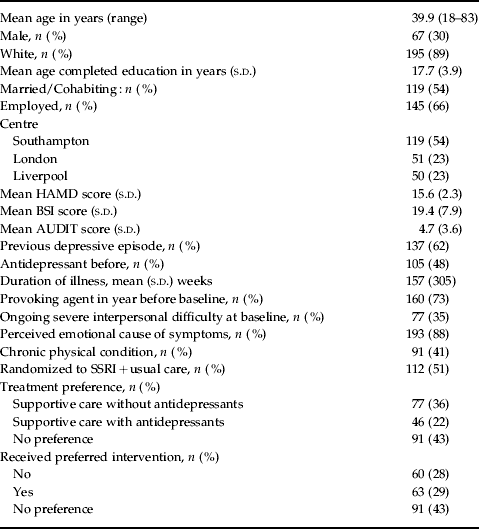
There were 220 participants in this study, of whom 186 (85%) were followed up at 12 weeks and 167 (76%) at 26 weeks. The baseline characteristics of participants are given in Table 1.
Participant characteristics at baseline

HAMD, Hamilton Depression Rating Scale; BSI, Bradford Somatic Inventory; AUDIT, Alcohol Use Disorders Identification Scale; SSRI, selective serotonin reuptake inhibitor.
Sustained recovery
In total, 58 participants (26%) were missing a HAMD score at either 12 or 26 weeks follow-up. Of the 162 participants who had a record of HAMD at both follow-up points, 77 (48%) had an HAMD score <8 at 26 weeks and were considered to have recovered; 39 (24%) had a HAMD score <8 at both 12 and 26 weeks, fulfilling our criteria for sustained recovery.
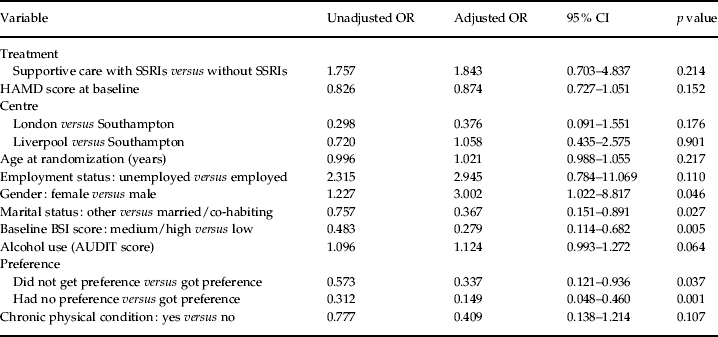
Table 2 shows the reduced logistic regression model of predictors of sustained recovery: this is based on 156 participants with complete data on the covariates in the model. The model we present includes only those factors associated with sustained recovery, in addition to automatically included design factors. The following covariates were not retained following the model reduction: previous antidepressants; previous depression; duration of current illness; severe interpersonal difficulties at baseline (LEDS); perceived cause is emotional; Beck Depression Inventory at baseline; provoking agent in year before onset.
Logistic regression model showing predictors of sustained recovery (HAMD <8 at both 12 and 26 weeks)

HAMD, Hamilton Depression Rating Scale; OR, odds ratio; CI, confidence interval; SSRI, selective serotonin reuptake inhibitor; BSI, Bradford Somatic Inventory; AUDIT, Alcohol Use Disorders Identification Test.
Sustained recovery was significantly (p<0.05) associated with being female, married/co-habiting, having a low BSI score, having a preference for treatment and receiving preferred treatment. Being married/cohabiting was significantly associated with sustained recovery after adjustment for alcohol use (AUDIT score). Gender was significantly associated with sustained recovery when the model had been adjusted for baseline BSI, AUDIT score, receiving preference, age, employment and chronic physical condition. There was no association between BSI scores and the psychic anxiety symptoms item on the HAMD, and a small association (correlation=0.25) between BSI scores and the somatic anxiety item on the HAMD, the total scores were moderately correlated (correlation=0.35). Treatment preference was associated with treatment arm [χ2(2)=9.00, p=0.007], with a greater preference for no drug treatment. Within the treatment arm, 20% of patients received their preferred treatment (i.e. antidepressant drugs) while 49% had no preference. In the control arm, 44% received their preferred treatment (i.e. no antidepressant drugs) and 36% had no preference. All VIFs were small, showing that multi-collinearity is not a concern.
We assessed the accuracy of the model using sensitivity and specificity after jack-knifing of the data (predicting the probability of recovery for each individual in the dataset by removing that individual and refitting the model). The jack-knifed results were 33% sensitivity, 88% specificity. Sensitivity is low at the cut-off of 0.5 as the criterion for recovery includes around 25% of patients rather than 50%: a cut-off at 0.25 would yield sensitivity and specificity combination at 62% and 69% respectively.
Predictions of sustained recovery
The approximate probability of sustained recovery for an individual can be derived by entering their characteristics into the linear predictor from the model in Table 2 and transforming the result using the equation:

The average centre effect across the sample has been incorporated into the constant of the linear predictor, which is as follows:

This approximation to the predictor using rounded coefficients leads to estimated probabilities that are within 5% of the unrounded predictor.
For example, the probability of recovery in a 40 year old, married/cohabiting female with few somatic symptoms, who received her preferred treatment of SSRI with supportive care, has a HAMD score of 16, an AUDIT score of 5 and is unemployed with no chronic physical condition can be derived using the linear predictor, as follows:

This gives an approximate probability of sustained recovery of 68%.
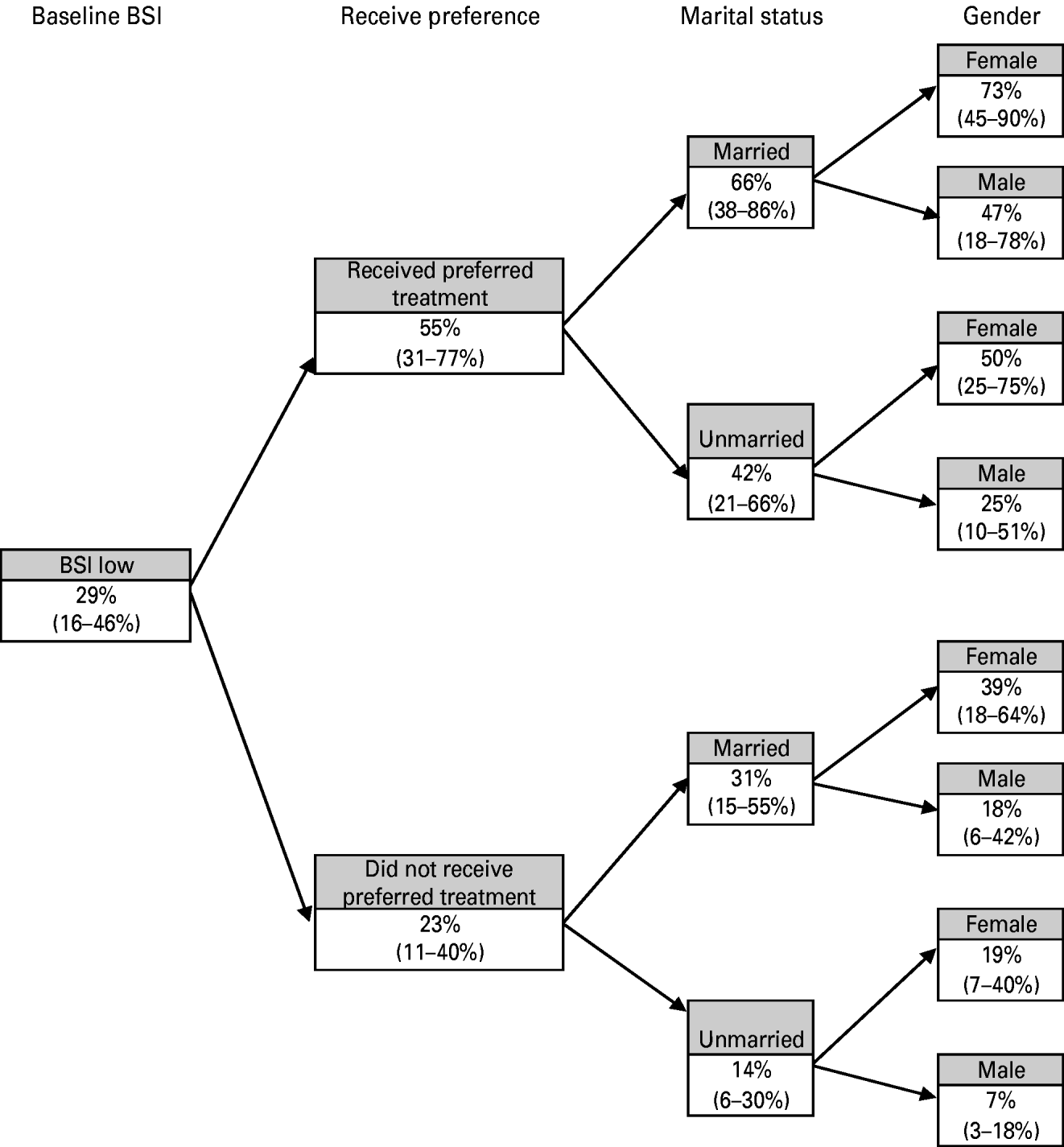
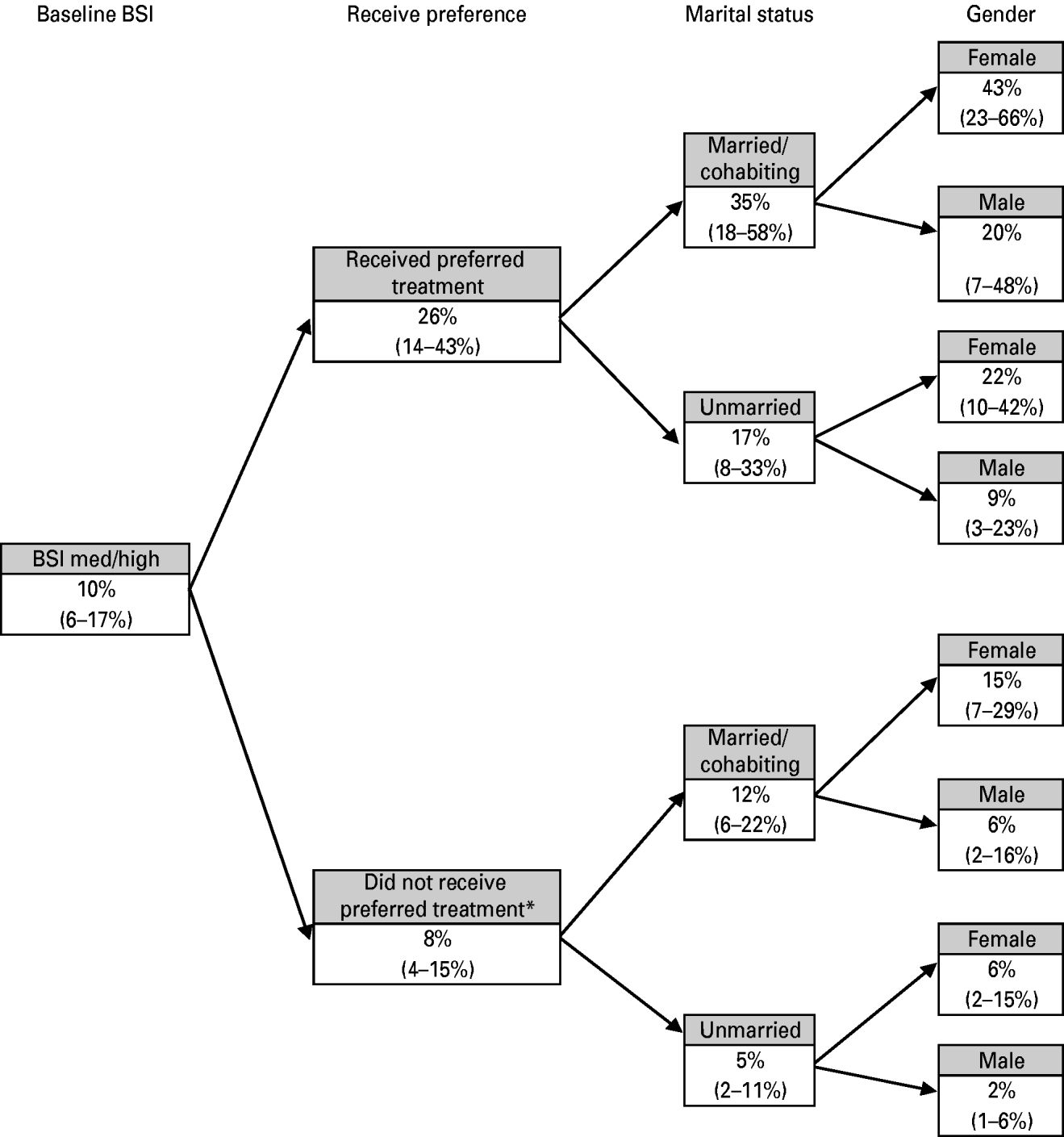
Figs 1 and 2 summarize the probabilities of sustained recovery, given the presence or absence of each of the four most significant predictors derived from the logistic regression and setting the other predictors to the average across the sample. The numerical example above is similar to that of the prediction shown in the top right box in Fig. 1, the difference being that, in the example, we have specified the values of all variables. The probability trees allow comparison of a range of probabilities for sustained recovery and also indicate the confidence intervals around the estimates: for example, between a married/cohabiting woman with few somatic symptoms who received her preferred treatment (as above – estimated probability of recovery 73%, range 45–90%), and a married/cohabiting man with more somatic symptoms who did not receive his preferred treatment (estimated probability of recovery 6%, range 2–16%).
Estimated probability (95% confidence interval) of sustained recovery given specific characteristics: start low baseline Bradford Somatic Inventory (BSI) score. For simplification of the graphical representation ‘did not get preference’ and ‘had no preference’ have been combined in ‘Did not receive preferred treatment’.

Estimated probability (95% confidence interval) of sustained recovery given specific characteristics: start medium/high baseline Bradford Somatic Inventory (BSI) score. For simplification of the graphical representation ‘did not get preference’ and ‘had no preference’ have been combined in ‘Did not receive preferred treatment’.

Discussion
Summary of findings
Almost half of participants showed evidence of recovery from depression across both treatment conditions at 26 weeks, while one-quarter showed evidence of sustained recovery at both 12 and 26 weeks. Sustained recovery was most likely for women, those who were married or cohabiting, those with a lower somatic symptom score and those receiving their preferred treatment. We have indicated how such findings could be used to model a patients' chance of recovery, given certain characteristics.
Strengths and limitations of study
Our study's strengths include being based in primary care and involving practices and patients from a wide variety of sociodemographic areas across England. We considered a range of psychological, physical and social predictors of outcome, using well-validated measures. We used these to develop and test a predictive model of recovery and propose the innovative use of probability trees as a means of illustrating recovery at the individual patient level; if such a tree were to be used as a practical tool, the order of nodes could be based on ease of measurement in any particular setting.
Our study also has limitations. It is a post-hoc exploratory analysis based on data generated to answer a different question in a randomized controlled trial. The participating GPs were broadly representative of GPs across England in terms of gender and proportion working part-time, though the study practices were larger on average than practices in England generally. Although representative of the population of depressed primary care patients in terms of age, male patients with depression were less likely to be referred into the study (Kendrick et al. Reference Kendrick, Chatwin, Dowrick, Tylee, Morriss, Peveler, Leese, McCrone, Harris, Moore, Byng, Brown, Barthel, Mander, Ring, Kelly, Wallace, Gabbay, Craig and Mann2009). We had 26% missing data on our primary outcome variable. Neither the sensitivity nor specificity of the predictive factors is particularly high, so we need to be cautious in interpreting our findings. We focused on mild to moderate depression; therefore, can give no information on predictors for recovery from severe depressive episodes. We focused on sustained recovery; therefore, our findings cannot be directly applied to patients who improved at 12 weeks and then got worse again, those who only improved at 26 weeks or those who did not improve at all.
We deliberately excluded potential modifiers post baseline, including possible effects of consultations with GPs, of actually taking antidepressant medication (rather than being offered it) and of inter-current life events and difficulties. We did not account directly for past history of depression, although previous antidepressant use may be a reasonable proxy measure. We did not account for other factors known to be associated with outcome of depression, including illness perceptions other than those concerning cause (Fortune et al. Reference Fortune, Barrowclough and Lobban2004), genetic markers (Lazary et al. Reference Lazary, Lazary, Gonda, Benko, Molnar, Juhasz and Bagdy2008), early adverse experiences (Weich et al. Reference Weich, Patterson, Shaw and Stewart-Brown2009), attachment (Bifulco et al. Reference Bifulco, Moran, Ball and Bernazzani2002), social support or personality (Casey et al. Reference Casey, Birbeck, McDonagh, Dalgard, Lehtinen, Britta, Ayuso-Mateos and Dowrick2004).
Comparison with existing literature
Although links between somatic symptoms and depression are recognized internationally (Gureje et al. Reference Gureje, Simon, Ustun and Goldberg1997), the association that we found between somatic symptoms and depression outcome appears stronger than in previous studies. The BSI was designed as a culturally sensitive measure of distress associated with depression and anxiety in non-Western populations. We therefore need to consider its possible significance in a predominantly Caucasian study population. Given that we controlled for depression and the presence of chronic physical illness in this analysis, the association between BSI and sustained recovery could indicate anxiety as an independent predictor of outcome (Saghafi et al. Reference Saghafi, Brown, Butters, Cyranowski, Dew, Frank, Gildengers, Karp, Lenze, Lotrich, Martire, Mazumdar, Miller, Mulsant, Weber, Whyte, Morse, Stack, Houck, Bensasi and Reynolds2007). However, we found weak associations between BSI score and the anxiety items on the HAMD. It is therefore more likely that the BSI is an indicator of somatically focused distress. Jackson et al. (Reference Jackson, Fiddler, Kapur, Wells, Tomenson and Creed2006) found number of bodily symptoms to be an independent predictor of quality of life after controlling for anxiety and depression in people attending medical out-patient clinics and the co-existence of painful physical symptoms and depression is associated with higher resource use in primary and specialist care (Watson et al. Reference Watson, Baird, Hösel and Peveler2009). This is a potentially important finding in the context of depression in primary care, which needs replication.
Our finding of a strong association between treatment preference and outcome is consistent with existing literature (Hunot et al. Reference Hunot, Horne, Leese and Churchill2007; Raue et al. Reference Raue, Schulberg, Heo, Klimstra and Bruce2009), but also raises questions. Our sample, recruited to a trial in which clinicians and patients were in equipoise about antidepressant treatment (Kendrick et al. Reference Kendrick, Chatwin, Dowrick, Tylee, Morriss, Peveler, Leese, McCrone, Harris, Moore, Byng, Brown, Barthel, Mander, Ring, Kelly, Wallace, Gabbay, Craig and Mann2009), may be atypical of patients presenting in primary care, many of whom have stronger preferences for or against medication. Our researchers obtained preference information after patients had consulted with GPs about their depression, which may have influenced their preference. Nevertheless, defining one's treatment preference may be important, implying ownership of the problem by the patient and commitment to a clear line of action; these may be as important as getting preferred treatment.
Our finding of a lack of association between treatment arm and sustained recovery is at variance with the main finding of the THREAD trial, which showed a modest but significant advantage for antidepressant treatment in reduction of depressive symptoms at either 12 or 26 weeks (Kendrick et al. Reference Kendrick, Chatwin, Dowrick, Tylee, Morriss, Peveler, Leese, McCrone, Harris, Moore, Byng, Brown, Barthel, Mander, Ring, Kelly, Wallace, Gabbay, Craig and Mann2009). However, these two outcomes are not identical; the analysis presented in this paper is limited to the 74% of participants providing HAMD scores at both follow-up points, rather than the 85% who provided scores at either point, which tends to reduce power to identify association with treatment arm.
Our finding of a lack of association between sustained recovery and life events and difficulties runs against considerable research evidence (Brown & Harris, Reference Brown and Harris1978) and – in a different analysis arising from the THREAD study – evidence of an association between life events and difficulties and remission at 12 weeks (Brown et al. Reference Brown, Harris, Kendrick, Chatwin, Craig, Kelly, Mander, Ring, Wallace and Uher2009). That analysis included both baseline (recent stressful experiences) and modifying factors (fresh start and difficulty reduction), whereas we focused entirely on factors that could be used to predict subsequent outcome at the time of diagnosis. Since modifying factors play a major part in remission, we remain convinced that sustained recovery from depression is more problematic for people living in aversive social contexts.
Implications for research and practice
Our predictive model advances knowledge of the factors affecting outcome of depression in primary care, but needs to be tested in other populations, with additional factors, and for more severe conditions. Our probability trees illustrate a potentially helpful method for the busy clinician, but are not robust enough to act as formal predictive tools, such as those employed to calculate risk scores for coronary disease. If our finding of association between somatic symptoms and depression outcomes are substantiated, then the BSI may become a useful standard instrument for clinicians assessing depressed patients.
Our findings enable primary care clinicians to identify which patients presenting with mild to moderate depression are more likely to recover and encourage treatment approaches based on patient preference (NICE, 2004; Peveler et al. Reference Peveler, Kendrick, Buxton, Longworth, Baldwin, Moore, Chatwin, Goddard, Thornett, Smith, Campbell and Thompson2005). If the patient wants an antidepressant, we suggest that the GP should prescribe one. If the patient prefers to wait before formal treatment then the GP should support this, especially if they have a low BSI, are married and female. If patients have no preference, then the primary results from our trial indicate that antidepressants should be offered (Kendrick et al. Reference Kendrick, Chatwin, Dowrick, Tylee, Morriss, Peveler, Leese, McCrone, Harris, Moore, Byng, Brown, Barthel, Mander, Ring, Kelly, Wallace, Gabbay, Craig and Mann2009). Social factors should also be considered and addressed, if sustained recovery is to be achieved (Brown et al. Reference Brown, Harris, Kendrick, Chatwin, Craig, Kelly, Mander, Ring, Wallace and Uher2009).
Acknowledgements
This study was funded by the National Institute for Health Research (Health Technology Assessment) programme, England. The opinions expressed in this paper are the authors' and do not represent the views of the Department of Health for England. The other members of the THREAD Study group were Helen Mander (University of Southampton), Adele Ring (University of Liverpool) and George Brown, Tom Craig, Tirril Harris, Vikki Kelly, Vuokko Liljankoski, Paul McCrone and Anthony Mann (Institute of Psychiatry, King's College London). We are indebted to all the family physicians and patients who took part in the study.
Declaration of Interest
C. Dowrick has received research funding from Lilly, Lundbeck, Servier and Wyeth pharmaceuticals, MRC and EU research funding for research into psychological treatments and has written about the limited value of antidepressants. R. Morriss has received honoraria from Lilly, AstraZeneca, Janssen-Cilag and Bristol–Myers Squibb and MRC funding for research into psychological treatments. R. Peveler has received fees for presenting at educational meetings and/or consultancy, from Lilly, GlaxoSmithKline, Pfizer, Lundbeck, Wyeth, AstraZeneca, Bristol–Myers Squibb, Servier and Organon pharmaceuticals. A. Tylee has received research funding and fees for educational meetings and advisory boards from Eli Lilly, Lundbeck, Servier, Organon, GSK, Pfizer, Duphar, Squibb, Boots and Wyeth over the last 20 years. He has also received research funding from MRC, the Health Foundation, the Mental Health Foundation, Department of Health HTA and NIHR for research into psychological and drug treatments for depression in primary care. R. Byng has received fees for speaking at an educational meeting from Lilly pharmaceuticals and has written about the limited value of antidepressants. T. Kendrick has received fees for presenting at educational meetings and/or research funding, from Lilly, Lundbeck, Servier and Wyeth pharmaceuticals and has also received HTA funding for research into psychological treatments.