

In the 1680s, João de Moura, a knight of the Order of Christ, presented an essay titled “Descrição histórica e política do Estado do Maranhão” to the king of Portugal, Dom Pedro II (1683–1706). Organized in the form of a dialogue between two friends (named Thought and Discourse), it dealt with the causes of the decline of the State of Maranhão and Pará (or simply State of Maranhão), an independent northern province of Portuguese America, in the Amazon region (see Figure 1).Footnote 1Discourse undertook an inquiry into the reasons underlying the crisis in the region, and Thought set out to explain the decadence of Maranhão and also to point out its potential for change. Many subjects were discussed by the two friends, including the fertility of the land, agriculture, trade, the population, and the discovery of forest products and their importance for the “growth” of the state.Footnote 2
The State of Maranhão and Pará
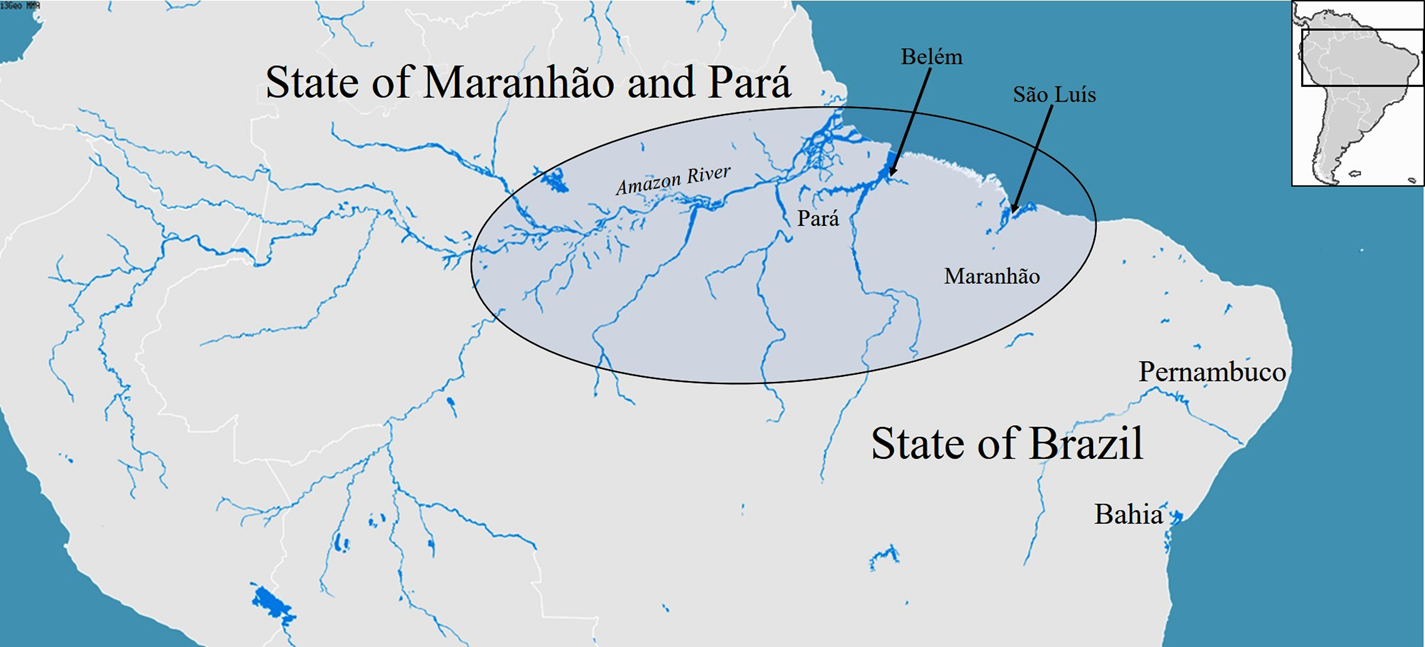
According to Thought, the decline of Maranhão had two main causes. First of all, those who conquered the land had come from Pernambuco, an important sugar production region of Portuguese America (see Figure 1). When they arrived, “they began to build sugar mills,” in which Indians worked as slaves.Footnote 3 As the Portuguese began to enslave people on a larger scale, the initial contact was transformed into hostility. According to Thought, these circumstances were aggravated by the discovery of Amazonian forest products, such as cacao, sarsaparilla, and clove bark, together often called drogas do sertão (spices from the hinterlands).Footnote 4
Discourse posed the question of how the spices could be the cause of the region's decline. It was clear in the defense offered by Thought that the drogas posed an “obstacle for the growth of the State,” by depriving it of resources. Soon after the settlers arrived from Pernambuco, they began to cultivate sugar and tobacco. With the discovery of the spices, however, the settlers preferred “to enter the hinterland, rather than plant their fields,” thus diverting to the sertão the slaves who were necessary for the sugar mills. Thought added that the discovery of the hinterland would not be of value to the king if the “foundations,” that is, the sugar mills and cultivated crops, were not established first. This was a convincing explanation for Discourse, according to whom the “growth of Maranhão consists in the settlers occupying themselves in the cultivation of the land.”Footnote 5
João de Moura's text reflects the generally held conviction that agriculture, especially the cultivation of sugarcane, was the ideal vehicle for the economic development of the colonies.Footnote 6 During colonial times, and especially from the second half of the seventeenth century onward, the Portuguese crown put into effect a series of economic policies to develop its colonies.Footnote 7 The colonial experience of Bahia and Pernambuco on the Brazilian coast where sugar production thrived, had consolidated a path for the economic development of the conquests of Portuguese America (see Figure 1).
In the seventeenth century, João de Moura framed a dilemma that still haunts policy makers in the region today. Could agriculture and extractive industry coexist in Amazonia? Which industry would provide the better path for the development of the region? Many seventeenth-century uncertainties still echo today, and these questions are an ongoing part of national and regional agendas, as activists and politicians continue to question the fate of such a vast territory. Not surprisingly, the dichotomy between agriculture and extractivism became a central theme in Brazilian historiography, as scholars sought to understand the conquest and colonization of the Amazon region in the seventeenth and eighteenth centuries.Footnote 8
Yet, unlike the captaincies of Bahia, Pernambuco to the northeast, or even Rio de Janeiro to the south, the Amazon region never became an important location for sugar production. As mentioned above by Thought, the discovery of the drogas do sertão, notably from the 1640s forward, led the settlers and the crown to exploit these new products. In the face of the loss of Portuguese trade routes in Asia, the region was seen as a potential “New India.”Footnote 9 This became clear when clove bark was discovered: the bark had a similar smell to the Indian clove. Moreover, there was an abundance of natural cacao orchards in many of the region's river basins and at the time a general increase of cacao consumption in Europe.Footnote 10 These facts led the crown to foster its cultivation and the gathering of wild fruits by Indians in the sertão.Footnote 11 Cacao and clove bark became the most important products of the regional economy in the colonial Amazon.Footnote 12
None of this meant that sugar was unimportant, or even that the crown and royal authorities had abandoned their intention to develop a sugar industry in the region, as we will see. In the Amazon region, however, the pathway followed was different from the rest of Portuguese America. Contrary to João de Moura's text, one does not need to see the drogas and sugar as mutually exclusive. Documentary evidence reveals that the economy of the drogas do sertão became increasingly important, especially in the western part of the State of Maranhão.
The growing economy of the drogas consolidated the crucial importance of Indian labor exploitation, since the spices were to be found only in the hinterland, through a complex fluvial network. For this kind of task, natives became essential. They rowed and guided the canoes that entered the sertão, gathered bark, fruits, and roots from the forest, and they also cultivated the settlers’ fields. Within this context, this text argues, the cultivation of sugar, and especially the production of one of its byproducts—cane liquor, or aguardente—gained a new significance in the region.
Documents produced by settlers, clerics, local and royal authorities, the crown, and its councils in Lisbon highlight the role played by the production of sugar and aguardente.Footnote 13 In the seventeenth- and early eighteenth-century Amazon region and Maranhão, they had a particular significance.Footnote 14 The documents also show that there were two faces to that significance. First, as was true in the State of Brazil, sugar plantations had to produce a commodity that could be exported and thereby generate revenues for the royal treasury. Sugar plantations, however, also produced aguardente for domestic consumption (including consumption by those Indians who worked for the Portuguese), which provoked distrust on the part of the crown, since aguardente was considered detrimental to sugar production. Nevertheless, aguardente production did become a central element for the Portuguese dominion and the functioning of Amazonian economy, and at the same time, it offered the opportunity to increase the revenues of the Royal Treasury.
This article is divided into four parts. After a discussion of royal policies for the increase of sugar production, I examine how, from the viewpoint of the crown, royal and local authorities, and some settlers, the growth of a cane liquor industry threatened sugar production. Next, I analyze, as one consequence of the European conquest of the region, the important role that aguardente played among Amazonian Indians. Finally, I address the transformation of royal policy as regards the production of aguardente, which by at the end of the seventeenth century came to be seen as central to the relationship that had been established with the Amazonian Indians, as well as to the functioning of the Amazonian colonial economy. Colonial experience influenced the dynamics of royal policy toward its colonies, yet it was also the case that rearrangement of these policies was related to the modes by which Indians incorporated a European drink into their new colonial status and relationships. Indians became central to the functioning of the colonial Amazonian economy; their consumption patterns, in turn, helped to shape it.
The “Multiplication of Sugar”
During the second half of the seventeenth century and throughout the eighteenth, the Amazonian economy relied on the extensive exploitation of forest products. Nevertheless, throughout the colonial period, and especially in the seventeenth and early eighteenth century, the Portuguese crown sponsored agriculture and sugar production in many ways, using strategies already established in the State of Brazil, such as tax exemptions, the importation of African slaves, juridical privileges, and the private administration of free Indian workers. In 1646, for example, the king renewed an exemption of tithes on sugar for eight years. Initially, the sovereign had decided that the State of Maranhão's settlers should not pay any tithes, an exemption granted for five years.Footnote 15 However, the royal treasurer of the State, Manuel Pita da Veiga complained that it was from the imposition of these tithes that the officials of the crown were paid. The Overseas Council, responsible to counsel the king on the colonies’ issues, then suggested that instead of five years of freedom, the king should grant eight years at half-tithes.Footnote 16
Years later, the sovereign granted more privileges to the senhores de engenho, the sugar mill owners. In 1688, the king decided to exempt them from “serving on the [municipal] Councils.” One of the reasons for doing so, it was said, was that the sugar mills were “too far from the cities,” and the absence of the mill owners would negatively affect the already precarious production of sugar in the region.Footnote 17 In addition, considering the abandonment of many sugar mills, the crown decided to exempt both the senhores and their planters (lavradores) from judicial confiscation of their machinery and slaves, for six years.Footnote 18 This privilege, officially granted in 1688, had actually been implemented earlier in response to settlers’ petitions.Footnote 19
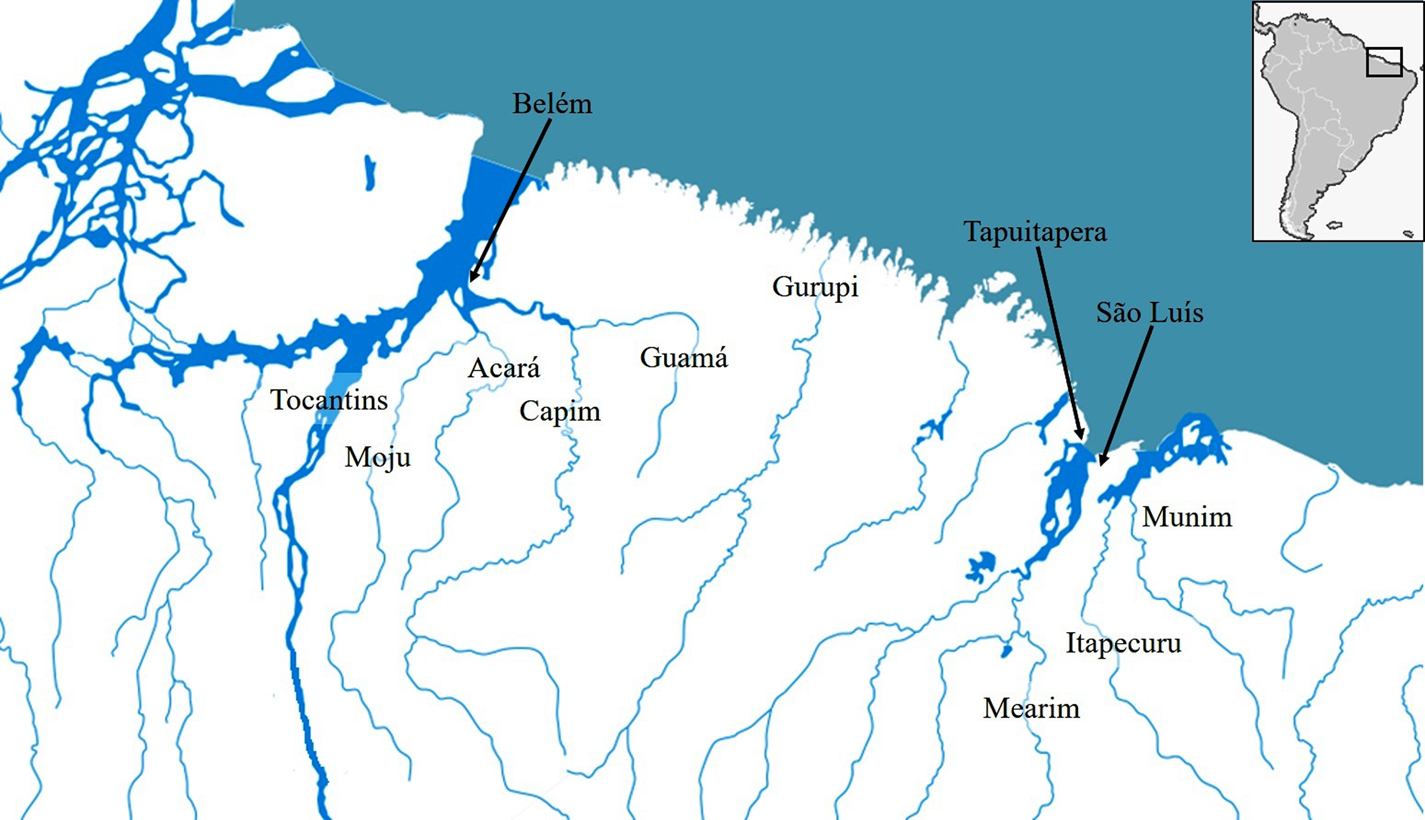
The experience of the State of Brazil was definitive in these cases. With regard to sugar, both the crown and the settlers viewed that state as an example of success, whose experience should guide the development of this product in the State of Maranhão. In 1648, for example, the judge of the Captaincy of Pará, Francisco Barradas de Mendonça, advised the king that those settlers who had built engenhos should have the same privileges “as those from Brazil.”Footnote 20 In 1675, a petition for ten years of tax exemption for Manuel de Morais, who had built an engenho on the Moju River in the Captaincy of Pará (see Figure 2), was granted, based on a law applied 20 years earlier to the new mills erected in the State of Brazil.Footnote 21
Main rivers of Maranhão and Pará
The importation of African slaves was another means of promoting sugar production in the Amazon region. Here again, the experience of the State of Brazil was used to legitimize the viewpoint of those who argued for the importation of African workers.Footnote 22 In 1661, the Jesuit father Antonio Vieira argued that although many Indians had been enslaved in Maranhão, the same number died, just as had happened in the State of Brazil, “where the colonists never had any remedy before they began to use slaves from Angola, because the Indians of the land are less capable of work and less resistant to disease.” Vieira added: “And since they are close to their own lands they easily escape toward them, or die from homesickness.”Footnote 23
The vicar general of the state, Father Domingos Antunes Tomás, held the same opinion. His view: “For the growth of that State, blacks from Angola and Guinea are needed.” Therefore, a large number of slaves should be imported, “because one knows that Brazil did not develop before blacks from Angola and Guinea were brought in, when they abandoned the Indian slaves, as happened in the Indies of Castile.”Footnote 24 This was not an opinion exclusive to clergymen.Footnote 25 In 1673, the Council of São Luís sent a letter to the prince arguing that there were myriad difficulties in enslaving Indians, and that the State could not live without slaves. Thus, the crown should send slaves from Angola, Guinea, and Cacheu, as “was done in Brazil.”Footnote 26
The relationship between sugar and African slaves was certainly evident from the experiences of Bahia and Pernambuco. During the sixteenth century and through the very early seventeenth, sugar production in these captaincies still relied on Indian laborers. As Stuart Schwartz suggests, however, from the 1570s onward “resistance, plague, and anti-enslavement legislation reduced the availability—and profitability—of Indians,” giving way to a widespread use of African slaves.Footnote 27 It was normal, then, that decades later in the State of Maranhão agricultural production, mainly of sugar, was considered to depend on the use of an African labor force.
During the 1690s, the crown tried to organize the slave trade to the State of Maranhão in a systematic way. The first impetus for doing so was a serious epidemic of smallpox (1695–96), which, according to David Sweet “represented a major crisis for the production system, depleting the labor force.”Footnote 28 In an account of the magnitude of the devastation, the Overseas Council suggested to the king that he should mitigate its effects with a cargo of African slaves, “since otherwise not only would they [the colonists] not have any way to succor the work of their mills and the benefit of their fruits, but they would also suffer great losses from the trade off of which they live.”Footnote 29
Second, the early slave trade to Maranhão was associated with the perception that the shipment of African slaves as financed by the crown could generate ancillary revenues for the royal treasury, especially for the building of fortresses, strategic in a frontier state such as Maranhão). After a debate at the Overseas Council, in which the opinions of Governor Antonio de Albuquerque Coelho de Carvalho were of much influence, the crown decided to dispatch several shipments of African slaves. These slaves were to be sold on behalf of the crown to settle the financial problems faced by the royal treasury. Moreover, the distribution of slaves among the settlers was reckoned it would in itself trigger an increase in production and therefore a growth in the royal finances, via the collection of tithes. In a revealing letter written in June 1693, Governor Coelho de Carvalho explained the advantages: “The benefits that can be expected from them [the slaves] for Your Majesty, because of the augmentation of the tithes for the mills, because of the multiplication of sugar; and overall, because of trade, loading many ships, with which the State will begin to improve.”Footnote 30
A few years later, the members of the Council of Belém received a letter from the king in which he acknowledged, as had the councilors themselves, that “the multiplication of the sugar mills” depended on the importation of African slaves.Footnote 31 In 1702, the king stated in a letter to the royal treasurer that the dispatch of the slaves had brought immediate profits to the royal treasury. However, he cautioned, the royal treasurer should bear in mind that it also interested the crown because of “the increment of the tithes generated by the cultivation of sugarcane and by the work in the sugar mills, and also for the utility of those vassals.”Footnote 32 Clearly, the importation of slaves was understood not only in terms of its immediate consequences, but also in the context of a broader policy of the crown to develop Maranhão through the advance of agriculture. It should come as no surprise that in 1699 the sovereign ordered that those who had bought African slaves could use them only to produce sugar crops for the engenhos.Footnote 33
A particularity of the State of Maranhão, however, was the importance of the Indian labor force.Footnote 34 Indian workers became essential for Portuguese conquest and to the colonization of the region. The ways in which the economy, population, and occupation of the Amazon region were understood by the Portuguese must also take these matters into account. For the seventeenth and first half of the eighteenth century, the historiography has privileged the study of these issues primarily from the missionary point of view. Settlers, authorities, and the crown itself, however, also viewed the Indian labor force in terms of its potential impact on agricultural development.
As with African slaves, grants of Indian slaves or the authorization to use free Indians were offered as a means with which to develop agricultural activities. In 1685, Governor Gomes Freire de Andrade explicitly stated that engenhos needed slaves because free Indians were unfit for sugar production. When he mentioned slaves, he meant Indian slaves, who could be taken from the sertões.Footnote 35 Although the employment of Indian laborers occasioned a series of juridical and political problems, the kings permitted their use in the sugar mills throughout the seventeenth and the beginning of the eighteenth centuries. That was the case for Manuel de Morais, who asked for 20 Indians for his engenho.Footnote 36 Another example was José da Cunha de Eça, who in 1702 received an authorization to bring 60 couples of free Indians to live in an aldeia (Indian village) beside his sugar mill.Footnote 37
The key element in these cases, which concerned the cultivation of sugarcane and the functioning of the sugar mills, was related to two laws. The first is an 1684 law, ignored almost completely, that authorized the retrieval (descimento) of free Indians from the sertão by settlers, under certain conditions.Footnote 38 It was mainly at the end of the seventeenth century and the beginning of the eighteenth that the settlers began to make use of this law, when epidemics devastated the Indian labor force, and more African slaves arrived in the region.Footnote 39 The second law, issued in 1688 after eight years of total prohibition of Indian slavery, reinstated the ransom of Indian slaves in the hinterland.Footnote 40 Although this law was thought to benefit those settlers who cultivated the land in general, a letter from the Maranhão governor to the city council of São Luís made it clear that the royal order was meant to privilege those “planting sugar and the senhores de engenho, meaning those engenhos that produce sugar.”Footnote 41 In 1689, the first records of the arrival of Indian slaves in São Luís after the reinstatement of slavery mentioned explicitly that they were to be distributed among the settlers for the production of sugarcane (“para benefício das canas” or “para benefício de fazer açúcar”).Footnote 42
The importance of sponsoring sugar production for the crown was also revealed in 1699, when the settlers presented their concerns about the preservation and the growth of Maranhão to the royal court. One suggestion, put forth by former governor Gomes Freire de Andrade, was that the crown should authorize the recruitment of sugar masters from Bahia.Footnote 43 In a letter sent to the governor, the sovereign stressed that these masters could help to improve the quality of Maranhão sugar and concomitantly assist in the growth of the royal revenues, because of the “better reputation” that this staple would have in Portugal.Footnote 44
These efforts to promote sugar production (and other products such as tobacco) did not, however, transform Maranhão into a second Bahia or Pernambuco, although sugarcane was cultivated and sugar was produced in the captaincies of Maranhão and Pará. There is no information concerning sugar production in the region for the seventeenth century. One can assume that the same technique used in the sugar region in Brazil would have been applied, as this was where the first settlers came from. One has to wait until the second half of the eighteenth century to find a detailed description of sugar production in the region, and this account is possibly based upon the Jesuit engenho of Ibirajuba, on the Moju River (see figure 2). The account was produced by Jesuit Father João Daniel, author of a famous treaty on Amazonian environment, society and economy, which he wrote during his captivity after the expulsion of the Jesuits from the Amazon region in 1759–60).Footnote 45
Scattered information about the senhores de engenho and their lavradores can be found in various sources, including some confirmations of land grants (sesmarias) given to settlers for sugar production. These confirmations and related documents indicate the existence of 30 sugar mill owners in the Captaincy of Pará (on the rivers Moju, Acará, Capim, and Tocantins) and in the Captaincy of Maranhão (on the rivers Itapecuru, Mearim, and Munim) between the 1640s and early 1700s (see Figure 2).Footnote 46 In the same regions, the documents confirm 20 sugar planters for that period.Footnote 47 An account written by the judge Maurício de Heriarte in the 1660s refers to the existence of 30 engenhos, the same number as we have found.Footnote 48 An anonymous account, most likely written during the same period, referred to 15 to 20 engenhos on the Mearim River, “besides many settlers who plant sugarcane for the engenhos.” There were in addition one or two sugar mills in the Itapecuru, two or three in Gurupi, and some in the Captaincy of Tapuitapera (see Figure 2). Finally, the Captaincy of Pará had sugar mills that spread out along four rivers.Footnote 49
Owing to the scarcity of documents, it is impossible to offer an accurate measurement of sugar production for the seventeenth century, even though it is clear that the quantities never reached very high levels. A document from the 1640s, found by Frédéric Mauro, indicated that Bahia's sugar produced almost four million réis in taxes.Footnote 50 Meanwhile, the tax revenue from Maranhão's sugar production was only 600,000 réis.Footnote 51 This was a period of consistently high sugar production; the crisis did not begin until the next decade, and was partially surmounted in the 1690s.Footnote 52 According to Frédéric Mauro's estimates, in 1639 the “northeast” region had more than 220 engenhos, and in 1710 it had almost 400 sugar mills.Footnote 53 In the early eighteenth century, the Jesuit father André João Antonil counted 146 engenhos in Bahia, 246 in Pernambuco, and 136 in Rio de Janeiro.Footnote 54 From those figures, it is clear that the 30 or so sugar mills that existed in the whole state of Maranhão represented a minor share of the overall numbers of sugar production in Portuguese America.Footnote 55
As for labor, it is clear that during the second half of the seventeenth century, and even the first half of the eighteenth, sugarcane was cultivated and processed by both Indian and African slaves. Even if there is not a single account of an engenho's workforce for the seventeenth century, fragments in the sources do suggest ideas of the labor composition in the region. A denunciation made before the Holy Inquisition against the Beckman brothers in 1675 mentioned that Tomás Beckman had performed a false Mass in a chapel of his engenho “with his family and his people, that is to say Indians and Blacks [tapanhunos].” One of the African slaves who took part in the fake ritual, Graça, even testified that no white was present, except for Tomás's wife and his brother-in-law, “and their slaves Maria black [preta], Agostinha black [preta] and Felipa black [preta], and she gives their names because they are alive and are blacks [pretas] more trustworthy than the Indians.”Footnote 56
As mentioned above, when the crown decided to sponsor slave trade to the State of Maranhão in the early 1690s in order to foster agriculture, many sugar planters from the Captaincy of Maranhão received African slaves, such as Diogo Fróis de Brito, a senhor de engenho (nine slaves), Marcos da Boavida, his lavrador (six slaves), Manuel Dornelas, also a senhor de engenho (six slaves), and Dornelas's lavrador, Tomé de Sá (four slaves).Footnote 57 A few years earlier, all of them had received Indian slaves explicitly for the cultivation of sugarcane, distributed by the Council of São Luís: seven for Fróis de Brito, six for Dornelas, four for Sá, and six for Boavida.Footnote 58 Thus, it is clear that during the seventeenth century, in the State of Maranhão and Pará, both Indians (mostly) and Africans were used in sugarcane cultivation.
As for data on sugar exports to Portugal, there is almost no information whatsoever for the seventeenth century. A letter from the royal treasurer of the Azores islands, from 1678, refers to ten boxes of white sugar (with 273 arrobas) and three of brown sugar (with 86 arrobas) arriving at Terceira Island from the Captaincy of Pará.Footnote 59 Export data from the eighteenth century confirm this picture: from 1730 to 1750, the Captaincy of Pará exported an average of 2500 arrobas per year, with a maximum of 8.3 thousand in 1749.Footnote 60 No such data for that period exist for Maranhão. According to Stuart Schwartz, sugar mills of the State of Brazil produced almost 1.3 million arrobas of sugar in 1710, and almost 938,000 in 1737.Footnote 61
Nevertheless, as was the case in the State of Brazil, the cultivation of sugarcane in the northern regions was not restricted to sugar production. In the Amazon region, the increase in the number of engenhos and in the cultivation of sugarcane and the gradual discovery and occupation of the region's hinterland conferred new roles on sugarcane and its sub-products.
The “Diminution” of Sugar
If sugarcane production was intensely encouraged and sponsored by the crown, one of its sub-products, aguardente, became a constant source of problems for Lisbon, the authorities, settlers, and Indians of the State of Maranhão. The main objections against the aguardente stills (called variously molinetes, engenhocas, or alambiques) revolved around the potential menace they could represent to sugar production: “diminishing” its production and extending the harmful effects that its consumption caused among the Portuguese and Indians. One has to stress that aguardente was produced not only in the engenhocas, which had been erected for this sole purpose, but also in the engenhos, where one could usually find a “house of stills” attached to the main sugar mill.Footnote 62
To gauge aguardente production in the State of Maranhão is an almost impossible task, at least for the seventeenth century. Still, the historical record does allow us to conclude that it was not insignificant. A document written in 1663 by Manuel da Vide Soutomaior indicates the low importation of wines and brandies from the Atlantic Islands and Portugal to the State of Maranhão. In this region, reported Soutomaior, there existed instead “a widespread use of the local aguardentes, which they [the settlers] continuously produce from sugarcane and others.”Footnote 63
The importance of aguardente in the region can be measured qualitatively, if not quantitatively. The opposition that its production provoked in the State of Maranhão reveals how authorities, some settlers, and the crown struggled against a product that became more and more important, paradoxically, not only for augmenting royal finances, but also for the strengthening of Portuguese dominion in the region. In the case of Maranhão, it becomes clear that, especially for the crown, aguardente production hindered sugar production, which itself was understood as an ideal of colonial economic development for the region.
The first complaints against aguardente appeared in the 1660s, when the Amazonian economy began to expand.Footnote 64 In 1663, an unknown writer denounced that too much had been spent producing aguardente, causing the “diminution of sugar” and contributing “to the detriment of wine imports.” He then suggested that a “moderate tribute” could be imposed on each canada [about 3 US pints] of aguardente produced in the region.Footnote 65 This proposal was certainly a way of compensating the royal treasury for the losses caused by the reduction of sugar production taxes and wine import tributes.Footnote 66 Some years earlier, a settler from the State had presented a document at court in which he complained about the engenhocas. Its author, Pedro Maciel Parente, was the son of a former state governor, Bento Maciel Parente. His objections clearly found an audience in Lisbon, as in August 1662 the king ordered the newly appointed governor, Rui Vaz de Siqueira, to convoke a judicial panel, or junta, to examine Maciel Parente's opinions in regard to the suppression of the engenhocas de aguardente: “They damage trade, with which the kingdoms and provinces become opulent.”Footnote 67
Once the junta had met and conferred, Rui Vaz de Siqueira sent its reports to the court, which then had them examined by the Overseas Council. According to the council, the main problem identified by the junta with regard to trade and sugar and tobacco production, “which are the staples that ships can take in Maranhão,” was the lack of slaves. In fact, it was “necessity” that compelled the settlers to build engenhocas, not only because of the scarcity of wines, but also because of the shortage of labor: with “only four Indians” one erects a molinete, whereas many more were needed for a sugar mill. The “remedy” for this problem was the recourse to Indian workers, both free and slaves. The junta also opined that the existing number of aguardente stills was enough to satisfy the needs of the state of Maranhão, and therefore suggested that the king not allow the construction of any more molinetes. Finally, the members of the junta explained that Pedro Maciel Parente's main motive in condemning the aguardente stills was the fact that he was a sugar mill owner himself.Footnote 68
The junta records on this matter defined an opposition that would last throughout the seventeenth century: at the court, and among many settlers, sugar and aguardente were thought to be mutually exclusive. That was probably why the junta took pains to identify Maciel Parente as a sugar mill owner, as it placed his opposition to the aguardente stills into a familiar context.
The conflicts engendered by the production of both sugar and aguardente were not exclusive to the State of Maranhão. Throughout the seventeenth century, production and commercialization of aguardente suffered strong opposition in Portuguese America. Since the end of Castilian rule of Portugal in 1640, its production had been forbidden several times (1647, 1649, 1659, and 1679), and prohibitions subsequently lifted. Although reasons varied over time and space, these bans were extended to all regions where sugar production was central, especially Bahia, but also Rio de Janeiro, where settlers rebelled in the 1660s.Footnote 69
The motives behind this opposition were several. One was the competition with brandy and wines produced in Portugal in slave trade.Footnote 70 Others included the considerable growth of an aguardente industry in colonial Brazil, and its crucial role in the internal market, including the African slaves; the damage that cane liquor could cause to the sugar industry, especially considering the fluctuations in the price of sugar and the competition from Dutch and British production; and moral and health reasons.Footnote 71 There were even political reasons.Footnote 72 In the State of Brazil, however, aguardente became more and more important for the reproduction of the slave system itself. Schwartz points out that the cane liquor sold in the local markets was not only a source of revenues for planters and sugar mill owners, but also played a central role in the slave trade.Footnote 73
In the Amazon region, however, aguardente was seen systematically, as a serious threat to the sugar production that the crown tried continuously to promote for the long-term development of the region. Complaints against this beverage arose throughout the seventeenth century. In the 1670s, authorities from the state of Maranhão attacked production once more, and denounced the vices it engendered. This time it was the royal treasurer who objected, claiming that alambiques should be forbidden in the name of royal service and the growth of the state, “since they are useless, except for the destruction of souls and vassals, both white and Indian, [and] ruin the royal revenues and damage the trade carried out by the ships which come to the State, because of the small cargo they can load, since most of the wealthy settlers, who could produce sugar, commit themselves to the stills.”Footnote 74
The same concern with agriculture drove João de Moura, in the 1690s, to suggest the prohibition of “a kind of drink people distill in Pará, because from its use great damages result, both to the Royal Treasury and to trade.” For the royal treasury, the harm originated in the fact that the production of aguardente wasted “the cane [that] could be used for sugar.” Not only did sugar incur more tithes, but it could also spur “growth to the prince's Treasury.” Moreover, “once dismissed, those who work on the production of this beverage (called jeribita)” would certainly work on “another product more fit for trade.” Finally, João de Moura observed that if wine and aguardente were sent from the kingdom, the people of Maranhão would have to “work more resolutely” to buy the imported drinks, which would be sold at a “higher price.”Footnote 75
All of this opposition to the molinetes and engenhos that produced aguardente, supported by the Overseas Council, led the crown on at least four occasions to forbid, restrict, or reinforce existing restrictions on its production. In 1684, since people in the State of Maranhão “lose their minds when they drink it, with clear danger for their own lives,” the king prohibited aguardente production. Only the drink fabricated from the “sugar honey [mel] and foam [espuma],” both derived from the sugar production process, was allowed, so long as there was “moderation in [the] number of stills and distilleries.”Footnote 76 In 1691, the king reinforced this order.Footnote 77
A few years later, though, the king decided to authorize those distilleries already in existence. At the same time, he banned the erection of new engenhocas.Footnote 78 In 1702, the crown insisted on enforcing these restrictions, although, as will be seen later, the king was aware of the economic and strategic role played by aguardente in the region. Thus, the crown determined that when the grinding of sugarcane was not possible, the settlers could erect stills and distilleries so that the cane would not be wasted. So now it was better to produce “the beverages drunk by these heathens and settlers,” than not to produce at all. It was the royal treasurer's task to inform the court of the molinetes that could hinder sugar production, and of those that could be authorized for grinding.Footnote 79
It was clear that, for the crown, aguardente represented a grave threat to sugar production. This concern originated from an understanding that royal revenues would increase from trade, which itself depended upon the steady increase of shipments to the kingdom. Thus, it was necessary to provide products such as sugar that could persuade tradesmen in Portugal to increase commerce with the state of Maranhão. In contrast to regions such as Bahia, Pernambuco, and Rio de Janeiro, the main trade routes that linked Maranhão with the rest of the empire were essentially those of the North and Equatorial Atlantic, that is, with Portugal itself, the Atlantic Islands (Madeira and the Azores), and, to a much lesser extent, Cape Verde and Guinea.Footnote 80 The dispatch of aguardente to buy slaves in Africa was never conjectured, though this had taken place in the South Atlantic circuits.Footnote 81 Thus, local aguardente could not be considered as a product for overseas trade, and as such it was useless for the increase of royal revenues.
For the crown, sugar represented not only a product that could be sold and traded but also a model for economic development that had been a success in other provinces of Portuguese America. Authorities and councilors sought to reproduce this model in the State of Maranhão, and tenaciously confronted the production of aguardente, which was thought to threaten economic growth and royal revenues.
Complaints against aguardente, however, were not shared by all of the Portuguese in the region. Gradually, starting near the end of the seventeenth century and the beginning of the eighteenth, the role played by aguardente changed, as did the general perceptions of this beverage. Settlers, authorities, and even the crown became more aware of its important function in Amazonian colonial society and economy. Even if data on the usage of aguardente are limited and fragmentary, they reveal the reasons that the crown would maintain an ambiguous stance toward cane liquor.
The “Beverage of Those Indians”
In 1682, the royal treasurer of Pará, João de Almeida Bacelar, informed the crown about the many problems affecting the exaction of tithes in that captaincy. According to Almeida Bacelar, it was common practice that the person who bid to collect the tithes received 15 Indians to assist him. According to the bidder, however, this practice was not properly carried out. For this reason, explained Almeida Bacelar, the governor had decided to choose some Indians from the Aruaqui aldeia to help the bidder in the exaction. The royal treasurer pointed out that by this means he could “better defend them [the Indians] against the oppression of settlers who deceive the Indians with aguardente, taking them to the sertões where they [are forced to] stay for six to eight months hunting for drogas.”Footnote 82
This letter highlights the importance that cane liquor had gradually acquired in the Amazon region. In 1695, for example, the Overseas Council examined a petition written by Francisco do Amaral, who possessed an indigo mill on the island of São Luís, and who requested authorization to build an engenhoca, “since it was necessary for the sustenance of the people who work in the indigo factory.” Not only was the still far enough away from any sugar mill to avoid interference, but it was useful to the inhabitants of São Luís, and most importantly, without the drink, “he [Amaral] cannot produce indigo, since it is the beverage of those Indians [índios e índias, in the original].” The former governor, Gomes Freire de Andrade, gave a revealing opinion on the case, supporting Amaral's petition with the statement that “it is certain that without aguardente no Indian works.”Footnote 83
A few years earlier, the king had confirmed an order issued by the same governor Freire de Andrade, prohibiting whites from going to the aldeia of Maracanã in the Captaincy of Pará, where the Indians who processed salt at the royal salt works lived.Footnote 84 The reasons advanced by Freire de Andrade and seconded by the king were based on many “complaints regarding some people who go to my salt works and the aldeia of Maracanã to trade salt for aguardente.”Footnote 85
Even the missionary villages could not function without aguardente, the Jesuits themselves had to confess.Footnote 86 As João Azevedo Fernandes puts it, aguardente was used to “conquer the hearts and minds of the Brazilian Indians.”Footnote 87 In a series of proposals presented to the king in the mid 1680s, the priests pointed out that they must always carry a set of products to give to the Indians who rowed their canoes and to those whom they visited in the sertões. “And these things are aguardente, manioc flour, tobacco, knifes, axes, fish-hooks, beads, needles, salt, combs, ribbon, and a greater assortment, which they expect the Fathers to give them, without which they complain and become displeased with Christian life and its harshness, and with these little gifts everything is softened and they are happier.”Footnote 88
As in many other parts of the Americas, distilled alcohol had been widely accepted among the natives in the Amazon region. The role played by alcoholic drinks and especially their use in the New World has been widely discussed in the historiography, focusing on the concept of food as a social sign.Footnote 89 Another focus is consideration of the cultural context within which those practices took place.Footnote 90 In the case of the Americas, as Claude Gélinas has suggested, it seems important not to mistake the ingestion of alcohol by Indians for merely a means of European domination. The acceptance of alcoholic beverages by Indians was not only the result of a new articulation of traditional practices involving alcoholic drinks (although parts of North America did not know alcoholic beverages), but it also resulted from conscious choices made by the Indians themselves.Footnote 91 John Monteiro had already pointed out that one can not consider Indian societies as necessarily “exterior and radically opposed” to colonial society; indeed, there existed several political options which brought together native groups and Europeans. Distilled beverages featured importantly in this negotiation, which was constructed from the experience of the encounter.Footnote 92
The case of the Maracanã Indians who illegally traded salt for aguardente exemplifies this perspective. Even if the king wished to condemn the bad behavior of the whites, since such trade would constitute an assault on royal privilege as well as a manipulation of the Indians, one has to look at the situation from a different vantage point. What one should ask is how these Indians of Maracanã, who were taking advantage of their privileged position in the Captaincy of Pará (they were responsible for its salt production) had managed to obtain from the whites what they needed and what they wished for: they may also have been manipulating the Portuguese. Like the Attikameks, also discussed by Gélinas, the Indians of Maracanã should not be viewed as naive traders who would give anything for a few bottles of aguardente. Rather, their exchange of salt for aguardente is a sign of an awareness of their own importance in colonial society and of their comprehension of trade codes within that society.Footnote 93
Documents written by whites, as Gilbert Quintero warns us, convey an image of the Indian as an avid consumer of aguardente, at the same time as they express a form of “colonial knowledge.” The depiction of Indians as insatiable drinkers reveals the extent of European prejudice against them. Indian drunkenness, as portrayed by the Europeans, could be a reflection “of the basic faults in character, disposition, and culture that allegedly made up inherent, inalienable aspects of primitive, pagan, Native American peoples.”Footnote 94 Nevertheless, one has to understand that, as Maia Conrad has illustrated in the case of the Iroquois, excessive drinking also derived from the disruptions caused by the arrival of the Europeans in the New World.Footnote 95
In contrast to the studies just mentioned that focus on North American Indians, alcoholic beverages and drunkenness were well known to the Indians in the Amazon region, as in many parts of South America, before the arrival of Europeans. As pointed out by João Azevedo Fernandes, the Portuguese when they arrived in America encountered a cultural world in which the consumption of fermented alcohol and drunkenness had a crucial social role. Fernandes claims that there was a confrontation of two different “alcoholic regimes” (regimes etílicos), indigenous and European, and argues for the need to overcome the image of alcohol solely as a means of destruction of the American Indians. Alcohol also allowed Indians to construct spaces of “spiritual autonomy,” within their own ancient traditions, which helped the natives to cope with the dramatic changes brought on by the conquest.
Even if American natives did not know distilled alcohol such as aguardente, Portuguese America was far from an “alcoholic void.”Footnote 96 Indian rituals in which drinking and binge-drinking were central were massively condemned and opposed by the Europeans (notably the clerics).Footnote 97 In the 1660s, for example, Judge Maurício de Heriarte, describing one ritual of the Tapajó, a people who lived in the middle regions of the Amazon River, connected the feasts and heavy consumption of “wine” made from maize with the “devil,” after whose arrival, “they start to dance and sing in their language and drink the wine until there is no more.”Footnote 98 A similar depiction of this ritual came from the Jesuit father João Felipe Bettendorff, who condemned the Indians’ dances and drinking.Footnote 99 These rituals, known as cauinagens and heavily censured by Europeans from the sixteenth century onward, occupied a central place in many Indian societies. According to João Azevedo Fernandes, in the case of the Tupinambá of coastal Portuguese America, one could say that their religion “was their chronicle of revenge, of devoured enemies, shattered skulls, and the cauinagens as the temple in which these stories were shared.”Footnote 100
If these texts convey a colonial discourse—and the association between drinking and the devil in Heriarte's account is symptomatic—Amazonian Indians’ drunkenness (at least for many peoples) cannot be seen only from this perspective. As mentioned above, Indian groups not only knew alcoholic beverages, but more, the consumption of alcohol played a crucial social role in many societies, and even does so today.Footnote 101 Consumption of fermented beverages made from a variety of fruits and roots, especially manioc, was and still is widespread over the South American lowlands, including Amazonia.Footnote 102
The pertinent question therefore is to discover how and why distilled drinks became increasingly important for the Indians during the colonial period. Reporting a first encounter with Indians from the Tocantins River in 1654, Jesuit Father Antonio Vieira describes how the Jesuits welcomed the natives with aguardente and noticed that although they disliked the beverage (estranharam a aguardente), they “promised they would get used to it.”Footnote 103 Father Vieira's account can be seen as a sign of the rapid spread of the colonial beverage among Indians.
Wide acceptance of the new beverage has to be understood by looking at the role that consumption of alcohol had taken prior to European arrival, and how ancient patterns of consumption among Indian peoples were disrupted and rearticulated by the Indians themselves. João Azevedo Fernandes argues that aguardente filled the void left by the successful combat of the clerics against Indian drinking practices, the cauinagens mentioned above.Footnote 104 Not by chance, the European idea that Indians needed cane liquor to work for the Portuguese and row them to and from the sertão, mentioned in the sources, was related to those Indians, slave or free, who were already part of the colonial society. In this sense, as suggested by Fernandes, aguardente could represent a substitute for fermented beverages that colonial Indians could no longer produce.
Basing their work in archaeological and ethnohistorical research on the Orinoco River in the northern Amazon region, Franz Scaramelli and Kay Tarble show how the introduction of distilled beverages among the Amazonian Indians of the Orinoco changed not only their patterns of consumption but also their patterns of production, and how it affected their relationships with foreigners. In fact, aguardente became the substitute for fermented drinks. Alcohol could no longer be produced among the Indians for themselves, but had to be traded with the whites. Thus, they conclude, “Drinking continued, as it continues today, but alcohol became a commodity—a product that had to be bought, rather than produced.”Footnote 105
Although aguardente is not explicitly mentioned, the denunciation of an Indian slave to the Inquisition in 1692 makes one imagine the impact of this alcoholic substitution. Franciscan friar Bernardino das Entradas heard the confession of Antonio, an Indian slave of Diogo Fróis (de Brito), one of the most important senhores de engenho of the Mearim River in the Captaincy of Maranhão (see Figure 2). According to Antonio, he had a sick daughter, and at the insistence of his master Fróis's wife, he decided to call Mateus, also an Indian slave of Fróis de Brito, who tried to heal the girl. Antonio explained that Mateus was a “master of parses that Indians use to perform in their feasts (folguedo),” and was called jangaruba, which meant “master of music.” Asked about the meaning of parses, Antonio answered that they were feasts “where Indians eat and drink.” Moreover, he said that those feasts were common among the “Indians of the land,” both Christian and “pagans.”Footnote 106
One has good reason to assume that Diogo Fróis produced not only sugar for his mill, but also aguardente that could be consumed by his Indian slaves in their own parses. In fact, all over Portuguese America, distribution of aguardente for the sugar mill's slaves was a common practice.Footnote 107 Indians such as Antonio and Mateus, and those who rowed the canoes that went deep into the sertão to bring ransomed slaves (such as Antonio and Mateus themselves)—the same Indians who consumed the aguardente—could have been reinterpreting their own habits and traditions and included the new distilled beverage in their practices.Footnote 108
The importance of aguardente in the Amazon region thus became a serious dilemma for the crown, which remained concerned with the problems related to sugar production throughout the seventeenth century. If it was common to perceive cane liquor as a threat to the development of sugar production—a trading staple, as the experience in the State of Brazil had shown so clearly—the authorities nonetheless had to face the importance of aguardente for the continuity of Portuguese dominion in the region, since it was an essential product for the maintenance of Indian-Portuguese relationships. At the end of the seventeenth century and beginning of the eighteenth, it became clear that total prohibition was not desirable, despite the problems that this would cause. Governors Gomes Freire de Andrade and Antonio de Albuquerque Coelho de Carvalho played a crucial role in this revision of how aguardente was viewed at court.Footnote 109
The Victory of Aguardente
From some of the letters and reports written by Freire de Andrade and Coelho de Carvalho, it becomes clear that the conflicts over sugar and aguardente in the seventeenth-century State of Maranhão were quite complex. Both men formulated solutions that presumed too much royal oversight. One year after arriving in the state of Maranhão, Gomes Freire de Andrade wrote a letter to the king explaining the many inconveniences that followed the extinction of the alambiques, decreed in September 1684, which excepted only those engenhocas that were considered by the governor and the municipal councils to be necessary. First of all, for the building of a molinete only few Indians were needed, and its revenue could reach one million réis. For a cane plantation aimed at producing sugar, at least 20 slaves were necessary. Moreover, he added, local production was currently insufficient to meet the demand for aguardente, which was indispensable “for the long tasks the Indians perform, rowing through the rivers, it being impossible for them to bear this effort without the help of this drink, which is also useful in trade with the Indians and for the health of the settlers, being the damage it wreaks on the spiritual, and the detestable vices it entails, not so harmful as the Council of Maranhão [that is, the Council of São Luís] has alluded to Your Majesty.”Footnote 110
One had to point out, continued Andrade, that in the case of aguardente produced on the island of São Luís, the sugarcane that existed there was not suitable for making sugar. Finally, he argued that “if Your Majesty forbids these beverages, the better part of the Royal Treasury revenues will be frustrated, since there are no other tithes so considerable and well paid.” He then suggested that only those molinetes with more than 12 slaves should be banned, a measure that would not interfere with “the utility the poor can take from it,” nor, he said, “will the State suffer a privation of this drink.” The Overseas Council supported the reasons advanced by Gomes Freire de Andrade, even suggesting the suspension of the former order so that the production of aguardente could be resumed. There is no evidence of any royal order following on Freire de Andrade's suggestions. Nonetheless, the issues exposed by the governor, who later became one of the most important counselors of the king and the Overseas Council in Amazonian matters, highlighted a series of fundamental issues.Footnote 111
First of all, poverty hindered the construction of sugar mills. Aguardente was in high demand, and it seemed natural to the governor that people would try to produce it, especially since its production required relatively few slaves. Moreover, it was required in dealings with the Indians of the hinterland, with those of the missionary aldeias, and with those who lived within the Portuguese cities and villages. Years later, governor Antonio de Albuquerque Coelho de Carvalho put it succinctly: the aguardente was “most needed for the government of the sertões and Indians.”Footnote 112 Even Freire de Andrade had already pointed out that without it, “no Indian works.” For the governor Gomes Freire de Andrade, then, aguardente production should be even greater than the amount produced at that time. Finally, he observed that if it threatened sugar, restrictions on its production could be considered, but never its prohibition, since it was a source of revenue for many people, as well as for the crown itself.
The importance of aguardente for the royal treasury, to which Freire de Andrade alluded, became more evident some years later when the crown organized the dispatch of an Indian nation—the “people of the black shin” (gente da canela preta)—to reinforce the State of Maranhão's infantry. In 1693, the king notified the governor of the expedition of two companies of Indians from Pernambuco, ordering him to prepare everything for their arrival. In his reply, the governor Antonio de Albuquerque Coelho de Carvalho emphasized the difficulties of the royal treasury and informed the king that he had convoked the “principals of this government” and with them settled a series of taxes with which to finance the new infantry, “despite the great poverty and misery of these people that made it difficult.”Footnote 113 Thus, new levies were created on meat, leather, slaves, aguardente, and engenhocas. Each canada of aguardente would bring in 100 réis; each molinete (in the Captaincy of Maranhão only) would pay 6,000 réis a year.
As usual, Gomes Freire de Andrade was heard by the Overseas Council, and he recalled that the king had repeatedly “ordered the prohibition and the dismantling of alambiques, because of the losses they cause to the sugar mills, consuming their sugarcane.” He pointed out that a taxation of 6,000 réis would legitimate the construction of engenhocas, which the king had tried to extinguish on so many previous occasions.Footnote 114 Freire de Andrade's opinion was supported by the Overseas Council and even by the king, who ordered the suppression of the duty on molinetes “because it is not convenient for my service that the construction of molinetes continue, since I have forbidden it by many orders.” Instead, wines and aguardente sent from the kingdom and the Atlantic Islands to the State of Maranhão should be taxed.Footnote 115
In July 1695, however, governor Antonio de Albuquerque Coelho de Carvalho commented on the new resolve of the king. According to his letter, summarized by the Overseas Council, he warned that Portugal, Azores, and Madeira delivered “few or even no wines and brandies” to the State of Maranhão.Footnote 116 Aguardente produced in the region, he argued, “was enough, and did not endanger the sugar mills.” He even thought that taxation should continue, since “besides the aguardente from the molinetes” they produced much from the sugar fabrication process. Not only was aguardente necessary for business in the sertões and to deal with Indians, but its taxation was also “moderate” for the settlers. The king, however, had to regulate its production, especially when it was being produced in proximity to the sugar mills.
Gomes Freire de Andrade was heard again, and he pointed out, as did Coelho de Carvalho, that if they were far enough away, the stills could not threat the engenhos and sugar production. It was for that reason that, despite royal orders, many molinetes still existed in the State of Maranhão. He also agreed with the governor Coelho de Carvalho that “without this kind of drink the State cannot survive”; its shortage would render the situation even more dire because almost no wine or brandy arrived from abroad. He concluded then that “the molinetes should be authorized, and they should pay taxes such as [that on] aguardente.”Footnote 117
In December 1695, the crown finally surrendered. Faced with the arguments presented by these two men, both experienced in Maranhão's affairs and both supported by the Overseas Council, the king stated in a letter to the governor that “the molinetes shall be allowed, and you shall not use my law with regard to the taxation of wines and aguardentes which are sent from the kingdom, and I determine that, according to your advice, new molinetes shall not be authorized, and most of the existing ones shall be recorded in the registry of the Treasury; I determine that you shall put in effect the taxation on the aguardentes that the molinetes of this State produce, and you shall hear the Councils to settle this levy.”Footnote 118
From this moment onward, many requests for authorization to build alambiques arrived at court. The case of Francisco Lameira de Franca is exemplary. According to the report issued by the Overseas Council, Lameira de Franca, a resident of Belém, had petitioned for a license to erect a molinete to maintain his mother and three aunts, “all too poor.” Governor Coelho de Carvalho certified Lameira de Franca's claims and argued that the king should grant the petition, “such as he [Governor Coelho de Carvalho] has already pointed out in another letter, in which he informed Your Majesty with regard to the molinetes.” This letter was written on July 11, 1695, one day after Carvalho had written to defend the continuation of the molinetes in the state of Maranhão. The governor's suggestion was approved by the Overseas Council, which determined that Lameira de Franca should “pay the same tax that the aguardente that Your Majesty authorized in that conquest shall pay.”Footnote 119 The king eventually granted Lameira de Franca the construction of his engenhoca.Footnote 120
Francisco Lameira de Franca's case actually began a few months before December 1695, the date of the royal order that favored the alambiques. The council and the king's decision, however, were issued after the crown had already decided to accept the maintenance and registry of the existing molinetes. Franca's plea was only the first of several. In the following years, the sovereign requested information from the governor concerning similar petitions from settlers of the State of Maranhão, such as those of José da Cunha de Eça, Clemente Soeiro Palheta, Marcos da Costa de Brito, José Portal de Carvalho, Eufrásia Caetana de Madureira, Simão da Cunha de Eça, and Manuel Gonçalves Luís.Footnote 121
Throughout colonial Iberian America, the crowns tried to control the production and trade of distilled beverages.Footnote 122 Brandies and spirits, no matter what products they were made from, came under the suspicions and control of local and royal authorities. Moral, economic, and fiscal reasons of diverse kinds underlay royal decrees concerning liquors. In the Spanish colonies, royal monopolies on aguardiente (the estancos) were first established in the eighteenth century.Footnote 123 Even the Portuguese territories in America saw the establishment of a fiscal structure that included the production of cane liquor, by the bidding of specific contracts.Footnote 124
Was the increase in royal revenues so considerable with the added taxation of cane liquor, as Freire de Andrade and Coelho de Carvalho had suggested? As mentioned above, there is no systematic registry of sugar or aguardente production for the state of Maranhão, at least for the seventeenth century and the beginning of the eighteenth. There is, however, an exception for the years 1699 to 1701, for the Captaincy of Pará only.Footnote 125 In fact, for this period there exists a copy of Pará’s customs registry (almoxarifado), held by the National Library of France (see Table 1). According to this registry, the tax created in 1695, fixed at 200 réis for each canada of cane liquor, was registered as income for the crown. A total of 17 producers was recorded. From March 17, 1699, to December 30, 1700, some 519,950 réis in taxes were paid (the clerk registered 100 réis more), corresponding to a production of 2,599 canadas and 3 quartilhos (a fourth of a canada). From January 1 to December 31 of 1701, there were 281,200 réis paid, corresponding to 1,406 canadas. Total production for these nearly three years (34 months, in fact) was 4,005 canadas and 3 quartilhos (a little more than 5,600 liters), which generated a total income of 801,150 réis. Monthly production for this period was an average of 118 canadas.
Taxation of local production. Captaincy of Pará (1699–1701)1
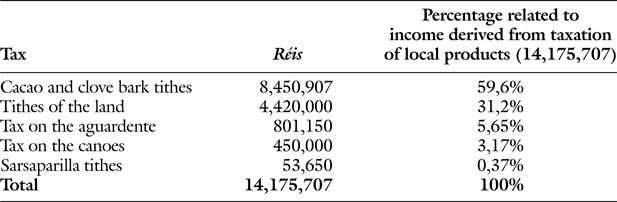
1 “Treslado das receitas que constaõ do livro do almoxar.do com que servio o almox.e que foi desta capitania do Parâ Luis Pereyra,” April 16, 1704, Bibliothéque Nationale de France, Manuscrits Occidentaux, Portugais 39, ff. 69–69v and 79v–80.
For the period 1699 to 1701, the customs office registered an income of a little more than 14 million réis derived from the taxation of local production. Cane liquor production generated a little less than 6 percent of total revenues.
From the figures above, it becomes clear that the taxation on aguardente had a moderate impact on the revenues of the royal treasury of the State of Maranhão. One has to consider, though, that this tax was recent (1695), as with the one levied on the canoes, and it would probably become higher with time. Moreover, as we have seen, aguardente production had been severely opposed by the kings for many years (at least since the 1660s), and the crown itself still had reservations even at the end of the seventeenth and beginning of the eighteenth century. The specter of sugar production, even if it did not threaten aguardente (two of the registered aguardente producers were also sugar producers), still haunted the molinetes.
By the end of the seventeenth century and the beginning of the eighteenth, therefore, sugar and aguardente were no longer diametrically opposed from the viewpoint of the crown.Footnote 126 The importance of aguardente was eventually acknowledged, based on recognition of its importance in dealing with the Indians and for the benefit of the royal treasury. Both factors were supported in the opinions of two experienced and influential governors of the State of Maranhão, Gomes Freire de Andrade and Antonio de Albuquerque Coelho de Carvalho, who provoked the king to revise his policies toward aguardente and sugar production. Even in 1702, as seen above, when the royal treasurer complained that the engenhocas and distilleries were responsible for the dismantlement of the sugar mills, the crown continued to authorize the erection of alambiques, insisting, nevertheless, that they should be built only where they could not menace sugar production.Footnote 127 Colonial experience and the particularities of the Amazon region, therefore, obliged the crown to adopt solutions specific to different situations.
Conclusion
At the very end of his reign, in 1706, Dom Pedro II would determine severe punishments for those senhores de engenho “who produce aguardente from the canas that can be used to produce sugar.” Although the king mentioned the “extinction of the molinetes,” the royal provision was clearly meant to condemn those senhores who had sugar mills and who also produced aguardente. It did not mean the total extinction of the alambiques. The only one to be sanctioned, according to the royal order, was the “senhor who from now on does not produce sugar and makes aguardente from the canas.”Footnote 128
Always with the caveat that the molinetes should not threaten sugar production, it became clear over time that aguardente was crucial for the government of Maranhão and Pará, the sertões, and the Indians. The establishment of a tax on the beverage and the authorization to erect new engenhocas proved that the crown had, finally, acknowledged the centrality of aguardente for the Amazonian economy and territorial dynamics.
Nevertheless, the issues surrounding aguardente would persist throughout the eighteenth century. Sue Gross and Ana Paula Macedo Cunha have shown that the debate continued through the first half of the eighteenth century, and became concentrated on those who diverted their efforts to producing aguardente, leaving sugar production behind.Footnote 129 Nevertheless, authorizations to build engenhocas continued to be granted, on condition that they be located at a certain distance from the sugar mills. Camila Loureiro Dias has stressed that during the Amazonian cacao boom in the 1720s and 1730s, aguardente was thought to be the best mode of payment for those Indians who took part in the expeditions that traveled to the hinterland in search of the drogas do sertão.Footnote 130
During the second half of the eighteenth century, when important reforms concerning both the role of Indians in Amazonian economy and society and the conduct of trade in the hinterland were put into practice, aguardente continued to be crucial in the exchanges between whites and the Indians, including those who lived in the sertão and those who belonged to the colonial villages (vilas and lugares de índios).Footnote 131 Not surprisingly, according to the new laws, aguardente was strictly forbidden in the Indian villages, yet it was permitted in the canoes that went to the sertão.Footnote 132
Portuguese authorities, counselors, kings, and even many settlers condemned aguardente for its role in hindering the development of a sugar industry in the State of Maranhão. According to them, the beverage caused not only moral problems among the Portuguese and the Indians, but, worse, it diverted efforts (and sugarcane) that should have been invested in producing sugar instead. If aguardente was the “villain,” however, one cannot neglect those who consumed it, notably the Indians. In the mid eighteenth century, the Jesuit father João Daniel stressed that the alcoholic drink that the Indians liked most was aguardente made from sugarcane (“aguardente de cana alambicada”). That was the reason, he explained, that it was the best product Portuguese could take in their “missions” to the Indians, since “for a flask” they would do anything.Footnote 133
The history of aguardente in seventeenth-century Portuguese Amazonia illustrates how colonial policies issued from Europe would be reshaped from colonial experience. On one hand, an ideal colonial model, although originally based on the establishment of a sugar industry, had to be thought of in other dimensions as well, since the production of aguardente revealed itself over time to be more important than sugar for the reproduction of colonial rule in the Amazon region. From another angle, it was the colonization process itself that engendered a shift in the policies that the crown used to administer the region.
Sugar production was the economic ideal of the crown for the state of Maranhão and Pará. That was the reason that the king, royal councils, and royal and local authorities struggled to establish a sugar industry in the region during the seventeenth century. However, Indians’ increasing demand for aguardente, possibly a substitute for their now-forbidden traditional fermented beverages, transformed the original plans. In fact, many settlers, even though they continued to produce sugar, also cultivated and ground sugarcane, mostly to produce the cane liquor needed for the Indians (and the settlers as well).
Contrary to the view of the crown, crown authorities, and some settlers, it was not aguardente itself that was responsible for the “diminution of sugar.” One could argue that Indians in the hinterland and especially those living in colonial villages and towns, reinterpreting their traditions and creating new patterns of consumption as their lives changed, created a demand for the spread of aguardente production, which became a medium for both Portuguese dominion and the survival of Indians in colonial society.
Given the crucial importance of Indians for the Portuguese colonization of the Amazon region, and given the economic dynamics that developed in the region during the second half of the seventeenth century, the stage was set for aguardente to become an important aspect of the political economy of the region. The alleged failure of a sugar industry in the Amazon region, stressed in both classic and recent historiography, calls out to be reassessed. On one hand, sugarcane cultivation had a political and strategic importance for the region, in addition to its economic impact. Governor Carvalho de Albuquerque's words are revealing: cane liquor was needed for the “government” of the Indians and the sertões. From another point of view, there was a sugar industry in the north, but it did not direct its efforts to exportation of sugar to Lisbon. Rather, it was intimately interconnected with other economic activities, such as the gathering of Amazonian spices in the hinterland and the Indian slave trade. Colonial Indians, not only through their labor and knowledge of the forest, but also through their consumption practices, helped to shape these dynamics and made them crucial to the functioning of the Amazonian economy.



