Introduction
An important domain of investigation within the field of psycholinguistics is lexical access; that is, the need to activate the lexical item that corresponds to the concept that one wishes to communicate. Although a great deal of research on lexical access has been conducted with adult bilinguals, there are significantly fewer studies examining such processes in very young bilinguals. A dominant perspective indicates that lexical and memory systems are interconnected, allowing bilinguals to store, access, and process lexical information of two languages (Bartolotti & Marian, Reference Bartolotti and Marian2012). Most models of lexical access share the assumption that lexical selection is a competitive process (Finkbeiner, Gollan & Caramazza, Reference Finkbeiner, Gollan and Caramazza2006; Levelt, Roelofs & Meyer, Reference Levelt, Roelofs and Meyer1999). This view assumes that the ease with which a target word is selected depends not only on its own activation level but on the activation level of competing lexical items as well. Even in the monolingual case, competition as occurs in polysemy (the presence of multiple possible meanings for the same word, e.g., twist) is assumed to cause interference on lexical decision tasks. The closer two lexical representations are in meaning, the more interference in selecting the target word. For example, when trying to name a picture of a couch, the lexical representations couch and sofa should become similarly activated given their synonymy, making the selection of the target lexical node very difficult. This challenging computational problem, also called the ‘hard problem’, is amplified in bilingual speakers, given that their vocabulary typically contains a large number of cross-language synonyms or translation equivalents (TE; e.g., chien and dog). Several explanations have been proposed to account for the way adult bilinguals solve this hard problem (Finkbeiner et al., Reference Finkbeiner, Gollan and Caramazza2006). To date, only a few of these models have been developmental in nature and all require further empirical evidence (DeAnda, Poulin-Dubois, Zesiger & Friend, Reference DeAnda, Poulin-Dubois, Zesiger and Friend2016).
Evidence for cross-language competition in lexical selection emerges from research using the Picture-Word Interference paradigm with adult bilinguals. This approach requires participants to name pictures in a target language, while ignoring distractor words in a non-target language. The presence of a semantically related distractor word from the non-response language causes interference, which is evinced by longer delays to name the target image (Ferré, Sánchez-Casas & Guasch, Reference Ferré, Sánchez-Casas and Guasch2006; Glaser & Düngelhoff, Reference Glaser and Düngelhoff1984; Glaser & Glaser, Reference Glaser and Glaser1989; Hermans, Bongaerts, de Bot & Schreuder, Reference Hermans, Bongaerts, De Bot and Schreuder1998; Kaushanskaya & Marian, Reference Kaushanskaya and Marian2007; Lupker, Reference Lupker1979; Lee & Williams, Reference Lee and Williams2001; Moldovan, Sánchez-Casas, Demestre & Ferré, Reference Moldovan, Sánchez-Casas, Demestre and Ferré2012). These studies provide evidence for semantic activation of two lexicons when multiple lexical representations are associated with the same semantic node. More specifically, results indicate that the degree of semantic similarity between words may modulate interference effects – i.e., more robust interference effects with words closer in meaning.
Alternatively, other research on both monolinguals’ and bilinguals’ lexical access reports faster lexical decision making for words that are semantically ambiguous (e.g., twist: to make into a spiral, to operate by turning, etc.; Rodd, Gaskell & Marslen-Wilson, Reference Rodd, Gaskell and Marslen-Wilson2002). The rich semantic representations associated with words with many senses facilitate their recognition. There are now several studies showing facilitation effects for TEs in adult bilinguals using both picture naming tasks (Broersma, Carter & Acheson, Reference Broersma, Carter and Acheson2016; Christoffels, De Groot & Koll, Reference Christoffels, De Groot and Kroll2006; Costa, Caramazza & Sebastian-Galles, Reference Costa, Caramazza and Sebastian-Galles2000; Costa & Caramazza, Reference Costa and Caramazza1999; Costa, Miozzo & Caramazza, Reference Costa, Miozzo and Caramazza1999; Gollan, Montoya, Fennema-Notestine & Morris, Reference Gollan, Montoya, Fennama-Notestine and Morris2005; Kroll, Bobb, Misra & Guo, Reference Kroll, Bobb, Misra and Guo2008) and masked priming paradigms (Basnight-Brown & Altarriba, Reference Basnight-Brown and Altarriba2007; Davis, Sánchez-Casas, Garcia-Albea, Guasch, Molero & Ferré, Reference Davis, Sánchez-Casas, Garcia-Albea, Guasch, Molero and Ferré2010; De Groot & Nas, Reference De Groot and Nas1991; Duñabeitia, Perea & Carreiras, Reference Duñabeitia, Perea and Carreiras2009; Duyck & Warlop, Reference Duyck and Warlop2009; Finkbeiner, Forster, Nicol & Nakamura, Reference Finkbeiner, Forster, Nicol and Nakamura2004; Kim & Davis, Reference Kim and Davis2003; Nakayama, Verdonschot, Sears & Lupker, Reference Nakayama, Verdonschot, Sears and Lupker2014; Voga & Grainger, Reference Voga and Grainger2007). In masked priming studies it would appear that adults are faster to select target words in a non-dominant language when they are primed in a dominant language with a corresponding TE (e.g., Basnight-Brown & Altarriba, Reference Basnight-Brown and Altarriba2007). Interestingly, however, much smaller – or even absent – effects have been observed in the direction of a non-dominant to dominant language (Grainger & Frenck-Mestre, Reference Grainger and Frenck-Mestre1998). With respect to picture naming tasks, there appears to be a facilitation effect for TEs in both dominant and non-dominant languages. For example, monolinguals tend to develop one-to-one relations in one language (e.g., the word “apple” refers to the concept of a round-shaped fruit), whereas bilinguals tend to develop many-to-one relations in two languages (e.g., the words “apple” and “pomme” both refer to the concept of a round-shaped fruit). Furthermore, although this facilitation effect has been observed using explicit translation cues (i.e., participants were asked to name a target word with its translation presented in written form as a distractor; Costa & Caramazza, Reference Costa and Caramazza1999; Costa et al., Reference Costa, Miozzo and Caramazza1999), it has also been observed to occur implicitly within adult bilinguals, without any sort of overt cues (Gollan & Acenas, Reference Gollan and Acenas2004). The fact that a facilitation effect has been shown to occur in paradigms where the prime is either absent or present provides evidence that both languages are indeed active during single-language tasks (Wu & Thierry, Reference Wu and Thierry2010). Although this effect has been observed to occur in adults, there is much less evidence showing simultaneous activation of both languages in very young bilinguals. The present study aimed to investigate the presence of the TE facilitation effect in a sample of 22-month-old bilingual toddlers in order to determine if this phenomenon emerges early in development.
Lexical processing in young bilinguals
As previously mentioned, although facilitation effects have been observed for TEs in adult bilinguals, there is currently a lack of research examining such effects very early in development when bilinguals are just beginning to build their receptive and expressive lexicons. Recent research based on modeling has shown a facilitation effect for word learning in very young bilinguals such that word learning appears to be facilitated by knowledge of a corresponding TE in the non-target language (Bilson, Yoshida, Tran, Woods & Hills, Reference Bilson, Yoshida, Tran, Woods and Hills2015). This suggests that having an existing semantic network expedites processing and integration of new referents into memory even at the earliest stages of bilingual acquisition. Indeed, Byers-Heinlein and Werker (Reference Byers-Heinlein and Werker2013) have proposed the lexicon structure hypothesis, which suggests that bilingual children with many TEs in their receptive and expressive vocabularies have a richer network of semantic connections relative to monolingual children, particularly at the earliest stages of development. The hypothesis suggests that children's use and development of disambiguation to infer the referent of a novel word will depend on their lexicon structure. More specifically, it relies on whether the lexicon structure consists of one-to-one mappings between words and concepts or many-to-one mappings between words and concepts (Byers-Heinlein & Werker, Reference Byers-Heinlein and Werker2013). Furthermore, as children acquire more TEs in their vocabulary, this semantic organization becomes more complex and may facilitate lexical processing and word learning in young bilinguals. Interestingly, research with adults suggests that increased semantic-relatedness between translation equivalents positively impacts the ease by which the association between word and concept is learned (Bracken, Degani, Eddington & Tokowicz, Reference Bracken, Degani, Eddington and Tokowicz2016). However, ambiguous words – words with many-to-one mappings – have been shown to impede word learning (Degani & Tokowicz, Reference Degani and Tokowicz2010).
This lexicon structure hypothesis is consistent with both the adult priming and picture naming literatures, as well as recent research corroborating the TE priming effect in bilinguals as young as 21 months of age. More specifically, Von Holzen and Mani (Reference Von Holzen and Mani2012) sought to investigate young bilinguals’ phono-lexical organization by manipulating the relations between prime and target words in English (non-dominant language) and German (dominant language) respectively. In the first condition, phonological priming occurred wherein the prime and target words were phonologically related. A subsequent condition consisted of phonologically similar words where the German translations of the English prime words (e.g., leg, “Bein”) rhymed with the German target word (e.g., stein, “stone”). Results revealed evidence for a facilitation effect such that bilingual toddlers’ word recognition was enhanced in their dominant language when primed with a phonologically related word in their non-dominant language. Interestingly, an interference effect emerged when toddlers were primed with phonologically similar words in their non-dominant language, as evinced by reduced word recognition in their dominant language. This study presents the first evidence for phonological and lexical access across languages in young bilinguals.
Based on the same foundations as the lexicon structure hypothesis, several computational models have been proposed to account for the complexities associated with bilingual lexical development and cross-language processing. The Distributed Representation Model proposed by De Groot and colleagues, for example, suggests that for adult bilinguals conceptual representations for words in each language are distributed, and that TEs consist of both shared and separate semantic components (De Groot, Reference De Groot1992a, Reference De Groot, Frost and Katz1992b; Van Hell & De Groot, Reference Van Hell and De Groot1998). Thus, when bilinguals are asked to identify or name an object with a known TE, it is presumed that there is a greater activation of conceptual nodes in semantic memory than when bilinguals are asked to identify or name an object without a known TE. This creates a facilitation effect, which leads bilinguals to process words with a TE more quickly than words without. Similarly, the DevLex II model, developed by Zhao and Li (Reference Li and Zhao2013), is based on self-organizing maps through Hebbian learning. As a result of this connectionist learning system, lateral connections are formed between phonological, articulatory, and semantic maps, with TEs consisting of both shared and separate semantic components (Li & Zhao, Reference Li and Zhao2013; for a comprehensive review of developmental models please see DeAnda et al., Reference DeAnda, Bosch, Poulin-Dubois, Zesiger and Friend2016). Changes in lexical density, or neighborhood effects, are then modeled within the semantic map, in order to account for reaction time differences that have been observed to occur across languages in the literature. Importantly, the DevLex II model suggests that TEs have the greatest amount of semantic overlap within this network, and therefore form the strongest lateral connections, ultimately resulting in a facilitation effect during lexical processing, and faster reaction times.
Interestingly, Poulin-Dubois, Bialystok, Blaye, Polonia and Yott (Reference Poulin-Dubois, Bialystok, Blaye, Polonia and Yott2013) found that having a greater proportion of TEs was associated with faster lexical processing in the dominant language in a sample of 24-month-old French–English bilinguals using the Computerized Comprehension Task, a forced-choice measure of receptive vocabulary (CCT; Friend & Keplinger, Reference Friend and Keplinger2003; Friend, Schmitt & Simpson, Reference Friend, Schmitt and Simpson2012). This finding suggests that the rate at which a young bilingual child is able to retrieve words from memory in online processing tasks is heavily reliant on their ability to make connections between the target word and existing lexical items within their emerging semantic network. Relatedly, there is research showing that vocabulary size in general is significantly associated with speed of lexical access for both monolingual (Fernald & Marchman, Reference Fernald and Marchman2012; Fernald, Marchman & Weisleder, Reference Fernald, Marchman and Weisleder2013; Fernald, Perfors & Marchman, Reference Fernald, Perfors and Marchman2006) and bilingual children within each of their languages (Hurtado, Grüter, Marchman & Fernald, Reference Hurtado, Grüter, Marchman and Fernald2014; Legacy, Zesiger, Friend & Poulin-Dubois, Reference Legacy, Zesiger, Friend and Poulin-Dubois2016a; Legacy, Zesiger, Friend & Poulin-Dubois, Reference Legacy, Zesiger, Friend and Poulin-Dubois2016b; Marchman, Fernald & Hurtado, Reference Marchman, Fernald and Hurtado2010). It is possible that as children acquire new words, semantic connections between words are refined and clarified, facilitating retrieval of words from memory and enabling additional vocabulary growth (DeAnda et al., Reference DeAnda, Bosch, Poulin-Dubois, Zesiger and Friend2016).
Although there is evidence for the facilitation effect in adult bilinguals, inconsistent results have been obtained in dominant and non-dominant languages depending on the research paradigm that was used. In toddlers, only one study, to our knowledge, has examined this effect (Poulin-Dubois et al., Reference Poulin-Dubois, Bialystok, Blaye, Polonia and Yott2013). In fact, this study was limited to examining the relation between proportion of TEs and processing speed on the CCT in only the dominant language in a sample of 24-month-old bilinguals. Therefore, the present study aimed to replicate and extend these findings to a younger sample of bilinguals by examining differences in processing speed across words on the CCT that either had or did not have a known TE (based on parent report from the MacArthur Bates Communicative Development Inventory: Words & Sentences; CDI). Thus, it was possible to examine the direct impact that TE knowledge has on the complex relation between processing of words in dominant and non-dominant languages in very young bilinguals. We hypothesized that, similar to adults, these young bilinguals would be faster at retrieving words on the CCT with a known TE in comparison to words on the CCT without a known TE. It was also predicted that word processing speed would be equivalent across the two languages, as recently reported on the same task in bilingual toddlers (Legacy et al., Reference Legacy, Zesiger, Friend and Poulin-Dubois2016b). Finally, we examined if the facilitation effect would be less robust in the non-dominant language, particularly in children with a less balanced exposure.
Method
Participants
The current sample is part of a longitudinal study consisting of six waves of data collection. Participants were recruited from the second wave of the study that originally recruited participants through birth lists provided by a governmental health agency. We required that toddlers had no auditory or visual impairments, nor any birth complications, in order to participate in the study. Consistent with previous work, the selection criterion for bilingualism was exposure to a second language at a minimum of 20% from birth (e.g., David & Wei, Reference David and Wei2008; Legacy et al., Reference Legacy, Zesiger, Friend and Poulin-Dubois2016a). Toddlers exposed to a third language were not included, unless it corresponded to less than 10% of total language exposure. A total of 51 infants was tested but some were excluded due to fussiness (n = 5) or failure to complete testing or to return the CDI (n = 6). An additional four participants were excluded because they either did not meet criteria for data analysis (i.e., minimum of one TE on the CDI that corresponds to the CCT target word; n = 4) or were identified as an outlier on the CCT (n = 1; defined as 2.5 SD or more above or below the mean). The final sample consisted of 36 French–English simultaneous bilingual toddlers (21 males and 15 females) with a mean age of 23.73 months (SD = .96). Participants’ ages ranged from 21.77 to 26.27 months. Participants were exposed to their non-dominant language an average of 35% of the time (SD = 9%, Range = 21–50%). A total of 17 children were English-dominant and 19 children were Frenchdominant.
Sixty-one percent of the sample consisted of first-borns, 31% consisted of second-borns, and 8% had two or more older siblings present in the household. Seventy-eight percent of mothers held a university degree.
Measures
Language Exposure Assessment Tool (LEAT)
The LEAT is a questionnaire that is administered in the form of a semi-structured interview, whereby parents are asked to estimate the number of hours that their child is exposed to each of their languages in a given week. Information is gathered on the number of individuals who interact with the child on a weekly basis, the languages that they speak to the child, and the context in which the interactions typically occur. A global language exposure estimate is then calculated as a percentage based on this data via an electronic form. Importantly, the LEAT demonstrates strong internal consistency (α = .96) and criterion validity in that relative language exposure predicted vocabulary size across French, English and Spanish samples of 17-month-old children (DeAnda, Bosh, Poulin-Dubois & Friend, Reference DeAnda, Bosch, Poulin-Dubois, Zesiger and Friend2016). Moreover, the measure accounts for unique variance in children's vocabulary over and above the variance accounted for by global parent estimates of exposure (DeAnda, Bosch, et al., Reference DeAnda, Bosch, Poulin-Dubois, Zesiger and Friend2016).
MacArthur-Bates Communicative Development Inventory: Words and Sentences (CDI)
The French-Canadian and the American-English adaptations of the CDI were used to assess toddlers’ total productive vocabulary and TEs (Fenson, Dale, Reznick, Thal, Bates, Hartung, Pethick & Reilly, Reference Fenson, Dale, Reznick, Thal, Bates, Hartung, Pethick and Reilly1993; Trudeau, Frank & Poulin-Dubois, Reference Trudeau, Frank and Poulin-Dubois1999). These parent report vocabulary checklists consist of 664 and 680 word items in French and English, respectively, and include nouns, verbs, and adjectives that children aged 16 to 30 months old would typically produce. A parent, caregiver, or educator who interacted with the child in the target language of the questionnaire, and who also had adequate knowledge of the child's lexicon in the language of interest completed each questionnaire. The CDI presents with good reliability and validity and has been translated in more than 50 languages. The original English (Fenson et al., Reference Fenson, Dale, Reznick, Thal, Bates, Hartung, Pethick and Reilly1993) as well as French-Canadian (Trudeau et al., Reference Trudeau, Frank and Poulin-Dubois1999) adapted versions were administered in the present study. Importantly, the CDI was used to identify TE pairs in bilinguals’ vocabularies.
Computerized Comprehension Task (CCT)
The CCT is a laboratory-based behavioural measure that assesses toddlers’ receptive vocabularies in French and English (Friend & Keplinger, Reference Friend and Keplinger2003; Friend et al., Reference Friend, Schmitt and Simpson2012). Two images simultaneously appear side by side on a tactile screen, and the child is verbally prompted to touch the image that corresponded to a target word. An auditory reinforcement ensued (e.g., the word dog in child-directed speech) only if the toddler touched the target image. The target and distractor images are balanced for colour, size, difficulty and word class. With regard to word class, the majority of trials assessed toddlers’ knowledge of nouns, followed by verbs and adjectives, consistent with the early word learning literature showing that acquisition of nouns occurs earlier than verbs and adjectives (e.g., Waxman, Fu, Arunachalam, Leddon, Geraghty & Song, Reference Waxman, Fu, Arunachalam, Leddon, Geraghty and Song2013). The CCT exists in two forms, whereby the images that serve as targets in one version and serve as distractors in the other.
A total of four training trials are administered, followed by 41 test trials of image pairs representing nouns (23 pairs), verbs (11 pairs), and adjectives (7 pairs). Image pairs correspond to words derived from the CDI: Words and Gestures (Dale & Fenson, Reference Dale and Fenson1996). The test trials vary in degree of difficulty (easy, moderately difficult, and difficult), and are classified based on normative parent report data obtained from the CDI (Dale & Fenson, Reference Dale and Fenson1996).
Subsequently, a total of 13 reliability trials were administered following the test trials if the child stayed in a quiet-alert state. The reliability trials consisted of picture pairs that previously appeared on the screen – however the target appeared on the opposite side. We employed a Pearson correlation between test and reliability trials and obtained a coefficient of .99, indicating that the CCT provides reliable estimates of toddlers’ receptive vocabularies. Similar indices of reliability have been obtained in previous studies (e.g., Friend & Keplinger, Reference Friend and Keplinger2003). The CCT also presents good convergent validity with the CDI and good test-retest reliability at 4-months follow-up (Friend & Keplinger, Reference Friend and Keplinger2003; Friend & Zesiger, Reference Friend and Zesiger2011).
Procedure
Children and their parents visited the lab on two separate occasions, with test language counterbalanced across visits. The testing sessions lasted about an hour and were scheduled one to two weeks apart. During the first visit, demographic and language exposure information were collected, and parents were instructed on how to fill out the CDI questionnaires, which were returned at the following visit. After an initial warm up period, children were taken into an adjoining room and seated comfortably on their parent's lap in front of the CCT. Parents were asked to wear opaque sunglasses and noise cancelling headphones to prevent parental interference. The experimenter, seated next to the child, then administered the CCT training trials until the child understood the task. Once children appeared to be comfortable interacting with the CCT touch screen, the experimenter proceeded with the test trials by asking the child, “Where's the __? Touch __.” for nouns, “Who is __? Touch __.” for verbs, and “Which one is __? Touch __.” for adjectives. Accuracy and reaction time (RT) were recorded automatically using the CCT software. Accuracy scores were calculated by summing the number of correct trials on the CCT, and RT was recorded from the time images were presented on the screen until the participant touched one of the two images. Images remained on the screen for a maximum of seven seconds. Trials were considered as missing if the participant did not produce a response. In the instance where the trial timed out after the seven seconds, the image disappeared and the child could no longer respond. Importantly, if the child reached for the screen as the trial timed out, an experimenter either coded the behavior or the trial was re-administered at the end of the session if the pointing behavior was ambiguous.
We first assessed children's dominant and non-dominant vocabulary size as well as their total conceptual vocabulary on the full set of items on the CCT. Then, correct and incorrect trials on the CCT in both the dominant and non-dominant languages of each child were sorted into one of two categories based on results obtained from the English and French versions of the CDI. The following categories were created: trials with a known TE (TE) and trials without a known TE (non-TE). For example, if a child correctly identified the word dog on the CCT, and was also reported to produce the words dog and chien on the CDI, the word dog was placed in the TE category. As a result, its corresponding RT was included in the participant's average RT score for correct trials with a TE. Similarly, if the child correctly identified the word dog on the CCT, but was not reported to produce the words dog and chien on the CDI, the trial was placed in the non-TE category, and its corresponding RT was included in the participant's average RT score for correct trials without a TE. Importantly, all RTs under 300 ms were excluded and considered to be impulse responses. Proportion scores of correct CCT trials with and without TEs were then calculated in the child's dominant and non-dominant language. Proportion scores consisted in the total number of correct trials divided by the total number of completed trials in each word category.
Lastly, a total proportion of TEs was calculated for each child by summing the total number of TE pairs selected by parents on the CDI and multiplying by two. Cognates (e.g., jeans in English, jeans in French) and semi-cognates (e.g., telephone in English, téléphone in French) were not included in this total to restrict our analysis of TEs to words whose meanings in one language could not be inferred from their meaning in the other language. This sum was then divided by the total number of words marked as produced in both languages, after non-equivalent words (words that exist on one form but not the other) were removed.
TE words on the CCT were determined based on a list of potential TE pairs derived from the CDI. This list was developed and reviewed by three French–English bilingual speakers who reviewed the English and French versions of the CDI and agreed on appropriate TE pairs. A TE consisted of a pair of items that were semantically similar and classified as belonging to the same word category. If the parent indicated that the child was able to produce the word in both English and French on the CDI, it was considered a TE. Importantly, when both versions of the CDI were administered, parents were instructed to only endorse an item if the child knows the ‘true meaning’ of the word and is able to produce the word outside a particular context.
Results
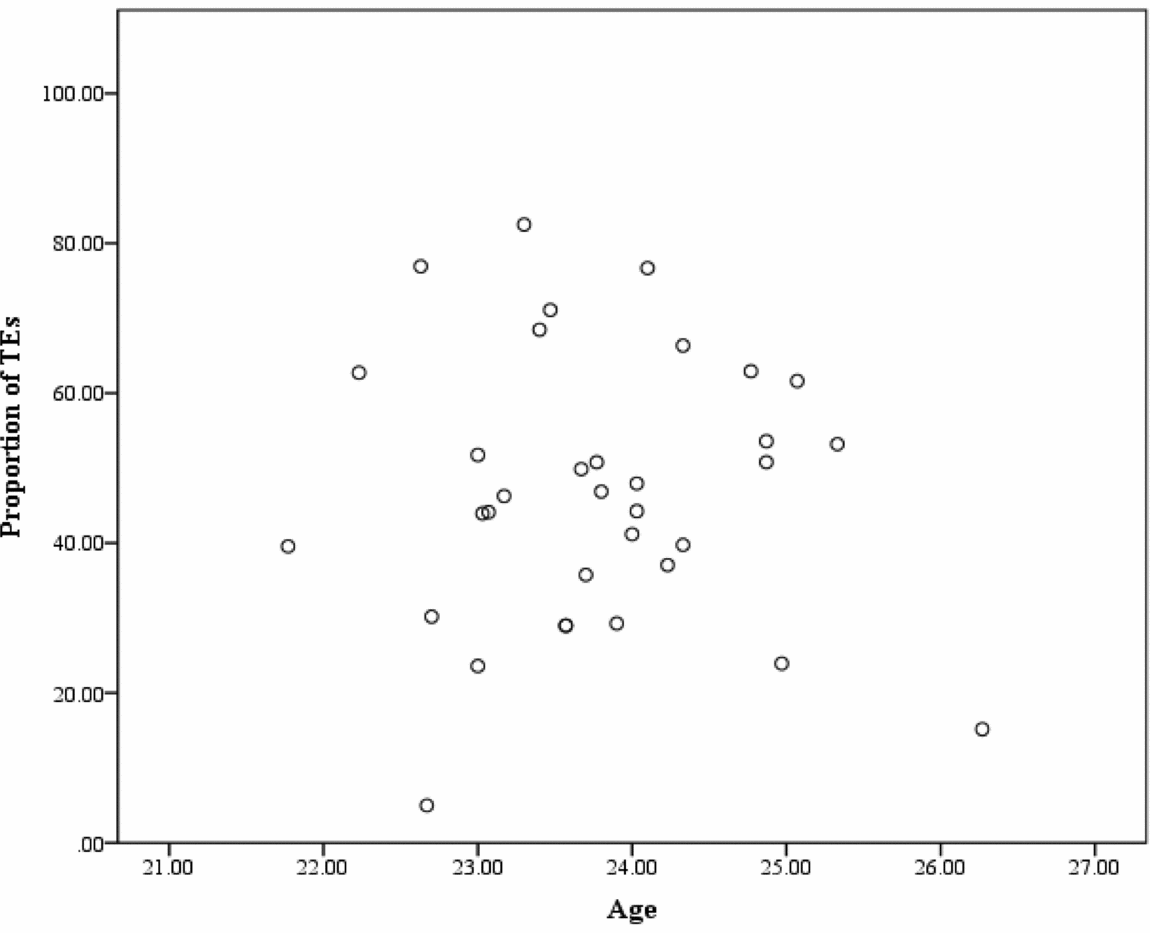
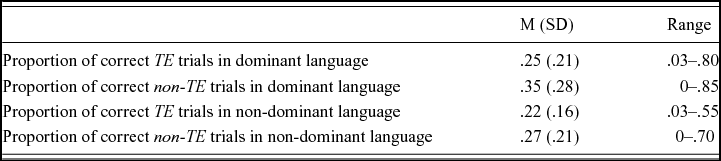
The first set of analyses examined the expressive vocabulary size and the proportion of TEs. Conceptual vocabulary, as measured by the CDI, ranged from 40 to 651 words (M = 280.33, SD = 154.71), and the percentage of TEs ranged from 5.00% to 82.49% (M = 46.88%, SD = 18.61%). Proportion of TEs for individual participants as a function of age is displayed in Figure 1. Consistent with previous work, children produced more words in their dominant language (M =241.40, SD = 156.34) relative to their non-dominant language (M =145.50, SD = 116.54) on the CDI, t (35) = 4.64, p < .001, d = 0.70 (e.g., Legacy et al., Reference Legacy, Zesiger, Friend and Poulin-Dubois2016a). As reported in previous research on word recognition in bilinguals with the CCT (Legacy et al., Reference Legacy, Zesiger, Friend and Poulin-Dubois2016b), toddlers understood more words in their dominant (M = 28.36, SD = 6.10) compared to their non-dominant (M = 24.19, SD = 5.73) language, t (35) = 3.95, p < .001, d = 0.71. RTs on the CCT were also analyzed. When breaking down receptive vocabulary comparisons into the TE and non-TE categories in a 2 (language: dominant vs. non-dominant) x 2 (word category: TE vs. non-TE) ANOVA, a main effect of language (F (35) = 15.23, p < .001, η2 = .30; dominant: M = 13.89, SD = .50) and word category (F (35) = 8.93, p = .005, η2 = .20; TE : M = 9.42, SD = 1.16 & non-TE: M = 16.11, SD = 1.22) emerged, such that children understood more words in their dominant language compared to their non-dominant language, regardless of the category of words. Children's greater number of correct trials in the non-TE category compared to the TE category can be explained by a larger number of non-TE trials available on the CCT. When proportion scores are considered, children completed an equal number of correct CCT trials across TE and non-TE categories (t (35) = .224, ns., d = 0.03). The mean proportion of words understood in each category is displayed in Table 1.
Toddlers’ proportion of TEs as a function of age (mo). Proportion scores did not include cognates (e.g., jeans in English, jeans in French), semi-cognates (e.g., telephone in English, téléphone in French) or non-equivalents (words that exist on one form of the CDI but not the other).

Descriptive statistics for accuracy on the CCT (N = 36).

Comparison of RTs across the TE and non-TE categories
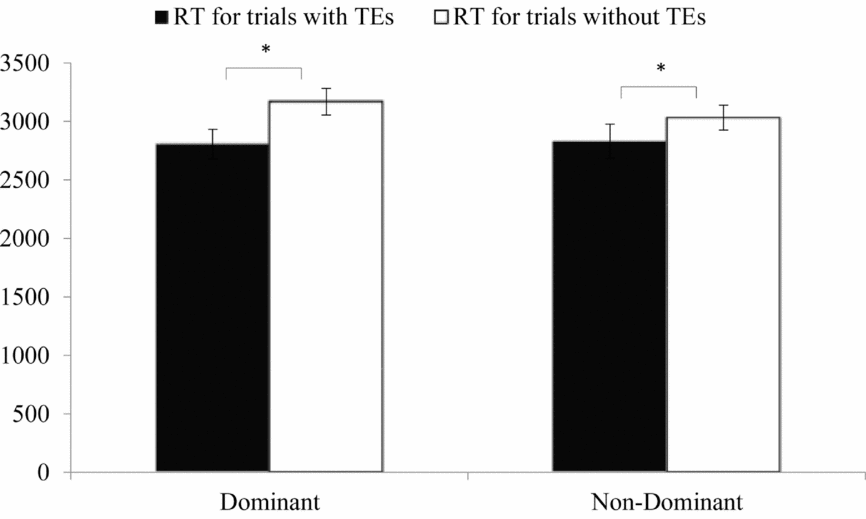
In order to examine whether speed of processing on correct CCT trials in their dominant and non-dominant languages differed as a function of whether they had corresponding TEs on the CDI, a Language x Word Category repeated measures ANOVA was computed. As shown in Figure 2, results indicated a main effect of word category (F (35) = 29.52, p < .001, η2 = .46), such that infants were faster to respond to trials with a known TE (M = 2700.64, SD = 84.71) compared to trials without a known TE (M = 3045.47, SD = 80.41). This confirms the existence of a TE facilitation effect in very young bilinguals, with moderate to large effect sizes observed across languages. There was no link between the facilitation effect across dominant and non-dominant languages (as represented by a difference score for each child; i.e., RT on CCT non-TE trials subtracted from RT on CCT TE trials) and relative exposure and receptive vocabulary ratios (calculated for each child by dividing their score in their dominant language by their score in their non-dominant language). This was evinced by null correlations among all variables.
Mean reaction times (ms) for CCT trials with and without corresponding TEs on the CDI in the dominant and non-dominant language. Error bars are representative of standard error of the mean.

It has recently been argued that incorrect haptic responses on the CCT reflect partial knowledge of a target word, as opposed to a lack of response, which reflects an absence of knowledge (Hendrickson, Mitsven, Poulin-Dubois, Zesiger & Friend, Reference Hendrickson, Mitsven, Poulin-Dubois, Zesiger and Friend2015). Thus, despite the small number of available trials, similar analyses were conducted on RTs for incorrect trials. These analyses revealed neither main nor interaction effects. That is, no difference was observed for RTs in the TE (N = 19; M = 3214.90, SD = 151.40) and non-TE (N = 19; M = 3339.22, SD = 174.48) categories for words coded as incorrect on the CCT in either dominant or non-dominant language. This indicates that the TE facilitation effect observed is specific to known words, and is not present on trials where only partial knowledge of words might exist.
Cross-linguistic relations in RT across the TE and non-TE categories
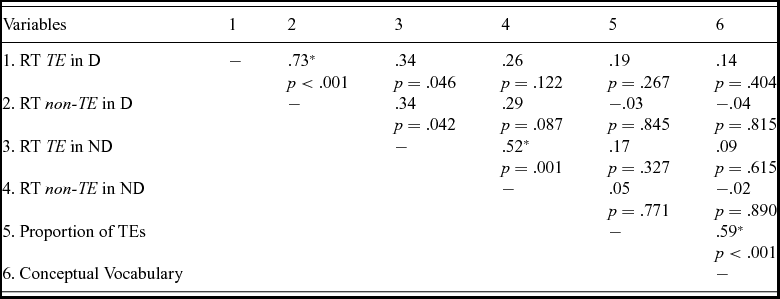
In order to examine the relation between RTs in the TE and non-TE categories, conceptual vocabulary, and the proportion of TEs, a series of zero-order correlations were computed. The False Discovery Rate method was applied to correct for multiple comparisons (Benjamini & Hochberg, Reference Benjamini and Hochberg1995). As shown in Table 2, RT for trials in the TE category was positively correlated with RT for trials in the non-TE category in both dominant and non-dominant languages. Moreover, conceptual vocabulary was positively correlated with proportion of TEs. No other correlations were statistically significant after applying False Discovery Rate corrections. Finally, although not reaching statistical significance, speed of processing was related across languages. Furthermore, the proportion of TEs in children's expressive vocabulary did not predict speed of lexical access, confirming that the facilitation effect is specifically related to the presence of synonymous lexical nodes for the target concept.
Zero-order correlations between CCT reaction times and CDI variables (N=36).

Note. * indicates significance using a False Discovery Rate adjusted alpha for multiple comparisons (Benjamini & Hochberg, Reference Benjamini and Hochberg1995). D=dominant;
ND=non-dominant
Discussion
The current study presents the first test of the translation facilitation effect in bilingual toddlers’ two languages. Like in adult bilinguals, a facilitation effect for TEs was observed with an online lexical retrieval task in a sample of 22-month-old French–English bilingual toddlers. Importantly, this facilitation effect appears to be present in both the bilinguals’ dominant and non-dominant languages, such that when a target word is presented in one language, implicit activation of its corresponding TE in the other language boosts speed of word retrieval.
The interconnectedness of bilingual memory has been an active topic of research in the literature on bilingualism. Decades of research on monolinguals have revealed that the adult lexicon functions as a network of interconnected words through which activation flows during language processing (Collins & Loftus, Reference Collins and Loftus1975; Holcomb, Grainger & O'Rourke, Reference Holcomb, Grainger and O'Rourke2002; Midgley, Holcomb, Van Heuven & Grainger, Reference Midgley, Holcomb, Van Heuven and Grainger2008). This type of model is supported by a number of on-line language processing tasks, including semantic priming tasks. Prior exposure to a related word facilitates subsequent word processing. That is, adults and children are faster and more accurate if the prime and target are semantically related (e.g., dog and cat). Such priming effects have been reported with lexical decision tasks, naming tasks, and event-related potential techniques (Finkbeiner et al., Reference Finkbeiner, Forster, Nicol and Nakamura2004; Fischler, Reference Fischler1977; Koivisto & Revonsuo, Reference Koivisto and Revonsuo2001; Perea & Rosa, Reference Perea and Rosa2002; Thompson-Schill, Kurtz & Gabrieli, Reference Thompson-Schill, Kurtz and Gabrieli1998). In very young children, innovative procedures such as the Head-Turn Preference procedure or the Intermodal Preference paradigm have also revealed that monolinguals show semantic priming between 21–24 months (Arias-Trejo & Plunkett, Reference Arias-Trejo and Plunkett2009; Styles & Plunkett, Reference Styles and Plunkett2009; Willits, Wojcik, Seidenberg & Saffran, Reference Willits, Wojcik, Seidenberg and Saffran2013). What about the lexical system of bilinguals? More than a decade of research has found ubiquitous evidence that lexical activation in bilingual memory operates in a parallel, language nonselective way, even when the social and linguistic context calls for only one language (Kroll & De Groot, Reference Kroll and De Groot2005). This question has also started to be investigated in bilingual children and there is evidence of both within-language and cross-language priming in 30-month-old bilinguals (DeAnda, Hendrickson, Zesiger, Poulin-Dubois & Friend, under review; Singh, 2013).
The present study used a touch-screen measure of online language processing to measure lexical access in very young bilinguals. This task differs in important ways from the paradigms that have traditionally been used in the literature, as it engages receptive vocabulary knowledge and does not present any explicit cues to the TE prior to prompting a response from the participant. Our procedure is a stringent test of the parallel activation of the two languages during the early stages of bilingualism; since the cross-language synonym is never presented, it needs to be implicitly activated in the presence of the target word. Thus, it would appear that both the target word and its corresponding TE automatically become activated in young bilingual language learners during online processing tasks by the end of the second year. Interestingly, the resting state of TE words appears to be higher than non-TE words, and they are faster to reach the activation threshold as a result. This in essence creates a cumulative frequency effect across dominant and non-dominant languages, providing strong evidence of an interconnected lexicon in bilinguals at this early stage of development.
No doubt, additional research will be needed to better understand the interconnectivity across languages in young bilinguals. For example, longitudinal designs would allow for the examination of the link between the strength of the association between cross-language synonyms and efficiency of lexical access. One might assume that the longer a TE has been in a child's vocabulary, the more likely it will be to facilitate word retrieval. Recall that the sheer percentage of TEs in a child's vocabulary was not related to speed of word processing across the two types of words. Furthermore, changes in word knowledge (from unknown to known) over time should be reflected in changes in the TE facilitation effect for this specific set of words. Finally, given that the CCT procedure can be administered as early as 16 months, future research should be directed to investigating the observed effect in even younger bilinguals, although the number of successful trials on the CCT tends to be limited in each of the bilinguals’ languages at that age (Legacy et al., Reference Legacy, Zesiger, Friend and Poulin-Dubois2016a).
Conclusion
In sum, this study provides the first evidence of a translation facilitation effect in bilingual children. The present set of findings, combined with recent research showing that young bilinguals retrieve words as quickly as monolinguals (Legacy et al., Reference Legacy, Zesiger, Friend and Poulin-Dubois2016a; Legacy et al., Reference Legacy, Zesiger, Friend and Poulin-Dubois2016b; Poulin-Dubois et al., Reference Poulin-Dubois, Bialystok, Blaye, Polonia and Yott2013) provides preliminary evidence that two translation equivalent nodes for the same concept impact lexical access even at the early stages of bilingualism. More specifically, given that the presence of a TE, as indicated by the CDI, facilitates identification and retrieval of a word on the CCT, this provides preliminary support for the activation of synonymous lexical nodes for a target concept in young bilinguals. This is in line with the substantial evidence showing that bilinguals exhibit some form of co-activation of both languages, even when the context requires use of only one of them. Such co-activation has been shown to create both interference and facilitation effects in adult bilinguals. Although we have shown that a facilitatory translation identity effect occurs at the early stages of bilingualism in a word recognition task, it remains to be seen whether facilitation or interference will be observed in a language production task, which is more susceptible to cognitive control mechanisms.