INTRODUCTION
The family, the most important unit of the social microstructure, provides care and protection for its members, particularly when they are unable to care for themselves. Providing care for a dying family member is a complex process that requires much effort and responsibility from caregivers since the family member's illness and subsequent care affects not only that particular person but also the relatives providing care for them. Authors dealing with issues such as the quality of life of families caring for a dying member (Meyers & Gray, Reference Meyers and Gray2001; Borneman et al., Reference Borneman, Chu and Wagman2003) state that this activity has an impact on the physical, psychological, social and spiritual aspects of life. The most common physical manifestations experienced by caregivers are fatigue, sleep disorders, and appetite loss (Wennman-Larsen & Tishelman, Reference Wennman-Larsen and Tishelman2002). This may also be due to the fact that, during the course of an illness, the care recipient may experience unpleasant symptoms, with a potentially negative impact on the caregiver. The psychological aspects most frequently reported by caregivers are emotional distress, stress, nervousness, fear, and depression (Peters & Sellick, Reference Peters and Sellick2006). Numerous studies have also pointed to the effect that caring for a dying person has on family and social relations (Boyle et al., Reference Boyle, Blodgett and Gnesdiloff2000; Crowe & Costell, Reference Crowe and Costello2003). Monitoring and assessment of the needs of family members of patients with life-limiting illnesses and consequent interventions may contribute to better quality of life and personal well-being for the family. Needs assessment allows for identification of areas that family members consider important and with which they need help and support (Waller et al., Reference Waller, Girgi and Lecathelinais2010). Support for family members is one of the main goals of palliative care, and it has been applied since the beginnings of the modern hospice movement. In practice, however, there are serious deficiencies in strategies regarding how to assess and react to caregivers' needs (Harding & Higginson, Reference Harding and Higginson2003; McMillan & Weitzner, Reference McMillan and Weitzner2003).
Research into care for family members began 20 years ago in three areas: caregiver burden, needs assessment, and quality of life (Deeken et al., Reference Deeken, Taylor and Mangan2003). Fridriksdóttir et al. (Reference Fridriksdóttir, Saevarsdóttir and Halfdánardóttir2011) claimed that family members of cancer patients have multiple needs, many of which are not adequately met. No questionnaire for research or clinical practice has been developed in the Czech Republic to be used in assessing family members' needs. Only Bužgová and colleagues (Reference Bužgová, Kozáková and Sikorová2015) developed a psychometric evaluation instrument for assessment of patients' needs in palliative care (PNAP). Certainly, research focusing on family members in palliative and cancer care in the Czech Republic is still in its infancy.
In other countries, several instruments for family members have been used, such as the Family Needs Assessment (FNA, 53 items; Tringali, Reference Tringali1986); the Need Satisfaction Scale (NSS, 20 items; Dawson, Reference Dawson1991); the Home Caregiver Need Survey (HCNS, 90 items; Hileman et al., Reference Hileman, Lackey and Hassanein1992); the Critical Care Family Needs Inventory (CCFNI, 45 items; Macey & Bouman, Reference Macey and Bouman1991); the Caregiver Needs Scale (CNS, 90 items; Longman et al., Reference Longman, Atwood and Sherman1992); the Family Needs Questionnaire (FNQ, 37 items; Serio et al., Reference Serio, Kreutzer and Witol1997); the Family Inventory of Needs (FIN, 20 items; Kristjanson et al., Reference Kristjanson, Atwood and Degner1995), and the Family Inventory of Needs–Husbands (FIN–H, 30 items; Kilpatrick et al., Reference Kilpatrick, Kristjanson and Tataryn1998). These assessment tools aim to identify priorities so that family members can receive support where it is most urgently needed. Additionally, they are a suitable means for evaluating treatment outcomes (Osse et al., Reference Osse, Vernooij-Dassen and de Vree2000) and developing communication between the caregiving team and the patient's family (Wen & Gustafson, Reference Wen and Gustafson2004). Most of these needs assessment instruments for family members have been developed and validated in English but not in Czech or other languages. Only the psychometric properties of the Persian (Bandari et al., Reference Bandari, Majideh and Nahid2014), Chinese (Chien et al., Reference Chien, Ip and Lee2005), and Spanish versions (Gómez-Martíinez et al., Reference Gómez-Martíinez, Arnal and Juliá2011) of the CCFNI have been published in international journals.
We chose the FIN questionnaire, which has fewer items, for use in the Czech setting. Based on so-called “fulfillment theory,” the FIN determines the extent to which needs are met when care is provided (Kristjanson et al., Reference Kristjanson, Atwood and Degner1995; Schaffer, Reference Schaffer1953).
Each year, approximately 105,000 die in the Czech Republic, 25% of whom perish from malignancies and 50% from cardiovascular and cerebrovascular diseases. The remaining 25% die of lung, liver, or kidney diseases, and injuries. The most common place of death is a hospital (60%), followed by long-term care facilities (9%). Usually, another four or five close relatives or friends are affected by a serious disease (Sláma et al., Reference Sláma, Kabelka and Špinková2013). Health professionals caring for patients with a terminal illness encounter approximately 300,000 to 400,000 family members each year who need their support. The FIN questionnaire could help physicians and nurses in hospitals or in home care to better identify family needs and thus ensure more adequate interventions. Our research into the use of the FIN will enable comparison of the results of family needs assessment in an international context.
The first palliative care research center was established in the Czech Republic last year with the objective of developing research and education in the area of palliative care. In order to support family care, identification of the needs of family member must be a research priority (Sláma et al., Reference Sláma, Kabelka and Špinková2013). In addition, medical, nonmedical, psychological, and social university centers are interested in developing research focused on family members. There are more than 40 such university centers in the Czech Republic.
The objective of our present study was to explore the psychometric properties of the Czech version of the FIN, which was translated by the authors.
The adaptation and psychometric validation of needs assessment instruments translated into other languages is an important step in enabling crosscultural comparisons (Garre-Olmo et al., Reference Garre-Olmo, Planas-Pujol and López-Pousa2010). Readers from other nations can be informed about the existence of a Czech-language version of the FIN, and they may subsequently use our results for crosscultural comparisons.
METHODS
Subjects
Our study comprised 272 family members of cancer patients at the University Hospital in Ostrava eligible for palliative care. The inclusion criteria were: to be over 18 years of age, to have signed an informed consent form, and to be a person providing major support to a hospitalized cancer patient for whom curative therapy has been discontinued. The questionnaire was completed by 146 family members on two separate occasions, with a time interval of 20–60 days.
The study conformed to the provisions of the Declaration of Helsinki and was approved by the ethics committees of the University Hospital. All patients were informed of the study objectives and gave their written consent.
Instruments
FIN Questionnaire
The Family Inventory of Needs is a 20-item questionnaire assessing the needs of family members of cancer patients. The tool was developed using the Critical Care Family Needs Inventory (CCFNI). It was designed to measure the importance of care needs and their fulfillment. The importance of needs is defined as family members' perceptions of needs for healthcare. Fulfillment is defined as the extent to which family members perceive that these care needs have been met (Kristjanson et al., Reference Kristjanson, Atwood and Degner1995).
Each questionnaire item represents one family member's needs. In the original version of the FIN, the importance of needs was rated on a scale of 1 (not important) to 10 (very important), and fulfillment was rated as met or unmet (Kristjanson et al., Reference Kristjanson, Atwood and Degner1995). The importance of needs subscale was later abridged to 1 (not important) to 5 (very important), and the fulfillment of needs subscale was extended to include three categories: met, partly met, and unmet. Fulfillment of a need is only rated if a respondent designates the particular need as important or very important (i.e., scores of 4 or 5 on the importance subscale). The original English questionnaire was translated into Czech with the consent of the author, Linda Kristjanson, and in accordance with relevant recommendations. A translation protocol based on the guidelines supplied by Streiner and Norman (Reference Streiner and Norman2003) was drawn up. The scale was first translated into Czech by a professional translator. It was then reverse-translated into English by another professional translator. The reverse translation was compared with the original English version, any discrepancies were discussed among the translators, and a consensus was reached for the final translation. As a preliminary check, six Czech-speaking caregivers were then asked to read through the questionnaire with a research assistant and indicate whether the instructions or any of the items were unclear. All items were deemed to be clear.
QOLLTI–F Questionnaire
The Quality of Life in Life-Threatening Illness–Family Carer Version (QOLLTI–F), developed by Cohen et al. (Reference Cohen, Leis and Kuhl2006), was employed to assess the construct validity of the FIN questionnaire. The QOLLTI–F questionnaire contains 16 items addressing the following subscales: carer's own state (five items), relationships (two items), carer's outlook (three items), quality of care (two items), patient condition (one item), finances (one item), and environment (two items). The response scales were 11-point numerical rating scales (range of scoring options from 0 to 10), with a descriptive anchor at each end.
Data Analysis
The data were processed using SPSS statistical software (v. 21). Convergent validity, reliability, and construct validity were utilized to assess the psychometric properties of the questionnaire.
Convergent Validity
Convergent validity was tested by exploratory factor analysis and principal component analysis, with a varimax rotation. As a convenience sample was used, an exploratory rather than confirmatory analysis of scales was performed. Factor analyses are the recommended statistical procedures for scale development and exploratory analysis (Nunnally, Reference Nunnally1978). The number of components was determined by evaluating the criterion of eigenvalues greater than 1 and examining the scree plot. Loadings greater than or equal to 0.30 were judged to be significant. Before the factor analysis was performed, its adequacy was verified by the Kaiser–Meyer–Olkin (KMO) measure and Bartlett's test of sphericity.
Reliability
Three aspects of reliability were assessed: internal consistency, item–total correlation, and test–retest reliability. The internal consistency of the scales was assessed by calculating Cronbach's alpha coefficients, with an acceptable value deemed to be α > 0.70 (Terwee et al., Reference Terwee, Bot and de Boer2007). The item–total correlation was estimated to be at least 0.40 (Ware & Gandek, Reference Ware and Gandek1998). Test–retest reliability was verified using Spearman's rank correlation coefficient (r), with an acceptable minimum of 0.70 (Terwee et al, Reference Terwee, Bot and de Boer2007). Over a period of no longer than five days, the questionnaire was completed by 35 family members to assess test–retest reliability. For test–retest reliability, 10% of a study group is normally used.
Construct Validity
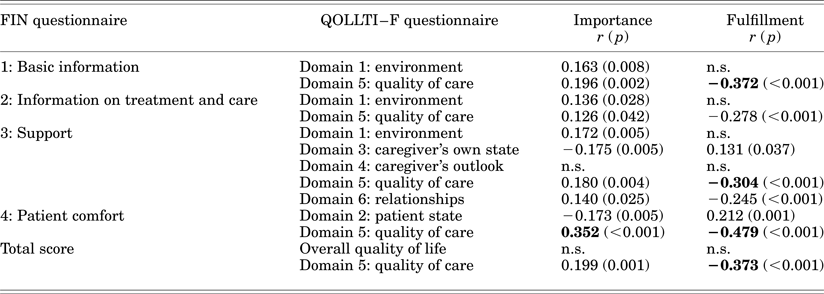
Construct validity was verified using Spearman's correlation coefficient between the FIN domains and selected domains of the Quality of Life in Life-Threatening Illness–Family Carer Version (QOLLTI–F) questionnaire. The nonparametric Spearman's rank correlation coefficient was used due to an abnormal data distribution (Kolmogorov–Smirnov test). Hendl (Reference Hendl2006) classifies the strength of a relationship according to the correlation coefficient r as follows: a weak relationship (r = 0.1–0.3), a moderate relationship (r = 0.3–0.7), and a strong relationship (r = 0.7–1). We hypothesized at least a moderate correlation between dissatisfaction with family members' needs fulfillment and the relevant quality-of-life dimensions. The QOLLTI–F questionnaire contains 16 items grouped into 7 domains (environment, patient's state, caregiver's own state, caregiver's outlook, quality of care, relationships, and financial worries). All 16 items have a possible range of 0 to 10. Additionally, there are two single-item measures of overall health and overall quality of life, ranging from 1 (very poor) to 7 (excellent).
RESULTS
Subjects
The psychometric properties of the FIN questionnaire were tested on a group of 272 family members of cancer inpatients receiving palliative care. Of these, 178 were female (65%) and 94 male (35%). The mean age of family members was 56.5 years (SD = 12.7, range = 26–89 years). Most frequently, family members were patients' spouses (90, 33%), followed by daughters (72, 27%), sons (46, 17%), partners (16, 6%), grandchildren (12, 4%), and other relatives (36, 13%).
Factor Analysis
Before a factor analysis was performed, its adequacy was verified by the KMO measure and Bartlett's test of sphericity. The KMO value was 0.92, that is, very high when compared with the recommended minimal value of 0.60. Bartlett's test of sphericity was employed to test the null hypothesis that the correlation matrix of the variables involved is an identity matrix, suggesting correlation coefficients of zero between the variables. The null hypothesis was rejected, meaning that a factor analysis could be performed (χ2 = 2735.1; df = 190; p < 0.001).
KMO values for individual variables can be found in the so-called anti-image matrix, that is, a matrix with negative partial correlation coefficients, and such values are shown on the diagonal of this matrix. All KMO values for individual variables were adequate (>0.5), ranging from 0.85 to 0.95. The interitem correlation was also adequate, ranging from 0.29 to 0.76, the only exception being item 19 (“Need to have someone concerned about my health”), which had an interitem correlation of only 0.08–0.26.
Additionally, communality was estimated after extraction of factors. The factor analysis explained 39–79% of the variance of variables. Only factors with a variance greater than 1 (eigenvalue) were included in the factor analysis.
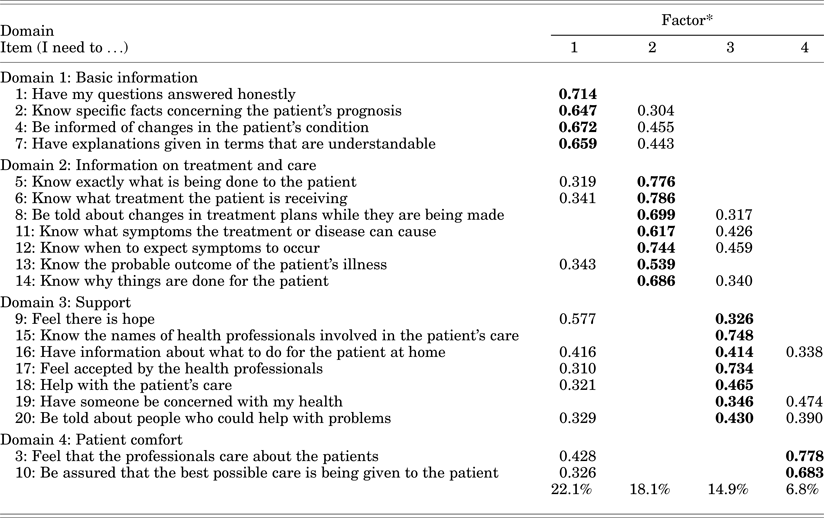
The exploratory factor analysis of all items distributed the responses into four different dimensions or factors (see Table 1). The first factor, explaining 19% of the variance, was termed “basic information.” It was concerned with providing understandable and objective information, and information on prognosis and changes in health status. The second factor was termed “information on treatment and care.” It explained information related to the treatment, care, and symptoms of the illness. The third factor, “support,” focused on support provided to family members by health professionals and on giving hope, help, and information about care at home. The last factor, “patient comfort,” was concerned with patient comfort and good care.
Exploratory factor analysis: burden of individual items

*Burdens greater than 0.3 are shown.
Reliability
Cronbach's α for the entire questionnaire were found to be high, at 0.924 for the importance subscale and 0.912 for the fulfillment subscale. The item–total correlation was also found to be adequate, ranging between 0.48 and 0.73 on the importance subscale and between 0.25 and 0.78 on the fulfillment scale.
Assessing Reliability in the Importance Subscale
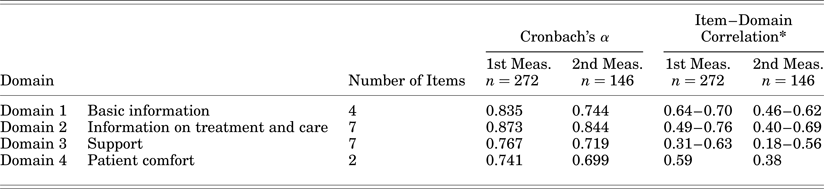
In all domains of the importance subscale, Cronbach's α was found to be adequate (>0.7) by both the first and second measurements (Table 2). A borderline value of α = 0.699 was ascertained by the second measurement in the patient comfort domain. The item–domain correlation was also adequate (r > 0.3). A low item–domain correlation was found by the second measurement for item 19 (“Need to have someone concerned about my health”) (r = 0.18). Additionally, the questionnaire's reliability was assessed after dividing family members into two subgroups. The first was made up of family members of patients able to communicate (n = 194), and the other subgroup comprised relatives of patients with cognitive deficits incapable of verbal communication due to progression of their disease. In both subgroups, the high reliability of the questionnaire was confirmed. The values of Cronbach's α for individual domains in family members of patients with/without cognitive impairment were 0.72–0.84 and 0.75–0.90, respectively.
Internal consistency of the importance subscale measured by Cronbach's α
*Total–item correlation.
Assessing Reliability in the Fulfillment Subscale
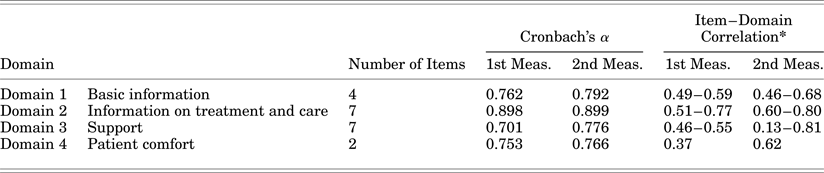
Similarly, in all domains of the fulfillment subscale, values of Cronbach's α were found to be adequate (>0.7) for both the first and second measurements (Table 3). Low item–domain correlations were indicated for item 9 (“Need to feel there is hope”) (r = 0.13) and again for item 19 (“Need to have someone concerned about my health”) (r = 0.21).
Internal consistency of the fulfillment subscale measured by Cronbach's α
*Total–item correlation.
When assessing reliability with family members divided into two subgroups according to the severity of patients' conditions (capable of communication vs. incapable of communication due to cognitive deficits), a high level of questionnaire reliability was observed in both family member subgroups. Relatives of patients with/without cognitive impairment had values of Cronbach's α of 0.70–0.87 and 0.71–0.91, respectively.
Test–Retest Reliability
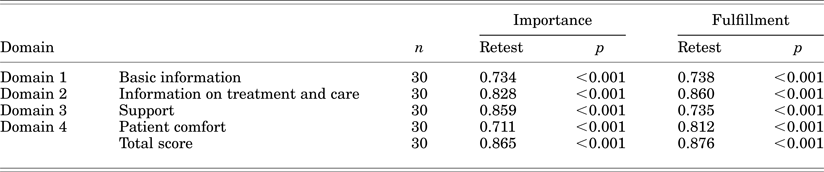
The test–retest reliability of all domains was found to be adequate (>0.7) (Table 4).
Test–retest reliability of subscales
Interdomain Correlation
Between individual domains of the importance and fulfillment subscales, moderate correlations were found (r = 0.3–0.7). Spearman's rank correlation coefficient revealed a strong relationship (r > 0.7) between total score and individual domains for both importance and fulfillment of needs (Tables 5 and 6).
Correlation of the importance of needs scales
**Correlation is significant at a level of significance of 0.01 (with a two-tailed hypothesis).
Correlation of the fulfillment of needs scales
**Correlation is significant at a level of significance of 0.01 (with a two-tailed hypothesis).
Validity
When assessing the construct validity of the FIN questionnaire, a relationship was discovered between selected domains of the FIN and QOLLTI–F. However, there was only a weak correlation (r < 0.3) for the importance subscale. With the fulfillment subscale, moderate correlations (r > 0.3) were indicated for the domains basic information, support, and patient comfort, and for total score (Table 7).
Correlation between selected domains of the FIN and QOLLTI–F
n.s. = not significant.
DISCUSSION
The objective of our study was to explore the psychometric properties of the Czech translation of the FIN. Family needs assessment has frequently been the subject of research investigations in the healthcare field (Deeken et al., Reference Deeken, Taylor and Mangan2003), and a number of family needs assessment instruments have been developed (Tringali, Reference Tringali1986; Dawson, Reference Dawson1991; Hileman et al., Reference Hileman, Lackey and Hassanein1992; Macey & Bouman, Reference Macey and Bouman1991; Longman et al., Reference Longman, Atwood and Sherman1992; Serio et al., Reference Serio, Kreutzer and Witol1997; Kristjanson et al., Reference Kristjanson, Atwood and Degner1995; Kilpatrick et al., Reference Kilpatrick, Kristjanson and Tataryn1998). However, these instruments are not yet available in all countries and languages (Guyatt et al., Reference Guyatt, Feeny and Patrick1993). Most questionnaires have been developed in English-speaking countries. Considering the differences between the cultural, social, and economic aspects, the availability of crossculturally valid multilingual versions of instruments is important for obtaining reliable and comparable data for international research.
Our study demonstrated that, from a linguistic/cultural perspective, the Czech version of the FIN questionnaire is suitable for use. The instrument was shown to have both high reliability (Cronbach's α > 0.9) and test–retest reliability (r > 0.7). The original version of the FIN had an internal consistency of 0.83 (Kristjanson et al., Reference Kristjanson, Atwood and Degner1995). The authors published the scale as a one-dimensional tool, without division into domains. The FIN has also been translated and used in Iceland. The Icelandic version was also characterized by high reliability on both the needs importance (0.92) and needs fulfillment (0.92) subscales (Fridriksdóttir et al., Reference Fridriksdóttir, Sigurdardottir and Gunnarsdottir2006). Wright and Dyck (Reference Wright and Dyck1984) developed a questionnaire for assessing the importance of needs for family members of hospitalized cancer patients. Its internal consistency was 0.73.
Exploratory factor analysis failed to confirm that the scale was one-dimensional. Four factors were defined, two of which included needs related to information. The third factor included support for family members, and the fourth was concerned with patient comfort. Similarly, Kristjanson and White (Reference Kristjanson and White2002) classified family caregivers' needs into four categories as follows: patient comfort, need for information, needs for physical care, and emotional needs. In our present study, the identified factor “support” included support provided by health professionals in the areas of: hope, acceptance, and concern about health, and support for potential home care, including information on healthcare and subsequent help. Similarly, Ewing and Grande (Reference Ewing and Grande2013) recognized two main categories of family caregivers' needs: support to enable them to provide care for their relatives and direct support for themselves. The former included needs related to patient symptoms, equipment necessary for care, help with providing personal care, education on recognition of illnesses, recognizing when death is near, provision of respite care, support of communication between the family and patient about the illness, and support at the time of death. The latter area involved needs related to caregivers' physical health, finance, work, and practical and emotional support. High reliability (Cronbach's α > 0.7) was revealed for all factors (domains) of both the importance and fulfillment subscales by the first and second measurements. Furthermore, the expected moderate correlation between dissatisfaction with needs fulfillment and the relevant quality of life dimensions was confirmed. Therefore, the questionnaire can be recommended for assessment of family member needs in the Czech Republic. The use of instruments with weak psychometric properties can seriously compromise the credibility of research findings (Garre-Olmo et al., Reference Garre-Olmo, Planas-Pujol and López-Pousa2010). Given its relevant psychometric properties, the FIN questionnaire was employed in a 2012–2015 Czech nationwide study supported by the Ministry of Health assessing the needs of family members of palliative care patients. Thanks to the use of an internationally recognized instrument, our study results can be compared with other similar studies.
CONCLUSION
From a palliative care perspective, working with the family of a dying patient requires a comprehensive approach when assessing the role of a caregiver, the relationship between the caregiver and care recipient, and the problems and needs of family members. Assessment of the family should be holistic, focusing on various areas, including relations, communication, problem solving, coping with burden, role fulfillment within the family, role performance, and emotional engagement. It should be the result of subjective assessment by the family members themselves and of objective observation and assessment of the family by professionals primarily providing care to the dying family member (Brener, Reference Brener2007).
Therefore, health professionals should have access to reliable and valid tools for accurate assessment of caregivers' needs, of the psychosocial impact on the family, and of quality of care. The Czech version of the FIN questionnaire that we produced could be used in both research and clinical practice.
ACKNOWLEDGMENTS
Our research was supported by the Czech Ministry of Health (Project NT 13417-4/2012: Identification of Patient and Family Needs in Palliative Care Related to Quality of Life).
APPENDIX: CZECH VERSION OF THE FIN