The Battle for Manila left a city in ruins. The widespread destruction of buildings throughout the city by the Japanese was compounded by further American bombardment and shelling and the assault on the walled city of Intramuros. For Manileños who had survived the brutal torture of their families and communities little was left of their former homes, churches, schools and hospitals. The razing of a once grand city was on a scale that placed Manila in the company of Stalingrad, Warsaw, Berlin, Dresden, Tokyo and Hiroshima as recipients of the most devastating physical effects of the Second World War. General MacArthur's promise to return to Manila and liberate it from the Japanese came at an immense cost and scholars have evaluated the decisions and policies that shaped the highly destructive nature of this battle.Footnote 1
Two pieces of US legislation largely set the terms for the economic revival of the Philippines after the war. The Philippine Rehabilitation (Tydings) Act passed by the US Congress in April 1946 centred on the distribution of US funds to assist in the reconstruction of private property and public institutions and infrastructure. Tied to the Rehabilitation Act, the Philippine Trade (Bell) Act established a new trade agreement in which US manufacturers and investors would enjoy commercial privileges in their business with the Philippines and in which Philippine exporters would gain reduced tariff access to the US market for particular agricultural goods.
Central to the design of the two Acts was the role given to private enterprise. On signing the trade legislation, US President Truman stated that its ‘sole purpose and guiding philosophy is to furnish a formula for the rehabilitation of the Philippine national economy through the encouragement of private enterprise and private initiative’.Footnote 2 One industry set to benefit the most was the shipping and trading industry which controlled the flow and distribution of goods into the Philippines. Although Manila's famous harbour had become cluttered with sunken Japanese warships, in August 1945 the first civilian cargo vessel to arrive after the war—the SS Bering—was able to have its goods transported on lighters up the Pasig.Footnote 3
The reopening of Manila's port not only revived the shipping and trading industry but also provided critical support for the city's postwar press, which embraced the advertising that trading companies generated. These companies eagerly bought newspaper space to advertise recently arrived goods from the United States along with notifications of what was in the process of being shipped. It is within this context that images and symbols of city reconstruction started to appear. Advertisements featuring dramatic illustrations of a future city rising above the ruins of the old were used to promote various commercial interests. There were also advertisements that traded in symbols related to the renewal of domestic life including that of new home construction. Even though government plans for the reconstruction of the city were being developed, advertisers were also promoting visions of an urban and architectural future for Manila. This article focuses on these advertisements as they constituted an imaginary realm of urban and architectural modernity for Filipinos and others in the aftermath of the war.
Historians have examined the political and economic forces that shaped the postwar reconstruction of the Philippines, but the ways in which the public imagination was engaged and re-energised are yet to be studied and understood. How was economic and physical recovery framed visually within the media? What images were used to inspire public confidence in the future? How were the cultural horizons of desire set? These questions are worth asking of any country in the context of postwar reconstruction. The concern here is how they can be directed towards understanding the complex situation of Manila at a particular juncture within its modern history as its politicians and planners contemplated the future of the city after the war and in the light of Philippine Independence. In focusing on advertised illustrations and visions of a postwar future for Manila this article continues a line of historical inquiry into the imagining of future cities at particular times, whether they were early twentieth-century projections of the high-rise metropolis, utopian visions of the ‘city of tomorrow’ or postmodern dystopias.Footnote 4 The projections described here, however, were not the creations of well-known visionaries or designers, but of far more veiled forces that operate in the world of commercial advertising and sales promotion.
The study of visions and projections of Manila's postwar future brings to light a previously uncharted aspect of the history of architectural modernism in the Philippines. Architectural historian Gerald Lico has explained how architectural modernism in the archipelago was held in abeyance until the 1950s when economic and cultural conditions became favourable for its development.Footnote 5 He identifies Manila's downtown as a place where new modern structures began to appear in the early 1950s.Footnote 6 From the mid-1950s, the Diliman campus of the University of the Philippines became a locus of modernist architecture as did the residential enclaves in Makati that attracted affluent home builders and buyers.Footnote 7 This article shows that preceding the concrete manifestation of architectural modernism in postwar Philippines was a period of image production and future imagining in which commercial advertising played a role in stimulating interest in modernist architectural concepts. It is argued that this period is important within the history of architectural modernism in the Philippines as it was a time, even if lacking in actual notable construction, when public interest in modern architecture was stimulated and fuelled by dramatic images of a new high-rise city and modern, American-inspired house design.
The study concentrates on advertisements published within the Manila Times. This is one of the oldest and most well-established newspapers in the Philippines, and still in publication today. It first appeared in October 1898 in response to the demand for news among men of the US army stationed in Manila.Footnote 8 Sporting the motto ‘Pioneer American Daily in the Far East’, it became an instrument for American interests within the Philippines. There was, however, a period in the years 1919 and 1920 when the paper was owned by Manuel Quezon and a group of Filipino businessmen who sought to bring a greater Filipino perspective to its pages.Footnote 9 In December 1928 the building in which the Manila Times was housed was destroyed by fire and after relocating and a change in ownership it struggled to regain its former position, ceasing publication in March 1930. By this time there were other established English-language newspapers circulating in the Philippines, namely the Manila Daily Bulletin and the Manila Tribune. Bombing and shelling during the war had heavily damaged the city's newspaper buildings and, as fighting still raged, a press was found which allowed for the production of the Chicago Overseas Tribune, its first edition printed using plates flown from Chicago.Footnote 10 This was joined by the Manila Free Philippines published by the US Office of War Information.Footnote 11 As one of the first locally produced privately-owned papers to appear after the war, the Manila Times was revived on 27 May 1945, initially as a Sunday paper and then as a daily from 5 September 1945. Published by the Manila Times Publishing Co.,Footnote 12 it was edited by David Boguslav, a respected journalist and editor who had worked for the paper in its earlier incarnation.Footnote 13 The years following the war were a heady time for Manila's press and Boguslav and his associates seized on the demand for international and national news within Manila's growing population.Footnote 14 As well as focusing on evolving US–Philippine relations and the politics of financial aid and trade agreements, there were also national elections and Philippine Independence to cover. By June 1947 the paper had a daily circulation of 68,750 copies and its Sunday issue had reached 81,500 copies.Footnote 15 The Sunday edition contained a magazine supplement which featured articles of general interest.
One of the reasons behind the postwar success of the Manila Times was that it had the support of Manila's powerful industrial capitalists and their advertising dollars. These included the Elizalde and Soriano oligarchs and their corporate interests. These interests are the subject of discussion in a later section of this article. Also, like its contemporaries, the Manila Times enjoyed the revenue generated from the constant flow of movie publicity issued by cinema owners and operators who were keen to welcome back patrons to Manila's reopened movie houses.
The Manila Times catered for an educated, middle-class and liberal-minded readership and its readers constituted an important consumer base for the economic recovery of the Philippines after the war. They possessed the financial power and means to purchase imported goods, shop at refurbished department stores, and patronise the new restaurants and nightclubs that were opening around town. Among these readers were members of Manila's business world, who, as agents of private enterprise and investment, were critical to the physical reconstruction of the city. Looking at advertisements published in this newspaper provides an insight into the way the desires of its readers were directed after the war. How did advertisements call out to these readers and attempt to capture their attention? What were the ‘hooks’ used to draw them into their circuitry of desire? This article considers these questions in relation to advertising that used images of urban and architectural modernity to capture attention. In addition to describing these images, the analysis examines the commercial interests involved and how they related to a broader set of relationships that formed between the Philippines and the United States after the war.
‘Rebuild Manila’
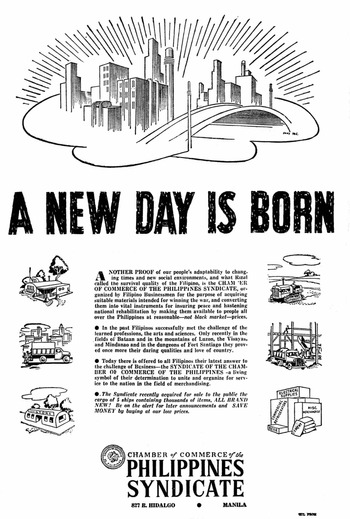
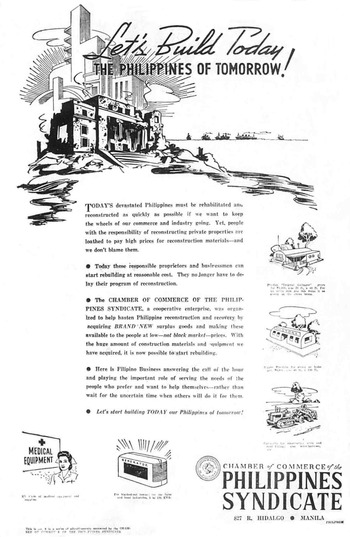
Some of the most eye-catching advertisements published in the Manila Times in the years following the war featured futurist illustrations of Manila in which a new city centre and skyline rise above the ruins of the old in a halo of modernity. This was the case with an advertising campaign run in January 1946 by the Chamber of Commerce of the Philippines Syndicate. Financed primarily by the Philippine National Bank and the Government-owned National Trading Corp., this business syndicate had won the bid for the contents of five US Liberty ships amounting to almost 50,000 tonnes of goods including quonset huts, medical equipment and generators.Footnote 16 The advertising campaign designed to promote the sale of these goods associated their availability on the open market with dramatic images of city reconstruction. In one advertisement, clusters of tall buildings stand alongside a river (Pasig?) and minimalistic curved bridge (fig. 1), and in another a large modern building sits behind the ruins of a neoclassical edifice with ships active on the horizon (fig. 2).
Advertisement for Chamber of Commerce of the Philippines Syndicate (Manila Times, 12 Jan. 1946, p. 3).

Advertisement for Chamber of Commerce of the Philippines Syndicate (Manila Times, 23 Jan. 1946, p. 3).

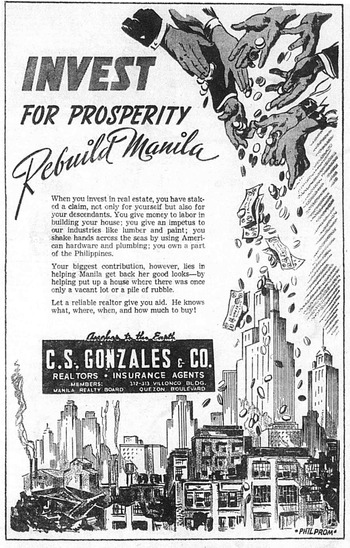
A second advertiser to use graphic images of city reconstruction was C.S. Gonzales & Co., real estate brokers and insurance agents.Footnote 17 Between June 1946 and January 1947 this company funded a series of advertisements centred on the theme of ‘rebuild Manila’.Footnote 18 In one, under the title of ‘Invest For Prosperity’, money is showered onto the ruins and shattered buildings of downtown Manila with a rendering of a new city skyline in the background (fig. 3). The text asked readers to invest in the property market, to ‘put up a house’, as a means of supporting local business and labour and help ‘Manila get back her good looks’.Footnote 19
Advertisement for C.S. Gonzales & Co. (Manila Times, 31 Jan. 1947, p. 11).

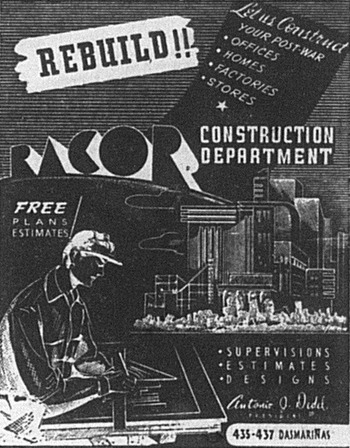
Not to remain silent were the construction companies that were established in Manila after the war.Footnote 20 These companies, staffed by contractors, architects and engineers, offered building design and construction services. Their advertising also centred on the theme of rebuilding and contained images of construction activity and future city skylines (fig. 4).
Advertisement for Racor Construction Department (Manila Times, 1 June 1946, p. 8).

The destruction caused by the war is represented within these advertisements as an opportunity for Manila to rebuild itself in an image of the modern American city. The stepped outlines are reminiscent of the interwar buildings of New York and Chicago. Faint linework is suggestive of a dream image of the rebirth of the city as a thriving metropolis and the idea that Manila would once again rise as a commercial centre and hub of economic activity in the region.
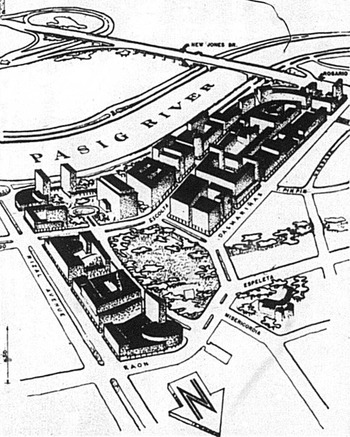
These advertisements appeared at a time when plans for the reconstruction of Manila were being developed by the City Planning Office, a committee of architects, planners and engineers headed by the American landscape architect Louis P. Croft.Footnote 21 Croft had arrived in the Philippines in 1934 to assume the role of National Parks Commissioner for the late President Quezon. Held in the Santo Tomas internment camp during the Japanese Occupation, he was able to promote his ideas for Manila to fellow internees.Footnote 22 The widespread destruction of the city during the war opened up possibilities that did not exist previously, and Croft and his committee formulated a vision for a ‘new Manila’ as an exemplar of modern city planning. Radical interventions were planned which required broad public support.Footnote 23 The first task was to formulate a major plan for a system of roads and highways to pass through and encircle the city.Footnote 24 In March 1946 the committee was transformed into a greater legal entity, the National Urban Planning Commission, with Croft as Acting Director. Zoning ordinances were revised, new subdivision regulations framed, and plans were made for the creation of a new civic centre and central park to the south of the Pasig River and for the redevelopment of the city's downtown commercial centre. The Down-town Area Plan included the consolidation of small lots into larger ones, the redirection of traffic routes, and the redesign and widening of Escolta, the city's principal commercial address, to improve public amenity and traffic flow.Footnote 25 A drawing published in July 1947 shows a concept of the downtown district with neatly arranged building blocks of mostly uniform heights and tracts of open space and gardens (fig. 5).
Down-town Area Plan (Sunday Times Magazine, 13 July 1947, p. 4).

This vision of downtown Manila lay in stark contrast to that offered within newspaper advertisements at the time. As described, these advertisements featured illustrations of a high-rise metropolis fashioned in the image of a modern American city. This was an unsentimental projection that celebrated unbridled growth at the hands of private enterprise and capitalist endeavour, not that of slow and regulated development according to new planning controls and ordinances. The aim of the advertisements was to capture the attention of newspaper readers and it was the ideal of the high-rise metropolis rather than the low-rise ‘beautified’ city that was deemed to carry greater impact.
Running in parallel with illustrations of city reconstruction was another focus of promotional activity related to the urban and architectural future of the Manila region, that of new home construction and suburban development. Manila's capitalists looked upon suburban home construction as holding significant potential for economic activity and launched advertising campaigns to promote their interests. The next section identifies who these capitalists were and what constituted the basis of their involvement in the arena of domestic architecture and home construction.
Postcolonial relationships
In his book The United States and the Philippines: A study of neocolonialism, Stephen Rosskamm Shalom explains how the years following the war were critical to the political and economic future of the Philippines in relation to the United States. The return of American army officials and the support they gave to the old political order provided an environment in which members of Manila's prewar elite were able to re-establish themselves politically and economically.Footnote 26 Prior to the war General MacArthur had been close friends with Manuel Roxas and other Manila elites and on his return to the Philippines supported Roxas in his ascension to become president of the new republic. This is the main example used by Shalom to describe the emergence of a neocolonial relationship between the United States and the Philippines after the war, a relationship he sees as one of collaboration between elite class interests in maintaining political and economic power. He defines neocolonialism as ‘an alliance between the leading class or classes of two independent nations which facilitates their ability to maintain a dominant position over the rest of the population of the weaker of the two nations’.Footnote 27
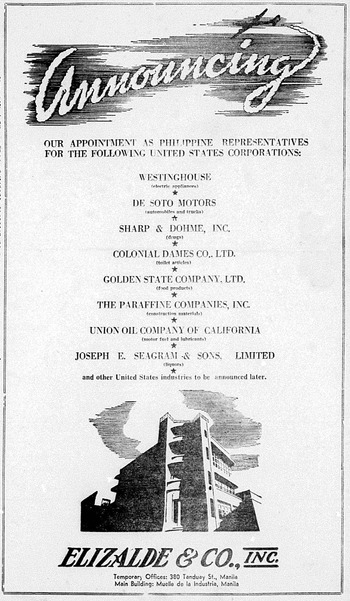
Shalom sees the Philippine Trade Act as a central instrument in the re-establishment of ties between economic elites within the Philippines and the United States. As US law, and ratified by the Philippine Congress, the Trade Act secured unrestricted, duty-free access to the Philippines for American manufacturers for a period of eight years. To raise public awareness and drive sales activity, these manufacturers needed Manila's capitalists and their companies to act as local promoters and distributors of their products. One of the most prominent of these was Elizalde & Co., a large Manila-based company whose status and power had come from an acquisition of the interests of Ynchausti y Compañia by members of the Elizalde family in 1933.Footnote 28 Among these interests were sugar plantations and mills, rope and paint factories, a distillery and an inter-island steamship company. After the war Elizalde & Co. was headed by Manuel ‘Manolo’ Elizalde, who had been incarcerated in Fort Santiago.Footnote 29 In a major boost to its operations, Elizalde & Co. became the representative of prominent companies and corporations wanting to enter or re-enter the Philippines including Westinghouse, The Parrafine Companies and Joseph E. Seagram & Sons.Footnote 30 A January 1946 advertisement for Elizalde & Co. proudly announced its new affiliations with the promise of more to come (fig. 6). The Elizalde Trading Corp. was subsequently established to manage the distribution of goods for these American companies. This involved responsibility for their local promotion.
Advertisement for Elizalde & Co., Inc. (Manila Times, 21 Jan. 1946, p. 5).

Another of Manila's large capitalist operations to become involved in the postwar distribution and promotion of American goods was A. Soriano y Cia, an investment and management company headed by the magnate Andreas Soriano Sr. Soriano had risen within the ranks of the San Miguel Brewery to become its president in 1931. During the 1930s he had established his own management company to handle a growing portfolio of interests within insurance, mining, fertiliser production, logging and lumber, and paper manufacturing. In February 1941 Soriano headed a group of businessmen in establishing Philippine Air Lines of which he was the general manager. Another of his company's interests was the Far East & Pacific Trading Co. (FEPTCO), which connected Soriano to North American manufacturers and the importation of their goods. After the war, FEPTCO managed the distribution and promotion of American liquor and cigarettes within the Philippines.
A third capitalist enterprise to rise in prominence as an importer of US goods into the Philippines after the war was American Factors Ltd, a Hawaiian-based company whose interests involved land ownership, sugar brokerage and the wholesale and retail industries. In August 1946 American Factors established a Philippine subsidiary, headed by Charles Hirst, to operate its new merchandising business within the archipelago.Footnote 31 It began its enterprise with a flourish of advertising for General Tire's car tyres, Fuller Paints and Hotpoint electrical appliances.Footnote 32
Not only were the Elizalde Trading Corp., FEPTCO and the Philippine subsidiary of American Factors prominent distributors and promoters of US consumer goods, their operations extended to the importation and promotion of American building products. In the years following the end of the war the Philippines experienced a critical shortage of building materials to support construction activity. As this activity steadily gained momentum, US manufacturers and their local distributors sought to capitalise on the growing demand for building products and supplies. In May 1946 the Elizalde Trading Corp. announced the arrival of a shipment of ‘Kimsul’ insulation manufactured by the Kimberly-Clark Corp.Footnote 33 By October that year it had set up a Building Materials Department and intensified its promotion of US-made building products which also included ‘Celo’ siding boards (Celotex Corp.), ‘Pabco’ plaster wall boards (The Parrafine Companies) and ‘Lumite’ insect screens (Chicopee Manufacturing Corp.) (fig. 7).
Advertisement for Elizalde Trading Corp. (Sunday Times, 9 Feb. 1947, p. 15).

The next section of this article examines the advertising campaigns and images designed to promote imported US products, as well as some locally manufactured materials, by the Elizalde Trading Corp., FEPTCO and the Philippine subsidiary of American Factors.
Images of domestic architectural modernism
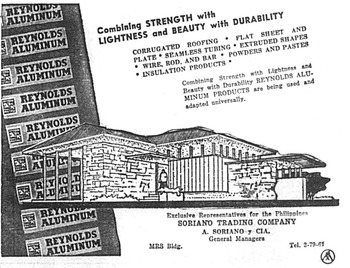
One of the main needs for people in Manila after the war were places to live. The war had reduced the number of habitable houses and apartments within the city by 50 to 60 percent.Footnote 34 After liberation many of the city's poor sheltered in makeshift structures and shacks concentrated in the Malate and Ermita districts. Quonset huts were used, sometimes in inventive ways, to create new homes.Footnote 35 Prefabricated houses also started to appear, a notable example of which was a large residence erected for Godofredo Rivera Sr within the Paco district. It was constructed by Filipino builders according to a scheme by American housing engineer Leon Bessire who had arrived in the Philippines sometime in the second half of 1946.Footnote 36 The Philippine Rehabilitation Act allowed funds to be released for private home construction, but the possibilities of this were limited due to the shortage of basic building materials and the high cost of labour. It is within this context that advertisements for US-manufactured building products were published within the Manila Times. These advertisements offered striking images of what future domestic existence might be and almost invariably involved illustrations of American-inspired contemporary house design. The first campaign to use this as a visual theme was run by the Soriano Trading Co. (the renamed FEPTCO) for the US-based Reynolds Metals Co. and its line of aluminum building products. FEPTCO had started advertising Reynolds aluminum corrugated roofing in September 1946, and beginning in January 1947 it funded an advertisement which featured an illustration of a modern house consisting of exposed stone walls, cantilevered projections and an open front room (fig. 8). Although not shown in any clear detail, the suggestion was that Reynolds aluminum products were integral to the qualities of strength and lightness seen in the house design.
Advertisement for Reynolds Aluminum (Manila Times, 29 Jan. 1947, p. 11).

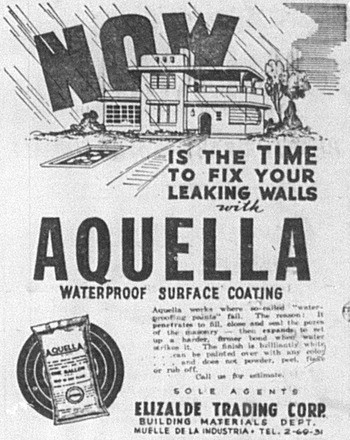
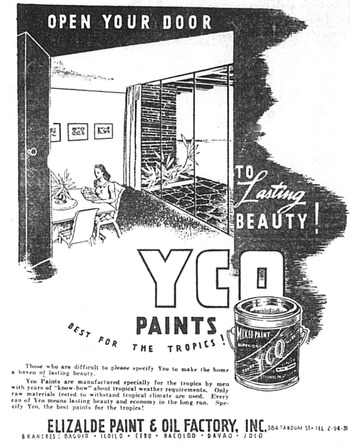
The Elizalde Trading Corp. also used illustrations of modern house design within its advertising. One of the products it was responsible for was ‘Aquella’, a waterproof coating agent for masonry construction, manufactured by New York-based International Aquella Products, Inc. A July 1947 advertisement featured a drawing of a modern double-storey house with a covered terrace and a garden setting (fig. 9). Seasonably attuned, rain is shown falling within the scene. Using images of modern domestic architecture was not new to Elizalde & Co. From the mid-1930s it had heavily marketed its YCO brand of paints and floor waxes using images and illustrations of modern house design. In 1939 and 1940 it funded a series of advertisements for YCO Paints featuring designs for ‘model houses’ illustrated through perspective renderings and plans, several of which were created by young graduate architect Manuel S. Legaspi, Jr.Footnote 37 After the war, the focus on house design continued and hit a high note of modernist idealisation with a July 1947 advertisement for YCO Paints (fig. 10).Footnote 38 Pictured is a spacious dining room with views to a garden terrace through a full-height window wall. Modern furniture and abstract art reinforce the modernist aesthetic for which the paints are promoted as critical for maintaining such ‘beauty’.
Advertisement for ‘Aquella’ waterproof surface coating (Manila Times, 12 July 1947, p. 2).

Advertisement for YCO Paints (Sunday Times, 27 July 1947, p. 4).

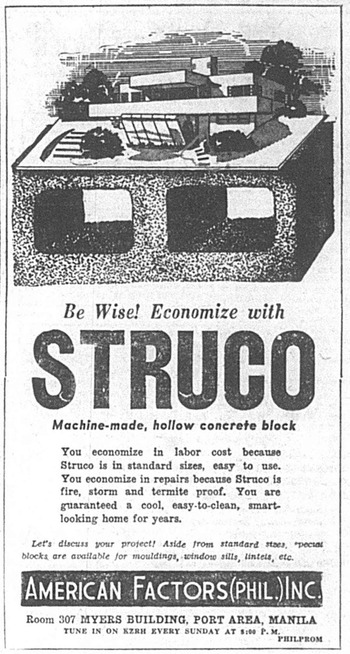
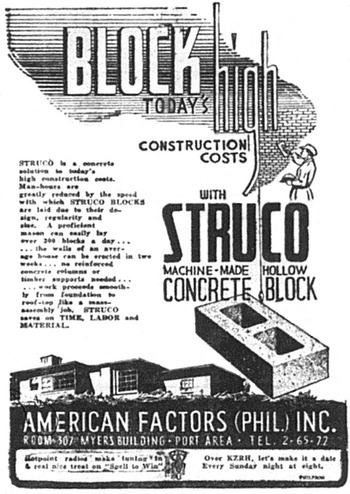
Advertising used by the Philippine subsidiary of American Factors also employed illustrations of modern domestic architecture. One of the US companies it was responsible for was W.P. Fuller & Co., the San Francisco-based paint manufacturer. Its products were promoted with illustrations of houses that were either ‘modernistic’ in style or contemporary pitched-roof suburban villas (fig. 11). The subsidiary was also responsible for marketing ‘Struco’, a locally manufactured hollow concrete block. After the war concrete blocks were one of the first building materials to be produced locally as a cheap and readily available option for wall construction. While advertisements for ‘Struco’ highlighted their economic value, they aimed to draw attention through illustrations of modernist-looking houses. One of these featured a white planar composition with a projecting terrace balcony overlooking an inclined site and garden (fig. 12) and another featured a low-lying and staggered house bedded into a natural landscape (fig. 13).Footnote 39
Advertisement for ‘Galvanox’ roof paint (Manila Times, 30 July 1947, p. 3).

Advertisement for ‘Struco’ concrete blocks (Manila Times, 10 Apr. 1947, p. 12).

Advertisement for ‘Struco’ concrete blocks (Manila Times, 21 Aug. 1947, p. 3).

None of the illustrations described here was a representation of a specific or recognisable house, but rather was meant to embody a concept of contemporary domestic architecture modelled on American styles and sources. The abstract white house depicted in the ‘Struco’ advertisement evoked in caricatured form the residential work of Los Angeles architects Richard Neutra and Rudolph Schindler.Footnote 40 The house illustrated in the advertisement for Reynolds aluminum with its textured stone walls and cantilevered projections echoed features of the residential work of Frank Lloyd Wright. The house illustrated in the advertisement for Fuller's ‘Galvanox’ roof paint is a more generic pitched-roof postwar suburban villa type.
Connected to these architectural ideas was the intimation of the contextual location of the illustrated houses. They are shown surrounded by open space and vegetation, suggesting a location away from a city centre. This was a promotional theme that had been established earlier in the twentieth century with the creation of new suburbs to the east of Manila. As explained by Michael D. Pante, the development of these suburbs was driven by the desire amongst foreign (principally American) and Filipino elites to live away from the crowded and noisy areas of downtown Manila and its adjoining residential districts.Footnote 41 Areas such as Santa Mesa and San Juan offered elevated home sites with exposure to fresh air and open space, making them attractive locations for home construction. The model was American suburban life with villas and bungalows placed within lawned and garden settings.Footnote 42 By the late 1930s there were a number of suburban subdivisions to Manila's east where home construction included large bungalow-type houses.Footnote 43
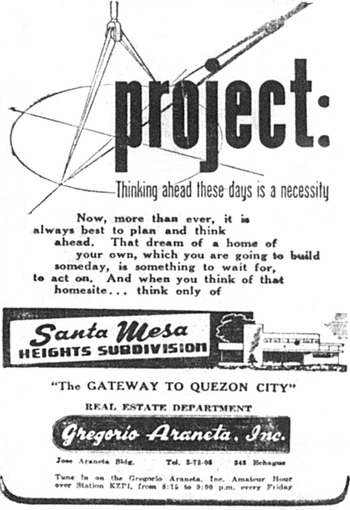
One of the most heavily marketed suburban subdivisions after the war was Santa Mesa Heights, promoted in April 1947 as a place to ‘build your dream house’ where ‘you’ could ‘enjoy cool and clean breeze’.Footnote 44 Its location on Quezon Boulevard made the subdivision an advantageous place to invest in property in anticipation of the creation of a new national capital in Quezon City. In July 1947 it was claimed ‘There is more home building going on in Santa Mesa Heights Subdivision than in any other part of the country. These homemakers are building their own homes at their own initiative with their own private capital.’Footnote 45 The advertising campaign run by the estate's manager, Gregorio Araneta, Inc., used different illustrations to capture attention, one of which showed a compass plotting out a circle which was meant to symbolise the act of making a plan, the caption reading: ‘Now, more than ever, it is always best to plan and think ahead. That dream of a home of your own, which you are going to build someday, is something to wait for, to act on’ (fig. 14).Footnote 46 At the base of Araneta's advertisements for Santa Mesa Heights was the reoccurring motif of an elevated modernist house with plain white walls, flat roof and a horizonal band of windows. This was in line with the broader promotional theme seen in other advertisements as representations of domestic architectural modernity.
Advertisement for Santa Mesa Heights subdivision (Manila Times, 26 July 1947, p. 3).

The advertisements studied here were not without their authors. Trading companies and real estate agents looked to Manila's advertising men and their agencies to design copy which would appeal to newspaper readers and motivate them to purchase the advertised product or service. The next section focuses on these agencies and a core audience for their campaigns.
Advertising agencies
John A. Lent explains that advertising in the Philippines took a step in the 1920s with the rise of one-man advertising organisations.Footnote 47 A leading figure was Frank J. Herier, an advertising expert from the United States who in 1916 organised the publicity department of the Pacific Commercial Co., the largest importing house in the Philippines. Later Herier became advertising manager for Alejandro Roces’ newspapers—La Vanguardia and Taliba—and set up his own advertising agency. With two other American expatriates involved in Manila's newspaper industry, F. Theo Rogers and North W. Jenkins, Herier ran the short-lived Philippine Agency Service Co., a clearing house for advertisements released by American advertising agencies.Footnote 48 By the early 1930s there were a number of advertising agencies in operation, the largest being the Advertising Bureau Inc., which, by 1940, had a staff of thirty.Footnote 49 It was divided into different departments and offered clients a range of services including sales promotion, advertising counsel and market and trade research.
An in-house art department staffed with trained commercial artists was a touchstone of the modern advertising agency and the most prominent agencies in Manila had notable figures in charge. The Advertising Bureau's art department was headed by Ricardo Gloria, ‘dean of Manila's commercial and social photographers’, particularly known for his cinematograph advertising slides.Footnote 50 French advertising specialist and artist Jean Bisson managed the Advanced Advertising Agency shortly before it became Jean Bisson Advertising in 1937. Bisson is credited with having changed the format of advertising in the Philippines in giving greater significance to artistic illustration.Footnote 51
One of the first agencies to be established after the war was PHILPROM (Philippine Promotion Bureau, Inc.) which was formed in September 1945 by Pedro E. Teodoro and Fred Benitez. Prior to the war, Teodoro had been the advertising manager for Elizalde & Co. and, on forming PHILPROM, brought Elizalde's account to the partnership.Footnote 52 PHILPROM was also the advertising agent for C.S. Gonzales & Co. and the Philippine subsidiary of American Factors, two companies important to this study.Footnote 53 PHILPROM was particularly strong in the area of urban and architectural imagery being responsible for the graphic images of modernist-looking houses in advertisements for Elizalde & Co. and American Factors.
In 1946 Andrea Soriano directed one of his company executives, Sebastian Ugarte, and the adman, Manuel Juan ‘Dindo’ Gonzalez, to organise an advertising agency to focus on billboard advertising.Footnote 54 Consequently, Advertising Associates Inc. (AA) was formed and later enlarged to handle the growing accounts and different types of publicity for Soriano's business holdings, including A. Soriano y Cia, Philippine Air Lines and the San Miguel Brewery.
The other business entity discussed here, Gregorio Araneta Inc., had its own in-house advertising department, which was headed by Rafael Anton.Footnote 55 In 1948 this department was transformed into the Ace Advertising Agency, the word Ace chosen because it would be the first agency then found within the telephone book.Footnote 56
There is no information to indicate if the advertisements studied here were the original creations of these admen and agencies or were reproduced or derived from illustrations and copy issued from elsewhere, particularly the advertising and sales departments connected to American manufacturers themselves and their headquarters in the United States. Many bear the stamp of the local agencies—either PHILPROM or ‘Associated’—which suggests they were original creations. Whatever the case, both agencies employed illustrations in their work that they believed would function as a hook in drawing attention to the advertised product or service. The illustrations were carefully drawn and rendered, which testifies to the importance placed on strong and evocative imagery to capture reader attention.
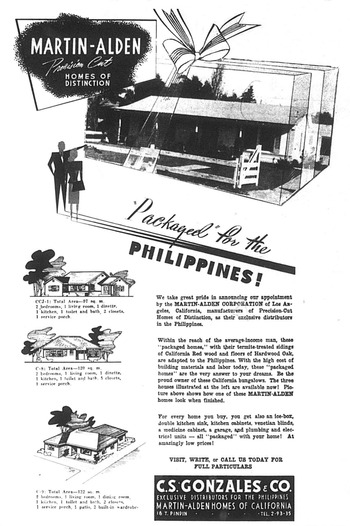
There were rare occasions when photographic images were used within advertisements for building products, notably for a short time in mid-1947 for ‘Struco’, which featured a recently constructed house and a rebuilt older one in the Malate district of Manila, both with more traditional architectural form.Footnote 57 A photographic image was also used within an advertisement for US-manufactured Martin-Alden packaged homes for which C.S. Gonzales & Co. had become the local distributor (fig. 15). This advertisement shows the figures of a smartly-dressed couple looking toward a photograph of one of these homes which sits above the slogan ‘“Packaged” for the Philippines’.Footnote 58 In the early postwar years, however, when emphasis was placed on future projection, drawn illustrations remained the dominant visual hook to capture reader attention.
Advertisement for Martin-Alden ‘Homes of Distinction’ (Sunday Times Magazine, 21 Sept. 1947, p. 12).

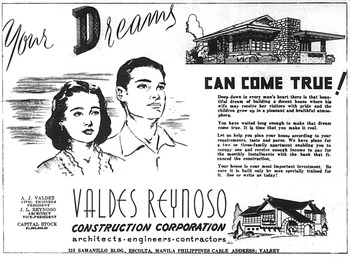
Apart from visual hooks, there were also psychological ones used to lure readers into the space of advertisements. These were tailored for particular target audiences and, in the case of advertisements featuring illustrations of modern house design, the target audience was young couples, newly-weds, who were contemplating the possible construction or purchase of a family home in the new suburban areas outside of central Manila. This was particularly revealed in two advertisements published in 1947 which provide an insight into the psychology involved. An advertisement for a Murphy Cabranette kitchen unit links marriage to a beautiful bride with a modern home (fig. 16). It plays on the obligation that a man should feel towards his new wife. This was also the theme of an advertisement for the Valdes Reynoso Construction Corp., which offered architectural and building services for new construction (fig. 17). Here a young couple gaze in the direction of a modern home of exposed stone and broad eaves, not dissimilar to an example described in the previous section. This was meant to represent the couple's ‘dream home’. The text focuses on the desires of the male subject as a dutiful husband and father: ‘Deep down in every man's heart there is that beautiful dream of building a decent house where his wife may receive her visitors with pride and the children grow up in a pleasant and healthful atmosphere.’Footnote 59
Advertisement for the Murphy Cabranette kitchen unit (Sunday Times, 11 May 1947, p. 3).

Advertisement for Valdes Reynoso Construction Corp. (Sunday Times Magazine, 1 June 1947, p. 2).

The psychology was to appeal to a man's sense of responsibility for the care of his wife and children. This framed the association with a modern home and modern conveniences as a vehicle for the fulfilment of these responsibilities. The advertisement for the Valdes Reynoso Construction Corp. goes so far as to evoke the social meaning of a contemporary-designed home. A ‘decent’ house was figured as a contemporary house, and owning a contemporary house would be a source of pride for a young middle-class couple especially when entertaining guests. There was also the suggestion of a suburban lifestyle with the reference to raising children in ‘a pleasant and healthful atmosphere’. An important context for these advertisements was that they appeared at a time when advertisers were targeting young mothers and the care of newborns to promote consumer goods (especially condensed milk), tapping into the rise in childbirth within the Philippines in the years after the war. An emphasis on the family and providing for new families was a powerful theme that could be exploited by advertisers to promote consumer goods as well as certain ideals related to future domestic life.
Conclusion
This article has charted a course through an imaginary terrain that advertisers created for the readers of the Manila Times. As the city started to embark on a process of reconstruction, advertisers sought to capture reader attention with dramatic futurist images of a thriving metropolis and alluring images of modern domestic architecture. These images were considered strong hooks for drawing readers into the imaginary space of advertisements and upon which to hang the promotion of products, services and real estate. In exploring this terrain, the article has opened an important dimension to the postwar economic history of the Philippines, that of the promotional activity that grew out of the re-establishment of trade relations with the United States. The formation of the new trade legislation and the reopening of the Philippines to the US import and export trade market might be well known, but the intense promotional activity that arose at the same time is yet to be fully documented and understood. As this article has shown in its study of trading companies and their promotion of building products, larger forces were at play that involved US manufacturing interests and the postwar re-establishment of some of Manila's industrial capitalists and their commercial operations.
The article has also shed light on an overlooked period in the history of architectural modernism in the Philippines. The immediate postwar years may not have yielded much of significant architectural merit,Footnote 60 but they certainly were a lively time of urban and architectural imaginings at the hands of newspaper advertisers. This is not an obvious place to look for formulations of urban and architectural modernity but, as this article has shown, newspaper advertising was a site for urban speculation and modern architectural imaginings from early 1946 on. These appeared as Manila's city planners were redesigning the city and publishing commentaries and plans of their schemes. Advertisers sought to exploit this mood for urban speculation. A future study might show how architects also started to engage with the public and media publicity as postwar property investment and construction activity gathered pace.
Concentrating on the Manila Times has allowed this article to build an understanding of the role played by this newspaper as a vehicle for commercial publicity. As mentioned earlier, this newspaper enjoyed the support of some of Manila's leading capitalists and was looked upon as a means of reaching an important consumer base. There were other newspapers in circulation that could have been drawn into the analysis, but the decision to focus exclusively on the Manila Times has provided an insight into the promotional strategies used to reach its audience. There is a need here to recognise the re-establishment of Manila's commercial radio stations after the war as another major vehicle for business and product advertising. The first of these stations was KZRH, which began broadcasting again on 1 July 1946, in time for independence celebrations.Footnote 61 KZRH was operated by the Manila Broadcasting Co., which was owned by the Elizalde brothers. From September 1946 the Philippine subsidiary of American Factors paid for a regular spot on this station every Sunday evening. It is yet to be determined if Elizalde & Co. and American Factors used radio advertising to promote the building products referred to here and how they might have done this.
It was always going to be interesting to discover how newspaper advertising attempted to set the cultural horizons of desire at this momentous time in the history of the Philippines. The initial steps in the physical recovery from war occurred at the same time the country was preparing for and celebrating its independence. Advertisers played on ideas of rebirth and renewal and, as this study has shown, their visual reference points for reconstruction had an American origin. The future skyline of downtown Manila would echo that of New York or Chicago. The ideal of owning a new home in the suburbs east of Manila involved the vague imitation of American house designs.Footnote 62 The connection with US imported products accentuated this Americanism. It was a potent time of urban and architectural imagining as advertisers sought to calibrate the strings of public desire. On occasion, the difficult circumstances facing Manila were recognised in depictions of charred and ruined buildings, but this was solely framed as a prelude to a bright and prosperous future. How this imagining changed as time went on is the subject for another article.