Background and introduction
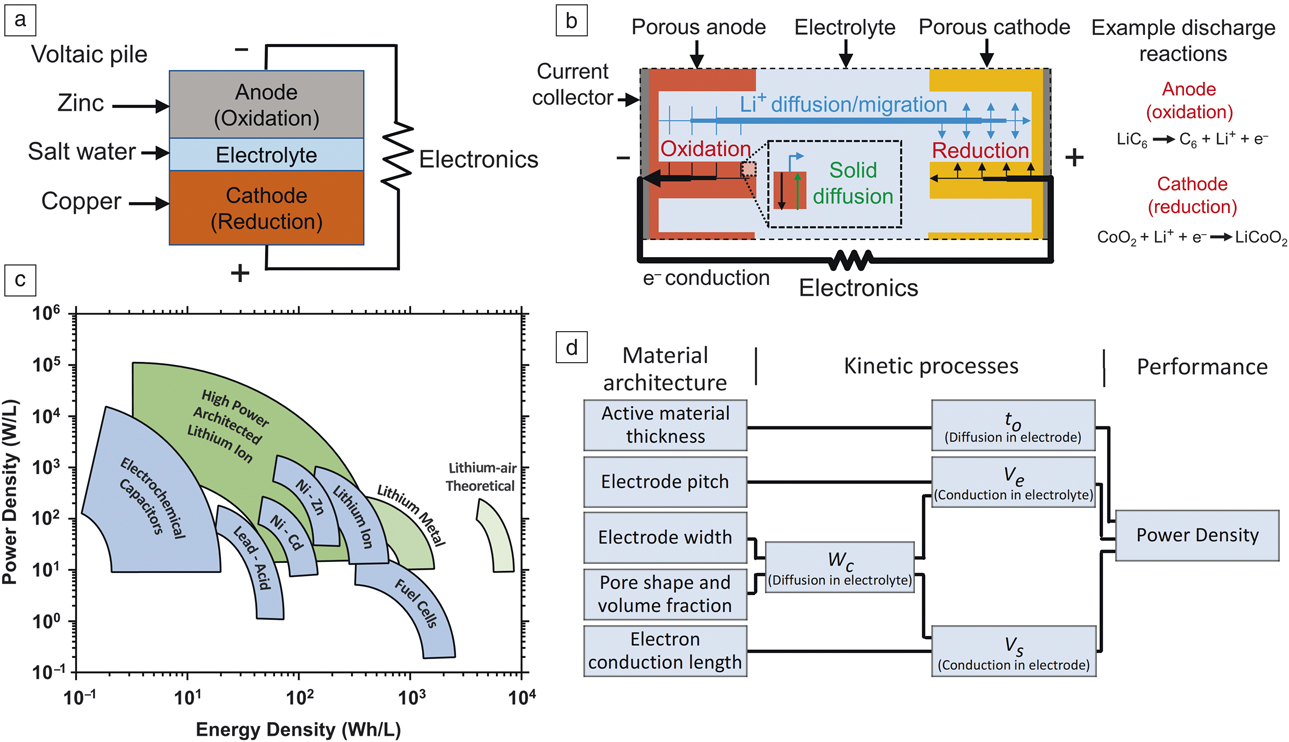
Electrochemistry, the study of chemistry enabled by the movement of electrons, is the foundation for many chemical processes ranging from biochemical reactions in living organisms to technology-enabled devices in modern energy storage and sensing applications. Figure 1a shows the main components of an electrochemical system—an anode, a cathode, and an electrolyte. Oxidation reactions occur at the anode, reduction reactions occur at the cathode, and the electrolyte allows ions to be transported between the two electrodes while preventing electron transport. Electrons, therefore, are forced to conduct through an external load, whereby one can extract the energy to do work or apply work to drive chemical changes.
Architected materials enable advanced electrochemical systems. (a) Electrochemical cell with anode, cathode, and electrolyte demonstrated with a voltaic pile. (b) A porous electrode material architecture in a lithium-ion battery with corresponding kinetic processes. (c) A Ragone plot comparing energy and power densities of energy-storage technologies. Green areas show where material architectures play important roles in realizing next-generation energy- and power-density technologies. (d) A design chart showing how material architecture affects corresponding physical processes to achieve a performance goal.
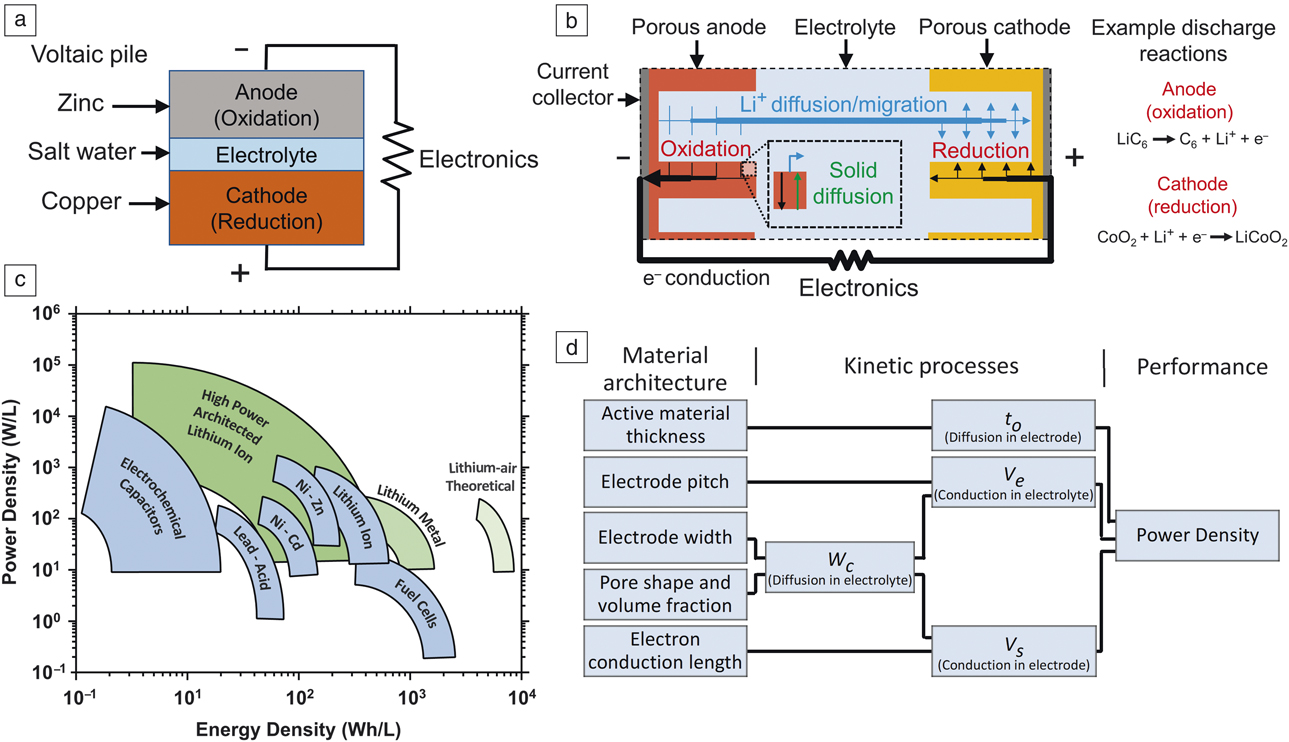
Material architecture has played a critical role in electrochemical research since the field’s genesis, when A. Volta realized the first battery using thin stacks of copper and zinc discs separated by a cloth-soaked electrolyte (Figure 1a, voltaic pile).Reference Heilbron1 One can understand the importance of material architecture by considering the constraints of a typical battery electrodeReference Park, Zhang, Chung, Less and Sastry2–Reference Pikul, Braun and King4 (Figure 1b). Energy is stored in the atomic bonds of the anode and cathode materials, and energy density is increased as more material is packed into the same volume. Electrochemical reactions, however, primarily occur at the interface between the electrodes and the electrolyte (Figure 1b, red text) so that large reaction rates, which increase power density, require electrodes with high surface area-to-volume ratios. Electrodes, therefore, can be geometrically optimized, typically through miniaturization and added porosity,Reference Braun, Cho, Pikul, King and Zhang3,Reference Sun, Liu and Cui5–Reference Long, Dunn, Rolison and White7 to have simultaneously high surface areas (power) and high solids volume fractions (energy).
Figure 1c shows a Ragone plot that compares the energy and power tradeoffs in different energy-storage technologies. Architected materials enable improvements in both power and energy (green areas) by accommodating chemical changes (reactions often have corresponding volume and materials property changes) and increasing transport of the reactants and products to and from reaction sites. Electrode architectures must be able to accommodate the transport of products and reactants across multiple phases with often varying transport speeds. Reactants and products stored in the solid electrode bulk must diffuse between the bulk and electrode surface (Figure 1b, green), where reactions occur, and be transported from the interface of one electrode to the other (Figure 1b, blue). Additionally, electrons (Figure 1b, black) and ions must be simultaneously transported between electrodes; as many battery materials are poor conductors of one or both, additional conductive components are included to mitigate transport deficiencies.
Many material architectures have been realized to overcome these constraints and often combine four or more materials into a single electrode. The appropriate scale of an electrode material architecture is set by the speed of transport through the solid or liquid medium (Figure 1b, d),Reference Park, Zhang, Chung, Less and Sastry2–Reference Pikul, Braun and King4 as detailed in Reference 4. For example, the lithium-ion diffusion coefficient in a solid electrode particle is typically ∼10–11 cm2/s, a range that constrains the particle radius to ∼2 µm to achieve a 1 h discharge. For this reason, most electrode particles are of micrometer scale. A similar analysis of lithium conduction and diffusion in the electrolyte explains why most battery electrodes are about 100-µm thick.Reference Pikul, Braun and King4
In summary, material architecture allows for the simultaneous balance between energy, reaction rates, chemical changes, mechanical stresses, and ion and electron transport. New material architectures that span the nano- to centimeter scale are enabling transformative advances throughout electrochemical systems, but ion and electron transport are ultimately constrained by the same fundamental thermodynamic and kinetic limits. It is, therefore, no coincidence that the macroscopic stacked electrode architectures in modern devices closely resemble the original voltaic pile presented by A. Volta in 1800.
In this article, we review the importance of architected materials in electrochemical systems and highlight recent advances. We focus on the kinetics and mechanics of energy-storage materials. The material architectures and electrochemical fundamentals we discuss can be applied to all electrochemical systems. We also examine emerging fields where electrochemistry is enabling new properties and functionality in architected structural materials.
Energy storage
The three main types of electrochemical energy-storage technologies are electrochemical capacitors, batteries, and fuel cells. Electrochemical capacitors ([ECs], also sometimes termed “supercapacitors”) have high power and low energy density; batteries have moderate power and moderate energy density; and fuel cells have low power and high energy density (Figure 1c).Reference Kötz and Carlen8–Reference Liu, Wang, Xu, Jiang, Li, Zhang, Lin and Shen10
Electrochemical capacitors generally store energy on the surface of their electrodes, either through double-layer capacitance or via surface-sited redox processes often termed “pseudocapacitance.”Reference Conway11–Reference Augustyn, Simon and Dunn14 Thus, their electrode architectures are engineered to increase the total surface area per weight, typically through high-surface-area carbon materials,Reference Sun, Zhu, Baumann, Peng, Xu, Shakir, Huang and Duan15,Reference Frackowiak and Beguin16 as this maximizes the total energy they can store. A challenge has been that high surface area-to-weight electrodes tend to have large volumes and their volumetric energy densities are low. Shortcomings in energy density can be addressed by using active materials that exhibit pseudocapacitance and incorporating such materials into engineered electrode architectures. For example, charge-storing metal oxides such as manganese oxide can be readily integrated into porous carbon architectures to amplify capacitive storage.Reference Sassin, Mansour, Pettigrew, Rolison and Long17 New electrode architectures that precisely control the stacking of 2D material heterostructures could enable high volumetric and gravimetric energy and power densities.Reference Pomerantseva and Gogotsi18–Reference Lukatskaya, Dunn and Gogotsi21
Batteries and fuel cells both store energy through faradic reactions. Batteries typically store energy in the electrode volume, whereas fuel cells store energy in chemical fuels that flow across or through conductive electrodes. Recently, these demarcations are becoming blurred as new innovations in flow batteries and metal-air batteries draw inspiration from both fields.Reference Dunn, Kamath and Tarascon22–Reference Li and Lu25 In all cases, the electrode material architecture critically affects the electrochemical kinetics (see the section on “Architected materials for improved kinetics”). In addition, faradaic reactions are often accompanied by large internal stresses that cause electrode degradation. New architectures that tailor the cell mechanics to accommodate these stresses are enabling electrodes with unprecedented high energy densities and cycle life—the number of times a device can be charged and discharged (see the section on “Architected materials for controlled mechanics, from fracture to flexibility”). In extreme cases, such as with lithium-metal anodes, the architecture dynamically affects a wide variety of chemical and physical processes, including kinetics and mechanics. These multimodal systems require new fundamental understanding of the underlying mechanisms that limit their performance and architectures that simultaneously control chemistry, mechanics, and transport (see the section on “Architected materials for solid metal anodes”).
Architected materials for improved kinetics
In energy storage, architected materials are frequently used to improve electrode kinetics and power density. Higher power densities are required to enable fast recharging, which is critical, for instance, in electric vehicle adoption,Reference Gnann, Funke, Jakobsson, Plötz, Sprei and Bennehag26 and new capabilities for electronics and robotics.Reference Arthur, Bates, Cirigliano, Johnson, Malati, Mosby, Perre, Rawls, Prieto and Dunn6,Reference Long, Dunn, Rolison and White7,Reference Golodnitsky, Nathan, Yufit, Strauss, Freedman, Burstein, Gladkich and Peled27 Early improvements in high-rate performance were achieved by reducing the size of electrode materials to the nanoscale, which significantly increased surface area and provided short ion diffusion paths through the solid materials.Reference Braun, Cho, Pikul, King and Zhang3,Reference Arthur, Bates, Cirigliano, Johnson, Malati, Mosby, Perre, Rawls, Prieto and Dunn6,Reference Tang, Zhang, Li, Ma and Chen28–Reference Zhang, Yu and Braun33 High power densities comparable to those of ECs,Reference Pikul, Gang Zhang, Cho, Braun and King30 however, were not fully realized until electrode architectures were designed to simultaneously reduce ion and electron transport resistances across the anode, cathode, and electrolyte.Reference Braun, Cho, Pikul, King and Zhang3,Reference Sun, Zhu, Baumann, Peng, Xu, Shakir, Huang and Duan15,Reference Pikul, Gang Zhang, Cho, Braun and King30,Reference Liu, Gillette, Chen, Pearse, Kozen, Schroeder, Gregorczyk, Lee and Rubloff31,Reference Pikul, Liu, Braun and King34–Reference Chen, Xu, Wang, Huang, Xi, Cai, Guo, Xu, Gao and Gao44
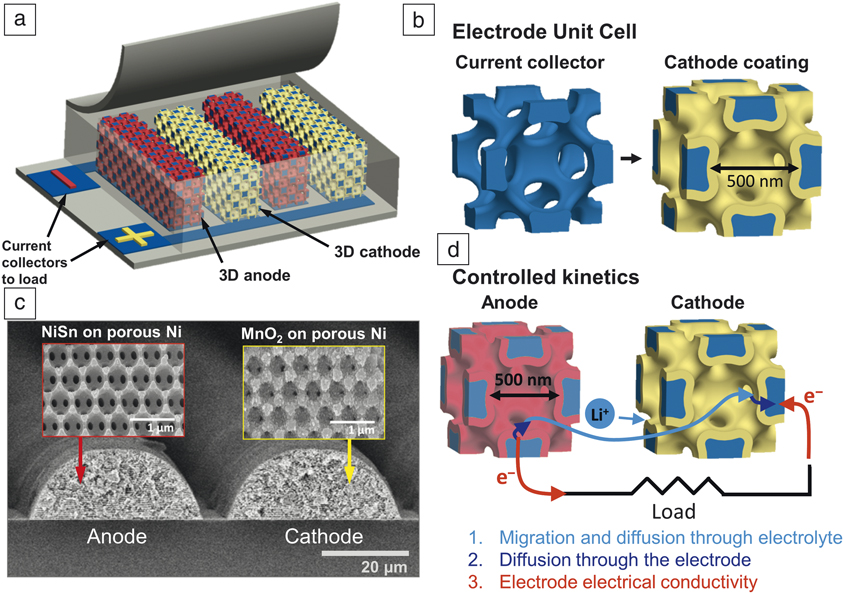
Figure 2 shows an example of a battery optimized for high power density. The electrode architectures combine continuous current collectors (blue) that increase electrical conductivity, thin active material coatings that reduce solid-state diffusion distances (red and yellow), continuous pores that hold the electrolyte and reduce tortuosity, and small separations between electrodes.Reference Pikul, Braun and King4,Reference Pikul, Gang Zhang, Cho, Braun and King30 Through advancements in electrode synthesis and fabrication, architected electrodes similar to the ones shown in Figure 2 achieved power densities as high as 74 kW/L, which is about 100–1000× greater than those of most commercial batteries and comparable to that of supercapactiors.Reference Pikul, Braun and King4,Reference Pikul, Gang Zhang, Cho, Braun and King30,Reference Pikul, Liu, Braun and King34 More recently, electrochemical transport simulations have assisted high-power battery designReference Pikul, Braun and King4,Reference Li, Du, Ruther, An, David, Hays, Wood, Phillip, Sheng and Mao38,Reference Anseán, Dubarry, Devie, Liaw, García, Viera and González45,Reference Liu, Jiang, Shi, Ma, Wang and Guo46 and have shown that the power performance in architectures similar to those in Figure 2 can be improved by a factor of 10× beyond prior results.Reference Pikul, Braun and King4
Architected materials for high-power batteries. (a) A rendering of a microbattery with architected electrodes for high power density.Reference Pikul, Gang Zhang, Cho, Braun and King30 (b) Unit-cell renderings of the architected electrodes in (a), which were fabricated by coating a thin film of electrode material on porous current collectors. (c) Scanning electron microscope images of the battery with architected electrodes.Reference Pikul, Gang Zhang, Cho, Braun and King30 (d) High power density was enabled by simultaneous reduction of ion and electron-transport paths, shown with colored arrows.Reference Pikul, Braun and King4

Realizing high-power material architectures with continuous current collectors requires coating ∼10–100-nm thin films of active materials without clogging the ∼100-nm diameter current collector pores that allow electrolyte penetration. If the electrode films are too thin, then the solids volume fraction is low and the energy density is too small for practical applications.Reference Pikul, Braun and King4 Several techniques have been developed to realize high solids volume fraction coatings of thin battery films in porous electrodes, including atomic layer deposition (ALD),Reference Liu, Gillette, Chen, Pearse, Kozen, Schroeder, Gregorczyk, Lee and Rubloff31,Reference Chen, Zhu, Chen, Shang, Cao, Hu and Rubloff47 chemical vapor deposition (CVD),Reference Zhang and Braun48,Reference Reeja-Jayan, Chen, Lau, Kattirtzi, Moni, Liu, Miller, Kayser, Willard and Dunn49 electrodeposition,Reference Pikul, Gang Zhang, Cho, Braun and King30,Reference Zhang, Yu and Braun33–Reference Ning, Pikul, Zhang, Li, Xu, Wang, Rogers, King and Braun35,Reference Werner, Rodríguez-Calero, Abruña and Wiesner40,Reference Zhang and Braun48,Reference Zhang, Ning, Busbee, Shen, Kiggins, Hua, Eaves, Davis, Shi, Shao, Zuo, Hong, Chan, Wang, Wang, Sun, Xu, Liu and Braun50–Reference Plylahan, Kyeremateng, Eyraud, Dumur, Martinez, Santinacci, Knauth and Djenizian53 and hydrothermal synthesis.Reference Liu, Zhang, Wang, Cho, Pikul, Epstein, Huang, Liu, King and Braun36 In addition to being conformal, coatings can have gradientsReference Pikul, Liu, Braun and King34 or allow for maskless deposition of electrode materials on a single current collector.Reference Pikul, Gang Zhang, Cho, Braun and King30,Reference Pikul, Liu, Braun and King34,Reference Ning, Pikul, Zhang, Li, Xu, Wang, Rogers, King and Braun35 Although these advanced fabrication technologies have yielded high-power architected electrodes, a significant challenge remains in realizing similar architectures using large scale manufacturing processes that produce tons of electrode materials with comparable costs to those of current batteries.Reference Schnell, Günther, Knoche, Vieider, Köhler, Just, Keller, Passerini and Reinhart54
A challenge in realizing high-power architected electrodes is the increase in unwanted side reactions between the electrode and electrolyte due to the large interfacial surface areas. Side reactions are particularly common in electrochemical systems with high potential energy (e.g., lithium-ion batteries), which can result in poor cycle life and increased internal resistances.Reference Verma, Maire and Novák55,Reference Barré, Deguilhem, Grolleau, Gérard, Suard and Riu56 New architectures that could achieve high power density with minimal or no side reactions through controlled chemistry and geometry would significantly advance the realization of fast recharging batteries for electronics and electric vehicles.
One area where architected materials have made significant contributions is in enabling high-performance microbatteries, which are miniature batteries with less than one cubic centimeter volumes used to power microelectronics and Internet of Things (IoT) technologies. Demand for IoT devices is expected to grow by 100 billion units over the next decade.57 Early microbatteries with 1000 Wh/L volumetric energy densities were fabricated by layering thin films of anode, electrolyte, and cathode.Reference Dudney58 Areal constraints on microelectronics, however, transitioned research toward 3D architected materials that could be made thick, to increase areal energy and maintain good kinetics.Reference Arthur, Bates, Cirigliano, Johnson, Malati, Mosby, Perre, Rawls, Prieto and Dunn6,Reference Sun, Zhu, Baumann, Peng, Xu, Shakir, Huang and Duan15,Reference Reeja-Jayan, Chen, Lau, Kattirtzi, Moni, Liu, Miller, Kayser, Willard and Dunn49,Reference Zhang, Ning, Busbee, Shen, Kiggins, Hua, Eaves, Davis, Shi, Shao, Zuo, Hong, Chan, Wang, Wang, Sun, Xu, Liu and Braun50,Reference Lai, Erdonmez, Marinis, Bjune, Dudney, Xu, Wartena and Chiang59,Reference Cirigliano, Sun, Membreno, Malati, Kim and Dunn60 These architected materials were enabled by advanced manufacturing processes such as 3D printing, self-assembly, and microfabrication.Reference Sun, Zhu, Baumann, Peng, Xu, Shakir, Huang and Duan15,Reference Pikul, Gang Zhang, Cho, Braun and King30,Reference Pikul, Liu, Braun and King34,Reference Ning, Pikul, Zhang, Li, Xu, Wang, Rogers, King and Braun35,Reference Werner, Rodríguez-Calero, Abruña and Wiesner40,Reference Reyes, Somogyi, Niu, Cruz, Yang, Catenacci, Rhodes and Wiley61–Reference Zhu, Fu and Yu63 A major challenge for these designs was the synthesis or integration of one electrode material within an already established 3D structure, as the processing temperatures and chemistries are often incompatible with already deposited materials. The difficulty of processing 3D electrolytes, in particular, limits many 3D microbattery architectures. Next-generation microbatteries will be architected to meet the demands of emerging applications. For example, microbatteries might be required to have a decade-long shelf life, recharge instantly, or biodegrade after being used.
Fuel cells have similar challenges and solutions as battery electrodes, except that in many cases, catalysts are required to accelerate fuel reaction rates. Catalysts are typically metal or metal oxide nanoparticles that are attached to a conductive scaffold. The catalyst density and conductive scaffold geometry are architected to maximize reaction rates and selectivity while minimizing the total catalyst volume.Reference Debe64,Reference Li and Sabir65 In addition, new catalysts are being architected at the atomic level to tune the selectivity and activity of reaction steps, enabling the synthesis of high-value chemicals and increased energy-storage efficiency.Reference Nørskov, Bligaard, Rossmeisl and Christensen66,Reference Zhang, Zheng, Voznyy, Comin, Bajdich, García-Melchor, Han, Xu, Liu and Zheng67
Architected materials for controlled mechanics, from fracture to flexibility
High-capacity electrode materials promise to increase battery energy density, but their electrochemical reactions are usually accompanied by massive volume changes that could damage or destroy electrodes and shorten cycle life. The volume expansions of lithium reactive electrodes, for example, are up to 420% for Si, 260% for Sn,Reference Winter and Besenhard68 and 80% for S.Reference Sun, Liu and Cui5 These volume changes have three detrimental effects: (1) they can fracture electrode particles; (2) they can swell or crack interfacial layers, such as the solid electrolyte interphase (SEI), which allows detrimental side reactions; and (3) they can cause electrode-scale particle rearrangement, which electrically isolates materials and reduces kinetics.Reference Sun, Liu and Cui5 In each case, material architectures have been realized to overcome or mitigate resulting performance degradations. Particle fracture can be mitigated using nanostructures below a critical size, 300–400 nm for Si nanowires,Reference Lee, McDowell, Berla, Nix and Cui69 where the electrochemically induced strain can be accommodated.Reference Kalnaus, Rhodes and Daniel70–Reference Zhu, Wang, Fan, Mei and Lu73 Interfacial layer fracture can be prevented with material architectures that encapsulate high-volume expansion materials in carbon cages.Reference Liu, Zhou, Liu and Cui74–Reference Wang, Li, Li, Liu, Lin, Zhu, Chen, Yang, Yan and Chen76 The interfacial layers form on the carbon cages, which minimally change volume, while the encapsulated particles expand without straining the carbon cage. This strategy can also separate particle-level strain from electrode-level strain and mitigate electrode degradation. Additional strategies for mitigating electrode degradation include the addition of polymer or inorganic binders that mechanically attach particles,Reference Cui, Hu, Wu, Choi and Cui77,Reference Ryou, Kim, Lee, Kim, Jeong, Hong, Ryu, Kim, Park and Lee78 and nanoscale architectures.Reference Zhang and Braun48,Reference Kim, Blomgren and Kumta79
In addition to preventing mechanical degradation, new electrode architectures offer great promise for enabling desired mechanical properties such as flexibility or stretchability. A variety of flexible and stretchable batteries have been demonstrated using material architectures that allow bending of hard materials, typically through miniaturization.Reference Zhang, Huang and Rogers80–Reference Liu, Song, Kong and Cui82 Realizing high energy density stretchable batteries is particularly challenging as most high energy density materials are brittle solids or metals, which have a high density of energetic bonds, but are not inherently stretchable. New intrinsically stretchable materials, such as elastomeric electrodes or electrolytes, would enable entirely new capabilities for stretchable energy storage. Liquid electrolytes that store energy, such as those in flow batteries, are also promising because they can accommodate large changes in geometry; recent advances in chemistry have demonstrated energy densities that approach those of solid materials.Reference Li, Nie, Vijayakumar, Li, Liu, Sprenkle and Wang83–Reference Robb, Farrell and Marshak85 In addition, fluids can perform multiple functions besides store energy, which increases their utility. For example, recent work has shown how a multifunctional energy-storage fluid was able to increase the energy density in a robotic fish by up to 4× compared to lithium-ion batteries by also acting as a mechanical transmission fluid for fin actuation.Reference Aubin, Choudhury, Jerch, Archer, Pikul and Shepherd86
Architected materials for solid metal anodes
Metals that are electrochemically active at relatively negative potentials are attractive anode materials for batteries, where the high specific capacity of metal-to-cation redox reactions results in correspondingly high energy density. The most notable examples are zinc, typically used with aqueous alkaline electrolytes (e.g., in Zn-MnO2 cells), and lithium, which is operated in particular nonaqueous electrolyte compositions. Long used for primary batteries, new advancements in material architecture and fundamental understanding of electrochemical plating has reinvigorated metal anode research with the aim toward their application in rechargeable batteries. The principal challenge for metal anodes is the reversible plating of metal without forming dendrites, as dendrites increase side reactions and may ultimately lead to electrical shorts and cell failure.
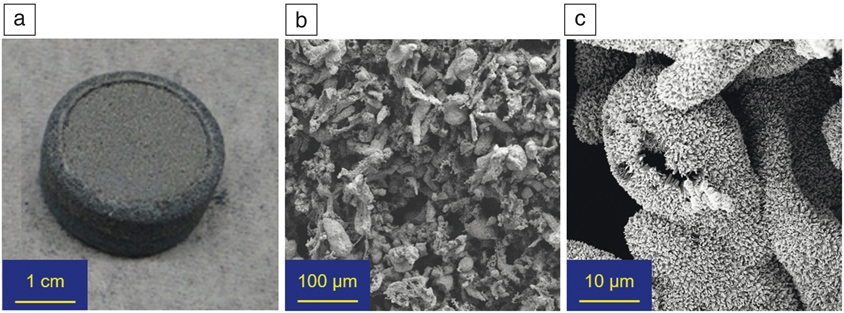
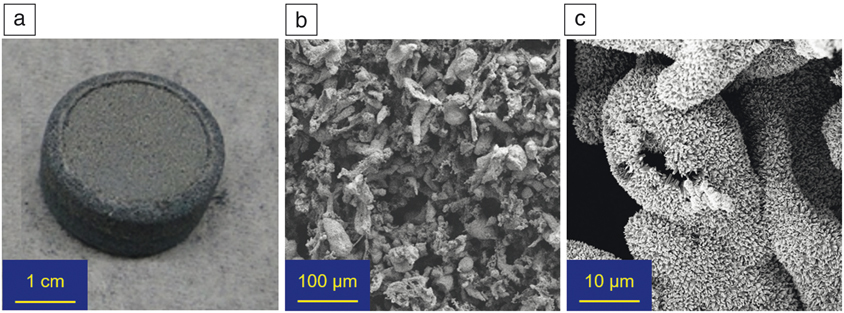
Zinc is particularly prone to shape change and dendrite formation due to the complexity of its redox reactions in alkaline electrolytes, which also involve such species as anionic zincates and zinc oxide. The historical limitations on rechargeability for zinc can be overcome by expressing zinc in a porous, monolithic 3D architecture (e.g., a zinc “sponge,” see Figure 3), rather than as a foil or conventional powder-composite. In such architectures, current is efficiently distributed across a larger electrode area such that the critical current density for dendrite formation is never broached, even at high overall charging rates and to deep levels of charge–discharge.Reference Parker, Chervin, Nelson, Rolison and Long87,Reference Parker, Chervin, Pala, Machler, Burz, Long and Rolison88 In addition to dendrite suppression and extended cycle life, 3D zinc architectures also enable unprecedented high-power discharge when used in silver–zinc cell configurations.Reference Ko, Geltmacher, Hopkins, Rolison, Long and Parker89 With these and related advances in zinc electrode design, the entire family of zinc-based batteries can now be revisited in extensively rechargeable forms.
Photograph (a) and scanning electron microscope micrographs (b, c) of a 3D Zn “sponge.”Reference Parker, Chervin, Nelson, Rolison and Long87
Realizing rechargeable lithium-metal anodes is challenging because of the difficulty in understanding and controlling the complex contributions from electrodeposition, surface energy, chemical side reactions due to lithium’s high reactivity, and elastic and plastic deformation.Reference Jana and García90–Reference Liu, Bao, Cui, Dufek, Goodenough, Khalifah, Li, Liaw, Liu and Manthiram92 Material architectures can overcome some of these challenges by managing the lithium stress, controlling the interfacial side reactions, reducing current density, increasing surface mobility of lithium ions, and introducing porous scaffolds to control lithium nucleation and growth.Reference Jana and García90–Reference Li, Wei, Xie, Tan, Zhang, Luo, Yuan, Song, Li and Shen93 Although promising, new material architectures combined with improved fundamental understanding of the underlying mechanisms for dendrite growth and side reactions are required to realize high energy density lithium-metal batteries that can be recharged for thousands of cycles.
Electrodeposition as a tool for advanced architected materials
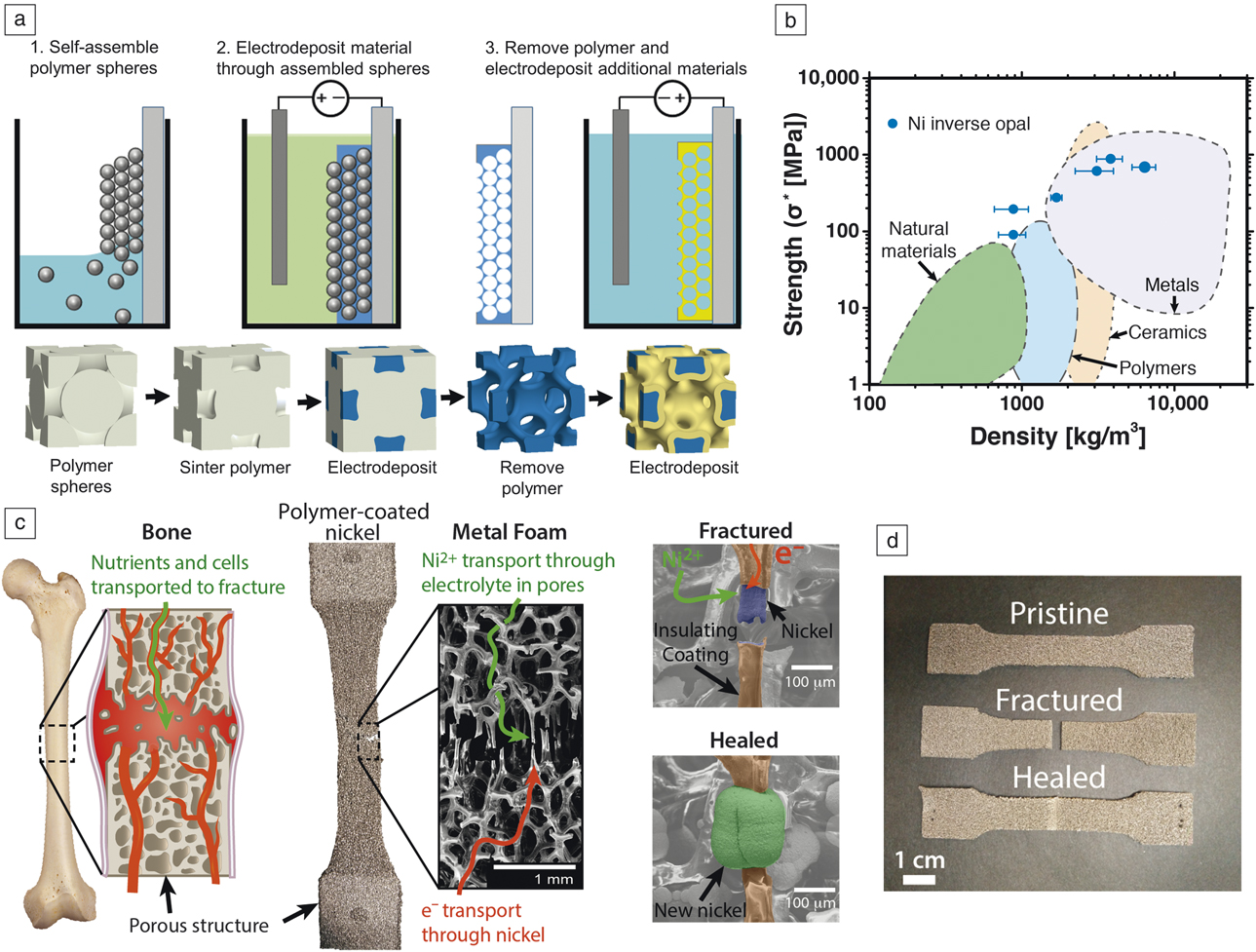
Electrochemical deposition is a powerful tool for synthesizing materials with complex 3D architectures, as many chemistries can be deposited at micrometers-per-minute rates with nanometer resolution. For example, an effective technique for achieving materials with hierarchical or controlled nanoscale architectures is to electrochemically deposit a material through a porous scaffold. After removing the scaffold, the electrodeposited material will retain the scaffold’s inverted shape with nanometer precision.Reference Pikul, Gang Zhang, Cho, Braun and King30,Reference Ning, Pikul, Zhang, Li, Xu, Wang, Rogers, King and Braun35,Reference Stein and Schroden94 Figure 4a illustrates this process with self-assembled particles as the scaffold. In addition to optical materials,Reference Arpin, Mihi, Johnson, Baca, Rogers, Lewis and Braun95 this fabrication approach has been used to realize current collectors for high-power batteries,Reference Pikul, Gang Zhang, Cho, Braun and King30,Reference Pikul, Liu, Braun and King34–Reference Liu, Zhang, Wang, Cho, Pikul, Epstein, Huang, Liu, King and Braun36 electrochemical sensors,Reference You, Pikul, King and Pak96 and high-strength and low-weight structural materials.Reference Pikul, Dai, Yu, Zhang, Kim, Braun and King97,Reference Pikul, Özerinç, Liu, Zhang, Braun, Deshpande and King98 In structural materials, the 10–100-nm struts in the porous nickel benefit from size-based strengthening so that the individual strut strengths approach their theoretical maximum, which is about 4× greater than the strength of macroscopic materials.Reference Pikul, Özerinç, Liu, Zhang, Braun, Deshpande and King98 Figure 4b shows the mechanical response of these materials. The material architectures can be modified through electrodeposition so that the materials have the strength of titanium and the density of water or comparable strength and density to high strength engineering alloys like Ti-6Al-4V and 7075-T6.
Electrodeposition as a tool for advanced architected materials. (a) Hierarchical materials with controlled porosity realized by electrodepositing materials through sacrificial scaffolds.Reference Pikul, Özerinç, Liu, Zhang, Braun, Deshpande and King98 (b) High-strength and lightweight properties of metal foam fabricated using the process in (a). (c) Electrochemical healing of cellular metals inspired by bone.Reference Hsain and Pikul99 Healing occurs by transporting electrons through the nickel and nickel ions through the electrolyte in the pores to the healing location. The nickel ions electrochemically reduce and new nickel is electrodeposited. (d) Metal foams before fracture and after healing.
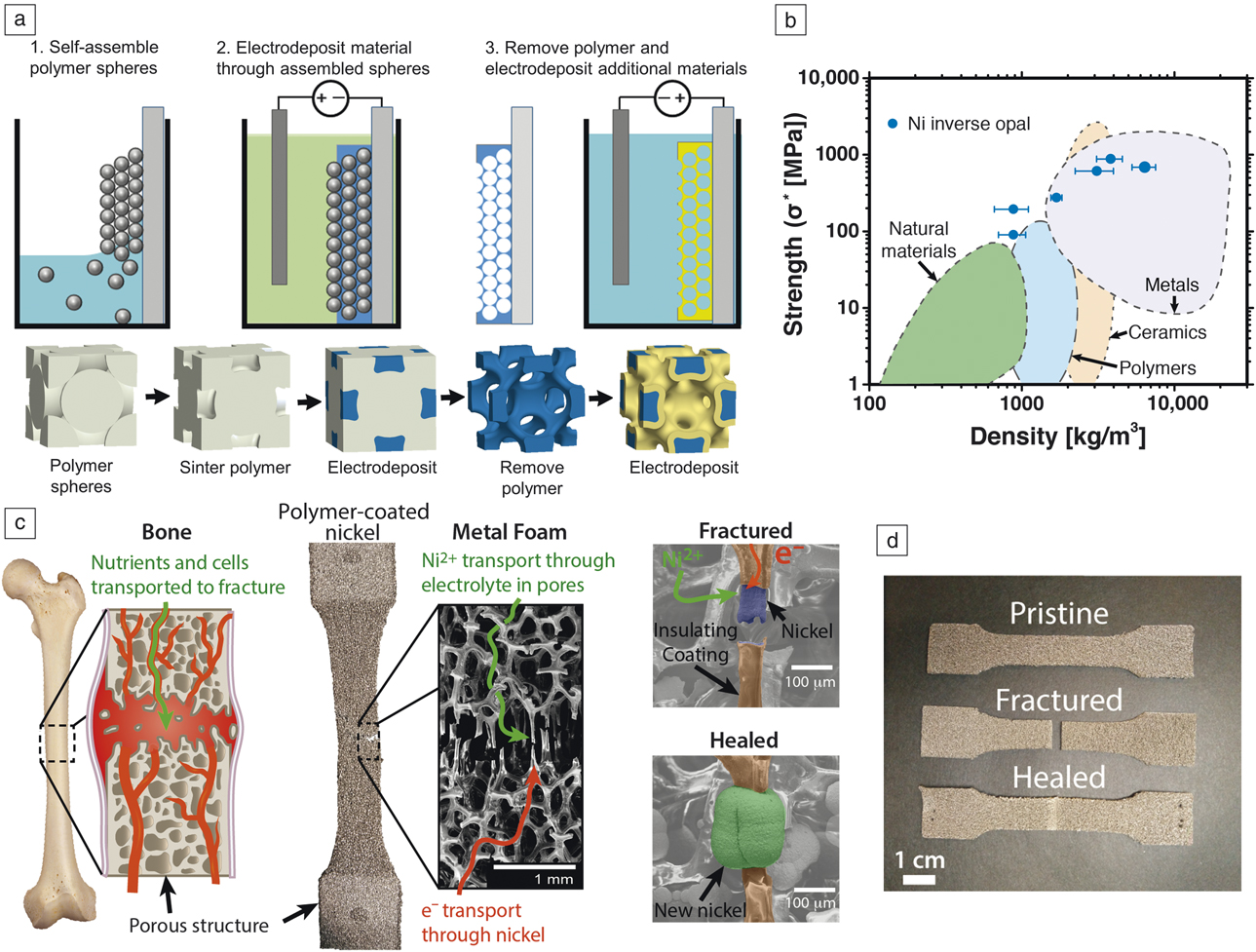
A unique feature of electrodeposition is that it can transport solid materials over centimeter distances in short times, especially when compared to the slow diffusion rates in solids. Solid nickel, for example, can be rapidly transported from a counter electrode, where it is oxidized, to a working electrode, where nearby nickel ions are reduced to form solid nickel. Using this concept, recent work demonstrated the first room-temperature healing of metals by transporting nickel directly to fractured struts in a structural nickel foam.Reference Hsain and Pikul99 Figure 4c shows the electrochemical healing process, which was inspired by transport-mediated healing in bone. The electrochemical healing of metal foams enabled 100% strength recovery (Figure 4d) after as little as 1500 J of energy input and 4h of healing. The electrochemical transport of metals into alloys that swell has also realized reconfigurable microlattices.Reference Xia, Afshar, Yang, Portela, Kockman, DiLeo and Greer100 These applications of electrochemistry are enabling dynamic architected materials with exciting new functionalities.
Conclusion
Architected materials have enabled numerous advances in electrochemical systems because they allow control of the chemical and physical processes that accompany electrochemical reactions. Next-generation electrochemical systems with improved performance will require novel material architectures that increase kinetics, accommodate mechanical stresses and chemical changes, and are sustainably manufactured at scale. Improvements are anticipated to come from new synthesis and manufacturing technologies, methods for harnessing sustainable materials, further understanding of fundamentals, and models that guide new architectures.
Acknowledgments
J.H.P acknowledges support from the US Office of Naval Research, Grant No. N00014-19-1-2353. J.W.L. acknowledges support from the US Office of Naval Research.

James H. Pikul is an assistant professor of mechanical engineering and applied mechanics at the University of Pennsylvania. He received his BS, MS, and PhD degrees in mechanical science and engineering at the University of Illinois at Urbana-Champaign. His research interests include soft-matter physics, advanced manufacturing, and electrochemistry to enable next-generation energy-storage technologies and multifunctional materials. His awards include the Office of Naval Research Young Investigator Award and 2013 Materials Research Society Gold Award. He is a 2019 Scialog Fellow for Advanced Energy Storage. Pikul can be reached by email at pikul@seas.upenn.edu.

Jeffrey W. Long is a research chemist at the US Naval Research Laboratory. He received his BS degree from Wake Forest University and his PhD degree in chemistry from the University of North Carolina at Chapel Hill. His current research focuses on the development of new nanostructured materials for applications ranging from electrochemical energy storage to filtration and decontamination. His awards include the Delores M. Etter Award from the US Navy. Long can be reached by email at jeffrey.long@nrl.navy.mil.