1. INTRODUCTION: PLAGUE AND CRIME IN HISTORY AND CHRONICLE
The history of the relation between disease and crime is dominated by three concepts: depression, amplification and opportunity. Disease is said to depress criminality, to amplify tensions, or to augment the opportunities for crime. Thus, historians have seen the operation of disease on society and institutions as providing a new dimension to existing conflicts, or as making existing structures more vulnerable to crime, or as creating new structures open to criminal exploitation. In the influenza epidemic of 1918, for example, physical violence is said to have fallen, ‘not just because criminals were sick, but because they feared infection too’.Footnote 1 Conversely, during plague epidemics in early modern Europe, ‘people broke into infected houses to loot them’, while others resisted the control measures put in place by public health boards;Footnote 2 in modern India plague measures created powers and places that were soon permeated by criminal behaviour.Footnote 3 Plague in Italy in 1576 and 1630 is said to have had the effect of echoing and amplifying existing social tensions, just as plague in early modern England is presented as having the potential to ‘inflame old resentments'.Footnote 4 This article asks which, if any, of this range of connections is evident during and after what has been described as ‘not just another’ epidemic, but ‘probably the greatest European catastrophe in history’.Footnote 5
In the few existing studies of criminality and judicial activity in 1348 and the years immediately following, two contrasting interpretations are evident, though neither is based on firm evidence: one interpretation tries to fit criminality into a model of social breakdown, while the other avoids or downplays the issue. In Britain, Benedict Gummer sees it as ‘likely’ that the plague ‘sharpened the … motives to steal’Footnote 6, while conversely the most recent study of plague epidemics in London by Barney Sloane concludes that ‘the evidence is very scant for any resultant breakdown in law and order’.Footnote 7 In Italy, Elisabeth Carpentier, in her classic and extensive study of responses to the plague in the city of Orvieto, saw the years 1349–1350 as offering ‘a spectacle of undeniable moral loosening’ and ‘a particularly unhealthy atmosphere’, but her evidence comes from government measures based on self-interested complaints, and hardly concerns crime at all, but tax flight, irregularities in public office, damage to crops and misappropriation.Footnote 8 The Orvieto city archive in fact has only fragmentary judicial records for the fourteenth century.Footnote 9 In his pioneering and still valuable study of the impact of the Black Death in Siena, William Bowsky twice asserted that there was an increase in crime and disorder following the plague, but provided no evidence to support these claims.Footnote 10 Elsewhere, recent works on plague and its impact have either not addressed the issue of crime and prosecution at all,Footnote 11 have subsumed it under comments about protest,Footnote 12 or have referred to it in only general terms, for example, suggesting a ‘flocking of “misdoers”’ from city to countryside ‘as in all primarily rural societies during times of economic upheaval’.Footnote 13 For Spain, Agustín Rubio's study of the Black Death in Valencia claimed that plague generated ‘social hypersensitivity’, allowing ‘hidden tensions and conflicts’ to erupt in greater magnitude,Footnote 14 but did not investigate further, while Melanie Shirk's promisingly study entitled ‘Violence and the plague in Aragon’ is based not on actual trial registers, but on the king's mandates and missives,Footnote 15 and seems intended to substantiate Gabriel Jackson's earlier, lurid claims that ‘robbery and hysteria became normal occurrences',Footnote 16 as Shirk concludes, unconvincingly given the evidence cited, that ‘the crimes noted here were nothing extraordinary’ but the ‘intensity of such violence was raised to an unprecedented height’.Footnote 17 After the plague, writes a historian of Navarre, ‘there broke an enormous wave of criminality’, evidenced in an outbreak of brigandage, though on this author's very evidence the wave was already rolling some years before 1348.Footnote 18 Even a more recent, more appropriately sourced, more quantitative study of crime and punishment in Navarre in the first half of the fourteenth century leaves without comment the peculiar figures for the years 1348–1349.Footnote 19 More generally, while noting that ‘few have gone beyond recounting dramatic episodes … to compare levels of violence before and after the Black Death’, Samuel Cohn has taken issue with the argument that mass mortality increased warfare, crime and revolt.Footnote 20 The existing scholarship on this theme thus either does not recognise the issue or adopts sensational assertions, based on unsupportive or inappropriate evidence.
Contemporary observers offer only thin support for any connection between crime and plague. Italian chroniclers pay little attention to this in their accounts of life in 1348 and the years that followed; thus chronicles from Bologna itself or its neighbour Ferrara, which in similar terms report the origin, transmission and mortality of the disease,Footnote 21 or diaries and chronicles from other cities, which range across religio-medical themes, discuss the social isolation of plague victims, the unofficiated, mass burials, the abandonment of public building works, the emotional effects on survivors, and wage and price inflation.Footnote 22 One Florentine, Matteo Villani, after haphazardly mentioning the origin, scale and causes of the epidemic, does open a chapter ‘How men became worse than before’, but focuses on only three sins: gluttony (feasting and a taste for delicacies), luxury (new fashions in clothing) and lower-class idleness/indulgence (the desire to avoid work and to enjoy fine food and clothes).Footnote 23 However, in 1350 the government of Siena did lament the great increase in violent crimes in that city and ‘the ever-growing impunity’ of criminals, and two years later it created a new police office.Footnote 24 In addition, one Venetian chronicler noted that ‘in this plague arose countless robbers, who thieved and looted houses’.Footnote 25 Contrary to this suggestion that plague created opportunities for larceny, in Piacenza the lawyer Gabriele de’ Mussis in his ‘History of the plague’ reports that thieving from the houses of the plague-stricken was inhibited by the idea that handling the goods of the deceased would transmit the disease.Footnote 26 So, an increase in criminality and immorality is not a common feature of Italian chronicle narratives of the Black Death of 1348.
This is in strong contrast to the famous description of plague in Giovanni Boccaccio's Decameron, with its suggestion that respect for the law was both eroded by misery and made unenforceable by deaths among the police and judiciary, that women's standards of bodily and sexual decency were undermined by their needs for therapeutic care, that the presence of disease encouraged moral bravado, while the absence of property owners, of law-enforcers and of family members and female servants allowed appropriation, law-breaking and promiscuity.Footnote 27 But Boccaccio's description, once taken as ‘description’, ‘observation’, ‘eye-witness account’ or as ‘chronicling responses to plague’,Footnote 28 has been undermined by a succession of scholars who have demonstrated its dependence on much earlier medieval sources,Footnote 29 and its divergence both from chronicle accounts, with their strong biblical echoes of old testament prophecies and new testament apocalyptic visions,Footnote 30 and from social practice, which showed a distinct lack of social dissolution as depicted by Boccaccio.Footnote 31 Meanwhile, literary scholarship has suggested the fictionality and pseudo-historicity of the Decameronian plague narrative.Footnote 32
By way of contrast, the few partial studies that have been conducted on contemporary trial records suggest effects only of opportunity: in Florence between points in the mid-1340s and the mid-1350s there seems to have been a rise in prosecuted crime, with theft doubling as a proportion of all prosecutions but with assault halving,Footnote 33 while in Venice too the number of theft trials remained high despite the demographic collapse, and included some cases of looting during plague emergencies.Footnote 34 The difficulty of the existing Florentine data and the partialness of the Venetian study, combined with the silence of most contemporary observers on the issue, are the prompts for this current study, the first to examine in close detail a continuous set of data from the 1340s in order to locate the effects of plague on criminal justice and perhaps on criminality.
2. BOLOGNA: CONTEXT, COURT, DOCUMENTATION
There are few Italian cities where it is possible to investigate more closely the profile of criminal trials around 1348. Bologna offers records for each year of the 1340s, though with some gaps. For most years from the late thirteenth century onwards, there is at least one register for each semester (period of six months), which represents the term of office of the chief judge (podestà) and his judicial subordinates (here the criminal judge). Cases came to this court through one of three means: accusation by the victim, denunciation by local, elected officials in city and countryside (ministrali, massari), and ex officio action by the judge (sometimes triggered by direct complaint – querella – from the victim, sometimes by ‘public voice and repute’). Accusation registers were kept separately, and many of the gaps occur in that series, with coverage in only three years in the 1340s: as a mode of initiating judicial action, accusation had been in sharp decline in the preceding decades.Footnote 35 The courts dealt with all forms of criminal behaviour, from murder and assault, through theft and robbery, to insult and gambling. Cases came from both the city and its dependent territory (the contado), though in differing proportions (slightly more cases from the contado in the mid-fourteenth century). The podestà's court was not the only one: although the court of the Capitano del Popolo had been abolished by the newly created ‘Protector and Governor’ of the city, Taddeo Pepoli (1337–1347), a new court of Taddeo's lieutenant (vicarius domini) dealt with a range of offences relating to public order and public office.Footnote 36 This study will draw material from this court for the first time.
Bologna's population was radically reduced by fourteenth-century plagues: from an apparent peak of over 50,000 inhabitants c. 1300, the population had fallen already to 35,000 by 1347 due to warfare and food shortages, then fell to 20,000–25,000 following the Black Death, and was to fall further in the plague epidemics of 1374 and 1399.Footnote 37 Bologna's experience of the plague has been most recently studied by Shona Wray. Eschewing narrative accounts of the plague in favour of the evidence of wills, which she argued provided ‘an accurate portrait of life during the crisis’, she critically examined and overturned the ‘popular image of the plague’ in which ‘family members abandoned each other and people streamed out of the city’.Footnote 38 Instead, she found that notaries, priests and neighbours remained in the city to assist both the diseased and the survivors. It is not certain when plague first arrived in the city: the evidence from wills suggests that plague hit Bologna in the second half of May, though local chronicles specify that it commenced in March and lasted until Michaelmas (29 September).Footnote 39 During the months when plague was active, people in Bologna were still agreeing commercial contracts, arranging marriages and pacifying old quarrels, while ordinary government continued.Footnote 40
Methodologically, it is important to recognise the character of the Bolognese judicial records. They are not just lists of sentences or records of fines paid, but full and sequential trial records, starting with the indictment, and then proceeding through the required phases – citation, responses, possible depositions of witnesses – to the sentence (usually a ban, sometimes a condemnation to financial, corporal or capital punishment, rarely an acquittal). Obviously, they are the records of crimes that were alleged and were reported, with all the human selectivity those processes involved – from the reporting efficiency of local officials to the power and sufficiency of the ‘public repute’ (publica vox et fama) that brought cases to the attention of the judge.Footnote 41 They are first and foremost records of trials rather than records of crimes. However, they lack some of the problems that have undermined statistical approaches to judicial sources in France: discontinuity, exemplarity, preoccupation with theft, over-representation of certain social groups or of the socially marginalised.Footnote 42 The problem of unreported crime and the ‘law of silence’ (Claude Gauvard) of course remains, as in any period of history.Footnote 43 In this period that problem is more acute, because while the Black Death may have affected criminality, it may also have affected judicial processes: the ability of courts to prosecute and to bring suspects to justice. In what follows, the focus is therefore on both the nature of prosecuted criminality and on court resources and processes.
3. CRIMINAL TRIALS IN BOLOGNA IN 1348
Eight registers in the archive in Bologna contain the trial records from the podestà's criminal court for 1348, unequally divided between the two judicial semesters.Footnote 44 These are the cases that came to the court by denunciation or ex officio action, and were tried by inquisition. The registers contain just 46 trials for the first six months of the year, and 29 trials commencing between mid-July and early December. Almost equally divided between city and countryside, the trials involved a total of 210 men (79 in the first semester and 131 in the second) and 11 women (10 in the first semester, 1 in the second), who were accused of a range of crimes among which violent assault and theft were the most common. In addition, a register of accusations, now at low levels, contains just 31 trials, mostly for minor violence (22 cases) and theft (6) from the first semester.Footnote 45
The Black Death may have made an impact on judicial processes in several ways: in the volume and type of criminal prosecutions; in the social profile of suspects; in access to the courts; and in the capacity of courts to hear cases, conduct trials to conclusions and to reach enforceable sentences. Existing scholarship would lead us to expect an increase in criminality together with a collapse of law and order. An increase in property offences is often noted, from petty thieving from abandoned houses,Footnote 46 to brigandage and high-way robbery in the countryside,Footnote 47 along with greater quarrelsomeness, spilling into violence, over disputed inheritances, legacies and debts. The disruptions caused by plague to employment, labour relations and food supplies may have led to crisis in the cities,Footnote 48 unrest in the countryside, and greater social friction, while rapid immigration in the wake of plague may have produced political dissent, instability and challenge to existing regimes.Footnote 49 Responding to situations of scarcity of labour and abundance of material possessions, governments quickly enacted new laws, with penalties, in an attempt to contain the pressures to increase wages and the desires to dress in more ostentatious attire. Meanwhile (we are told), the wholesale suspension of government functions at the height of the plague in the summer of 1348 was repaired only slowly in criminal justice as judges were hard to find and criminals hard to bring to justice.Footnote 50
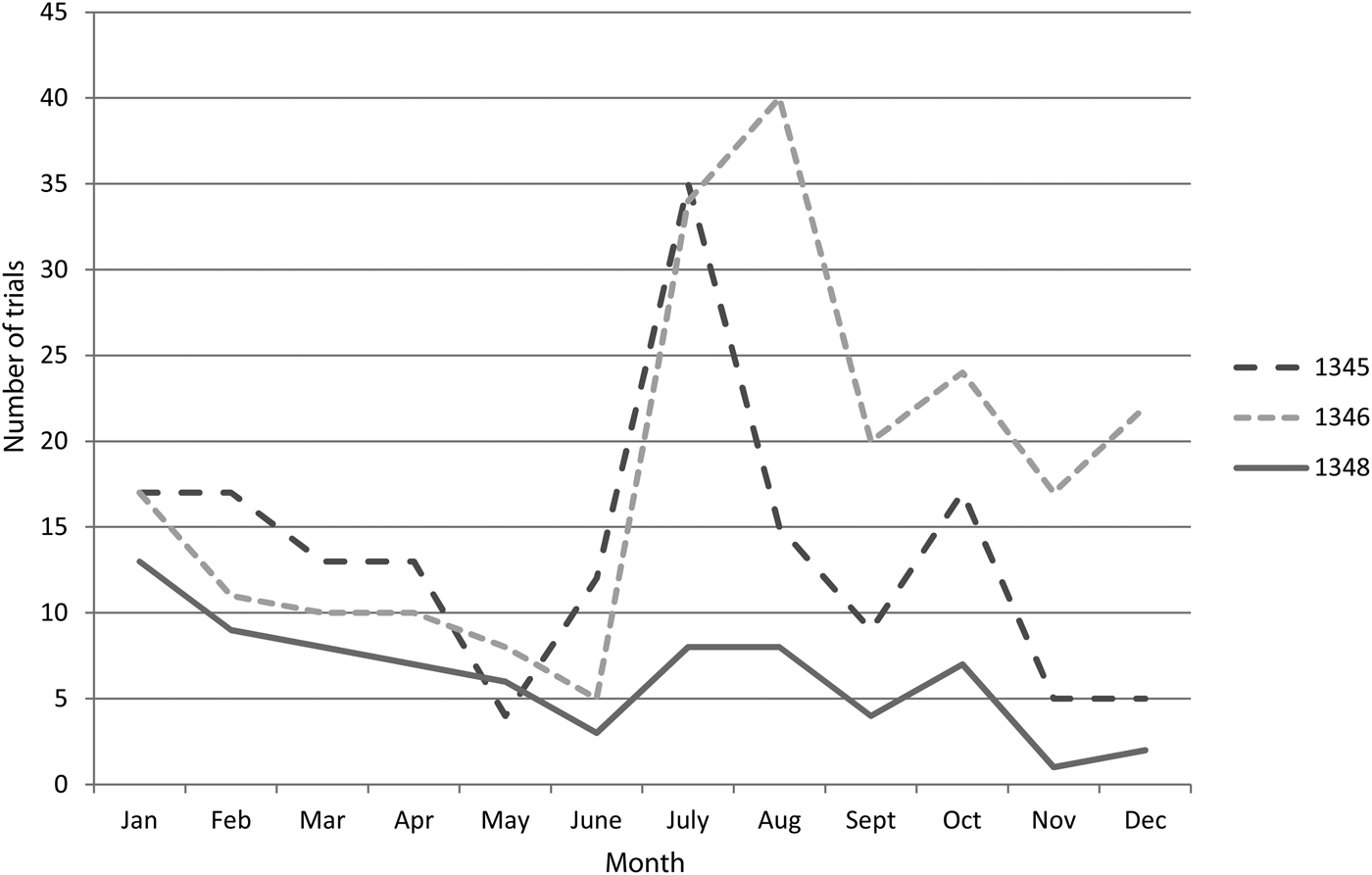
In Bologna, the volume of trials shows a drastic reduction from previous years: the total for 1348 (75) is less than half of the average for total cases in the previous eight years (precisely: 40 per cent of 186). The month-by-month figures – illustrated here in the comparison between 1348 and 1345–1346 (Figure 1) – also show the impact on judicial practice, even though most of the court personnel seem to have remained alive and in post,Footnote 51 as opposed, it seems, to the unpaid, elected local officials whose responsibility it was to denounce crimes in their districts (see section 3 below). Law-enforcement was not incapacitated through lack or absence of paid officials: that the ‘high ranks’ were ‘hardly touched’ was not unusual during epidemics.Footnote 52
The Podestà's court: number of inquisitorial trials by date of initiation. Source: Archivio di Stato, Bologna, Curia del Podestà, Inquisitiones, buste 162–165, 168 and 168bis.

Prosecutions in 1348 began at a level fairly consistent with previous years, and (surprisingly) echoed the normal pattern of falling numbers during the first semester, with low points in May and June,Footnote 53 followed by peaks in July and August. The level of prosecutions in the first semester of 1348 does not yet suggest any impact of plague, and the trial records start to diverge from the normal pattern only in the second half of the year. Despite being depressed in number, slightly beyond the proportionate fall in population, the rhythm of criminal trials in fact shows a remarkable consistency with the norm, suggesting perhaps that plague did not disturb the seasonality of crime or crime reporting.
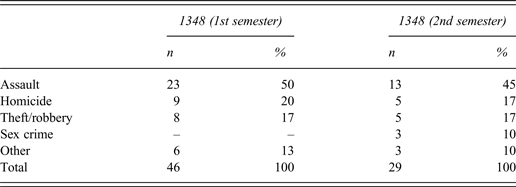
Turning to type of offence (Table 1), most of the trials were for homicide or assault, as in previous years (see Appendix): 14 homicides ranging from city-street stabbings with a single wound,Footnote 54 to an armed peasant gang attacking their neighbours and leaving a trail of corpses and casualties.Footnote 55 The 36 assaults range from punches and minor cuts inflicted with knives,Footnote 56 to more serious, organised assaults, such as that plotted by five city-men and two women, and put into bloody effect by a third woman, to castrate a man using a breadknife.Footnote 57 Theft trials fell in number and remained level as a proportion between the two semesters. Thieves included opportunists, such as the man who consumed the grain he was transporting to the city or another who made off with a guest's horse from an inn,Footnote 58 to the organised, such as a pair of concerted partners in crime who kidnapped a man and stole his money,Footnote 59 and the ‘professionals’, two out of three of them from Modena, who confessed to a combined total of 43 counts of theft since the previous summer, one of them mainly rustling livestock, a second mostly pilfering items of clothing from houses in Bologna, and a third taking household objects, tools and food from houses in the suburbs and contado.Footnote 60 Prosecution for theft continued in the second semester, both single acts and a small series of burglaries, but with no indication that the houses had been abandoned or the victims struck by plague.Footnote 61 There were no trials for sex crime in the early months of 1348 – except for the attack by two law students on the house of a widow, Caterina, pushing the door, throwing stones at the roof and uttering profanities, allegedly for the purpose of having sex with Caterina's daughters (which the suspects denied).Footnote 62 However, there were three in the second semester. Two of these were attempted rapes, one in a village and one in the suburbs, involving a child;Footnote 63 and the third was a rare case of a villager charged with forcibly marrying his servant to another inhabitant.Footnote 64
The podestà's criminal court: inquisitorial trials in each semester of 1348
Source: Archivio di Stato, Bologna, Curia del Podestà, Inquisitiones, buste 168 and 168bis.
The other crimes prosecuted were relatively minor offences in the first semester such as leaving a castle at night by climbing over the stockade, setting fire to a haystack, and preventing the arrest of a debtor – though far more serious in the second: two cases of sedition. In one, three men were charged with conspiracy to raise ‘rumour and tumult’ and to ‘make sedition’ in the castle of San Giovanni in Persiceto; and in the other, 84 men from the territory of neighbouring Imola were charged with armed assembly and ‘greatest tumult and rumour’ at Sassonigro, causing the wounding or killing of 10 people.Footnote 65 These instances of disorder might seem to constitute different categories – conspiracy as against local cross-border warfare – and it is difficult to get behind the legal description of the indictment. The motives, causes and objectives of these insurgents are kept from us by the trial record, but these two cases suggest a level of unrest among the rural population that one might be tempted to relate to the greater lower-class ‘insolence’ that some contemporaries perceived and which many historians have stressed in the post-plague environment (though Cohn has recently shown that violent social protest retreated across Europe in the years 1348–1352).Footnote 66
The social profile of the suspects was predominantly lower class, as indicated by the occasional occupational descriptor (13 servants, 2 bakers, a miller, a barber, the sons of a fisherman), and by the frequent absence of surnames. Significantly, most of the servants (11 out of 13) were prosecuted in the second semester.Footnote 67 Offenders coming from outside Bologna were few, 8 in the first semester, mostly from neighbouring cities, proportionately more in the second semester (11 in total) and from further afield, including Pavia, Vicenza, Tortona and Ravenna. Again, there is therefore a slight upward trend in prosecutions against transient and subaltern groups.
Access to the court – the pattern of initiation of trials – reveals particular features in 1348. The vast majority of trials were initiated as ex officio inquisitions, with only 15 cases coming to court through the denunciation of a local official, in city or countryside.Footnote 68 This contrasts with the pattern in 1347, when the denunciations and inquisitions were equal in number, each initiating half of the cases during the year. So, a very particular and unusual pattern obtains in 1348: few denunciations from within the city walls, and a high proportion of ex officio trials. This could mean one of several things: mortality or flight among the ministrali was so high that they no longer functioned as a means of denouncing crimes; or the adoption of a more active judicial response during crisis (which might explain the exemplarity of some prosecutions).
As for the capacity of the court to resolve cases, four possible trial outcomes were usually, but not consistently, noted in the record: acquittal, confession (and execution), condemnation (meaning a monetary penalty) or ban, following non-appearance (the ban specified the penalty, usually monetary, that the convict had to deliver in order to be readmitted to the community). The court achieved final sentences on almost all the cases, registering 27 bans (59 per cent) and 14 confessions (30 per cent) in the first semester and 22 bans (76 per cent) and 5 confessions (17 per cent) in the second. Again, there is comparison with the immediately preceding year, in which 70 per cent of cases ended in a ban, and 11 per cent in confession and punishment (‘facta fuit executio’, ‘decapitatus’, ‘suspensus’), with the remainder being acquittals or interventions to terminate the process (in the form of certificates issued by the bishop that the suspect was a cleric and therefore not subject to the secular court or simple mandates issued by the lord of the city commanding the podestà to cease prosecution). In none of these years should contumacy rates be taken as a sign of failure, as has recently been underlined.Footnote 69 While the rates of contumacy and confession in 1348 appear consistent with 1347, acquittals and terminations are notably absent: evidence perhaps that suspects did not have access to authorities with the power to intervene, such as the bishop's vicar for proof of clerical status, or to the city's Pepoli lords for an order to terminate a trial.
In general terms, the proportions of prosecuted crime in 1348 show nothing exceptional: the predominance of crimes of violence, the high proportion of homicides and the relatively low incidence of theft all fit into the usual pattern of medieval criminal prosecution. Theft trials remain steady, not responding in any way to the alleged new opportunities for larceny – as in a later plague year, 1383, when a total of only 12 cases of theft (6 per cent of the total) were prosecuted.Footnote 70 However, on closer inspection, numerous features appear aberrant. The year provides an unusual pattern of initiation and termination of trials, with a collapse in the number of denunciations and a lack of interventions during or after the trial by the political or ecclesiastical authorities. More onus was falling on the podestà to gather information and to proceed ex officio. There are strong contrasts between the first and second semesters in the number, proportion, severity or rarity of specific crimes (insurgency, paedophile rape, forced marriage), and in the social profile and geographical provenance of suspects (more servants, more outsiders from further afield).
Was there a breakdown in law and order in 1348? Bowsky's presentation of the impact of the Black Death on Sienese government and society is sometimes adduced in evidence of the claim that there was. Within a general picture of governmental shut-down in the summer months (‘most governmental activity ground to a halt’), Bowsky in fact says nothing about the criminal courts during the epidemic, only that the civil courts were suspended until September. He then uses two pieces of evidence to support a claim that crime and disorder increased following the plague: a statement by the city council in September 1350 lamenting ‘the ease with which culprits could evade justice merely by leaving the city’; and the appointment in March 1350 of an official to protect border areas from ‘highwaymen and murderers’.Footnote 71 This evidence, while in no way supporting the notion of an increase in crime – it is evidence only of a desire to round up more criminals – might suggest a failure in the capacity of the policing and judicial systems. This would be supported, and explained, by Bowsky's third piece of evidence: the ‘acute shortage’ that Siena faced in and after 1348 in recruiting the necessary foreign judges to the roles of podestà and Capitano del popolo.Footnote 72
The claim that there was a collapse in law and order in Siena thus rests on two bases: suspension of government activity at the height of the epidemic in the summer of 1348, and shortage of judicial and policing personnel in the following years, facilitating successful flight from justice and the infestation of border areas by brigands. Bologna suffered from neither of these two problems. The criminal court remained active over the summer of 1348 – summoning suspects or witnesses, hearing responses, issuing bans and sentences – and its activity is recorded on 19 days in July, 22 in August, 17 in September and 18 in October.Footnote 73 The court registers also include the journal (‘memoriale’) of one of the notaries to the criminal court, recording cases in hand for July and August: it has entries for eight days in July and nine days in August, and notes the summonses of suspects, confessions, bans, and the hanging of one Modenese man for stealing from the houses of students in June and July (he returned some of the goods to their owners).Footnote 74 This continued judge-led activity offset the apparent, temporary cessation in private accusations after June,Footnote 75 and in denunciations of crimes by local officials in May–July.Footnote 76 Furthermore, pardons for criminal offences continued to be issued as usual throughout the period March to September, on the basis of petitions from convicts and reports from the communal bandits’ office, as this element of criminal justice continued to operate.Footnote 77 So there was no breakdown of criminal trial processes in 1348: the court acted on information about crimes, issued summonses and interviewed witnesses, the judge gave sentence and even hanged a thief (a conventional symbol of justice at work), while the Pepoli lords issued pardons. Nor is there any evidence for a shortage of personnel: the two podestà for 1349, Lodovico Vicardi da Narni and Guido Gaetani da Pisa, starting in January and July, promptly took up their posts, and by 1351 the podestà's personnel had been strengthened, for whereas in the first semester of 1348 he had a staff (familia) of 86 (like his predecessor in 1345), in 1351 he had a staff of 101, consisting of one more judge, three more notaries, four more domicelli, and, most importantly, 16 more berrovieri (patrolmen).Footnote 78 It was at the next outbreak of plague in 1363 that the Bolognese government faced a problem in recruitment, but on that occasion a chronicler remarked that there was little crime anyway.Footnote 79 The impression of a government that carried on through the plague even at its height is confirmed by other official documents. Every year, several hundred notaries and other citizens were elected to a range of six-monthly posts as recorders, registrars, accountants or supervisors in the public administration: for 1348 there was a higher-than-usual number of substitutions in the second semester.Footnote 80 The absent or deceased were replaced. The same impression is given by the register of decrees issued by the lords of the city, Giovanni and Giacomo Pepoli, for 1348. Chancery notaries who died were replaced within days.Footnote 81 The number of decrees issued during the plague months (March–September) was over 20 per cent higher than in the corresponding period of the previous year, and even in July and August more decrees were issued than in the same two months of 1347.Footnote 82 When the College of Notaries could not conduct its business because of the number of deaths among its governing council of 40, the council was enlarged to 100 members.Footnote 83 When it became impossible, because of the scale of mortality, for the tax farmers to meet their contractual payments, they were released from their obligations and the taxes taken back into direct management.Footnote 84 Instead of closing down, some parts of government intensified.
What changed during the height of the epidemic was the volume of denunciations from local elected officials, ministrali and massari. Given that there were a hundred of these in the city alone,Footnote 85 it is unlikely that they were all victims of the plague. If we believe the trial record, their continued inactivity in denouncing crimes continued after 1348, for in 1349 all the trials were formatted as ex officio inquisitions or private accusations, rather than local denunciations. Moreover, the records of the election of ministrali are interrupted between 1349 and 1351.Footnote 86 It would be easy to suppose that this interruption was caused by plague, as elections each January involved an assembly of two-thirds of the male parishioners, the drawing of a name-slip from a bag or box, and the presiding presence of the local priest, a process (it might be argued) easily disrupted by mass mortality. However, other records dispel this supposition. Among the first duties of the ministrali was the compilation of lists of able-bodied males for military service, and in January 1349 there were enough newly elected ministrali to compile almost as many such lists as in January 1348.Footnote 87 Moreover, and crucially, the separate repository of papers for the criminal court in 1349 does contain denunciations by the ministrali, dated between February and December,Footnote 88 some of which in the trial registers were inaccurately described as ex officio inquisitions, the others not appearing at all, because of gaps in the registers.Footnote 89 So ministrali and massari were in post and active from the start of 1349. As for 1350, it is true that there is little documentation surviving from the podestà's criminal court for much of that year (see Appendix), but this was due not to plague but to political change, as the podestà in post in October was replaced without being paid (so probably retained his registers).Footnote 90
4. BOLOGNA: CRIMINAL TRIALS IN THE MEDIUM TERM, 1340–1351
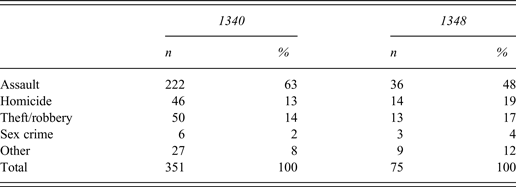
The evidence from the year 1348 alone is not enough to determine particularity. Comparison is needed with other years. To provide that, three points of comparison are made here: with the years 1340 and 1351 and with the full court activity for the 12 years between 1340 and 1351. As will become clear, 1340 looks like an exceptional year for the volume of criminal cases, and the subsequent years seem to return to more ordinary levels. Fourteen registers contain the inquisitorial trial records for the whole of 1340. This is a fortuitous and valuable number, as it represents almost all the registers for that year. The number of cases is the first indication of the much greater level of court activity: 345 in total, over four times the number in 1348 (Table 2).Footnote 91
The podestà's criminal court: inquisitorial trials for 1340 compared with 1348

Source: Archivio di Stato, Bologna, Curia del Podestà, Inquisitiones, buste 153, 168 and 168bis.
As one would expect, most of the trials in 1340 were for assault or homicide, with theft making up an equal number and proportion to homicide. The majority of assaults were in the city (131 out of 222) but the majority of homicides were in the contado (36 out of 46). The contado was the setting for a much more varied repertoire of killing, having more cases of clearly premeditated and brutal slaughter. The worst of these occurred at Borgo Panigale and was described as a ‘great tumult’ (‘magnus rumor’): a crowd of 19 men chased their targets from another village, shouting ‘Alamorte, alamorte’, and savagely killed two of them, one receiving over 20 wounds including a cut throat, and the other one a great wound to his neck.Footnote 92 Also occurring in the countryside were the only infanticide and the only killing in the course of robbery in these months.Footnote 93 The remaining trials show a much broader range of prosecuted criminal behaviour than was the case in 1348: seven cases of arson,Footnote 94 one of counterfeiting,Footnote 95 one of private imprisonment,Footnote 96 and one of forging a legal document.Footnote 97 Also among these cases there is also rape,Footnote 98 attempted rapeFootnote 99 and abduction for sexual purposes.Footnote 100 The suspects are predominantly citizens and inhabitants of Bologna and its territory, from the productive or service classes (bakers, barbers, butchers, tailors, etc., with a handful of servants); if they originate from outside Bologna, they were most likely to come from the neighbouring cities (Modena, Ferrara) or from northern Tuscany (Florence, Pistoia, Prato, Lucca).Footnote 101 Initiation divided roughly 60:40 between official denunciations and ex officio inquisitions. So, the comparison between 1340 and 1348 suggests that it is not the overall profile of cases in 1348 that needs explanation but their range, number and distribution. Small numbers of attempted rape cases or of rural disturbances were not unusual – though the pattern of prosecutions in 1340 does underline the exceptional features of the sex crimes of 1348 (rape of a child, forced marriage). The reduction in numbers of trials was greater than the reduction in the population, and the proportion of trials for crimes of violence fell considerably in 1348. Meanwhile, the higher proportion of servants and foreigners among the suspects in 1348 suggests both greater sensitivity to subaltern criminality and greater geographical mobility.
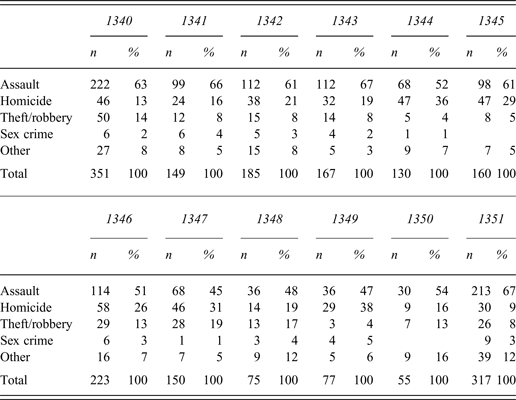
However, 1340 was exceptional: the average annual total of cases in the period 1341–1347 was much lower at 166. More typical was a year such as 1345 (see Appendix), with 160 criminal trials, the bulk of them assaults, and the bulk of the assaults involving a single blow or wound to the head, limbs or body of the victim.Footnote 102 The number of homicide trials in 1345, at 47, was just above average (44) for this pre-plague period in the 1340s. As in other years, the majority of killings took place in the contado, with homicidal tensions for example between men and women,Footnote 103 servants and masters,Footnote 104 parishioners and priest.Footnote 105 All the thieves were men: those hanged for theft included one habitual highway robber, and two housebreakers, responsible among them for over 40 thefts over the previous 12 months, while others were punished for single, small-value pilferings or for livestock rustling.Footnote 106 The social profile of the suspects, where mentioned, is overwhelmingly in the productive, commercial and service sectors: smiths and carpenters, butchers and millers, servants and barbers, and so forth. Also the suspects were overwhelmingly local: only a handful originated from outside Bologna and its territory. This year of trials was unusual only in having no sexual offences: by contrast, there had been one in 1344,Footnote 107 and six in 1346.Footnote 108 This profile reinforces the commonalities and particularities of 1348 already noted, in particular in relation to the quite ordinary proportions and character of violence and theft, and the greater presence of migrants and servants among the culprits in that year.
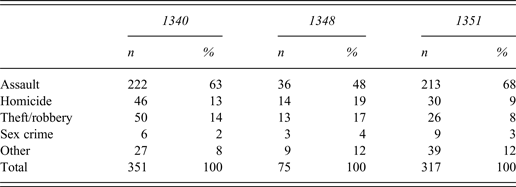
These conclusions are, however, complicated when we turn to the year 1351, just three years after the Black Death. Fourteen trial registers for the two semesters (another near-complete set) contain over 300 trials, involving 515 persons, virtually entirely men (Table 3).
The podestà's criminal court: inquisitorial trials for three years (1340, 1348 and 1351)
Source: Archivio di Stato, Bologna, Curia del Podestà, Inquisitiones, buste 153, 168, 168bis, 171 and 172.
The first striking feature of criminal trials in this year is this: despite the large reduction in population, the court is only slightly less active than in the corresponding period of 1340, itself a highpoint: an 8 per cent fall in caseload. A second feature is the near-disappearance of women among the indicted and convicted: just 11 trials involved women as perpetrators in this period.Footnote 109 Might these two features be related to the social incidence of plague mortality? If the epidemic killed mainly women and children, as it did in Cremona in 1452,Footnote 110 it would have increased the proportion of adult males in the population, the most criminal group. There are two problems with this suggestion: the mortality in Cremona was unusual, and the first plague outbreak was more ‘egalitarian’, killing irrespective of age or sex.Footnote 111 If anything, bubonic plague tended to remove young adult males;Footnote 112 and it is the number of males prosecuted in 1351, not just the proportion, that increases. The explanation lies elsewhere. Most of the prosecutions are for assault and these cases are a much higher proportion in 1351 than in any year in the 1340s. This was the product of two factors. First, there was an increased prosecution of minor bodily harms, with many more cases (65 in all) involving just punches or pushes or the aggressive use of weapons or objects without shedding blood,Footnote 113 the sort of cases which used to be brought through accusation and now came through denunciation. Second, there was a high incidence of prosecution of violent acts committed by garrison soldiers then present in the city, both violence among themselves and violence against citizens: 67 trials of Lombard and German soldiers for assault, and 7 trials for homicide, most of them crimes taking place in the city.Footnote 114 When two rapes inflicted by soldiers on local women are added, the total number of trials directly attributable to foreign soldiers rises to over 20 per cent of the total.
5. REGIME CHANGE: EFFECTS ON THE PODESTÀ'S COURT
This evidence of tension and confrontation between armed forces and citizenry relates to the political context of Bologna in this year. In October 1350, the native regime led by the Pepoli family, having failed to defend the territory from military incursion, sold the city to the Visconti lords of Milan.Footnote 115 Bologna then became a centre and base of Milanese expansion, but as such it incurred only damage to its population, through the costs of war, the destruction of trade, the devastation of the countryside and the reduction in revenues. These political changes had effects on criminal justice, which make it difficult to assess any continuing effects of plague: on the one hand, crimes of political dissent and soldierly disorder become significant, and, on the other, the range and practice of the podestà's court evolved. Bolognese resistance manifested itself in the trial records over the issues of military resources and obligations. One citizen was prosecuted for uttering contemptuous words during a muster, another for defamatory words directed at the Visconti lord, and a third for aggression towards the officials during a muster of the civic militia in preparation for a military expedition.Footnote 116 Two Florentine citizens and a former servant of the Pepoli were tried for plotting to oust the Visconti from Bologna.Footnote 117 A city official who spoke words likely to cause ‘scandal and detriment’ to the Visconti lordship was condemned to have his tongue amputated.Footnote 118 Former Visconti officials who extorted money from 60 Bolognese citizens, for licences to return home from military duty in Tuscany, were fined a large sum of money each, and those 60 men were banished for bribing officials to leave the army.Footnote 119
What is different after 1348 is that trials resulting from these actions of dissent and friction were conducted in the podestà's criminal court, whereas earlier the lieutenant of the Pepoli lord of the city had heard such cases.Footnote 120 Among various trials for fiscal and security offences – contraband, resisting public debt collectors, tax fraud – the lieutenant's court had mainly heard cases of violence inflicted by (or occasionally on) soldiers and their servants from Germany and Lombardy: 61 trials of assault and homicide survive in the records of the lieutenant's court for the 1340s, ranging from single punches in the face to grievous assaults in which, for example, a soldier struck a local official and his daughter so hard on their heads that he broke his sword in three places.Footnote 121
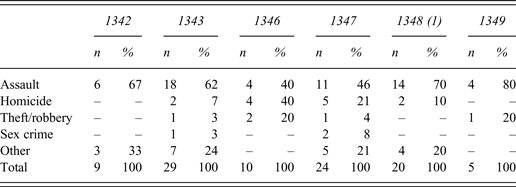
Two features of this court's activity are striking (Table 4). First is the absence of any documentation for the second semester of 1348, and the very reduced caseload for 1349. Second is the adoption of abbreviated and accelerated procedure. In the lieutenant's court, no witness is summoned, and pacification between victim and assailant is routinely used to ‘circumvent’ the trial.Footnote 122 This seems to be part of a ‘massive recourse to direct justice of the lord, overleaping the formal procedural stages’, that marked Taddeo Pepoli's lordship,Footnote 123 and contrasted to the usual, earlier-fourteenth century praxis of the podestà's criminal court, where the first action of the judge on receiving notification of a crime was to summon the witnesses, and to proceed only after ascertaining that there was sufficient proof. In the lieutenant's court, the first action was to summon the alleged offender, and to proceed rapidly to banishment when he did not appear. In only one case does the suspect appear in court in order to deny the charge, with the witnesses then being summoned and heard.Footnote 124
Criminal prosecutions in the Pepoli Lieutenant's court, 1342–1349
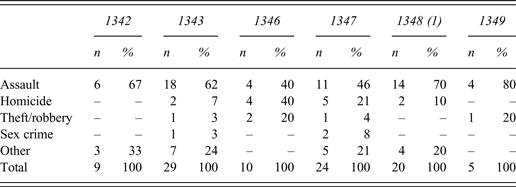
Source: Archivio di Stato, Bologna, Comune, Governo, Signoria Pepoli, Atti del vicario, busta 272.
After 1349, when the lieutenant's court was dissolved, this sort of martial and state-authority case flowed into the podestà's court, and that court seems to have adopted these same features of abbreviated trial. This development, which does not seem to be a mere change in notarial record-making, would be an extraordinary departure, running contrary to both earlier and later practice, and in itself could explain some further innovations in inquisitorial trials. In the mid-1340s, before any action was taken against the suspect by the podestà's criminal court, witnesses were summoned and questioned regarding their knowledge of the alleged offence, and the basis of that knowledge. Mostly, they reported being present and seeing the offence, but even where they merely reported ‘public knowledge’ (publica vox et fama) this was usually taken as sufficient proof for summoning and banning the suspect, even with a penalty of death.Footnote 125 By 1350, the trial record gives the impression that practice was to summon the witnesses only if the suspect appeared in court and denied the charge.Footnote 126 If accurate, this would constitute a major change in court practice that may in turn have prompted the increasing involvement of lawyers in inquisitorial trials, presenting lengthy objections (‘exceptions’) to the action by the judge, in a practice borrowed from civil litigation.Footnote 127 Defence lawyers are noticeably absent from trials in the mid-1340s,Footnote 128 and become more common in the later fourteenth century. They would thus have acted as the counter in practice to some learned lawyers’ arguments aimed at facilitating successful prosecution. Learned lawyers favoured accommodating inferences and assumptions in criminal trials as a means of more effective repression of crime.Footnote 129
Moreover, this apparent transition to a contracted procedure in the mid-fourteenth century followed the steep decline in usage of the private criminal accusation.Footnote 130 In the later thirteenth and early fourteenth centuries, this had been a common means of bringing inter-personal violence and property offences to court.Footnote 131 Still, in 1342 there were 42 such cases (in four registers), mainly accusations of physical violence, including one of homicide, but also six cases of theft and one of adultery.Footnote 132 In 1348 the number of accusations fell to 31 (in two registers), now only for assault, theft, perjury and criminal damage.Footnote 133 Post-plague, the separate registration of private accusations becomes fragmentary, and consists of two folios for 1351, covering only one clear case (of theft), and one folded sheet for 1368, covering claims for damage: a far cry from the hundreds of accusations each semester in the late thirteenth century.Footnote 134 In the later fourteenth century, those few accusations that came forward – mainly actions of trespass or criminal damage – were incorporated into the inquisition registers. It is possible that these changes in court practice were related to a crisis created by plague: it might be argued that a breakdown in law and order prompted the government to instruct the judiciary to adopt summary methods in order to ensure, as the common justification went, that no crime went unpunished. This is an attractive hypothesis, but not altogether convincing, for a number of reasons: no such instruction survives in the government records; and the circumvention of judicial procedures was already a feature of lordly government in Bologna before 1348.
Three separate changes in 1350–1351 therefore make it difficult to attribute features of the criminal trial record to the after-effects of plague: the inclusion of minor violence, previously initiated by accusation and registered separately; the incorporation of cases involving the garrison troops, previously tried in the lieutenant's court; and the use of the criminal court to repress acts of political dissent. Within three years of a demographic disaster, it is features of Visconti rule – garrisons, fiscal pressure, military demands, tighter political controls – that more prominently mark the judicial record.
6. CONCLUSION
This article started with a simple question, but ends with a complex answer. Looking for the effects of epidemic disease on criminality requires taking into account the effects of disease on prosecutions and judicial resources, personnel and procedures. Prosecutions clearly fell during the plague of 1348, though not from its eruption in March, but from its peak in July–August. Moreover, they fell more than the fall in the population. They fell mainly because of the large reduction in denunciations coming from elected local officials. Denunciations recovered from early 1349, and, after a gap in the records, by late 1350 were flowing again at pre-plague rates. What this means needs to be related to the effect of plague on the judiciary and its resources. The court continued to function, even at the height of the epidemic, and its processing of cases followed pre-plague patterns in terms of outcomes. If local officials were not denouncing crimes, other routes to the court remained open and were used. The choice, as regards effects on criminality, is then between two assumptions: either the denouncing officials died or fled and were not replaced, leaving a quantity of crime unreported, or the direct routes to the court were adequate for a depressed level of crime. The fact that a new set of local officials were, as usual, in post in January 1349, and did report some crimes in the city in that year, may be the evidence that tips the balance in favour of a depressed quantity of crime. That criminality, especially violence, declined during the epidemic is not to be discounted. The expectation that medieval people reacted with violence to adversity is well-rooted in the historiography, going back to Johan Huizinga, but has more recently been challenged by those who see violence as contained within rituals of confrontation.Footnote 135 As for quality, plague clearly had effects on what and whom were prosecuted – a narrower range of behaviours, a broader range of culprits – but absent is any swelling of opportunistic larceny. After 1348, there are some unusual features of the trial record: a rise in homicides in 1349 (as judges focused on serious crime?), and then a spectacular increase in cases of violence in 1351, now dissociated from its normal relation to homicide.Footnote 136 However, local political and judicial factors are more convincing as explanations for these changes than plague: the concern of the militaristic regime to maintain order, the continued reduction of accusatory proceedings with consequent channelling of minor cases into inquisitorial hearings, and the change in relation between the population, which fell, and the forces of law and order, which rose. The implications of these findings for plague studies are that historians need to put aside the outdated allure of the Boccaccian ‘moral loosening’, with its suggestions of greater promiscuity and indulgence and of a collapse of law and order, and to refocus on judicial activity and the changes to the origin and type of case, and the number and character of culprits. Justice did not sleep during the Black Death.
ACKNOWLEDGEMENTS
I gratefully acknowledge assistance from the University of Roehampton, which part-funded visits to the archives, the organisers and audience at the Fifteenth-century Society Conference ‘Society in an Age of Plague’, where this paper was first discussed, and Sarah Blanshei and this journal's anonymous referees for their stimulating comments.
APPENDIX
The podestà's criminal court: inquisitorial trials, 1340–1351a