PRELIMINARIES
This study looks at contextual vowel nasalization. A widespread phonetic process in Cajun English (Dubois & Horvath, Reference Dubois and Horvath2000) and Southern English, vowel nasalization also takes place in Louisiana FrenchFootnote 1, a severely endangered language variety spoken by fewer and fewer people every year. The current work seeks to understand the dynamics of phonetic vowel nasalization in Louisiana French in order to shed light on the mechanics of language contact, bilingualism, and language death. The diachronic aspect of the analysis affords a comparison through time of speakers born between 1888 and 1953. This section lays out the variables to be considered in the investigation.
The French Triangle of Acadiana, situated in southwestern Louisiana, brings together 22 parishesFootnote 2 with a higher-than-average level of French language and/or culture (Breton & Louder, Reference Breton and Louder1979; Estaville, Reference Estaville1988)Footnote 3. There is geographically based linguistic variation in French-speaking Louisiana (Baronian, Reference Baronian2005a, Reference Baronian2005b; Dubois, Reference Dubois, Valdman, Auger and Piston-Hatlen2005; Salmon, Reference Salmon2007, Reference Salmon2009), though interdialectal contact may be effectively reducing such variation (Byers, Reference Byers1988; Rottet, Reference Rottet2004). This study controls for regional variation by examining the Louisiana French spoken in a small area of lower Lafourche Parish, at the southeastern corner of the French Triangle.
Louisiana French has been in decline for over a century in urban centers like New Orleans, and since the Second World War in more remote, rural areas of the state like lower Lafourche Parish, as English has come to dominate nearly all linguistic arenas. In such a state of endangerment, Louisiana French is expected to exhibit rapid linguistic change over short periods of time in comparison with varieties spoken in vibrant Francophone communities. Endangered languages also exhibit speech style contraction: since they are “restricted to a few speech situations […] the styles merge with one another” (Dressler & Wodak-Leodolter, Reference Dressler and Wodak-Leodolter1977:37). Such register contraction is present for semi-speakers under 30 in Lafourche Parish (Rottet, Reference Rottet, Valdman, Auger and Piston-Hatlen2005b), but speech register differentiation is still present for older fluent speakers (Blainey, Reference Blainey and Mailhot2009; Carmichael, Reference Carmichael2008). It is therefore important to examine the role of speech register in Louisiana French phonetic and phonological variation, which this analysis achieves by contrasting conversation in more formal and less formal settings.
Sex is another factor to consider in a sociolinguistic analysis of language death and sound patterns (Dressler & Wodak-Leodolter, Reference Dressler and Wodak-Leodolter1977:40)Footnote 4. In St. Landry Parish Cajun English, there are sex-based differences regarding the realization of nasalized consonants (Dubois & Horvath, Reference Dubois and Horvath1998:164), and Dubois (Reference Dubois1999), cited in Dubois and Horvath (Reference Dubois and Horvath2000:311–312), reports that sex is an active variable in Louisiana French vowel nasalization rates. This investigation will test whether or not this observation holds for speakers from lower Lafourche Parish.
A person's linguistic patterns can change over the course of his or her lifespan for a variety of reasons (Sankoff & Blondeau, Reference Sankoff and Blondeau2007). With the potential for extensive linguistic change over time, a speaker's age may especially influence the pronunciation variants he or she uses in an endangered language (Bullock & Gerfen, Reference Bullock and Gerfen2004; Dubois & Noetzel, Reference Dubois and Noetzel2005; Rottet, Reference Rottet2001). This raises the question of how to treat the factor of time in studies of language endangerment. Sankoff and Blondeau (Reference Sankoff and Blondeau2007) contrast apparent time (synchronic analyses comparing several generations of speakers from a community recorded at a single point in time) and real time (diachronic analyses comparing one or more generations of speakers recorded at different points in time) approaches to explanations of language change. Within the category of real time linguistic research there are both panel studies, which compare speech from the same speakers, and trend studies, which compare speech from the same linguistic community (Sankoff & Blondeau, Reference Sankoff and Blondeau2007).
It is particularly important to have longitudinal evidence available when examining variation and change in an endangered language. However, language death is often closely tied to negative language attitudes, such that native speakers and outsiders see little value in preserving or documenting an endangered language. Thus, earlier recordings of endangered languages do not usually exist. Studies in the domains of syntax and morphology demonstrate the extensive paradigmatic and analogical leveling going on in Louisiana French (e.g., Dubois, Reference Dubois2001; Neumann-Holzschuh, Reference Neumann-Holzschuh2009; Rottet, Reference Rottet1998, Reference Rottet, Auger and Word-Allbritton2000, Reference Rottet, Brasseur and Falkert2005a), but only a handful of studies have been able to consider diachronic sound change in this language variety (e.g., Dubois, Reference Dubois, Valdman, Auger and Piston-Hatlen2005; Dubois, Noetzel, & Salmon, Reference Dubois, Noetzel, Salmon, Brasseur and Falkert2005, Reference Dubois, Noetzel and Salmon2006; Salmon, Reference Salmon2007, Reference Salmon2009). The present work is in a fortunate position: acoustically verified transcriptions of 1970s Louisiana French allow for both an apparent time and a real time analysis of speech patterns in lower Lafourche Parish.
While precise language learning environment information is not available for speakers recorded in the 1970s, the current investigation will examine the effect of a speaker's generation on his or her speech patterns, following previous studies that use Dubois’ (Reference Dubois and Valdman1997) classification of Louisiana French speakers (e.g., Dubois, Reference Dubois, Valdman, Auger and Piston-Hatlen2005; Salmon, Reference Salmon2007, Reference Salmon2009).
CONTEXTUAL NASALIZATION
The syllable boundary is important for contextual nasalization (also called nasal coarticulation) in both English and French. In English, nasality spreads from a syllable-final nasal consonant to a preceding vowel, as in the example fan (/fæn/ → [fæ̃n]) (Cohn, Reference Cohn1993). This regressive or anticipatory nasalization is non-contrastive and is generally delimited by the syllable boundary. French differs from English in two important ways. First, French has both contrastive and non-contrastive nasal vowels. Second, in French, phonetic vowel nasality comes from a preceding nasal segment rather than a following nasal segment. Numerous studies observe this carryover (progressive, perseverative) contextual nasalization using acoustic and aerodynamic evidence (Basset, Amelot, Vaissière, & Roubeau, Reference Basset, Amelot, Vaissière and Roubeau2001; Delvaux, Demolin, Harmegnies, & Soquet, Reference Delvaux, Demolin, Harmegnies and Soquet2008; Kelly, Poiré & Williams, Reference Kelly, Poiré and Williams2007).
The French-based Creoles spoken in the Antilles and Louisiana French exhibit a more liberal system of phonetic vowel nasalization, in the sense that an oral vowel can nasalize if it either precedes or follows a nasal segment (Valdman & Klingler, Reference Valdman, Klingler and Valdman1997). Louisiana French appears to have a larger prosodic domain of application than English and other varieties of French, since previous descriptions of the language variety state that any vowel can become phonetically nasalized by a following nasal segment, even across the word boundary (Guilbeau, Reference Guilbeau1950; Papen & Rottet, Reference Papen, Rottet, Dubois and Boudreau1996, Reference Papen, Rottet and Valdman1997; Valdman & Klingler, Reference Valdman, Klingler and Valdman1997). Since syllable and word boundaries do not block contextual nasalization in all languages of the world (Chafcouloff & Marchal, Reference Chafcouloff, Marchal, Hardcastle and Hewlett2006:76), this examination will look at the strength of the syllable boundary, but also the word boundary. The current investigation concentrates on those mid and low vowels with corresponding phonemic nasal vowels. While high vowels /i, y, u/ can undergo contextual nasalization in Louisiana French (e.g., cousine [ku.zĩn] ‘female cousin’), they do not have phonemic nasal counterparts (Delvaux, Reference Delvaux2000), and are phonetically more nasalized than non-high oral vowels in similar contexts, at least in Standard French (Delvaux et al., Reference Delvaux, Demolin, Harmegnies and Soquet2008).
In a situation of language death, the number of contrastive phonemes is expected to decrease. Specifically, segments that have a phonemic contrast in the dying language, but a phonetic contrast in the dominant language, are most likely to disappear (Bullock & Gerfen, Reference Bullock and Gerfen2004:95; Dressler, Reference Dressler, Seliger and Vago1991:100). However, active phonemic contrasts can survive in the dying language (Andersen, Reference Andersen, Lambert and Freed1982:95).
Phonetic nasal vowels are present in both French and English spoken in Louisiana, and so are expected to survive the test of time even though they are not phonemic. Contrastive nasal vowels do not exist in English, but are highly productive phonemes in French, making it reasonable to predict that they will also remain in Louisiana French. Nevertheless, maintaining both phonemic and phonetic nasal vowels makes for a more complex sound system, a characteristic not traditionally predicted in a case of language death. Rather, it would normally be expected that the functioning of these two types of nasal vowels should interact in order to create a simplified system.
Louisiana French has been in intense contact with English since the Second World War in lower Lafourche Parish. Anticipatory vowel nasalization, the type of vowel nasalization associated with English, is a widespread characteristic of Louisiana French (Conwell, Reference Conwell1961; Dubois, Reference Dubois1999, cited in Dubois & Horvath, Reference Dubois and Horvath2000; Guilbeau, Reference Guilbeau1950, Reference Guilbeau1958; Papen & Rottet, Reference Papen, Rottet, Dubois and Boudreau1996, Reference Papen, Rottet and Valdman1997; Parr, Reference Parr1940). This study sets out to quantify contextual nasalization through time in Louisiana French, controlling for sociolinguistic and systemic factors, in order to understand the extent to which language contact and language death have influenced contextual nasalization over the past 40 years.
SPEAKERS
The analysis draws on two sets of interviews with Francophone residents of Golden Meadow, Louisiana. At the southern end of Lafourche Parish and the southeastern extremity of Acadiana, Golden Meadow sits on the last habitable piece of land before the coastal marshes give way to the Gulf of Mexico. In this town of roughly 2200 people, approximately 28% of the population speaks Louisiana French; this rate is nearly ten times that of the state, which is estimated to be 3% (Census Bureau, 2011). The vast majority of Golden Meadow French speakers are over 50 years of age, since this language is no longer passed on to children. Also, because Louisiana French is an orally transmitted variety, speakers do not read or write the language. However, locals have only been in intense contact with English since the oil boom of the 1940s, in contrast with more heavily populated traditionally Francophone areas such as Baton Rouge or New Orleans, where English has dominated for much longer. This explains the higher-than-average rate of French use in the town.
Alain Larouche carried out the first set of interviews with Golden Meadow French speakers in 1977 (Larouche, Reference Larouche1979, Reference Larouche1980) as part of the Louisiana Project (Projet Louisiane, Breton & Louder, Reference Breton and Louder1979; Louder & Waddell, Reference Louder and Waddell1979). Since interviewees spoke with a community outsider, the Larouche sound files provide a more formal speech register for analysis (per the attention to speech model [Labov, Reference Labov, Baugh and Sherzer1984]). Archivists at the University of Louisiana at Lafayette's Center for Louisiana Studies digitized surviving cassette tapes in WAV format and made them available for academic research (Center for Louisiana Studies, 2011).
The author conducted a second series of interviews in 2010 and 2011 in the Golden Meadow area (Blainey, Reference Blainey2013), contributing to the international Phonology of Contemporary French project (la Phonologie du Français Contemporain [PFC], Durand, Laks, & Lyche, Reference Durand, Laks, Lyche, Pusch and Raible2002, Reference Durand, Laks, Lyche and Williams2005). The PFC-Louisiana protocol calls for four conversational tasks: guided (formal) conversation, free (informal) conversation, sentence translation, and word translation (Klingler & Lafleur, Reference Klingler, Lafleur, Detey and Nouveau2007). More specifically, interviewees carry on the formal conversation with a community outsider and the informal conversation with a community insider in order to maximize the difference between conversational speech registers (Labov, Reference Labov, Baugh and Sherzer1984). While the Blainey sound files offer four speech styles, the current analysis considers data from the conversational portions—formal and informal—of the interviews in order to compare them with the Larouche data.
Twelve speakers (seven male, five female) have been selected from the 1977 interviews, based on their demographic characteristics and adequate sound file quality. These speakers have birth years ranging from 1888 to 1939, and spent all or most of their lives in Golden Meadow or neighboring Galliano. There are 20 speakers (10 male, 10 female) interviewed in 2010 or 2011; born between 1921 and 1953, they are all from Golden Meadow or GallianoFootnote 5.
Altogether, the 32 speakers represent four generations of Louisiana Francophones as defined in Dubois (Reference Dubois and Valdman1997, Reference Dubois, Valdman, Auger and Piston-Hatlen2005). Specifically, Dubois (Reference Dubois, Valdman, Auger and Piston-Hatlen2005:288–289) identifies monolingual French speakers born between 1888 and 1901 as ancêtres (‘ancestors’); those born between 1902 and the First World War, with at least some education and differing levels of French-English bilingualism, are the doyens (‘elders’). Speakers belonging to the aîné (‘older’) generation were born between the end of the First World War and the beginning of the Great Depression, and they learned English early on in life, teaching it to their children and using it in their daily lives (Dubois et al., Reference Dubois, Noetzel, Salmon, Brasseur and Falkert2005:29). Finally, the cadet (‘younger’) generation was born during the Depression until after the Second World War, had more access to education, and also had the highest level of exposure and shift to English (Dubois, Reference Dubois, Valdman, Auger and Piston-Hatlen2005:289). The speech corpus includes one ancestor, two elders, 16 older speakers and 13 younger speakers.
METHOD: IDENTIFICATION OF NASAL(IZED) VOWELS
In comparison with the spectrographic output of corresponding oral vowels, contrastive and non-contrastive nasal vowels have a weaker, broader first formant (F1) (Delattre, Reference Delattre1954; Vaissière, Reference Vaissière1995), a lowered second formant (F2) (Delvaux, Metens, & Soquet, Reference Delvaux, Metens and Soquet2002) and a general decrease in energy between 2000 and 3000 Hz (Delvaux, Demolin, Soquet, & Kingston, Reference Delvaux, Demolin, Soquet and Kingston2004). This often means that a nasal or nasalized vowel's harmonics are faint or absent from the spectrogram, creating what has been termed a nasal eye between the lower and upper formants (Buniet, Reference Buniet1997; Grosjean, Reference Grosjean1995). Such a space between formants is especially characteristic of back nasal vowels in French (Violin-Wigent, Reference Violin-Wigent2006), but also identifies French round vowels (Montagu, Reference Montagu2002; Teffahi, Guerin & Djeradi, Reference Teffahi, Guerin and Djeradi2005), so that it is necessary to use both perceptual and acoustic evidence to distinguish between them. The first nasal formant (F1) often blends with F1, and measurements of F1 vary with the researcher, the size and shape of the nasal cavity, and the speaker's sex (Hansen, Reference Hansen1998).
While these considerations advocate for an analysis that relies on more than just spectrographic cues, care must be taken with a perceptual approach as well, since other factors can influence the perceptual salience of a vowel's nasality. The perception of nasality depends on the ratio between the total duration of a given vowel and the duration of the vowel that is nasalized. The contrast between oral and nasal vowels diminishes in fast speech (Vaissière, Reference Vaissière1995) due to coarticulatory gestures that may reduce the relative nasality of nasal vowels and increase the relative nasality of oral vowels (Benguerel, Hirose, Sawashima, & Ushijima, Reference Benguerel, Hirose, Sawashima and Ushijima1977). Also, nasal appendices assimilate to a following consonant and may go unnoticed if a purely perceptual approach is adopted (Taylor, Reference Taylor1996–Reference Taylor1997). For these reasons, it is important to use both spectrographic and perceptual evidence when working with vowel nasality. In the present study, nasalized vowels were first identified using perceptual cues; any cases of uncertainty were verified using spectrographic cues. Remaining ambiguous tokens were presented to other linguists working with Louisiana French.
METHOD: SELECTION CRITERIA
The analysis considers those vowels that have phonemic nasal counterparts in French ([e, ε, a, ɔ, o, œ, ø]). All vowels classified as phonetically nasalized must not be phonemically nasal in Standard French; thus, the vowel in the feminine adjective bonne (/bɔn/ ‘good’) is a potential candidate, while the vowel in masculine bon (/bɔ̃/ ‘good’) is notFootnote 6. Also, any vowel preceded or followed by a nasal segment is checked for phonetic nasality, so that the vowel in the feminine pronoun ma (/ma/ ‘my’) is checked for nasalizationFootnote 7. Finally, a vowel must be perceptibly nasal in order to be identified as a nasalized vowel (see the preceding section).
The current analysis considers five minutes of speech for each speaker and, for the later recordings, for each speech style, giving a total of 260 minutes of conversational Louisiana French (60 minutes from 1977; 200 minutes from 2010–2011). All speech has been phonemically transcribed and verified with a native Louisiana French speaker from lower Lafourche Parish. The nasalized vowel identification method outlined above yields 1260 nasalized vowels for analysis.
In order to understand how often contextual nasalization takes place, it is necessary for the analysis to include vowels that do not nasalize even though they are in a contextual nasalization environment. How should such vowels be identified? The distribution of nasalized vowels in the corpus reveals that 82% of all identified nasalized vowels (n = 1037/1260) come after oral segments. This means that the preceding phonetic environment is not a good predictor for the presence of contextual nasalization. When singling out cases where no nasalized vowel surfaces (but potentially could), the analysis includes only oral vowels with a nasal element in the following phonetic environment (e.g., bonne [bɔn] ‘good’, avait un [aveε̃] ‘had a’), excluding oral vowels with a nasal segment in the preceding phonetic environment, unless there is a following nasal element (e.g., ma [ma] ‘my’, aime aussi [εmosi] ‘like as well’). There are 1541 cases of unrealized contextual nasalization (vowels before a nasal that could have nasalized, but did not). In sum, the study looks at 2801 tokens of potential vowel nasalization.
RESULTS: QUANTITATIVE SUMMARY
This section considers the rate of vowel nasalization through the lens of several factors, beginning with a quantitative summary of the surrounding phonetic environment of phonetic nasal vowels. Logistic regression analyses then explore the relative importance of the following systemic and sociolinguistic factors on variable contextual vowel nasalization: the word membership of the following segment; the syllable membership of the following segment; the nasality of the preceding segment; the quality of the potentially nasalized vowel; the speaker's generation and the data setFootnote 8; and the speaker's sex.
Table 1 contains all tokens under analysis, and shows that the rate of contextual nasalization has decreased over the past four decades, even though contact with and shift towards English have increased. The difference in the overall rate of contextual nasalization is significant between the 1977 data set and 2010–2011 data setsFootnote 9.
Rate of contextual nasalization by data set: 1977, 2010–2011 Formal (2010-F) and 2010–2011 Informal (2010-I) data sets

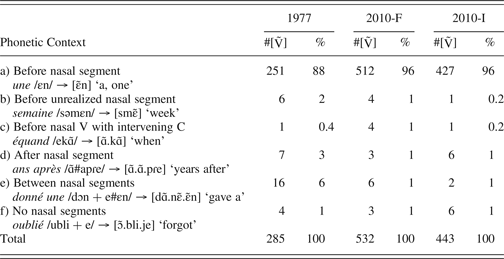
Contextual nasalization occurs most often before a nasal segment, but nasalized vowels appear in other phonetic environments as well. Table 2 explores only the nasalized vowels for each data set, laying out their distribution by the surrounding phonetic context.
Number and percentage of contextually nasalized vowels ([Ṽ]) by phonetic context: 1977, 2010–2011 Formal (2010-F) and 2010–2011 Informal (2010-I) data sets

Table 2 demonstrates that only a very small percentage of nasalized vowels can be found without a following nasal segment of some sort. Since the first phonetic context in the table, “Before Nasal Segment”, accounts for the overwhelming majority of nasalized vowels in all three data sets (between 88% and 96%), the quantitative analysis now focuses on data from this environment, excluding contexts b-f.
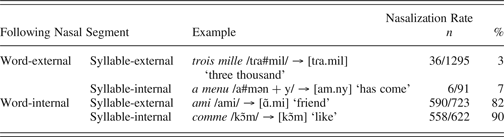
Previous descriptions of Louisiana French assert that the process of vowel nasalization is largely governed by the syllable domain, as it is in English, with contextual nasalization occurring variably across the syllable and word boundaries (Guilbeau, Reference Guilbeau1950, Reference Guilbeau1958; Papen & Rottet, Reference Papen, Rottet, Dubois and Boudreau1996, Reference Papen, Rottet and Valdman1997; Valdman & Klingler, Reference Valdman, Klingler and Valdman1997). Table 3 considers all nasalized and non-nasalized tokens that precede a nasal segment, subdividing them by the following nasal segment's word and syllable membership. Table 3 clearly demonstrates that the syllable boundary alone cannot account for vowel nasalization patterns. Specifically, if the following nasal segment is syllable-internal, but word-external, nasalization occurs only 7% of the time. However, if the following nasal segment is syllable-external, but word-internal, the vowel nasalizes 82% of the time. Thus, contextual nasalization occurs regularly across the syllable boundary, but rarely across the word boundary. This runs counter to earlier assumptions about contextual nasalization in Louisiana French.
Rate of contextual nasalization with a following nasal segment by word and syllable boundaries for all data sets combined
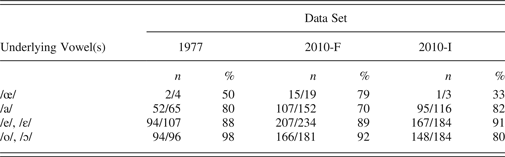
Further precisions come in Table 4, which shows the rate of contextual nasalization for each underlying oral vowel across the data sets, considering only those cases with a word-internal following nasal segment. Overall, the three vowels nasalize between 75% and 98% of the time in this environment. Vowel nasalization becomes less frequent for /o/~/ɔ/ across time and speech register.
Rate of contextual nasalization before a word-internal nasal segment by vowel quality:1977, 2010–2011 Formal (2010-F) and 2010–2011 Informal (2010-I) data sets
RESULTS: LOGISTIC REGRESSIONS
The examination now turns to logistic regressions carried out using Goldvarb software (Sankoff, Tagliamonte, & Smith, Reference Sankoff, Tagliamonte and Smith2005) to test how these factors compare in their influence on contextual nasalization rates, along with sociolinguistic factors. Specifically, the regression analyses include the systemic factor groups of vowel quality (/e/~/ε/, /o/~/ɔ/, /a/), nasality of the preceding segment (oral, nasal), syllable membership of the following segment (syllable-internal, syllable-external) and word membership of the following segment (word-internal, word-external). Significant factor groups are presented wherever possible by range in decreasing orderFootnote 10. Note that due to a low number of available tokens, the 45 data points involving the vowel quality /œ/ do not figure in the logistic regressions. Also, 70 cases of vowel nasalization are excluded from the analysis, since oral counterparts in the same phonetic contexts are not part of the data set (see Table 2, contexts b-f). In addition, the nasality of the following segment is not included as a factor group, since all tokens under analysis come before a nasal segment.
The logistic regressions also include the external factor groups of generation (ancestor, elder, older, younger), data set (1977, 2010-F, 2010-I), and sex (male, female). Regarding the generation and sex factor groups, in the 1977 data set, female speakers are all part of the older generation, and there is a single male speaker from the younger generation. As a result, the intergenerational analysis of the 1977 corpus only considers male speakers, excluding the younger generation speaker and grouping together the speakers from the ancestor and elder generations. In terms of data sets, comparisons are of the 1977 and 2010-F data on the one hand, since they share the same speech style but vary in terms of time period, and the 2010-F and 2010-I data sets on the other hand, as they come from the same time period but differ in the degree of formality.
1977 MALE SPEAKERS
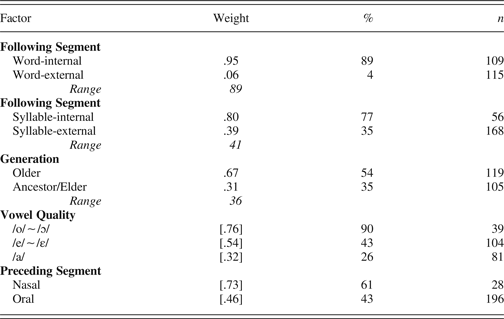
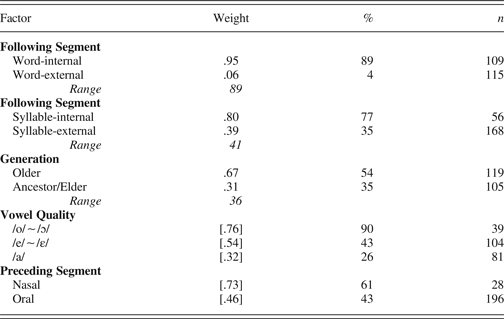
Table 5 summarizes the analysis of six male speakers from the 1977 data set. Three of the five factor groups (word membership of the following segment, syllable membership of the following segment, generation) have a statistically significant effect on the occurrence of vowel nasalization. Specifically, the factor weights show that contextual nasalization is strongly favored when the following segment is word-internal, at .95; when the following segment is syllable-internal, at .80; and among the older generation of male speakers interviewed in 1977, at .67. Neither vowel quality nor the nasality of the preceding segment has a significant effect on contextual nasalization in this data set.
Factors contributing to vowel nasalization for six male speakers in the 1977 data set Input = .358 n = 224
Note: Statistically insignificant factor weights appear in brackets.
OLDER GENERATION SPEAKERS
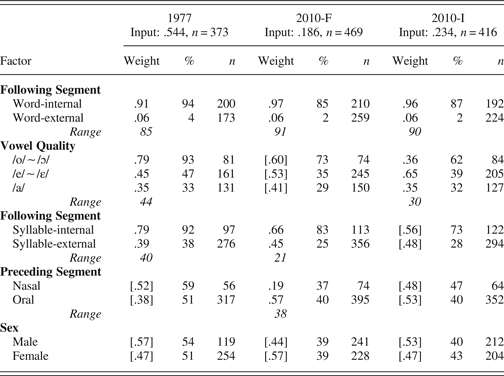
The analysis now compares results for speakers from the same generation, first contrasting the interview time period (1977 versus 2010-F) and then the speech style (2010-F versus 2010-I), since these can be important factors in sound pattern variation and change. The younger generation is not examined, because although the 2010–2011 interviewees include six men and six women belonging to the younger generation, there is only one speaker interviewed in 1977 who is part of this age group. However, the even distribution of older generation speakers interviewed in each time period makes this generation ideal for a longitudinal comparison. Eight of the speakers interviewed in 1977 (three men, five women) have birth years between 1918 and 1931, and there are also four men and four women from the 2010–2011 interviews born during the same time period. Table 6 gives the results for older generation speakers in the 1977 and 2010–2011 interviews.
Factors contributing to vowel nasalization for eight older speakers from each data set
Note: Statistically insignificant factor weights appear in brackets.
Beginning with the comparison of time periods, Table 6 shows that the word membership of the following nasal segment is the most powerful factor group in both 1977 and 2010-F speech, with a range between 85 and 91. Specifically, a word-internal nasal segment strongly encourages vowel nasalization, while a word-external nasal segment almost always blocks contextual nasalizationFootnote 11. The syllable boundary plays a secondary role in accounting for vowel nasalization patterns, and it becomes less important over time, since the range for this factor group relative to those of the other factor groups in each analysis is smaller in 2010-F than in 1977. Also, the speaker's sex is not selected as a significant factor group in either regression. In terms of differences, the quality of the vowel is a significant factor in 1977 formal speech, but not in 2010–2011 formal speech, though the direction of effect is the same. In addition, the nasality of the preceding segment is a significant factor group in the 2010-F data set, but cross tabulations show that this is because of an uneven distribution of tokens by the nasality of the preceding segment within the word and syllable membership factor groups.
Turning to the comparison of speech styles among older generation speakers recorded in 2010–2011, only the word boundary and the vowel quality have a significant effect on contextual nasalization in the less formal speech style. This means that the syllable boundary, already a less powerful factor in 2010–2011 formal speech than it was in 1977, does not have a significant effect on vowel nasalization in less formal speech.
OLDER AND YOUNGER GENERATION SPEAKERS
Is there a generational difference in contextual nasalization among speakers interviewed in 2010–2011? In order to address this question, the analysis considers logistic regressions for each speech style, including the factor group of generation.
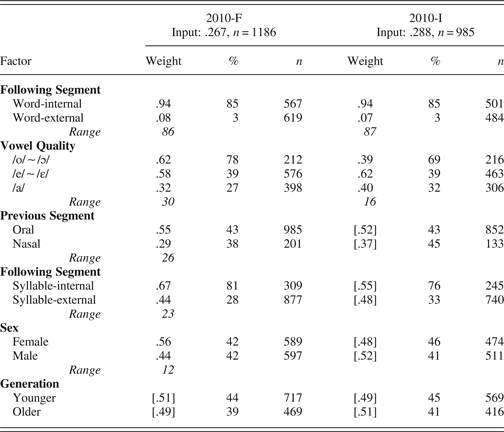
In Table 7, the overall factor group ranking by range is consistent between the two speech styles. Regarding systemic factors, the word boundary and the vowel quality are statistically significant factor groups for vowel nasalization in more and less formal speech. However, while the nasality of the preceding segment and the syllable membership of the following segment are statistically significant factor groups in formal speech, they are not in less formal speech. Note that for the 2010-I data set, there is a mismatch between the factor weights and percentages in the vowel quality factor group. Cross tabulations reveal that this discrepancy is due to the distribution of /o/~/ɔ/ with respect to the word membership of the following nasal segment: tokens from underlying /o/~/ɔ/ make up a very small proportion of the tokens with a following word-external nasal segment (n = 32/501), but form a large proportion of the tokens with a following word-internal nasal segment (n = 184/484) in the 2010-I corpus.
Factors contributing to vowel nasalization for older and younger speakers in 2010–2011
Note: Statistically insignificant factor weights appear in brackets.
As for the sociolinguistic variables of generation and sex, Table 7 shows that in the 2010–2011 interviews, there is no statistically significant difference between older and younger generation speakers regarding contextual vowel nasalization. The factor group of sex appears significant in formal speech (with a small range of 12), even though men and women nasalize vowels at the same rate. Cross tabulations indicate that this is due to an imbalanced ratio of word-internal to word-external following nasal segments by sex, such that women produce 54% of the tokens with a word-internal following nasal segment (n = 168/309), while men produce 52% of the tokens with a word-external following nasal segment (n = 456/877).
In sum, the logistic regressions confirm that the word domain is the best predictor of vowel nasalization in all subsets of the speech data. Specifically, vowel nasalization almost never crosses the word boundary, although it can cross the syllable boundary. Different factor group ranges suggest that some of the factors controlling this process have changed over time and may also vary depending on the formality level of the conversation.
DISCUSSION
Altogether, a quantitative review of the data has shown that the overall rate of contextual nasalization has decreased significantly over time, and that contextual nasalization often crosses the syllable boundary, but rarely crosses the word boundary. Logistic regressions have verified that a word-internal following nasal segment is the best predictor for vowel nasalization in all subsets of the data. Importantly, these results have provided clear evidence that contextual nasalization in Louisiana French is primarily governed by the scope of a given word, rather than a given syllableFootnote 12, which goes against earlier impressionistic reports of phonetic vowel nasalization.
The analysis compared older generation speakers recorded in 1977 to older generation speakers recorded in 2010–2011. For both groups, the word membership and the syllable membership of the following segment were significant factors. However, a comparison of 2010–2011 formal and informal speech for older generation speakers indicated that in the less formal speech register, the syllable membership of the following segment no longer had a statistically significant effect on contextual vowel nasalization. The investigation of older and younger generation speakers recorded in 2010–2011 suggested that contextual nasalization currently involves more factors in formal speech than in less formal speech.
Logistic regressions also showed that there is no statistically significant difference between older and younger generation speakers regarding contextual vowel nasalization in the 2010–2011 interview data. This stands in contrast to the results of the 1977 data analysis, which revealed a generational split amongst six male speakers. While the 1977 data sample cannot be compared directly to the 2010–2011 sample, as the former includes ancestors and elders while excluding female speakers, and the latter includes female speakers in addition to younger speakers, it is still worthwhile to note that a generational divide appears to have existed, at least for male speakers, in 1977, but does not exist in 2010–2011.
Neither sex nor, in 2010–2011, generation is a significant factor group for vowel nasalization, indicating that speakers do not appear to use the phonetic process of contextual nasalization to identify with one or more sub-groups of the population. Previous work found that sex and generation are active sociolinguistic factors for nasalized consonants in Cajun English (Dubois & Horvath, Reference Dubois and Horvath1998) and nasalized vowels in Louisiana French (Dubois, Reference Dubois1999, cited in Dubois & Horvath, Reference Dubois and Horvath2000). It may be that methodological differences explain the contrasting results, as the current study employed both impressionistic and acoustic cues to identify nasalized vowels, or that demographic differences between the speaker samples are at the root of the divergence.
It should be noted that there are rare cases, in all three data sets, of contrastive nasal vowels influencing non-contrastive nasal vowels when the latter surface without a following nasal segment (e.g., troisième /tɾwa + zjεm/ → [tɾa.zjε̃] ‘third’) or nasalize without a nasal conditioning environment (e.g., aussi /osi/ → [ɔ̃.si] ‘also’). This evidence of blurred boundaries may suggest that the two types of nasal vowels in Louisiana French are just beginning to overlap in their application. However, the vast majority of nasal vowels appear without a following nasal segment, while virtually all nasalized vowels are produced with a following nasal segment. This indicates that the two types of vowel nasality remain separate, even though Louisiana French is seriously endangered.
Considering the length of time between the 1977 and 2010–2011 interviews and Louisiana French's severely threatened status, it is remarkable that the phonetic process of contextual nasalization has maintained such a relative level of stability. This is likely because contextual nasalization is also a phonetic process in English, and is thus reinforced as a dynamic process in Louisiana French. Just the same, phonetic nasal vowels are included in past descriptions of Francophone communities where English was not yet the majority language. Additionally, while contextual nasalization is regressive in both Louisiana French and English, the domain of application is different in each language. Furthermore, the rate of vowel nasalization has actually gone down over time, even as the influence of English has increased in the Golden Meadow area. Therefore, it is important to recognize that although contact with English may be encouraging contextual vowel nasalization in present-day Louisiana French, it does not appear to be the origin of this phenomenon.
CONCLUSION
In his description of Golden Meadow Louisiana French, Guilbeau (Reference Guilbeau1950:53–54) asserts that contextual nasalization is regressive (anticipatory) and happens within the word boundary, but he also observes that both progressive (carryover) contextual nasalization and anticipatory nasalization across word boundaries occur in Golden Meadow Louisiana French, without specifying the relative frequency of these phenomena.
The analysis of data from interviews with 32 native speakers, yielding nearly 3000 data points for analysis, has clearly shown that contextual nasalization functions differently than has been assumed in the past: it is almost exclusively regressive in Louisiana French, with nasality rarely crossing the word boundary or moving from left to right in the speech stream, and systemic variables are most actively involved in the process.
The results have demonstrated that contextual nasalization rates have gone down in Golden Meadow Louisiana French over the past 40 years. This runs counter to expectations, since contextual nasalization is a widespread process in English, the dominant contact language, and would normally be predicted to thrive in Louisiana FrenchFootnote 13. Moreover, the domain of application for phonetic vowel nasality has not changed to mirror the English syllable-level template. Thus, while English contextual nasalization seems to be encouraging the maintenance of this phonetic contrast in French, at least to a certain extent, it is not the root of this phenomenon in Louisiana French.
Predictions in the literature on language death and sound systems have focused on the phonemic inventory, but contextual nasalization allows the study of a phonetic process that is widespread in both the dying and the dominant language. Results suggest that such a process may still decline in a situation of severe language endangerment, but not as quickly as phonetic processes not shared with the dominant language. It is hoped that this research will spur further linguistic investigations of this disappearing language variety.