Significant outcomes
Within two large randomised clinical trials (N = 765), pre-treatment WBC count did not predict better or worse bipolar disorder treatment response.
We performed analyses within four different treatment arms all lasting 24 weeks and gender-stratified analyses, all supporting the primary negative findings.
Limitations
We had only one measurement of WBC before treatment.
WBC count seems to be an overly broad immune system measure and we had no information on WBC subtypes or other immune system markers.
This study represents secondary and explorative analyses.
Introduction
Increasing evidence suggests that immune system alterations are involved in the aetiology (Cassidy et al., Reference Cassidy, Wilson and Carroll2002; Drexhage et al., Reference Drexhage, Knijff, Padmos, Heul-Nieuwenhuijzen, Beumer, Versnel and Drexhage2010; Bai et al., Reference Bai, Su, Tsai, Wen-Fei, Li, Pei-Chi and Mu-Hong2014; Dargel et al., Reference Dargel, Godin, Kapczinski, Kupfer and Leboyer2015; Dickerson et al., Reference Dickerson, Katsafanas, Schweinfurth, Savage, Stallings, Origoni, Khushalani, Lillehoj and Yolken2015) and treatment response of bipolar disorder (Li et al., Reference Li, Hong, Zhang, Wu, Wang, Yuan, Li, Huang, Lin and Fang2015). However, although treatment regimens differ substantially depending on the clinical presentation of bipolar disorder patients (Vieta et al., Reference Vieta, T’joen, McQuade, Carson, Marcus, Sanchez, Owen and Nameche2008; Bowden et al., Reference Bowden, Vieta, Ice, Schwartz, Wang and Versavel2010), biomarkers have not yet been integrated in everyday clinical practice. Furthermore, the immune system markers that have been studied to predict treatment response are not easily measurable in normal clinical settings, for example TGF-β1 and interleukin-23 (IL-23) (Li et al., Reference Li, Hong, Zhang, Wu, Wang, Yuan, Li, Huang, Lin and Fang2015).
Studies have indicated that pro-inflammatory markers, such as C-reactive protein (CRP) or IL-1 receptor antagonist (IL-1ra), are associated with bipolar disorder severity (Hope et al., Reference Hope, Ueland, Steen, Dieset, Lorentzen, Berg, Agartz, Aukrust and Andreassen2013) and symptom clusters (Hope et al., Reference Hope, Dieset, Agartz, Steen, Ueland, Melle, Aukrust and Andreassen2011; Hope et al., Reference Hope, Ueland, Steen, Dieset, Lorentzen, Berg, Agartz, Aukrust and Andreassen2013; Lotrich et al., Reference Lotrich, Butters, Aizenstein, Marron, Reynolds and Gildengers2014; Hope et al., Reference Hope, Hoseth, Dieset, Mørch, Aas, Aukrust, Djurovic, Melle, Ueland, Agartz, Ueland, Westlye and Andreassen2015). Work from our group showed that bipolar disorder patients with either higher or lower white blood cell (WBC) counts had greater symptom severity (Kohler et al., Reference Köhler, Sylvia, Bowden, Calabrese, Thase, Shelton, McInnis, Tohen, Kocsis, Ketter, Friedman, Deckersbach, Ostacher, Iosifescu, McElroy and Nierenberg2017; Kohler-Forsberg et al., Reference Köhler-Forsberg, Sylvia, Deckersbach, Ostacher, McInnis, Iosifescu, Bowden, McElroy, Calabrese, Thase, Shelton, Tohen, Kocsis, Friedman, Ketter and Nierenberg2018). The WBC count represents a routine immune system marker frequently measured in everyday clinical practice, with high levels (i.e. leucocytosis) indicating an inflammatory response and low levels (i.e. leucopenia) indicating insufficient immune activity. Whether such an overall and easily available immune system marker could predict response to specific treatment approaches in bipolar disorder is of particular clinical interest. It has been shown that higher levels of specific inflammatory markers may predict differential treatment response in depression (Uher et al., Reference Uher, Tansey, Dew, Maier, Mors, Hauser, Dernovsek, Henigsberg, Souery, Farmer and McGuffin2014) and bipolar disorder (Li et al., Reference Li, Hong, Zhang, Wu, Wang, Yuan, Li, Huang, Lin and Fang2015). Furthermore, whether immune deprivation may be associated with greater symptom severity (Kohler et al., Reference Köhler, Sylvia, Bowden, Calabrese, Thase, Shelton, McInnis, Tohen, Kocsis, Ketter, Friedman, Deckersbach, Ostacher, Iosifescu, McElroy and Nierenberg2017; Kohler-Forsberg et al., Reference Köhler-Forsberg, Sylvia, Deckersbach, Ostacher, McInnis, Iosifescu, Bowden, McElroy, Calabrese, Thase, Shelton, Tohen, Kocsis, Friedman, Ketter and Nierenberg2018) and differential treatment response (Brod et al., Reference Brod, Rattazzi, Piras and D’Acquisto2014) in bipolar disorder has been discussed. The WBC count, although a broad and unspecific marker, can possibly address both these questions at the same time. Therefore, the aim of the present explorative and secondary analyses was to investigate whether a pre-treatment WBC count, indicating low, normal or increased immune system activity, was associated with differential treatment response to four different treatment arms within two large randomised clinical trials with similar study designs on outpatients with bipolar disorder.
Methods
The present study represents secondary analyses from the Clinical and Health Outcomes Initiatives in Comparative Effectiveness for Bipolar Disorder Study (Bipolar CHOICE) (Nierenberg et al., Reference Nierenberg, Sylvia, Leon, Reilly-Harrington, Shesler, McElroy, Friedman, Thase, Shelton, Bowden, Tohen, Singh, Deckersbach, Ketter, Kocsis, McInnis, Schoenfeld, Bobo and Calabrese2014) and the Lithium Treatment Moderate-Dose Use Study (LiTMUS) (Nierenberg et al., Reference Nierenberg, Sylvia, Leon, Reilly-Harrington, Ketter, Calabrese, Thase, Bowden, Friedman, Ostacher, Novak and Iosifescu2009). Both were 6-month, multisite randomised comparative effectiveness trials on outpatients with bipolar disorder. Patients from both studies were similar on important baseline characteristics (Kohler et al., Reference Köhler, Sylvia, Bowden, Calabrese, Thase, Shelton, McInnis, Tohen, Kocsis, Ketter, Friedman, Deckersbach, Ostacher, Iosifescu, McElroy and Nierenberg2017). The studies investigated four different treatment arms. Bipolar CHOICE compared the classical mood stabiliser lithium to quetiapine, each combined with other medications for bipolar disorder (but not with one another) in a fashion consistent with typical clinical practice (i.e. adjunctive personalised treatment, referred to as APT). LiTMUS compared lithium treatment combined with optimised personalised treatment (OPT) to OPT without lithium. Patients in Bipolar CHOICE were treated with higher lithium doses compared to patients in LiTMUS. The Institutional Review Boards of the different sites approved the study protocols, and the rationale, design and specific methods are reported in detail elsewhere (Nierenberg et al., Reference Nierenberg, Sylvia, Leon, Reilly-Harrington, Ketter, Calabrese, Thase, Bowden, Friedman, Ostacher, Novak and Iosifescu2009; Nierenberg et al., Reference Nierenberg, Sylvia, Leon, Reilly-Harrington, Shesler, McElroy, Friedman, Thase, Shelton, Bowden, Tohen, Singh, Deckersbach, Ketter, Kocsis, McInnis, Schoenfeld, Bobo and Calabrese2014). Subjects provided verbal and written informed consent prior to participation. Participants could not be treated with lithium or quetiapine at baseline since lithium increases WBC levels (Amitai et al., Reference Amitai, Zivony, Kronenberg, Nagar, Saar, Sever, Apter, Shoval, Golubchik, Hermesh, Weizman and Zalsman2014).
Participants
For Bipolar CHOICE, 482 participants were randomised, whereas for LiTMUS, 283 were randomised. Participants were aged between 18 and 62 years. Both studies used similar broad inclusion and limited exclusion criteria to maximise sample heterogeneity and hence result generalisability. Participants in both studies were required to have a DSM-IV-TR bipolar I or bipolar II disorder and be at least mildly symptomatic [Clinical Global Impression Scale for Bipolar Disorder (CGI-BP) ≥3 (Spearing et al., Reference Spearing, Post, Leverich, Brandt and Nolen1997)] at study entry. We applied the overall CGI-BP severity scale including the CGI-BP subscales for depressive and manic symptoms at baseline and at every follow-up visit. In both studies, psychiatric and substance use disorder diagnoses were determined using the extended Mini-International Neuropsychiatric Interview, an electronic version of a validated structured diagnostic interview (Sheehan et al., Reference Sheehan, Lecrubier, Sheehan, Amorim, Janavs, Weiller, Hergueta, Baker and Dunbar1998). Clinical interviews obtained demographic information, psychiatric and medical history and current medications. In both studies, a fasting blood draw at study entry assessed the WBC, which was expressed in International Units, that is × 109/l. As in previous studies, we defined a low WBC count as <4.5 × 10⁹/l and a high WBC count as ≥10 × 109/L (Kohler et al., Reference Köhler, Sylvia, Bowden, Calabrese, Thase, Shelton, McInnis, Tohen, Kocsis, Ketter, Friedman, Deckersbach, Ostacher, Iosifescu, McElroy and Nierenberg2017; Kohler-Forsberg et al., Reference Köhler-Forsberg, Sylvia, Deckersbach, Ostacher, McInnis, Iosifescu, Bowden, McElroy, Calabrese, Thase, Shelton, Tohen, Kocsis, Friedman, Ketter and Nierenberg2018).
Statistical analysis
Participants in both studies were rated in up to nine visits for a total of 24 weeks. We performed mixed effects linear regression analyses to investigate the association between the baseline WBC count and treatment response and report β values including 95% confidence intervals (95% CI). We adjusted all analyses for the following baseline variables that may affect treatment response and WBC counts: age, gender, body mass index (BMI), current smoking and baseline CGI-BP severity. A two-sided p value <0.05 was used as the significance threshold. Due to the number of analyses performed, we adjusted for multiple testing by dividing the p value of 0.05 with the number of tests performed.
First, we investigated an association between WBC count and treatment response in both studies separately. Second, we specifically investigated the four treatment arms (i.e. lithium plus APT and quetiapine plus APT in Bipolar CHOICE respectively and lithium plus OPT and OPT alone in LiTMUS). Third, since we previously found gender differences regarding associations between immune system markers and bipolar disorder severity (Kohler et al., Reference Köhler, Sylvia, Bowden, Calabrese, Thase, Shelton, McInnis, Tohen, Kocsis, Ketter, Friedman, Deckersbach, Ostacher, Iosifescu, McElroy and Nierenberg2017; Kohler-Forsberg et al., Reference Köhler-Forsberg, Sylvia, Deckersbach, Ostacher, McInnis, Iosifescu, Bowden, McElroy, Calabrese, Thase, Shelton, Tohen, Kocsis, Friedman, Ketter and Nierenberg2018), we performed gender-stratified analyses in both Bipolar CHOICE and LiTMUS. Fourth, we performed gender-stratified analyses within each of the four treatment arms.
All statistical analyses were performed using STATA version 14.
Results
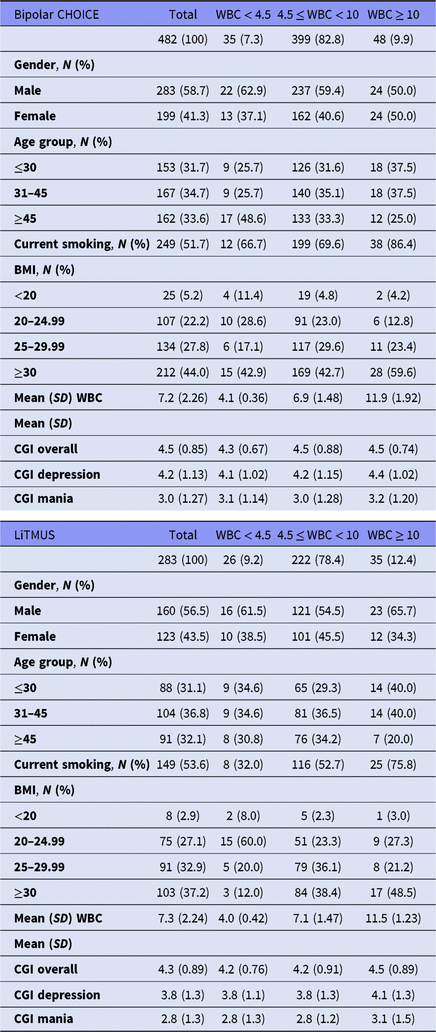
Valid WBC counts at study entry were available for all 482 participants from Bipolar CHOICE and all 283 participants from LiTMUS. The baseline characteristics of all participants depending on baseline WBC count are shown in Table 1. The mean WBC was 7.2 × 10⁹/l in Bipolar CHOICE and 7.3 × 10⁹/l in LiTMUS, which is similar to values in the general U.S. population aged 18 years or above (Liu & Taioli, Reference Liu and Taioli2015).
Baseline information for 482 patients with bipolar disorder from the CHOICE study and 283 patients with bipolar disorder from the LiTMUS study, depending on baseline white blood cell counts (WBC)

WBC levels and treatment response
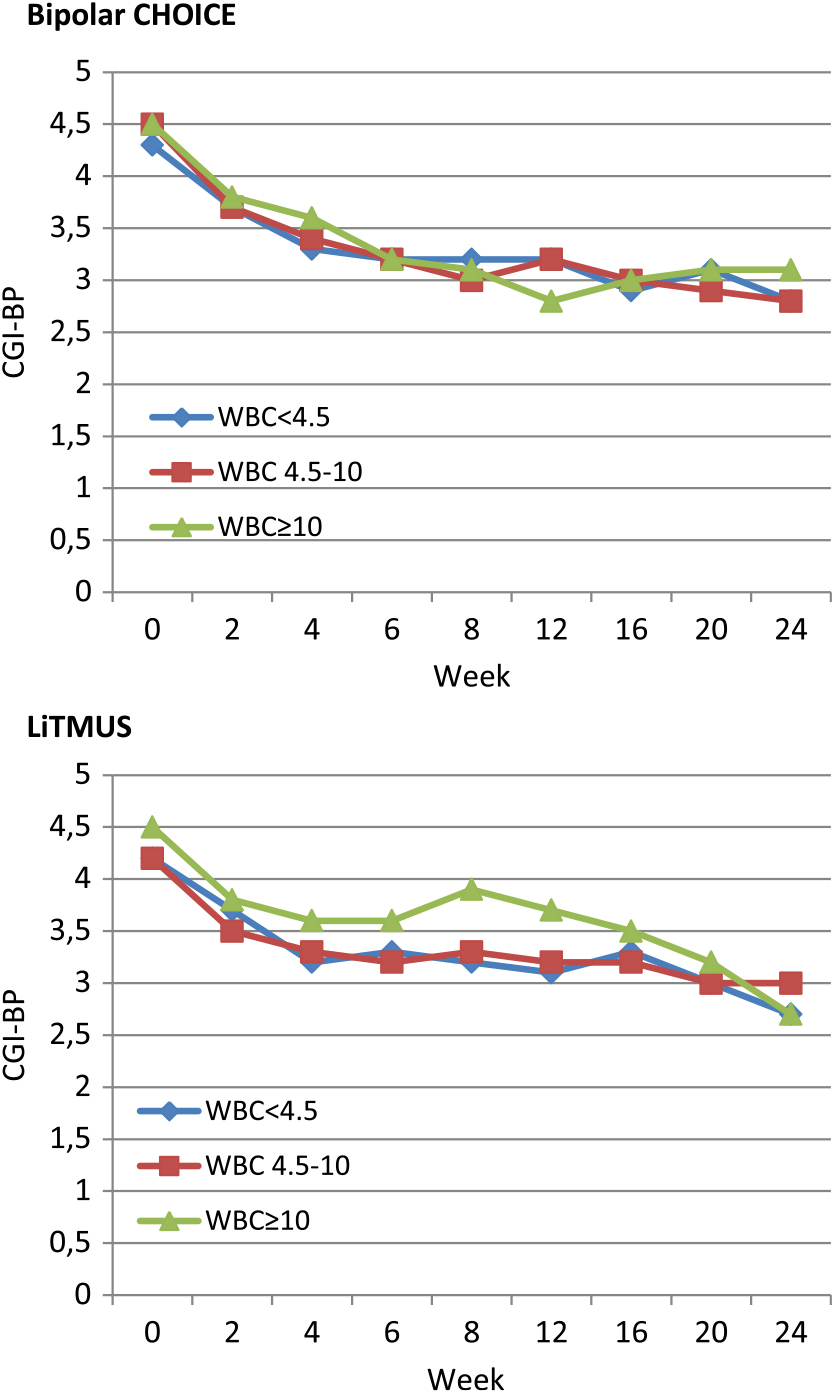
As shown in Fig. 1, patients with low (i.e. <4.5 × 10⁹/l) or high (i.e. ≥10 × 109/l) WBC counts improved to a similar degree as patients with a WBC count of 4.5–10 × 109/l on the overall CGI-BP (all p > 0.1 for comparison of the three WBC groups at every study visit). We found similar results on the CGI-BP subscales for depressive and manic symptoms (all p > 0.1 at every study visit).
We found no differences in treatment response on any CGI-BP scale based on pre-treatment WBC count in the four different treatment arms (supplementary Table 1).
Treatment response* measured with the Clinical Global Impression scale for bipolar disorder (CGI-BP) in the Bipolar CHOICE (top; N = 482) and LiTMUS (bottom; N = 283) trials depending on pre-treatment white blood cell (WBC) count. * We found no significant (i.e. p < 0.05) difference between the three WBC groups at any time point.

Supplementary Table 2 shows gender-stratified analyses regarding treatment response based on pre-treatment WBC levels. We found inferior treatment effects in the LiTMUS study among women with WBC ≥ 10 × 109/l, compared to women with WBC of 4.5–10 × 109/l, on overall CGI-BP (p = 0.025) and CGI-BP mania subscale (p = 0.009); however, these results were not significant after adjustment for multiple comparisons. Finally, we found no gender differences within the four treatment arms depending on pre-treatment WBC levels (results not shown, all p > 0.05).
Discussion
The present study represents the largest investigation to date on whether an overall immune system marker may predict differential response to mood-stabilising treatment. Among 765 outpatients with bipolar disorder from two similar randomised clinical trials, pre-treatment WBC count did not predict better or worse response to four different treatment arms (standard-dose lithium plus APT, quetiapine plus APT, moderate-dose lithium plus OPT or OPT alone). Importantly, we were able to adjust for important covariates, including smoking and BMI.
These negative findings are important for several reasons. Firstly, our results suggest that WBC count may not be used to predict treatment response among outpatients with bipolar disorder. We had a large sample (N = 765) and were able to explore four different and frequently applied treatment approaches, which included different lithium dosages. Since lithium increases circulating WBCs (Amitai et al., Reference Amitai, Zivony, Kronenberg, Nagar, Saar, Sever, Apter, Shoval, Golubchik, Hermesh, Weizman and Zalsman2014), patients with low WBC levels could have responded differently to lithium. However, secondly, WBC seems to be an overly broad and non-specific marker to reliably predict treatment response. Thirdly, we assessed patients frequently, followed them for 24 weeks and were able to include information on important covariates and perform gender-stratified analyses, all supporting the generalisability of our negative findings to everyday clinical settings.
Thus, future studies need to measure a range of more specific immune system markers and specific WBC cell lines before and during treatment in different groups of patients to investigate whether baseline measurements or changes during treatment of some specific immune system markers may predict better treatment response in subgroups of patients.
Strengths and limitations
Strengths include the large sample size, frequent mood assessments and the long follow-up. Furthermore, the clinical generalisability of our results was enhanced by the limited exclusion and broad inclusion criteria, participants from both studies being similar and the possibility of investigating four different treatment arms.
Limitations of this study are as follows. First, it represents secondary and explorative analyses and the WBC level was not measured with the aim of predicting treatment response. Second, we only had one WBC measurement at baseline, but we followed individuals for 24 weeks and the immune system is highly variable. Third, the WBC count is very broad and non-specific. Fourth, WBC measurements were not taken at specific time points of the day and were analyzed in different laboratories at the different investigator sites. In addition, the baseline blood tests were taken at different time points, and WBC levels vary depending on time of the year (Liu & Taioli, Reference Liu and Taioli2015). Fifth, we had no information on WBC subtypes or other immune system markers, neither at baseline nor during follow-up. Sixth, we only included outpatients, with the majority being in a depressive episode. Seventh, we had no information on somatic diseases, such as infections, that could have affected the WBC level.
Conclusion
Among 765 outpatients with bipolar disorder from two large clinical trials, we found that pre-treatment WBC count did not predict differential treatment response for four different 24-week treatment approaches.
Supplementary material
To view supplementary material for this article, please visit https://doi.org/10.1017/neu.2019.19
Author ORCIDs
Ole Köhler-Forsberg, 0000-0001-5121-1287
Disclosures
Dr. Nierenberg is a consultant for the Abbott Laboratories, American Psychiatric Association, Appliance Computing Inc. (Mindsite), Basliea, Brain Cells, Inc., Brandeis University, Bristol-Myers Squibb, Clintara, Corcept, Dey Pharmaceuticals, Dainippon Sumitomo (now Sunovion Pharmaceuticals Inc.), Eli Lilly and Company, EpiQ, L.P./Mylan Inc., Forest, Genaissance, Genentech, GlaxoSmithKline, Hoffman LaRoche, Infomedic, Lundbeck, Janssen Pharmaceutica, Jazz Pharmaceuticals, Medavante, Merck & Co. Inc., MSI Methylation Sciences Inc., Naurex, Novartis, PamLabs, Parexel, Pfizer Inc., PGx Health, Ridge Diagnostics Shire, Schering-Plough, Somerset, Sunovion Pharmaceuticals Inc., Takeda Pharmaceuticals, Targacept and Teva; he has also consulted through the MGH Clinical Trials Network and Institute (CTNI) for Astra Zeneca, Brain Cells Inc., Dianippon Sumitomo/Sepracor, Johnson and Johnson, Labopharm, Merck & Co. Inc., MSI Methylation Sciences Inc., Novartis, PGx Health, Shire, Schering-Plough, Targacept and Takeda/Lundbeck Pharmaceuticals. He receives grant/research support from American Foundation for Suicide Prevention, Agency for Healthcare Research and Quality (AHRQ), Brain and Behavior Research Foundation, Bristol-Myers Squibb, Cederroth, Cephalon, Cyberonics, Elan, Eli Lilly and Company, Forest, GlaxoSmithKline, Janssen Pharmaceutica, Lichtwer Pharma, Marriott Foundation, Mylan, NIMH, PamLabs, PCORI, Pfizer Inc., Shire, Stanley Foundation, Takeda Pharmaceuticals and Wyeth-Ayerst. Honoraria include Belvoir Publishing, University of Texas Southwestern Medical Center, Brandeis University, Bristol-Myers Squibb, Hillside Hospital, American Drug Utilization Review, American Society for Clinical Psychopharmacology, Baystate Medical Center, Columbia University, CRICO, Dartmouth Medical School, Health New England, Harold Grinspoon Charitable Foundation, IMEDEX, Israel Society for Biological Psychiatry, Johns Hopkins University, MJ Consulting, New York State, Medscape, MBL Publishing, MGH Psychiatry Academy, National Association of Continuing Education, Physicians Postgraduate Press, SUNY Buffalo, University of Wisconsin, University of Pisa, University of Michigan, University of Miami, University of Wisconsin at Madison, APSARD, ISBD, SciMed, Slack Publishing and Wolters Kluwer Publishing ASCP, NCDEU, Rush Medical College, Yale University School of Medicine, NNDC, Nova Southeastern University, NAMI, Institute of Medicine, CME Institute and ISCTM. He is currently or was formerly on the advisory boards of Appliance Computing Inc., Brain Cells Inc., Eli Lilly and Company, Genentech, Johnson and Johnson, Takeda/Lundbeck Pharmaceuticals, Targacept and InfoMedic. He owns stock options in Appliance Computing Inc., Brain Cells Inc. and Medavante; he has copyrights to the Clinical Positive Affect Scale and the MGH Structured Clinical Interview for the Montgomery-Asberg Depression Scale exclusively licensed to the MGH Clinical Trials Network and Institute (CTNI).
Dr. Tohen was a full-time employee at Eli Lilly and Company (1997–2008). He has received honoraria from, or consulted for, Abbott Laboratories, Actavis, AstraZeneca, Bristol-Myers Squibb, GlaxoSmithKline, Eli Lilly and Company, Johnson and Johnson, Otsuka, Merck & Co. Inc., Sunovion Pharmaceuticals Inc., Forest, Gedeon Richter, Roche, Elan, Alkermes, Allergan Inc., Lundbeck Pharmaceuticals, Teva, Pamlab, Wyeth and Wiley Publishing. His spouse was a full-time employee at Eli Lilly and Company (1998–2013).
During the last three years, Dr. Terence Ketter has had financial interests/arrangements or affiliations with organisations that could be perceived as real or apparent conflicts of interest. Dr. Ketter has received grant/research support (through Stanford University) from the Agency for Healthcare Research and Quality, AstraZeneca, Cephalon Inc. (now Teva Pharmaceuticals), Eli Lilly and Company, Pfizer Inc. and Sunovion Pharmaceuticals Inc.; he has served as a consultant/advisory board member for Allergan Inc., Avanir Pharmaceuticals, Depotmed, Forest Pharmaceuticals, Genentech, Janssen Pharmaceuticals, Merck & Co. Inc., Myriad Genetic Laboratories Inc., ProPhase, Sunovion Pharmaceuticals Inc. and Teva Pharmaceuticals; he has received lecture honoraria (NOT speakers’ bureau payments) from Abbott Laboratories Inc., GlaxoSmithKline, Otsuka Pharmaceuticals, Pfizer Inc. and Sunovion Pharmaceuticals Inc.; and he has received royalties from American Psychiatric Publishing Inc. In addition, Dr. Ketter’s spouse has been an employee of and stockholder of Janssen Pharmaceuticals.
For the past 36 months, Dr. Ostacher has been a consultant to Alkermes, Janssen (Johnson and Johnson), Otsuka, and Sage Therapeutics and has received research funding from Palo Alto Health Sciences Inc. He is a full-time employee of the U.S. Department of Veterans Affairs.
The other authors declare no competing interests.
Authors contributions
OKF, AAN and LGS planned this study and prepared the analysis plan. OKF and AAN had access to all data and performed the analyses. All authors contributed to the interpretation of the results. OKF, AAN and LGS wrote the first draft of the manuscript, which was critically revised by all authors, and all authors have approved the final manuscript.
Financial support
Bipolar CHOICE was funded by the Agency for Healthcare Research and Quality (AHRQ), 1R01HS019371-01, and LiTMUS was funded by NIMH contract NO1MH80001.
The funders had no role in study design; in the collection, analysis and interpretation of data; in the writing of the report; and in the decision to submit the article for publication.
Ethical standards
The authors assert that all procedures contributing to this work comply with the ethical standards of the relevant national and institutional committees on human experimentation and with the Helsinki Declaration of 1975, as revised in 2008.