INTRODUCTION
A growing body of research has documented that religious minorities often face the brunt of religious restrictions and discrimination. These include reports by government agencies such as the U.S. State Department (Jahangir Reference Jahangir2009; U.S. Department of State 2012) advocacy groups such as Amnesty International and Forum 18, and research case studies (Sanasarian Reference Sanasarian2000; Richardson Reference Richardson2004; Paden Reference Paden2005; Lu Reference Lu2008; Palmer Reference Palmer2011). Perhaps the most convincing evidence, however, has come from quantitative data collections on religion and state relations (Marshall Reference Paden2008; Pew Forum on Religion and Public Life 2009), some of which specifically document a rise in religious discrimination (Grim and Finke Reference Grim and Finke2006; Fox Reference Fox2008; Reference Fox2015; Reference Fox2016).
Despite this near global consensus that minority religions are frequent targets, questions remain on why and when minority religions face higher levels of discrimination. Early research based on the quantitative data collections reported that democracies are less likely to discriminate against these groups (Fox Reference Fox2008; Grim and Finke Reference Grim and Finke2011). More recent research confirms these findings and uses improved data to document how discrimination varies by the religious identity of both the minority and majority religions (Fox Reference Fox2016). Yet these broad brush strokes leave many areas unexplored.
We offer multiple methodological improvements that allow us to more fully test key theoretical propositions explaining the state's discrimination against religious minorities. First, we offer more detailed and precise measures for several key concepts. For instance, rather than using a single summary measure of discrimination, we distinguish between discrimination against a minority religion's institutions and clergy and more general discrimination against the membership. Second, we account for variations as well as similarities in discrimination faced by minorities within a given country using a mixed-effects mixed-distribution model (Tooze, Grunwald, and Jones Reference Tooze, Grunwald and Jones2002). This allows us to compare, in a multi-level framework, the effects of all predictors on two outcomes: the probability that a minority will face any measurable discrimination and the magnitude of discrimination when any is observed. Third, the RASM (Religion and State-Minorities) Round 2 data collection we draw from allows us to use the religious minority as unit of analysis and to measure religious discrimination targeted at a single religious minority.Footnote 1
These refinements allow us to test a series of hypotheses on discrimination generated by the religious economy theory. This theory proposes that minority religions face discrimination from the state because they represent unwanted competition for the state-supported religion and are viewed as a threat to the state and larger culture; yet previous research has not adequately tested these propositions. Building on previous applications of this theory (Wybraniec and Finke Reference Wybraniec and Finke2001) and a growing body of research on the judicialization of politics (see Hirschl Reference Hirschl, Whittington, Daniel Kelemen and Caldeira2008), we also test a hypothesis on the role of an independent judiciary in reducing discrimination against minorities. Finally, we will include measures of governance, social context, and religious minority traits to test for alternative explanations.
Our findings confirm the importance of religion and state relations and an independent judiciary as predictors of state discrimination against religious minorities, and they identify how the relationships vary based on the targets of discrimination. We begin with an overview of the hypotheses we test.
RELIGIOUS MINORITIES AND THE STATE
The starting point of religious economy models is that religious institutions compete for resources, including the favor and support of the people as well as the resources of the state (Finke Reference Finke1990; Reference Finke2013; Iannaccone Reference Iannaccone1992; Stark and Finke Reference Stark and Finke2000; Gill Reference Gill2008). Minority religions threaten these resources by challenging the beliefs of the dominant religion, the legitimacy of its institutions and the favored treatment it receives from the state or the society as a whole.Footnote 2 In order to prevent unwanted competition and to secure more authority and resources, the dominant religion often seeks an alliance with the state. Depending on the extent of the alliance, this partnership can give the favored religion(s) legal privileges, material resources, and additional avenues for restricting religious competitors. For state leaders, the alliance offers support and often legitimacy from the culture's dominant religion (Gill Reference Gill2008).
When applied to religious minorities, this theory offers several propositions about how discrimination against minorities should increase. The most obvious is that state-religion alliances are associated with more discrimination against minority religions. Previous research finds tentative support for this relationship (Fox Reference Fox2006; Reference Fox2008; Reference Fox2016). However, these studies fail to control for the traits of the religious group and the type of discrimination faced, and most use states as the unit of analysis. Using the RASM Round 2 data on religious minorities, this research uses more fully specified and multi-level models to understand the relationship state support of religion holds with discrimination against minority institutions and their members. Stated formally, the hypothesis tested is:
(Hypothesis 1) to the extent that the state favors a single or select group of religions, discrimination against minority religions will increase.
The theory also proposes that minority religions can serve as an unwanted competitor for secular states even absent an established religion. Although any government can view minority religions as a threat, this research focuses on current and former communist governments, with legacies of official secular ideologies and practices about how religions are approved and tolerated by the state.Footnote 3 Whether it is Falun Gong in China, the Jehovah Witnesses in Russia, or small Pentecostal sects in many nations, a growing body of research demonstrates how even a small minority religion can be perceived by the state as a political, social, and ideological threat (see Richardson Reference Richardson2004; Lindholm, Durham, and Tahzib-Lie Reference Lindholm, Cole Durham and Tahzib-Lie2004; Kirkman Reference Kirkman2013). Though restrictions are often placed on all religions in current and former communist nations, certain minority religions frequently face the most significant discrimination because they fail to meet the stringent demands these nations frequently impose. For example, requirements about size, duration, and other matters often prevent minority religions from achieving state recognition and force them to operate as underground movements (Froese Reference Froese2008; Yang Reference Yang2012; Koesel Reference Koesel2014; Sarkissian Reference Sarkissian2009; Reference Sarkissian2015). This leads to a second hypothesis:
(Hypothesis 2) discrimination against minority religions will increase in countries with current or former communist governments.
More recent applications of this theory suggest that social and cultural pressures fuel government actions that result in increased religious persecution and reduced freedoms (Grim and Finke Reference Grim and Finke2011; Finke and Martin Reference Finke and Martin2014; Fox Reference Fox2016), even in democracies (Brathwaite Reference Brathwaite2015). Moreover, qualitative research and formal reports offer numerous examples of how these pressures influence the state's treatment of religions (Sanasarian Reference Sanasarian2000; Fox Reference Fox2004; Richardson Reference Richardson2004; Jahangir Reference Jahangir2009; Marshall Reference Marshall2008; Sarkissian Reference Sarkissian2009; U.S. Department of State 2012; Palmer Reference Palmer2011; Yang Reference Yang2012). Both theory and research suggest that religious minorities are especially vulnerable to these pressures because they are often political, ethnic, or cultural minorities as well (see Richardson Reference Richardson2004; Reference Richardson2015; Fox Reference Fox2016). Moreover, because many forms of discrimination are enacted at the local level, where social and cultural pressures are most influential, we propose that these pressures will increase discrimination against religious minorities. Therefore, our third hypothesis is:
(Hypothesis 3) to the extent that social and cultural pressures actively favor a single or select group of religions, discrimination against minority religions will increase.
Applications of religious economy models also stress how the judiciary often protects minority rights (Wybraniec and Finke Reference Wybraniec and Finke2001; Martin and Finke Reference Martin, Finke and Hertzke2015). Although democracy and specifically free elections are often associated with increased freedoms and reduced discrimination (Keith Reference Keith2002; Bueno de Mesquita et al. Reference Bueno de Mesquita, Downs, Smith and Marie Cherif2005; Fox Reference Fox2016), majority rule does not favor all groups equally. Lacking legislative power and administrative authority, religious minorities often rely ultimately on constitutionally-protected rights.Footnote 4 Yet the type of constitutionFootnote 5 and how well its protections are enforced can limit the level of protection minorities receive. Whereas over 90% of national constitutions promise religious freedoms (Fox and Flores Reference Fox, Flores and Fox2012), the vast majority of those states have other laws restricting them (Grim and Finke Reference Grim and Finke2011). The disconnect between promise and practice is most evident in countries under religious law but its potential exists everywhere.
We are proposing that an independent judiciary diminishes this disconnect by protecting minority religions from discrimination by the majority. Research demonstrates how judicial decisions help to bring legislative and administrative actions in line with constitutional assurances, by upholding the minority religions’ rights to practice their faith (e.g., public worship, registration, land ownership, publications, etc.) and by preventing discrimination against their members (see Richardson Reference Richardson2004; Reference Richardson2015). When other branches of the government or the military can sway judicial decisions, we propose that religious minorities will face more discrimination — even when elections are free and open. The specific hypothesis we test is:
(Hypothesis 4) to the extent that a country holds an independent judiciary, discrimination against minority religions will decrease.
This hypothesis is consistent with a growing body of research and theory documenting the importance of the judiciary in shaping political action. Some refer to this as the “judicialization of politics” (see Hirschl Reference Hirschl, Whittington, Daniel Kelemen and Caldeira2008). Previous research demonstrates the importance of the judicial system for defending religious freedoms (Finke and Martin Reference Finke and Martin2014). We propose that it is especially crucial in deterring discrimination against minority religions.
Building the Full Models
When we test the hypotheses above, we also enter measures for competing or related explanations. As reviewed above, the religious economy theory implies that minority religions are less threatening when there is no single dominant religion seeking to preserve state resources, larger cultural legitimacy, or specific resources received from their memberships. Accordingly, we control for religious homogeneity and the state's recognition of an official religion. To better understand the relationship between democracy and discrimination against religious minorities, we offer multiple measures of democracy and governance that extend beyond the presence of an independent judiciary. Finally, economic and demographic measures, which are often associated with discrimination against other civil liberties (e.g., Fox Reference Fox2008; Reference Fox2015), are entered. Together these measures allow rigorous tests of the theoretical propositions presented.
Group-level Influences
This study also investigates beyond national context and explores if the traits of religious minorities are related to discrimination. Minority-level data let us account for group-specific characteristics such as size and identity. Previous work has shown that the extent of religious discrimination varies considerably between minorities within as well as across states; however, this work has not explained why some minorities in a single state are subject to more discrimination than others (Akbaba and Fox Reference Akbaba and Fox2011; Fox Reference Fox2016). Our models let us test how national context and traits of religious minorities might each help to explain discrimination faced by minority religions.
Beyond Institutional Discrimination
Finally, the religious economy propositions draw attention to discrimination against the religious minority institutions, stressing how the institutions offer unwanted competition for the dominant religion and the state. But not all of the discrimination targets minority religions’ institutions or clergy. Some discrimination is directed at lay members of a minority religion, interfering with their practice of religion in public or private and their status outside of religious contexts. This raises important questions about how well the propositions generalize to non-institutional forms of discrimination. Will support for each of the hypotheses depend on the type of discrimination being studied?
To answer this question, we test the hypotheses using three indices of discrimination: an aggregate index of multiple modes of discrimination, a sub-index measuring only discrimination against the institutions and clergy of the minority religions, and a sub-index capturing discrimination against the religious practice of minorities that does not specifically target their institutions or clergy. Past theoretical work has focused most extensively on discrimination against institutions. While past empirical work demonstrates that patterns of discrimination differ when comparing institutional and non-institutional forms of discrimination, the causal aspects of this research examined only aggregate indexes (Fox Reference Fox2015; Reference Fox2016).
DATA AND METHODS
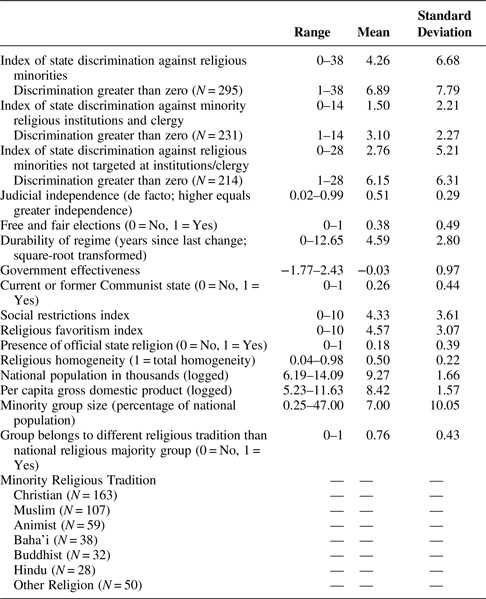
The RASM data collection includes any religious minority that makes up at least 0.25 percent of a country's population or is part of a faith with more than 500,000 adherents worldwide, for a total of 587 minorities in 174 countries.Footnote 6 We analyze minority-level data from 2008, the most recent year for which RASM data was collected; all other variables in our models utilize year-2008 data as well.Footnote 7 Our analytic population after list-wise deletion to account for missing data includes 477 minority groups in 154 countries. Although most of our independent variables are measured at the national level, we also include measures of minorities’ size and religious tradition. Below we offer more details on the data collections, measures and analytic strategy used. The range, mean and standard deviation are listed for each of the measures in Table 1.
Descriptive statistics

N = 477. Cases are minority groups in 154 countries whose national populations are greater than 250,000.
Measuring Discrimination
We employ three indexes of restrictions against religious minorities, capturing multiple dimensions of state discrimination. Our primary discrimination measure is an aggregate additive index made up of all 29 discrimination indicators from the RASM data, such as limits on a group's ability to practice their faith in public, mandatory education in the majority religion, coercive campaigns and anti-group propaganda in government publications. Each discrimination indicator was coded as follows:
0. No restrictions
1. Slight restrictions
2. Significant restrictions.Footnote 8
Our second index isolates the seven indicators of religious discrimination from the aggregate index that target the religious minority's institution or clergy. These include restrictions on institutional access to property and places of worship, limits on how clergy are ordained and on clerical access to hospitals and prisons, and requirements that minority religious institutions register with the state. The third index encompasses the other 22 indicators of religious discrimination from the aggregate index and captures many varied forms of discrimination against members of minority faiths, e.g., limits on observing religious holidays and other religious practices, facilitating forced conversions, and disseminating anti-group propaganda.Footnote 9
Measures for Independent Variables
We draw our independent variables from several different data sources. First, we capture state favoritism and support for religion using two measures employed in separate models. The first measure, from the RAS Project, captures the presence of an official state religion, and the second — Grim and Finke's (Reference Grim and Finke2006) 11-point government favoritism of religion index (GFI), based on coding of the State Department's 2008 International Religious Freedom report — measures official support for select religions. Our measure of social restrictions on religious groups is the social restrictions index, an 11-point continuous measure originally developed by Grim and Finke (Reference Grim and Finke2006) and modified by Finke and Martin (Reference Finke and Martin2014). This measure captures the extent of negative attitudes and hostility toward non-traditional faiths on the part of citizens and established religions.
Our measure of judicial independence, from Linzer and Staton (Reference Linzer and Staton2015), captures the extent to which judiciaries exhibit de facto (rather than de jure) independence from external influences. To isolate the effect of judicial independence on discrimination from other aspects of democratic governance, we control for the presence of free and fair national leadership elections using the Free and Fair Elections Database (Bishop and Hoeffler Reference Bishop and Hoeffler2016; see also Bishop and Hoeffler Reference Bishop and Hoeffler2014). Further, we identified whether a state had a communist government at some point in time as reported in the Infoplease (2016) database; about one in four groups lived in countries that had or currently have communist governments.
We control for a number of important national-level variables, such as two additional state characteristics: political tenure and government effectiveness. Tenure or regime durability is based on changes in the nature of state authority as measured by the Polity IV Project, and captures how long a state has maintained its present regime (Marshall, Gurr, and Jaggers Reference Marshall, Robert Gurr and Jaggers2012). We measure government effectiveness using the Kaufmann, Kraay, and Mastruzzi (Reference Kaufmann, Kraay and Mastruzzi2010) index, capturing the government's commitment to policy implementation and perceptions about the quality of public and civil service. Buckley and Mantilla (Reference Buckley and Felipe Mantilla2013, 343) found a positive relationship between government effectiveness and state regulation of religion, but did not include specific controls for indicators of democracy such as an independent judiciary and free elections. In addition, we measure religious homogeneity (i.e., the lack of religious pluralism in a country) using a Herfindahl index calculated from the World Religion Dataset's year-2005 religious affiliation data (Maoz and Henderson Reference Maoz and Henderson2013); the maximum value indicates complete monopoly by one brand. Finally, we control for the natural logs of countries’ populations and per capita GDP (gross domestic product), which are derived respectively from the U.S. Census' (2014) International Data Base and The World Bank (2014).Footnote 10 Multi-collinearity diagnostics support controlling for all of these predictors in our models, as each has a variance inflation factor (VIF) value well below the common standard of 10 (Kutner et al. Reference Kutner, Nachtsheim, Neter and Li2004, 408) and have an average VIF value of approximately 2.2.
At the religious minority level, we include three predictors derived from the RASM data. The first measures each minority religion's size as a percentage of the national population. The second classifies each minority into one of four religious traditions (the three most-frequently occurring in the RASM data — Muslims, Christians, and animists — and a fourth category encompassing other traditions). Finally, we code for whether the minority religion belongs to the same world religious tradition as the dominant religion, identified using demographic data from the World Religion Dataset (Maoz and Henderson Reference Maoz and Henderson2013). For example, if both religions are Christian, the measure is coded “0.” If the minority and dominant religion are from different world religions (e.g., one is Muslim and the other is Christian), the measure is coded “1.”
Data Analysis
We analyze our data using a series of mixed-effects mixed-distribution models with random intercepts (Tooze, Grunwald, and Jones Reference Tooze, Grunwald and Jones2002). These models estimate two equations with a common likelihood function and correlated random intercepts. The first is a probit regression equation that models the presence or absence of discrimination; we address the presence of many groups in our population (about 38%) that faced zero measured discrimination by modeling the probability of facing discrimination explicitly. The second is an OLS (ordinary least squares) regression equation modeling the level of discrimination faced by groups, if discrimination is greater than zero.Footnote 11 All religious minorities are included in the first equation, while the second uses data on only those groups that experienced any measured discrimination; both equations contain identical sets of covariates. We estimate all models in Stata 13 using Roodman's (Reference Roodman2011) conditional mixed process (cmp) estimator.
RESULTS FOR AGGREGATE DISCRIMINATION INDEX
Table 2 presents the results of our hypotheses tests using the aggregate index of discrimination. Each model includes two simultaneously-estimated equations. The first column of results from each model, labeled “Presence of Discrimination,” shows probit regression coefficients estimating the probability that a given minority group faces state discrimination. Marginal probability effects derived from the probit coefficients in this and other tables were calculated separately and reported throughout the following sections to demonstrate key variables’ effects on discrimination. The second column, labeled “Level of Discrimination,” contains results from the OLS regression equation modeling the log-transformed severity of discrimination faced by minority groups when the level of discrimination was greater than zero. The equations in Model 1 measure state support for religion using the government favoritism of religion index (Grim and Finke Reference Grim and Finke2006), while the equations in Model 2 control instead for whether states have an official religion.
Modeling discrimination against religious minorities, 2008

***p < 0.001; **p < 0.01; *p < 0.05; †p < 0.10. Results from equations estimating presence of discrimination are provided as probit coefficients, and results from equations estimating log-transformed level of discrimination are provided as OLS regression coefficients. Standard errors provided in parentheses. N (Minorities) = 477 in 154 countries.
Results from Model 1 consistently support our first hypothesis. We find that state support for a single or select group of religions is positively associated with discrimination against minority faiths. The government favoritism index is a significant predictor of both the presence and level of discrimination against religious minorities. This indicates that stronger government support for the majority religion in a country is associated with a higher probability that minority groups there will be discriminated against (Presence of Discrimination), and that when discrimination is present, the severity of that discrimination increases as support for the majority religion grows (Level of Discrimination).Footnote 12 Marginal effects calculated using the coefficients in Model 1 reveal that each one-unit increase in a country's favoritism score increases the probability that a minority group there will face discrimination by 5.6% (b = 0.399). Likewise, where discrimination exists, a one-unit increase in the favoritism score increases the level of discrimination faced by 9.7% (e .0928 = 1.0972). Model 2 provides some support for this hypothesis as well. Though the presence of an official religion does not influence levels of discrimination minority groups encounter, groups in countries with an official religion are 28.1% more likely to face any discrimination than where no official religion exists (b = 1.870).
The hypotheses on state ideologies and cultural pressures are generally supported when modeling the level of discrimination. Though neither measure predicts the presence of discrimination in either model, both models show that groups in current or former communist countries face significantly higher levels of discrimination (approximately 67% higher). The social restrictions index is also a highly significant predictor in both models estimating levels of discrimination. In Model 1, where social restrictions exert a weaker effect, one-unit increases on this index are associated with 8% higher discrimination levels.
The final hypothesis, concerning the importance of an independent judiciary, is consistently supported. Independent judiciaries are negatively associated with both the presence and level of discrimination against religious minorities. Estimates for Model 2 reveal that religious discrimination is 65.7% less likely in countries with wholly independent judiciaries than where judicial independence is absent (b = −4.381). Where some discrimination exists but the judiciary is wholly independent, groups face 76.6% less discrimination than where de facto judicial independence is absent (e −1.4512). Both effects are even stronger in Model 1. It is noteworthy that these effects exist net of the presence of free and fair elections, which do not exert a significant influence on the presence or degree of discrimination in Table 2.Footnote 13 Similarly, regime durability and government effectiveness are generally not associated with differences in discrimination, though we do observe a positive yet weak association between government effectiveness and levels of discrimination (where any of the latter exists). These results support the argument that independent judiciaries offer more reliable protections for minorities than do free elections or other aspects of governance. While independent judiciaries help explain both the probability of discrimination occurring and the level of discrimination against minority religions, free elections and government effectiveness generally do not.
Moving beyond our governance and religious economy measures, few other variables hold significant relationships with the presence and amount of discrimination in our models. However, a notable exception is the effect of religious homogeneity. For both models, religious homogeneity is a significant predictor of the presence — but not the level — of discrimination. This finding indicates that with a more diverse religious landscape comes a lower probability that religious minorities will find themselves the subjects of religious discrimination from the state.
When examining characteristics of individual religious minority groups, we find mixed evidence of intergroup differences. Where groups faced any discrimination, minority Christians faced significantly greater levels of discrimination than Muslims. They also faced marginally stronger amounts of discrimination and a higher probability of being discriminated against than groups comprising the “Other” minority group category. We also found marginally higher levels of discrimination against groups belonging to religious traditions that differed from the national majority (e.g., Buddhists in a majority Sunni Muslim country vs. Shi'a Muslims in that country). However, with the exception of the difference between Christians and Muslims, none of these effects were significant above the 95% confidence level. Moreover, we found no significant associations between minority group population size (as a proportion of the national population) and the presence or level of discrimination a given group faced.
RESULTS COMPARING TYPES OF DISCRIMINATION
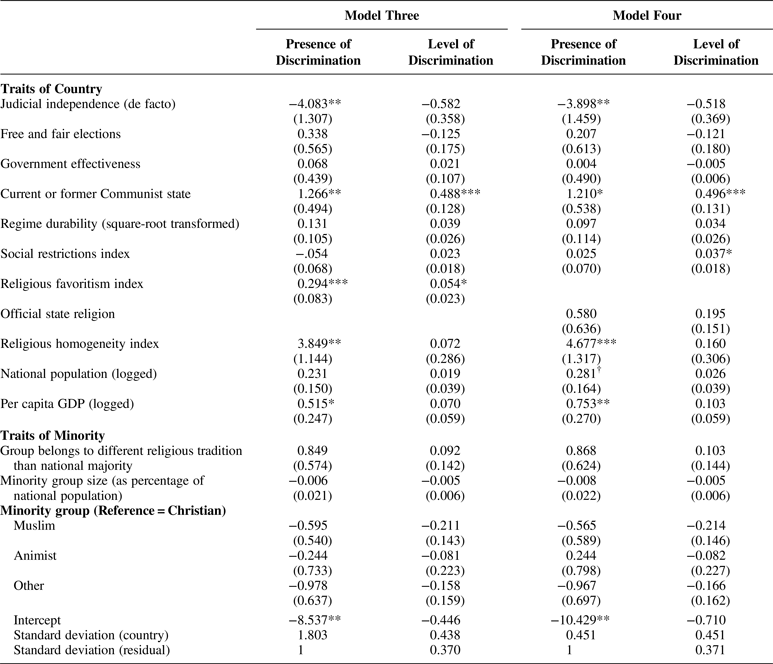
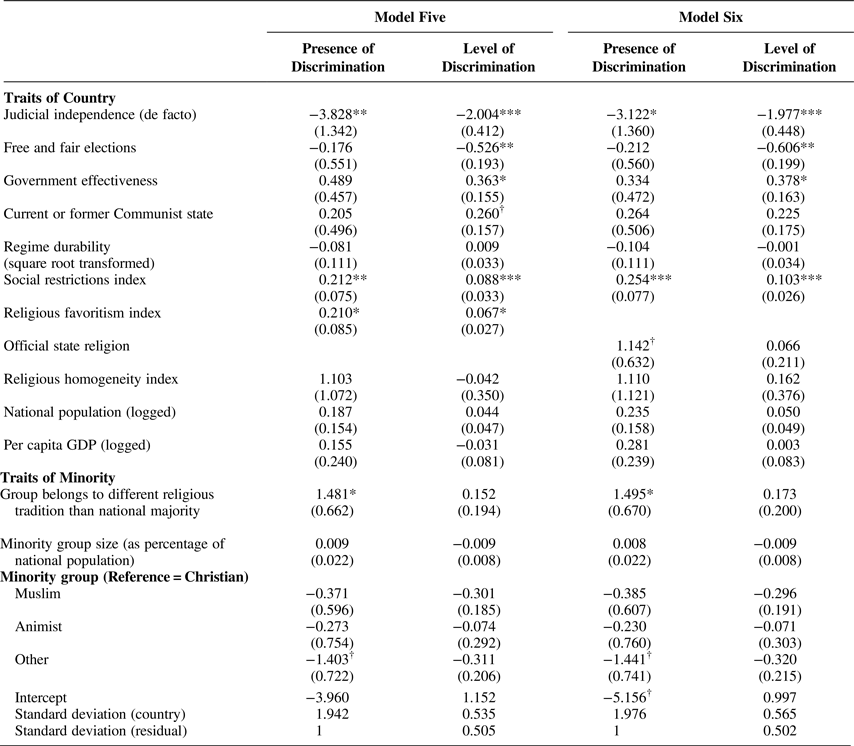
Tables 3 and 4 replicate the models in Table 2, but allow us to distinguish between two forms of discrimination. While discrimination modeled in Table 2 included all 29 measures of discrimination, Table 3 explores discrimination targeted at the minority religions’ institutions and clergy, and Table 4 explores forms of discrimination against members of a minority faith other than the clergy, such as restricting individual members’ ability to practice their religion.
Modeling discrimination against minority religious institutions and clergy, 2008

***p < 0.001; **p < 0.01; *p < 0.05; †p < 0.10. Results from equations estimating presence of discrimination are provided as probit coefficients, and results from equations estimating log-transformed level of discrimination are provided as OLS regression coefficients. Standard errors provided in parentheses. N (Minorities) = 477, in 155 countries.
Modeling discrimination against all members of religious minorities, 2008 (excludes discrimination targeted at institutions and clergy)

***p < .001; **p < .01; *p < .05; †p < .10. Results from equations estimating presence of discrimination provided as probit coefficients, and results from equations estimating log-transformed level of discrimination provided as OLS regression coefficients. Standard errors provided in parentheses. N (Minorities) = 477 in 154 countries.
The results in these tables reveal commonalities as well as important differences in how the predictors influence different kinds of restrictions. Both Table 3 and 4 show that government favoritism toward select religious groups is a positive predictor of discrimination against clergy and religious institutions as well as against members of minority faiths. Though these tables show that the only way the presence of an official religion influences discrimination is against members and not institutions or clergy (and only in a marginally significant way, as shown in Table 4), the religious favoritism index is positively associated with the presence and level of both modes of discrimination. In addition, judicial independence is negatively associated with the presence of both modes of discrimination. It is likewise associated with levels of discrimination against members of minority groups, though as Table 3 shows, judicial independence does not influence how much discrimination is imposed on minority religious institutions and clergy.
Tables 3 and 4 reveal key differences in the effects of social pressures and countries’ communist histories on the two modes of discrimination. Social restrictions against religious groups tend not to translate to state discrimination against minority institutions and clergy; Table 3 shows no significant effects of this measure except for a positive association with discrimination levels in Model 4. However, social restrictions against some religious groups are powerfully associated with government discrimination. In Table 4’s first model, one-unit increases on the social restrictions index correspond with a 3.6% greater probability that a minority group's members will encounter state religious discrimination, and a 9.2% increase in the severity of discrimination among groups that face any degree of it. Both effects are even stronger in Model 6 when controlling for the existence of an official religion.
Conversely, countries' communist history only affects discrimination against minority religious institutions and their clergy. Results of Table 3 indicate that in countries that have had a communist government, discrimination targeted at clergy and minority institutions is approximately 22% more likely to exist (regardless of which model is interpreted). When minorities do face discrimination, it is 62.9% higher in current or former communist states based on Model 3 and even higher in Model 4. Yet these effects are largely absent when explaining discrimination targeted at members of religious minorities in Table 4, and are not significant at the 95% confidence level.
Among predictors measured at the minority group level in Table 3, we do not find significant effects on discrimination imposed on clergy or institutions. However, we observe in Table 4 that members of religious minorities are significantly more likely (approximately 25% using either model) to face some amount of discrimination if they belong to a different religious tradition than their country's majority faith. This indicates that individuals who share the same faith tradition as the majority of their fellow citizens but belong to a different denomination or subgroup receive some protection from state discrimination, though as Table 3 shows, this is not the case among members of the clergy. We also observe in Table 4 that members of minority Christian faiths face are marginally more likely to face state discrimination than members of other minority faiths (excluding Muslims and animists), similar to the effect observed in Table 2.
DISCUSSION/CONCLUSION
Despite agreement that minority religions are frequent targets of religious discrimination, little research has attempted to understand why, and existing research, including previous analyses of the RASM data used here (Fox Reference Fox2016), has failed to identify why some minorities in the same country are targeted for more discrimination than others. Building on the religious economy theory and work in the judicialization of politics, we offered four propositions to help explain why some religious minority groups are targeted more than others. Relying on the recently collected RASM, which uses minority religions as the unit of analysis and develops improved measures, this research explores how national context and minority-level traits are related to this discrimination.
We found support for all four propositions when modeling our summary index of religious discrimination against minority religions. An independent judiciary and state support for select religions were strongly associated with both the presence and severity of discrimination in all models. As predicted, the independent judiciary held negative relationships with the presence and severity of discrimination, whereas state support was positive. Our social restrictions index and our indicator of states' communist past or present each helped explain the severity of the discrimination when it occurred, but not the probability of it occurring.
When we disaggregated the summary index into two sub-indexes, however, important distinctions emerged. As suggested by the first hypothesis, state support for select religions is a powerful predictor of discrimination against minority religions regardless of the discrimination measure used. Likewise, as our fourth hypothesis suggests, religious minorities face less discrimination where national judiciaries enjoy more independence. But support for the remaining two hypotheses varies by the type of discrimination modeled. A country's status as a current or former communist state strongly predicts discrimination against minority religions’ institutions and clergy, but not discrimination against all members of those faiths. By contrast, social and cultural restrictions generally fail to predict discrimination against institutions or clergy of minority religions, but help explain the presence and level of state discrimination targeted beyond formal institutions.
Minority-level measures such as membership in the same religious tradition as the national majority and the identity of the group's religious tradition had limited explanatory power. We did, however, observe differences in levels of aggregate discrimination between Muslims and Christians, and found that members of religious groups of a tradition different than the national majority were more likely to experience discrimination than groups belonging to the same tradition as the majority. Finally, coefficients for the control variables were seldom significant in any of the models. The measures for per capita GDP and religious homogeneity were linked to discrimination against minority religious institutions, but contributed little when explaining other forms of discrimination. Similarly, free and fair elections as well as the effectiveness of governments at implementing policy were linked to discrimination not targeted at clergy and institutions, but had no effect on discrimination with an institutional focus.
The implications of these findings are many. First, an independent judiciary offers minority institutions and clergy greater protection from discrimination than free elections, regime durability or effective governments. This finding aligns with a growing body of research on the “judicialization of politics” and extensive qualitative research on religious minorities (Richardson Reference Richardson2004; Hirschl Reference Hirschl, Whittington, Daniel Kelemen and Caldeira2008). Unable to sway public opinion or force legislative action, minorities can rely on courts for protection where they are relatively free from outside interference. Though judicial independence was significantly related to discrimination in almost all of our models, free and fair elections and government effectiveness had effects in very few, and regime durability did not influence discrimination in any of the models.
Consistent with arguments from religious economy theory, the results also suggest that when the state or the dominant religion favored by the state perceives religious minorities as a threat, discriminatory legislation and actions follow. The findings are especially strong regarding discrimination targeted at the minority religions' institutions and clergy. When state resources are used to support a select religion or the state holds a strong secular ideology, the power of the state can be used to control and deter the actions of minority religions. Our measure for state support of religion was significant in all of our models, and being a current or former communist state was significantly associated with discrimination in the majority of models. Yet a country's communist history was not associated with discrimination outside minority groups’ institutional apparatus, suggesting that these states may feel most threatened by the religious institutions themselves and not by the actions of individual members of these faiths.
Despite supporting many of the expectations of past theory and research, our findings raise several unresolved issues. For example, many questions remain on how and when social and cultural pressures contribute to discrimination. We found tentative support for such pressures being directly related to discrimination against minorities, with the relationship being significant when estimating levels of non-institutional discrimination in all but one of our models. But past research has suggested that states' legislative actions may mediate social pressures and states' treatment of minority religions (Grim and Finke Reference Grim and Finke2007). If so, does this explain why the relationship between the social pressures and discrimination was less consistent as a predictor of discrimination targeting institutions and clergy?
This research also offers a first glimpse at how the traits of the minority religions might contribute to the discrimination they face. Our results show that neither belonging to a religious tradition different than the dominant religion (with the exception of its effect on the presence of discrimination in Table 4) nor the size of the minority group are generally linked to a greater probability of facing discrimination, or to the level of discrimination enacted by the state. These non-findings lend themselves to at least two interpretations. First, the relationship might be attenuated due to a weak measure. The measure we used is a dichotomy (i.e., same world religion or different world religion) and does not offer a distance score between the two religions. Second, the finding could be accurate, suggesting that a minority religion of the same tradition might be equally threatening to the majority religion as one outside it. A sect of the same world religion might better compete for resources from the state and from the people. For example, Christian sects in Russia and Muslim sects in Afghanistan have often been perceived as threats by the majority religion and the state.
Finally, our findings raise several questions about how the covariates of religious freedoms and discrimination vary from other types of freedoms and discrimination. Per capita GDP was a significant predictor of discrimination against institutions and clergy, but was insignificant for discrimination of other kinds, and national population size was not a predictor of religious discrimination of any kind. Why and how do the explanations for discriminating against religious minorities vary from discriminating against other minorities?
Many questions remain, but this research makes key contributions to understanding how discrimination against religious minorities manifests itself. The results largely support the arguments proposed. Our findings suggest that because religious minorities represent unwanted competition for the dominant religion and can be perceived as a threat to the state and larger culture, they commonly face discrimination. Moreover, because these groups are by definition minorities, they find more protections from an independent judiciary than open and free elections. Despite constitutional promises to the contrary, religious minorities remain frequent targets of state discrimination.
Supplementary materials and methods
To view supplementary material for this article, please visit https://doi.org/10.1017/S1755048317000037