Intimate partner violence (IPV), while a complex phenomenon, is a preventable (Campbell, Reference Campbell2002) public health concern (Abramsky et al., Reference Abramsky, Watts, Garcia-Moreno, Devries, Kiss, Ellsberg and Heise2011) that is of global significance (Devries et al., Reference Devries, Mak, Garcia-Moreno, Petzold, Child, Falder and Rosenfeld2013). The term ‘violence’ (derived from the Latin word ‘vis’) refers to the use of constraint, force, physical superiority and domination on another person (Casique & Furegato, Reference Casique and Furegato2006). The World Health Organization (WHO) categorises violence into three broad domains: self-inflicted, interpersonal and collective (Krug, Mercy, Dahlberg, & Zwi, Reference Krug, Mercy, Dahlberg and Zwi2002). As an interpersonal problem, WHO defines IPV as ‘any behaviour within an intimate relationship that causes physical, psychological or sexual harm to those in the relationship’ (Krug, Mercy, Dahlberg, & Zwi, Reference Krug, Mercy, Dahlberg and Zwi2002, p. 89). The use of the term ‘IPV’ recognises that this form of violence can be perpetrated by both men and women, with no limitations on marital status or sexual orientation (Ali & Naylor, Reference Ali and Naylor2013). Further, the term aids in distinguishing violence between sexual partners (i.e., IPV) from other types of violence such as child abuse and neglect, youth violence, elder abuse, self-inflicted and collective violence (Ali & Naylor, Reference Ali and Naylor2013).
Family stress factors such as alcohol and other drugs (AOD) and IPV contribute considerably to the risk of child abuse and neglect (Choenni, Hammink, & van de Mheen, Reference Choenni, Hammink and van de Mheen2017; Murphy, Harper, Griffiths, & Joffrion, Reference Murphy, Harper, Griffiths and Joffrion2017). The presence of these adverse health behaviours in a family environment significantly damages the mental and physical health of all family members – women, men and children (Murphy et al., Reference Murphy, Harper, Griffiths and Joffrion2017). For example, systematic and meta-analysis reviews indicate that for men, perpetrating IPV is associated with increased AOD misuse, rates of depression, suicidal thoughts, stress, anxiety, low self-esteem and increased use of health services (Coben & Friedman, Reference Coben and Friedman2002; Oram, Trevillion, Khalifeh, Feder, & Howard, Reference Oram, Trevillion, Khalifeh, Feder and Howard2014). For women, the experience of IPV is associated with a range of mental health issues (e.g., depression, PTSD, anxiety, self-harm and sleep disorders) and poor physical health (e.g., somatic disorders, chronic disorders and chronic pain, gynaecological problems) (Dillon, Hussain, Loxton, & Rahman, Reference Dillon, Hussain, Loxton and Rahman2013). Further, a meta-analysis of IPV-related trauma indicated that children’s exposure to IPV was longitudinally associated with child externalising and internalising problems (Vu, Jouriles, McDonald, & Rosenfield, Reference Vu, Jouriles, McDonald and Rosenfield2016).
The presence of these family stress factors unquestionably devastates the lives of children and their families and increases the likelihood of child removal and placement in out-of-home care (Murphy et al., Reference Murphy, Harper, Griffiths and Joffrion2017). Children living with parents/caregivers who use violence in their relationship is ‘increasingly recognised as a distinct form of child maltreatment […] with outcomes similar to other types of abuse and neglect’ (McTavish, MacGregor, Wathen, & MacMillan, Reference McTavish, MacGregor, Wathen and MacMillan2016, p. 504). There is no doubt that living in a family environment characterised by the presence of AOD and IPV is detrimental for a child’s development, yet out-of-home care may also be traumatic for the developing child (Doyle, Reference Doyle2007; Murphy et al., Reference Murphy, Harper, Griffiths and Joffrion2017). However, these points warrant further investigation and debate.
A substantial number of studies and literature reviews have explored the statistical and clinical association between AOD and IPV (Abrahams, Jewkes, Laubscher, & Hoffman, Reference Abrahams, Jewkes, Laubscher and Hoffman2006; Abramsky et al., Reference Abramsky, Watts, Garcia-Moreno, Devries, Kiss, Ellsberg and Heise2011; Ali & Naylor, Reference Ali and Naylor2013; Devries et al., Reference Devries, Child, Bacchus, Mak, Falder, Graham and Heise2014; Graham, Bernards, Wilsnack, & Gmel, Reference Graham, Bernards, Wilsnack and Gmel2011; Macy, Renz, & Pelino, Reference Macy, Renz and Pelino2013; Ragavan, Iyengar, & Wurtz, Reference Ragavan, Iyengar and Wurtz2014). However, there is a pressing need for knowledge translation in relation to the association between AOD, IPV and child abuse and neglect. The strong emphasis on translational research is described elsewhere (Hameed, Reference Hameed2018). Generally, the core concept of translational research is translating research into effective practices and policies (Woolf, Reference Woolf2008). Further, the heterogeneous nature of studies addressing the association between AOD and IPV may reflect the differences between the studies, problems with the methods and measures, and the limitations of the literature reviews. This leads to a lack of clarity in the conclusions that can be drawn from the literature. Thus, researchers, practitioners and policy makers who use these studies and literature reviews to guide their professional actions may draw erroneous interpretations, form mistaken beliefs and/or experience confusion in their efforts to support and help parents with AOD and IPV issues. This extends to the children affected by these adverse experiences who may also be subject to abuse and neglect.
In response to the high levels of concern for children affected by family stress factors such as AOD and IPV, this paper has two objectives. First, it employs a review-of-reviews methodology to explore the overall pattern of the association between AOD and IPV. Second, it synthesises and integrates this information to relate it to families experiencing AOD, IPV and child abuse and neglect. The discussion focuses on knowledge translation and the needs of parents and children involved with child protection authorities.
Review-of-reviews
First, this paper reviews the vast literature related to the relationship between AOD and IPV employing a focused review-of-reviews approach. This approach optimises the ability to capture a vast body of literature and is an accepted practice in medical, social and health-related literature (Biddle & Asare, Reference Biddle and Asare2011; Smith, Devane, Begley, & Clarke, Reference Smith, Devane, Begley and Clarke2011). According to the guidelines of the Preferred Reporting Items for Systematic Reviews and Meta-Analyses (PRISMA) (Moher, Liberati, Tetzlaff, & Altman, Reference Moher, Liberati, Tetzlaff and Altman2009), a protocol was developed detailing the specific objectives, search methods, criteria for review selection and approach for data extraction. Second, this paper synthesises and integrates this information to relate it to families experiencing AOD, IPV and child abuse and neglect, with an emphasis on knowledge translation.
Literature search procedures
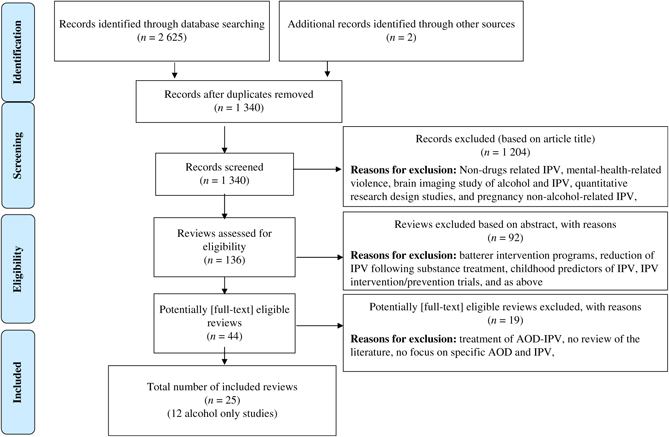
Using the PRISMA guidelines, three methods were employed to obtain relevant reviews from 1970 to (and including) June 2017. To identify published reviews, the following search strategies were conducted: (1) a comprehensive search of the electronic databases Scopus, Medline, PubMed, Ovid, PsycInfo, PsychLit, PsychARTICLES and Drug; the search strategy used the following terms: ‘alcohol use/abuse/misuse’, ‘drugs’, ‘illicit drugs’, ‘IPV’, ‘partner aggression/violence’, ‘domestic violence’, ‘family violence’, ‘reviews’; (2) a manual bibliographic search of reference lists of previously published papers and selected journals – the references of the retrieved studies were cross-checked for applicability; (3) in some cases, the first author of the retrieved studies was contacted directly. These strategies ensured the inclusion of a majority of potentially eligible studies (see Figure 1).
PRISMA flow diagram.

Figure 1 demonstrates that the search included 2627 records, which was then reduced to 1340 articles after removing duplicates. These papers were then searched: by reading the title first (n = 1340) and subsequently, if necessary, the abstract (n = 92) and the paper (n = 72). This yielded 44 potentially relevant papers, of which a total of 25 review papers fulfilled the inclusion criteria. In reviewing this body of literature, the study’s goal was to highlight the patterns in the findings rather than present an exhaustive analysis of all the reviews.
Inclusion criteria
Reviews were included in the study according to the following inclusion criteria: (1) they have been published in full and had undergone peer review; (2) they were not dissertation papers, editorials, letters, conference proceedings, books or book chapters; (3) they were reviews of the literature (meta-analytic, systematic, narrative and focused reviews) on AOD and IPV with no restrictions on sexual orientation; (4) they included study participants of at least 18 years of age; (5) the reviews were available in English.
This paper excluded the following research: (1) individual quantitative and/or qualitative studies because these had been included in the selected review papers; (2) non-AOD-related IPV such as sexual abuse and psychiatric disorders; (3) extreme forms of IPV (e.g., homicide, filicide); (4) unpublished papers and/or reviews that had not undergone peer review. Figure 1 also presents the reasons for exclusion of studies. Given the present research is a focused review, only AOD-related IPV reviews were included. The paper also provides a discussion that synthesises and integrates the findings to relate them to child abuse and neglect, with an emphasis on knowledge translation.
Results
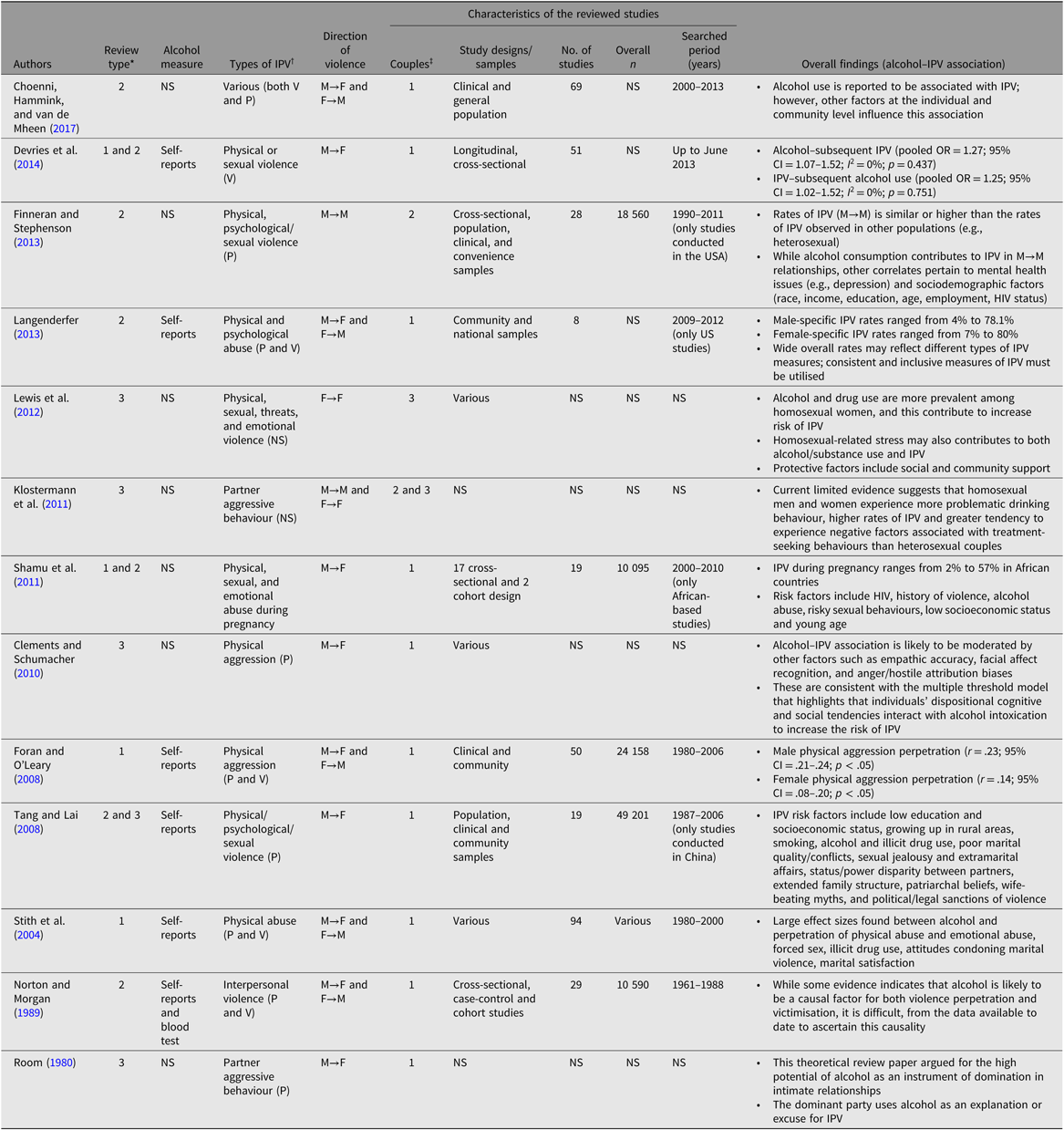
Table 1 provides a descriptive summary (e.g., review type, types of IPV, direction of violence, couples, number of studies, main findings) of 13 review papers synthesising the substantial accumulated body of research evidence on the association between alcohol use and IPV (reviews related to other drugs are synthesised in a narrative form). Of these 13 papers, 7 focused on heterosexual couples (Clements & Schumacher, Reference Clements and Schumacher2010; Devries et al., Reference Devries, Child, Bacchus, Mak, Falder, Graham and Heise2014; Foran & O’Leary, Reference Foran and O’Leary2008; Langenderfer, Reference Langenderfer2013; Norton & Morgan, Reference Norton and Morgan1989; Stith, Smith, Penn, Ward, & Tritt, Reference Stith, Smith, Penn, Ward and Tritt2004; Tang & Lai, Reference Tang and Lai2008), and 3 on men who have sex with men, and/or women who have sex with women (Finneran & Stephenson, Reference Finneran and Stephenson2013; Klostermann, Kelley, Milletich, & Mignone, Reference Klostermann, Kelley, Milletich and Mignone2011; Lewis, Milletich, Kelley, & Woody, Reference Lewis, Milletich, Kelley and Woody2012). Further, a systematic and meta-analytic review focused on the prevalence and risk factors of IPV during pregnancy in studies exclusively conducted in African countries (Shamu, Abrahams, Temmerman, Musekiwa, & Zarowsky, Reference Shamu, Abrahams, Temmerman, Musekiwa and Zarowsky2011).
Descriptive summary and main findings of relevant review papers pertaining to alcohol (only) and IPV

M = male; F = female; NS = not specified.
* 1 = meta-analytic; 2 = systematic; 3 = focused/narrative.
† P = perpetration; V = victimisation.
‡ 1 = heterosexual; 2 = men who have sex with men; 3 = women who have sex with women.
Table 1 presents the results from the meta-analytic reviews, demonstrating that there is a small to moderate effect size for the association between alcohol and IPV (M→F violence perpetration: r = .23; 95% confidence interval [CI] = .21–.24; p < .05; F→M violence perpetration: r = .14; 95% CI = .08–.20; p < .05) (Foran & O’Leary, Reference Foran and O’Leary2008). Examining physical violence and/or sexual violence victimisation, Deveries et al. (Reference Devries, Child, Bacchus, Mak, Falder, Graham and Heise2014) reported that 9 of 12 estimates (data from seven longitudinal studies) demonstrated increased odds of alcohol consumption and subsequent IPV (pooled odds ratio [OR] = 1.27; 95% CI = 1.07–1.52). In contrast, 14 of 15 estimates (nine longitudinal studies) demonstrated a reverse direction of increased odds of IPV and subsequent alcohol use (pooled OR = 1.25; 95% CI = 1.02–1.52). However, the magnitude of these effect sizes may reflect the types of sample, study designs and measurement, particularly alcohol measures, which were often non-standardised self-report questionnaires.
Further, utilising data from 19 studies conducted in China (N = 49,201), Tang and Lai (Reference Tang and Lai2008) found the average lifetime and year prevalence of M→F IPV was (respectively) 19.7% and 16.8% for any type of IPV, 42.6% and 37.3% for psychological IPV, 14.2% and 6.7% for physical IPV, and 9.8% and 5.4% for sexual IPV. Similarly, a meta-analysis of 19 studies based in African countries yielded an overall prevalence of IPV in pregnancy of 15.23% (95% CI = 14.38–16.08%) (Shamu et al., Reference Shamu, Abrahams, Temmerman, Musekiwa and Zarowsky2011). However, consistent with findings from other review papers, alcohol alone was neither a sufficient nor a necessary factor in predicting IPV (Room & Rossow, Reference Room and Rossow2001). For example, male perpetrator risk factors included career–life stress (r = .26), emotional/verbal abuse (r = .49), forced sex (r = .45), illicit drug use (r = .31), attitudes condoning marital violence (r = .30), marital satisfaction (r = −.30) and traditional sex role ideology (r = .29), while alcohol use accounted for a moderate association with IPV (r = .24) (Stith et al., Reference Stith, Smith, Penn, Ward and Tritt2004). In contrast, while female perpetrator risk factors included low marital satisfaction (r = −.25), female victimisation risk factors included violence towards male partners (r = .41), female depression (r = .28), fear of partner violence (r = .27) and alcohol misuse (r = .13) (Stith et al., Reference Stith, Smith, Penn, Ward and Tritt2004).
Overall, these reviews support the proposition that substance consumption in general, and alcohol consumption in particular, contributes to a wide range of adverse consequences, including injury (Cherpitel, Reference Cherpitel1993, Reference Cherpitel1994, Reference Cherpitel2007; Cherpitel et al., Reference Cherpitel, Bond, Ye, Borges, Macdonald, Stockwell and Cremonte2003; Vitale & Mheen, Reference Vitale and Mheen2006; Zeisser et al., Reference Zeisser, Stockwell, Chikritzhs, Cherpitel, Ye and Gardner2013; Zerhouni et al., Reference Zerhouni, Bègue, Brousse, Carpentier, Dematteis, Pennel and Cherpitel2013), IPV (Abel, Reference Abel1977; Bennett, Holloway, & Farrington, Reference Bennett, Holloway and Farrington2008; Boles & Miotto, Reference Boles and Miotto2003; Foran & O’Leary, Reference Foran and O’Leary2008; Hoaken & Stewart, Reference Hoaken and Stewart2003; Moore & Stuart, Reference Moore and Stuart2005; Moore et al., Reference Moore, Stuart, Meehan, Rhatigan, Hellmuth and Keen2008; Norton & Morgan, Reference Norton and Morgan1989; Parker & Auerhahn, Reference Parker and Auerhahn1998; Sønderlund et al., Reference Sønderlund, O’Brien, Kremer, Rowland, De Groot, Staiger and Miller2014; Tyner & Fremouw, Reference Tyner and Fremouw2008), homicide (Darke, Reference Darke2010; Kuhns, Wilson, Clodfelter, Maguire, & Ainsworth, Reference Kuhns, Wilson, Clodfelter, Maguire and Ainsworth2011; Kuhns, Wilson, Maguire, Ainsworth, & Clodfelter, Reference Kuhns, Wilson, Maguire, Ainsworth and Clodfelter2009), self-harm and suicidal behaviour (Cherpitel, Borges, & Wilcox, Reference Cherpitel, Borges and Wilcox2004) and child abuse and neglect (Goldberg, Lex, Mello, Mendelson, & Bower, Reference Goldberg, Lex, Mello, Mendelson and Bower1996; Stover & Kiselica, Reference Stover and Kiselica2015). However, the consensus is that these relationships are exceedingly complex (Boles & Miotto, Reference Boles and Miotto2003), interactional and multifactorial (moderated by various individual and environmental factors) (Hoaken & Stewart, Reference Hoaken and Stewart2003).
The quantitatively oriented results are also consistent with findings from the narrative (qualitative) focused reviews that found alcohol–IPV association is moderated (and likely mediated) by various other factors such as low education and socioeconomic status, growing up in rural areas, poor marital quality/high degree of marital conflict (Tang & Lai, Reference Tang and Lai2008), anger/hostile attribution and cognitive-social biases (Clements & Schumacher, Reference Clements and Schumacher2010). Qualitative findings demonstrate that the association between AOD and IPV varies in multiple ways and is exacerbated by complicating factors, including sociocultural factors (e.g., norms, social environment, gender habitus, living in poor area, unemployment) (Haritavorn, Reference Haritavorn2013; James, Johnson, & Raghavan, Reference James, Johnson and Raghavan2004) and pre-existing aggressive tendencies (Hamilton & Goeders, Reference Hamilton and Goeders2010). In fact, rather than considering AOD as a causative factor for violence in general, and for IPV in particular, AOD can be conceptualised as triggering violent behaviours, in particular IPV (McMurran, Jinks, Howells, & Howard, Reference McMurran, Jinks, Howells and Howard2010).
Further, Room (Reference Room1980) theorised that alcohol provides a particularly useful explanation and/or excuse for both men and women to engage in IPV. That is, alcohol has a high potential for use as an instrument for domestic domination. This explanation refutes the perspective that sees a relationship between the pharmacological effect of alcohol and violence (see Goldstein, Reference Goldstein1985 for a tripartite framework pertaining to the drug–violence nexus). These propositions, which are derived from anthropological data, suggest that the ‘connection between alcohol and disinhibition is a matter of cultural belief rather than pharmacological action’ (Room, Reference Room1980, p. 2). Despite these theoretical explanations, AOD and IPV are among the multiple contributory risk factors for perpetrating child abuse and neglect, leading to an increased likelihood of child removal from original family (Choenni et al., Reference Choenni, Hammink and van de Mheen2017; Murphy et al., Reference Murphy, Harper, Griffiths and Joffrion2017).
In relation to the children of parents presenting with AOD and/or IPV issues, a number of systematic reviews indicate that children’s awareness and mere exposure to IPV in their parents or caregivers has deleterious consequences (Bair-Merritt, Blackstone, & Feudtner, Reference Bair-Merritt, Blackstone and Feudtner2006; Klostermann & Kelley, Reference Klostermann and Kelley2009; MacMillan & Wathen, Reference MacMillan and Wathen2014; Wathen & MacMillan, Reference Wathen and MacMillan2013). Children can be exposed to IPV in many ways (Hamby, Finkelor, Turner, & Ormond, Reference Hamby, Finkelhor, Turner and Ormrod2011), including seeing and/or hearing the violence or seeing the victims’ injuries after a violent episode. IPV is cumulative in its effect and is associated with social, behavioural, emotional and cognitive problems in children, which often persist into adulthood (Gilbert et al., Reference Gilbert, Widom, Browne, Fergusson, Webb and Janson2009). Intervening with women and men to end IPV has the potential to disrupt intergenerational transmission of IPV, which may avoid some children (particularly boys) becoming victims or perpetrators as adults (Margolin & Gordis, Reference Margolin and Gordis2004). Further, the mental health effect of IPV on parents results in a toxic family environment for children’s development. There is compelling evidence that children exposed to toxic levels of stress experience long-lasting effects on cognitive development, speech and language, and mental and physical health (Bair-Merritt, Blackstone, & Feudtner, Reference Bair-Merritt, Blackstone and Feudtner2006; Shonkoff et al., Reference Shonkoff, Garner, Siegel, Dobbins, Earls and McGuinn2012).
Both AOD and IPV can have considerable adverse influences on parenting behaviours and styles, which may lead to child abuse and neglect (Stover & Kiselica, Reference Stover and Kiselica2015). These adverse experiences increase the likelihood of families’ involvement with child protection authorities and have considerable implications in relation to substantiated child abuse and neglect. For example, children of parents presenting with AOD and IPV are more likely to spend longer time in out-of-home care (Brook & McDonald, Reference Brook and McDonald2009; Brook, McDonald, Gregoire, Press, & Hindman, Reference Brook, McDonald, Gregoire, Press and Hindman2010). The presence of these family stress factors has considerable implications for the placement of children in child welfare custody as well as for family reunification strategies (Murphy et al., Reference Murphy, Harper, Griffiths and Joffrion2017). It is important to acknowledge the interrelationship between AOD, IPV and child abuse and recognise the direct and indirect ways in which children’s behavioural, emotional and cognitive development can be harmed. The co-occurrence of AOD, IPV and child abuse and neglect is a tripartite tragedy, which contributes considerably to significant impairments with long-lasting negative effects for all members of the family.
Discussion
This paper examines the overall pattern of findings on the relationship between AOD and IPV, employing a focused review-of-reviews methodology. Overall, the pattern of findings supports the existence of a moderate association between AOD and IPV (both in relation to perpetration and victimisation). However, the reviewed body of literature supports the proposition that there are also multiple contributory and causal mechanisms linking AOD and IPV, including the characteristics of the individual, the effects of AOD (mainly alcohol), the environment and the cultural expectations surrounding alcohol and IPV. However, while these factors are important to consider when examining IPV, none are identified as a sole cause of IPV.
The findings of the present review are consistent with the broader research literature arguing that both AOD and IPV can have a considerable effect on parenting behaviours and styles that increase the risk of child abuse and neglect (Stover & Kiselica, Reference Stover and Kiselica2015). Children’s exposure and/or awareness of violence between parents/caregivers is increasingly recognised as a distinct form of child maltreatment with deleterious outcomes that are similar to other types of abuse and neglect (Klostermann & Kelley, Reference Klostermann and Kelley2009; MacMillan & Wathen, Reference MacMillan and Wathen2014; McTavish et al., Reference McTavish, MacGregor, Wathen and MacMillan2016; Seay & Kohl, Reference Seay and Kohl2013; Wathen & MacMillan, Reference Wathen and MacMillan2013). The psychological and physical effects of IPV on parents contributes considerably to a toxic family environment, in which the safety of children is compromised.
From a clinical perspective, families experiencing these risk factors (i.e., AOD and IPV) are also more likely to experience a range of other risk factors such as poverty and housing issues. For example, within the context of Australia, Aboriginal and Torres Strait Islander families experience a disproportionate level of AOD and IPV, which is often related to past and present individual, family and community trauma (Atkinson, Reference Atkinson2002). The effects of colonisation and the legacy of extreme social disadvantage and ongoing trauma are reflected in the high rates of community and family violence and contribute to higher rates of maternal mortality, stillbirth, adverse neonatal outcomes and high rates of children in out-of-home care (Australian Institute of Health and Welfare, 2018).
These adverse experiences increase the likelihood of families’ involvement with child protection authorities and have considerable implications for substantiated child abuse and neglect, as well as family reunification. For example, in 2016, the Victorian Government (Australia) implemented amendments to the Children, Youth and Families Act 2005 to ‘promote planning, decision making and permanency for vulnerable children and young people’. While this Victorian legislation grants parents 12 months to demonstrate their capacity to care for their children, the findings of the present review highlight that the experience of multiple risk factors further complicates families’ abilities to provide a safe and abuse-free home environment for their children. This discussion considers possible implications related to this fast track to permanent care.
Research and clinical implications and applications: A knowledge translation perspective
AOD–IPV relationship
Overall, the pattern of findings supports the existence of a moderate association between AOD and IPV. While the quantitative studies provided a measure of risk association, other factors such as gang membership, aggressive/impulsive personality, positive attitudes towards violence, age and sex were also significant predictors of IPV. The evidence from several reviews also supports the argument that while risk of IPV increases with increasing AOD-related issues, this risk is culture-specific and related to broader sociocultural factors such as living in a poor area, constant exposure to AODs, witnessing violence, unemployment and limited resources and social support.
Examining the AOD–IPV relationship in the context of the aforementioned adverse experiences has important clinical implications for child abuse and neglect. For example, interventions and responses for reducing and minimising the effect of AOD-related IPV, in particular in relation to children, have been a central focus of law enforcement, public policy and child protection services (Frederico, Jackson, & Black, Reference Frederico, Jackson and Black2008; Murphy et al., Reference Murphy, Harper, Griffiths and Joffrion2017). In the Australian context, the Victorian legislation for the permanent care of children requires parents/caregivers to demonstrate their capacity to care for their children within a 12-month period. The tripartite tragedy, that is, AOD, IPV and child abuse and neglect, along with the presence of other family stress factors and difficulties are likely to decrease the chance of family reunification. Further, parents experiencing such difficulties and risk factors may not receive the services they need in a timely manner. Understanding how both perpetrators and victims of IPV presenting with AOD-related difficulties can be supported to remove the structural and personal barriers for seeking help and taking protective actions for themselves and for their children would have important implications for policy and practice. Understanding this warrants further investigation and research.
Generally, AOD and IPV are considered antisocial activities that have significant adverse health effects and reflect a systemic or institutionalised problem rather than being purely an individually determined phenomenon (Adames & Campbell, Reference Adames and Campbell2005). This conceptualisation of IPV has implications for men and their pursuit of expression of masculinity and normative heterosexuality. More broadly, alcohol-related violence perpetrated by men may help to establish and maintain a gendered identity (Peralta, Tuttle, & Steele, Reference Peralta, Tuttle and Steele2010) and domestic domination (Room, Reference Room1980). This line of analysis implies that one of the intervention strategies and efforts should focus broadly on the environmental and sociocultural elements that engender IPV rather than on individual or personal factors (Adames & Campbell, Reference Adames and Campbell2005). For example, community-level strategies may involve both men and women, family members, local governmental leaders and other community institutions and their leaders (including social service agencies and their service providers) (Adames & Campbell, Reference Adames and Campbell2005).
Prevention and early intervention
This focused review-of-reviews clarifies that AOD, in particular alcohol, is one of the many contributing risk factors for IPV. Family stress factors such as AOD and IPV have also been identified as risk factors for child abuse and neglect (Taylor, Marquis, Coall, & Wilkinson, Reference Taylor, Marquis, Coall and Wilkinson2017). Children’s exposure to AOD and IPV is increasingly recognised as a distinct form of child maltreatment (McTavish et al., Reference McTavish, MacGregor, Wathen and MacMillan2016). From a knowledge translation perspective, the development and evaluation of efficacious early preventive interventions for families at high risk of AOD misuse and/or engaging in IPV depends on basic risk factor research (Hameed, Reference Hameed2018). Such research would involve efforts to distinguish modifiable versus non-modifiable risk factors, with the former being the direct target of preventive interventions. However, this field of research requires considerable translational work to fulfil the goal of prevention. Given the moderate relationship between AOD (in particular alcohol) and IPV, families who present as experiencing these adverse issues may constitute a high-risk target group for the implementation of focused violence prevention activities with a major focus on evidence-informed strategies to ensure children’s safety.
However, currently no one strategy is sufficient to prevent AOD-related IPV. In contemporary society, broad-based, multidisciplinary and culturally relevant strategies are needed to meet the various needs of individuals and communities. Such broad-based, multilevel interventions (e.g., community-based interventions, social marketing campaign activities) may considerably add to change at the individual, family, organisational and community/population levels. In addition, the development of valid and reliable screening measures for AOD-related issues, including IPV, is beneficial for early detection and intervention. It is anticipated that early preventive interventions may disrupt the progression of AOD use to dependence, as well as decrease the risk of engaging in IPV and perpetrating child abuse and neglect. Such speculation is worth investigating in future research.
Identified research gaps and key areas for future research
This review-of-reviews highlighted the significant and ongoing concerns related to AOD and IPV and identifies several gaps in the literature. For example, an important topic for further research is whether AOD consumption facilitates or provides an excuse for the elevated risks of physical, verbal, psychological and/or sexual IPV. In addition, it is not clear whether styles of AOD consumption (e.g., short-term sporadic consumption versus long-term habitual consumption) differ in how they are risk factors for IPV. The degree to which IPV can be specifically attributable to alcohol only (as opposed to other drugs) also requires further research. Several other areas also warrant further research, for example, measuring the relationship between different facets of alcohol use (e.g., levels of consumption versus patterns of drinking, location of drinking and misusing drugs) and IPV. In addition, the following questions warrant research attention: Does AOD use directly contribute to IPV? Does experiencing IPV increase the risk in AOD use, or is there a bidirectional relationship between AOD and IPV? What is the association between AOD, IPV and harsh parenting behaviours (Gustafsson & Cox, Reference Gustafsson and Cox2012), quality of maternal parenting and co-parenting capability (Casanueva, Martin, Runyan, Barth, & Bradley, Reference Casanueva, Martin, Runyan, Barth and Bradley2008), and negative parenting styles or general criminal behaviours leading to child abuse and neglect (Payne, Higgins, & Blackwell, Reference Payne, Higgins and Blackwell2010).
In the highly sensitive context of child abuse and neglect, there is a need to develop a stronger evidence base to better understand (1) the potential differences in families experiencing IPV with and without AOD involvement and (2) the effects of AOD-related issues and IPV on service provision, service planning and areas of opportunity for intervention. Further, in relation to the families involved with child protection authorities, it should be examined as to what extent these difficulties and other factors contribute to children requiring out-of-home care intervention. It should also be examined as to what extent these family stress and risk factors contribute to reunification success or failure. Another important avenue for research is discovering what families experiencing these risk factors should do to increase the likelihood of reunification with their child. Filling these research gaps would provide new information about both the nature and extent of AOD involvement in IPV, the effect this has on treatment and service provision, as well as the effect on permanency planning for children involved with child protection authorities.
For example, considering the Victorian legislation for the permanent care of children, as part of orders for a child’s return to their parents, the parents can be required to cease reported AOD misuse and violent behaviours. Families involved with child protection authorities may face many and varied difficulties and family stress risk factors that further complicate their ability to demonstrate a sufficient capacity to provide a safe and caring environment for their child who has been placed in out-of-home care. Increased knowledge of risk factors and their interrelationships will greatly benefit clinical practice focused on changing parental behaviour and reducing risk to the child, and subsequently increasing the likelihood of reunification success and ensuring the child’s safety. However, overall, the care system’s response to children affected by parental AOD-related issues and IPV, and children’s and families’ progress in treatment, is not sufficiently understood.
Implications for child welfare policy
AOD and IPV have a profound effect on individuals, the community, service providers and, more importantly, the children being exposed to or witnessing parental AOD use or misuse and/or IPV. Children exposed to parental AOD misuse and IPV are at a high risk of experiencing various physical and developmental difficulties, including attachment, emotional and behavioural problems (Bair-Merritt et al., Reference Bair-Merritt, Blackstone and Feudtner2006; Holt, Buckley, & Whelan, Reference Holt, Buckley and Whelan2008; Lamers-Winkelman, Schipper, & Oosterman, Reference Lamers-Winkelman, Schipper and Oosterman2012; MacMillan & Wathen, Reference MacMillan and Wathen2014; McTavish et al., Reference McTavish, MacGregor, Wathen and MacMillan2016; Rizo, Macy, Ermentrout, & Johns, Reference Rizo, Macy, Ermentrout and Johns2011; Seay & Kohl, Reference Seay and Kohl2013; Wathen & MacMillan, Reference Wathen and MacMillan2013). However, while children’s exposure to parental AOD and IPV is traumatic, it is argued that the extent of trauma depends on the context and the child’s comprehension of the experience, rather than on the event itself (Finkenauer et al., Reference Finkenauer, Buyukcan-Tetik, Baumeister, Schoemaker, Bartels and Vohs2015). Thus, interventions to address the consequences of abuse and neglect, as well as strategies to keep the child safe within the home, focus not only on the individual child and family but also on the broader system of family, school and community. To implement interventions effectively, it is important to have a sound knowledge about the relationship between AOD and IPV to ensure the collaborative approach and efficacy of child-focused services and the adult-related services attended by parents to manage and treat IPV and AOD-related issues.
Both AOD and IPV have significant implications for child development and contribute considerably to higher risks of perpetrating child abuse and neglect, and thus contribute significantly to families and children being involved with child protection authorities. AOD and IPV are major health and child protection issues facing governments, countries, cultures and all levels and types of societies (Graham et al., Reference Graham, Bernards, Wilsnack and Gmel2011; Wilsnack, Reference Wilsnack2012). Overall, the presence of a range of family stress factors in families involved with child protection authorities complicates parents’ ability to demonstrate their willingness to change their behaviour and provide a safe and caring environment for their children.
Thus, there is an urgent need to research systematically the extent to which services and programmes adequately meet the needs of these families and children. However, within the Australian context, there is insufficient research on parents’ perceptions of what can be done to address AOD and IPV, in particular within culturally and linguistically diverse communities. This is a crucial point for families involved with child protection authorities. Parental beliefs and opinions about the factors leading to child abuse and neglect, as well as their beliefs about what is needed to provide a safe and caring environment for their children, is central to service provision and attempts at family reunification and preservation. These points warrant further appropriate research.
Conclusion and summary
The findings of this review-of-reviews support the view that a single risk factor explaining IPV is simplistic and ignores other contributing factors that must also be understood. Thus, IPV is best situated within a multifactorial paradigm. Further, according to the current literature, IPV is a complex interpersonal problem rooted in the interplay of various biological and environmental factors, including consumption of AOD, for which implementing prevention strategies is a desirable aim. Family stress factors, including AOD and IPV, are risk factors for child abuse and neglect. Overall, the presence of these adverse health behaviours considerably disrupts the lives of families, with tragic consequences. Understanding the relationship and dynamics between these adverse family stress factors may assist in targeting treatment and appropriate care responses to both the affected children and their parents/families. However, extensive translational research and knowledge exchange is needed to achieve the aim of intervening early, ensuring positive outcomes for parents, children and the wider community.
Disclaimer on publication
Author affiliation is provided for identification and correspondence purposes only and are not intended to convey or imply concurrence with, or support for, the positions, opinions or viewpoints expressed by the author. Responsibility for the information and views set out in this paper lies entirely with the author.
Mohajer Abbass Hameed holds a masters in psychoanalysis and a PhD in developmental psychopathology, with an emphasis on quantitative methodologies. He has worked as a senior clinician and currently is a research fellow within the University of Melbourne, Department of General Practice, Safer Families Centre of Research Excellence.