INTRODUCTION
The structure and dynamics of adult populations of marine benthic invertebrates greatly depend on processes in the early life history stages, which are in turn influenced directly by habitat characteristics (Hunt & Scheibling, Reference Hunt and Scheibling1997). For example, larval settlement is linked to combinations of physical, chemical and biological factors associated with a potentially suitable area or with conspecifics. In particular, gregarious settlement (when larvae are more likely to settle on a substrate where there are already conspecifics) has been observed in up to 35 species from 8 phyla of marine invertebrates (Toonen & Pawlik, Reference Toonen and Pawlik2001), including barnacles, bivalves and tubeworms (Pawlik et al., Reference Pawlik, Butman and Starczak1991).
In geologically active zones on mid-ocean ridges and seamounts, hydrothermal vents provide habitats for organisms, most of which are endemic and that are highly adapted to specific physico-chemical conditions, such as high temperatures and concentrations of hydrogen sulphide and other metals, and low concentrations of oxygen. At settlement, larvae of vent species must recognize specific cues associated with the vent environment (Van Dover, Reference Van Dover2000), such as elevated hydrogen sulphide concentrations (Rittschof et al., Reference Rittschof, Forward, Cannon, Welch, McClary, Holm, Clare, Conova, McKelvey, Bryan and Van Dover1998) or the presence of other hydrothermal vent organisms (Mullineaux et al., Reference Mullineaux, Fisher, Peterson and Schaeffer2000; Hunt et al., Reference Hunt, Metaxas, Jennings, Halanych and Mullineaux2004). Larval settlement is most commonly quantified on substrates deployed for known periods of time; however, the monitoring frequency can bias conclusions on the relative importance of pre- and post-settlement events (Hunt & Scheibling, Reference Hunt and Scheibling1997). In hydrothermal vents, monitoring frequency is particularly low because of the remoteness of these habitats. As a result, conclusive studies on patterns of larval settlement at hydrothermal vents are limited (Van Dover et al., Reference Van Dover, Berg and Turner1988; Mullineaux et al., Reference Mullineaux, Mills and Goldman1998, Reference Mullineaux, Fisher, Peterson and Schaeffer2000, Reference Mullineaux, Mills, Sweetman, Beadreau, Metaxas and Hunt2005; Kelly et al., Reference Kelly, Metaxas and Butterfield2007).
Vestimentiferan tubeworms are a conspicuous component of the vent macrofauna that contribute greatly to the total biomass of these habitats (Sarrazin & Juniper, Reference Sarrazin and Juniper1999; Govenar & Fisher, Reference Govenar and Fisher2007). Additionally, vestimentiferan assemblages increase habitat complexity by providing 3-dimensional structure with their tubes, effecting increased community diversity and species richness (Govenar & Fisher, Reference Govenar and Fisher2007). At hydrothermal vents, settlement of tubeworms has been linked to the chemical characteristics of the fluid (Mullineaux et al., Reference Mullineaux, Mills and Goldman1998), facilitation by heterospecifics (Mullineaux et al., Reference Mullineaux, Fisher, Peterson and Schaeffer2000), and to a response to cues provided by adult worms (Hunt et al., Reference Hunt, Metaxas, Jennings, Halanych and Mullineaux2004). Although gregarious settlement has not yet been described in hydrothermal vent tubeworms, it has been documented for shallow water serpulid polychaetes (Toonen & Pawlik, Reference Toonen and Pawlik1996).
Vestimentiferan tubeworms provide an excellent system for quantifying settlement in a remote habitat, such as vents. They occupy chitinous tubes that even if empty, in the event of mortality of the occupant after settlement, can last in situ for periods of >2 years (Ravaux et al., Reference Ravaux, Zbinden, Voss-Foucart, Compère, Goffinet and Gaill2003). Spatial and temporal patterns in settlement can be quantified based on the total number of tubes present at any one location (including occupied and unoccupied ones). Post-settlement mortality can also be inferred from the relative abundance of tubes of a particular size (and thus age) occupied by worms at the time of observation. In this study, we report observations of patterns of pulsed, gregarious settlement in the tubeworm Lamellibrachia sp., from Monowai Volcano on the Tonga–Kermadec arc.
MATERIALS AND METHODS
Study site
The Tonga–Kermadec arc is a 2500-km chain of submarine volcanoes located off the northern coast of New Zealand and extending to the southern coast of Fiji. In the north, the Tonga arc extends from 16°S to 27°S, and, in the south, the Kermadec arc extends from 27°S and 38°S. Monowai Volcanic Complex (MVC) is a 10-km wide active submarine volcano with a caldera complex. It is located at 25°53′S 177°1′W, in the transition zone between the southern end of the Tonga arc and the northern end of the Kermadec arc. MVC is built on a low relief basaltic andesitic lava shield within a north-east rift (Schwarz-Schampera et al., Reference Schwarz-Schampera, Botz, Hannington, Adamson, Anger, Cormany, Evans, Gibson, Haase, Hirdes, Hocking, Juniper, Langley, Leybourne, Metaxas, Mills, Ostertag-Henning, Rauch, Rutkowski, Schmidt, Shepherd, Stevens, Tamburri, Tracey and Westernstroer2007).
Mussel Ridge hydrothermal vent field is located on the western side of Monowai caldera. The substrate is muddy with slabs of sulphur-cemented ash, rich in hydrocarbons and massive anhydrite (Schwarz-Schampera et al., Reference Schwarz-Schampera, Botz, Hannington, Adamson, Anger, Cormany, Evans, Gibson, Haase, Hirdes, Hocking, Juniper, Langley, Leybourne, Metaxas, Mills, Ostertag-Henning, Rauch, Rutkowski, Schmidt, Shepherd, Stevens, Tamburri, Tracey and Westernstroer2007), and scattered rocks with sizes on the order of 100s cm3. In 2007, venting occurred at low temperatures through cracks, where large portions of the substrate were uplifted. The vent sites were covered with large mounds of mussels growing on small rocks or clumped directly on the muddy substrate. Areas with venting and dense mussel beds also supported diverse macrofauna, fish and invertebrates, such as crustaceans, polychaetes, sponges and anemones.
SAMPLE COLLECTION AND PROCESSING
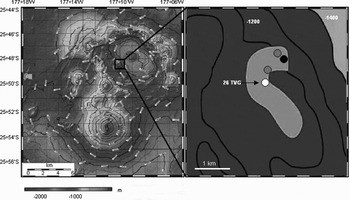
Populations of the vestimentiferan Lamellibrachia sp. were located with the remotely operated vehicle, ROPOS, aboard the RV ‘Sonne’, at several locations on Mussel Ridge on Monowai caldera in May 2007, during dives R1043 and R1044 (Figure 1). These populations were described using a colour video camera (Sony DXC-990 three CCD, broadcast quality NTSC, 16× zoom) mounted on ROPOS, which is close to the seafloor, has a high pixel resolution resulting in high quality video footage and has an adjustable angle and focal length; and from images with a Sony Cybershot DSC-F707 camera. The position and spatial extent of the populations were defined using the ROPOS navigation track. Sizes of tubeworms were estimated in situ using 10-cm laser scale projected by ROPOS. Average sizes of mussels and crabs were also estimated using the laser scale and were used to estimate in situ tubeworm lengths when the laser scale could not be used. Two rocks covered in discrete patches of the vestimentiferans were collected using a TV-grab (26TVG) from Mussel Ridge at approximately 1050 m depth (Figure 1).
Area sampled on Monowai Volcano Complex on the Tonga–Kermadec arc during ROPOS dives R1043 and R1044. The location where TV-grab 26TVG was collected is also shown. Dark grey and black circles indicate areas where tubeworms were seen on dives R1043 and R1044, respectively, but not collected. This figure is modified from Schwarz-Schampera et al. (Reference Schwarz-Schampera, Botz, Hannington, Adamson, Anger, Cormany, Evans, Gibson, Haase, Hirdes, Hocking, Juniper, Langley, Leybourne, Metaxas, Mills, Ostertag-Henning, Rauch, Rutkowski, Schmidt, Shepherd, Stevens, Tamburri, Tracey and Westernstroer2007).

Once on deck, the rock samples were immediately photographed and transferred into 95% ethanol for long-term storage.
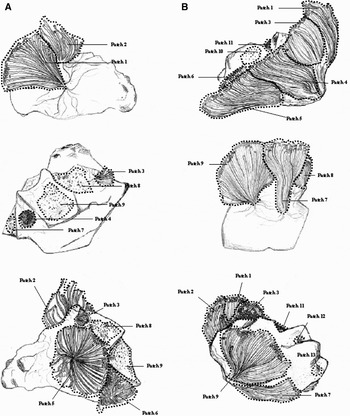
We defined a ‘patch’ of tubeworms as a distinct aggregation of individuals, the tubes of which were attached to an area <25 cm2 on the substrate, and with a clear spatial separation from other patches (Figures 2 & 3). Each patch of vestimentiferans on each of the two rocks was photographed. All individuals were then removed from the rocks using tweezers, photographed and enumerated. The length of all individuals (tip of the tube to the base where the tube first attached to the substrate, but excluding the long ‘root’ anchoring them to the substrate) was measured on the photographs using the image analysis program SigmaScan Pro 5 (accuracy: 0.1 mm). The roots were intertwined among individuals from different patches, and their position was not considered in this analysis. Roots were variable in length (<1 cm–~10 cm) and although in some instances covered up to 50% of the surface area of the rock, they did not extend beyond the rocks into the substrate. The tips of the roots were flattened and firmly attached onto the rocks and did not penetrate into the sediment. After the tubeworms were removed, the area of the cleared surfaces on the substrate was also photographed and measured. When tubeworms were too small to be removed from the substrate without damaging them, they were all counted and assumed to be smaller than the smallest that were removed successfully (0.5 cm).
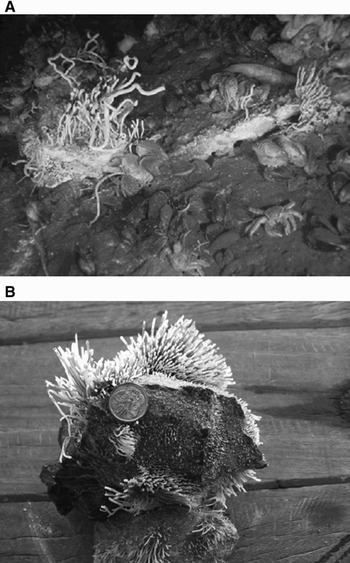
Photographs of rocks with patches of settlers of the tubeworm Lamellibrachia sp. from Monowai Volcano Complex: (A) in situ; and (B) collected sample on board ship. The image in (B) is a bird's eye-view of the schematic presentation of rock A, panel 3 in Figure 2.

Schematic representation of the location and distribution of nine patches of Lamellibrachia sp. on one rock (A), and 13 patches on another (B), collected in 2007 from Mussel Ridge vent field on Monowai Volcano Complex. Each patch is identified with dotted lines.

To quantify post-settlement mortality, all patches were subsampled using the greatest of 10% of the total number of individuals or 10 tubes that were randomly selected from the patch, including tubes that were <0.5 cm in length and were not removed from the rock for the length measurements. The tubes were dissected for the presence of the tubeworm, and empty tubes were considered to represent dead individuals at the time of collection.
Length–frequency distributions of all tubeworms on each rock were generated, using intervals chosen to encompass all individuals on the particular rock, and to be greater than the error in the length measurements (Kelly & Metaxas, Reference Kelly and Metaxas2007). Length–frequency distributions were compared between patches using G-tests. When the null hypothesis of no difference in size–frequencies between patches was rejected (P < 0.001), differences between each pair of patches on each rock were tested. Pair-wise tests were conducted using a Bonferroni adjustment for a family error rate of 5% for each rock. The relationship between mean length and the abundance of individuals in each patch (pooled data from both rocks) was explored by fitting a power function to the data.
RESULTS
Tubeworms were observed in two locations during dive R1043 and one location during R1044, at 1026–1053 m depth, where the temperature of the hydrothermal fluid was 10–42oC. Fluid sampling in two locations on Mussel Ridge indicated weakly acidic vent fluids with high H2S content (7.42–17.61% volume; 0.159–0.342 µmol kg−1) (Schwarz-Schampera et al., Reference Schwarz-Schampera, Botz, Hannington, Adamson, Anger, Cormany, Evans, Gibson, Haase, Hirdes, Hocking, Juniper, Langley, Leybourne, Metaxas, Mills, Ostertag-Henning, Rauch, Rutkowski, Schmidt, Shepherd, Stevens, Tamburri, Tracey and Westernstroer2007, Reference Schwarz-Schampera, Botz, Hannington, Evans, Gibson, Haase, Hirdes, Hocking, Juniper, Langley, Leybourne, Metaxas, Ostertag-Henning, Rauch, Rutkowski, Schmidt, Shepherd, Stevens and Tracey2008). On dive R1043, dense patches of Lamellibrachia sp. were present on rocks and covered ~50–60% of their surface area. Individual tubeworms ranged from <1 cm to ~40 cm in length, occurring in distinct patches of similarly sized tubeworms. These rocks were found within 10 cm of direct flow of vent fluids with a temperature of 25oC, H2S content of 0.342 µmol kg−1, and at a depth of 1153 m. They covered ~5% of the immediate (~0.5 m2) area centred on the vent opening. In these populations, the smaller patches of worms appear to have settled closest to the venting fluids, eliminating the possibility of larger worms diverting the flow of vent fluids to newer recruits (Figure 2A). Mussels and crabs were also present and covered ~22% and ~3% of the area, respectively. Tubeworms were also observed at a second location during this dive, ~160 m away. Here, larger (5–33 cm) tubeworms were almost uniformly distributed at a low abundance of ~40 ind m−2 and covered only ~4% of the substratum, while mussels and crabs occupied ~12 and 3% of the substratum, respectively. On dive R1044, dense patches of tubeworms occurred on a rock approximately 30 cm × 25 cm × 10 cm (L × W × H, respectively). The tubeworms covered ~60% of the rock, and the rock covered ~7% of a ~0.5 m2-area on the bottom, while clumps of mussels and crabs covered 21% and 4% of the area, respectively. The population structure of small tubeworms was similar on substrates that were observed near venting fluids on dives R1043 and R1044, and by extension most likely at the site of sample collection with the TV-grab, which was in the same area (Figure 1). In areas where the population structure of the tubeworms was different, abundance being lower and the average size greater, there was no obvious source of vigorous venting nearby.
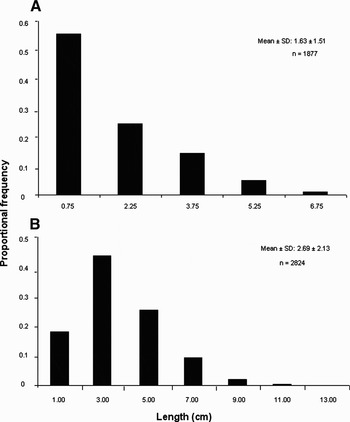
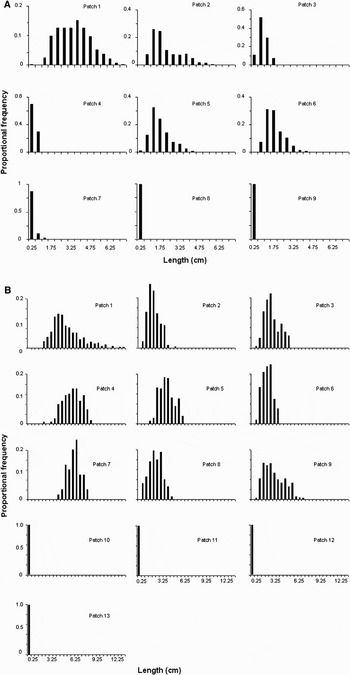
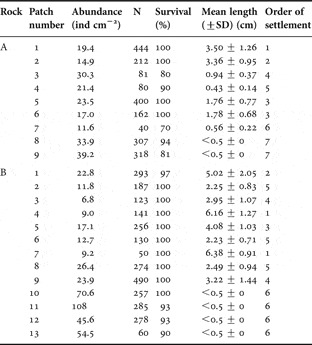
On the collected rocks, several discrete patches of Lamellibrachia sp. could be identified (9 and 13 patches on each rock, respectively) (Figure 3) and on the more heavily colonized rock, discrete patches of similarly sized individuals were often tightly packed together (Figure 3B). Mean tubeworm length within a patch ranged from <0.5 to 6.38 cm and mean abundance from 6.8 to 108 ind cm−2 (Table 1). Length–frequency distributions generated from each rock with all patches pooled (Figure 4), and for individual rocks (Figure 5) were unimodal, and several of them were positively skewed. Lengths ranged from <0.5 to ~7.0 cm on one rock and <0.5 to 13.0 cm on the other, and length–frequency distributions varied among patches on both rocks (P < 0.001). On one rock (Figure 5A), there were no differences between the distributions in patches 5 and 6, and 8 and 9. On the other rock (Figure 5B), there were no differences in the length distributions between patches 2, 6, and 8; 3 and 9; 4 and 7; and 10–13. Length–frequency distributions varied significantly within all remaining pairs of patches on both rocks.
Length–frequency distributions of Lamellibrachia sp., pooled across all patches on each of two rocks (A and B), collected from Mussel Ridge vent field on Monowai Volcano Complex. Labels on x- axis provide the mean length of each category. Cell sizes for each category were selected to be greater than the standard error in the measurements.

Length–frequency distributions of Lamellibrachia sp. in the nine individual patches on one rock (A) and the thirteen individual patches on the other rock (B), sampled from Mussel Ridge vent field on Monowai Volcano Complex, using a TV-grab. Labels on x- axis provide the mean length of each category. Cell sizes for each category were selected to be greater than the standard error in the measurements.

Characteristics of patches of the tubeworm Lamellibrachia sp. on two rocks collected near Bouquet vent on Monowai Volcano Complex. For each patch, mean length and abundance of tubeworms, as well as suggested order of settlement within a rock, are given. Standard errors of 0 are shown for patches in which all worms were too small to be removed. These were therefore all assumed to be smaller than 0.5 cm.

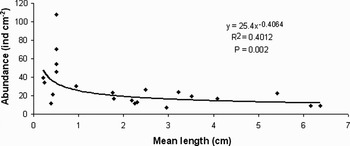
Mean abundance of Lamellibrachia sp. within a patch ranged from 11.6 to 30.3 ind cm−2 on one rock, and from 6.80 to 108 ind cm−2 on the other (Table 1). The mean length of tubeworms decreased exponentially with increasing abundance (Figure 6) (R2 = 0.40, P < 0.05).
Relationship between average length and abundance of the tubeworm Lamellibrachia sp., for data pooled across all individuals in all patches on both rocks collected from Mussel Ridge vent field on Monowai Volcano Complex.

Out of the 486 tubes examined from the 22 patches on the two rocks, 20 (7%) were empty, and the average survival per patch was 95.0 ± 1.76 % (± SD) (Table 1). The remaining tubes, still occupied by tubeworms, were assumed to have been alive at the time of collection.
DISCUSSION
In this study, we observed patches of tubeworms sorted by size, suggestive of pulsed, gregarious settlement. The differences in length–frequency distributions among patches suggest that each patch was settled by a different cohort. Assuming that all individuals of the same size are of a similar age, and that patches with the same distribution were settled simultaneously by the same cohort, we can hypothesize the order of settlement for the different patches on each rock (Table 1). Variation in size within a patch can be attributed to individual variation in growth rate. The small differences in average tube size between patches suggest that larvae settled in frequent pulses, in turn indicating a relatively continuous larval supply. Although extensive populations of adults were not found on Mussel Ridge, the observed small assemblages of tubeworms must provide a local source of larvae. An allochthonous larval source is unlikely, given the geographical isolation of Monowai.
The presence and proximity of distinct patches underscore the important role of using conspecifics as a cue for settlement. Biological cues have been implicated in settlement and succession patterns of vent tubeworms (Mullineaux et al., Reference Mullineaux, Fisher, Peterson and Schaeffer2000; Thiébaut et al., Reference Thiébaut, Huther, Shillito, Jollivet and Gaill2002; Hunt et al., Reference Hunt, Metaxas, Jennings, Halanych and Mullineaux2004). Similar patterns have been observed for shallow water polychaetes and have been attributed to chemical cues produced by conspecifics (Pawlik et al., Reference Pawlik, Butman and Starczak1991; Toonen & Pawlik, Reference Toonen and Pawlik1996, Reference Toonen and Pawlik2001). It is possible that the older individuals settled in the most favourable location on the substrate, and the later arrivals settled in close proximity. For example, size-sorted settlement in mussels has been suggested to result from a reduction in habitat suitability by the older settlers for subsequent ones, which then settle in more peripheral locations (Johnson et al., Reference Johnson, Childress, Beehler and Sakamoto1994; Comtet & Desbruyères, Reference Comtet and Desbruyères1998). In our study, it is unlikely that habitat modification by the first settlers was significant, given the size of the blocks that the patches were on and the size of even the largest individuals on these blocks. Additionally, images taken in situ do not show a pattern of patches of larger tubeworms being positioned nearer the flow than those of smaller individuals (see Figure 2B as an example).
Size–frequency distributions were slightly positively skewed and dominated by small individuals (0.0–1.5 cm for one rock, and 2.0–4.0 cm for the other). Although this pattern would normally imply a high rate of early mortality (Hunt & Scheibling, Reference Hunt and Scheibling1997), this is not the case in our study since ~95% of the tubes examined still contained intact tubeworms, including patches with tubeworms <0.5 cm in length. In fact, there was no relationship between the average length of tubeworms and mortality rate in a patch. The lack of individuals >13 cm on the rocks, and the negative relationship between size and abundance suggest a recent increase in settlement frequency. This increase could be the result of enhanced larval supply, either through increased larval retention or decreased larval mortality during dispersal. Unlike in mid-ocean ridges, vent populations on seamounts can be small and spatially restricted (Metaxas, unpublished data). Consequently, even a small increase in the local population can result in an increase in larval local production. Additionally, the circulation regime over seamounts can result in larval retention. Alternatively, enhanced settlement may have resulted from recent changes in factors directly affecting larval behaviour, such as in the physical and chemical cues. It is thought that the chemical nature of the hydrothermal environment is one of the most important cues to attract vent settlers (Rittschof et al., Reference Rittschof, Forward, Cannon, Welch, McClary, Holm, Clare, Conova, McKelvey, Bryan and Van Dover1998).
The spatial extent of the populations of Lamellibrachia sp. on the explored portions of Monowai was small and their distribution patchy. The occurrence of these patches was mostly focused on openings with apparent fluid venting, also indicated by altered rocks and sulphur precipitation. Tubeworms were absent or rare in other explored seamounts along this arc (Volcano 19, Volcano 1 and Hine Hina), and molluscs were the dominant taxon. Consequently, these tubeworm populations can only be maintained and expanded, if local recruitment is successful. Gregarious settlement can contribute to recruitment success in areas of suitable habitat where conspecifics are already established.
ACKNOWLEDGEMENTS
This project was completed during MANGO, a multidisciplinary international project led by the University of Kiel and the Federal Institute for Geosciences and Natural Resources. We thank Uli Schwarz-Schampera who was the Chief Scientist on the cruise for his support and enthusiasm, as well as the crews of the RV ‘Sonne’ and ROV ‘ROPOS’ for their efficiency and hard work. We also thank Di Tracey (NIWA), Kim Juniper (University of Victoria) and Cat Stevens (NIWA) for their help with sample collection, processing, and storage. Uli Schwarz-Schampera provided the data on H2S concentrations. An anonymous referee provided comments, which helped improve the manuscript. Canadian funding was provided through an NSERC Ship time grant (Applicant: Mark Hannington), and an NSERC Discovery Grant to Anna Metaxas.