INTRODUCTION
Sorghum (Sorghum bicolor) is the most important cereal crop in the semi-arid tropics (FAO, 1995) and quantitatively ranks second to maize (Zea mays) in Africa (Taylor, Reference Taylor2003). It has been recognized as a potentially valuable industrial crop by livestock feed manufacturers, confectioners, and the beverage and brewing industries (Food Security Department, 2003; ICS-Nigeria, 2003). Recent renewed interest in biofuel production has led to this energy crop being seriously considered for exploitation (Saballos, Reference Saballos and Vermerris2008). Currently, Nigeria produces about one-third of the sorghum in Africa and is considered the leading sorghum-producing country in the continent (Taylor, Reference Taylor2003). The bulk of sorghum production is generated from the core savanna region, where the crop is the most widely grown of all cereals produced by the smallholder farmers in the region (Chiroma et al., Reference Chiroma, Folorunso and Alhassan2006; ICS-Nigeria, 2003). In the West Africa savanna, crops are frequently prone to drought due to the erratic nature of both the onset and cessation of rains (Babalola and Opara-Nadi, Reference Babalola and Opara-Nadi1993). Besides, there is growing evidence of impending reduced annual rainfall in the savanna region of Nigeria which, coupled with temperature increases, would reduce soil moisture availability (Adejuwon, Reference Adejuwon2004). These hydro-climatic constraints pose a potential threat to Nigeria's position in sorghum production. In effect, Chiroma et al. (Reference Chiroma, Folorunso and Alhassan2006) decry a steady decline in productivity of the crop in the savanna region in the last few decades, due mainly to drought.
In recent years, there appears to be an upsurge in interest in the growing of sorghum in the more humid forest-savanna transition zone of Nigeria. Although the agro-climatic suitability of this zone for cultivation of sorghum has long been known (Bello, Reference Bello1997), there is still a lack of information on the effect of tillage methods on grain yield of the crop in the zone (Agbede and Ojeniyi, Reference Agbede and Ojeniyi2009). In Nsukka area of the zone (which typifies a derived savanna ecological setting in southeastern Nigeria), the reputation of sorghum for hardiness is compatible with the low-input agriculture common among the resource-poor farmers. Indeed, many of them have demonstrated interest in the crop, as it is often seen growing in the farmers’ fields. Should an appropriate tillage method for sorghum be developed for this category of farmers, they could take advantage of the comparatively low input requirement of the crop to maximize yield and optimize returns.
Among tillage systems, no-till (NT) is increasingly popular around the world and, so, should be investigated against conventional tillage (CT) for sorghum in the zone. Generally, tillage systems modify soil structure, temperature and water distribution; hence, they influence root distribution (Waddell and Weil, Reference Waddell and Weil1996) and ultimately crop yield. They produce differing effects on these key productivity indices of the soil, thus the existing relationships among tillage systems and crop yields are neither strong (Hatfield et al., Reference Hatfield, Sauer and Prueger2001) nor fully defined and understood (Agriculture and Rural Development, 2004). Specifically for sorghum, whereas some workers found NT to increase grain yield over CT (Agbede et al., Reference Agbede, Ojeniyi and Awodun2008; Moroke et al., Reference Moroke, Schwartz, Brown and Juo2005; Stone and Schlegel, Reference Stone and Schlegel2006), others found the reverse (Guzha, Reference Guzha2004; Laddha and Totawat, Reference Laddha and Totawat1997; Shemdoe et al., Reference Shemdoe, Van Damme and Kikula2009). In Lal's (Reference Lal2007) view, NT is a promising innovation whose potential benefits is probably highest in the sub-Saharan Africa. Ironic as it may appear, the majority of cereal growers in the region still use CT as a more realistic approach to land preparation.
In the strict sense of the term, NT is a form of conservation tillage that involves leaving crop-residue mulch on the soil surface. Hence, researchers in the tropics often apply externally sourced mulch on untilled soil to simulate the exact nature of NT. This practice has been recommended with respect to yield (e.g. Alhassan et al., Reference Alhassan, Kundiri and Folorunso1998; Franzen et al., Reference Franzen, Lal and Ehlers1994; Lal, Reference Lal1995; Mbagwu, Reference Mbagwu1990; Obi and Nnabude, Reference Obi and Nnabude1990; Osuji, Reference Osuji1984). However, all the cited studies concentrated on grain crops other than sorghum. As for sorghum, NT (with or without mulch) has been reported as suitable for enhancing grain yield in the southwestern part of the forest-savanna transition zone of Nigeria (Agbede and Ojeniyi, Reference Agbede and Ojeniyi2009). There was no attempt, however, by these authors to test what the effect would be if the CT were combined with mulch, nor was the effect on soil moisture and the crop's water use (WU) reported. Above all, the impact of the many changes due to tillage and mulch varies not only among crops but also across locations (Hatfield et al., Reference Hatfield, Sauer and Prueger2001), underscoring the need for research on tillage-mulch-yield relationships to be crop- and location-specific.
The search for the most suitable tillage method for sorghum under the prevalent dryland production in this zone should consider not just yield but also rainwater retention in the soil. Even though south Nigeria is more humid than the north, management-responsive water deficits often occur in the former (Aina, Reference Aina1993), due to a number of factors. In Nsukka agro-ecology, for instance, erratic distribution of rainfall and appreciable losses of soil moisture to deep percolation are common phenomena. There are even indications that the expected decrease in rainfall in the savanna region (Adejuwon, Reference Adejuwon2004) would most likely involve the area (Igwe, Reference Igwe2004). Moreover, in spite of the prevailing sub-humid climate, the area is often characterized by high atmospheric demand. It is, therefore, worthwhile to quantitatively assess the crop WU throughout the growing season. This, apart from enabling comparison of water use efficiency (WUE) under the selected tillage methods, would help in water budgeting for the crop. Attempts using the water balance approach have begun for sorghum in some tropical environments including northern Sudan, Burkina Faso (Zougmore et al., Reference Zougmore, Mando and Stroosnijder2004), central Rift Valley of Ethiopia (Mesfine et al., Reference Mesfine, Abebe and Al-Tawaha2005) and northeastern Nigeria (Chiroma et al., Reference Chiroma, Folorunso and Alhassan2006). Similar information regarding WU and grain yield of sorghum under different tillage methods, which is needed for informed adoption of a given method or validation of existing findings, is scanty in southeastern Nigeria. A two-year field study was, therefore, conducted in Nsukka to assess the relative efficacy of NT and CT systems with and without surface mulch for improving soil moisture retention, WU, grain yield and WUE of sole-cropped sorghum.
MATERIALS AND METHODS
Study environment
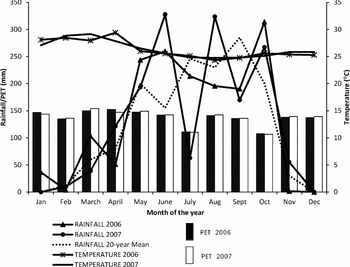
The experiment was carried out in 2006 and 2007 at the University of Nigeria Teaching and Research Farm, Nsukka (06°52´N; 07°24´E; alt. 400 m asl) in southeastern Nigeria. Characteristically, rainfall distribution during the wet season is bimodal, with peaks during July (the longer wet season) and October (the shorter wet season). Mean monthly values of some relevant climatic variables in the two years of the study are shown in Figure 1. Parallel to the long-term averages in the area presented by Igwe (Reference Igwe2004), the mean annual total rainfall (1590 mm) for the two years was slightly lower than the corresponding potential evapotranspiration (PET) (1645 mm).
Mean monthly values of some climatic variables in the two years of the study. Calculation of potential evapotranspiration (PET) based on Blaney-Criddle equation (Blaney and Criddle, Reference Blaney and Criddle1950).

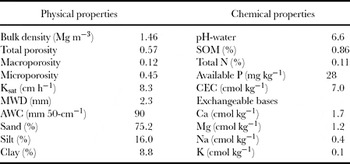
The soil, a sandy loam, belongs to the Nkpologu series and has been classified, according to the Soil Survey Staff (2006) Keys to Soil Taxonomy, as Typic Paleustult. Moisture and thermal regimes of the soil are ustic and isohyperthermic respectively. The soil is deep, well drained, coarse textured and low in organic matter content, with leaching as a major problem (Igwe, Reference Igwe2004). Runoff rarely occurs at the experimental site mainly because of the gentle slope of the landscape (about 1–2%) and coarse-textured nature of the soil, both of which encourage high infiltration rates. The 15-bar soil moisture exceeds 0.10 m3 m−3 in the Ap and Bt horizons (Obalum, Reference Obalum2004). Table 1 shows selected physicochemical properties of the topsoil determined just before the field operations in the first year.
Some physicochemical properties of the top soil (0–10 cm) at the start of the study.

Ksat: saturated hydraulic conductivity, MWD: mean weight diameter; AWC: available water capacity (held between 0.06- and 15-bar tension); SOM: soil organic matter; CEC: cation exchange capacity.
For about 10 years before the initiation of the experiment, the field was under natural vegetation fallow, comprising mostly grasses and few interspersing legumes. Dominant grass species at the site included Andropogon gayanus, Celosia trigyna, Cynodon nlemfuensis, Emilia sonchifolia, Panicum maximum, Oldenlandia corymbosa and Spermacoce verticillata.
Field preparation, experimental layout and design, and cultural practices
The land was cleared manually with minimal soil disturbance in both years of the study. Prior to the pre-planting tillage operations during the growing seasons of the two years, thoroughly mixed organic manure (poultry droppings) was applied uniformly over the entire field at 5 Mg manure ha−1; no inorganic fertilizers were used. This was based on the recommended minimum application rate of 5 Mg manure ha−1 (where available) for sorghum, as a substitute for inorganic fertilizer (ICS-Nigeria, 2003).
Two factors – tillage systems and mulch practices – were investigated. Treatments consisted of factorial combinations of two tillage systems, NT and CT, and two mulch practices, leaving bare and covering with mulch. The mulch material comprised mainly dry leaves of Paspalum notatum and was applied at the rate of 5 Mg ha−1. Flat beds, cleaned-weeded with caution to minimize disturbance to the soil, represented NT; manually prepared seedbeds, tilled to depths of about 20 cm, represented CT. The factors were laid out in a 2 × 2 split-plot (wherein the two tillage systems were the main plots and the two mulch practices were the sub-plots). This arrangement yielded four treatments (NT left bare (NTB), NT plus mulch (NTM), CT left bare (CTB), and CT plus mulch (CTM)) replicated four times in a randomized complete block design (RCBD). Each of the four treatments measured 4.2 m × 2.1 m, with demarcations in-between them in a block. There were narrow pathways (width, 40 cm), with raised earth bunds on both sides, separating all adjoining blocks. Similar but higher earth bunds were built round the entire field (area 18 m × 8.4 m), to minimize interference.
Late-maturing sorghum (cultivar SAMSORG-16 (FFBL)) was manually sown, after being treated with Apron Star (metalaxyl-M), on 3 July 2006 and 7 June 2007. These sowing dates are within the range (early June to early July) that this tall-growing sorghum cultivar could be planted in this present location, considering the recommended practices for similar cultivars in the forest-savanna transition and southernmost savanna zones of Nigeria (Bello, Reference Bello1999; ICS-Nigeria, 2003). Seeding was at three per hill in shallow (1–2 cm) openings. Crop stands were spaced 60 cm between and 30 cm within rows. To achieve close to the recommended sole sorghum plant density of 53 333 plants ha−1 (Olufajo, Reference Olufajo1995), the seedlings were thinned down to one per stand 14 days after sowing (DAS), giving a plant population of 55 555 plants ha−1. Application of mulch followed immediately after thinning. All plots were kept free from weeds using a hand hoe or by hand picking throughout the growing seasons; no herbicides were used. Soil disturbance in especially the NT plots was minimal, as seeding and the occasional weeding operations were done with caution. Stem borer attacked the sorghum plants in the first year, and the pest was controlled by applying 10 granules of Furadan to the plants’ whorls.
Monitoring of profile soil moisture storage
The initial moisture content of the soil down to 50 cm depth was determined immediately after sowing, on the assumption that the profile had been wetted homogenously. Subsequent sampling for the monitoring of changes in the profile soil moisture storage was started 14 days after mulch application. Since plant water need over periods of about 10 days would usually be met by soil moisture storage (Stern et al., Reference Stern, Dennett and Dale1982), the sampling interval was 10±1 day. The dates were chosen to avoid monitoring immediately after rains, in order to maximize the chances of doing so on days when differences did appear. Notably, the aim was not to achieve an exact picture of the pattern of WU by the crop throughout the growing period, but to identify any differences among treatments (Tilander and Bonzi, Reference Tilander and Bonzi1997). The soil moisture storage as influenced by the treatments was determined 11 times before harvest in each growing season.
During the sampling period, two of the four replicates of each treatment were selected for monitoring the soil moisture storage. Designated portions, centrally located within the plots, away from the border rows, were permanently marked for the repeated moisture content measurements. Sampling was limited to 50 cm depth zone, the zone of greatest root density of sorghum (Moroke et al., Reference Moroke, Schwartz, Brown and Juo2005; Zaongo et al., Reference Zaongo, Hossner and Wendt1994). On each sampling occasion, the approach used by Hulugalle and Lal (Reference Hulugalle and Lal1986), Moitra et al. (Reference Moitra, Ghosh and Sarkar1996) and Zougmore et al. (Reference Zougmore, Mando and Stroosnijder2004) in determining the moisture storage in the first 50-cm depth in similar studies with soils in the same textural class (sandy loam) as the present soil was adopted. In essence, this meant sampling in four depth increments (0–10, 10–20, 20–30 and 30–50 cm soil layers), determining their moisture contents gravimetrically, converting to volumetric and depth basis using pre-determined bulk densities and thicknesses of the respective soil layers, and finally summing up the values from all the four soil layers.
Water balance
A simple water balance equation was used to compute crop evapotranspiration (ET) or WU as follows:

where, with all the parameters measured in mm, ET = evapotranspirational WU,
P = precipitation (mainly rainfall), I = applied irrigation water,
C = capillary rise (from the water table by upward water flux) to the root zone,
S 1 = initial profile soil moisture storage, S 2 = final profile soil moisture storage,
D = drainage below the rooting depth, R = runoff (positive value) or runon (negative value).
The daily values of P for the entire period were obtained from the University Meteorological Station, located about 50 m away from the experimental field. Irrigation was zero in this study, and so, I dropped out of the equation. When the water table is more than 1 m or thereabout below the bottom of the root zone, C would normally be ignored (Allen et al., Reference Allen, Pereira, Raes and Smith1998); and this condition occurred in the study area. The initial and the final profile soil moisture storage were obtained from all two successive sampling dates, the difference (S 1 – S 2) of which represented the change in soil moisture storage, ∆S. On each new date of monitoring, S 2 was taken as S 1 while the new moisture storage became S 2. D was simulated as outflow from a well-designed non-weighing drum lysimeter, buried surface level in the soil over 25 years ago at about 30 m away. The outflow was measured on daily basis. Based on the assumption that the drainage process of deep percolation took place only when the theoretical field capacity (simulated at 60-cm-water tension) was exceeded (Oluwasemire et al., Reference Oluwasemire, Stigter, Owonubi and Jagtap2002), moisture storage and D under any given treatment were regarded as variables that exhibited an inverse relationship. Thus, the values of moisture storage were used to adjust D for the different treatments. Although the lowest steady state infiltration rate that could be recorded on this soil would normally surpass the highest likely intensity of average tropical rainstorms (Mbagwu, Reference Mbagwu1991), we further ensured reduction of runoff and runon to zero by the bunds built round the entire field and equally used to demarcate the blocks. Thus, the ET was estimated from the equation:

The total WU was the sum of all the values of ET computed from the first to the last sampling date before harvest.
Measurement of grain yield at maturity
At the time of harvest on 10 December 2006 and on 7 December, 2007, sorghum heads were picked from the central four rows of four plants per row, giving 16 plants per plot (equivalent to about 18 140 plants ha−1). The grain yield was assessed after threshing, expressed on a dry matter basis and converted to hectrage equivalent.
Yield-water use relationship
The relative WU, computed as the ratio of the actual WU to the PET based on the formula of Blaney and Criddle (Reference Blaney and Criddle1950), was used as a measure of whether the crop water demand was met or not during the growing seasons; and this was related to the grain yield. Thereafter, WUE, being a factor which relates crop yield to WU, was computed for all the treatments as a quotient of the grain yield (expressed in kg ha−1) and the total WU (mm).
Data analysis
All the measured parameters under the various treatments were tested for significant differences using analysis of variance (ANOVA) for a split-plot in RCBD. Where significant, separation of treatment means was achieved by the procedure of Fisher's least significant difference (F-LSD) as described by Obi (Reference Obi2002); p = 0.05 was used as the critical limit for distinguishing the degree of variance between means.
RESULTS
Rainfall pattern during the growing seasons
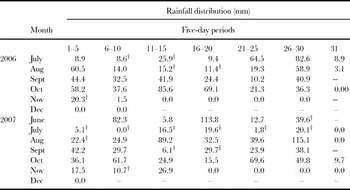
The five-day distribution and analysis of rainfall during the months of the study period is shown in Table 2. As implied from the analysis of rainfall (Griffiths, Reference Griffiths1959), rainfall seemed to be generally better distributed in the 2006 than in the 2007 growing season. By the definition of Griffiths (Reference Griffiths1959), fewer dry five-day periods were recorded in the first (5) compared with the second season (11). Since total annual rainfall was almost equal in both years (Figure 1), the results of the analysis indicate that rainfall was comparatively erratic in the 2007 growing season. Moreover, almost all the five-day periods in July 2007 were dry, and rainfall reached its peak in August of the same year (Figure 1). In this agro-ecological zone, rainfall normally reaches its peak in the longer wet season during July. This is normally followed by a period of short break in August, during which a natural dry spell is experienced. Considering the traditional rainfall pattern in the area, the 2007 rainfall pattern was somewhat anomalous.
Distribution of rainfall in the months of the two growing seasons.

†Dry periods.
Moisture retention and evapotranspirational water use
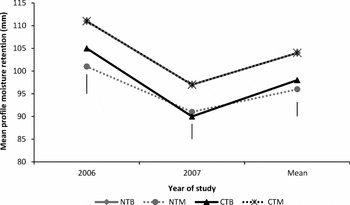
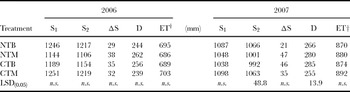
The mean seasonal moisture retained in the root zone showed significantly (p ≤ 0.05) higher values in the NTB and the CTM (which mirrored each other) than in the NTM and the CTB in both years (Figure 2). The main effects of the tillage and the mulch factors were, however, not significant. From all indications, the superiority of the NTB and the CTM over the NTM and the CTB tended to be more pronounced in the second year with unfavourable rainfall than in the first year with normal rainfall. The components of water balance under the different treatments are shown in Table 3. The treatments had significant (p ≤ 0.05) effect only in the second year, when the final profile storage was higher while drainage was lower in the NTB and the CTM than in the NTM and the CTB. Considering the moisture stored within and that drained out of the root zone under the tillage methods, it would appear that the drainage and storage of soil moisture exhibited an inverse relationship.
Mean seasonal profile soil moisture retention under the different treatments. Vertical bars represent l.s.d. (0.05) among treatments. Note: NTB and CTM showed equal mean value in both years.

Components of water balance under the treatments in the two years of the study.

From sowing to harvest, rainfall (P) amounted to 910 mm in 2006 and 1113 mm in 2007.
S1 and S2 stand respectively for the initial and the final profile soil moisture storage, S calculated as Σni=1S i, where n is 11, the number of times S was determined in each year.
∆S = change in the profile soil moisture storage, i.e. S1 – S2; D = drainage or deep percolation below the root zone; †total water use = P + ∆S – D.
NTB: no-till left bare; NTM: no-till plus mulch; CTB: conventional tillage left bare; CTM: conventional tillage plus mulch.
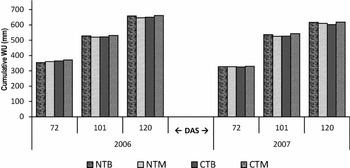
In both years, differences in the total WU among the treatments were not appreciable (Table 3). As shown by the cumulative WU at 72, 101 and 120 DAS (Figure 3), the result just presented is a manifestation of the negligible in-season differences among the treatments, which exhibited no consistent trend in either year. The main effects of the tillage systems and the mulch practices were not significant either. Generally, differences in total WU were more between the two years than among the treatments.
Cumulative water use (mm) at selected stages of development of the crop. DAS: days after sowing.

Grain yield under the tillage-mulch treatments
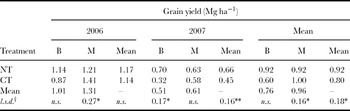
Sorghum grain yields as affected by the tillage and mulch treatments are shown in Table 4. Although there was overall yield advantage of the NT over the CT, the difference was significant (p ≤ 0.05) only in the second year – when rainfall distribution was rather erratic. Contrary to the anticipated results, the applied mulch significantly (p ≤ 0.05) enhanced the grain yield in the 2006 growing season with normal rainfall distribution, but failed to do so in 2007. In the tillage × mulch interaction, there was significantly (p ≤ 0.01) lower yield in the CTB than in the rest of the treatments – NTB, NTM and CTM for which values were comparable.
Grain yield of sorghum under the tillage-mulch treatments.

NT: no-till; CT: conventional tillage; B: bare; M: mulch.
†Given for tillage system, mulch practice, and tillage × mulch in that order.
* and ** denote significant differences at p ≤ 0.05 and 0.01 levels of probability, respectively.
When averaged over the two growing seasons, the differences between the NT and the CT became insignificant, while the mulch plots still proved superior to their bare counterparts (Table 4). In the pooled-over-year yields, the interaction was significant (p ≤ 0.05) in the same pattern as that in the second year – lower yield in the CTB than in the rest of the tillage methods.
Instability of yield in the two cropping seasons
The data in Table 4 clearly show that, as with total WU, variations in yield were more between the two years of the study than among the treatments. Averaged over the treatments, the yield was 1.16 and 0.56 Mg ha−1 in the first and second seasons respectively, representing about 52% decline in yield in the second. Relative to the first year, the yield in the second year was deemed a ‘decline’ based on the commonly reported mean grain yields in Nigeria, such as 1.12 Mg ha−1 from the core sorghum-growing savanna zone (Chiroma et al., Reference Chiroma, Folorunso and Alhassan2006) and 1.18 Mg ha−1 at Owo in the western part of the forest-savanna transition zone (Agbede et al., Reference Agbede, Ojeniyi and Awodun2008). However, a mean value of 0.88 Mg ha−1, intermediate to the present results, has been reported from the present location (Amana, Reference Amana2008).
Relative water use and water use efficiency
The values of the relative WU under the NTB, NTM, CTB, and CTM were 1.04, 1.02, 1.03 and 1.05 respectively in the first year; and 1.12, 1.13, 1.13 and 1.15 respectively in the second year, showing that the relative WU was not appreciably affected by the treatments. Since the crop ET (or WU) indicated comparable values among the treatments in both years of the study, the relative WU (ratio of the actual to the potential ET) would be expected to follow suit.
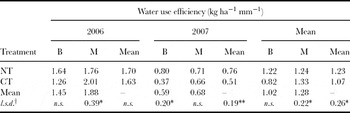
Table 5 shows the WUE of sorghum in the two growing seasons. In the first year, the NT and the CT showed comparable values. Differences were due to the mulch practices; the value was significantly (p ≤ 0.05) higher under the mulch treatments (NTM and CTM) than under the bare treatments (NTB and CTB). In the second year, WUE was significantly (p ≤ 0.01) influenced by the tillage systems; the NT treatments (NTB and NTM) gave higher values than the CT treatments (CTB and CTM). In the interaction, the CTB gave significantly (p ≤ 0.01) lower value than the rest of the treatments. Generally, the WUE values were quite low and variable between the two years of the study, with the lowest and the highest values obtained respectively in the CTB and the CTM.
Water use efficiency of sorghum under the tillage-mulch treatments.

NT: no-till; CT: conventional tillage; B: bare; M: mulch.
†Given for tillage system, mulch practice, and tillage × mulch in that order.
* and ** denote significant differences at p ≤ 0.05 and 0.01 levels of probability, respectively.
DISCUSSION
Significant differences in moisture retention but not in water use
The improved moisture retention in the CTM over the NTM and the CTB is attributed respectively to the surface-modifying effect of CT (Hillel, Reference Hillel1982; Omer and Elamin, Reference Omer and Elamin1997) and to the reduced evaporative losses due to the presence of mulch. Similar observations have been reported elsewhere in northeastern Nigeria (Alhassan et al., Reference Alhassan, Kundiri and Folorunso1998; Chiroma et al., Reference Chiroma, Folorunso and Alhassan2006). The similarity of the CTM and the NTB and the overall trend in soil moisture status may be explained in part by the trend of soil porosity (CTM > NTB = CTB = NTM) under these tillage methods at the end of the study (Obalum and Obi, Reference Obalum and Obi2010). With respect to enhancement of rainwater retention in this soil, it could be inferred from our results that the NT, unlike the CT, is not compatible with surface-applied mulch. From a long-term study in an Alfisol in southwestern Nigeria with a set of tillage treatments identical to the ones under investigation, Opara-Nadi and Lal (Reference Opara-Nadi and Lal1986) also reported similar effects of NTB and CTM on available moisture. They found, however, that the NTM and CTB which indicated comparable values in the present study gave the highest and the lowest values respectively. Since NTM is usually ineffective in conserving moisture in soils characterized by poor aggregation and weak structure (Aina, Reference Aina1993), the failure of the NTM to improve the soil moisture status over the CTB in the present soil is unsurprising.
Notably, the higher moisture status under NTB and CTM was not reflected in the crop WU. This suggests that enhancement of soil moisture through tillage methods may not confer corresponding higher consumptive use of water, nor imply that the crop WU is lower in them. The non-significant differences in WU supports Osuji (Reference Osuji1984), following a study of maize under four tillage treatments in a sandy loam in southwestern Nigeria. The negligible differences may have been due to a combination of physical and physiological factors on some sampling dates (Hulugalle and Lal, Reference Hulugalle and Lal1986). Similar observations as regards the effect of NT and CT on the total WU have been reported elsewhere for sorghum (Mesfine et al., Reference Mesfine, Abebe and Al-Tawaha2005) and sunflower (Aboudrare et al., Reference Aboudrare, Debaeke, Bouaziz and Chekli2006). On the other hand, Tolk et al. (Reference Tolk, Howell and Evett1999) found that mulch had no appreciable influence on total WU of maize. These authors showed how the beneficial effect of mulch in reducing evaporation from the soil surface early in the season virtually disappeared at full crop establishment. In the present study, the plant density at full establishment of the tall sorghum cultivar provided a low degree of canopy cover. This, coupled with the prevailing sub-humid climate in this location, may have contributed to the non-significant effect of mulch on the total WU. In a comparatively dry environment, Mesfine et al. (Reference Mesfine, Abebe and Al-Tawaha2005) found that total WU of sorghum was lower under mulch than under no-mulch.
Generally higher water use in the second compared to the first year
The higher WU in the second than in the first year might have resulted partly from the differences in rainfall pattern in the two years (Collinson et al., Reference Collinson, Azam-ali, Chavula and Hodson1996; Scherer et al., Reference Scherer, Seelig and Franzen1996). Jin et al. (Reference Jin, Cornelis, Schiettecatte, Lu, Yao, Wu, Gabriels, De Neve, Cai, Jin and Hartmann2007) also found, as in this study, that rainfall variations had larger influence on the magnitude of water balance components than did soil management practices. Besides the variations in rainfall, the sensitivity to photoperiod of the sorghum cultivar of this study must have contributed to the observation. Although the crop was sown a month earlier in the second than in the first year, it was due for harvest at about the same time of the year in both years. Flowering at the end of the rains regardless of sowing date appears to be a common agronomic trait of such locally adapted sorghum cultivars (Craufurd and Qi, Reference Craufurd and Qi2001). Consequently, the crop lasted longer in the field and had longer vegetative growth period (including an elongated inductive phase) in the second than the first year. The apparently delayed growth cycle resulted in profuse ET in the second year, which not only compensated for the lower cumulative WU (at specific growth stages) in the second year (Figure 3), but also resulted in higher total ET values in the second than in the first year. Hattendorf et al. (Reference Hattendorf, Redelfs, Amos, Stone and Gwin1988) indicated that seasonal ET could be altered not only by cultural practices, but also by variety selection and weather conditions, and so warned that values from studies of this nature should not be viewed as absolute for the test crops, but as providing a relative comparison among treatments.
Variations in grain yield and relationship with moisture retention pattern
The yield advantage of NT over CT was substantial only in the second year due probably to the erratic distribution of rainfall in that year. This may be attributed to the ability of the NT to induce at the beginning of growing seasons such better growing conditions as higher soil moisture storage (Lopez et al., Reference Lopez, Arrue and Siinchez-Giron1996; Opara-Nadi, Reference Opara-Nadi1993) and lower soil temperatures (Anikwe and Ubochi, Reference Anikwe and Ubochi2007; Dalmago et al., Reference Dalmago, Bergamaschi, Comiran, Bianchi, Bergonci and Heckler2004). Such conditions under the NT early in the second year (when soil moisture monitoring had not commenced) provided protection in the crop's root zone against the short duration droughts experienced in that year (Table 2), hence the enhanced yield under the system. This result suggests that the NT shows better response in crop yields under unfavourable growing conditions associated with a comparatively dry year (Azooz and Arshad, Reference Azooz and Arshad1998; Bescansa et al., Reference Bescansa, Imaz, Virto, Enrique and Hoogmoed2006; Buschiazzo et al., Reference Buschiazzo, Panigatti and Unger1998; De Vita et al., Reference De Vita, Di Paolo, Fecondo, Di Fonzo and Pisante2007). The higher grain yield with the NT is in good agreement with the results reported for sorghum in another sandy loam in western Nigeria (Agbede et al., Reference Agbede, Ojeniyi and Awodun2008). However, it contrasts with sorghum responses to tillage trials in other sandy loam soils in western India (Laddha and Totawat, Reference Laddha and Totawat1997) and in Tanzania (Guzha, Reference Guzha2004).
Mulch enhanced the grain yield in the first year (with normal rainfall distribution) but not in the second year (with a relatively erratic rainfall). Although this appears rather ironic, the explanation lies in the fact that the main effects of the bare and mulch treatments on soil moisture retention were not significant in either year. This result implies, therefore, that enhanced soil moisture status is not a necessity for mulch-induced enhancement of sorghum grain yield in this environment. Mbagwu (Reference Mbagwu1991) who similarly reported an increase in grain yield of maize with mulch in the present location attributed the observation to moderating effect of mulch on soil temperature. In the semi-arid tropics where the bulk of sorghum is grown, increased yield with mulch is a common agronomic result for the crop (Chiroma et al., Reference Chiroma, Folorunso and Alhassan2006; Eagleton et al., Reference Eagleton, Mohamed, Odowa and Muse1991; Mesfine et al., Reference Mesfine, Abebe and Al-Tawaha2005), as well as for other crops (Chakraborty et al., Reference Chakraborty, Nagarajan, Aggarwal, Gupta, Tomar, Garg, Sahoo, Sarkar, Chopra, Sarma and Kalra2008; Gicheru et al., Reference Gicheru, Gachene, Mbuvi and Mare2004; Ramalan and Nwokeocha, Reference Ramalan and Nwokeocha2000). The present result supports other previously reported increases in cereal grain yields with mulch in other sub-humid tropical environments (Ghuman and Sur, Reference Ghuman and Sur2001; Moitra et al., Reference Moitra, Ghosh and Sarkar1996).
The significant differences among the tillage methods in rainwater retention in both years and in grain yield only in the second year highlight the weak control the soil moisture status had over the grain yield. According to Tilander and Bonzi (Reference Tilander and Bonzi1997), enhancement of moisture storage in the soil does not always guarantee high yield. In the first year only of this study, the crop followed fallowed land. The ‘favourable’ cropping history in the first relative to the second year may have, therefore, masked the effects of the tillage-induced differences in soil moisture on the crop's grain yields in the first year (Agriculture and Rural Development, 2004). Considering the higher moisture retention in NTB and CTM compared with NTM and CTB (Figure 2), it would seem that other factors than the soil moisture status were responsible for the reduced grain yield in the CTB, which was not equally observed in the NTM. Anikwe et al. (Reference Anikwe, Obi and Agbim2003) showed how seasonal variations in moisture contents as induced by different soil and crop management practices had no influence on the grain yield of maize in the present location. We therefore infer that the higher grain yield in NTB, NTM and CTM than in CTB was not due only to the differences in their soil moisture status.
Other productivity indices were probably more favourable in the other tillage methods (NTB, CTM and NTM), hence the increased grain yield in them compared to CTB. In the case of NTB, for instance, it could be due to improved access by the roots of the sorghum crop to the moisture stored deeper in the profile under the treatment (Moroke et al., Reference Moroke, Schwartz, Brown and Juo2005). On the other hand, the positive yield response to CTM could be linked to the favourable interplay between rainwater supply and evaporative demand throughout the growing season (Gill et al., Reference Gill, Gajri, Chaudhary and Singh1996). The corresponding result under NTM may likely be due to the potential of the mulch component of the treatment to conserve moisture early in the season, subsequent release of which regulated soil microclimatic conditions for the crop (Rathore et al., Reference Rathore, Pal and Sahu1998). Slightly different from our results, Mesfine et al. (Reference Mesfine, Abebe and Al-Tawaha2005) found that NTM and CTM gave statistically higher grain yield of sorghum relative to NTB and CTB. However, similarity in sorghum yields in NTB and NTM and their superiority to CTB has also been reported following a similar study in another sandy loam in southwestern Nigeria (Agbede and Ojeniyi, Reference Agbede and Ojeniyi2009). The yield advantage of CTM over CTB in the present study also concurs with that reported for wheat (Triticum aestivum) (Jin et al., Reference Jin, Cornelis, Schiettecatte, Lu, Yao, Wu, Gabriels, De Neve, Cai, Jin and Hartmann2007). Similarly, the yield advantage of NTM over CTB corroborates some previous trials with various cereals in the present location (Mbagwu, Reference Mbagwu1990; Obi and Nnabude, Reference Obi and Nnabude1990) and elsewhere in Nigeria (Alhassan et al., Reference Alhassan, Kundiri and Folorunso1998; Lal, Reference Lal1995; Osuji, Reference Osuji1984).
Since crop management was the same in both years, the observed disparity in grain yield may be the result of differences in environmental conditions during critical growth stages (Laddha and Totawat, Reference Laddha and Totawat1997). As part of its WU characteristics, sorghum extracts more water from the booting stage through heading to flowering. Specifically, these physiological stages of growth usually fall between 90 and 110 DAS for the long season variety used in this study (Steduto and Albrizio, Reference Steduto and Albrizio2005). Based on the above time range, the critical stage of high water demand in the second year (6–25 Sept.) coincided with the short break in rainfall, unlike the corresponding stage in the first year (1–20 Oct.) (Table 2). This resulted in a short dry spell, hence the reduction in yield in the second relative to the first year. Lack of rain at booting, flowering and/or grain filling has similarly been shown to decrease the grain yield of rainfed sorghum (Craufurd and Peacock, Reference Craufurd and Peacock1993; Tewolde et al., Reference Tewolde, Mulkey and Robert1993). Therefore, the better distribution of rainfall in the first than the second year could largely explain the difference in yield between the two years of the study. Mesfine et al. (Reference Mesfine, Abebe and Al-Tawaha2005) and Stone and Schlegel (Reference Stone and Schlegel2006) also found that sorghum yields varied considerably between years and showed a close dependence on rainfall distribution.
The lower yield in the second year could be due partly to the early planting and the associated longer vegetative growth period (Laddha and Totawat, Reference Laddha and Totawat1997). Besides, yield normally declines in the second relative to the first year of cropping a plot of land to sorghum (ICS-Nigeria, 2003). Another factor that might have contributed to the better yield in the first relative to the second year was more favourable soil reaction. Zaongo et al. (Reference Zaongo, Hossner and Wendt1994) reported that root penetration of sorghum was controlled by soil pH. The mean soil pH was 6.6 before cropping in the first year and 5.4 immediately after the study. Based on the recommended 6.5 for optimum yields of sorghum (Mask et al., Reference Mask, Hagan and Mitchell1988), the soil reaction was more favourable to the crop in the first than the second year.
The implication of relative water use
Although there was evidence of water stress during the mid season – which decreased yield – in the second year, the values of the relative WU generally indicate that the seasonal water demand of sorghum was sufficiently met. According to Hulugalle and Lal (Reference Hulugalle and Lal1986), values of relative WU from 0.75 and above in a growing season signify absence of water stress for most cereals. Monitoring of WU was over 10-day intervals, but water stress could be masked if it were for shorter periods followed by adequate rainfall. The present results suggest, therefore, that there might have been at least one such case during the crop's stage of peak water demand in the second year. However, it is noteworthy that the reduced grain yield in the CTB compared to the rest of the tillage methods in both years was not due to any peculiar water stress under the treatment, but to some other factors.
Variations in water use efficiency
The nominal differences in WUE between the NT and the CT in the first year could be explained by the favourable rainfall distribution in that year, more so with the prevailing sub-humid climate in the area. Similar observation has been reported for barley (Hordeum vulgare) under two tillage intensities in another sandy loam in a sub-humid eastern India (Sarkar and Singh, Reference Sarkar and Singh2007). In contrast, the higher WUE with the NT in the second year stemmed from the protection it had provided against short duration droughts in that year. The positive effect of mulch on WUE in the first year implies that there was more beneficial use of soil water by the crop under the treatment (Tolk et al., Reference Tolk, Howell and Evett1999). In a sandy loam in northeast Nigeria, Chiroma et al. (Reference Chiroma, Folorunso and Alhassan2006) attributed similar results to cumulative effects of improved soil physical conditions and storage of rainwater deeper in the profile, which created an environment conducive for sorghum growth. There exist other reported cases of enhanced WUE of some cereals with mulch in other tropical sandy loam soils (Moitra et al., Reference Moitra, Ghosh and Sarkar1996; Sarkar and Singh, Reference Sarkar and Singh2007).
Low WUE values in the CTB could be due to low soil moisture storage at early growth stages (Gibson et al., Reference Gibson, Radford and Nielsen1992). Despite the similarity in moisture status of the NTM and the CTB, the latter showed higher WUE than the former. This was due probably to the mulch-induced better plant water status in the NTM which was impossible in the CTB (Rathore et al., Reference Rathore, Pal and Sahu1998). Higher WUE under NTM than under CTB has also been reported by other workers (Mesfine et al., Reference Mesfine, Abebe and Al-Tawaha2005; Osuji, Reference Osuji1984; Sarkar et al., Reference Sarkar, Paramanick and Goswami2007). As with the present results, Chiroma et al. (Reference Chiroma, Folorunso and Alhassan2006) also reported highest and lowest values of sorghum WUE under equivalents of the CTM and the CTB respectively.
The variable nature of the result is a common phenomenon with WUE studies (Hatfield et al., Reference Hatfield, Sauer and Prueger2001), especially those involving sorghum (Mesfine et al., Reference Mesfine, Abebe and Al-Tawaha2005; Unger, Reference Unger1991). In the present situation, the variability was attributed mainly to the difference in rainfall between the two years of the study (Mesfine et al., Reference Mesfine, Abebe and Al-Tawaha2005). This, coupled with the other yield-limiting factors discussed earlier, resulted in lowering of grain yield in the second year. With the additional factor of generally higher WU in the second year compared to the first, between-year variability in WUE would be expected.
Comparable grain yield and water use efficiency in three treatments
Yields and WUE were higher in NTB, NTM, and CTM than CTB. The comparable values under NTB and NTM appear to de-emphasize the relevance of mulch under the study scenario, more so as NTB (without mulch) enhanced the soil moisture status over NTM (with mulch). Since both CTM and CTB were CT treatments, the apparent divergence in yield and, hence, in WUE between them was probably due to the positive effect of mulch on grain yield. These results imply that with NT, mulch may not be necessary especially when it is also desired to complement the subsequent rainfall for the succeeding crop with good soil moisture status. On the other hand, use of CT for the growing of sorghum in this location requires that mulch be applied, so as to boost its grain yield and WUE. It could be that the pulverized condition of the soil under CT and the transitory detention of light rains intercepted by mulch encourage gradual infiltration into the soil, thereby creating a soil microclimate conducive for the crop. The significant differences in the second year are a pointer to the fact that such a combination of CT with mulch is a necessity for enhancing grain yield and WUE of the crop particularly under a situation of unfavourably distributed rainfall.
CONCLUSIONS
Both NTB and CTM were superior to NTM and CTB with regard to rainwater retention in the soil. However, the effects of these tillage methods on the crop WU were not significant. The grain yield was higher in the other tillage methods than in CTB. In general, the enhanced grain yield under the two NT treatments with and without mulch is a pointer to the superiority of NT over CT – which enhanced the crop yield only with mulch. The relative WU for all the treatments showed that the poor yield in CTB was not caused by a shortfall in the crop water demand. Since the WU indicated statistically similar values, the pattern of the effects of the tillage methods on the grain yield was reproduced in the WUE. The overall trend of the yield and WUE results in each year underlines the importance of seasonal rainfall pattern, as this had an overriding influence on the effects of the tillage methods. Moreover, variations in these parameters were greater between the two years of the study than among the tillage methods.
On the coarse-textured and structurally fragile soils common in this environment, CTB proved to be the least sustainable option for growing sorghum. The CT system should always be combined with mulch, as this has been found to maximize the rainwater resource to enhance grain yield and WUE. However, the combination is obviously burdensome, considering the cost of CT and that of procurement and transport of mulch. So, other good soil and water conservation practices, such as NTB and NTM that produced similar effects to CTM, may be preferred. Neither of the two NT treatments was superior to the other in terms of grain yield and WUE. The only distinction was that NTB, like CTM, exhibited such a desirable additional trait of enhancing the soil moisture status relative to NTM. The practice of NT without mulch has an extra appeal to the farmer in that it entails very low land preparation cost – and this makes it irresistible. It is, therefore, recommended that NTB be adopted for growing sorghum in this environment. Long-term studies may be further needed to ascertain its sustainability for enhancing soil moisture, grain yield and WUE of the crop.
Acknowledgements
Mr Bernard Umeh and other staff attached to the Soil Science Section of the University of Nigeria Teaching and Research Farm assisted during the field phase of the research.