Agency and personhood: the definition
The role of agency and the position of the individual in social life have come to occupy a central position in archaeological theory. However, despite the extended bibliography (e.g. Dobres and Robb 2000a), agency remains elusive (Brumfiel 2000, 249 – see the various definitions listed in Dobres and Robb 2000b, table 1.1, 9), or has become a platitude (Dobres and Robb 2000b, 3), a politically correct cliché, a deus ex machina used to explain any pattern, or even the absence of pattern. Most scholars would agree with most elements in Brumfiel's noncommittal definition whereby agency ‘refers to the intentional choices made by men and women as they take action to realize their goals’ (Brumfiel 2000, 249). However, Brumfiel herself reveals the problems by asking whether the social goals that agents pursue are cross-culturally valid, or deeply embedded in cultural traditions and moral commitments (ibid., 249). Her remark raises further questions: can agency theory, and specifically the notion of the agent as defined in modern social theory, be used to study premodern societies? Can we talk about free will and self-consciousness in premodern societies?
If we examine how these questions have been treated in archaeological theory (which I attempt in the next section), we see that the answer is ambivalent. On the one hand, doubts have been mounting as to whether modern agency theory can be applied to the past. As a result, recent discussions have begun to explore the notion of ‘personhood’, i.e. the different ways people define themselves and their position in the social and cosmological universe. However, agency theory itself has not really been modified in the light of the discussion on personhood; in fact, more often than not these two issues are discussed separately. My main argument in this paper is that agency can only be examined alongside personhood, as this is the only way which will allow us to conceptualize forms of agency different from our own.
In the next section, therefore, I will present the debate on agency and personhood as it has developed over the last three decades. I hope that this discussion will reveal both the strengths and weaknesses of the debate, but will also reassert the importance of these two concepts. This critical discussion will enable me to formulate my theoretical approach and my methodology, which will be applied in the following section to a specific historical formation: the southern Greek mainland at the onset of the Late Bronze Age (or Mycenaean period), a period which witnessed pervasive cultural and social changes, involving the redefinition of notions of the person and the body.
Agency and personhood: the debate
Presenting the debate on agency and personhood, separating the stages of the discussion or unravelling distinct approaches is an arduous task. Some classic works (Merleau-Ponty 1962; Bourdieu 1977; Giddens 1979; Strathern 1988) have had widespread influence, but have been criticized from different angles, or have led to very different conclusions. The treatment will inevitably be eclectic and schematic, as I can only discuss a few authors whose contribution I consider decisive, or directly relevant to my argument.
Knowledgeable social actors The importance of agency and the role of social action were central elements in the critique of the New Archaeology in the late 1970s and early 1980s. It was stressed at the time that explanations of social processes have to take into account the individual's ability to make choices and resist dominant interpretations (Hodder 1982, 5). Ironically, similar arguments were used against these early postprocessual studies (Hodder 1982; Shanks and Tilley 1987; Barrett 1994; etc.). As Matthew Johnson (1989, 190) said, ‘The individual has been triumphantly reinstated at the centre of the stage in theory, but written out of the script in practice.’ Indeed, in the early stages of the postprocessual approach there is a palpable tension between active subjects, reified discourses and dominant ideologies (see also Thomas 2002, 36).
The postprocessual approach developed a more explicit understanding of social agency with the adoption of Giddens's model of the ‘knowledgeable social actor’, capable of manipulating or transforming the rules which govern his/her behaviour (Giddens 1979). However, most applications in archaeology involved lengthy and abstract theoretical discussions followed by rather limited analyses of the data. For instance, Johnson's (1989) study of 16th-century folk housing attributes variation in house plans to choices made by the owners. Effectively, he argues that a practice or form is adopted because somebody has chosen to adopt it – and thereby enters a circular argument.
The critique came mostly from gender archaeology. As Gero succinctly put it (2000, 12), ‘the knowledgeable actor is nominally neutral, but gendered male by association with traditional male behaviour’, such as striving for power and prestige, and with ‘modern male-associated personal qualities emphasizing decisiveness and assertiveness’. Indeed, most archaeological studies of agency at the time focused on aggrandizing, competitive leaders (Meskell 1996). Giddens's ‘knowledgeable agent’ resembled the classic liberal, free-willed and rational individual, the ‘unencumbered self’ (Sandel 1982) who acts autonomously, unhindered by webs of relations, obligations and traditions (Gero 2000; Meskell 1999). As Gero (2000, 35) remarked, ‘these notions of agency . . . devalue building community and consensus, averting conflict . . . or restricting and controlling self-interested expressions of power’. In this way, a modern-day perception of agency – but effectively an essentialized, abstracted construct (ibid. 36; Meskell 1999, 26) – is projected to the past. However, agency takes different, historically specific forms; we cannot talk of agents without placing them in the cultural background and the historical conditions within which they operate (Johnson 2000, 213). As Barrett (2000, 62) rightly remarked, ‘agency is not a force operating outside history, [nor] something essential and timeless . . . which fashions the world without itself being fashioned’. To conclude, Giddens's social agent, at least in the way it has been applied in archaeology, projects an anachronistic vision of a free-willed, self-centred individual, unencumbered by social ties and obligations.
Embodied persons and lived experiences More recently, Giddens's model has been attacked for presenting a dehumanized and power-centred vision of the past. The critics have been inspired by phenomenology and the emphasis on embodiment, perception and experience (Merleau-Ponty 1962), notions of difference and performance developed by third-wave feminism and queer theory (Butler 1990), and the recentring of the individual in recent studies (e.g. Cohen 1994). This wave of studies, primarily by Lynn Meskell (1996; 1998; 1999), but also by Tarlow (1999) and Hodder (2000), brought some sharp and provocative critique to the discussion.
Tarlow's (1999) starting point was a critique of power-centred approaches to the past, and her aim became to study individuals in the past as experiencing and emotional subjects. However, there are internal contradictions in her treatment of emotion, motivation and experience. She emphasized the need to incorporate notions of agency (ibid., 26), but saw volition as a ‘socially constructed trait’ (ibid., 27). She stressed the need to incorporate three-dimensional experiencing individuals into archaeological discourse (ibid., 19), but she admitted that she had to shift the focus ‘from delineating the precise emotional experiences of individuals to understanding the emotional values of a culture’ (ibid., 34). In the end, Tarlow reached very interesting conclusions about collective attitudes to death, about the social construction of emotions and about self-representation at death, but she did not reconstruct subjective and individual experiences of death.
The critique of social constructionism was also the starting point of Meskell's discussion. She criticized Giddens, Bourdieu and Foucault for depicting the individual as merely socially or culturally driven and for eliminating agency and intentionality (Meskell 1999, 24–28, 132). It is beyond the scope of this article to discuss whether Giddens's structure–agency duality (Giddens 1979), Foucault's subjectivation (Foucault 1984) and Bourdieu's habitus (Bourdieu 1977) can be dismissed so easily. My main point is that the inability to conceive of the relationship between the individual and society or culture as anything other than tense and opposed (ibid., 3) is in itself a deeply modern view (C. Fowler 2004, 87). The relationship between the two is seen in many other historical contexts as permeable and fluctuating.
Since ‘the emphasis on collective structures has left the individual sadly undertheorized’ (Meskell 1998, 363), Meskell's aim becomes to recentre agency and the individual in archaeological theory (Meskell 1999, 216). However, her notion of the individual is ambivalent. While she emphasizes the difference between her notion of individuality and Western, modern-day individualism (ibid., 10), I would like to argue that she does not succeed in conceptualizing the individual in a non-individualistic way, nor in reconstructing individual agency, experience and consciousness in ancient Egypt.
To start with, Meskell does not really reconstruct individual bodily experiences. She discusses bodily practices as well as general perceptions of the body and the soul, but does so almost exclusively on the basis of written sources. This is a missed opportunity, since ancient Egypt offers plenty of scope for comparing, for instance, variation in body modification and treatment at death with idealized representations of the human figure in art or literature.
Her discussion of personhood and agency is contradictory. On the one hand, she stresses that perceptions of the self are culturally specific (ibid., 8). On the other, by insisting that we should not deny people in the past the self-consciousness and agency we so much value in ourselves, she effectively implies that premodern societies have the same notions of agency as we do. She does not really engage with the critique voiced against projecting the notion of the individual onto premodern societies (e.g. Strathern 1988; Thomas 1996), which she dismisses as ‘ethnocentric’ (ibid., 10).
Meskell rightly points out (see also Hodder 2000, 21) that archaeological analyses seek to identify the general patterns and dismiss individual variation as irrelevant ‘noise’. However, her own attempt to play general norms against individual variation is weak. She does not make systematic correlations between the aspects of the mortuary evidence (tomb construction, treatment of the body, composition of the funerary assemblage, etc.), and therefore cannot make systematic observations on the intersection of variables, the locus of individual variation. As a result, some very interesting general observations cannot be linked with the descriptive presentation of individual burials. The two levels, the general and the individual, are not contrasted against each other, but merely juxtaposed.
Let me give specific examples of Meskell's use of agency. She attributes variation among child burials to individual choice (Meskell 1999, 146) without really exploring the reasons underlying free choice, or trying to understand the symbolic and social connotations of the different practices attested. Effectively this takes us back to the kind of tautological explanations I commented upon earlier: a practice is adopted because somebody has chosen to adopt it, and thereby express his/her free will.
Elsewhere, she attacks the prevailing opinion that people of modest means perpetuated the views sanctioned by the state (ibid., 4). She argues that individuals in Deir-el-Medina subverted the system, and rose through the ranks by bribery, corruption or even fortuitous pregnancy (ibid., 25, 221). However, her examples imply exactly the opposite. These people may have improved their position in the system, but they did not subvert it; rather by internalizing the established codes and values, they reproduced and perpetuated the status quo. But my main objection is that Meskell makes no attempt to place these individual examples in the matrix of social obligations and relations. In the end, she presents them as autonomous, self-promoting and opportunistic individuals, as modern individuals.
To conclude: despite many sharp insights, the core of Meskell's argument, i.e. her concept of agency and personhood, is flawed. According to her, individuals are unhindered by social ties, historical conditions and cultural traditions. Once more, lengthy theoretical discussions are followed by tenuous analyses and, in this case, a rather shallow search for ‘real people’.
Relational, embedded, permeable, partible ‘dividuals’ The approaches I now turn to arose out of a widespread critique of the notion of the individual as the main paradigm for personhood and agency (e.g. Thomas 1996; Barrett 2000; Chapman 2000; Brück 2001; Thomas 2002; C. Fowler 2004; Jones 2005; Meskell and Joyce 2003; Chapman and Gaydarska 2007), inspired by Merleau-Ponty's phenomenology of perception and Heidegger's notion of Dasein, but also by anthropological studies of personhood (primarily Strathern 1988). These studies emphasize that rejecting the individual is not an attempt to dehumanize the past (C. Fowler 2004, 86). While we should not deprive people in the past of their individuality, we must also accept that there exist different modes of personhood and self-consciousness (ibid.). Understanding and reconstructing notions of the person that are different from ours become the explicit aim of these approaches.
Personhood is seen as contingent upon specific historical and cultural conditions. It is constituted in the relations with other human beings, material objects and the cosmos (which encompasses the natural world, spirits, ancestors, etc.). Persons are not demarcated by their bodily boundaries, as personal identities stretch through time (through memories, stories, objects) and across experiential space (Thomas 1996, 83). Human beings are thereby enmeshed in the world (in the sense of Heidegger's Dasein, or being-in-the-world; Thomas 1996).
At the same time, persons may be partible, or ‘dividual’. Not only do they consist of different elements – e.g. mind, soul, body – but in certain societies, Melanesia being the classic ethnographic example (Strathern 1988), persons are seen as composite and multi-authored (Fowler 2004, 5). Persons are composed of social relations with others, or with the ancestors. They therefore owe parts of themselves to others – as revealed in mortuary and marriage rites, or in ceremonial exchanges. Alternatively, persons may be permeable rather than partible (Busby 1997; C. Fowler 2004); they are constituted in the flow of substances (blood, semen, etc.) underwritten by exchanges, marriage, feasts and so on between members of the group.
To conclude, these approaches provide a much more subtle understanding of personhood, which will provide the basis of my own approach. However, problems persist. The overreliance on specific ethnographic models has resulted in a generalized and homogeneous picture (Jones 2005, 195). Little attempt is made to qualify these models, in some cases at least, because only limited analyses of empirical data are carried out. For instance, Brück's entire discussion of personhood in the British Neolithic rests on the absence of patterning in three trenches at the entrance of the Mount Pleasant earthwork enclosure (Brück 2001, 658–62). Successful applications of the notion of relational, embedded personhood do exist, but limitations of space allow me only to mention Chapman's close contextual analyses (Chapman 2000; Chapman and Gaydarska 2007), which have revealed different facets and manifestations of relational and partible personhood in different contexts, regions and periods of Balkan prehistory.
The main problem with most discussions of relational personhood is that agency is either left out altogether or is treated in an unsatisfactory way (as already pointed out by Chapman and Gaydarska 2007, 16). For instance, it is difficult to understand how Thomas combines a notion of personhood heavily based on Heidegger's Dasein (being embedded, enmeshed in the world) with Giddens's model of the reflexive actor (Thomas 1996, 47–48). It is true that Heidegger's notoriously opaque text has been read in many different ways – for instance, Rioux (1963) stresses freedom to act, while Dreyfus (1980) emphasizes embeddedness – but Thomas glosses over these interpretive difficulties. In the end, most authors resort to generalities. Brück's complex discussion of relational personhood can effectively be reduced to one sentence: that in societies where personhood is relational, the notion of the objectified, demarcated, manipulable person does not apply, and therefore it is impossible to control people's readings of space, practices or monuments (Brück 2001, 655). Her critique of earlier interpretations of British Neolithic monuments as legitimizing power relations is largely (though perhaps not fully – Thomas 2001) justified – but the conclusion that people resist the dominant discourse is not particularly new. The same can be said about Thomas's conclusion that meaning is ‘lodged in tradition’, but is also ‘open to negotiation and re-encoding at the local level’ (Thomas 1996, 100). Of course, meaning may have been redefined at the local level, but this remains a theoretical assumption rather than a conclusion based on a close contextual analysis of different types of data. I do not imply that we need to return to testing or to hypothetico-deductive exercises, but we do have to find ways to offer interpretations that are not only theoretically appealing but also compelling (Brumfiel 2000, 254). By now, statements to the effect that ‘different people assign different meanings to the same practice/space/monument’ are becoming a worn-out cliché.
To conclude: these approaches provide a more subtle understanding of personhood, but few have devised suitable methods to explore these questions in the archaeological record. At the theoretical level, there is an unresolved tension between, on the one hand, the emphasis on embeddedness and relationality and, on the other, the use of generalized notions of personhood and incongruent notions of agency. In order to resolve this problem, I turn to a source of inspiration ignored by archaeologists: moral philosophy.
Moral agents So far, we have seen that action is discussed primarily in terms of its consequences rather than its underlying reasons. While intentionality is referred to in general terms in the archaeological literature on agency, little attention is paid to the question why do people act the way they do? How do they make choices? I now need to confront this question directly, because the discussion so far has led me to reject individualistic conceptions of agency. Seeking the answer in moral philosophy requires some justification, as this is not an option commonly followed in archaeology. Despite the justified criticisms by the proponents of the experiential approach (see above), archaeological explanation revolves largely around issues of power and status. To give an obvious example, mortuary ritual is primarily interpreted in terms of display and competition rather than in relation to the proper respect for the dead or piety towards ancestral spirits. Mortuary practices, therefore, raise deeply moral issues – but in archaeology they are reduced to a narrow social dimension.
I believe that every action bears, expresses and reflects upon moral beliefs, because people act in pursuit of certain goods that define the purpose and meaning of their life. Needless to say, both the definition of those goods and the means employed to attain them vary immensely between, but also within, groups of people. A Kwakiutl chief and a modern bank manager may both strive for power and distinction, but they do so in very different ways. In contrast, earthly power is meaningless for a Christian monk whose highest virtue is humility and charity. Since the demise of Christianity and the failure of the Enlightenment to provide a rational basis for moral evaluations, we cannot any more appeal to universal moral principles. Therefore we need moral theory.
The question is, how can contemporary moral theory contribute to an understanding of personhood and agency in the past? Admittedly, moral philosophy often operates at a level of abstraction that alienates non-philosophers. However, there are moral philosophers who situate their discussion in specific historical situations. And there is one society which straddles the transition between prehistory and history, and which has become the focus of moral analyses: Homeric society. Indeed, as we will see below, the discussions on action, responsibility and intentionality in the Homeric epics are extremely sophisticated, and therefore enable us to refine notions of personhood and agency in premodern societies. Homer, of course, mythologizes the Mycenaean golden age (1700–1100 B.C.), while my study covers the beginning of this period (1800–1600 B.C.). However, I do not want to emphasize cultural continuity and temporal proximity too much, since the epics were composed during the 8th century B.C., and inevitably contain elements of this later period. I have to stress that I do not want to project ‘Homeric’ values to the beginning of the Mycenaean period; rather, the aim of my discussion is to acquire the conceptual tools which will allow me to reconstruct agency in a relational social universe. I am also aware of the dangers incurred when using a literary construct and a specific literary genre, epic song, to shed light on a prehistoric society. I will return to this point towards the end of this section.
Unsurprisingly, there is no consensus on notions of the self held by Homer's protagonists. At the early stages of the debate, ‘progressivist’ scholars (Finley 1954; Snell 1960; Vernant 1988) argued that Homeric individuals lacked moral self-consciousness and a true will, because in Homer there is no sustained, rational and disciplined deliberation on the causes and consequences of action. Human beings were said to be helpless in the face of divine intervention and fate. However, more recently, Bernard Williams (1993) rejected the supposed contrast between our ‘developed’ moral consciousness and the more ‘primitive’ (unreflective, incoherent) ethical experience of the Homeric personages. He argued that Homeric men and women had the capacity to deliberate and to distinguish between intentional and unintentional actions (ibid., 5), though these are not necessarily identical to modern-day equivalent notions. He emphasized that Homeric heroes were not concerned solely with their own success, as the competitive ethos is simultaneously egoistic and heteronomous. Men (admittedly, only men) achieve their own goals and define themselves by means of interaction with others. They strive for excellence, but at the same time accept and internalize the rules and conventions that guide forms of self-assertion (ibid., 100).
Here Bernard Williams builds on an earlier position developed by Alasdair MacIntyre (1985), which I will discuss more extensively, as it has been instrumental in shaping my approach. First, I should point out that my discussion will gloss over substantial differences between Williams's and MacIntyre's positions, as I am not trying to assess different views on Homeric notions of the self, but to distil an abstract scheme of notions of agency in premodern, and specifically in ‘heroic’, societies. I also have to emphasize that MacIntyre's discussion of Homeric society is only a small component of a much broader argument, notably his sharp critique of contemporary moral discourse and his controversial attempt to revive an Aristotelian conception of ethics. MacIntyre places the emphasis on the intelligibility of action rather than on action as such (MacIntyre 1985, 209). Actions become intelligible to the agents themselves and to others, if they are situated within practices, within a discourse about virtues and within a moral tradition. MacIntyre defines practice as any socially established and largely cooperative activity with its own internal and authoritative standards within which human beings pursue excellence and extend their powers (ibid., 187). As modern examples of practices he mentions chess and physics, but also maintaining a household and a family; we could think of hunting, feasting or metalworking as examples from the premodern world. Further, MacIntyre makes a very important distinction between external goods, only contingently attached to practices, and internal goods (ibid., 188–91). Wealth, fame and power are external goods, because they can be achieved by a variety of practices, and are typically objects of competition. Internal goods can only be attained by conforming to the standards of excellence definitive of the specific practice, and can only be achieved by those who possess virtues, i.e. a disposition to act in the right way. In contrast to external goods, those internal to a practice enhance the position of the entire group who participate in the practice.
The main purpose of human action in ‘heroic’ societies such as the world depicted by Homer (i.e. societies where the warrior is the paradigm of human excellence) is to realize the goods internal to practices, such as fighting, hunting or feasting. To put it differently, the main purpose is to attain excellence by exercising virtues such as courage, physical strength, intelligence and cunning on the one hand, or hospitality and generosity on the other (ibid., 122–23). The entire group rejoices at a victorious battle, benefits from a successful hunting expedition or enjoys a generous feast. The aim is to increase the glory of the kin and social group, to ensure fidelity and reliability among fighting companions and allies – and not solely to achieve individual distinction. Virtues are therefore by definition interpersonal and cannot be defined outside their social context. Nor can they be discussed except as part of a tradition through which they have been conveyed by means of stories, images and memories. Therefore in heroic societies the self is not detachable from the social structure, or from history and tradition (ibid., 221). This does not entail that the individual is determined by those structures: it is in moving forward from them that self-definition is achieved (ibid.).
But how exactly can this be achieved if goals are defined within the web of social interaction? Here we become aware of the limitations of MacIntyre's discussion, or at least of its applicability to a prehistoric situation. After all, Homeric society is a literary construct, an epic poem which by definition omits conflictual readings, contest and change and presents the system of values as static and monolithic. MacIntyre may help us develop a relational understanding of agency, but he cannot account for conflict and change within a moral tradition (though he does discuss the decay and abandonment of traditions and the conflict between traditions in his sequel to After virtue (MacIntyre 1988)).
I suggest that here we can use an insight offered by the political philosopher Michael Walzer. I should clarify that this argument is developed as part of a very different discussion, the debate between universalism and relativism, or between communitarian and liberal philosophy, but it is directly relevant here. According to Walzer (1994, passim), social actors act from the position of membership of different networks of sociability, impersonate different roles and adopt different moral positions. Therefore each social actor is a unique constellation of (sometimes divided) loyalties. Neither group identity nor personal identity are clearly demarcated, as both groups and individuals are mixed with what appears to be outside them. In fact, they can only maintain the delusion of purity by denying the fact of mixture (Orlie 1999, 147), or, to put it differently, the fact of relationality. As a result, both selves and groups contain the potential of their transformation.
To conclude: my aim in this section was to reintroduce the moral dimension, and to emphasize that personal goals are shaped by deeply embedded, though for each actor differently defined, cultural values and moral commitments. The previous section has given us an understanding of relational, embedded notions of the person, while here we begin to develop a relational understanding of agency. At the same time, a sense of how personhood and agency change begins to emerge.
From theory to method
Let me summarize the main conclusions, and at the same time suggest specific methods to apply them to archaeological material.
Personhood The discussions I presented above have allowed us to reach a better understanding of personhood as fluid, but firmly embedded in social relations, moral traditions and historical conditions. The priority is now to integrate this improved theoretical understanding with a more explicit methodology. I propose to examine personhood first by exploring the interfaces of the person:
• the relation between the person and his/her kin, age, sex group and social community;
• the relationship with the ‘Other’, i.e. with neighbouring or distant ethnic and cultural groups;
• the relationship between persons and the ‘supernatural’ – gods, spirits, or supernatural beings;
• the relationship between persons and (animate or inanimate) objects; and
• the relationship between persons and the natural world, specifically humans and animals.
Moreover, we need to examine systematically the various cross-cutting dimensions along which persons are categorized: age, gender, status, wealth, kinship position and so on. The analysis will need to combine different types of evidence and different modes of representation, e.g. mortuary practices, imagery, house architecture, etc. Needless to say, it is not possible to combine all these analyses in this one article.
Agency Agency has become a central concept in archaeological theory, even though it defies general definition. The debate about agency has stumbled upon the following problems:
• the widespread tendency to project anachronistic notions onto the past, be it the sociological model of the ‘knowledgeable agent’ or the modern notion of the individual;
• the inability to bridge abstract theoretical discussions with close and multifaceted analyses of empirical data; and
• an incapacity to develop an understanding of agency which is congruent with relational notions of personhood.
Despite this lack of progress, the concept of agency has changed the way we think about past societies. It has forced us to abandon two extreme positions: that people in the past were constrained by tradition, or that they were virtually unconstrained, autonomous agents. It has helped us to move beyond general processes, norms, dominant ideologies and reified discourses to individual variation and deviation. It has made us question essentialist notions of society, gender, women and so on, and think about the intersection of different dimensions of identity. It has allowed us to move beyond the idea of determination by social structures, since each actor partakes of different networks of sociability. It enables us to draw a framework within which change can be conceptualized.
In terms of methodology, my first suggestion is straightforward: we cannot even begin to discuss agency in any given social setting unless we first try to understand the notions of the person held in that society. Second, if we want to understand agency, we need to reconstruct the cultural ideals, the moral values and age/gender norms that guide social life. I propose that the study of mortuary practices and the representation of the human figure in the imagery of the period can provide an ideal entry into these problems. Finally, in order to understand the role of agency in social life we need to undertake a close analysis of the evidence in order to understand how these ideals were adhered to, deviated from, adapted and/or subtly transformed by communities, groups and individuals. I propose that by combining relational notions of personhood and agency, we will be able to understand the specific articulation of the self, the society and the cosmos in historically situated cases.
Having clarified my approach and proposed a methodology, it is time to apply these ideas and to reconstruct notions of the person held by the inhabitants of the Greek mainland during the transition to the Mycenaean period.
Notions of the person at the onset of the Mycenaean period
I will discuss notions of the person which emerged during the transition from the Middle to the Late Bronze Age (or Mycenaean period), i.e. ca 1800 to 1600 B.C. The discussion will be based on the burial evidence and the imagery of the period.
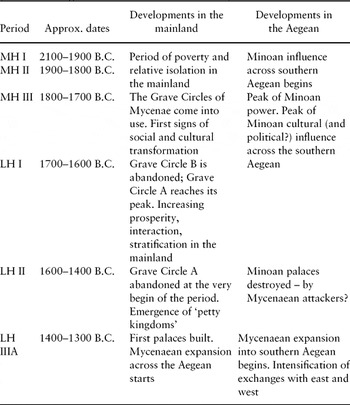
Table 1 sketches the historical development during this period. The transition to the Late Bronze Age in the Greek mainland sees two important developments: (a) the rapid transformation of the relatively egalitarian and kin-based societies of the southern mainland to the early Mycenaean ranked and competitive principalities, and (b) their increasing incorporation into Aegean networks of alliances and exchange. The period therefore witnesses rapid social change, and a deep cultural transformation as the mainland societies open themselves to external influences, but also struggle to retain and define a separate identity (Voutsaki 1998; Wright 2008b).
Chronological diagram. Abbreviations: MH = Middle Helladic (Middle Bronze Age in the southern Greek mainland); LH = Late Helladic (Late Bronze Age in the southern Greek mainland)

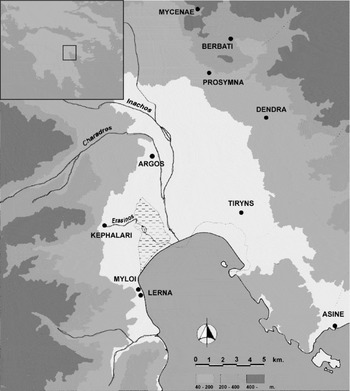
The changes are seen most clearly in the mortuary sphere, and I will therefore start my discussion with an examination of the changes in the burial practices. The main sites mentioned in the discussion are shown in figure 1.
Map of the MH Argolid with main sites mentioned in the text.

Burial practices During the earlier part of the Middle Bronze Age (MH I–MH II), burials are as a rule single, contracted and usually unfurnished (or poorly furnished) inhumations placed in simple intramural tombs such as pits and cists (Mee and Cavanagh 1998, 23–40; Milka 2006, 53). Gender and status differentiation are not given salient expression in the mortuary ritual, while age seems to be a more important social criterion (Voutsaki 2004; Milka in Voutsaki et al. 2007, 65–66). The spatial connection between groups of graves and houses implies that kinship relations structured the mortuary domain (Milka, in press).
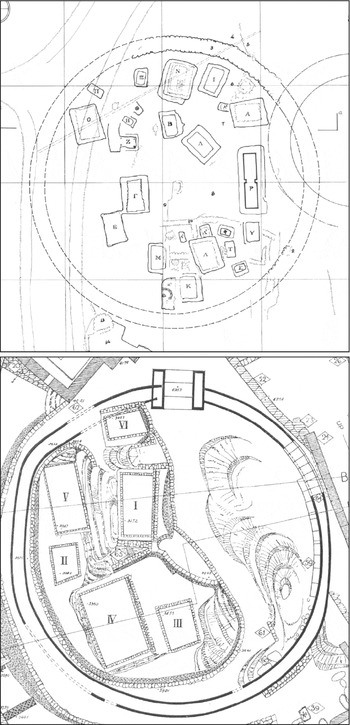
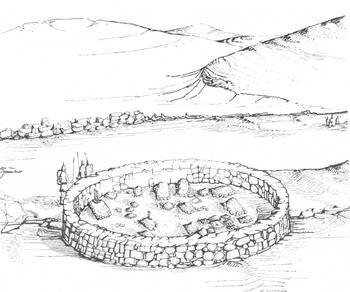
Towards the end of the period (MH III–LH I), graves move into formal cemeteries outside the settlement area, become larger and richer, and are sometimes reused several times (Mee and Cavanagh 1998, 23–40; Voutsaki 1998). Age, gender and wealth differentiation become more marked (Voutsaki 2004). These trends find their most dramatic manifestation in the Grave Circles of Mycenae (of which A was discovered by H. Schliemann in 1876 (Karo 1930–33), and B by Greek archaeologists in the 1950s (Mylonas 1973); see figure 2). The people buried in these graves were separated from the surrounding cemetery by means of a circular enclosure and made conspicuous with sculptured grave markers (figure 3). They were further distanced from the community by the use of large and deep graves, the so-called ‘shaft graves’, and the adoption of unprecedented amounts of wealth deposited with the dead (Voutsaki 1999; Voutsaki forthcoming).
Grave Circle B and Grave Circle A of Mycenae (from Mylonas (1973, plate 1) and Karo (1930–33), Abb. 2, respectively).

Reconstruction of Grave Circle B (from Mylonas (1973, figure 29)).

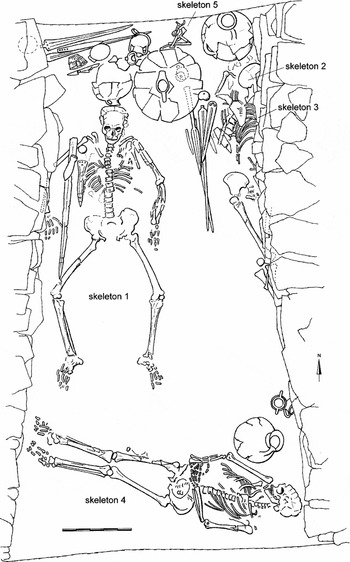
My exploration of personhood will start with a reconstruction of the mortuary rites in the Grave Circles during the transitional (MH III–LH I) period. Burial must have taken place shortly after death. We may imagine the preparation of the body in all its finery, the lying-in-state, the funerary procession, and the lowering of the corpse into the tomb. We can reconstruct the patterns underlying the careful positioning of the corpse, and the arrangement of the offerings in zones on, next to and around the body (Voutsaki forthcoming). There is plenty of evidence which allows us to reconstruct the rites surrounding the disposal of the body: the libations and animal sacrifices, the ‘funerary meal’ at the opening of the tomb. After a certain period had elapsed, the tomb was reopened, and a new burial was lowered into the grave. In the Grave Circles we see the gradual introduction of secondary treatment: earlier burials are sometimes pushed away while still in semi-articulated state, but in other cases they are fully disarticulated and swept away to a heap (figure 4). In some cases, the offerings were left with (and even carefully placed on) the disarticulated remains, but in other cases they were broken, scattered and at times removed from the grave.
Primary and secondary burials in grave Γ (based on Mylonas (1973, figure 5)). Skeletons 1 and 4 are primary burials; skeleton 3 is a secondary, only partly disarticulated burial; and skeletons 2 and 5 are fully disarticulated secondary burials, pushed into a heap.

Following the classic studies by Hertz (1960) and Van Gennep (1960), it can be suggested that the tripartite structure of the mortuary ritual, and in particular the disarticulation of the skeletons and partial destruction of the offerings during the secondary treatment, indicate a belief in a gradual transformation of the dead into a (malevolent) ghost or spirit, and eventually a (benevolent) ancestor. This transformation must have been fraught with anxiety and fear – at least, the separation of the mortuary and domestic domains, the evidence for libations and sacrifices and the careful filling-in and covering of the tomb may be interpreted as an attempt to keep away and propitiate the spirits. While the archaeological evidence does not allow us fully to substantiate a belief in a ‘soul’, it does indicate that the mainlanders were aware of the conflict of material dealings with an immaterial world.
The disarticulation of earlier remains, and the (partial) obliteration of wealth differences through the secondary treatment imply an emphasis on the unity of the burial group and a partial negation of separate identities (Voutsaki 1998). The introduction of burial mounds at other sites (Asine, Argos – see figure 1) and the appearance of larger houses that seem to consist of different domestic units (Voutsaki, in press) are manifestations of the same phenomenon. The multiple use of tombs indicates that the emphasis is on the continuity of the kin group; the tombs are now the containers of the ancestors, but also of the generations to come. This trend is enhanced by the parallel introduction of tombs especially designed for reuse – the tholos and chamber tomb – in MH III–LH I (Mee and Cavanagh 1998, 41–60). The practice of multiple burial, reuse and secondary treatment will spread quickly and become the norm across the entire southern mainland in the Late Bronze Age. Personal identities are therefore seen as dissolving within the continuity of the kin group; the person is only a link between the ancestors and future descendants. A perception of the person very different from our notion of the individual as a self-contained and clearly demarcated entity is already emerging.
So far, the emphasis has been on continuity and unity: the introduction of multiple tombs emphasizes permanence and common descent, while the tripartite sequence of the mortuary ritual reaches its climax and fulfils its purpose in the final stage of reintegration. At the same time, however, mortuary practices are pervaded by an increased emphasis on differentiation: while variation in the wealth deposited with the dead may be the most obvious one, other more subtle changes have gone unnoticed: the fragmentation of the social body through the emphasis on the burial (kin?) group (Voutsaki 1997), and an increasing segregation between not only status groups, but also age and sex groups (Voutsaki 2004).
In the Grave Circles women and children are underrepresented (Triantaphyllou in Voutsaki et al. 2007, 90–91). In contrast, according to the osteological analysis of unfortunately only a small extant sample, women and children predominate among the modest graves surrounding the Grave Circles (Triantaphyllou in Voutsaki et al. 2007, 89). Some child burials in the Grave Circles are rich, though never as rich as the adult burials. Rich female burials are found in the two Grave Circles, but a clear segregation of male and female assemblages and roles emerges in this period (Kilian-Dirlmeier 1986; Voutsaki, forthcoming). In the Grave Circles, men are buried with large numbers of weapons and metal vases, especially drinking cups, but also with ornaments and precious containers. Women were laid out with elaborate jewellery, precious containers and clay cups, but receive neither weapons nor cups in precious materials. The funerary assemblage engenders men, and highlights facets of male virtue (see also Bazelmans 2002, 78–79, for the relationship between appearance and reputation in early medieval warrior aristocracies). Men have to be beautiful, young, perfectly proportioned, athletic, muscular, strong and courageous, and have to feast, hunt and fight with other elite men. Men have to strive for excellence within a group of peers, and within a network of social relations.
We see therefore a tension in the mortuary ideology which reveals two opposed principles of social categorization: on the one hand, descent and the unity of the kin group; and on the other, differentiation along lines of age, gender and personal achievement. Persons (and men, in particular) are defined through participation in gift exchange networks (by means of which valuables were acquired), in hunting expeditions and fighting, as well as in ceremonies of conspicuous consumption, such as feasting or the lavish deposition of valuables with the dead (Voutsaki 1997).
I want to concentrate now on this latter aspect of personal identities: the relation between people and objects. I will discuss this question in relation to gift exchange and conspicuous consumption, two practices that played a crucial role in this period. I will begin with Mauss's famous dictum on the fusion between the subject and the object in gift exchange: ‘To give something is to give part of oneself. To give away is to give part of one's nature and substance, to receive something is to receive a part of someone's spiritual essence’ (Mauss 1954, 10). In gift exchange, value is created through a mingling, a fusion between the transactor and the gift. While we may think that men define value, without valuables men cannot define their own status (Munn 1983, 284; Gosden and Marshall 1999, 170). The value of objects and the prestige of people are more than simply related: they are created simultaneously; they are mutually defined.
Moreover, the question of value raises the problem of the distinction between persons and things. In our world, we tend to consider this distinction absolute, but in premodern thought objects are known to have life histories (Kopytoff 1986; Gosden and Marshall 1999) and personalities, or to have names and legends attached to them – swords in Homer being a typical example (Bennet 2004). Things allow the person to extend beyond his bodily boundaries. Valuables circulating in a gift exchange network carry the fame of the original owner outside the social group into a network of social alliances and they maintain his memory beyond his lifetime. Things are therefore extensions of people; or, to put it differently, people's identity, fame and prestige can be dispersed in time and across space through the circulation of things.
The conspicuous consumption of objects establishes a different relation between people and things. Instead of extending one's identity, the opposite now happens: consumption allows one to absorb and appropriate the transitory gifts with all their associations of exotic places, famous previous owners and foreign value systems. Consumption removes objects from circulation and withholds them (Chapman 1996; Voutsaki 1997). What is more, consumption, in a world pervaded by the principle of reciprocity, abolishes the reciprocal relationship and prevents others from acquiring the coveted object. The lavish destruction of valuable goods is ironically the only way for the person to detach him-/herself from the reciprocal obligations of the kin group and the alliance network. It is therefore the only way to accumulate, albeit symbolically (Voutsaki 1997). In addition, if valuables are deposited as offerings to the dead in multiple tombs – as is the case from the transition to the Mycenaean period onwards, then these valuables are seen as retained within the kin group which now embraces the ancestors. The deposition of valuable offerings with the dead is a form of sacrifice: it establishes communication between the mourners and the ancestors; that is, across different planes of existence.
Finally, the fusion between subject and object is completed by the use of valuables in bodily practices (Meskell and Joyce 2003, 58–65; Voutsaki, forthcoming). Bodies in the Grave Circles were modified and groomed; tweezers, razors and combs were even included among the offerings. They were dressed in elaborate costume, as indicated by valuable pins and sewn-on golden ornaments found on the bodies. They were adorned with jewellery, golden diadems and bands, while a few men (notably only men) received gold or electron masks. Weapons were always placed to the right of male burials. Drinking and pouring vases were placed near the head of the deceased, while larger containers (presumably containing token food provisions) were positioned along the body or beyond the feet. Exotic objects presenced distant places and past transactions with famous previous owners. Mortuary ritual therefore reassembles personal identities and contains the drift of meaning. Ironically, this momentary attempt to counter the disintegration of personal identities takes place just as persons begin to dissolve into ancestors.
To sum up the discussion so far: the deposition of wealth in tombs signalled not only the social transformation of the mainland societies – the emergence of differentiation – but also a deeper ideological change, central to the definition of the person. The person is still largely defined through his/her position in the kin matrix, but a new criterion of both social and moral evaluation emerges in this period: personal achievement and excellence in practices such as gift exchange, hunting, fighting, feasting and mortuary ritual. These practices serve to bond as much as to divide – at a deeper level, they also create an alternation between the dispersion and reassembling of personal identities, the cyclical notion that describes life and death in the Mycenaean world.
Imagery I want now to reflect more on the representation of the human body and its role in the construction of personal identities (Hamilakis, Pluciennik and Tarlow 2002, 4). While doing so, I will briefly touch upon another important dimension in the creation of personhood: the encounter with, and gradual incorporation of, the ‘Other’, the neighbouring ethnic and cultural groups. As pointed out above, certain communities and elite groups in the mainland become in this period more receptive to influences from the Aegean islands and Minoan Crete. I will once more concentrate on the Grave Circle offerings because they are unique in terms of the frequency and complexity of figurative art, and mark a sudden departure from the uniconic MH tradition (Rutter 2001, 141–42).
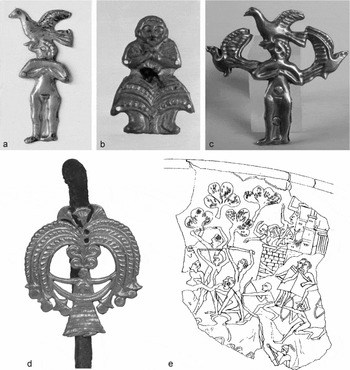
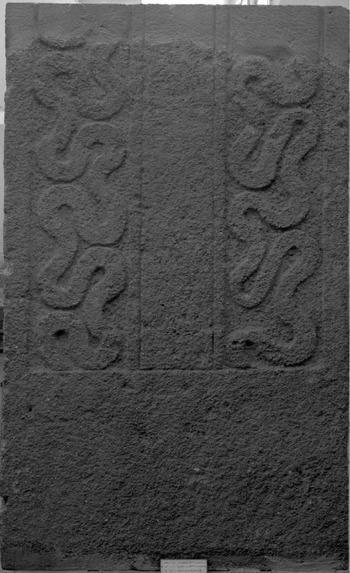
I would like to discuss how the person is depicted, with particular attention to gender differences (age differences are written out: children are not depicted, and all people are portrayed in a state of eternal youth and vigour). Women (figure 5d) are rarely portrayed: a silver and golden elaborate pin shows a typical Minoan woman, with flounced skirts and bare breasts, while the same general idea can be found in a small golden foil ornament (figure 6). A couple of other foil ornaments show a unique representation of a naked woman (an instance of Near Eastern influence?) with birds perched on her arms and head (figure 5a, c). Finally, in the ‘Siege Rhyton’, a silver libation vase with relief decoration depicting the siege of a city (figure 5e), women are depicted as onlookers rather than as participants in action. It is as if there is a certain hesitation and uncertainty surrounding the female figure, a reluctance to reflect on norms of female behaviour, and especially an incapacity to formulate a distinct local idiom. Interestingly, women rarely receive funerary markers, and if they do, they seem to be plain, or decorated with simple geometric motifs (figure 6).
Depictions of women on the Grave Circles assemblage: a, b, c, cut-out golden foil ornaments; d, head of golden and silver pin; e, detail from the ‘Siege Rhyton’. All courtesy of the National Museum, Athens.

Funerary marker with relief decoration, probably from a woman's grave (Grave Circle A). Courtesy of the National Museum, Athens.

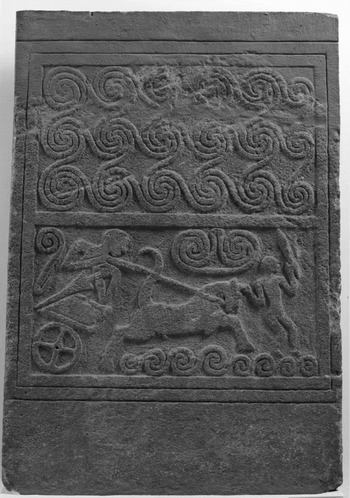
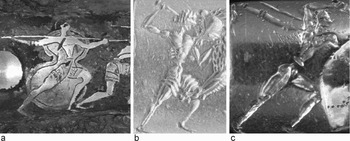
In contrast, men are depicted in an almost obsessive manner on weapons, ornaments, precious containers and metal drinking cups, but also on the sculptured funerary markers, the only element of the grave which remained visible after the grave was sealed (figure 7). Men are always engaged in fighting and hunting (figure 8). It might be said that an iconography of power and aggression is very fitting in this period. However, the type of scene is significant: there are very few battle scenes – most scenes involve close combat, either between men, or between men and wild animals. Interestingly, the outcome remains always unclear: in sheer contrast to contemporary imagery of power in Egypt or Mesopotamia, it is neither victory nor triumph that is celebrated, but the contest itself. What is emphasized is parity (between men, between men and animals, between animals) rather than difference and hierarchy. The production of a certain kind of person, a male member of the elite, is thus contingent upon a web of relations with peers and rivals. Moreover, no single figure is assigned a central or elevated position. In fact, these competitive scenes do not involve individuals, but abstracted and idealized persons. For instance, on the golden rings with depictions of duels, the musculature of the male figures (figure 9) is rendered in amazing detail, but the faces are very schematic. These images materialize the body beautiful, the contemporary elite male ideal, the heroic ideal. Objects and images are harnessed in the objectification not only of gender norms, but also of notions of the person. Interestingly, the stylistic idioms employed, specifically the dress or hairstyle, may be Minoan, but they are translated into mainland values and practices.
Funerary marker with figurative decoration from a man's grave (Grave Circle A). Courtesy of the National Museum, Athens.

Depictions of men on the Grave Circles assemblage (a selection): a, the ‘Lion Hunt’ dagger; b, c, d, golden rings. All courtesy of the National Museum, Athens.


Only a brief comment can be made on the relationship between human beings and the animal world. By far the most commonly represented animals are lions, followed by wild birds, bulls and horses; among domesticated animals, only horses and dogs are represented. Therefore only wild animals, or domesticated animals which belong to the male sphere of hunting and fighting, are included in the figurative repertoire. Interestingly, the evidence of horse and dog burials found perhaps already in this period, and certainly in the later Mycenaean period (Reese 1995; Hamilakis 1996), allows us to conclude that horses and dogs were considered companions, perhaps persons, rather than mere possessions. As pointed out before, men and animals are represented as near equals, men are seen as fighting with lions and bulls; alternatively lions, bulls, horses and deer chase or fight with each other. A golden object is decorated with lions chasing what seems to be a griffin, and elsewhere a sphinx appears; there does not seem to be a dividing line between animals and ‘supernatural’, hybrid beings.
There is a more difficult question that still needs to be addressed: why do images appear in this period? I suggest that at one level it is because images tell stories and preserve glorious achievements which enshrine notions of descent and common origins – the staple element of personal and group identities. Identity and fame are dispersed not only through the circulation of objects, but also through the circulation of stories, myths and images. But at a deeper level, the production of a certain kind of person is contingent upon synchronous relations with peers, and also upon narrative relations with ancestors and mythical figures. After all, notions of the self rely on narrative: the story of one's life is always embedded in the story of one's community (MacIntyre 1985, 221).
To conclude: the introduction of figurative art in this period involved the appropriation of exotic styles, idioms and decorative modes in order to express a separate mainland identity, and also in order to externalize new notions of the person and new gender and elite ideologies.
From personhood to agency The discussion in the previous sections has allowed me to conclude that personhood at the onset of the Mycenaean period was relational, embedded, and ‘dividual’. But how can we attempt the next step? How can we understand whether people reflected upon, redefined, moved forward from, or simply conformed to these generalized ideas? How can we ‘see’ agency in the archaeological record, and how can we understand the way it operated? The discussion in the first part of this paper has led me to conclude that I do not believe in unrestrained freedom of action, nor in total social and cultural determination. What matters, however, is to find ways to establish how people in the past, both groups and individuals, positioned themselves in this continuum of possibilities.
Let us examine once more mortuary practices in the Grave Circles of Mycenae. If we look at the sequence of the burials in (the earlier, and better-documented) Grave Circle B (Dickinson 1977; Dietz 1991; Graziadio 1988), we detect both general trends and individual variation. Among the earliest graves (graves A1, A2, Z, Η, Θ, Ι, Λ2, Ξ, Ξ1, Σ, Τ, Φ, or Early Phase; cf. Graziadio 1988), the traditional combination of single, contracted inhumations in a simple pit predominates. Not only does Grave I, however, depart from traditional custom in every respect (it is a shaft grave, containing a fully disarticulated heap of bones and a primary burial in extended position, adorned with golden ornaments and accompanied by weapons), but also all these novel practices will become the norm in the next period. Τhe later graves (graves Α, Γ, Δ, Ε, Κ, Λ1, Μ, Ν, Ο, Π, or Late Phase II; cf. Graziadio 1988) are predominantly shaft graves containing multiple inhumations, including secondary burials and a much wider range of valuable offerings. Grave Λ1, however, departs from this general trend and retains in most respects the traditional practices: it is a pit, with an adult man in contracted position, accompanied by a cup and a jug, a combination which becomes common in this period. The only other pit certainly used in this period is grave Π, which contains a child in extended position accompanied by three cups and a jug. While there is therefore a set of practices that characterize the Grave Circle B group as a whole, each burial is characterized by a certain amount of variation, as it adopts an individual combination of novel and traditional features.
If we now move to the slightly later Grave Circle A, we see that it contained far fewer tombs (six compared to 24 in Grave Circle B), all of them deeper and larger, much more complex, and immensely richer than the graves in the earlier circle. This spiralling ostentation implies an even more pervasive need to outdo the previous funeral ceremony, and an almost orchestrated attempt to adopt all innovative practices at once (sculptured markers, ‘funerary meals’, shaft graves, extended position, multiple burials, large numbers of weapons or drinking cups, masks, offerings from faraway lands, golden ornaments covering the entire tomb, etc.). As a result, despite this race of innovation and display, mortuary patterning in Grave Circle A is more coherent and homogeneous than in Grave Circle B. I would like to suggest that even the aggressive and flamboyant members of the Grave Circle A elite conformed to a group logic – while they were avidly innovating. Each burial supported, imperceptibly shifted or challenged this group logic, this ‘micro-tradition’ as John Chapman has called it (2000, 177), as people adhered to a repertoire of forms, on which they drew for similarities and oppositions (ibid., 190). Interestingly, some innovations, such as the mummification of one body (Schliemann 1878, 340–43), were never repeated again in the course of Mycenaean history.
Another example of a micro-tradition can be given: a group of more modest graves inside and around a tumulus, the IQ tumulus in the ‘East Cemetery’ (Dietz 1980), in the nearby site of Asine (figure 1), which was among the first extramural cemeteries to come into use, most likely in MH II, and remained in use into LH II (Voutsaki, Dietz and Nijboer, in press). The use of extramural cemeteries spreads from MH III onwards. The graves – both those inside the tumulus and those surrounding it – are remarkably homogeneous: there are only cists, most of small or average size, and most contained single, contracted inhumations at a period when extended position, secondary treatment and reuse were spreading rapidly. The dead are accompanied by a few offerings – but one grave contained a thin golden diadem. Graves are sometimes placed near earlier graves, or follow their orientation. We see here once more a micro-tradition, a localized set of practices that was adhered to for a long period. Only one LH I grave is different: a larger cist grave, with probably a man in extended position, accompanied by 16 vases and a dagger. This grave conforms to some aspects of the local micro-tradition (use of cist, single interment), but departs in other respects (extended position, more offerings). If, however, we examine the composition of the funerary assemblage, we see that it follows another widespread pattern, the deposition of weapons and drinking cups with men.
‘Citing’ and transforming earlier, local practices was one aspect of individual choices; the other was to relate to practices adopted by other groups or other communities (indeed the concept of citation is used in both a temporal and a spatial sense in archaeological analyses; e.g. Jones 2005, 199–200). The tumulus in Asine is contemporary with another tumulus, also opened in MH II outside the inhabited area in the inland site of Argos (figure 1). The two cemeteries shared also another innovation which was unique in the MH II Argolid: the use of large storage jars for adult burial.
We see therefore that each grave represents the outcome of a set of choices. Who made these choices, the deceased or the mourners? Or, to put it differently, whose agency is expressed in the burial? I would like to suggest that this ‘either–or’ formulation is symptomatic of our tendency to perceive the relation between the person and the group as tense, thereby denying relationality in social life. In mortuary practices in particular, the mourners are restricted by a set of cultural traditions and religious obligations summarized in the notion of proper respect for the dead (Tarlow 2002, 86), but also by the physicality of the corpse and the presence of the dead in the cultural and physical landscape (Graham 2009, 54).
We see therefore that choices in the mortuary sphere involved a precarious balance between conforming to and departing from traditional practice, as well as choices between different allegiances. I would like to suggest that this is where agency operates. I used a series of contextual and comparative observations (which could be extended in space and time) which, I suggest, reveal that agency followed a relational logic. I would like to argue that people adapted their behaviour according to the social relations they were engaging in – with their own kin group and their ancestors, with neighbouring families or communities, with age and sex groups. As each person was a unique constellation of dimensions of difference and networks of sociability, it is the very relationality of his/her existence that became the foundation of his/her agency.
Conclusions
In the transition to the Late Bronze Age, notions of personhood undergo a profound transformation manifested through changing notions of the body. We can observe a nascent differentiation between status, sex and age groups, and an incipient segregation of male and female roles. The person detaches him-/herself from the nexus of reciprocal kin obligations. We see that elaborate tombs and complex rites and objects and images and stories are harnessed in this process of separation of persons from their kin group and their social community. However, this detachment is still relative, hesitant and incomplete: people are singled out through mortuary ritual, but this happens at the very moment their membership within the kin group becomes even more emphasized. Men distinguish themselves in agonistic contests, but at the same time seal relations of parity with companions and allies. Men and women elevate themselves by absorbing valuable objects into their personal identity, but symbolic accumulation becomes possible only at the moment of death, sacrifice and deposition. Images celebrate the deeds of heroes, but these images are not individualized – they express abstract ideals rather than personal achievements.
The beginning of the Mycenaean period is characterized by this tension between disengagement from and integration within the group. The process of differentiation is only just beginning, but the amounts of energy spent in ostentatious gestures and the spiralling elaboration in the mortuary sphere imply that this is a contested and fragile process. This initial transformation unleashes a process of rivalry and emulation between emerging elites and warring communities which eventually engulfs the entire southern mainland. Fluid and unstable conditions last until around 1350 B.C. when palatial complexes are built in those centres that emerge triumphant out of this process of competition.
However, we are not dealing only with a social but also with a pervasive cultural transformation and a redefinition of notions of the person. An increasing emphasis on internal separation, segregation and differentiation between age, sex and status groups can be observed in this period, but the ‘boundaries’ of the person remain blurred and ambiguous. Human beings become transformed into spirits and ancestors. Humans seem to recognize certain animals as equals, possibly as persons in their own right. The relation between people and objects is deeply permeable: objects become bound up with human projects, and conversely people absorb things into their own personal identities.
To conclude, mainland society at the onset of the Mycenaean period scarcely conceives of the self outside the matrix of relations that hold together society and the cosmos. Notions of the person in the MH III–LH I mainland were relational, embedded, ‘dividual’, permeable. It is obvious that this notion of personhood is very different from our perception of the self as a distinct entity, as a demarcated and autonomous individual. However, people could set their own goals and transform their lives precisely because of this interconnectivity. They could do so because each person consisted of a unique combination of intersecting vectors of difference, had different allegiances, had a unique biography engaging with different groups and communities in different stages of his/her life, and hence positioned him-/herself differently regarding cultural traditions and social obligations. Each person contained the potential for change.
Acknowledgements
Different versions of this paper were presented to audiences in Cambridge, Oxford and Amsterdam. My thanks to John Bennet, Ton Derks and Jan Paul Crielaard for their invitation, and to participants, especially to Cynthia Shelmerdine and Robin Osborne, for insightful criticisms. I would like to thank Steve Matthews for impromptu theoretical discussions and for bringing crucial books and articles to my attention, and the other members of the Theoretical Archaeology Group in Groningen, Inger Woltinge, Johan Thilderquist and Annet Nieuwhof, for discussions (and jokes) about archaeological theory. I am grateful to Vassilis Voutsakis for discussions on political philosophy and agency. The text has benefited substantially from comments by the editors and the two anonymous reviewers. This paper is based on research carried out as part of the Middle Helladic Argolid Project, a five-year multidisciplinary project financed by the Netherlands Organization for Scientific Research (NWO) and the University of Groningen. For the aims and methods of the project, see http://www.MHArgolid.nl.