Introduction
Although there is consistent evidence that physical and cognitive capabilities decline with age, whether this is a result of age or disuse is an ongoing debate (Baker et al. Reference Baker, Horton, Pearce and Deakin2007). The rise of Masters (or Veteran or Senior) sport in many Western countries has provided a context for people to continue to compete in, and train for, sport as they get older. In Masters sport, competition is for people who, by their age, are considered past the typical age of peak performance for a particular sport (Weir, Baker and Horton Reference Dionigi, Horton and Baker2010). In other words, the commencing age is sport dependent (e.g. running commences at age 35, swimming commences at age 25 and gymnastics at age 22). Individual events (such as those stated above) are organised in five-year age bands and team sports, such as soccer/football, field hockey, basketball, touch football (i.e. tag/tip rugby with no tackling), are organised in 10-year age bands. The focus of this study is on Masters athletes greater than 55 years of age, based on the assumption that athletes of this age are past the typical age of peak performance in all sports.
Quantitative studies of age-related changes in skilled performance suggest that physical and mental capabilities can be maintained at high levels, despite advancing age, if there is continual, intensive involvement in the activity (Baker et al. Reference Baker, Horton, Pearce and Deakin2007). Many Masters athletes can be considered sports ‘experts’ because their performance is superior to their counterparts in the general population and they have highly specific knowledge with regard to competition in their sport (e.g. training methods and game/event rules). This study seeks to understand how older Masters athletes (i.e. competitively active older adults; mean age = 72 years) account for their performance preservation in sport.
Theoretical framework
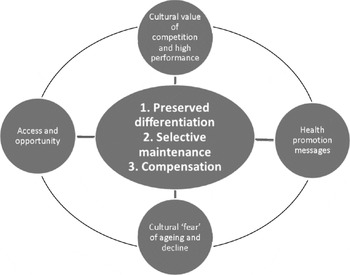
Many socio-cultural and individual explanations exist for sports performance maintenance. This study focuses on three biological/behavioural/psychological explanations and examines them in the broader cultural context of sport and ageing (see Figure 1 for the theoretical framework which guided this study). Horton, Baker and Schorer (Reference Horton, Baker and Schorer2008) outlined three key explanations for the capacity to maintain performance and skill in the face of overall declines in function: (a) preserved differentiation, (b) selective maintenance and (c) compensation.
Theoretical framework.

Preserved differentiation suggests that the ultimate level of achievement of any individual is determined by innate general biological factors and abilities (Krampe and Charness Reference Krampe, Charness, Ericsson, Charness, Feltovich and Hoffman2006; Salthouse Reference Salthouse, Birren and Schaie1990). For example, older athletes can maintain high performance due to general physical and mental characteristics that have remained stable across their athletic career. Selective maintenance proposes that ‘experts’ are able to maintain high levels of performance in certain domains through sustained practice in that area (Krampe and Ericsson Reference Krampe and Ericsson1996). For example, regular and specific training for a particular game or event allows older people to continue competing at Masters level. Compensation theory proposes that ‘experts’ maintain superior performance in an activity as general capacities decline by compensating with other capacities. For instance, Salthouse (Reference Salthouse1984) found that older typists maintained similar performance to young typists by scanning further ahead in the text, which compensated for slower finger speed. Dionigi (Reference Dionigi2008: 158) showed that older Australian Masters athletes compensated for their loss in endurance, speed and strength by developing new skills and/or using ‘their head more than their feet’, particularly in racquet sports such as squash and tennis.
In general, models of motivation (see Biddle and Mutrie Reference Biddle and Mutrie2008) propose that when we attribute important outcomes to stable qualities (versus unstable qualities) or to factors that are inside (versus outside) our control, our interest in, and adherence to, a task is significantly affected. For example, psychological/behavioural models argue that if we focus on what is within our control in a sports event, such as self-improvement, rather than our opponents' ability or the weather (i.e. factors which are outside of our control) then we are more motivated to perform the task. However, what such models rarely consider is how socio-cultural factors play a role in motivation, effort and decisions to maintain sports performance. Most models of motivation focus on the individual and fail to consider the social and cultural processes which might create the conditions for a desire to perform. Therefore, for the purpose of this study, we situated Horton, Baker and Schorer's (Reference Horton, Baker and Schorer2008) explanations within socio-cultural factors that also affect performance preservation, as shown in Figure 1 and discussed below.
Previous research on older athletes has revealed that such individuals have to negotiate many physical, mental and cultural factors in order to maintain sports performance. For example, Grant (Reference Grant2001: 785) found that older New Zealand Masters competitors had to overcome ageist attitudes such as ‘at your age you shouldn't be doing this’ when returning to, commencing or continuing sports participation and training in later life. This finding highlights the stereotype or common assumption that sport is the domain of the young and robust (Dionigi Reference Dionigi2008). Grant also described how these older athletes had to manage their ageing bodies by accepting their limitations and adjusting their style of play. Langley and Knight (Reference Langley and Knight1999) found that continued sports participation was a key adaptive strategy for a 68-year-old male tennis player coping with changes associated with ageing. Dionigi (Reference Dionigi2002, Reference Dionigi, Baker, Horton and Weir2010) has explored the role of sports participation in identity management and found that the desire and determination to continue sports participation in later life is closely tied to maintaining a ‘sense of self’ as an athlete or a highly capable person. Similarly, Tulle (Reference Tulle2007) found that Veteran runners in Scotland were motivated to train and compete to maintain bodily competence and to continue to express their sense of identity. In line with this, many older sportspeople believe that if they stop training and competing they will lose their sense of self and their independence. ‘Use it or lose it’ is a common catch-phrase that has emerged from interviews with older athletes (Dionigi Reference Dionigi, Baker, Horton and Weir2010; Grant Reference Grant2001). This phrase is typically used by participants to explain their belief that via ongoing physical activity, training and competing they can maintain the use of their mind and body to avoid the losses they associate with ageing, such as physical and mental decline. However, the ability to maintain existing physical and mental patterns (or a sense of self-consistency) becomes difficult due to the ageing body and changes in personal circumstances.
Therefore, what these above studies collectively show is that psycho-social models of identity maintenance in later life (e.g. Erikson Reference Erikson1997; Kleiber Reference Kleiber1999) cannot completely explain how older people maintain their athletic identity, despite ageing. On the other hand, post-modern perspectives on identity management in later life (e.g. Biggs Reference Biggs1997; Chapman Reference Chapman2005) have described identity as something which is shifting, chosen, multiple and open-ended. Therefore, traditionally identity management ‘was about how to construct an identity and keep it solid and stable, [whereas] the post-modern ‘problem of identity’ is primarily how to avoid fixation and keep the options open’ (Bauman Reference Bauman1995: 81). The socio-cultural context in which today's older people are situated plays a key role in identity management and hence, their maintenance of sports performance.
The personal and cultural value placed on individual physical ability, good health, competition and performance enhancement in Western society appears to be a key motivator of performance preservation among older athletes. Western culture generally ‘fears’ ill health in old age, as well as the decline typically associated with ageing, as demonstrated by current health promotion messages which encourage older people to remain active, productive and independent for as long as possible (Blaikie Reference Blaikie1999; Chapman Reference Chapman2005). Individuals who invest in these health promotion discourses and (negative) values associated with biological ageing tend to engage in the practices these messages promote, such as self-responsibility for health. For example, case study research by Roper, Molnar and Wrisberg (Reference Roper, Molnar and Wrisberg2003) on an 88-year-old Masters runner, who began competing at age 64, highlighted the importance that some older people place on competition, performance and training in an effort to maintain a healthy lifestyle. Dionigi and O'Flynn (Reference Dionigi and O'Flynn2007) described how older athletes negotiate sport performance discourses through their talk and practices by demonstrating the importance of winning, pushing the body to its limit, training hard and doing one's best in competition (in addition to expressing the social, health and fun aspects of these events). Furthermore, by drawing on post-modern theories of identity management, Dionigi's (Reference Dionigi, Baker, Horton and Weir2010) research suggested that older people who have never previously competed in sport can develop a competitive, athletic identity through sports participation in later life. Tulle (Reference Tulle2007) found that for Veteran runners health was not necessarily the driver for continued sports performance in later life, rather, health was a positive by-product that aligned with health promotion discourses. Finally, it is important to note that the participants in the studies reviewed above are typically white and middle class, which highlights that performance maintenance in sport is ultimately affected by access and opportunity.
What the above research has indicated is that psychological, behavioural and biological mechanisms, as well as socio-cultural factors (such as access, opportunity, social constructions of sport and ageing) play a role in performance preservation and motivation. None of these studies, however, have directly reported on how older athletes explain their capacity to maintain performance nor qualitatively examined how older Masters athletes account for their performance preservation in sport. In addition, none of these studies have explained how socio-cultural factors potentially shape older athletes accounts of what they do and why they do it. Understanding how older adults attribute their above-average functioning is important given the economic and social factors associated with the ageing of populations across industrialised countries. A greater understanding of the experience of ageing and the mechanisms which maintain human performance is important because in the older population the capacity to maintain feelings of competency and independence for as long as possible has the potential to improve life quality. Therefore, the aim of this study was to examine how competitively active older people make sense of their capacity to maintain sports performance.
Methods
This study forms part of a larger research project which examined the experiences and practices of older World Masters Games competitors (see Dionigi, Horton and Baker Reference Dionigi, Horton and Baker2010 for more details on the data collection and sampling strategies used in this project). The data on which this article is based emerged from semi-structured interviews with participants from the 2009 Sydney World Masters Games in Australia. Participants explained how they are able to continue competing in sport, in spite of their ageing bodies, and described their training methods and strategies for performance maintenance. This qualitative approach has the potential to provide unique insight into mechanisms of performance preservation as expressed by older athletes, and bring out subtleties and complexity that may not be accessible through methods used previously.
Participants
This study was of a purposive sample of 44 older athletes (21 men and 23 women) with an average age of 72 years. There were six women and five men aged 56–64 years, eight men and eight women aged 65–74 years, seven women and five men aged 75–84 years, and three men and two women aged 85–90 years. This breakdown of differentiation in age ranges shows that the spread of participants included 11 people who could be considered ‘younger-old’ (i.e. under 65 years), 16 people who were ‘middle-old’ (i.e. 65–74 years) and 17 who were ‘older-old’ (i.e. 75 years and over). Participants were selected based on age (55 years and over), gender (male and female), country (English speaking, Western nations) and sport (a range of individual and team sports; see Patton Reference Patton2002 for a description of typical-case or purposive sampling). We collected our data via interviews over the course of the ten-day World Masters Games sporting festival which attracted approximately 28,000 competitors from around the world who participated across 28 sports.
In general, the sampled participants were white and middle class – a cohort largely determined by the demographic profile of competitors at such events (Dionigi and O'Flynn Reference Dionigi and O'Flynn2007). The participants were from Australia (N = 24), Canada (N = 9), the United States of America (USA) (N = 6) and New Zealand (N = 5). We deliberately interviewed people from a range of sports to gather a variety of perspectives, but the sports were limited to the individual or paired events that were being held at the one site (i.e. Sydney Olympic Park). Most team sports were played away from this central site and therefore were too difficult to access during our data collection period. The participants competed in swimming (N = 21), athletics/track and field (N = 9), squash (N = 4), orienteering (N = 3), weightlifting (N = 3), tennis (N = 2), badminton (N = 2) and cycling (N = 1, who was also a track and field athlete). Forty-five per cent of the sample were sports ‘novices’ because they began competing when they were over 50 years of age, while 55 per cent of the group said that they were life-long ‘continuers’ of sport or ‘re-starters’ (i.e. those who had returned to sport after raising their children and/or when they retired from employment). Pseudonyms are used to protect the participants' identities. Institutional human ethics approval from Charles Sturt University, Australia and participant consent were granted prior to data collection.
Data collection and analysis
Participants were each interviewed (once) on-site at the 2009 World Masters Games. They were approached by the interviewer who explained the research and invited them to participate in an interview. Each interview averaged 30 minutes in length and was audio-recorded. Participants were asked open-ended questions about how they account for their capacity to maintain sports performance in later life. For a copy of the complete interview guide the reader is referred to Dionigi, Horton and Baker (Reference Dionigi, Horton and Baker2010). In particular, they were asked to explain how they are able to continue competing in sport, in spite of their ageing bodies, and to describe their training methods and strategies for performance maintenance.
Participant interviews were transcribed and then analysed using codes for theme development. Initially, each interview was coded and grouped into common ideas that seemed important to the participant in regard to their explanations of performance preservation. Some initial themes included genetics, family history, determination, modifications, training, physical activity, winning, self-improvement and pushing to the limit. The next phase involved linking the coded text into common topics (or raw data themes) that were typical across the complete interview data set and on the topic of performance maintenance. Called cross-case analysis, this method was used because it helps to identify common themes across individual interviews and recognises that while each person's story is unique, there are common topics, patterns, and findings among participant narratives (Huberman and Miles Reference Huberman, Miles, Denzin and Lincoln1998; Rubin and Rubin Reference Rubin and Rubin1995).
Further analysis consisted of connecting parallel raw data themes together to produce higher-order themes (Van Manen Reference Van Manen1998). For example, genetics and family history were collapsed into one theme called ‘It's in my genes’ and training and physical activity were merged into another theme about maintenance. Specifically, this process involved the first author developing more refined concepts that best represented how the participants explained their capacity to maintain sports performance. Ongoing discussions between the three authors enabled critical reflection on the emergent themes and facilitated consensus, credibility and verification on the representativeness and interpretation of findings. ‘In vivo codes’ (i.e. catchy words or phrases taken from the quotes made by participants) were used as theme names (Strauss and Corbin Reference Strauss and Corbin1998). Four major themes were established and agreed upon among the three authors: ‘Use it or lose it’, ‘Adapt’/‘modify’, ‘It's in my genes’ and ‘I like to push myself’. The final stage of analysis involved interpreting the older athlete's stories within the theoretical framework established earlier in this paper (see Figure 1). That is, the findings are discussed in terms of the three key performance maintenance theories: (a) preserved differentiation, (b) selective maintenance and (c) compensation, as well as within the broader context of socio-cultural factors affecting sports performance preservation in later life.
Findings
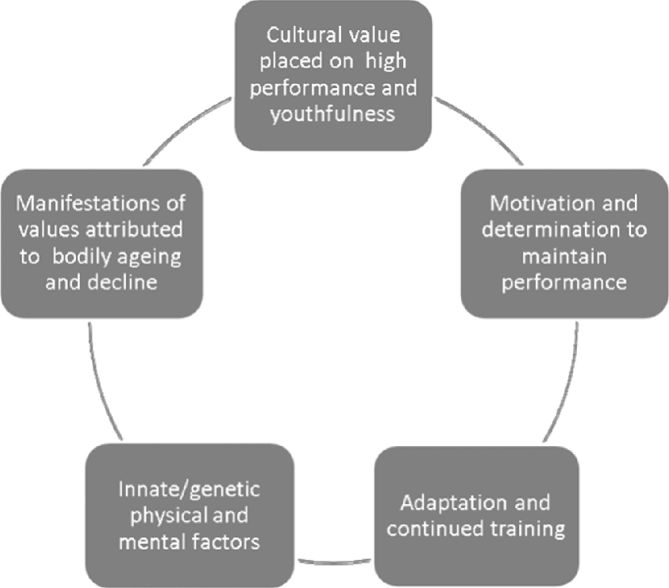
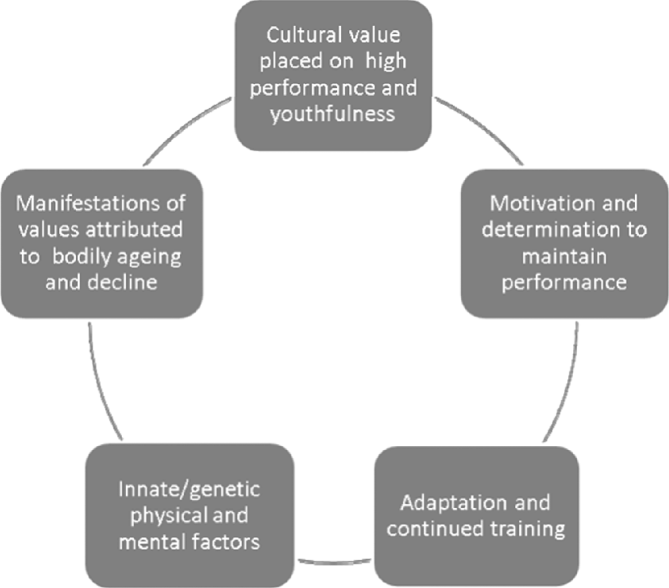
The four main themes will be presented in turn, however, it is acknowledged that there is overlap between themes because they are interrelated. A conceptual model that represents the relationships among the themes has been developed from these findings (see Figure 2). This model will be discussed after the following presentation of data.
Conceptual model of sports performance preservation in later life.
‘Use it or lose it’: maintenance
A dominant narrative among the athletes was that the capacity to maintain sports performance and skill required an immense amount of ‘work’ and ‘time’, which included the continuation of a physically and mentally active lifestyle and specific training for their sport. Therefore, the ‘use it or lose it’ phrase held two interrelated meanings for participants in this study. It referred to the ongoing practice and use of the skills required for a particular sport (specific training), as well as the perceived need to keep one's mind and body active through everyday activities (general maintenance).
Specific training
The participants provided lengthy descriptions of their training regimes and their preparation in the lead up to the World Masters Games. For instance, Valerie, a 66-year-old Australian weightlifter and swimmer, who has participated in Masters sport for ten years said:
Monday afternoons I drive [30 km] and I have a two-hour [weights] session. A long time out from a competition I do a lot of repetitions of lighter weights, working on technique and I may be there two and a half, even three hours sometimes. By the time I've stretched and stretched some more, done Yoga and the same afterwards. And I do a lot of abs work, you know, to keep your body strength in the core because core strength is very important in weightlifting. And then Tuesday morning's swimming. Wednesday I have off. Thursday morning I swim and sometimes I train Friday afternoons, sometimes Saturday mornings. But if I train Friday afternoon's I swim Saturday mornings. So it's usually swim three, weightlifting training three [days per week].
Walter, an 80-year-old Australian swimmer who began competitive swimming at age 20 years, explained, ‘it's a discipline and I would rarely have a long period off swimming. If I don't swim for two or three days, I feel as though I'm getting sluggish. So I might even just go for what I call an exercise swim.’ Similarly, Mary, an 80-year-old swimmer from Australia who began Masters swimming at 60 years of age, said, ‘I train three times a week in the pool and I swim in the river [which is] a talking point because in Tasmania nobody swims in the river, it's too cold!’ Darren, a 61-year-old Canadian swimmer, who returned to sport at the Masters level in his mid-forties, explained:
Well for maintaining performance I have to … swim three to four times a week. I like to swim a minimum of 2,000 and a maximum of 3,000 [metres] and I don't want to do any more than that. At the same time I like to take my dog for a walk up the mountains. She will get that a couple of hours a day … Most of us need around 1,000 metres [of swimming] before the body even starts to work and then [our coach] starts putting interval training in with a little bit more speed work. He certainly builds on our endurance things and then he works the strokes in a different way as well … I need a coach.
Having a coach who assisted them with their training was common among both men and women. As Judy, age 74, an Australian track and field athlete who has competed since she was age 12, said:
I train at the gym twice, three times a week with my training partner who is here competing and she's 20 years younger than me. And we throw three days a week. The athletic track is pretty close to where we live which is great. And we did have a really fantastic coach who was a grade 5 coach and he passed away not very long ago. He was a coach for athletes and he sets all the exams and everything for throwing.
In addition to having a coach, several people included a healthy diet as part of their regime. Cathy commented, ‘I'm a healthy person. I eat well … I go and swim at least three times a week … and we have a coach … he tells you what to do and what not to do’ (age 77, Canadian swimmer). Barney, an 86-year-old thrower from the USA said, ‘I work out doing throws, all the throws three days a week and the other two days – downstairs grunting and grinding with the weights and I run, on the days I do weights I run on the treadmill and I eat right, I don't eat junk, I don't eat [red] meat.’
Some participants described how they had to train diligently to return to a competitive level after time off sport. For example, Daniel, age 78, a Canadian squash player, described how his squash club helped bring him back to a competitive level after five years off due to the death of his wife. His ‘strict’ training regime involved:
… a lot of running … I did a lot of physical training. I had the physio in the Club give me a regime that I did four times a week and it got me back almost to the level that I wanted to be … I was doing weights, I was doing cardio … I was getting four to five miles when I was golfing … I was on the court four times, as least four times [a week] … I do [squash] drills for an hour and a half before I play [a game of squash] … Each court session is a minimum of, I would say, two and a half or three hours … So between the gym work and squash and the golf, I got back to a level that I liked …
Consistently, the selective maintenance account suggests that maintaining domain-specific skills requires sustained effort and practice (Horton, Baker and Schorer Reference Horton, Baker and Schorer2008). Dionigi (Reference Dionigi2008), Tulle (Reference Tulle2007) and Roper, Molnar and Wrisberg (Reference Roper, Molnar and Wrisberg2003) found in their research on older athletes that ongoing, regimented training was important to participants. Interestingly, our findings above suggest that maintenance of training does not necessarily have to continue across one's life in order to achieve high-level performance in older age. It appears that specific training can begin or be resumed later in life and still be effective for performance.
General maintenance
Participants also used the phrase ‘use it or lose it’ more generally. Many described the need to keep one's mind and body active through everyday activities in order to maintain sports performance (and delay age-related decline). As Victor stated, ‘Try to avoid getting decrepit, that is, I try to keep my mind working and my body so that it can do what I want to do’ (age 71, Canadian squash player since the age of 21 years). Judy, age 74, who has competed in athletics since she was age 12, explained:
I like doing what I'm doing in athletics and I'm able to do it. And what I do is reasonable and I enjoy it, and it keeps me healthy, keeps me alert, keeps the old mind ticking over which is pretty important because I go to nursing homes to see my ex mother-in-law and some of the people in there are much younger than me and they're just sitting there doing nothing, and it's sad to see all that. It really is.
The concern of physical and mental decline, dependency on others and other ‘losses’ that they associated with old age, motivated participants to keep training and competing in their sport. Evidently, participants invested in cultural discourses (e.g. health promotion messages) that value health, ability and independence and were determined to delay age-related decline for as long as possible. In fact, participants expressed a desire to keep competing in sport until they were no longer physically capable. George, a 70-year-old badminton player from New Zealand, who has been competing since the age of 27, said, ‘when I can't move that's when I'll have to stop.’ Cathy (age 77, a Canadian who began Masters swimming at age 65) believed, ‘There's nothing that will stop me [swimming] except death. I'll do this until I die.’ Reciprocally, the skill, endurance and mobility gained through sports training contributed positively to participants' overall quality of life. Geoff, a 67-year-old Australian tennis player who was a former elite track and field athlete said:
I think by participating in sport or exercise or something to some extent, use it or lose it … it makes you more healthy … helps you with your whole life, you know, you've got the rest of your life so you're fitter to do the other things you want to do.
Lucy (age 66, New Zealand badminton player) was a representative (elite) netball player in her youth. Lucy progressed to Masters badminton at age 33 after sustaining an injury. She believed:
It just gives you a marvellous feeling that you can still compete at this age level and I think, that's what we always say as long as the body tells us that we can still participate, yeah I'll do it … I just like the movement, sort of helps you keep your bones and you know, you don't stiffen up – and I think if you keep moving I think you age much better.
Several participants also said that because they were maintaining their capabilities, fitness and health through competing in sport they were more independent and socially active. ‘It motivates you to get out and socialise and have fun with other adults that enjoy keeping physically fit,’ explained Betty, a 64-year-old swimmer from Canada who was 48 years old when she began Masters sport. Bill has competed in tennis since the age of ten years and he agreed, ‘[Sport] enhances your life, you know, because it's, you've still got to have a social network, you've still got to have an interest in books and all that sort of stuff … a balanced lifestyle as far as I'm concerned’ (age 61, Australian tennis player).
Participants expressed a sense of self-confidence, competency, independence and endurance that extended beyond the context of sports performance. These feelings and their capacity to maintain an active lifestyle gave participants a perceived sense of control over their lives more generally. In this sense, when applying the selective maintenance theory to older cohorts, the continued challenge and stimulation of one's mental and physical abilities is not necessarily limited to specific training regimes and the resulting performance outcomes. It can also include the general continuation of mind and body activities of daily living to delay declines typically associated with ageing, which consequently contributes positively to one's quality of life. Similarly, Dionigi (Reference Dionigi2008, Reference Dionigi, Baker, Horton and Weir2010), Tulle (Reference Tulle2007) and Grant (Reference Grant2001) found that feelings of empowerment and identity management were common among older athletes. At the same time, in order to maintain sports performance, a level of compensation was often required. It was found that participants used both maintenance and compensation discourses when explaining their capacity to preserve sports performance in later life.
‘Adapt’/‘modify’: compensation
Athletes spoke of their capacity to adjust their style of play, develop new skills or change sports to compensate for their decline in speed, strength and endurance, particularly the women:
… you are getting older and you lose your speed, you lose your strength as you get older and you just don't throw as well as you used to, but it's a matter of adapting your thoughts to, you know, you're not going to do as well as when you were young. And you … try and do your best as you get older. (Heidi, athletics, age 76, Australian; she has competed in track and field since the age of 18 years)
You adjust – in weightlifting there are certain ways that you see the Olympians doing it, but we, as we get older, adjust, because of our problems with our bodies, to that, so I don't full squat. I don't split-jerk. I power jerk, but it's all legal. You're allowed to do these things, but you adjust to what you can do. (Valerie, weightlifting, age 66, Australian; she has competed in Masters since age 57 years)
Through acquiring sport-specific compensatory skills these athletes could offset decline in other areas and remain competitive and competent in their sport. Donna, age 66, an Australian runner of 26 years, explained, ‘rather than just give [your sport/event] away … find out what you can do about [your physical condition/body] to make it better and then work with it.’ Some athletes spoke of changing contexts to maintain sports performance. For instance, Lucy explained that due to injury she moved from playing representative (elite) netball to Masters badminton, ‘So I haven't really retired from sport. I've just gone from one sport to another and I've actually stayed on the badminton team’ (age 69, New Zealand).
The participants also demonstrated an investment in Western health promotion ideals which encourage physical activity and self-responsibility for health and independence in later life. For example, Betty, age 64, a Canadian swimmer said:
I have been diagnosed with severe degeneration in all of my neck vertebrae and so I have modified the swimming events that I'm doing. I only do freestyle and backstroke now. I do the exercises regularly. I have to take the responsibility to do everything I can to make me be able to continue on to do the physical activity for as long as I can. That's my responsibility.
In addition, all of the participants recognised that both internal/stable and external/unstable factors played a role in performance preservation. For instance, Rick, 74, an Australian track and field athlete stated:
I think there's two sides to it. I think first of all there's your genes … all my family lived for a long time, so I think a lot of it's in your genes. But I think you can enjoy life a lot more if you're able to do it … So I find things to do that fit my physical ability … Everybody here today's got an ache and a pain … And they get round it or they modify it in some way or they just live with it and say, ‘Well, tough.’ But they still come along …
The above quote highlights the combination of genetics, adaptation, continuation and determination that was typical in the study participants' responses. They tended to explain their performance maintenance in terms of innate general mental and physical factors (preserved differentiation), combined with adjustment (compensation) and continued participation and training (selective maintenance account).
Furthermore, a common thread running through all the themes in this study was the participants' demonstrated determination to continue with sport, regardless of age, ability or when one began competing. Valerie, the 66-year-old Australian weightlifter, claimed:
… we all have our problems and we work through them. And I think it just depends on your strength of character really. Some people just can't do it. And others we just don't like giving in. Stubborn's the word!
Irrespective of the actual genetic contribution to physical performance, it is clear that some participants believed their in-born traits (physical and/or mental) played an important role. This finding is further articulated in the following theme.
‘It's in my genes’: innate physical and mental factors
A dominant theme among the athletes, regardless of when they began competing in sport, was the attribution of their disposition for performance maintenance to their sporty ‘nature’, ‘family history’ and/or innate ‘determination’. For instance, Marlene, who has been competing in Masters swimming for seven years, said, ‘I presume it's in my genes really’ (age 66, New Zealand). Others commented that competing in sport was a continuation of ‘who they are’ and ‘where they have come from’:
Oh well because I've done it [for] so long I couldn't imagine not doing athletics … no, I can't imagine not doing a sport of some kind. I did a lot of different sports when I was younger. (Heidi, age 76; Australian track and field athlete since 18 years of age)
I've always been an active sort of person. 'Cause my parents – father used to be a bit of an athlete, football and that. Mother used to play tennis. It's always been part of my family life. (Geoff, age 67; Australian tennis player, who was a track and field athlete in his youth)
I was brought up in a competitive family; I loved competition. I think I've always had a pretty good attitude towards competition as well; I love winning, of course, but I don't mind losing, especially if it's to good competition. (Bernice, age 62; Masters swimmer of ten years from the USA)
It's just that I've got a competitive nature I suppose and I just like improving and the fact that I can beat someone else of my age. I find it's very stimulating and interesting … I like testing myself. (Donna, age 66; long-distance runner since the age of 39 years from Australia)
For some, sport was their ‘life blood’. For example, ‘As I say, I can't stop [competing]. I enjoy any sport. I watch sport all the time. I watch the netball. I used to play netball … [sport participation is] my life. I would say sport would be my life’, stated Lucy (age 69, New Zealand; badminton player who was a representative (elite) netball player in her youth).
Likewise, Daniel, a 78-year-old Canadian squash player who began competing at the age of 13, said:
It's been mandatory that I do something [i.e. play a sport since his youth] and I guess it would be like an addiction and you miss it when you don't do it. I missed it terribly when I had to take time off due to my wife's death, but now that I am back at it again, I feel 100 per cent better.
Martha, an 82-year-old swimmer from Australia (who began competitive swimming at 15 years of age) agreed:
I think that I would miss it a lot, I'd feel old. As soon as I hit the water I feel alive … if I haven't been in the water for a while I feel … as though I'm missing something … I don't like to sit, some people are sitters, I'm not a sitter.
These responses demonstrated a belief in the preserved differentiation hypothesis (Horton, Baker and Schorer Reference Horton, Baker and Schorer2008). That is, descriptions of oneself as physically ‘active’ or ‘competitive’, and discussions about being from a ‘sporty family’, showed that participants attributed performance maintenance to general characteristics that have remained stable across their athletic career. Dionigi (Reference Dionigi2008) found similar results from her research on older Australian Masters athletes, where many considered participation in sport as their ‘life blood’.
However, these older athletes believed that it was not only innate physical attributes, but also mental capacities that affected performance preservation. For instance, when asked to explain his capacity to continue competing in athletics, Filips, an 87-year-old Latvian who migrated to Australia as a young man in 1949, replied, ‘Oh probably genes … but then again I suppose the Nordic attitude, in my case personally, because in the Baltic States, Fins have a nice word for it … Sisu – Stick-at-it-ness.’ Interestingly, this word describes inner, ongoing determination and perseverance, particularly in the face of adversity. In this sense, Filips' decision to compete in Masters athletics (i.e. a course of action) and his continuation of participation, despite getting older (i.e. sticking to that decision against repeated setbacks) is sisu. This word typically described the participants in this study, regardless of their nationality or place origin. As mentioned above, their desire and determination to find ways to continue involvement in sport was a common thread running through all the themes in this study. According to Walter, an 80-year-old Australian swimmer, ‘It's all a question of attitude. If you've got the right attitude, you keep going.’ This finding also demonstrates an investment into cultural ideals which encourages older people to maintain independence in later life through ongoing physical activity. This ‘keep going’ mentality is implicit in contemporary ‘ageing well’ and health promotion discourses and it tends to ignore financial, cultural and physical access barriers to continued physical activity (Dionigi Reference Dionigi, Baker, Horton and Weir2010). Moreover, having the determination to continually improve and/or the act of defining oneself as competitive involved an investment in the performance enhancement model of sport. This investment also played a motivating role in performance preservation.
‘I like to push myself’: investment in the performance enhancement sports model
The ‘power and performance’ model of sport emphasises competition, improved performance, aggression and youthfulness, and it is typically used to describe mainstream and elite sports (Coakley Reference Coakley2007). Alternatively, Masters sport is usually framed in discourses of fun and friendship or a ‘pleasure and participation’ model (Coakley Reference Coakley2007). The findings from our study showed that although socialising, participating and travelling were enjoyed by participants, competition was also extremely important to them. A dominant discourse among participants was that their ‘competitive mindset’ kept them training and competing, regardless of whether they were athletes in their youth. For example, Olivia, a 90-year-old Canadian who began competing in track and field at age 77 said:
I think winning is important and I think that's what I focus on because I always check to see what the record is to see if I can meet it or beat it. And that keeps me going and travelling …
Darren, age 61, a Canadian swimmer who began competing in his mid-forties agreed:
I think it's the challenge. You are always striving to either get a personal best or to lose as little as you can and there is just a whole sense of fitness and feeling good about things that I like. I don't have to come first although it is nice.
Mary, an 80-year-old Australian swimmer who began competing at age 60, said:
Challenge – challenging yourself really and when you get older in a way you don't want to let go of the fact that you can swim those times so you try to maintain that, those times. Quite often you can't.
Cathy, age 77 from Canada, who started Masters swimming at age 65 commented:
I am a competitive person to begin with. I like to push myself … It's the feeling good when you master something that you are able to do it. It makes you feel – to me it makes me feel good if I can – I don't need to win although I try to. But if I don't win it is okay, it is the fun of pushing your body as hard as you can and see what you can do.
While this theme demonstrates the participants' desire to set goals and overcome physical and mental challenges as they age, it also shows that these practices, desires and explanations could be a manifestation of the values they (and society in general) attribute to bodily ageing and high performance. That is, their explanations show that they valued high performance, pushing their body to its limit, breaking records and winning medals, which reflects (and demonstrates an investment in) the cultural value of competition and youthfulness in Western society. Moreover, performing in sport was a strategy for maintaining (or creating) a sense of athletic identity or a continued coherent sense of self in later life, regardless of age or when one began competing in sport. For example, Walter, an 80-year-old Australian swimmer explained:
I always enjoy a challenge. My wife says I'm a competitive animal. And I enjoy a challenge to better myself either to beat a time, or to break a record, or to do a personal best. And I'm always looking to do that and it's very encouraging.
Likewise, Donna, age 66, a long-distance runner from Australia said:
I've been competing a long time, since about 1982 … I'm not one who would run just to keep fit. I like the competition, the idea of bettering myself and beating someone else … It keeps me motivated and keeps me going and it does of course keep me fit, but that's a side benefit.
The overlap of mechanisms to explain performance maintenance identified earlier is also apparent in this final theme. These participants believed that their innate characteristics, combined with their ongoing commitment, competitiveness and sense of joy from pushing the body to its limit account for their capacity to preserve sports performance, despite their advancing age. The participants used ongoing sports participation as a means of managing (or establishing) a sense of athletic identity, similar to findings from past research on older athletes (e.g. Dionigi Reference Dionigi, Baker, Horton and Weir2010; Grant Reference Grant2001; Langley and Knight Reference Langley and Knight1999; Tulle Reference Tulle2007). The findings also showed that participants invested in some key aspects of the performance enhancement model of sport because they valued winning, trying their best, improving or maintaining their performance levels and breaking records. Evidently, the importance individuals place on Western values of competition and performance maintenance acted as a key motivating factor for performance preservation.
Discussion
Older athletes drew on at least one (and at times a combination) of the key mechanisms outlined by Horton, Baker and Schorer (Reference Horton, Baker and Schorer2008) when accounting for their performance preservation, expertise and stamina in sport. The findings add strength to the argument that age alone does not necessarily limit sports performance. The statements and actions of these older athletes support quantitative findings (e.g. Baker et al. Reference Baker, Horton, Pearce and Deakin2007; Krampe and Ericsson Reference Krampe and Ericsson1996; Salthouse Reference Salthouse1984) demonstrating that compensation and continued training are effective ways to counter physiological decline in later life. Interestingly, it was not only life-long athletes, but also late-life beginners to sport who demonstrated high performance and skill. Although many participants used the preserved differentiation account to explain their capacity for performance preservation, at the same time they referred to their physical ability and continued involvement as key factors, as well as described their innate mental capacity as a driving force in performance maintenance. These findings suggest variability within the preserved differentiation hypothesis in the context of older athletes' attributions, specifically, between innate cognitive ‘drives’ that motivate an athlete to train and compete and innate physical abilities that allow functioning (and thereby performance) to be maintained. Our analysis brought out the complexity and overlap of stable (innate) and unstable (continued involvement) explanations for performance preservation. This hybrid explanation has not previously been identified in quantitative studies most likely because the focus here is on how the participants themselves account for their performance or skill level.
Figure 2 depicts this explanation in a conceptual model of sports performance preservation in later life that has emerged from the findings in this study. The model shows how socio-cultural values of high performance and youthfulness shape (and are shaped by) individual motivation and determination to maintain sports performance. However, due to the physical ageing process, this maintenance requires adaptation and modification of skills in order to continue training, combined with some innate physical ability and mental strength. Rather than actual explanations, all of these accounts of performance preservation could be seen as expressions of negative values attributed to ill health in old age which reproduces the cultural fear of ageing as decline and the importance attributed to high performance and youthfulness. In this sense, the participants' accounts were articulations of key socio-cultural values, such as old age as decline, and the search for explanations in individuals themselves.
Further research on a hybrid explanatory model of performance maintenance among older sportspeople is warranted. Little is known about the positive and negative consequences of stable (i.e. preserved differentiation) and unstable (i.e. selective maintenance and compensation) attributions for maintaining physical and mental function in this population (Horton, Baker and Schorer Reference Horton, Baker and Schorer2008). It is also worthwhile to examine how these attributions may generalise to affect long-term involvement in a range of preventive health behaviours. Although outside the scope of the present study, future research (and practice) should examine in more detail the differences between life-long participants in sport and those beginning or re-joining sport after decades of non-involvement. It is encouraging that participants can achieve high levels of performance even starting at a late age, which may provide inspiration for other older adults to become involved in sport and consequently play a key role in health promotion (Horton Reference Horton, Baker, Horton and Weir2010). The expertise literature relating to older adults concentrates on maintenance – primarily of skills developed in youth (Baker et al. Reference Baker, Horton, Pearce and Deakin2007; Krampe and Ericsson Reference Krampe and Ericsson1996). Therefore, investigating expertise among older adults with no prior experience – in sports, music, or any other endeavour – could have important practical and theoretical implications beyond physical activity participation.
The participants in this study were white and predominantly middle class, which raised questions about the extent to which performance preservation is limited to those who have the social and economic resources to compete in Masters sport. Notably, none of the participants spoke of access issues or identified their financial/socio-economic status as a factor facilitating their performance maintenance. In a sense, research into participants of international multi-sport events like the World Masters Games is necessarily limited to a narrow ‘privileged’ socio-economic group (Dionigi and O'Flynn Reference Dionigi and O'Flynn2007). The participants in this study demonstrated a desire to continue physical, mental and social engagement in later life and postpone what they believed to be age-related decline by maintaining performance in sport. In other words, the training of the body and the monitoring of one's performance were associated with concerns of a declining body, the loss of independence, and perhaps fears of ageing. Such motivations for performance are not typically associated with elite or youth sports participation, but seem common among older cohorts (Dionigi and O'Flynn Reference Dionigi and O'Flynn2007). At the same time, the participants in the current study also invested in sport performance discourses associated with mainstream sport. Such discourses are concerned with competing to win and pushing the boundaries of one's personal best (Coakley Reference Coakley2007). Dionigi and O'Flynn (Reference Dionigi and O'Flynn2007) reported similar findings from a group of older Australian Masters athletes. Similarly, Grant (Reference Grant2001) found that ‘serious play’ was a common theme among a group of older New Zealand athletes and past research on the meaning of running demonstrated the value participants place on competition and training (Tulle Reference Tulle2007; Roper, Molnar and Wrisberg Reference Roper, Molnar and Wrisberg2003). The athletes in all of these studies showed an investment in sport performance discourses and their associated practices, such as trying to win, training for peak performance, aiming to break national and world records, and/or reach a personal best. Further research is needed to identify what it is about competition that drives older people to maintain performance and to determine what outcomes participants experience above and beyond those gained from regular non-competitive physical activity.
The ‘use it or lose it’ phrase, which has been noted in past studies on older athletes (Dionigi Reference Dionigi, Baker, Horton and Weir2010; Grant Reference Grant2001), also emerged in the current study to explain the participants' belief that if they do not continue to use their mind and body in specific and general ways they will inevitably lose control of their physical and mental ability and function. This finding shows how the talk and action of older athletes readily align with contemporary notions of ‘ageing well’ as obligation. These discourses encourage older people to maintain involvement in meaningful and stimulating activities, particularly physical activities, in order to age well and maintain a coherent sense of self (Chapman Reference Chapman2005). In the current study, the participants' desire and determination to continue sports participation in later life was evident in all of the themes. This finding shows how performance preservation was closely tied to maintaining a ‘sense of self’ as an athlete or a highly capable person. Similarly, Dionigi (Reference Dionigi2002, Reference Dionigi, Baker, Horton and Weir2010) and Tulle (Reference Tulle2007) found that older athletes were motivated to train and compete to maintain bodily competence and continue to express their sense of identity. In other words, many older people believe that if they stop training and competing in sport they will lose their sense of self and their independence. This finding also demonstrates the participants' personal investment in Western cultural ideals of sport, competition, ability, performance enhancement, self-responsibility for health and independence, as was also shown by Dionigi and O'Flynn (Reference Dionigi and O'Flynn2007). Further research is needed on the personal and cultural consequences of an investment in discourses that promote self-responsibility for health and ongoing performance enhancement (such as the risk of sports injury or the risk of mental health issues when one is no longer able to participate in sport), especially given the likelihood of physiological decline in later life. Such research could inform policy and service provision in regard to the risks and benefits of promoting sports participation in later life.
Interestingly, apart from the ‘adapt’/‘modify’ theme where women were more vocal about compensation, no other noticeable differences emerged between reasons given by males compared to females, or from the younger-old and middle-old (aged in their late fifties to early seventies) compared to the older-old (aged 75 and over), in regard to performance preservation. More targeted research with larger samples is necessary to determine whether findings differ by age, gender and socio-cultural background. In addition, this study did not examine differences between individual versus team sport athletes or variation between sports emphasising different performance capacities (e.g. comparing sports underpinned by muscular strength and endurance versus those underpinned by perception and decision-making). Making such comparisons will contribute to a better understanding of how performance can be maintained in a diverse range of sports.
Conclusion
Maintaining athletic performance has traditionally been articulated as an individual process, almost to the exclusion of the socio-cultural factors that provide the conditions in which individuals can give expression to strategies to maintain performance. This research has highlighted the importance individuals and Western society place on competition and performance maintenance, as well as the individual and cultural fear of decline in old age, which can act as key motivating factors for performance preservation in later life. Of the three key performance maintenance models (i.e. (a) preserved differentiation, (b) selective maintenance and (c) compensation; Horton, Baker and Schorer Reference Horton, Baker and Schorer2008) primarily used to interpret the data, no single mechanism could best explain the data. Rather, the findings extend past research by showing how older athletes tend to combine and/or generalise stable and unstable attributes of performance preservation by drawing on socio-cultural values of health, sport and ageing to make sense of their experiences. Overall, the findings highlight that the capacity to maintain sports performance (and in essence ward off physical and mental decline) involves negotiating many individual and socio-cultural obstacles, but the process can provide older individuals with a sense of identity management, bodily competence and quality of life. The extent to which such outcomes can be generalised to older adults in other domains and contexts requires further exploration.
Acknowledgements
This research collaboration was supported by the Charles Sturt University, Faculty of Education, Research Development Fund. The lead author would like to thank Charles Sturt University's Centre for Inland Health for the support they provided through a Research Centre Fellowship. The authors would like to thank Communities NSW and the Sydney World Masters Games Organising Committee for allowing us to conduct this research at the Sydney 2009 World Masters Games. The views expressed in this publication are the views of the authors and do not necessarily represent the views of the participants in this research.