Introduction
Brazil is a mega-diverse country that harbours the world’s richest flora (more than 45,800 known species; Lista de Espécies da Flora do Brasil, 2014), with a very high percentage (∼46%) of endemics (Forzza et al., Reference Forzza2012). The magnitude of the threat to this extraordinary patrimony is shown by the fact that Brazil is home to two out of 35 hotspots of biodiversity – the Atlantic Forest and the Cerrado (Brazilian savannas) – for their exceptional concentrations of endemic species and rates of habitat loss (Mittermeier et al., Reference Mittermeier, Gil, Hoffman, Pilgrim, Brooks, Mittermeier, Lamoreux and Fonseca2005; Ribeiro et al., Reference Ribeiro, Martensen, Metzger, Tabarelli, Scarano, Fortin, Zachos and Habel2011).
Habitat degradation has also affected swamp forests, a type of vegetation that grows on soils saturated or inundated by water table movements (WCMC, 1992; Scarano, Reference Scarano2006). These forests show naturally fragmented distribution and are related to hydromorphic soils, occurring by springs, riverbanks or oxbow lakes and natural depressions of the terrain (Ivanauskas et al., Reference Ivanauskas, Rodrigues and Nave1997; Toniato et al., Reference Toniato, Leitão-Filho and Rodrigues1998; Jacomine, Reference Jacomine, Rodrigues and Leitão-Filho2004). They are widely distributed in the Neotropics and show interfaces with different types of vegetation, including rainforests, such as the Atlantic Forest, and grasslands, such as the Cerrado (Teixeira & Assis, Reference Teixeira and Assis2011).
The overall structural and floristic patterns of Brazilian swamp forests have been described as having low diversity at local scale, dominance by one or few species, and species composition strongly influenced by the surrounding vegetation (Teixeira & Assis, Reference Teixeira and Assis2011; Kurtz et al., Reference Kurtz, Gomes and Scarano2013). Similar patterns are also found in other swamp forests across the tropics (e.g. Richards, Reference Richards1979; Phillips et al., Reference Phillips, Rouse and Bustin1997; Pitman et al., Reference Pitman, Terborgh, Silman and Nuñez1999; Posa et al., Reference Posa, Wijedasa and Corlett2011). However, there are only a few large-scale phytogeographical comparisons among Brazilian swamp forests (Rodrigues & Nave, Reference Rodrigues, Nave, Rodrigues and Leitão-Filho2004; Silva et al., Reference Silva, Van Den Berg, Higuchi and Oliveira-Filho2007; Teixeira & Assis, Reference Teixeira and Assis2011), and hardly any have addressed coastal plain swamps. The only large-scale comparison including swamp forests of the coastal plain was carried out by Kurtz et al. (Reference Kurtz, Gomes and Scarano2013). These authors evaluated the floristic similarities among a set of coastal swamp forests and some other, possibly related, types of vegetation in Brazil. The results indicated an overall low similarity pattern, even with other swamp forests, and a strong influence of the neighbouring vegetation on the floristic composition of the swamp forests studied. Consequently, the authors proposed that swamp forests of southeast Brazil might not comprise a distinguishable floristic unit and attributed this to potential sources of local variation, notably migration and establishment of adaptable species from the neighbouring vegetation types. Here, we enhance the sampling universe both numerically and geographically to verify whether swamp forests in southeast and southern Brazil comprise a discrete floristic unit.
In this paper we compare the floristic and diversity patterns at 37 swamp forest sites. Our aims are (i) to synthesise information about plant diversity of swamp forests in southeast and southern Brazil, including sites of the coastal plain and inland plateau, and (ii) to investigate floristic similarities and differences among these swamp forests. Considering that these two sets of forests are subject to different physiographic conditions and, consequently, are surrounded and affected by different types of vegetation, we expect that the swamp forests of the coastal plain will be more similar to each other than to their counterparts on the inland plateau.
Material and Methods
Data source
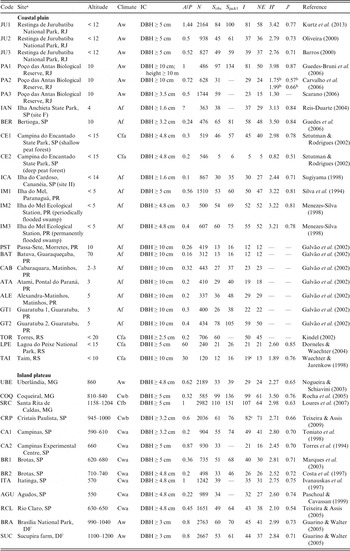
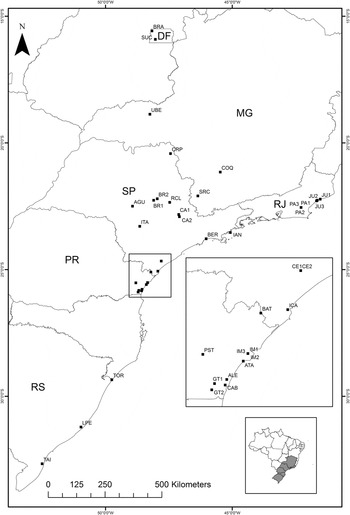
We include in the analyses 28 phytosociological studies conducted in swamp forests of southeast and southern Brazil, in a total of 37 sites surveyed: 24 sites located in the coastal plain between Rio de Janeiro and Rio Grande do Sul states, and 13 sites located in the inland plateau of Brazil (Table 1; Fig. 1). The sampling effort (number of individuals surveyed) was different between surveys, depending on the inclusion criteria and sample size (Table 1). However, because of the low number of studies conducted so far, this was not considered a restriction for comparing surveys.
Phytosociological surveys of the woody layer of swamp forests from southeast and southern Brazil

Altitude: approximate altitude (metres above sea level); Climate: according to Köppen classification; IC: inclusion criteria (DBH = diameter at breast height); A/P: sample area (ha)/number of points; N: number of live individuals sampled; S obs: observed number of species; S jack1: estimated number of species; I: identified species; NE: non-exclusive species used in the multivariate analyses; H′: Shannon diversity index (nat.ind.–1); J′: evenness.
a Sites may be at different successional stages or have different conservation status, but since this information was not consistently provided by the authors it was not included in the table.
b Values of H′ and J′ for the two fragments surveyed.
c Number of species in the floristic survey.
Map of southeast and southern Brazil, showing the location of the 37 swamp forests analysed. DF: Distrito Federal; MG: Minas Gerais; SP: São Paulo; RJ: Rio de Janeiro; PR: Paraná; RS: Rio Grande do Sul (see Table 1 for details and references).

Data analysis
We obtained from each site the following: species numbers, species list, Shannon diversity index (H′) and evenness (J′), the latter two parameters being calculated with natural logarithms (Zar, Reference Zar1996). We also obtained, whenever possible, the number of sampling units per site and the number of species occurring in only one sampling unit. These data were used to compute the non-parametric richness estimator Jackknife 1 (first-order Jackknife; see Colwell & Coddington, Reference Colwell and Coddington1994). This incidence-based estimator has shown good performance and its use has been recommended in biodiversity studies (Hortal et al., Reference Hortal, Borges and Gaspar2006; Willie et al., Reference Willie, Petre, Tagg and Lens2012).
To assess floristic heterogeneity of the swamp forests analysed, we created a binary matrix of species from all sites. For this, plant names were reviewed according to Lista de Espécies da Flora do Brasil (2014), or by specialists. Species not identified at this level and exotic species were excluded from the analyses. This species matrix included 518 trees and shrubs (Kurtz et al., Reference Kurtz, Caris and Scarano2014). To verify the occurrence of these species in the neighbouring non-flooded vegetation, i.e. Atlantic Forest, Cerrado and/or Restinga (vegetation on sandy coastal plains), we compiled data from the literature (available from authors by request). The higher the percentage of shared species, the higher the influence of these non-flooded vegetation types on the flora of the swamp forests. A very high percentage means that swamp forests of southeast and southern Brazil might not comprise a distinguishable floristic unit.
Considering that our aim was searching for overall phytogeographical patterns for swamp forests, we excluded from multivariate analyses species sampled in just one site (exclusive species). This resulted in a new matrix with 250 species. We used a simple correspondence analysis (CA; Greenacre, Reference Greenacre1984). The strength of CA is that the ordinations of species and samples are obtained simultaneously, allowing an examination of the relationships between them in a single analysis (Valentin, Reference Valentin2000). The calculations were performed with STATISTICA 8.0 (StatSoft, Reference StatSoft2007). To confirm our initial expectation, i.e. that swamp forests of the coastal plain are more similar to each other than to their counterparts on the inland plateau, these sets of forests should be separated in the CA diagram.
We also tested the correlation between floristic and geographical distances among sites. The geographical distances were calculated with the tool ‘Point distances’ from Geospatial Modelling Environment 0.7.3.0 (Beyer, Reference Beyer2012), in ArcGIS 10.2.1 (ESRI, 2013). To assess floristic similarity, we used the Sørensen distance (see McCune & Mefford, Reference McCune and Mefford2011) on the matrix of 250 species. To verify the correlation between the matrices of floristic and geographical distances, we used the Mantel test (see Sokal, Reference Sokal1979). The significance was verified with the Monte Carlo test, with 1000 randomised runs. The calculations were performed with PC-ORD 6.0 (McCune & Mefford, Reference McCune and Mefford2011).
Results
Species richness, diversity and evenness
The swamp forests analysed showed a general pattern of low species richness, diversity and evenness (Table 1); monodominance or oligarchy at a local scale was frequent. Even the richness estimates were relatively low, rarely exceeding a hundred species per site. The percentage of species observed at each site relative to the estimated number of species was higher than 70% (except for site GT1; 68.4%), reaching 88.3% at site IM1.
Some sites had extreme values for the parameters analysed. Swamp forests degraded or at initial successional stage (PST and BAT), or located at higher latitudes (LPE and TAI, Rio Grande do Sul state), showed very low species richness. The extreme case was a forest on deep peat (> 5 m) on the coastal plain of São Paulo (CE2), which showed only five species (S jack1 = 6) and strong co-dominance of Ilex pseudobuxus Reissek and Ternstroemia brasiliensis Cambess. These two species accounted for 97.3% of individuals sampled, resulting in extremely low diversity and evenness (H′ = 0.82; J′ = 0.51). These results contrast with those found for a shallower section of the same peat (∼1.5 to 3 m deep; CE1: S obs = 46; S jack1 = 57; H′ = 2.98; J′ = 0.78).
On the other hand, an area located on the coastal plain of Rio de Janeiro (PA1) and another on the plateau of Minas Gerais (COQ) had high species richness (S obs = 97 and 99; S jack1 = 134 and 136, respectively) and relatively high diversity (H′ = 3.98 and 3.50, respectively). PA1 also had the highest evenness (J′ = 0.87). Site SRC, located on the plateau of Minas Gerais, showed the highest species richness (S obs = 110; S jack1 = 151), but low diversity (H′ = 2.98) and evenness (J′ = 0.63). This fact reflects an oligarchic structure, where Myrsine leuconeura Mart., Myrceugenia ovata (Hook. & Arn.) O.Berg, and Sebastiania brasiliensis Spreng. together constituted almost half (48.4%) of individuals sampled.
Intermediate values of species richness can also be associated with very low values of diversity and/or evenness. This occurred as a consequence of the dominance of Tabebuia cassinoides (Lam.) DC. in a permanently flooded swamp forest on the coastal plain of Rio de Janeiro (PA3: S obs = 59; H′ = 1.30), and oligarchy of Euterpe edulis Mart., Calophyllum brasiliense Cambess. and Magnolia ovata (A.St.-Hil.) Spreng. in a swamp forest on the plateau of São Paulo (RCL: S obs = 49; S jack1 = 64; H′ = 2.10; J′ = 0.54).
Phytogeographical relationships
Considering all species identified at the 37 sites (S = 518), 268 (51.7%) were sampled at only one site, and 349 (67.4%) at up to two sites. On the other hand, only six species (1.2%) were sampled at more than half the sites: Calophyllum brasiliense (30), Tapirira guianensis Aubl. (25), Pera glabrata (Schott) Poepp. ex Baill. (23), Alchornea triplinervia (Spreng.) Müll.Arg. (20), Euterpe edulis and Tabebuia cassinoides (19 sites each). Of these 518 species, at least 445 (85.9%) were recorded in the neighbouring non-flooded vegetation. Conversely, only 24 species (4.6%) seem to be restricted or occur preferentially on soils subjected to flooding (data available from authors by request).
Species often sampled on the coastal plain were: Tabebuia cassinoides, Calophyllum brasiliense, Alchornea triplinervia, Psidium cattleianum Sabine, Myrcia multiflora (Lam.) DC., Pera glabrata, Clusia criuva Cambess., Tapirira guianensis, Euterpe edulis, Ocotea pulchella (Nees & Mart.) Mez and Myrcia racemosa (O.Berg) Kiaersk. On the inland plateau, Dendropanax cuneatus (DC.) Decne. & Planch., Magnolia ovata, Calophyllum brasiliense, Tapirira guianensis, Cecropia pachystachya Trécul, Protium spruceanum (Benth.) Engl., Guarea macrophylla Vahl, Pera glabrata, Handroanthus umbellatus (Sond.) Mattos, Citronella gongonha (Mart.) R.A.Howard, Cedrela odorata L., Myrcia laruotteana Cambess. and Styrax pohlii A.DC. were frequent. Some of these species may have great phytosociological importance at a local scale.
In the swamp forests of the coastal plain, 304 species were sampled in total, and in those located on the inland plateau, the total was 313 species, indicating very similar figures. Only 99 species (19.1%) were common to both sets of swamps. Although the number of sites surveyed on the coastal plain was almost twice that of the inland plateau (24 vs. 13), the effort in terms of total individuals sampled was greater on the plateau (20,171 vs. 15,996).
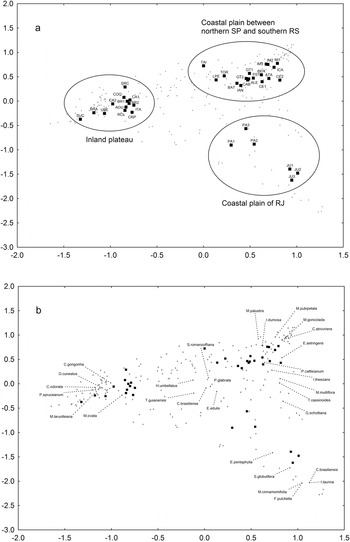
The CA evidenced three groups of swamp forests (Fig. 2a). The first axis separated swamp forests of the coastal plain (right side of diagram) from those of the inland plateau (left side). The second axis separated the swamp forests of the coastal plain: sites of Rio de Janeiro, below, and sites located between northern São Paulo and southern Rio Grande do Sul, above. Considering the difficulty of adequately representing all 250 species analysed in a single diagram, we highlight in Fig. 2b some frequent species that illustrate different associations with those groups of swamp forests. This does not mean these species are necessarily exclusive to a specific group. Thus, some species are related to the coastal plain where they are widely distributed (e.g. Psidium cattleianum, Myrcia multiflora, Ilex theezans Mart. ex Reissek, Geonoma schottiana Mart. and Tabebuia cassinoides; the latter did not occur in Rio Grande do Sul). Other species are associated with one or another of the two sections of coastal plain discriminated in the analysis, i.e. Rio de Janeiro (e.g. Symphonia globulifera L.f., Inga laurina (Sw.) Willd., Eriotheca pentaphylla (Vell. & K.Schum.) A.Robyns, Miconia cinnamomifolia (DC.) Naudin, Ficus pulchella Schott and Calyptranthes brasiliensis Spreng.) and São Paulo to Rio Grande do Sul (e.g. Ilex dumosa Reissek, Eugenia astringens Cambess., Maytenus gonoclada Mart., Cyathea atrovirens (Langsd. & Fisch.) Domin, Myrcia palustris DC. and Myrcia pubipetala Miq.). In fact, many species that occur on the coastal plain, independently of the occurrence on the inland plateau, have their southern limits in swamps of Paraná or of the north-central portion of Rio Grande do Sul. In turn, Magnolia ovata, Dendropanax cuneatus, Protium spruceanum, Citronella gongonha, Cedrela odorata and Myrcia laruotteana are related to the inland plateau. Finally, some species show no apparent preference for the plateau or coastal plain, and they occur indiscriminately in both situations. These species (e.g. Calophyllum brasiliense, Tapirira guianensis, Pera glabrata, Euterpe edulis, Handroanthus umbellatus and Syagrus romanzoffiana (Cham.) Glassman) are placed in the centre of the diagram. The eigenvalues for the first two axes were 0.58 (axis 1) and 0.44 (axis 2).
Scatter plots showing the position of 37 swamp forests of southeast and southern Brazil (a) and their non-exclusive woody species (b) in relation to the first two axes of the correspondence analysis (see Table 1 for details and references).

The Mantel test indicated a significant correlation between floristic and geographical distances among sites (r = 0.45; p = 0.001).
Discussion
Species richness, diversity and evenness
The overall low diversity and evenness in swamp forests is often associated with the intense selective character of oxygen deprivation caused by soil waterlogging (e.g. Scarano, Reference Scarano2006). Our results indicate, however, some degree of site-level variation in richness (S obs = 5 to 110; S jack1 = 6 to 151), diversity (H′ = 0.82 to 3.98) and evenness (J′ = 0.51 to 0.87) of swamp forests, which may be related to climate (Waechter & Jarenkow, Reference Waechter and Jarenkow1998; Dorneles & Waechter, Reference Dorneles and Waechter2004), topography and flooding regime (e.g. Rocha et al., Reference Rocha, Carvalho, Fontes, Oliveira-Filho, Van Den Berg and Melo-Marques2005; Scarano, Reference Scarano2006; Kurtz et al., Reference Kurtz, Gomes and Scarano2013), water quality (Sztutman & Rodrigues, Reference Sztutman and Rodrigues2002), successional stage (Galvão et al., Reference Galvão, Roderjan, Kuniyoshi and Ziller2002), and history of human disturbance (Galvão et al., Reference Galvão, Roderjan, Kuniyoshi and Ziller2002). These frequently operate in an integrated way.
Swamp forests are composed of (i) flooding specialists, (ii) generalists (i.e. species apparently indifferent to the content of water in the soil), and (iii) low tolerance species (species with a preference for drier soils) (see Ivanauskas et al., Reference Ivanauskas, Rodrigues and Nave1997; Marques et al., Reference Marques, Silva and Salino2003; Dorneles & Waechter, Reference Dorneles and Waechter2004; Carvalho et al., Reference Carvalho, Nascimento, Braga and Rodrigues2006; Kurtz et al., Reference Kurtz, Gomes and Scarano2013). The relative contribution of these three groups to the structure of a specific site can vary considerably in response to the sources of local variation mentioned above. In general, flooding specialists (e.g. Tabebuia cassinoides, Calophyllum brasiliense, Symphonia globulifera, Protium spruceanum and/or Magnolia ovata) and some generalists (especially Tapirira guianensis) are notable in the structure (e.g. Toniato et al., Reference Toniato, Leitão-Filho and Rodrigues1998; Galvão et al., Reference Galvão, Roderjan, Kuniyoshi and Ziller2002; Sztutman & Rodrigues, Reference Sztutman and Rodrigues2002; Marques et al., Reference Marques, Silva and Salino2003; Rocha et al., Reference Rocha, Carvalho, Fontes, Oliveira-Filho, Van Den Berg and Melo-Marques2005; Teixeira & Assis, Reference Teixeira and Assis2005, Reference Teixeira and Assis2009; Carvalho et al., Reference Carvalho, Nascimento, Braga and Rodrigues2006; Kurtz et al., Reference Kurtz, Gomes and Scarano2013), while other generalists and species with preference for drier soils promote richness and diversity at a given site. These latter species have low density and phytosociological importance, and have only one or a few individuals in the surveys.
Even at a given site, small topographic variations produce differences in the intensity of water saturation in very close patches of soil, promoting environmental heterogeneity and allowing the establishment of species with different ecological requirements (Scarano, Reference Scarano2006). Indeed, surveys by other authors that comprised wide flooding regime amplitude related to topographic variations showed higher species richness (JU1, PA1, COQ and SRC). Thus, the different types of neighbouring vegetation are the primary sources of generalists and species of drier soil (e.g. Costa et al., Reference Costa, Schlittler, Cesar and Monteiro1997; Ivanauskas et al., Reference Ivanauskas, Rodrigues and Nave1997; Marques et al., Reference Marques, Silva and Salino2003; Teixeira & Assis, Reference Teixeira and Assis2005; Carvalho et al., Reference Carvalho, Nascimento, Braga and Rodrigues2006; Toniato, Reference Toniato, Mariath and Santos2006; Kurtz et al., Reference Kurtz, Gomes and Scarano2013).
On the coastal plain of southeast Brazil, forests subjected to permanent flooding are typically dominated by Tabebuia cassinoides (e.g. PA3, PST and BAT; see also Araujo et al., Reference Araujo, Scarano, Sá, Kurtz, Zaluar, Montezuma, Oliveira and Esteves1998; Menezes & Araujo, Reference Menezes, Araujo, Menezes, Peixoto and Araujo2005). This species is highly resistant to flooding and direct light, and shows pronounced asexual reproduction via roots and fallen trunks, which favours its predominance in areas affected by rising groundwater level (Scarano et al., Reference Scarano, Rios and Esteves1998; Scarano, Reference Scarano2006) or recurrent logging (Galvão et al., Reference Galvão, Roderjan, Kuniyoshi and Ziller2002). Eventually, and with no apparent reason, Tabebuia cassinoides is absent from certain sites (CE1 and CE2), within its natural range.
Throughout the process of ecological succession controlled by the water table flooding regime, there are profound changes in physiognomy, composition, diversity and structure of the coastal swamp forests. With reduction in the intensity and duration of flooding, there is a decline of Tabebuia cassinoides and an increase in other tree species, including the flooding specialist Calophyllum brasiliense (e.g. Galvão et al., Reference Galvão, Roderjan, Kuniyoshi and Ziller2002) and many other species from the surrounding vegetation. Differences in species richness (S obs = 59 vs. 97), diversity (H′ = 1.30 vs. 3.98) and structure (monodominance of Tabebuia cassinoides vs. high evenness) of areas subjected to permanent (PA3) and periodic flooding (PA1) of a swamp forest in Rio de Janeiro illustrate these changes (see also Araujo et al., Reference Araujo, Scarano, Sá, Kurtz, Zaluar, Montezuma, Oliveira and Esteves1998; Menezes & Araujo, Reference Menezes, Araujo, Menezes, Peixoto and Araujo2005).
Regarding the inland plateau, some studies have established, at a local scale, correlations between flooding regime and canopy openness, and species distributions (Teixeira et al., Reference Teixeira, Assis, Siqueira and Casagrande2008, Reference Teixeira, Assis and Luize2011; Teixeira & Assis, Reference Teixeira and Assis2009), but so far there is no consistent information about the dynamics of primary succession of swamp forests there.
Some authors have described differences in tree composition, diversity and structure in swamp forests that occur in dome-shaped peat grounds in the tropics (e.g. Phillips et al., Reference Phillips, Rouse and Bustin1997; Page et al., Reference Page, Rieley, Shotyk and Weiss1999; Posa et al., Reference Posa, Wijedasa and Corlett2011). These phasic communities occur in concentric zones from the periphery to the top of the dome, and their distribution at a local scale has been related to gradients in hydrology, nutrient availability, thickness of peat (Phillips et al., Reference Phillips, Rouse and Bustin1997; Page et al., Reference Page, Rieley, Shotyk and Weiss1999) and, presumably, the availability of species within dispersal distance (Posa et al., Reference Posa, Wijedasa and Corlett2011). Here the primary succession does not always mean an increase in richness and diversity of tree species, as outlined above for coastal swamp forests in southeastern Brazil. Instead, the process of peat accumulation produces increasingly oligotrophic conditions towards the top portion of the dome, eventually conditioning the development of species-poor, stunted forests (e.g. Phillips et al., Reference Phillips, Rouse and Bustin1997).
Phytogeographical relationships
Two major phytogeographical patterns emerge from our analyses. First, there is a strong influence of the neighbouring non-flooded vegetation on the flora of swamp forests of southeast and southern Brazil. Detrended correspondence analysis including the coastal lowland vegetation in the same region (Marques et al., Reference Marques, Swaine and Liebsch2011) showed a similar pattern, i.e. swamp forests did not form a distinct group in the diagram and they tended to be closer to neighbouring unflooded forests and scrubs. Thus, swamp forests of southeast and southern Brazil cannot be considered a distinguishable floristic unit, reinforcing the conclusion of Kurtz et al. (Reference Kurtz, Gomes and Scarano2013). The influence of neighbouring vegetation types has also been described for other tropical swamp forests (e.g. Pitman et al. Reference Pitman, Terborgh, Silman and Nuñez1999, for the Peruvian Amazon). Posa et al. (Reference Posa, Wijedasa and Corlett2011) indicated in their literature review that only some 11% of plants recorded in peat swamp forests of southeast Asia were restricted to that habitat. This figure is close to ours, and suggests that the influence of surrounding vegetation on the flora of swamp forests could be a pattern throughout the tropics.
Second, the floras of swamp forests of southeast and southern Brazil show high spatial heterogeneity, with the great majority of species sampled being restricted to one or a few of the 37 sites analysed (see Kurtz et al., Reference Kurtz, Caris and Scarano2014). Considering the influence discussed above, this floristic heterogeneity largely reflects the heterogeneity of the vegetation domains in which the swamp forests occur, i.e. Atlantic Forest (Oliveira-Filho & Fontes, Reference Oliveira-Filho and Fontes2000) and Cerrado (Ratter et al., Reference Ratter, Bridgewater, Atkinson and Ribeiro1996). Posa et al. (Reference Posa, Wijedasa and Corlett2011) argued that there is no single peat swamp forest vegetation across southeast Asia, and that the ecological and floristic heterogeneity found there suggests that each swamp is distinct.
The geographical location of each site, and its associated climate and neighbouring vegetation types, seem to be the determining factors behind the similarity relationships indicated in the CA. This analysis clearly differentiated swamp forests located on the coastal plain from those of the inland plateau, thus confirming our initial expectation. The analysis further separated swamp forests of the coastal plain of Rio de Janeiro (subject to a dry winter: Aw climate type) from the other coastal swamp forests (without dry season: Af or Cfa). Indeed, the correlation between floristic and geographical distances among sites, indicated by the Mantel test, highlights the main effect of regional-scale changes in species composition of swamp forests.
Swamp forests of the coastal plain, between Rio de Janeiro and northern Rio Grande do Sul, occur within the Atlantic Forest sensu stricto (s.s.; i.e. rainforests) or in areas of Restinga, the flora of which is strongly influenced by the Atlantic Forest (see Araujo, Reference Araujo2000). Oliveira-Filho & Fontes (Reference Oliveira-Filho and Fontes2000) indicated that the decrease in temperature and increase in annual precipitation along the coast between northern Rio de Janeiro and southern São Paulo were responsible for variations in composition of the tree component of the Atlantic Forest s.s. Although they did not include swamp forests (nor the latitudinal variation included here) in their analyses, our results strongly suggest that these climatic variations are also determining the composition of swamp forests, either directly or through the influence of the neighbouring Atlantic Forest s.s.
The Atlantic Forest s.s., which has its meridional limit on the northern coast of Rio Grande do Sul (Joly et al., Reference Joly, Leitão-Filho, Silva and Câmara1991), exerts less influence on the southernmost swamp forests due to the dilution of tropical forest species that occurs southwards (Waechter & Jarenkow, Reference Waechter and Jarenkow1998). However, this was not sufficient to separate sites LPE and TAI in the CA from their counterparts located further north.
In turn, swamp forests of the inland plateau are located in areas subject to a dry season of varying duration (prevailing climate Cwa or Aw). In southeast Brazil, changes in the rainfall pattern (i.e. decrease of annual means and increase in seasonality) in the E–W direction, related to distance from the Atlantic Ocean, promote the transition between rainforests and semideciduous forests (plateau forests; Leitão-Filho, Reference Leitão-Filho1987; Oliveira-Filho & Fontes, Reference Oliveira-Filho and Fontes2000). These changes, in addition to factors such as fire and soil fertility, also promote the transition of semideciduous forests to the Cerrado (Oliveira-Filho & Ratter, Reference Oliveira-Filho and Ratter1995; Oliveira-Filho & Fontes, Reference Oliveira-Filho and Fontes2000). Thus, climatic conditions and the influence of semideciduous forests and/or Cerrado seem to lead to the separation of the swamp forests of the inland plateau from their counterparts on the coastal plain.
Dispersal limitation could also potentially contribute to site differences. We believe that this is less relevant to the overall pattern since many of the species present in such sites have long distance mechanisms of dispersal. However, this awaits further elucidation.
Finally, despite recent advances, the ecology of swamp forests in Brazil is still poorly known. New local surveys are encouraged, especially in the North and Northeast regions, where there are so far no quantitative data. An increase in local surveys would allow new phytogeographical analyses at a larger spatial scale.
Acknowledgements
The authors are grateful to A.Q. Lobão, A. Quinet, A. Joffily, A.M.A. Amorim, A.L. Peixoto, C.G.P. Quinet, C.M. Mynssen, C.N. Fraga, C.F.C. Sá, D. Sampaio, D.C. Daly, E.F. Guimarães, F.R.G. Salimena, F. França, G.V. Somner, H.C. Lima, I. Cordeiro, J. Nakajima, J.L.M. Aranha Filho, J.M.A. Braga, J. Jardim, J.P.P. Carauta, J.F.A. Baumgratz, L.A.F. Carvalho, L.G. Lohmann, L.C.S. Giordano, M.S. Kropf, M.C. Souza, M. Sobral, M.A.N. Coelho, M.F. Freitas, M. Gomes, M.P. Morim, M.G. Bovini, M. Groppo, N.C. Bigio, N. Marquete, P.J.F. Guimarães, P. Fiaschi, R.C.C. Reis, R.B. Lima, R.L. Esteves, R. Marquete, R.S. Bianchini, S. Romaniuc Neto, V. Bittrich and W.A. Rodrigues for assistance with identification of the botanical material and/or review of scientific names, and to the anonymous referees for their constructive criticism of the manuscript.