Sialic acids are substituted neuraminic acid derivatives and to date more than 50 members of sialic acid family have been identified (Spichtig et al. Reference Spichtig, Michaud and Austin2010). The main representative forms of sialic acid are N-acetylneuraminic acid (NeuNAc) and N-glycolylneuraminic acid (Salcedo et al. Reference Salcedo, Lacomba, Alegria, Barbera, Matencio and Lagarda2011). In milk sialic acid is found in four different forms; lipid-bound, protein-bound, oligosaccharide-bound and as free sialic acid (Wang et al. Reference Wang, Brand-Miller, McVeagh and Petocz2001). Sialic acids are bioactive compounds and their role in infant nutrition for brain development has been emphasised (Wang & Brand-Miller, Reference Wang and Brand-Miller2003) as large amounts of this carbohydrate are found in the brain and in the central nervous system in the form of gangliosides and glycoproteins contributing to the functioning of cell membranes and membrane receptors. There are many methods available for the analysis of sialic acids, and they have been reviewed recently (Lacomba et al. Reference Lacomba, Salcedo, Alegria, Lagarda, Barbera and Matencio2010). Classically, sialic acid determination in biological samples has been carried out by spectrophotometry involving the nonspecific reaction between sialic acid and the various reagents like resorcinol, thiobarbituric acid (Warren, Reference Warren1959; Aminoff, Reference Aminoff1961; Romero et al. Reference Romero, Pardo, Porro and Alonso1997) and the enzyme coupled assay (Sugahara et al. Reference Sugahara, Sugimoto, Nomura and Usui1980; Teshima et al. Reference Teshima, Tamal, Hayashi and Emi1988). HPLC based methods have also been employed for the estimation of sialic acid in biological samples (Martin et al. Reference Martin, Vázquez and Rueda2007; Spichtig et al. Reference Spichtig, Michaud and Austin2010; Lacomba et al. Reference Lacomba, Salcedo, Alegria, Barbera, Hueso, Matencio and Lagarda2011). All of these methods require the release of sialic acids before analysis either by acid or enzymatic hydrolysis. Recently, Matsuno & Suzuki (Reference Matsuno and Suzuki2008) described a simple fluorimetric method (FluA) for quantification of sialic acid in glycoproteins in which sialic acid can be estimated even in the bound form. In present study, the method has been applied for the estimation of sialic acid in skim milk, commercial GMP, whey protein concentrate (WPC), whey protein isolate (WPI), and milk based infant formula.
Industry has shown increasing interest in the use of dried cheese whey as a partial substitute for non-fat milk solids in ice-cream and related desserts (Josephson et al. Reference Josephson, Holloway-Thomas and Warthesen1980). Being a cheap dairy by-product, adulteration of milk with whey becomes economically attractive. Such practice makes market competition unfair and defrauds the consumer (de Carvalho et al. Reference de Carvalho, de Carvalho, Alcântra and Bonomo2007). The most frequently used method to detect cheese whey adulteration is the identification of GMP which is present in the cheese whey but not in milk (Chavez et al. Reference Chavez, Salinas, Jauregui, Palomares and Macias2008). Various techniques used for the detection of GMP are colorimetric (Koning et al. Reference Koning, Elisses and De Vries1966; Josephson et al. Reference Josephson, Holloway-Thomas and Warthesen1980), chromatographic (Saito et al. Reference Saito, Yamaji and Itoh1991; Thoma et al. Reference Thoma, Krause and Kulozik2006; Fernandez et al. Reference Fernandez, Menendez, Riera and Alvarez2011), immunological (Bremer et al. Reference Bremer, Kemmers-Voncken, Boers, Frankhuizen and Haasnoot2008; Chavez et al. Reference Chavez, Salinas, Jauregui, Palomares and Macias2008; Martin-Hernandez et al. Reference Martin-Hernandez, Munoz, Daury, Weymuth, Kemmers-Voncken, Corbation, Toribio and Bremer2009), electrophoretic (Cherkaoui et al. Reference Cherkaoui, Doumenc, Tachon, Neeser and Veuthey1997; Nakano et al. Reference Nakano, Ikawa and Ozimek2007) and by use of biosensors (Spreeta, Taxas Instruments, Attleboro, MA). As GMP contains bound sialic acid in its structure, the fluorescence based sialic acid estimation method was further applied for the detection of GMP in milk with a view to detect adulteration of milk with sweet whey.
Materials and Methods
Unless otherwise specified cow milk samples were used. Pooled raw cow and buffalo milk samples were collected from Institute's cattle yard in pre-cleaned glass bottles. Rennet (meito rennet-Mucor meihei, type II) and NeuNAc were purchased from Sigma Aldrich Inc. St. Louis, USA. Other chemicals were of analytical grade and were purchased from Merck Specialties Pvt. Ltd, Mumbai, India. A sample of milk-based infant formula was obtained from the local market. The WPC and WPI were obtained as gift from Modern Dairies, Karnal. Two commercial GMP samples (designated as GMP I and GMP II) were obtained as gift from Davisco Food International, USA and Arla Foods, Denmark.
Fluorimetric method of sialic acid in milk and milk products
The FluA method described by Matsuno & Suzuki (Reference Matsuno and Suzuki2008) for the estimation of sialic acid in glycoprotein was adapted for milk with slight modifications. Milk samples were skimmed (4000 g, 10 min, 4 °C) and then diluted 8 times with distilled water and used directly for further analysis, while other milk products (commercial GMP preparations, WPC, WPI, and infant formula) were dissolved in distilled water to the final concentration of 200 μg/ml (w/v). All the reagent solutions were precooled in an ice bath before use. Sixty microlitres of freshly prepared sodium periodate (10 mm) was added to 600 μl of prepared sample taken in a 10 ml polypropylene test tube. The tube was placed in ice-bath for 45 min and then 300 μl sodium thiosulphate (50 mm) was added to terminate the reaction. Then, 1·5 ml ammonium acetate (4·0 m, pH 7·5) and 1·2 ml 50% ethanolic solution of acetoacetanilide (100 mm) were added and the tubes were incubated at 25 °C for 10 min. The fluorescence intensities of the content were measured in fluorimeter (Cary Eclipse, Varian) using excitation and emission wavelength at 372 and 471 nm, respectively. The above mentioned protocol was followed for the estimation of total sialic acid in skim milk samples. For the estimation of protein bound sialic acid, the milk samples were dialysed with 3500 Da cut off cellulose dialysis membrane (Fisherbrand) using Milli Q water at 4 °C for 24 h with frequent changes of water. Protein bound sialic acid in milk sample was estimated by measuring sialic acid in the retentate. The other forms of sialic acid i.e. free and oligosaccharide bound sialic acid (F + O) were estimated together by difference.
Standard curve for sialic acid
Appropriate volumes of aqueous stock solution (0·16 mm) of NeuNAc were diluted with distilled water to obtain a series of standard solutions of sialic acid (8·3 to 66·6 nmol) in 600 μl. These standard solutions were treated as described above. The fluorescence intensity obtained was plotted against concentration of NeuNAc expressed as sialic acid.
Recovery experiment
NeuNAc levels in milk were raised by 8·3, 16·6 and 24·9 nmol by addition of calculated amounts of sialic acid. Sialic acid levels were then measured as explained above (n = 5) using the regression equation obtained from the standard curve and then recovery was calculated.
NeuNAc determination by thiobarbituric acid (TBA) method
NeuNAc content of two commercial GMP samples was also estimated by TBA assay (Matsuno & Suzuki, Reference Matsuno and Suzuki2008). Briefly, GMP was dissolved in water up to 1 mg/ml. 200 μl of this solution was mixed with 250 μl 90 mm H2SO4 in a test tube. The test tube was kept at 80 °C/1 h in a water bath. The contents of the tubes were neutralised by adding 45 μl 1 m NaOH followed by addition of 250 μl periodic acid (25 mm in 62·5 mm H2SO4). The contents were incubated at 37 °C/30 min followed by termination of reaction by addition of 200 μl sodium arsenite (2% in 0·5 m HCl). The contents were allowed to stand at room temperature for 3 min and subsequently 2 ml TBA solution (0·1 m, aqueous) was added. The test tube was heated in boiling water bath for 7·5 min and subsequently cooled in ice water bath. Then, 5 ml n-butanol/HCl solution (95:5, v/v) was added and content was shaken vigorously. Absorbance of butanol layer (upper layer) was measured at 550 nm in a UV-Visible spectrophotometer (Shimadzu UV 2550). For standard preparation, 194 μl 0·16 mm stock NeuNAc solution was mixed with 259 μl 88 mm H2SO4. The mixture was hydrolysed and treated as mentioned above and used as reference for sialic acid estimation.
The estimated sialic acid content in commercial GMP samples obtained by both the methods (FluA and TBA) was compared using paired t-test (Medndham et al. Reference Medndham, Denney, Barnes and Thomas2000).
Preparation of sweet whey
Milk samples were skimmed (4000 g, 10 min, 4 °C) and then brought to 32 °C. Rennet was added to final concentration of 0·02% (w/v) and stirred for 1 min over a magnetic stirrer and then incubated for 45 min at 32 °C. Set curd was cut and centrifuged (6000 g, 10 min, 4 °C) to get clear whey. Whey was heated at 80 °C/5 min in the water bath, quickly brought to room temperature and then stored at 4 °C. The sweet whey obtained was used on the same day.
Preparation of adulterated milk
Adulterated milk samples were prepared by adding sweet whey to cow milk. For this, binary milk mixtures (v/v) of sweet whey in cow milk containing 5, 10, 20 and 50% sweet whey were prepared. The samples were stored at 4 °C and analysed within 24 h.
Detection of sweet whey in milk using FluA method
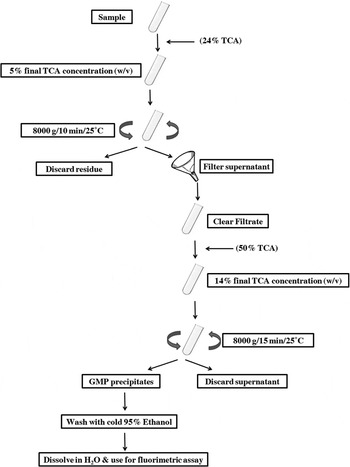
The procedure followed to isolate GMP from adulterated milk samples for the detection of sweet whey in milk is outlined in Fig. 1. Three millilitres of authentic milk sample, adulterated milk sample and sweet whey were mixed with 24% (w/v) trichloroacetic acid (TCA) solution to get a final TCA concentration of 5% (w/v) in a 15 ml polypropylene conical centrifuge tube. After incubating the mixture for 30 min at 35 ± 2 °C, the contents were centrifuged (8000 g, 10 min, 25 °C) and supernatant was filtered through Sartorius 292 filter paper. The clear filtrate obtained was again mixed with 50% TCA (w/v) to a final concentration of 14% (w/v) followed by centrifugation (8000 g, 15 min, 25 °C). The supernatant was discarded and precipitates obtained were washed with cold (10–15 °C) 95% ethanol. The precipitates were then resuspended in 4 ml distilled water. 600 μl of this solution was used for the estimation of sialic acid by above mentioned FluA method.
Isolation of GMP from adulterated milk samples for the detection of sweet whey in milk

Results and Discussion
Sialic acid residues are often present at the terminal position of numerous carbohydrate chains of glycoconjugates (glycoproteins, glycolipids and lipopolysaccharides) (Lacomba et al. Reference Lacomba, Salcedo, Alegria, Lagarda, Barbera and Matencio2010). Typically, the analysis of sialic acids start with their release either by enzymatic or acid hydrolysis followed by determination by different analytical techniques. The FluA method for the sialic acid estimation is based on the periodate oxidation of sialic acid with the generation of formaldehyde which is then estimated by cyclisation reaction between acetoacetanilide and formaldehyde (Hantzsch reaction) in the presence of ammonia (Matsuno & Suzuki, Reference Matsuno and Suzuki2008). The resulting dihydropyridine derivative is fluorescent and its intensity depends on the initial amount of sialic acid in the reaction mixture. Since in the O-glycosylation binding of sialic acid, the C2 is involved (Thoma-Worringer et al. Reference Thoma-Worringer, Sorensen and Lopez-Fandino2006), the C8 and C9 are free and available for oxidation by periodate, therefore, this method is also applicable to bound sialic acid. Almost all other widely used methods of sialic acid estimation require release of bound sialic acid either by acidic or enzymatic hydrolysis. Major milk carbohydrate i.e. lactose as observed did not show any fluorescence as it is oxidised more slowly by periodate at 0 °C, therefore the oxidation conducted at such a low temperature is highly specific to sialic acid in milk. For the estimation of sialic acid in milk and milk products, a standard curve of NeuNAc in Milli Q water was prepared and the fluorescence responses were found to be linear between 8·3 and 66·6 nmol (r 2 = 0·999).
Recovery of sialic acid
The recovery was estimated by spiking milk samples with known concentrations of NeuNAc (8·3, 16·6 and 24·9 nmol). Estimated values of sialic acid in unspiked samples, spiked samples and recovery calculations are shown in Table 1. The recovery of added sialic acid in milk was in the range of 91·6–95·8%. These results confirm the applicability of the method to milk. Further, the specificity of the method was established by adding glucose (1 g/l) and lactose (30 g/l) to milk samples which did not change the fluorescence intensity of such samples.
Estimated values of sialic acid (means±se) in skim milk spiked with different levels of sialic acid and recovery of added sialic acid (n = 5)

Analysis of NeuNAc in GMP by TBA and FluA method
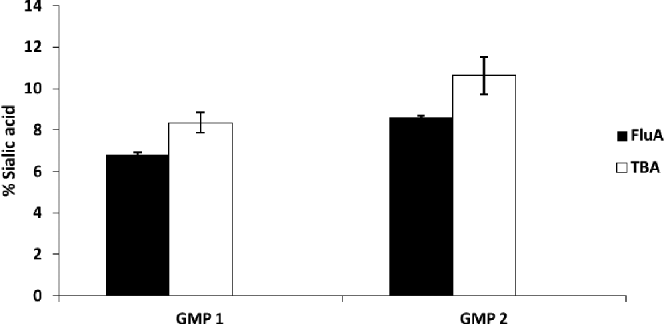
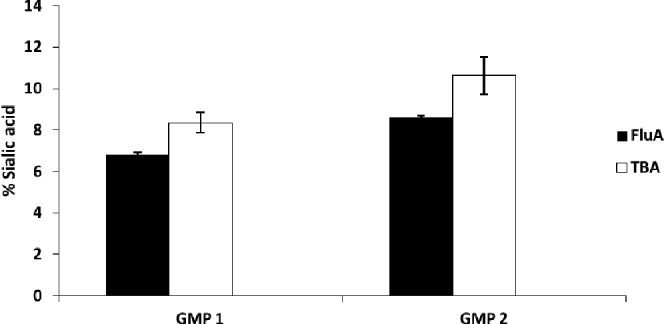
FluA method was compared with TBA method. NeuNAc content was determined in two commercial GMP samples both by TBA and FluA. Content of NeuNAc was found to be lower in GMP I (FluA 6·8% ±0·1; TBA 8·35% ±0·52) than in GMP II (FluA 8·6% ±0·11; TBA 10·63% ±0·97) (Fig. 2). Using the t-test, the mean results from both the assays were not significantly different (P < 0·05) from each other. According to manufacturer's specification, GMP I contains 7% and GMP II contains 9% sialic acid. The estimated TBA values were found to be higher than those obtained by FluA method. The higher estimated values of sialic acid obtained by TBA method vis-à-vis FluA method are perhaps due to the low specificity of TBA reagent (Lacomba et al. Reference Lacomba, Salcedo, Alegria, Lagarda, Barbera and Matencio2010). In a similar comparative study done by other workers (Fernando & Woonton, Reference Fernando and Woonton2010) for the estimation of NeuNAc in GMP, higher values were obtained using TBA assay compared with HPLC based method.
Sialic acid content in two commercial GMP preparations using fluorimetric method (FluA) and thiobarbituric acid (TBA assay). Error bars represent the standard error (n = 5).
Estimation of sialic acid in milk and milk products
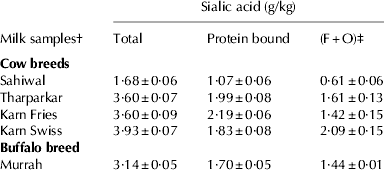
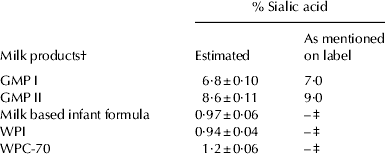
The level and distribution of various forms of sialic acid in skim milk i.e. total sialic acid, protein bound sialic acid and other forms of sialic acid (F + O) in the milk of different Indian cow breeds and one buffalo breed estimated by FluA method is given in Table 2. The sialic acid content in milk on dry mass basis was dependent on breed and was in the range of 1·68–3·93 g/kg. Sialic acid in Sahiwal, an indigenous cattle breed, was less than 50% of that of Tharparkar, another indigenous cattle breed. Tharparkar and Karan Fries (crossbred Holstein Friesian and Tharparkar) have similar levels of sialic acid. The sialic acid content of Karan Swiss (crossbred Brown Swiss and Sahiwal) was found to be highest of all the breeds studied. Sialic acid in Tharparkar cattle and Murrah buffalo breeds are significantly higher than the reported value of 2·30 g/kg (Koliwer-Brandl et al. Reference Koliwer-Brandl, Siegert, Umnus, Kelm, Tolkach, Kulozik, Kuballa, Cartellieri and Kelm2011) and 0·19 g/kg (Spichtig et al. Reference Spichtig, Michaud and Austin2010) for bovine milk. These differences are possibly due to differences in breed, nutrition and climate. Dietary uptake of sialic acid has been correlated with the brain development. The dietary sources of sialic acid may play a role in determining the final concentration of sialic acid in brain and may possibly affect the learning ability of human infants (Wang et al. Reference Wang, Brand-Miller, McVeagh and Petocz2001). As sialic acid is an attractive constituent, manufacturers may claim their milk products have higher sialic acid content as a market strategy. Therefore, to check such claims, the determination of sialic acid in commercial products, which declare the presence of sialic acid e.g. GMP powders, would be useful and this method can be easily used for this purpose. Table 3 represents the percentage of sialic acid in the commercial GMP samples as calculated by this method compared with those mentioned on the labels. For comparison, the other products such as infant formula, WPC, WPI have also been included in the study. The estimated values by FluA method indicate that in commercial GMP samples, the values were in close agreement with those mentioned on the label. Thus, the FluA method can be used for ascertaining the quality of GMP with respect to its sialic acid content.
Total sialic acid, protein bound and other forms of sialic acid (F + O) in skim milk samples (dry matter basis) of different cow and buffalo breeds (n = 3) estimated by fluorimetric method (means±se).
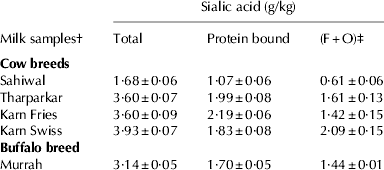
† Pooled milk samples collected on different days.
‡ Other forms of sialic acid i.e. free and oligosaccharide bound (F + O) sialic acid were estimated by difference.
Sialic acid content (mean±se) of different milk products as estimated by fluorimetric method.
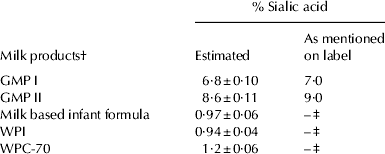
† Same sample was analysed five times.
‡ Not mentioned on the label.
Application of FluA method for detection of adulteration of milk with sweet whey
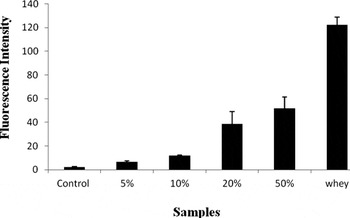
GMP is the major source of sialic acid in sweet whey (Nakano & Ozimek, Reference Nakano and Ozimek1999) and is also a marker peptide of sweet whey adulteration in milk. For the detection of adulteration of milk with sweet whey, GMP in adulterated milk sample was selectively precipitated using TCA. For this, TCA concentration in milk sample was first raised to 5% in order to precipitate caseins and whey proteins. In the supernatant thus obtained, TCA concentration was increased to 14% to precipitate GMP. Since GMP contains bound sialic acid, the precipitated GMP was subjected to fluorescence measurement. As the concentration of whey was increased in the samples, amount of GMP or sialic acid increased with corresponding increase in fluorescence intensity (Fig. 3). It was observed that the control milk samples also showed low fluorescence which may be due to unreacted acetoacetanilide (Matsuno & Suzuki, Reference Matsuno and Suzuki2008). The limit of detection (LOD) of the method as described by AOAC (Lynch, Reference Lynch, Horwitz and Latimer2005) was found to be 5%. LOD was calculated as the blank value plus 3 times the standard deviation. Although there was increase in fluorescence with increase in the level of sweet whey in milk, the increase was not linear, probably due to partial coprecipitation of GMP with casein by TCA (Fernandez et al. Reference Fernandez, Menendez, Riera and Alvarez2011). We have tried different levels of TCA (3, 5 and 8%) for precipitation of milk proteins and it was found that 5% TCA was best to achieve optimum results for detection of adulteration of milk. Although 5% TCA can partially precipitate GMP, the described method can be used for detection of adulteration in milk with cheese whey qualitatively. When sialic acid in GMP is required to be measured for quality control purpose, direct FluA method described here can be used.
Relative fluorescence intensity of control (pure milk), milk samples adulterated with sweet whey (5, 10, 20 and 50%) and whey. Error bars represent standard error in estimation (n = 6).

Conclusions
The results obtained in the present study reveal that the FluA method following Hantzsch reaction can be employed for the estimation of sialic acid in milk and milk products. The method is rapid in comparison with existing methods available for the estimation of sialic acid in skim milk and milk products as it does not require prior hydrolysis. The method was further applied for the qualitative detection of sweet whey adulteration in milk and can detect presence of 5% sweet whey in milk. Since, many biological properties of GMP (cholera toxin binding, brain development etc.) have been attributed to its sialic acid content, the FluA method can also find application in ascertaining the quality of commercial GMP preparations with respect to their sialic acid content.
This work was supported by National Agricultural Innovation Project, Indian Council of Agricultural Research, India and authors sincerely acknowledge for the financial support.