Introduction
Since its first delineation by Kraepelin (Reference Kraepelin1896), cognitive dysfunction has been considered a core aspect of schizophrenia (Kahn and Keefe, Reference Kahn and Keefe2013). Although many studies have focused on distinctive cognitive domains, less attention has been paid to general intelligence, despite it being a robust measure that integrates a variety of cognitive functions (Colom et al., Reference Colom, Karama, Jung and Haier2010). Lower intelligence quotient (IQ) or general cognitive ability composite scores (g) have consistently been reported in schizophrenia patients (Aylward et al., Reference Aylward, Walker and Bettes1984; Heinrichs and Zakzanis, Reference Heinrichs and Zakzanis1998; Keefe and Fenton, Reference Keefe and Fenton2007; Dickerson et al., Reference Dickerson, Stallings, Vaughan, Origoni, Khushalani, Dickinson and Medoff2011; Irani et al., Reference Irani, Kalkstein, Moberg and Moberg2011), indicating that IQ is lower once the illness is present.
This begs the question whether lower IQ is a result of the illness or whether it is a risk marker for schizophrenia. The latter is suggested by findings that mean IQ-scores are below those of healthy subjects years before the onset of psychotic symptoms in individuals who later develop schizophrenia (Woodberry et al., Reference Woodberry, Giuliano and Seidman2008; Khandaker et al., Reference Khandaker, Barnett, White and Jones2011; Dickson et al., Reference Dickson, Laurens, Cullen and Hodgins2012; Agnew-Blais and Seidman, Reference Agnew-Blais and Seidman2013; Kendler et al., Reference Kendler, Ohlsson, Sundquist and Sundquist2015; Hochberger et al., Reference Hochberger, Combs, Reilly, Bishop, Keefe, Clementz, Keshavan, Pearlson, Tamminga, Hill and Sweeney2018). More specifically, it is not the level of IQ per se but rather a deviation from what is expected based on the level of IQ of biological relatives (Kendler et al., Reference Kendler, Ohlsson, Mezuk, Sundquist and Sundquist2016).
Not only is lower IQ associated with future development of schizophrenia, also a decline in global cognitive functioning precedes the onset of psychotic symptoms in children (Kremen et al., Reference Kremen, Buka, Seidman, Goldstein, Koren and Tsuang1998) and adolescents (Fuller et al., Reference Fuller, Nopoulos, Arndt, O'Leary, Ho and Andreasen2002; Reichenberg et al., Reference Reichenberg, Weiser, Rapp, Rabinowitz, Caspi, Schmeidler, Knobler, Lubin, Nahon, Harvey and Davidson2005; Mollon and Reichenberg, Reference Mollon and Reichenberg2018), and this decline seems specific for schizophrenia (van Oel et al., Reference van Oel, Sitskoorn, Cremer and Kahn2002; Meier et al., Reference Meier, Caspi, Reichenberg, Keefe, Fisher, Harrington, Houts, Poulton and Moffitt2014; Ullman et al., Reference Ullman, Hornik-Lurie and Reichenberg2017). In contrast to the consistent – though limited – evidence of IQ decline prior to illness onset, it is less clear whether it declines after illness onset (Zipursky et al., Reference Zipursky, Reilly and Murray2013). Reviews summarizing longitudinal studies on cognitive functioning (e.g. global cognition such as IQ and specific cognitive domains) in schizophrenia fail to find evidence of decline over time (Rund, Reference Rund1998; Kurtz, Reference Kurtz2005; Irani et al., Reference Irani, Kalkstein, Moberg and Moberg2011). However, these results are hard to interpret, since less than a third of the included studies compared performance in patients with that of a control group. This is problematic, because stability or improvement in patients may still represent a deficit when compared with changes in healthy individuals (Szoke et al., Reference Szoke, Trandafir, Dupont, Méary, Schürhoff and Leboyer2008; Granholm et al., Reference Granholm, Link, Fish, Kraemer and Jeste2010; Harvey et al., Reference Harvey, Reichenberg, Bowie, Patterson and Heaton2010; Bozikas and Andreou, Reference Bozikas and Andreou2011).
In a meta-analysis on longitudinal IQ studies that restricted itself to studies which included patients and healthy controls, Hedman et al. (Reference Hedman, van Haren, van Baal, Kahn and Hulshoff Pol2013) reported a relative decline – or lack of improvement – in intelligence in schizophrenia patients, which was interpreted as the absence of a learning effect. However, these results must be considered preliminary due to the relatively small number of subjects (i.e. 280 patients and 306 healthy controls) that were included in the few controlled longitudinal studies (n = 8) conducted so far.
IQ is a highly heritable trait (Posthuma et al., Reference Posthuma, de Geus and Boomsma2001; Bouchard, Reference Bouchard2009) and deficits in intellectual function are present in first-degree relatives of schizophrenia patients (Groom et al., Reference Groom, Jackson, Calton, Andrews, Bates, Liddle and Hollis2008; Maziade et al., Reference Maziade, Rouleau, Gingras, Boutin, Paradis, Jomphe, Boutin, Létourneau, Gilbert, Lefebvre, Doré, Marino, Battaglia, Mérette and Roy2009, Reference Maziade, Rouleau, Mérette, Cellard, Battaglia, Marino, Jomphe, Gilbert, Achim, Bouchard, Paccalet, Paradis and Roy2011). That the level of intelligence is affected in co-twins of patients indicates that lower IQ in schizophrenia can partly be explained by common genes (Toulopoulou et al., Reference Toulopoulou, Picchioni, Rijsdijk, Hua-Hall, Ettinger, Sham and Murray2007). So far, it is unknown to what extent the association between IQ change and schizophrenia liability is either causal or a consequence of common environmental influences or pleiotropic influences of genetic variants that lead to both lowering of IQ and increased risk for psychosis (Walters and Owen, Reference Walters and Owen2007). Using a twin design, Hedman et al. (Reference Hedman, van Haren, van Baal, Brans, Hijman, Kahn and Hulshoff Pol2012) reported a lack of increase in IQ in patients, not in co-twins, indicating that in chronically ill patients environmental factors implicated in the disease are associated with a lack of IQ improvement over time.
Larger studies – including patients, their family members and healthy controls – are needed to adequately address IQ change during the course of illness and the genetic and environmental contributions to this change. Therefore, we examined whether IQ change (measured three times with 3-year intervals) differs between 1022 patients with non-affective psychosis, 977 of their non-psychotic siblings, and 565 controls.
Method
Study design Genetic Risk and Outcome of Psychosis (GROUP)
Data are part of the longitudinal GROUP study in the Netherlands and Belgium. At baseline, patients were identified through clinicians working in regional psychotic disorder services, whose caseloads were screened for inclusion criteria. Subsequently, patients presenting at these services as either out-patients or in-patients were recruited for the study. Siblings were recruited via the proband. Controls were selected through random mailings to addresses in the catchment areas of the cases.
At baseline, patients met Diagnostic and Statistical Manual of Mental Disorders-Fourth Edition-Text Revision [DSM-IV-TR (American Psychiatric Association, 2000)] criteria for a non-affective psychotic disorder. At follow-up measurements, after an average of approximately 3 and 6 years, the diagnostic interview was repeated. Exclusion criteria for healthy controls were a history of psychotic disorder or having a first-degree family member with a history of psychotic disorder.
The study protocol was approved centrally by the Ethical Review Board of the University Medical Center Utrecht and subsequently by the local review boards of each participating institute. All subjects gave written informed consent in accordance with the committee's guidelines.
Subjects
For all patients, diagnostic information from the available measurements was taken into account to decide what the most accurate diagnosis was. For patients with an illness duration at baseline of longer than 2 years the baseline diagnosis was chosen, while for patients with an illness duration at baseline, shorter than 2 years as well as for siblings and controls the last diagnosis was used. All individuals with at least one IQ measurement were included.
Measurements
Information on age, gender and highest educational level were assessed. Patients underwent the Positive and Negative Syndrome Scale [PANSS (Kay et al., Reference Kay, Fiszbein and Opler1987)]; siblings and healthy controls were administered the Community Assessment of Psychic Experiences (CAPE; http://www.cape42.homestead.com) and the Structured Interview for Schizotypy-Revised [SIS-R (Vollema and Ormel, Reference Vollema and Ormel2000)]. To assess substance abuse and dependence, the Composite International Diagnostic Interview [CIDI (Organization, 1997) section L (substance use)] was used. The WAIS-III short form was used to estimate IQ. For more detailed information, see online Supplement 1 and Korver et al. (Reference Korver, Quee, Boos, Simons and de Haan2012).
Statistical analyses
GROUP database version 6.0 was used. Baseline differences between groups on demographic and clinical variables were investigated using analysis of variances for continuous variables and χ2 statistics for categorical variables. Also, differences on baseline demographic and symptom severity variables between those who participated only once (either baseline, second or third measurement) and those who participated twice or three times were investigated.
Baseline IQ and change in IQ
We compared schizophrenia patients and their non-psychotic siblings with healthy controls on baseline IQ and change in IQ (and on the four individual subtests) applying multi-level mixed model analyses, using the lme function in the nlme package (Pinheiro et al., Reference Pinheiro, DebRoy, Bates and Sakar2012) in R (https://www.R-project.org/). The multi-level approach takes into account (1) the correlation between multiple measurements from the same person, (2) the correlation between individuals within a family and within a center, and (3) the presence of missing data. Consequently, individuals with only one or two IQ measurements can be included in the analyses, not just those with complete data. This reduces the uncertainty (e.g. noise) in the IQ estimates and the effect of attrition bias.
We applied a three-level model, i.e. measurements within subjects, within families, and within centers. Age was centered around the mean. IQ was modeled as a function of group membership (control, sibling, and patient), age (at each measurement), and the interaction between group and age. Consequently, B-values represent the mean IQ change per year in each group. We corrected for the potential confounding effect of gender. Random intercepts per subject, per family, and per center were applied. First, the control group served as a reference, resulting in the contrast between controls v. patients and controls v. siblings. Next, the patient group was defined as a reference to establish the contrast between patients v. siblings. The analyses were repeated for the scaled scores of the WAIS-III subtests.
To rule out that findings are explained by psychopathology in siblings or controls, analyses were repeated after excluding siblings and controls with a psychiatric diagnosis (hereafter referred to as being ‘unaffected’). In addition, analyses were repeated including only schizophrenia patients and comparing them with unaffected siblings and controls.
Significance level was set at p < 0.05/15 = 0.0033 [five IQ-variables (IQ and four subtests) × three pair-wise comparisons].
(Subclinical) symptom severity
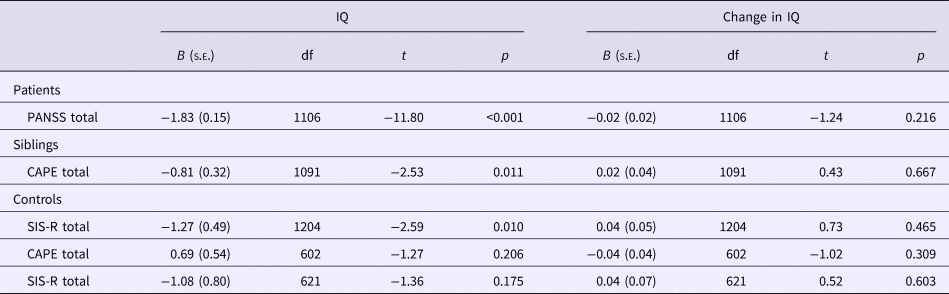
In patients, we investigated the effect of (change in) symptom severity on (change in) IQ. At each measurement, the five PANSS factor scores were highly correlated with the PANSS total score (all r > 0.70); we therefore used the total score as symptom severity measure to reduce the number of tests. We applied the same multi-level mixed model analysis, now modeling IQ as a function of symptom severity, age (at each measurement), and the interaction between symptom severity and age. Similar analyses were done in siblings using the SIS-R total score and CAPE total score. Again, the total scores were used because the correlation between the sum score of the positive and negative subscale of the SIS-R and the correlations between the sum score of the positive, negative and depression dimension of the CAPE were moderate to high in both groups (SIS-R: controls r > 0.74, siblings r > 0.78; CAPE: controls: all r > 0.42, siblings: all r > 0.44).
Results
Demographic and clinical characteristics
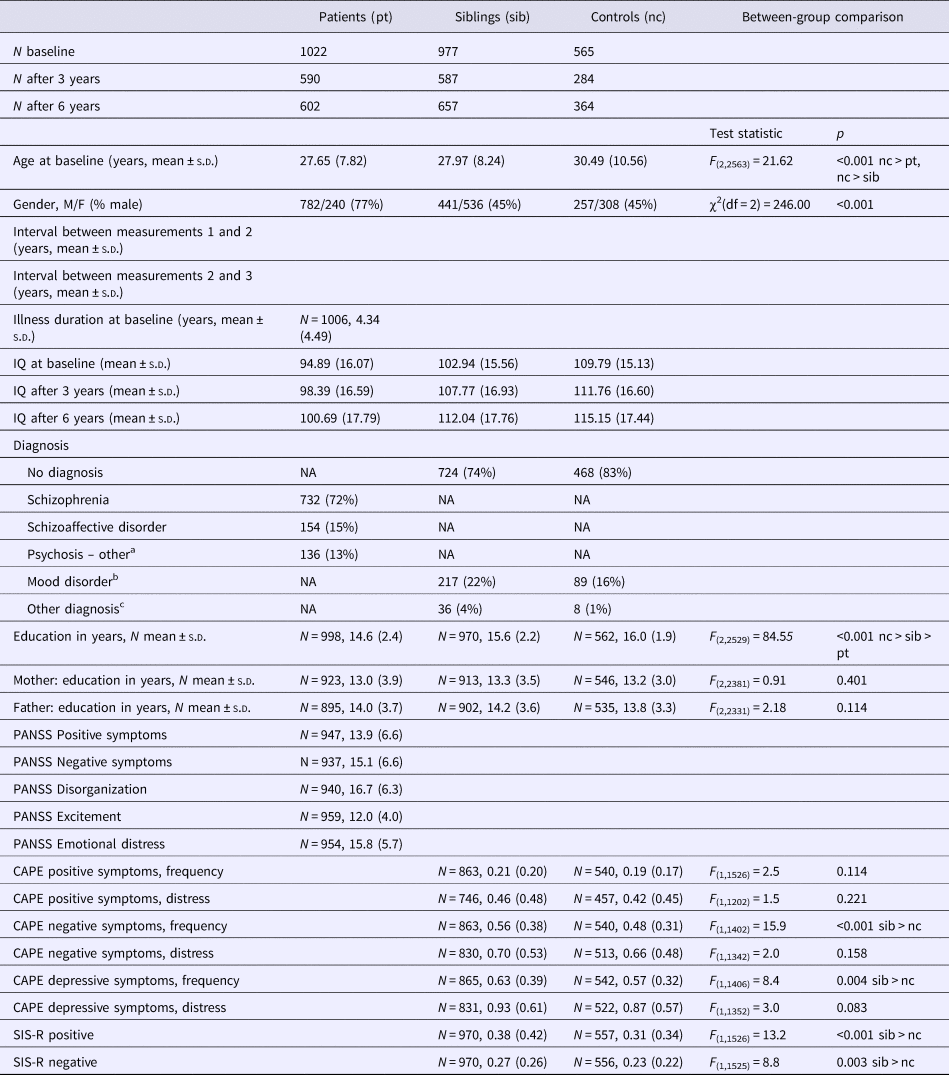
Age at baseline differed significantly between groups, with controls being almost 3 years older than patients and siblings. Males were significantly overrepresented in the patients relative to siblings and controls. Controls had significantly higher education levels than siblings, who in turn were higher educated than patients. No significant group differences were found for parental level of education.
Siblings had significantly more negative and depressive symptoms (CAPE), as well as higher scores on positive and negative schizotypy (SIS-R) than controls. See Table 1 for further demographic and clinical information.
Demographic and clinical information of schizophrenia patients, siblings and controls at baseline

Baseline information is presented here, unless only follow-up information was available.
a Psychosis-other in patients: bipolar disorder N = 3, brief psychotic disorder N = 25, delusional disorder N = 11, drug induced psychotic disorder N = 8, psychotic disorder NOS N = 73, schizophreniform disorder N = 16.
b Mood disorder in siblings: bipolar disorder N = 21, cyclothymic disorder N = 1, depressive disorder NOS N = 5, dysthymic disorder N = 3, major depressive disorder N = 187. Mood disorder in controls: depressive disorder NOS N = 1, dysthymic disorder N = 1, major depressive disorder N = 87.
c Other diagnoses in siblings: ADHD N = 3, adjustment disorder N = 8, alcohol dependence/abuse N = 1, anorexia nervosa N = 2, Cannabis dependence/abuse N = 2, dyssomnia NOS N = 1s, panic disorder N = 5, PDD-NOS N = 4, sleeping disorder N = 4, PTSD N = 1, reading disorder N = 1, schizoid/schizotypal personality disorder N = 3, somatization disorder N = 1. Other diagnosis in controls: adjustment disorder N = 3, borderline personality disorder N = 1, sleeping disorder N = 2, PTSD N = 1, specific phobia N = 1.
For information on attrition, see online Supplement 2.
Baseline IQ and change in IQ
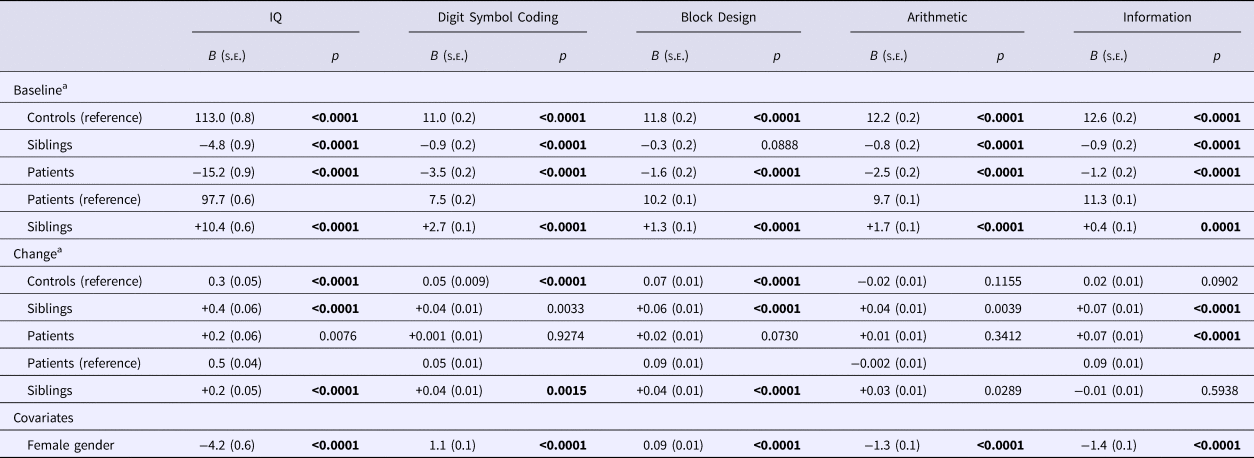
See Table 2 for results of the multilevel analysis. With the control group as a reference, the intercept gives the mean baseline (time = 0) IQ scores for a male (male = 1; reference group) aged 31.14 years (i.e. centered age). Estimates of deviation from the intercept are given for patients and siblings.
Overview of multilevel analyses on differences between all patients, all siblings, and all healthy controls on IQ and change in IQ

p-values in bold represent group differences that reached significance after Bonferoni correction, p < 0.0033.
Removing gender or adding gender × group did not change results for IQ.
Removing affected controls, affected sibs, and/or non-schizophrenia patients did not change results for IQ.
a The control group was used as reference group. For controls the estimated scores and changes in scores per year during the interval are presented, while for patients and siblings the deviations from the scores in controls are provided.
At baseline, the average IQ for a 31-year-old male control is 113.0. At baseline, both patients (IQ = 97.8) and siblings (IQ = 108.2) had a significantly lower IQ and lower subtest scores (except for Block Design) than controls. Siblings had significantly higher IQ and subtest scores than patients.
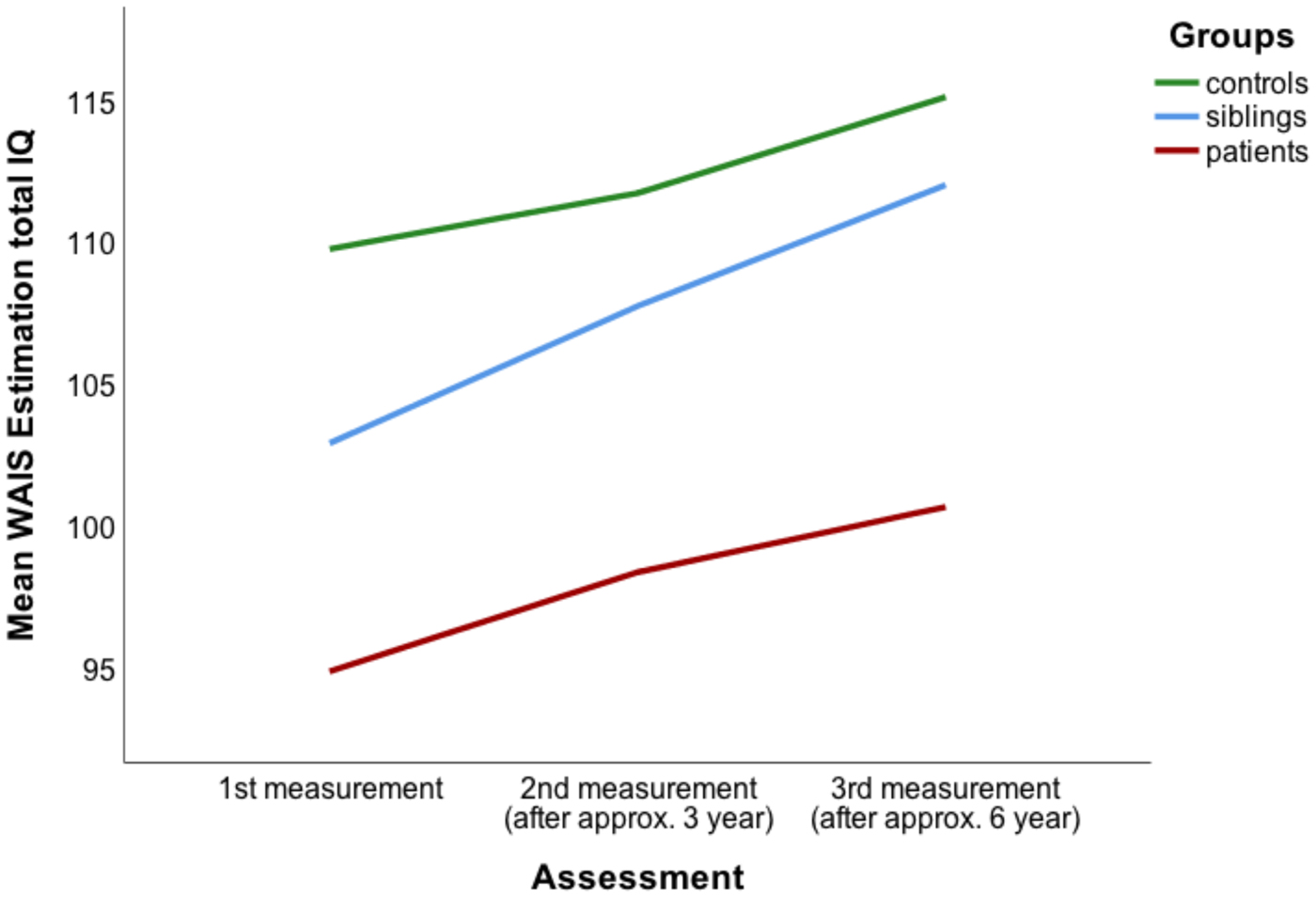
IQ increased significantly over time in all groups (controls: +0.3 points/year, siblings: +0.7 points/year, patients: +0.5 points/year) and the increase was significantly more pronounced in siblings as compared with controls and patients. Controls and patients did not differ significantly. See Fig. 1 and online Supplement 3.
Mean IQ at each measurement is plotted for patients, siblings, and healthy controls.

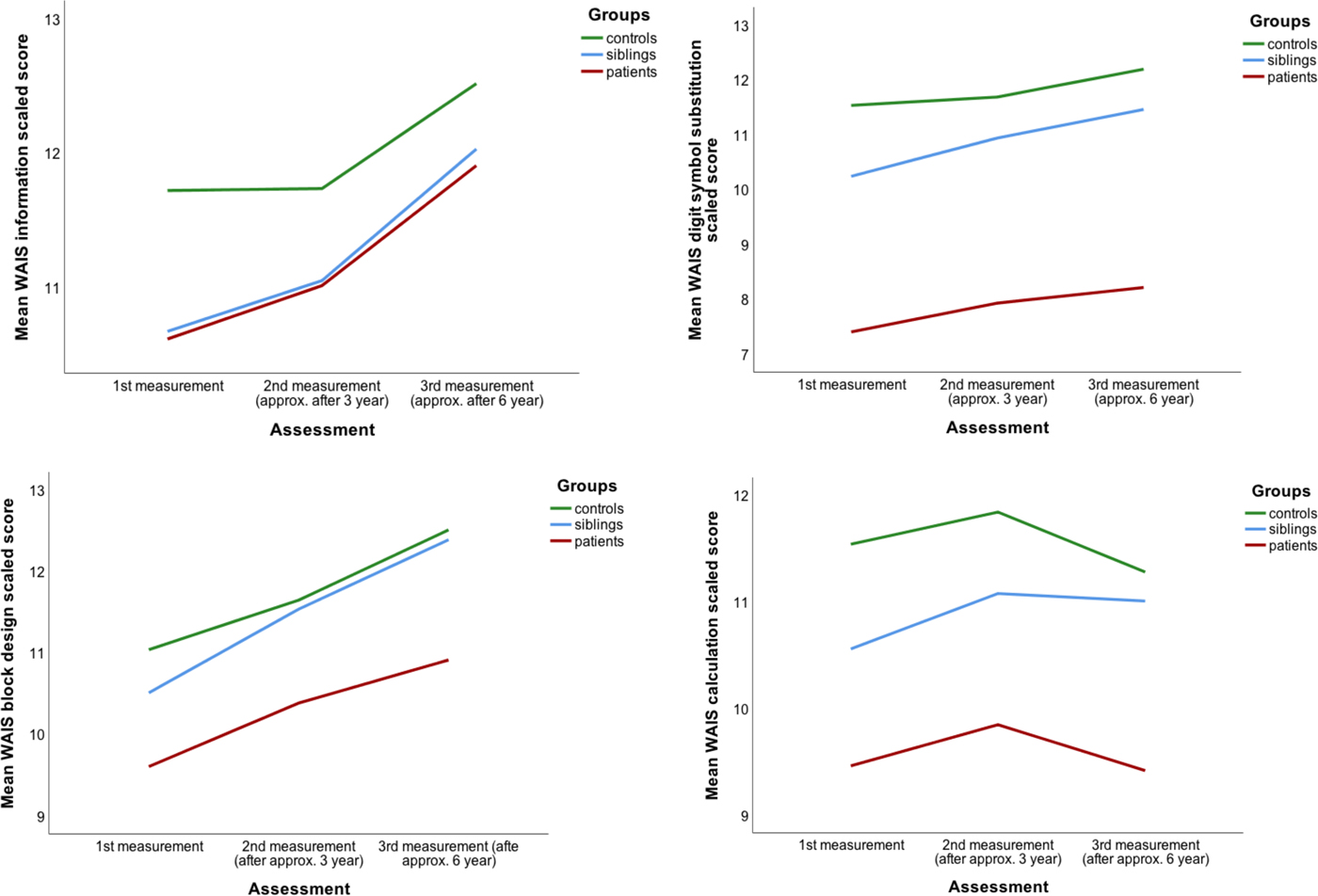
Over time, controls improved significantly on Digit Symbol-coding (+0.05 points/year) and Block Design (+0.07 points/year), but not on Arithmetic and Information. On Digit Symbol-coding and Block Design, siblings showed a more pronounced increase in performance (+0.09 points/year and +0.13 points/year, respectively) as compared with controls and patients (+0.05 points/year and +0.09 points/year), which is a similar pattern as in IQ. No improvement was found in any of the groups on Arithmetic. Finally, siblings and patients (both +0.09) showed improvement over time on Information, which was significantly more pronounced than in controls (0.02 points/year) (see Fig. 2).
Mean subtest score at each measurement is plotted for patients, siblings, and healthy controls.

Including only patients with schizophrenia and/or excluding siblings and controls with a psychiatric diagnosis did not change this pattern of findings (see online Supplement 4).
(Sub)clinical symptom severity
In patients, lower IQ was significantly related to higher PANSS score, while IQ change was unrelated to symptom severity change. In siblings, higher SIS-R and CAPE scores were significantly related to lower IQ, while IQ change was unrelated to change in either measures. In controls, no significant associations were found between IQ (change) and (change in) SIS-R and CAPE scores (see Table 3).
The associations of IQ and IQ change with clinical or subclinical symptom measures in patients, siblings, and controls

Discussion
To our knowledge, this is the largest study to date – including 1022 patients with non-affective psychosis (72% schizophrenia), 977 of their siblings, and 565 controls – examining IQ at three measurements over a 6-year follow-up period. Our main finding is that patients, although displaying the expected lower IQ, did not differ from controls in terms of IQ change per year. That is, patients showed an average increase of 0.5 points/year, while controls increased with 0.3 points/year. IQ in siblings was higher than in patients but lower than in controls. Moreover, IQ increase in siblings (0.7 points/year) was significantly more pronounced than in patients and controls.
The finding in patients contrasts with our earlier meta-analysis in which we quantified studies comparing IQ change between patients and healthy subjects (Hedman et al., Reference Hedman, van Haren, van Baal, Kahn and Hulshoff Pol2013). The meta-analysis showed a smaller IQ increase in patients (effect size −0.48). IQ in both groups was quite similar between the current study and the meta-analysis (respectively, patients: IQ = 97.7 and 97.2; controls: IQ = 113.0 and 109.3), as was IQ increase in patients (respectively, +0.5 points/year and +0.3 points/year). However, there is a remarkable difference in IQ increase in controls between the meta-analysis (+2.1 points/year) and the current study (+0.3 points/year). The meta-analysis contained studies with major differences in sample characteristic (e.g. age, illness duration, and age at onset), methods to establish IQ (e.g. different versions of full scale or short versions of WAIS or WISC), and follow-up duration (ranging between 1 and 8 years), which might have played a role. As the current patient sample is more than three times larger than that included in the meta-analysis, we conclude that IQ does not (further) decrease during the first 10–15 years of the illness in schizophrenia. There is, however, suggestive evidence that IQ decline occurs in later stages of the illness (Harvey, Reference Harvey2001; Stirling et al., Reference Stirling, White, Lewis, Hopkins, Tantam, Huddy and Montague2003; McIntosh et al., Reference McIntosh, Gow, Luciano, Davies, Liewald, Harris, Corley, Hall, Starr, Porteous, Tenesa, Visscher and Deary2013). A meta-analysis of longitudinal cognition studies showed that the cognitive performances of first-episode patients, those at ultra-high-risk to develop psychosis, and healthy controls all significantly improved over time (Bora and Murray, Reference Bora and Murray2014). Together, this supports the notion that cognitive abnormalities (including low IQ) in schizophrenia develop long before the onset of the first psychotic episode as a result of abnormalities in neurodevelopment.
Interestingly, siblings had a more pronounced IQ increase than controls and patients. This was explained by an improved performance on Digit-symbol Coding (relative to patients), Block Design, and Information (relative to patients and controls). Of particular interest is the improvement of the Information subtest score, as also patients showed a significantly greater increase in performance than controls. The WAIS Information subtest has been suggested to be an estimate of pre-morbid IQ (O'Connor et al., Reference O'Connor, Wiffen, Reichenberg, Aas, Falcone, Russo, Sood, Taylor and David2012), despite overestimating IQ scores for both patients and controls. This may suggest that both patients and their siblings underperformed at baseline. Also, symptom severity does not offer a satisfactory explanation for the increased IQ in patients and siblings, as improvement in (sub)clinical symptoms was unrelated to IQ increase in any of the groups.
So, we can only speculate why siblings show a more pronounced IQ increase. One possibility is that familial risk for schizophrenia dampens intellectual development during adolescence and early adulthood. When the increased risk does not lead to full-blown psychosis, IQ normalizes to the level of those without familial risk. Alternatively, psychological factors may play a role. That is, at baseline, siblings may be more anxious than controls and patients, as they may be aware of being at increased risk to develop the same symptoms as their affected sibling. Over time this fear reduces, leading to better performance on the tasks. Except for the possible underperformance as indirectly suggested by the increase in the Information subtest score in siblings, we have no data to substantiate these arguments.
The subtle increase in IQ over time may also be a direct effect of repeated testing; repeated evaluation with the same test often leads to an improvement in performance, a so-called practice effect (Catron, Reference Catron1978). If this is the case, patients show a similar practice effect as controls, while practice effects in siblings are more pronounced. However, whether these effects can solely be explained by practice effects is unclear. Practice effects are considered to be most pronounced with short interval durations (weeks), frequent retesting, and test coaching (Hausknecht et al., Reference Hausknecht, Halpert, Di Paolo and Moriarty Gerrard2007; Bartels et al., Reference Bartels, Wegrzyn, Wiedl, Ackermann and Ehrenreich2010), all of which do not apply to the current study.
At baseline, the mean IQ in siblings was intermediate between that of patients and controls. This suggests that the association between IQ and schizophrenia is based on shared genetic and/or familial environmental influences. The sibling-design does not allow distinguishing between genetic and environmental contributions to variation in IQ. Previously, a multicenter twin-study reported that cognition (including IQ) shared a genetic influence with schizophrenia (Toulopoulou et al., Reference Toulopoulou, van Haren, Zhang, Sham, Cherny, Campbell, Picchioni, Murray, Boomsma, Hulshoff Pol, Brouwer, Schnack, Fañanás, Sauer, Nenadic, Weisbrod, Cannon and Kahn2014), indicating that schizophrenia liability is in part caused by cognitive deficits. However, in a sample drawn from the Swedish national registries, Kendler et al. (Reference Kendler, Ohlsson, Sundquist and Sundquist2015) reported a similar association between IQ and schizophrenia risk among close relatives of patients and the general population, suggesting that genes that are shared among family members do not contribute to the association between IQ and schizophrenia. Thus, possibly environmental factors specific to those who eventually develop schizophrenia are causal to the schizophrenia–IQ association. An important difference between these two studies, which may explain the discrepancy in findings, is that Kendler et al. (Reference Kendler, Ohlsson, Sundquist and Sundquist2015) used IQ data acquired before illness onset, while Toulopoulou et al. (Reference Toulopoulou, van Haren, Zhang, Sham, Cherny, Campbell, Picchioni, Murray, Boomsma, Hulshoff Pol, Brouwer, Schnack, Fañanás, Sauer, Nenadic, Weisbrod, Cannon and Kahn2014) obtained IQ after illness onset.
Despite the large sample size of this study, our findings must be considered in light of some limitations. First, baseline IQ in the controls was higher than the expected population mean of 100 (Wechsler, Reference Wechsler1997). Importantly, and lending credence to our findings, patients had an IQ of approximately 1 s.d. below that of controls which is consistent with previous studies (Heinrichs and Zakzanis, Reference Heinrichs and Zakzanis1998; Mesholam-Gately et al., Reference Mesholam-Gately, Giuliano, Goff, Faraone and Seidman2009). Nevertheless, IQ in patients was also relatively high. Thus, we may have included relatively high-functioning participants. Whether this may be caused by our ascertainment strategy, the norms that were used to create the Dutch version of the WAIS, or the ways that the IQ tests were implemented in this study remains unknown. Second, not all individuals participated at all three measurements. We applied statistical methods that allowed the inclusion of all individuals with at least one IQ measure, thereby reducing the bias and improving the accuracy of the IQ estimates. However, those patients who were lost for follow-up had more severe symptoms. The differences were subtle, though, with a difference in PANSS subscale-scores of approximately one point. More importantly, patients and siblings with only one IQ measure had significantly lower IQs (i.e. five–six points) than those who participated more than once. Possibly, had we included more severely ill patients or patients with a lower IQ multiple times, a decline (or a diminished increase) in IQ would have been found. There is also evidence that we lost the siblings with a lower IQ and it is unclear how this may have influenced our results. Finally, future work should investigate the influence of relevant confounders, such as medication use, illness course in terms of relapses and readmissions during the follow-up period, smoking and drug (ab)use on change in IQ during the course of illness, and might aim to identify the presence of subgroups of patients with a specific and well-defined cognitive and/or clinical profile [e.g. (Kubota et al., Reference Kubota, van Haren, Haijma, Schnack, Cahn, Hulshoff Pol and Kahn2015)].
In conclusion, during the first 10–15 years of the illness, IQ increases to a similar (and subtle) extent in relatively high-functioning schizophrenia patients and controls, despite the lower IQ in patients. Our findings implicate a nonlinear lifetime pattern of changes in intellectual performance. Previous reports showed a decline in the decade before the onset of psychosis (Kremen et al., Reference Kremen, Buka, Seidman, Goldstein, Koren and Tsuang1998; Reichenberg et al., Reference Reichenberg, Weiser, Rapp, Rabinowitz, Caspi, Schmeidler, Knobler, Lubin, Nahon, Harvey and Davidson2005) or even before the age of 18 months (Mollon et al., Reference Mollon, David, Zammit, Lewis and Reichenberg2018). We show here that this is followed by stability during early adulthood, and (at least in a subgroup of) patients in more advanced stages of schizophrenia again a more pronounced decline in some specific cognitive domains has been reported (Kirkpatrick et al., Reference Kirkpatrick, Messias, Harvey, Fernandez-Egea and Bowie2008). This implies that most of the IQ decline may have occurred when psychosis is fully developed (or possibly shortly thereafter). Consequently, the underlying (brain) pathology of schizophrenia may be more developmental (Rapoport and Gogtay, Reference Rapoport and Gogtay2011) and/or maturational (van Haren et al., Reference van Haren, Hulshoff Pol, Schnack, Cahn, Brans, Carati, Rais and Kahn2008) in nature rather than the result of a degenerative process. Furthermore, IQ of siblings was intermediate between that of patients and controls, implying the influence of familial factors. The steeper increase in IQ in siblings as compared with patients and controls needs further investigation and replication.
Supplementary material
The supplementary material for this article can be found at https://doi.org/10.1017/S0033291718003537.
Acknowledgements
We are grateful for the generosity of time and effort by the patients, their families, and healthy subjects. Furthermore, we would like to thank all research personnel involved in the GROUP project, in particular: Joyce van Baaren, Erwin Veermans, Ger Driessen, Truda Driesen, Karin Pos, Erna van ’t Hag, Jessica de Nijs, Atiqul Islam, Wendy Beuken, and Debora Op ’t Eijnde.
Financial support
We thank the Geestkracht programme of the Dutch Health Research Council (ZonMw, grant number 10-000-1001) for funding the infrastructure for the GROUP study, and participating pharmaceutical companies (Lundbeck, AstraZeneca, Eli Lilly, and Janssen Cilag) and universities and mental health care organizations (Amsterdam: Academic Psychiatric Centre of the Academic Medical Center and the mental health institutions: GGZ Ingeest, Arkin, Dijk en Duin, GGZ Rivierduinen, Erasmus Medical Centre, GGZ Noord Holland Noord. Groningen: University Medical Center Groningen and the mental health institutions: Lentis, GGZ Friesland, GGZ Drenthe, Dimence, Mediant, GGNet Warnsveld, Yulius Dordrecht and Parnassia psycho-medical center The Hague. Maastricht: Maastricht University Medical Centre and the mental health institutions: GGZ Eindhoven en De Kempen, GGZ Breburg, GGZ Oost-Brabant, Vincent van Gogh voor Geestelijke Gezondheid, Mondriaan, Virenze riagg, Zuyderland GGZ, MET ggz, Universitair Centrum Sint-Jozef Kortenberg, CAPRI University of Antwerp, PC Ziekeren Sint-Truiden, PZ Sancta Maria Sint-Truiden, GGZ Overpelt, OPZ Rekem. Utrecht: University Medical Center Utrecht and the mental health institutions Altrecht, GGZ Centraal and Delta) for matching funds. This paper has been presented at the SIRS meeting 14–18 April 2012, Florence, Italy, and at the ICOSR meeting 21–25 April 2013, Orlando, Florida, USA.
Conflict of interest
None.
Author ORCIDs
N. E. M. Van Haren 0000-0002-3090-7653