Interest in identifying heterogeneous groups among antisocial individuals has increased considerably in recent years, and the construct of callous–unemotional (CU) traits has been one focus of this interest. CU traits are considered to be the affective dysfunction component of psychopathy and reflect characteristics such as deficient affect, empathy, and affiliative capacity (Frick, Ray, Thornton, & Kahn, Reference Frick, Ray, Thornton and Kahn2014). With the same sample as the present study, CU traits in early adolescence predicted antisocial and criminal behavior in early adulthood (i.e., 2 years after high school), over and above prior and concurrent conduct problems (McMahon, Witkiewitz, Kotler, & Conduct Problems Prevention Research Group, Reference McMahon, Witkiewitz, Kotler and Conduct2010). Once considered homogenous, there is now growing recognition of multiple developmental pathways to CU traits – known as primary and secondary variants – illustrating the developmental equifinality principle that states that a common outcome can develop over time from different starting points (Cicchetti & Rogosch, Reference Cicchetti and Rogosch1996). Derived from the theoretical work of Karpman (Reference Karpman1941), primary CU traits are thought to be underpinned by genetically based temperamental deficits in fear and emotional responsivity. In contrast, secondary CU traits are theorized to develop from experiences of environmental and social adversity, particularly parental trauma or maltreatment. Specifically, exposure to this trauma places children at risk for emotion dysregulation and hyperarousal (Cicchetti, Reference Cicchetti2016), which disrupts children's capacity to process negative emotions and derails conscience development (Kimonis, Frick, Munoz, & Aucoin, Reference Kimonis, Frick, Munoz and Aucoin2008; Kochanska, Aksan, Knaack, & Rhines, Reference Kochanska, Aksan, Knaack and Rhines2004). This inhibition of empathy is then reinforced because it reduces emotional distress, thus serving as a protective mechanism against further adversity (Bennett & Kerig, Reference Bennett and Kerig2014; Lansford et al., Reference Lansford, Malone, Stevens, Dodge, Bates and Pettit2006).
The dominant approach for identifying these variant groups has been clustering methods. The indicators tend to include CU traits (or the broader psychopathy construct in adult samples; i.e., interpersonal, affective, and impulsive-lifestyle dimensions) in combination with anxiety symptoms (Craig, Goulter, & Moretti, Reference Craig, Goulter and Moretti2020). Variant groups are then validated against theoretically and empirically relevant variables (e.g., depression, posttraumatic stress symptoms) (Craig & Moretti, Reference Craig and Moretti2019; Goulter, Kimonis, Denson, & Begg, Reference Goulter, Kimonis, Denson and Begg2019; Kimonis, Goulter, Hawes, Wilbur, & Groer, Reference Kimonis, Goulter, Hawes, Wilbur and Groer2016b). Several studies have suggested that primary and secondary CU variants are phenotypically indistinguishable with regard to observable characteristics of uncaring and callousness (e.g., Kimonis, Fanti, Goulter, & Hall Reference Kimonis, Fanti, Goulter and Hall2016a; Kimonis, Frick, Cauffman, Goldweber, & Skeem, Reference Kimonis, Frick, Cauffman, Goldweber and Skeem2012a), although these variant groups may be distinguishable on a number of important maladaptive constructs (Fanti, Demetriou, & Kimonis, Reference Fanti, Demetriou and Kimonis2013; Kahn et al., Reference Kahn, Frick, Youngstrom, Kogos Youngstrom, Feeny and Findling2013). However, the research examining outcomes of primary and secondary CU variants is limited by its focus on stress-related psychopathology and specific antisocial behaviors (e.g., substance use), and there are several additional maladaptive and adaptive outcomes that have yet to be examined.
Additional limitations of the extant research base on CU variants are that it has tended to be cross-sectional in design and although mixed-sex samples have been used, few researchers have examined sex differences. Given theory suggesting that secondary CU traits represent an adaptive developmental process involving emotional numbing in order to cope with experiences of adversity (Karpman, Reference Karpman1941; Porter, Reference Porter1996), conclusions from cross-sectional CU variant research are developmentally constrained. Of the limited longitudinal research, Fanti and Kimonis (Reference Fanti and Kimonis2017) identified CU variants among boys and girls at age 3 years, and at age 15 years primary and secondary CU groups were undifferentiated on externalizing problems but secondary CU variants scored higher than primary CU variants and a low problems group on internalizing symptoms. The authors also found several differences in cognitive and biological indices, but they did not examine sex differences. Other research found that, when controlling for sex, oxytocin methylation at birth and low childhood adversity scores were associated with greater CU traits at age 13 years among primary CU variants, whereas secondary CU variants were exposed to greater stressors during the prenatal period (Cecil et al., Reference Cecil, Lysenko, Jaffee, Pingault, Smith, Relton and Barker2014). Another study identified stable primary and secondary CU variants from age 7 years through to 15 years among high-risk girls (Goulter, Kimonis, Hawes, Stepp, & Hipwell, Reference Goulter, Kimonis, Hawes, Stepp and Hipwell2017). Compared with primary CU variants and a low problems group, secondary CU variants had greater depression and lower self-control at age 7 years and poorer mental health outcomes at age 16 years. These studies, however, are limited to childhood and adolescence, and it is currently unknown whether CU variants identified in adolescence show distinct developmental outcomes in adulthood related to the divergent primary versus secondary processes.
While mixed-sex samples have been examined (e.g., Bennett & Kerig, Reference Bennett and Kerig2014; Kahn et al., Reference Kahn, Frick, Youngstrom, Kogos Youngstrom, Feeny and Findling2013), few studies have investigated sex differences or whether sex moderated the findings. It is important to examine sex differences among CU variants given studies showing that female participants scoring high on psychopathy often fail to show core emotional deficits (e.g., attenuated emotion startle reflex) frequently found in male populations (Justus & Finn, Reference Justus and Finn2007; Vitale, Maccoon, & Newman, Reference Vitale, Maccoon and Newman2011). This may be because of the putative contextual origin of psychopathy or CU traits in female versus male samples. Some researchers have suggested that environmental factors may play a greater role in the development of CU traits in females relative to males (Verona & Vitale, Reference Verona, Vitale and Patrick2018). To illustrate, in a large longitudinal sample of twins, Fontaine, Rijsdijk, McCrory, and Viding (Reference Fontaine, Rijsdijk, McCrory and Viding2010) found that shared environmental influences (which may have included an adverse home environment and negative parenting behaviors) predicted stable high trajectories of CU traits among girls compared with boys, for whom they found that higher genetic heritability predicted high trajectories of CU traits. In the CU variant literature, two cross-sectional studies with youth samples did not find sex differences on negative affect between primary and secondary CU variants (Craig & Moretti, Reference Craig and Moretti2019; Gill & Stickle, Reference Gill and Stickle2016). These studies suggest that differences on affect between primary and secondary CU variants could persist beyond the effect of sex; however, these studies were cross-sectional in design and may not capture the developmental process of secondary CU traits, which could be particularly important in females relative to males. A greater understanding of the adult phenotypic presentations of primary versus secondary CU traits may inform developmental theory on CU variants, especially when differentiated by sex.
Maladaptive outcomes
Central to theory on the development of secondary CU traits is the experience of early life adversities (e.g., childhood trauma or maltreatment; Craig, Goulter, & McMahon, Reference Craig, Goulter and McMahon2021; Karpman, Reference Karpman1941; Porter, Reference Porter1996). In the stress literature, adverse experiences have been linked to the development of internalizing and externalizing problems (Obradović, Shaffer, & Masten, Reference Obradović, Shaffer, Masten, Mayes and Lewis2012), suggesting that secondary CU variants may show higher levels of internalizing symptoms. Quite consistently across studies, male and female youth with secondary CU traits report greater levels of internalizing symptoms (e.g., anxiety, depression, posttraumatic stress) compared with those with primary CU traits (Fanti et al., Reference Fanti, Demetriou and Kimonis2013; Tatar, Cauffman, Kimonis, & Skeem, Reference Tatar, Cauffman, Kimonis and Skeem2012). The findings on externalizing problems are less consistent, however. To illustrate, justice-involved individuals with secondary CU traits showed higher levels of delinquency and reactive aggression but were indistinguishable from those with primary CU traits on proactive aggression (Kimonis, Skeem, Cauffman, & Dmitrieva, Reference Kimonis, Skeem, Cauffman and Dmitrieva2011; Vaughn, Edens, Howard, & Smith, Reference Vaughn, Edens, Howard and Smith2009). Other researchers have found that high-risk youth with secondary CU traits reported greater symptoms of attention-deficit/hyperactivity disorder (ADHD) than youth with primary CU traits and a low problems group (Craig & Moretti, Reference Craig and Moretti2019). Similarly, other research found no significant differences between clinic-referred CU variants on aggression and externalizing behavior, but greater psychopathology associated with dysregulation (e.g., ADHD symptoms) among those with secondary CU traits compared to primary CU traits (Kahn et al., Reference Kahn, Frick, Youngstrom, Kogos Youngstrom, Feeny and Findling2013). Thus, although secondary CU variants are characterized by internalizing problems, both CU variants also may be associated with externalizing problems, with secondary CU variants showing greater reactive externalizing problems due to their underlying dysregulation.
Some researchers have theorized that secondary CU variants may show greater involvement in substance use than primary CU variants, especially depressant substances (e.g., alcohol) to relax the central nervous system and emotional hyperactivity linked with these traits (Kimonis, Tatar, Joseph, & Cauffman, Reference Kimonis, Tatar, Joseph and Cauffman2012b; Waller & Hicks, Reference Waller and Hicks2019). Furthermore, co-occurring substance use, particularly alcohol use pathology, has been found to be more prominent among youth with secondary CU traits, compared with those with primary CU traits (Kimonis et al., Reference Kimonis, Tatar, Joseph and Cauffman2012b; Vaughn et al., Reference Vaughn, Edens, Howard and Smith2009). However, other research has found no differences between groups differentiated on median splits of CU traits and anxiety (Cecil, McCrory, Barker, Guiney, & Viding, Reference Cecil, McCrory, Barker, Guiney and Viding2018). In the research outlined thus far, what is unclear is whether these differences in internalizing and externalizing problems are simply co-occurring psychopathologies, or whether youth with secondary CU traits are at a higher risk of developing these types of problems later in life compared to youth with primary CU traits.
CU traits characterize those youth at risk for more severe antisocial behavior (Frick et al., Reference Frick, Ray, Thornton and Kahn2014; McMahon et al., Reference McMahon, Witkiewitz, Kotler and Conduct2010); however, whether the type of criminal behavior differs among youth with primary versus secondary CU traits is still unclear. The majority of studies examining criminal offending between variants comprise adult samples and use the broader psychopathy construct in the clustering approach. Several have found that both community-based and justice-involved males with primary psychopathic traits had higher rates of violent offenses compared with males with secondary psychopathic traits and low problems groups (Drislane et al., Reference Drislane, Patrick, Sourander, Sillanmäki, Aggen, Elonheimo and Kendler2014; Swogger & Kosson, Reference Swogger and Kosson2007). Among studies with youth participants, only one (to our knowledge) has examined criminal offending (Vaughn et al., Reference Vaughn, Edens, Howard and Smith2009). The authors found, in contrast to studies with adults, that youth with secondary traits scored higher than those with primary traits on violent and property offending. Some research has found that the affective dimension of psychopathy (i.e., CU traits) is associated with violent criminality, whereas other research has found that it is the impulsivity dimension – often more strongly linked with secondary CU traits – that predicts violent and nonviolent recidivism (Goulter, Kimonis, & Heller, Reference Goulter, Kimonis and Heller2018). Thus, discrepant findings in the research on adults and youth may be due to whether the complete psychopathy construct or just the affective dimension are used as indicators in the clustering method. Finally, to our knowledge, no research has examined whether primary and secondary CU variants are distinguished on risky sexual behavior and intimate partner violence – two outcomes strongly linked with experiences of early life adversity (Homma, Wang, Saewyc, & Kishor, Reference Homma, Wang, Saewyc and Kishor2012; Millett, Kohl, Jonson-Reid, Drake, & Petra, Reference Millett, Kohl, Jonson-Reid, Drake and Petra2013). However, one study with groups differentiated on median splits of CU traits and anxiety found that youth with high CU traits and anxiety had more unsafe sex than youth with high CU traits only (Cecil et al., Reference Cecil, McCrory, Barker, Guiney and Viding2018).
Adaptive outcomes
Early life adversity has been associated with dysregulation of biological systems and associated stress-related poor physical health outcomes in the long term (Felitti et al., Reference Felitti, Anda, Nordenberg, Williamson, Spitz, Edwards and Marks1998; Norman et al., Reference Norman, Byambaa, De, Butchart, Scott and Vos2012). Over time, the process of allostasis (i.e., the biological response to stressors to regain homeostasis) creates strain on organs and modifies metabolic hormones (e.g., insulin, glucose), known as allostatic load (McEwen, Reference McEwen1998). Thus, it would stand to reason that individuals with secondary CU traits would show poorer physical health in adulthood related to their histories of trauma and deprivation, compared to individuals with primary CU traits. One study found that, compared with undergraduates with secondary CU traits, undergraduates with primary CU traits scored higher on a measure of positive affect that assessed features such as being active, alert, attentive, enthusiastic, proud, and strong (Falkenbach, Stern, & Creevy, Reference Falkenbach, Stern and Creevy2014). However, no research to date has examined health and wellbeing among primary and secondary CU variants longitudinally from adolescence to adulthood.
In the broader psychopathy literature, the concept of successful psychopathy has been proposed to explain why some individuals with core interpersonal and affective features avoid antisocial behavior and, instead, serve in “successful” professions and prove valuable to society (Benning, Venables, & Hall, Reference Benning, Venables, Hall and Patrick2018; Gao & Raine, Reference Gao and Raine2010; Lykken, Reference Lykken1995). This concept has focused on adult samples and it is currently unclear which adult outcomes relate to youth CU traits. Further, the vast majority of research has examined the full psychopathy construct in the context of criminal or maladjusted samples; however, these findings may not translate to community or noncriminal populations and there may be adaptive outcomes associated with CU traits. For example, research has found that some psychopathic traits (e.g., narcissism) are linked with greater education and employment opportunities (Smith & Lilienfeld, Reference Smith and Lilienfeld2013). In addition, in the aforementioned longitudinal study, Fanti and Kimonis (Reference Fanti and Kimonis2017) found that children with primary CU traits scored higher on cognitive and academic achievement compared with their secondary CU counterparts. However, most research on primary and secondary CU variants has focused on maladaptive outcomes and has failed to examine whether those with primary CU traits show greater adaptive functioning compared to individuals with secondary CU traits.
The Present Study
While appearing similar with reference to their callous disregard of others, primary and secondary CU variants may be associated with different outcomes related to their distinct etiologies. The present work is the second study in a series of two studies. Our first study examined the role of early (i.e., kindergarten to Grade 2) individual (i.e., emotion regulation and prosocial behavior) and environmental (i.e., harsh parenting and parental warmth) factors for predicting primary and secondary CU traits in adolescence (Craig et al., Reference Craig, Goulter and McMahon2021).Footnote 1 This study found that high levels of emotion regulation and prosocial behavior earlier in childhood predicted primary CU traits, while low levels of emotion regulation and low maternal warmth predicted secondary CU traits. Although harsh parenting was not associated with secondary CU traits, there is evidence that low parental warmth is critically involved in the development of CU traits (Pasalich, Dadds, Hawes, & Brennan, Reference Pasalich, Dadds, Hawes and Brennan2011). Parental warmth is important in conscience development (Kochanska, Reference Kochanska1997), and it has been proposed that the affective quality of the parent–child relationship is related to the development of secondary CU traits (Larstone, Craig, & Moretti, Reference Larstone, Craig, Moretti, Larstone and Livesley2018).
No research has examined CU variants identified in adolescence and outcomes in adulthood. Thus, in this second study we aimed to extend our previous study by determining whether primary and secondary CU traits in adolescence are associated with distinct maladaptive and adaptive outcomes in adulthood. Using the same clustering method as our first study, we identified primary and secondary CU variants with CU traits from the Antisocial Process Screening Device (APSD) (Frick & Hare, Reference Frick and Hare2001) and anxiety from the Child Behavior Checklist (CBCL) (Achenbach, Reference Achenbach1991) in Grade 7. This approach is in line with other studies in the field; in a recent systematic review (Craig et al., Reference Craig, Goulter and Moretti2020) examining CU variants in youth samples (k = 41), the majority of studies used mixture models or clustering methods (k = 28), and several cluster-based studies included two indicators (e.g., Docherty, Boxer, Huesmann, O'Brien, & Bushman, Reference Docherty, Boxer, Huesmann, O'Brien and Bushman2016; Euler et al., Reference Euler, Jenkel, Stadler, Schmeck, Fegert, Kölch and Schmid2015; Meehan, Maughan, Cecil, & Barker, Reference Meehan, Maughan, Cecil and Barker2017). We then validated identified primary and secondary CU variants against theoretically relevant variables, also in Grade 7, and hypothesized that secondary CU variants would score higher than primary CU variants on internalizing (withdrawn, somatic complaints) problems. Next, we examined whether primary and secondary CU variants were associated with distinct maladaptive and adaptive outcomes in adulthood (at age 25 years). We focused on seven domains indexing adult functioning previously employed by Dodge et al. (Reference Dodge, Bierman, Coie, Greenberg, Lochman and McMahon2015). Specifically, we examined internalizing scores and symptoms in the clinical range (anxiety, depression, avoidant personality, somatic complaints) and externalizing scores and symptoms in the clinical range (antisocial personality disorder [ASPD], ADHD), substance use (alcohol, cannabis, other substances) problems, criminal offenses (substance, violent, property), sexual and partner experiences, health and wellbeing, and education and employment. Compared to those with primary CU traits and low CU and anxiety symptoms, it was hypothesized that youth with secondary CU traits would show greater adult maladaptive outcomes, including greater symptoms of internalizing and externalizing problems, higher rates of substance use, higher rates of nonviolent and violent criminality, and greater risky sexual behavior and intimate partner violence. It was hypothesized that youth with primary CU traits and the low symptoms group would show more positive adult adaptive outcomes, including higher health and wellbeing scores, and they would be more likely to be educated and/or employed, compared to those with secondary CU traits. Finally, we also examined sex differences. Given no research has examined sex differences among CU variants longitudinally, we had no a priori directional hypotheses for this aim.
Method
Participants and procedure
The Fast Track project is a longitudinal, multisite (Durham, North Carolina; Nashville, Tennessee; Seattle, Washington; and rural Pennsylvania) investigation of the development and prevention of child conduct problems (Conduct Problems Prevention Research Group, 2019). In 1991–1993, 9,594 kindergarteners across three cohorts were screened for classroom conduct problems by teachers using the Teacher Observation of Classroom Adaptation-Revised Authority Acceptance Score (Werthamer-Larsson, Kellam, & Wheeler, Reference Werthamer-Larsson, Kellam and Wheeler1991). A subset were screened for home behavior problems by parents using a 22-item instrument based on the CBCL (Achenbach, Reference Achenbach1991). The teacher and parent screening scores were standardized within site and summed to yield a total severity-of-risk screen score. Children were selected for inclusion into the high-risk sample based on this screen score, moving from the highest score downward until desired sample sizes were reached within sites, cohorts, and groups. The outcome was that 891 children (control = 446, intervention = 445) participated. In addition to the high-risk sample of 891, a stratified normative sample of 387 children was identified to represent the population normative range of risk scores and this sample was followed over time. The present study used data from the high-risk control (65% male; 44% Black, 51% White, 5% other race) and normative (51% male; 42% Black, 51% White, 7% other race) samples; the intervention sample was not included in the present analyses. 79 of the participants recruited for the high-risk control group were included as part of the normative sample; thus, the total final sample included 754 participants. Legal guardians provided consent and the participants assented to procedures. Parents were compensated with $75 for completing each of the summer interviews and teachers were compensated $10/child each year for completing classroom measures. At the age 25 assessment, condition-blinded adults were trained to interview participants in person or via telephone. Participants were paid $100 for the interview. Each participant was invited to nominate a peer (e.g., spouse or friend) for an independent interview about the respondent. All procedures were approved by the institutional review boards of participating universities.
Measures
The present study included data collected from the following periods: covariates in kindergarten, clustering and validating variables in Grade 7, and adult outcomes at age 25 years.
Covariates (kindergarten)
Covariates measured in kindergarten included the initial risk screen scores summed from standardized teacher and parent screening scores (M = 1.01, SD = 1.64, range = −3 to 5), sex (male = 58%), socioeconomic status (M = 25.66, SD = 12.90; Hollingshead, Reference Hollingshead1975), and race/urban status (urban Black = 45.5%, urban White = 24.5%, rural White = 25.5%). The race/urban status variable was created to account for the multisite sampling of the Fast Track project that resulted in almost all Black participants living in urban areas.
Clustering variables (Grade 7)
CU traits
CU traits were measured with parent report on the APSD (Frick & Hare, Reference Frick and Hare2001). The APSD is a 20-item measure that assesses CU traits, narcissism, and impulse control/conduct problems on a 3-point scale (0 = not at all true, 1 = sometimes true, 2 = definitely true). The six-item CU traits subscale (e.g., “is concerned about the feelings of others,” reverse scored) was also used in the present study and demonstrated acceptable internal consistency (α = .66).
Anxiety symptoms
Anxiety symptoms were assessed with raw scores from the anxious/depressed problems narrow-band scale from the CBCL (Achenbach, Reference Achenbach1991). The CBCL comprises 112 items that differentiate clinically-referred from non-referred children. Items are scored on a 3-point scale (0 = not true, 1 = somewhat or sometimes true, 2 = very or often true). Internal consistency was good for this scale (α = .85).
Validating variables (Grade 7)
Psychopathology
Raw scores from the narrow-band scales of the CBCL (Achenbach, Reference Achenbach1991) were included as validating variables, including withdrawn problems and somatic complaints (internalizing), and delinquent and aggressive behavior (externalizing). Internal consistency was acceptable to good for these subscales (α = .76–.91).
Parent–child conflict
Parent–child conflict, including physical and verbal aggression, as assessed with the Conflict Tactics Scale (Straus, Reference Straus1979) were also included as validating variables. This parent-report measure assesses how the parent reacts in conflict with the child, such as yelling at or insulting the child, and hitting or trying to hit the child. Items are rated on a 7-point scale ranging from 0 = never to 6 = almost every day. Internal consistency was acceptable for these subscales (α = .65–.76).
Adult outcomes (age 25 years)
Psychopathology
Self- and peer reports of internalizing and externalizing problems were assessed with T scores from the 132-item Adult Self-Report and Adult Behavior Checklist-Friend (Achenbach, Reference Achenbach1997). The externalizing broad-band scale is composed of items from the delinquent and aggressive behavior problem narrow-band scales; the internalizing broad-band scale comprises items from the anxious/depressed, withdrawn, and somatic problem narrow-band scales. Items are scored on a 3-point scale (0 = not true, 1 = somewhat or sometimes true, 2 = very or often true). Internal consistency was excellent for the broad-band externalizing (α = .95) and internalizing (α = .95) scales. These measures also assessed psychiatric symptoms for anxiety, depression, avoidant personality, somatic problems, ASPD, and ADHD. Indicators were scored (1 = yes, 0 = no) using DSM-IV (Diagnostic and Statistical Manual of Mental Disorders, fourth edition) criteria. Across disorders, internal consistency was good (α = .77–.90).
Substance use
Self- and peer reports of substance use were assessed with the 57-item Tobacco, Alcohol, and Drugs Survey – Version 3 adapted from the National Longitudinal Study of Adolescent Health (Bureau of Labor Statistics, 2002). The present study included three dichotomous indicators – binge drinking (defined as five or more drinks on one or more occasion in the last month and five or more drinks on 12 or more occasions in the last year), heavy cannabis use (defined as 27 or more days of use in the past month), and other substance use (defined as use of cocaine, crack, inhalants, heroin, LSD, phencyclidine, ecstasy, mushrooms, speed, or other pills not prescribed by a physician in the past month). Internal consistency was marginal to acceptable for these subscales (α = .53–.65). In addition, a substance use problem indicator was created from the alcohol and drug module of the National Institute of Mental Health Diagnostic Interview Schedule (Robins, Helzer, Croughan, & Ratcliff, Reference Robins, Helzer, Croughan and Ratcliff1981). This was scored 1 if any of the substance use problems were met, or 0 otherwise.
Any problem
An “any problem” indicator was created, scored as 1 if criteria for any of the following problems were present, or 0 otherwise: anxiety, depression, avoidant personality, somatic problems, ASPD, ADHD, alcohol misuse, binge drinking, heavy cannabis use, or other substance use.
Sexual behavior
The 37-item Overview of Sexual Experiences (Capaldi, Stoolmiller, Clark, & Owen, Reference Capaldi, Stoolmiller, Clark and Owen2002) assessed self-reported risky sexual behavior. Participants reported the number of lifetime partners on a 7-point scale (0 = 0, 1 = 1–2, 2 = 3–5, 3 = 6–10, 4 = 11–15, 5 = 16–20, 6 = 21–50, 7 = 50+). We are not suggesting that a greater number of sexual partners is maladaptive, but rather a greater number of sexual partners increases risk for certain health problems that can be maladaptive. In addition, a risky sexual behavior score was created by multiplying the number of partners in the past 12 months with a sum of two scales: new-partner condom non-use (0 = no new partner, 1 = always use condom, 2 = most times use condom, 3 = about half time use condom, 4 = sometimes non-use, 5 = never use) and regular-partner condom non-use (1 = always use condom, 2 = most times use condom, 3 = about half time use condom, 4 = sometimes non-use, 5 = never use).
Partner violence
Self- and peer reports of partner violence were measured with the self-report 47-item General Violence Questionnaire (Holtzworth-Munroe, Rehman, & Herron, Reference Holtzworth-Munroe, Rehman and Herron2000). Violent acts (i.e., threatened with a knife or gun; pushed, shoved, grabbed, slapped, or threw something; punched, hit, kicked, bit, or slammed against a wall; beat up or choked, strangled, burned, or scalded on purpose; or used a knife or gun) over the past 12 months perpetrated by participants towards romantic partners were summed. In this sample, 502 participants reported having a romantic partner in the past 12 months. Internal consistency was acceptable (α = .75).
Criminal offenses
Court records were supplemented using a national database (based on full name, birthdate, and social security number) that included all arrests, adjudications, diversions, and magistrate appearances. We limited offenses to convictions and diversions of violent, substance, and property or public order crime. Severity-weighted indices were created by multiplying frequencies with severity across all lifetime convictions (Conduct Problems Prevention Research Group, 2010). For violent crimes, severity levels ranged from 1 to 3 (severity 3 included aggravated/armed robbery, murder, rape, kidnapping, sex offenses, and first-degree assault; severity 2 included robbery and first-degree burglary; severity 1 included driving under the influence and carrying a concealed weapon). Severity levels for substance crimes ranged from 1 to 2 (severity 2 included manufacturing and possession with intent to sell; severity 1 included possession). Severity levels for property/public order crimes ranged from 1 to 3 (severity 3 included breaking and entering, identity theft, forgery, failure to register as a sex offender, and prostitution; severity 2 included possession of stolen property, vandalism, disorderly conduct, violation of protection order or contempt; severity 1 included loitering, littering, and public consumption).
Wellbeing and health
The 36-item Short-Form Health Survey (Ware & Sherbourne, Reference Ware and Sherbourne1992) was used to create a general health index that comprised a mean score across items, capturing overall health status, the presence of chronic conditions, magnitude of bodily pain, and the presence of physical health issues for self- and peer report. Self- and peer report on the Adult Self-Report were also used to compute personal strength and happiness scores. Internal consistency was acceptable to good for these subscales (α = .68–.88). Using these scores and the general health index, an additional overall wellbeing score was created by averaging across the scores.
Education and employment
Two dichotomous scores indicating whether (a) the participant had graduated from high school and (b) was currently employed full-time or enrolled in higher education were created from the National Longitudinal Survey (Howe & Frazis, Reference Howe and Frazis1992).
Data analyses
Missing data were estimated using multiple imputation (Newgard & Haukoos, Reference Newgard and Haukoos2007). In line with past research in the field (Craig et al., Reference Craig, Goulter and Moretti2020), a two-step clustering procedure was used to identify CU variant groups based on CU traits and anxiety.Footnote 2 This method was selected to avoid the arbitrariness of k-means or hierarchical clustering in isolation, and because no a priori allocation of the number of clusters is required (Everitt, Landau, Leese, & Stahl, Reference Everitt, Landau, Leese and Stahl2011). In addition, studies comparing statistical approaches have identified the two-step approach as one of the most reliable methods to identify subgroups with high generalizability across diverse samples (e.g., Benassi et al., Reference Benassi, Garofalo, Ambrosini, Sant'Angelo, Raggini, De Paoli and Piraccini2020; Gelbard, Goldman, & Spiegler, Reference Gelbard, Goldman and Spiegler2007; Kent, Jensen, & Kongsted, Reference Kent, Jensen and Kongsted2014). In the first step of the two-step procedure, the formation of pre-clusters is established using a distance measure. In the second step, the standard hierarchical clustering algorithm is used on the pre-clusters. This is a probabilistic approach that provides a range of solutions, which are then reduced to the optimal number of clusters on the basis of the Bayesian information criterion (BIC) or the Akaike information criterion (AIC). Next, differences between clusters on grouping, validating, and outcome variables were examined using one-way analysis of covariance for continuous variables and binary logistic regression for dichotomous variables.Footnote 3 Covariates (initial risk screen, sex, socioeconomic status, urban/rural status, and race) were included in these analyses. We repeated analyses separately for sex.Footnote 4
Results
Grouping and validating variables
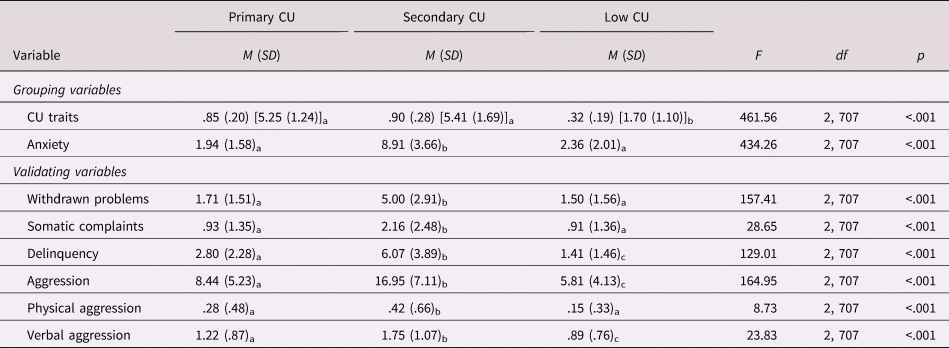
The two-cluster solution had a BIC change score of −309.58, an AIC change score of −328.07, and a ratio of distance measure of 1.78. The three-cluster solution had a BIC change score of −162.56, an AIC change score of −181.05, and a ratio of distance measure of 2.92. The four-cluster solution had a BIC change score of −38.25, an AIC change score of −56.74, and a ratio of distance measure of 1.03. Thus, the clustering analysis identified an optimal three-group solution: a high CU and low anxiety group (primary CU variant, n = 282; high-risk, n = 135, normative, n = 147; male, n = 187, female, n = 95), a high CU and high anxiety group (secondary CU group, n = 142; high-risk, n = 93, normative, n = 49; male, n = 84, female, n = 58), and a low CU and low anxiety group (low group, n = 328; high-risk, n = 137, normative, n = 191; male, n = 165, female, n = 163).
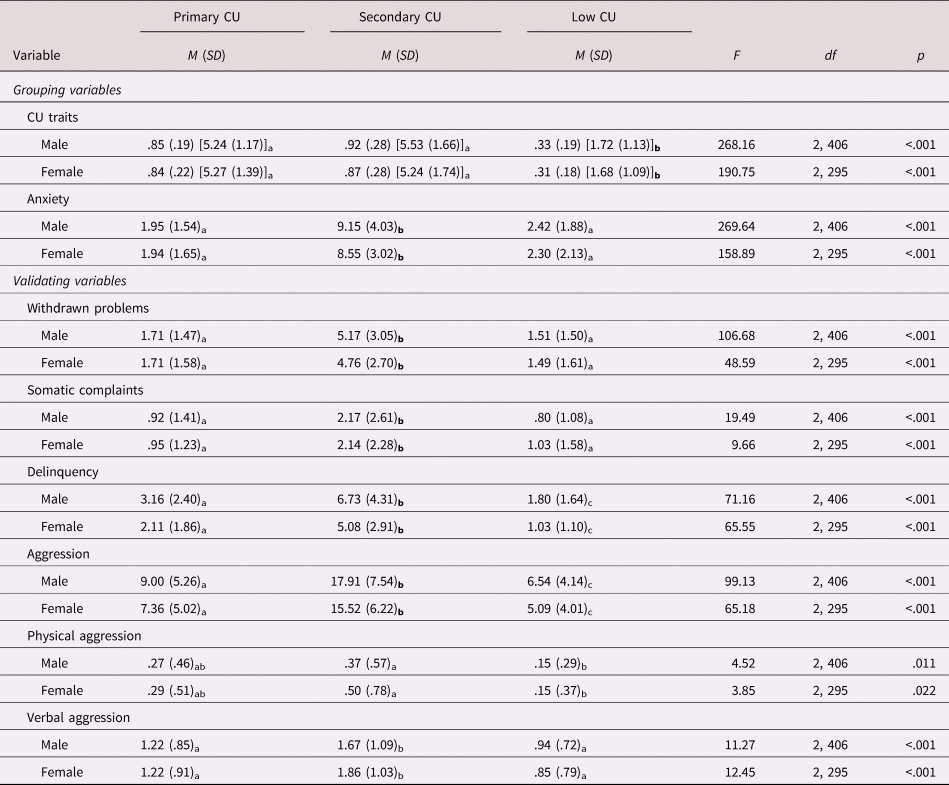
As shown in Table 1, primary and secondary CU variants did not differ on the level of CU traits, but they scored higher than the low group. Conversely, primary CU variants and the low group did not differ on anxiety, but they scored lower than secondary CU variants. With regard to the validating variables, secondary CU variants scored higher than primary CU variants and the low group on withdrawn problems, somatic complaints, and physical aggression. Finally, all groups differed from each other on delinquency, aggression, and verbal aggression, with secondary CU variants scoring the highest, followed by primary CU variants, and then the low group. The findings remained mostly consistent when examining males and females separately (see Table 2).
Comparison of CU variants and low CU on grouping and validating variables
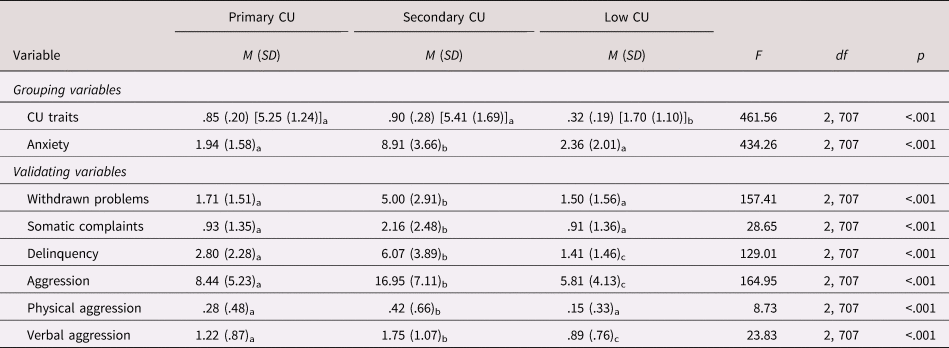
Note: CU = callous–unemotional. [] = sum scores. Subscripts indicate significant differences between groups (i.e., different subscripts indicating significant differences).
Comparison between male and female CU variants and low CU on grouping and validating variables
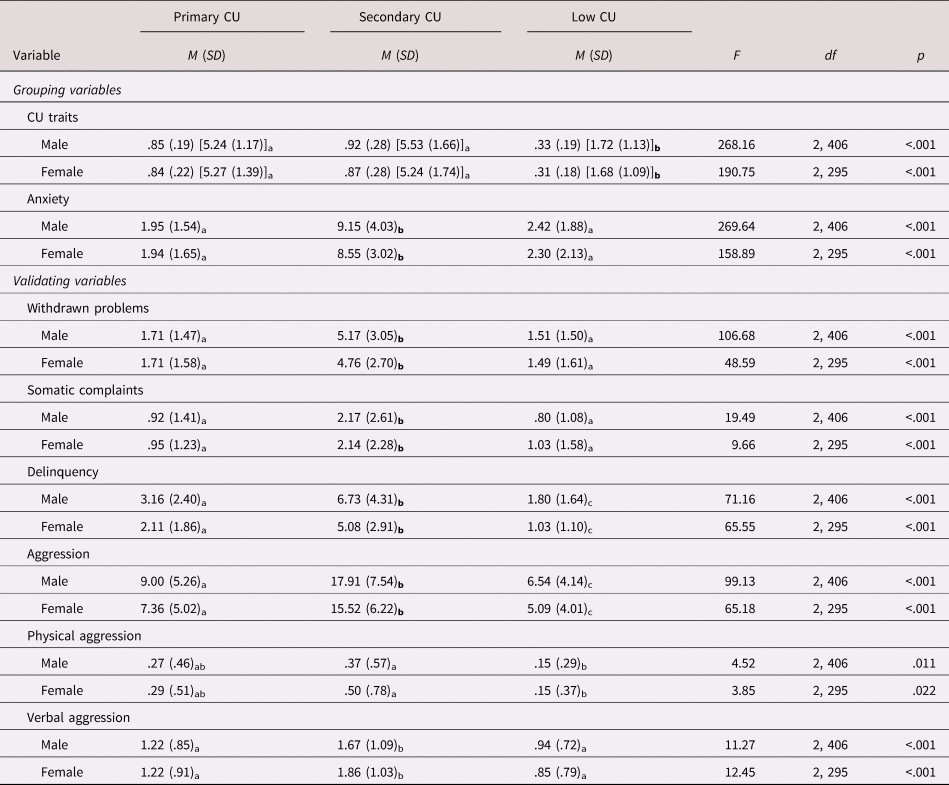
Note: CU = callous–unemotional. [] = sum scores. Subscripts indicate significant differences between groups (i.e., different subscripts indicating significant differences).
Outcome variables
Maladaptive outcomes
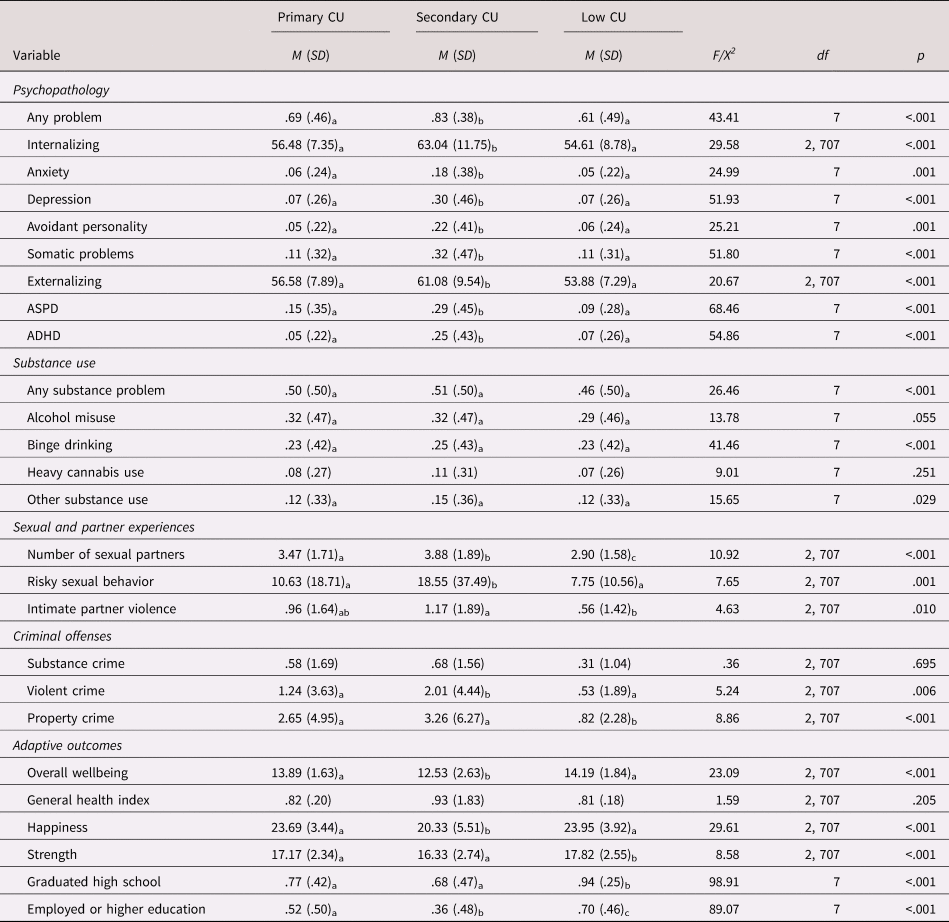
As shown in Table 3, compared with primary CU variants and the low group, secondary CU variants scored higher on levels of internalizing and externalizing psychopathology. In addition, compared to primary CU variants and the low group, secondary CU variants were also more likely to endorse our “any problem” variable, and clinical levels of anxiety, depression, avoidant personality, somatic problems, ASPD, and ADHD symptoms. Secondary CU variants also reported a greater number of sexual partners and risky sexual behavior compared with primary CU variants and the low group, and greater intimate partner violence compared with the low group. Finally, although both primary and secondary CU variants scored higher than the low group on property crime, secondary CU variants scored higher than both primary CU variants and the low group on violent crime. Groups did not differ on clinical levels of substance use or substance crime.
Comparisons between CU variants and low CU on outcome variables
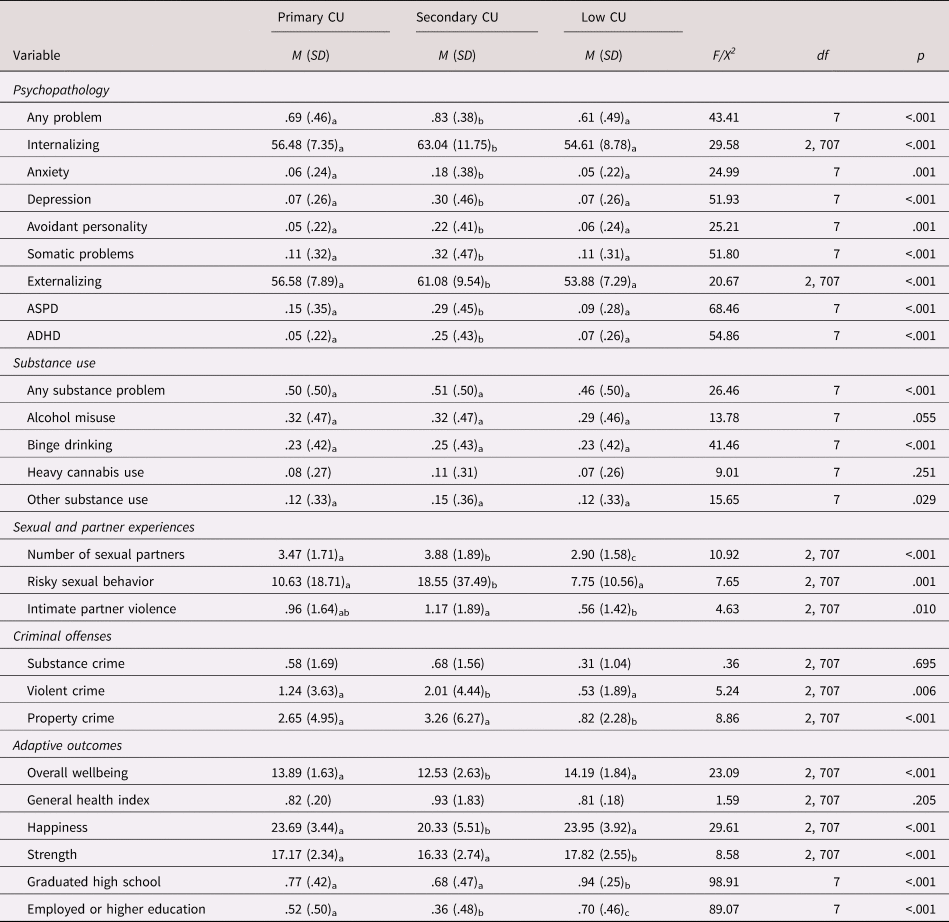
Note: CU = callous–unemotional, ASPD = antisocial personality disorder, ADHD = attention-deficit/hyperactivity disorder. Subscripts indicate significant differences between groups (i.e., different subscripts indicating significant differences).
Adaptive outcomes
With regard to adaptive outcomes, primary CU variants and the low CU group had higher overall wellbeing and happiness scores than secondary CU variants. The low group scored higher on strength, and was more likely to have graduated high school and be employed or in higher education, than both primary and secondary CU variants. Primary CU variants were more likely to be employed or in higher education than secondary CU variants. Groups did not differ on the general health index.
Sex differences
Maladaptive outcomes
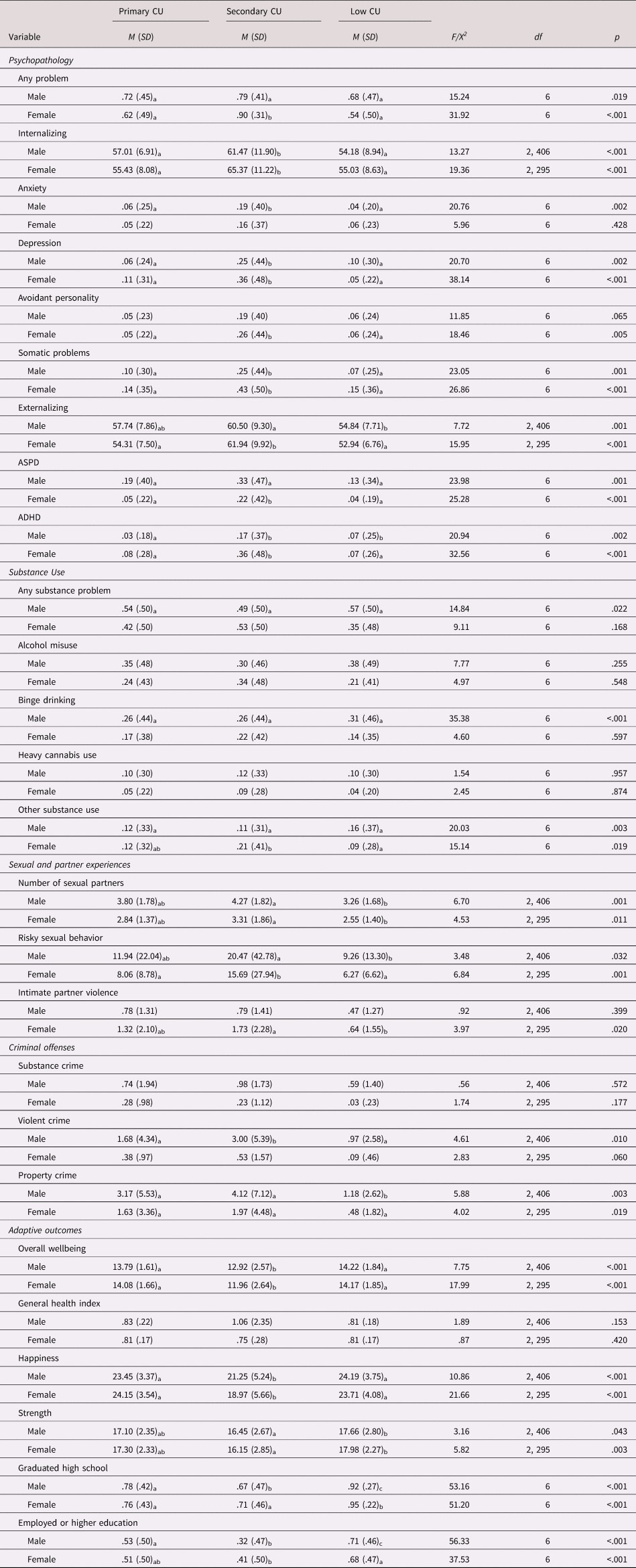
As shown in Table 4, male and female secondary CU variants scored higher on levels of internalizing symptoms, and were more likely to show clinical levels of depression and somatic problems compared with their primary CU and low counterparts. Compared with female primary CU variants and the low group, female secondary CU variants were more likely to endorse “any problem” and clinical levels of avoidant personality symptoms; groups did not differ on these variables in the male sample. Compared with male primary CU variants and the low group, male secondary CU variants were more likely to show clinical levels of anxiety; groups did not differ on anxiety in the female sample. With regard to externalizing problems, male primary and secondary CU variants did not differ from each other, but female secondary CU variants scored higher than female primary CU variants and the low group. Whereas male primary and secondary CU variants did not differ on ASPD symptoms, female secondary CU variants were more likely to show ASPD symptoms than female primary CU variants and the low group. Finally, male secondary CU variants were more likely to show clinical levels of ADHD symptoms than male primary CU variants; and female secondary CU variants were more likely to show ADHD symptoms, compared with both female primary CU traits and the low group. Female secondary CU variants scored higher than the low group on other substance use. There were no other group differences for the male and female samples on substance use.
Comparison between male and female CU variants and low CU on outcome variables
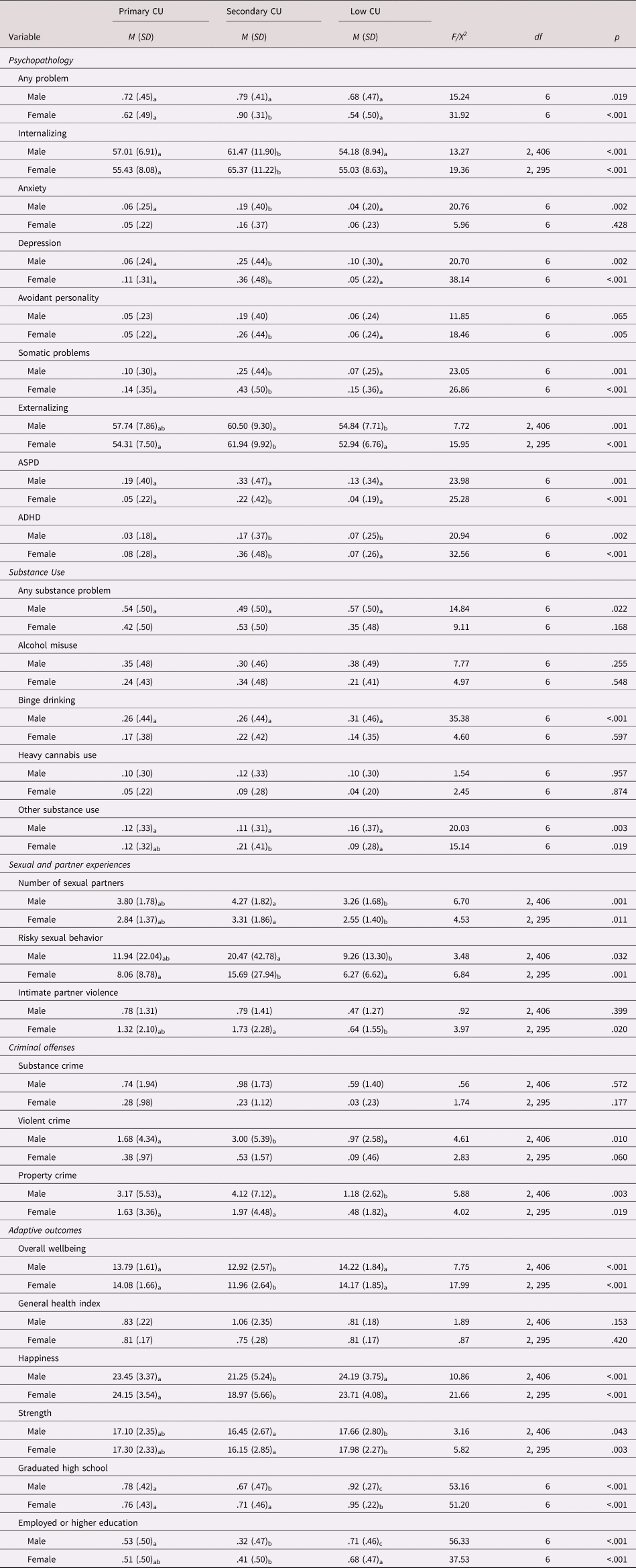
Note: CU = callous–unemotional, ASPD = antisocial personality disorder, ADHD = attention-deficit/hyperactivity disorder. Subscripts indicate significant differences between groups (i.e., different subscripts indicating significant differences).
Male and female primary and secondary CU variants did not differ on number of sexual partners, but male and female secondary CU variants scored higher than their low symptom counterparts. This finding was consistent for males and risky sexual behavior; however, for the female sample, secondary CU variants scored higher than primary CU variants and the low group. Female primary and secondary CU variants did not differ on intimate partner violence, but female secondary CU variants scored higher than the low group. Whereas male secondary CU variants scored higher than both male primary CU variants and the low group on violent crime, there were no significant differences for the female sample. Finally, male primary and secondary CU variants scored higher than the low group on property crime, and there were no significant differences for the female sample.
Adaptive outcomes
Male and female primary CU variants and the low CU group had higher overall wellbeing and happiness scores compared with their secondary CU counterparts. Male and female groups did not differ on general health index scores. Males and females in the low group scored higher than their secondary CU counterparts on strength. Males and females in the low group were more likely to have graduated high school than both primary and secondary CU variants. Finally, males in the low group were more likely to be employed or in higher education than male primary and secondary CU variants, and females in the low group were more likely to be employed or in higher education than male secondary CU variants.
Discussion
The purpose of this study was to inform current developmental understanding of the phenotypic presentations of primary versus secondary CU variants. Almost all prior research on CU variants has used cross-sectional study designs and, although mixed-sex samples have been used, few studies have examined sex differences. This prospective longitudinal study found that individuals with primary and secondary CU traits identified in Grade 7, and validated against several theoretically relevant constructs in Grade 7, predicted distinct maladaptive and adaptive outcomes more than 10 years later at age 25. It is important to note that primary and secondary CU variants did not differ on level of CU traits, but they scored higher than the low CU and anxiety symptoms group. Furthermore, primary CU variants and the low group did not differ on anxiety, but they scored lower than secondary CU variants. These findings provide support for the identification of CU variants in the present sample and they are in line with past research (Kimonis et al., Reference Kimonis, Frick, Cauffman, Goldweber and Skeem2012a, Reference Kimonis, Fanti, Goulter and Hall2016a).Footnote 5 While some studies on CU variants have also identified an anxiety-only group, these studies are often composed of clinical or self-reporting samples (e.g., Fanti et al., Reference Fanti, Demetriou and Kimonis2013; Kahn et al., Reference Kahn, Frick, Youngstrom, Kogos Youngstrom, Feeny and Findling2013). In the present study, our sample was characterized as a high-risk community sample and parents reported on CU traits and anxiety symptoms. Many other studies on CU variants also do not identify an anxiety-only group (e.g., Euler et al., Reference Euler, Jenkel, Stadler, Schmeck, Fegert, Kölch and Schmid2015; Fanti & Kimonis, Reference Fanti and Kimonis2017; Gill & Stickle, Reference Gill and Stickle2016), and these differences support the need for further research on CU variants across diverse samples.
With regard to adult outcomes, we found that, compared with individuals with primary CU traits and those with low symptoms, individuals with secondary CU traits reported greater adult internalizing and externalizing problems, a greater number of sexual partners and risky sexual behavior, and greater involvement in violent crime. Conversely, individuals with primary CU traits and low symptoms had greater wellbeing and happiness than those individuals with secondary CU traits, and those with low symptoms were more likely to have graduated high school and be employed or in higher education, compared with both primary and secondary CU variants. Primary CU variants were more likely to be employed or in higher education than secondary CU variants. We also found several differences across the male and female samples, which we discuss further below.
Maladaptive outcomes
Secondary CU variants scored significantly higher on Grade 7 withdrawn problems and somatic complaints validating variables, and were more likely to endorse clinical levels of anxiety and depression, compared with primary CU variants and the low group. These findings support past cross-sectional studies (Fanti et al., Reference Fanti, Demetriou and Kimonis2013; Tatar et al., Reference Tatar, Cauffman, Kimonis and Skeem2012), and we extend this research by showing that these associations are established over 10 years later. Compared with primary CU variants and the low group, secondary CU variants also showed a greater probability of endorsing adult avoidant personality clinical-range symptoms. Avoidant personality disorder (i.e., feelings of inadequacy and hypersensitivity to negative evaluation in social situations) (American Psychiatric Association, 2013) has not been examined previously with regard to CU variants, but our finding is perhaps not surprising given the link between avoidant symptoms and experiences of early life stress (Taillieu, Brownridge, Sareen, & Afifi, Reference Taillieu, Brownridge, Sareen and Afifi2016).
In the externalizing domain, secondary CU variants scored significantly higher on Grade 7 delinquent and aggression validating variables and adult externalizing symptoms, compared with primary CU variants and the low group. As noted earlier, the research on externalizing problems among primary versus secondary CU variants is equivocal and the divergent findings may be due to the level of emotionality associated with specific problems (e.g., proactive vs. reactive aggression) (Kahn et al., Reference Kahn, Frick, Youngstrom, Kogos Youngstrom, Feeny and Findling2013; Kimonis et al., Reference Kimonis, Skeem, Cauffman and Dmitrieva2011; Vaughn et al., Reference Vaughn, Edens, Howard and Smith2009). In other words, secondary CU variants may be more reactively aggressive than primary CU variants, who may be more instrumental in their aggressive behavior. It would be important for future research to further explore functions (i.e., reactive vs. proactive/instrumental) and forms (i.e., physical vs. psychological) of aggression among CU variants. Secondary CU variants were also more likely to endorse adult ASPD and ADHD clinical-range symptoms than primary CU variants and the low group. Similar to avoidant personality symptoms, ASPD symptoms have also been linked to experiences of early life stress and poor parenting behaviors (Taillieu et al., Reference Taillieu, Brownridge, Sareen and Afifi2016). In addition, experiences of stress are associated with emotion dysregulation, which may have contributed to secondary CU variants endorsing greater adult ADHD clinical-range symptoms, compared with primary CU variants. ADHD is characterized by emotion dysregulation and reward dominance, and CU traits are also typified by reward dominance (Frick, Kimonis, Dandreaux, & Farell, Reference Frick, Kimonis, Dandreaux and Farell2003). The present findings add to preliminary evidence linking dysregulated ADHD symptoms to secondary CU traits (Craig & Moretti, Reference Craig and Moretti2019; Kahn et al., Reference Kahn, Frick, Youngstrom, Kogos Youngstrom, Feeny and Findling2013).
Although secondary CU variants had a greater number of violent offenses relative to primary CU variants and the low group, primary and secondary CU variants were undifferentiated on property offenses. We hypothesized that secondary CU variants would score higher on criminality than primary CU variants, given the link between secondary variants and criminality in the youth literature (Vaughn et al., Reference Vaughn, Edens, Howard and Smith2009); our findings suggest that this may be specific to violent crime. Further, compared with individuals with primary CU traits and the low group, those with secondary CU traits reported a greater number of sexual partners and greater risky sexual behavior – in line with past research linking early adversity and risky sexual behavior (Homma et al., Reference Homma, Wang, Saewyc and Kishor2012). Finally, we did not find that primary and secondary CU variants were distinguished on substance use or intimate partner violence. As mentioned earlier, to our knowledge, the present study is the first to examine intimate partner violence and risky sexual behavior among CU variants. Thus, further research is needed to further explore the associations between these variables.
Adaptive outcomes
Given the construct of successful psychopathy (Lykken, Reference Lykken1995) in the adult psychopathy literature, it is surprising that no research has examined adaptive outcomes of primary and secondary CU variants, with the exception of the work of Fanti and Kimonis (Reference Fanti and Kimonis2017). Our findings that primary CU variants scored higher on several adaptive outcomes, compared with secondary CU variants, contribute significantly to this research base. Primary CU variants scored higher on adult overall wellbeing (which included general physical health) and happiness, than secondary CU variants. Antisocial and violent behaviors were not included as characteristics of psychopathy in original conceptualizations (Cleckley, Reference Cleckley1976). Thus, the adaptive findings may be the consequence of primary and secondary CU variants’ putative etiologies, such that primary CU variants have escaped the poor parenting behaviors and heightened negative emotionality experienced by secondary CU variants in early childhood and it is these experiences that shape the development of poorer physical health among the secondary group (Felitti et al., Reference Felitti, Anda, Nordenberg, Williamson, Spitz, Edwards and Marks1998; Norman et al., Reference Norman, Byambaa, De, Butchart, Scott and Vos2012). Given the role of other psychopathy dimensions in adaptive outcomes (i.e., narcissism; Smith & Lilienfeld, Reference Smith and Lilienfeld2013), it would also be important for future research to examine narcissism in the context of CU variants.
Sex differences
We identified several sex differences, and these showed that there was differentiation on outcomes between female primary and secondary CU variants and male primary and secondary CU variants. Research on CU traits has focused on male samples and even less research has examined sex differences among CU variants more specifically. Of the variant studies that have examined sex, two cross-sectional studies did not find significant differences between male and female CU variants on negative affect (Craig & Moretti, Reference Craig and Moretti2019; Gill & Stickle, Reference Gill and Stickle2016). In the present longitudinal study, compared with females with primary CU traits, females with secondary CU traits reported greater levels of externalizing symptoms and risky sexual behavior, and were more likely to endorse a clinical range of avoidant and ASPD symptoms. Female primary and secondary CU variants were not differentiated on anxiety. Porter (Reference Porter1996) suggested that the development of CU traits among secondary variants is an adaptive developmental mechanism involving emotional suppression or numbing to cope with their experiences of early life trauma – described as “acquired callousness” by some researchers (Bennett & Kerig, Reference Bennett and Kerig2014; Kerig, Bennett, Thompson, & Becker, Reference Kerig, Bennett, Thompson and Becker2012). The present study is the first to examine an extended timeframe for outcomes; perhaps by adulthood, female secondary CU variants have suppressed their psychological distress and they no longer recognize or sense their anxiety symptoms. Subsequent longitudinal research should examine adolescent-to-adult trajectories of anxiety symptoms among individuals with secondary CU traits to empirically examine Porter's (Reference Porter1996) thesis and determine the developmental timing of secondary CU variants’ dissociation of affect.
Conversely, male primary and secondary CU variants were not distinguished on these variables. Where male CU variants diverged was on clinical levels of anxiety and violent offending, such that male secondary CU variants were more likely to endorse clinical levels of anxiety and have higher levels of violent crime compared with male primary CU variants and the low symptoms group. Past research has suggested that adverse environmental factors play a greater role in the development of CU traits in female samples relative to male samples, for whom genetic factors are more strongly associated with CU development (Fontaine et al., Reference Fontaine, Rijsdijk, McCrory and Viding2010). Adverse experiences, particularly poor parenting behaviors, often result in a developmental “cascade” of negative psychosocial consequences that continues throughout the life course (Cicchetti, Reference Cicchetti2016, p. 2). Thus, among female populations, the greater impact of environmental factors on the development of CU traits may result in female primary and secondary CU variants to appear quite distinct over time. However, these differences may only become apparent when examining CU variants longitudinally. Among male samples, the greater genetic heritability on the development of CU traits may result in male primary and secondary CU variants appearing phenotypically similar and in line with the prototypical presentation. However, this has yet to be tested empirically. It is thus important for future research to examine sex-contingent differences in environmental versus genetic influences on primary and secondary developmental pathways. These findings are, however, in line with theoretical frameworks on the development of secondary CU traits (Karpman, Reference Karpman1941; Porter, Reference Porter1996) and may explain why cross-sectional studies do not find differences between male and female CU variants (Craig & Moretti, Reference Craig and Moretti2019; Gill & Stickle, Reference Gill and Stickle2016). It is important to note that this study was the first to examine the effect of sex on adult outcomes among CU variants and thus the aim and analyses were exploratory in approach. While our provisional findings on possible sex differences, particularly as they pertain to differences between primary and secondary CU variants (rather than across sex) add to this literature, further research is needed examining the role of sex (including as a potential moderator) on the development of primary versus secondary CU traits and adult outcomes.
Strengths and limitations
The present longitudinal study examined adult outcomes associated with adolescent primary and secondary CU variants, contributing significantly to the current research base, which primarily consists of cross-sectional studies. We also examined several outcomes that past research has neglected and identified several sex-specific findings. However, our findings must be considered within the context of several methodological limitations.
First, CU traits were assessed with the APSD. Although the APSD has been established as a strong instrument for assessing multidimensional psychopathic traits in youth samples, there is debate with regard to the CU subscale due to inconsistencies in the items across prior factor analytic studies. Future CU variant studies might consider employing a more comprehensive measures of CU traits, such as the Inventory of Callous–Unemotional Traits (Frick, Reference Frick2004). In addition, as indicated throughout, CU traits were not assessed with the APSD at any other time point, and thus we were unable to determine the stability of primary and secondary CU traits from adolescence to adulthood. Given that primary CU variants are theorized to be underpinned by a genetic constitution and secondary CU variants are suggested to have environmental origins (Karpman, Reference Karpman1941), it is plausible that secondary CU traits are less stable than primary CU traits. Research examining early low prosocial emotions provides preliminary support for the stability of primary CU traits relative to secondary CU traits (Craig et al., Reference Craig, Goulter and McMahon2021). This is an important avenue for future research to explore – understanding the stability of primary versus secondary CU traits has significant clinical implications for treatment timing and response.
Second, the other variable included in the cluster analysis was the CBCL anxious/depressed narrow-band scale. Although the majority of studies in this field use anxiety, our measure also included depression symptoms. However, this measure has been used in a number of youth CU variant studies (Craig et al., Reference Craig, Goulter and Moretti2020). The CBCL anxious/depressed narrow-band scale is also a better representation of posttraumatic symptoms than the six-item DSM-oriented anxiety scale, and more closely aligns with the original theory and conceptualizations of secondary CU traits (Karpman, Reference Karpman1941; Porter, Reference Porter1996). Secondary CU traits are thought to be a trauma response; thus, using measures that comprise anxiety, depression, and posttraumatic items, which are common among individuals with trauma histories (Gardner, Thomas, & Erskine, Reference Gardner, Thomas and Erskine2019), may more accurately identify secondary CU variants than anxiety alone.
Third, while the present study is the first to examine adult outcomes of adolescent primary and secondary CU traits, the majority of adolescent variant studies cluster on CU traits and the majority of adult variant studies cluster on the broader psychopathy construct. Given that our findings cover multiple developmental periods (i.e., adolescence and adulthood), we drew upon both the adolescent and adult variant research base to interpret the findings. However, as noted, these bodies of research have used different measures (i.e., CU traits vs. psychopathy, respectively) and thus our findings should be interpreted with caution until replicated across multiple approaches. Our field has also used varying methodologies to identify variants. In a recent systematic review examining CU variants in youth samples (k = 41), 28 studies used clustering methods (e.g., two-step approach) or mixture models (e.g., latent profile analyses), and some studies used moderation (k = 5) or clinical cutoffs (k = 4) (Craig et al., Reference Craig, Goulter and Moretti2020). Other methods included median or tertile splits, or using a certain standard deviation above the mean. We elected to use clustering analyses to most closely align with the field; however, other approaches may be more appropriate in some instances and further research is needed examining differing methodological approaches for identifying CU variants.
Implications and Conclusion
Examining developmental outcomes of primary and secondary CU variants has important theoretical and clinical implications. Theoretical perspectives on primary and secondary CU variants propose that individuals with primary CU traits may be innately deficient in affect, whereas secondary CU traits could be a developmental process resulting in dysfunctional affect (Karpman, Reference Karpman1941; Porter, Reference Porter1996). However, much of this research has been cross-sectional in design, and thus, our findings demonstrating distinct adult emotion-related outcomes (e.g., internalizing and externalizing symptoms) between primary and secondary CU variants inform these theoretical models by demonstrating that affective differences may persist into adulthood. In addition, it is these emotion-related outcomes that may also have implications for intervention development. For example, individuals identified as having secondary CU traits in early adolescence reported higher levels of internalizing and externalizing psychopathology in adulthood, relative to individuals with primary CU traits and those with low symptoms, suggesting that these individuals may benefit from interventions targeting emotion dysregulation. In contrast, intensive interventions focused on empathy skills and reward-oriented approaches may be more effective for those individuals with primary CU traits (Kimonis et al., Reference Kimonis, Fleming, Briggs, Brouwer-French, Frick, Hawes and Dadds2019). However, research examining treatment response among individuals with primary versus secondary CU traits is lacking, constituting an important area for future clinical development and research.
It is important to note that, for many outcomes, individuals with primary CU traits did not differ significantly from those with low CU and anxiety symptoms. However, compared with the low symptoms group, primary CU variants were more likely to have been convicted of property offenses and less likely to have graduated high school and to be employed or in higher education. These findings support research suggesting that CU traits are important in differentiating individuals at risk for a number of negative outcomes (Frick et al., Reference Frick, Ray, Thornton and Kahn2014). The diverse adult outcomes among individuals with primary versus secondary CU traits perhaps appear to pertain to their distinct etiologies. That is, primary CU variants, with their theorized temperamentally fearless disposition, showed greater adult criminality compared to those with low symptoms, but also greater adaptive outcomes compared to those with secondary CU traits. Conversely, secondary CU variants, with their distinct early life experiences (Craig et al., Reference Craig, Goulter and McMahon2021), showed greater negative emotionality as assessed by a number of outcomes. Of note, primary and secondary CU variants were indistinguishable on adolescent CU traits, and although we were unable to determine whether this persisted into adulthood, the present findings support the importance of considering subtyping or clustering approaches given the divergent future pathways of CU variants. Our findings also point to the importance of longitudinal research for informing sex differences in developmental models of CU variants. In sum, studying various developmental pathways results in more accurate conceptualization of antisocial behavior, which in turn can serve as the foundation for more successful intervention efforts.
Acknowledgments
Data from the Fast Track project (http://www.fasttrackproject.org) were used in this work. We are grateful to the members of the Conduct Problems Prevention Research Group (in alphabetical order, Karen L. Bierman, Pennsylvania State University; John D. Coie, Duke University; D. Max Crowley, Pennsylvania State University; Kenneth A. Dodge, Duke University; Mark T. Greenberg, Pennsylvania State University; John E. Lochman, University of Alabama; Robert J. McMahon, Simon Fraser University and BC Children's Hospital Research Institute, and Ellen E. Pinderhughes, Tufts University) for providing the data and for additional involvement. We are grateful for the collaboration of the Durham Public Schools, the Metropolitan Nashville Public Schools, the Bellefonte Area Schools, the Tyrone Area Schools, the Mifflin County Schools, the Highline Public Schools, and the Seattle Public Schools. We appreciate the hard work and dedication of the many staff members who implemented the project, collected the evaluation data, and assisted with data management and analyses.
Funding Statement
The Fast Track project has been supported by the National Institute of Mental Health (grants R18MH48043, R18MH50951, R18MH50952, R18MH50953, R01MH062988, K05MH00797, and K05MH01027), the National Institute on Drug Abuse (grants R01DA016903, K05DA15226, RC1DA028248, and P30DA023026), the National Institute of Child Health and Human Development (grant R01HD093651), and the Department of Education (grant S184U30002). The Center for Substance Abuse Prevention also provided support through a memorandum of agreement with the National Institute of Mental Health. Additional support for this study was provided by a BC Children's Hospital Research Institute Investigator Grant Award and a Canada Foundation for Innovation Award to Robert J. McMahon.
Conflicts of Interest
None.