Introduction
Greater wellbeing and resilience may be associated with higher levels of cognitive performance, yet little is known about the relationship between neural circuits engaged by cognitive tasks and wellbeing and resilience, and whether genetics or environment contribute to these associations. Mental wellbeing is comprised of subjective wellbeing or ‘hedonia’ (defined as levels of positive and negative affect and satisfaction with life), and psychological wellbeing or ‘eudaimonia’ (defined as the development of human potential, including concepts such as autonomy and purpose in life) (Gatt, Burton, Schofield, Bryant, & Williams, Reference Gatt, Burton, Schofield, Bryant and Williams2014). In contrast, resilience is defined as the process of adaptive recovery following adversity or trauma (Alexander & Gatt, Reference Alexander, Gatt, Miu, Homberg and Lesch2019).
Previous behavioural studies have demonstrated positive associations between wellbeing and cognitive functions, including cognitive inhibition, flexibility, motor coordination, working memory and sustained attention (e.g. Davis et al., Reference Davis, Bryan, Li, Best, Hsu, Gomez and Liu-Ambrose2015; Gale et al., Reference Gale, Cooper, Craig, Elliott, Kuh, Richards and Deary2012; Lee & Chao, Reference Lee and Chao2012; Llewellyn, Lang, Langa, & Huppert, Reference Llewellyn, Lang, Langa and Huppert2008; Routledge et al., Reference Routledge, Burton, Williams, Harris, Schofield, Clark and Gatt2017). For example, Llewellyn et al. (Reference Llewellyn, Lang, Langa and Huppert2008) found a positive association between wellbeing (measured by the CASP-19) and cognitive function, including time orientation, verbal memory, prospective memory, verbal fluency, numerical ability, cognitive speed, and attention, in a cohort of 11 234 adults aged 50 and above. This is in line with other research showing a relationship between general cognitive ability at age 11 and wellbeing (using the Warwick–Edinburgh Mental Wellbeing Scale) later in life in a meta-analysis of four cohorts totalling 8191 participants aged between 50 and 87 years (Gale et al., Reference Gale, Cooper, Craig, Elliott, Kuh, Richards and Deary2012). Similarly for resilience, greater cognitive function, including cognitive performance under stress (Simeon et al., Reference Simeon, Yehuda, Cunill, Knutelska, Putnam and Smith2007), has been associated with higher levels of resilience (Deng et al., Reference Deng, Pan, Zhou, Chen, Liu, Huang and Rosenheck2018; Gilbertson et al., Reference Gilbertson, Paulus, Williston, Gurvits, Lasko, Pitman and Orr2006; Parsons, Kruijt, & Fox, Reference Parsons, Kruijt and Fox2016; Wingo, Fani, Bradley, & Ressler, Reference Wingo, Fani, Bradley and Ressler2010). Based on this behavioural evidence, it is therefore likely that the neural circuits underpinning cognitive function, or more specifically executive functioning, is also associated with wellbeing and resilience (Alexander & Gatt, Reference Alexander, Gatt, Miu, Homberg and Lesch2019; Berridge & Kringelbach, Reference Berridge and Kringelbach2011; Feder, Nestler, & Charney, Reference Feder, Nestler and Charney2009). In line with this idea, studies have reported relationships between weaker hippocampal activation and post-traumatic stress disorder (PTSD) symptoms severity during an inhibition task (Go/NoGo) (van Rooij et al., Reference van Rooij, Stevens, Ely, Hinrichs, Michopoulos, Winters and Jovanovic2018), between higher dorsolateral prefrontal cortex activity and resilience to anxiety during a working memory task (Scult, Knodt, Radtke, Brigidi, & Hariri, Reference Scult, Knodt, Radtke, Brigidi and Hariri2017), and between decreased functional coupling between inhibitory control and memory-related regions-of-interest, and resilience to trauma during a memory suppression task (Mary et al., Reference Mary, Dayan, Leone, Postel, Fraisse, Malle and Gagnepain2020). Conversely, other research has shown that impairments in cognitive functions, particularly for executive functioning, are normally observed in various major mental illnesses using behavioural and neuroimaging methodologies (Alexander & Gatt, Reference Alexander, Gatt, Miu, Homberg and Lesch2019; Williams, Reference Williams2016). Comparatively, very limited neuroimaging research has been conducted in wellbeing and resilience and their association with executive function, which include tasks of working memory, attention and inhibition, and even less so in twin samples.
The goal of this study is to investigate the associations between wellbeing, resilience, and the neural correlates of sustained attention and working memory in a sample of healthy adult twins (future studies will consider the associative role of inhibition). To measure wellbeing, we will use the COMPAS-W wellbeing questionnaire, a composite measure of subjective and psychological wellbeing (Gatt et al., Reference Gatt, Burton, Schofield, Bryant and Williams2014). To measure resilience, we will focus on those individuals who report exposure to early trauma and will assess their levels of positive adaptation (i.e. levels of wellbeing despite trauma exposure). To measure sustained attention and working memory, we will use the well-validated Continuous Performance Task (CPT) (Riccio, Reynolds, Lowe, & Moore, Reference Riccio, Reynolds, Lowe and Moore2002). This task has been employed in various studies (Breukelaar et al., Reference Breukelaar, Williams, Antees, Grieve, Foster, Gomes and Korgaonkar2018; Gatt et al., Reference Gatt, Burton, Routledge, Grasby, Korgaonkar, Grieve and Williams2018; Korgaonkar, Grieve, Etkin, Koslow, & Williams, Reference Korgaonkar, Grieve, Etkin, Koslow and Williams2013) and includes a working memory load. In our previous work using the same task and a larger sample of twins (n = 1502) from the TWIN-E study (Gatt et al., Reference Gatt, Korgaonkar, Schofield, Harris, Clark, Oakley and Williams2012), we showed that increased wellbeing was associated with better-sustained attention and working memory at the behavioural level (Routledge et al., Reference Routledge, Burton, Williams, Harris, Schofield, Clark and Gatt2017). In addition, multivariate twin analyses in the same study revealed a significant genetic correlation between wellbeing and working memory performance, and no significant genetic or environmental correlations between wellbeing and sustained attention, with a (non-significant) genetic correlation nonetheless stronger than the environmental correlation.
By comparing twins, we will examine how different genetic and environmental factors may contribute to the working memory and sustained attention-related neural circuits in terms of heritability and shared genetic and environmental variance. Heritability of the COMPAS-W scale has been estimated at 48% (Gatt et al., Reference Gatt, Burton, Schofield, Bryant and Williams2014), while twin-based heritability estimates of resilience vary from 25% to 70% (e.g. Hofgaard, Nes, & Røysamb, Reference Hofgaard, Nes and Røysamb2021; Kim-Cohen, Moffitt, Caspi, & Taylor, Reference Kim-Cohen, Moffitt, Caspi and Taylor2004; Wolf et al., Reference Wolf, Miller, Sullivan, Amstadter, Mitchell, Goldberg and Magruder2018), depending on how resilience is defined and measured. However, the genetic contribution of neuroimaging correlates of wellbeing and resilience is still lacking. In terms of the heritability of brain activations related to working memory, the largest twin study to date has reported estimates between 0% and 65%, averaging at around 33% (Blokland et al., Reference Blokland, McMahon, Thompson, Martin, de Zubicaray and Wright2011). To the best of our knowledge, no twin study has investigated the heritability of sustained attention-related brain activation. Moreover, no twin study has evaluated whether any associations between wellbeing and brain activations to working memory and sustained attention are driven by common genetic or environmental factors. This information will help determine the causal drivers as well as highlight appropriate intervention options that may be useful in improving wellbeing and resilience.
Based on previous work showing a positive association between wellbeing and behavioural sustained attention and working memory performance (e.g. Davis et al., Reference Davis, Bryan, Li, Best, Hsu, Gomez and Liu-Ambrose2015; Gale et al., Reference Gale, Cooper, Craig, Elliott, Kuh, Richards and Deary2012; Routledge et al., Reference Routledge, Burton, Williams, Harris, Schofield, Clark and Gatt2017), we hypothesise that levels of wellbeing and resilience to trauma would be associated with neural activity in some of the brain regions implicated in attention and memory. We also hypothesise that the heritability of brain regions associated with sustained attention, working memory and wellbeing and resilience will be low to moderate, based on previous behavioural and fMRI twin studies (Blokland et al., Reference Blokland, McMahon, Hoffman, Zhu, Meredith, Martin and Wright2008, Reference Blokland, McMahon, Thompson, Martin, de Zubicaray and Wright2011; Matthews et al., Reference Matthews, Simmons, Strigo, Jang, Stein and Paulus2007; Routledge et al., Reference Routledge, Burton, Williams, Harris, Schofield, Clark and Gatt2017). Finally, we predict that the relationships between measures of wellbeing and resilience and neural activity would reflect a stronger shared genetic contribution in light of our previous behavioural results (Routledge et al., Reference Routledge, Burton, Williams, Harris, Schofield, Clark and Gatt2017), assessed using multivariate twin modelling of monozygotic and dizygotic twin pairs.
Methods
Participants
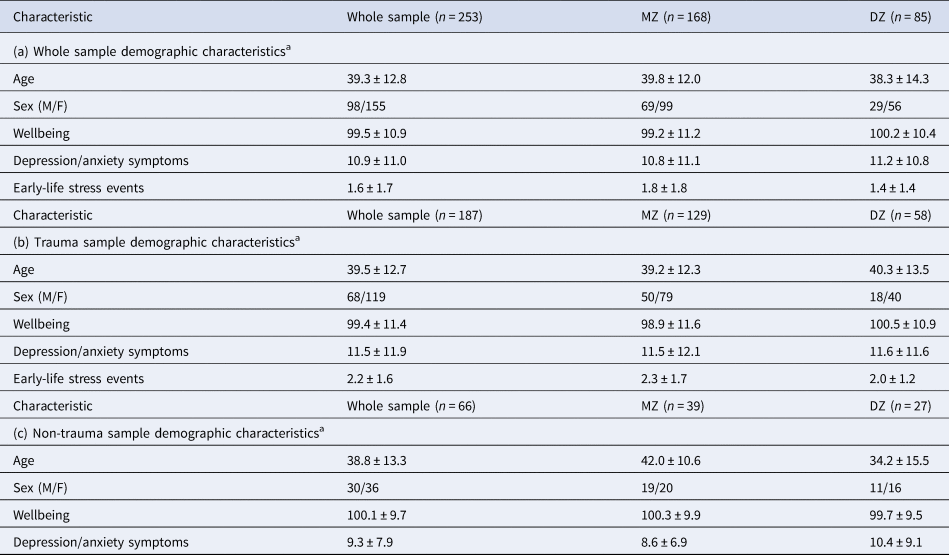
Healthy same-sex monozygotic and dizygotic twins from the TWIN-E study participated in this study (Gatt et al., Reference Gatt, Korgaonkar, Schofield, Harris, Clark, Oakley and Williams2012). The study received approval from the Human Research Ethics Committees of the University of Sydney (03–2009/11 430) and Flinders University (FCREC#08/09). Prior to enrolment, all participants provided written informed consent after receiving a written description of the study. Eligible participants were same-sex, healthy, adult twin pairs, with English as a primary language, and of European ancestry to avoid population stratification effects in genetic analyses. Exclusion criteria include lifetime/current psychiatric illness (based on diagnostic self-report); stroke or neurological disorder; genetic disorder; brain injury (causing loss of consciousness for more than 10 min); chronic and serious medical conditions (e.g. cancer or heart disease); blood-borne illnesses (e.g. HIV, hepatitis); drug/alcohol substance abuse; and sensory impairments to hearing, hand movement, or vision (not corrected by glasses/lenses). For those twins involved in the MRI-testing component, several other safety criteria are checked and confirmed prior to testing, including prior surgeries, body piercings, tattoos or permanent eyeliner, magnetic dentures, the presence of metal clips, implants, stents, rods or screws, or foreign metal fragments and shrapnel. In addition, participants are automatically excluded from the MRI session if they are pregnant or breastfeeding, or weigh over 150 kg. The present study included 260 twins who completed the fMRI testing phase at the University of Sydney. Of these 260 participants, four were excluded because of head movements (>2 mm) and three because of artefacts in the functional images, resulting in a sample size of 253 (Table 1). The trauma-exposed sub-sample consisted of 187 participants and the non-trauma exposed sub-sample consisted of 66 participants (Table 1).
Sample demographic characteristics

MZ, monozygotic twins; DZ, dizygotic twins.
Wellbeing was measured using the COMPAS-W and depression/anxiety symptoms was measured using the Depression Anxiety Stress Scale (DASS-42).
a Results presented as mean ± standard deviation.
Questionnaires
The methodology used in the current study has been previously used in healthy and clinical populations (Paul et al., Reference Paul, Lawrence, Williams, Richard, Cooper and Gordon2005, Reference Paul, Gunstad, Cooper, Williams, Clark, Cohen and Gordon2007; Silverstein et al., Reference Silverstein, Berten, Olson, Paul, Willams, Cooper and Gordon2007; Williams et al., Reference Williams, Simms, Clark, Paul, Rowe and Gordon2005) and is detailed in Gatt et al., Reference Gatt, Korgaonkar, Schofield, Harris, Clark, Oakley and Williams2012. Using the WebQ online test battery (Gatt et al., Reference Gatt, Korgaonkar, Schofield, Harris, Clark, Oakley and Williams2012), we measured wellbeing using the COMPAS-W, a 26-item composite measure of subjective and psychological wellbeing (Gatt et al., Reference Gatt, Burton, Schofield, Bryant and Williams2014). This scale has demonstrated high internal and test-retest reliability and validity (Gatt et al., Reference Gatt, Burton, Schofield, Bryant and Williams2014). Here, we used the raw total wellbeing score as a continuous variable measuring both subjective and psychological wellbeing. Trauma participants were also grouped into three categories of wellbeing based on their COMPAS-W z-scores (one standard deviation (sd) below average, and one standard deviation above). Those who scored 1 sd below (−1 sd) were labelled as languishing, those who scored between −1 and +1 sd were included in the moderate group, while those with +1 sd scores were included in the flourishing group. This categorisation was consistent with cluster analysis (Gatt et al., Reference Gatt, Burton, Schofield, Bryant and Williams2014) and was used in the present study to graph group insulae z-score means, for data visualisation purposes.
Resilience was defined as a positive adaptation in the presence of trauma exposure. In this study, we used the COMPAS-W scores to define resilience in the sub-sample of participants who reported exposure to childhood trauma. This method provides a continuous variable of resilience, where participants exposed to trauma yet reporting high wellbeing scores were considered more resilient. Participants exposed to trauma and reporting low wellbeing scores were considered less resilient. This method of defining resilience has been used and validated (Gatt et al., Reference Gatt, Burton, Routledge, Grasby, Korgaonkar, Grieve and Williams2018).
We measured early-life stress (trauma) using the 19-item Early Life Stress Questionnaire, which assesses the occurrence of specific early-life stressors before the age of 19 years that have been shown to have a psychological impact in childhood, including abuse, neglect, family conflict, illness/death of relatives and natural disasters. This measure has demonstrated high reliability, validity and internal consistency (Sanders & Becker-Lausen, Reference Sanders and Becker-Lausen1995).
We also measured depression and anxiety symptoms using the Depression Anxiety and Stress Scale (DASS-42) (Lovibond & Lovibond, Reference Lovibond and Lovibond1995). The DASS-42 is a questionnaire consisting of three self-report scales designed to measure the symptoms of depression, anxiety and stress which has demonstrated high internal reliability and has been validated with other measures of depression and anxiety (Crawford & Henry, Reference Crawford and Henry2003). In our previous study of the overall TWIN-E sample assessed with behavioural measures (Routledge et al., Reference Routledge, Burton, Williams, Harris, Schofield, Clark and Gatt2016), we showed that DASS-42 and COMPAS-W share about 30% of the variance in scores in this healthy cohort, demonstrating their mutual importance in the measurement of overall mental health. Therefore, we included the DASS-42 to examine the associations between cognitive functions and wellbeing, independent of symptoms of depression and anxiety. Because the DASS-42 scores were positively skewed, we applied a log plus 1 transformation in order to normalise the distribution of the data.
Functional MRI task
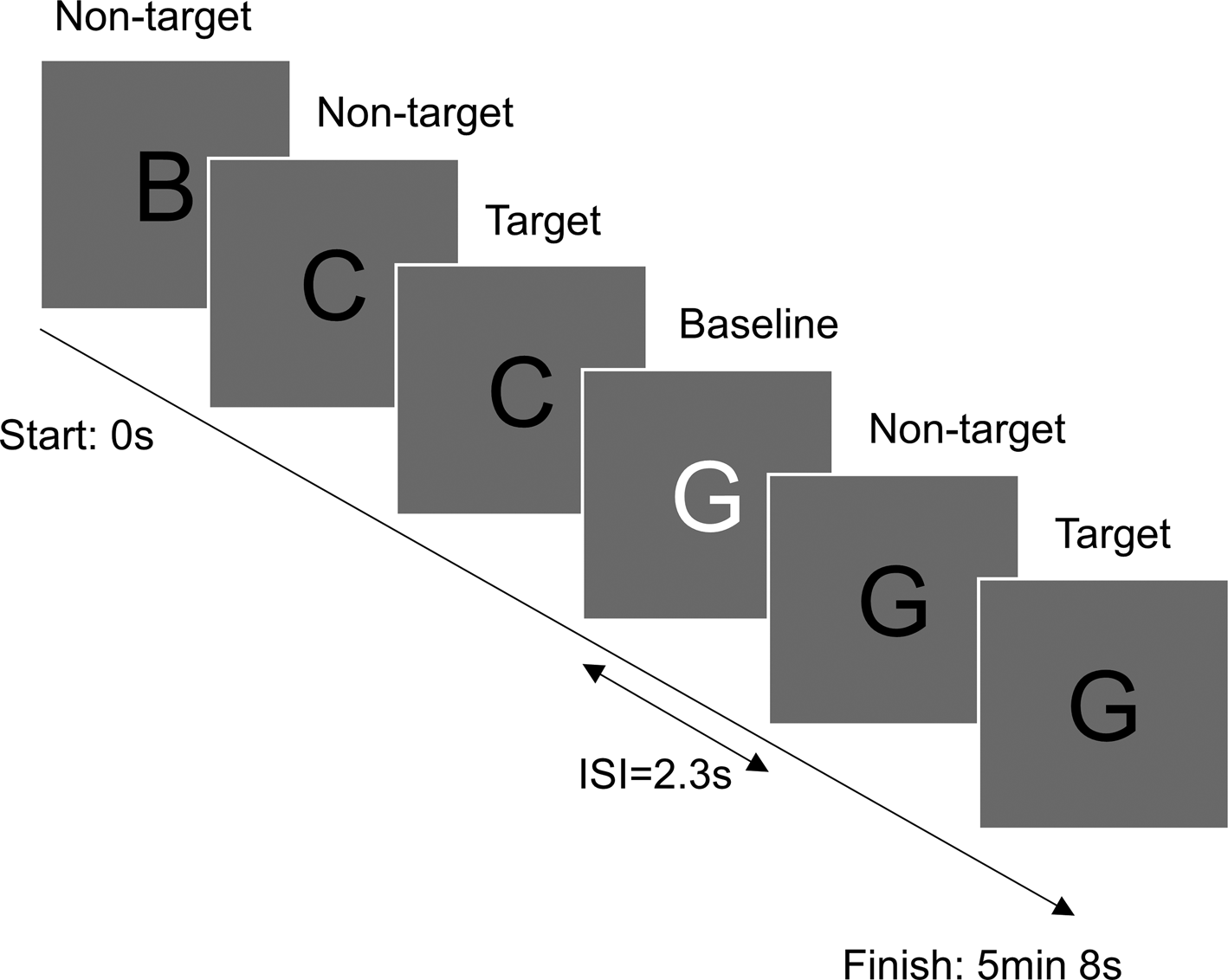
For the current study, we probed sustained attention and working memory updating using the CPT, which was part of the MRI component of the TWIN-E study. Details of the other cognitive and emotional tasks are presented in Table 5 of the TWIN-E protocol (Gatt et al., Reference Gatt, Korgaonkar, Schofield, Harris, Clark, Oakley and Williams2012). One hundred and twenty stimuli were presented (B, C, D or G letters, for 200 ms each, ISI = 2.3 s). Fifty were yellow letters to be held in working memory (non-target: no consecutive repetition), 30 were one-back sustained attention stimuli (target: consecutive repetition of the same letter in yellow) and 40 were perceptual baseline stimuli in white letters (Fig. 1). We were interested in the sustained attention aspect of the task, captured by the sustained attention (target) minus baseline contrast, and the working memory aspect of the task, captured by the working memory (non-target) minus baseline contrast. The total scan time duration was 5 min and 8 s.
Continuous Performance Task (CPT). One hundred and twenty stimuli are presented (B, C, D or G letters, for 200 ms each, ISI = 2.3 s). Fifty were yellow letters (displayed in black in this figure) to be held in working memory (no consecutive repetition), 30 were 1-back sustained attention stimuli (consecutive repetition of the same letter in yellow (displayed in black in this figure)) and 40 were perceptual baseline stimuli in white letters.

Functional MRI data preprocessing
We acquired MR images on a 3.0 T GE Signa HDx scanner (GE Healthcare) using an 8-channel head coil at the Westmead Hospital Medical Imaging Service, Sydney. We acquired 3D T1-weighted volumes using a spoiled gradient echo (SPGR) sequence (TR = 8.3 ms; TE = 3.2 ms; flip angle = 11 degrees; inversion time = 500 ms; FOV = 256 mm; slice thickness: 1 mm; 180 sagittal slices; frequency/phase matrix = 256 × 256; voxel size = 1 × 1 × 1 mm; NEX = 1; ASSET = 1.5; scanning time = 7.12 min). The functional run consisted of 120 T2*-weighted echo-planar imaging (EPI) images (TR = 2500 ms; TE = 27.5 ms; FOV = 240 mm; flip angle = 90 degrees; 40 contiguous axial slices using an interleaved sequence; 120 volumes; frequency/phase matrix = 64 × 64; voxel size = 3.75 × 3.75 × 3.5 mm; scanning time = 5.13 min). Three dummy scans were acquired at the start of the EPI acquisition.
The fMRI data were pre-processed and analysed using SPM12 software implemented on MATLAB (Wellcome Department of Imaging Neuroscience, London, UK; http://www.fil.ion.ucl.ac.uk), using a standard SPM pipeline. First, the functional images were corrected for slice timing differences and referenced to the first slice. Then, they were realigned to the first image of each task run. The average T1-weighted structural image was then coregistered to the mean of the functional volumes. By using the unified segmentation procedure, normalisation parameters were estimated (Ashburner & Friston, Reference Ashburner and Friston2005), which were then used to normalise the functional images to the stereotactic coordinate system defined by the Montreal Neurological Institute (MNI), images were resliced to a voxel size of 2 × 2 × 2 mm. Finally, fMRI data were smoothed with an isotropic Gaussian filter of 8 mm full width at half maximum (FWHM).
Functional MRI data analysis
In the first-level fixed-effect analysis, we used a canonical hemodynamic response function convolved with an event-related model to model the blood oxygen level-dependent (BOLD) responses (Friston et al., Reference Friston, Fletcher, Josephs, Holmes, Rugg and Turner1998). This resulted in time courses that were then applied to the general linear model (GLM), which included three experimental regressors (baseline: letter in white; target: consecutive repetition of the same letter in yellow; and non-target: non-consecutive repetition of a letter in yellow) as well as six movement regressors derived from the realignment step, included as covariates of no-interest. A high-pass filter with a frequency cut-off of 128s was applied to remove low-frequency noise, and serial autocorrelations were estimated using an AR(1) model.
We then used a region of interest (ROI) analysis approach to test our hypothesis of wellbeing and resilience being associated with the activation of brain regions involved in attention and working memory. Fourteen ROIs (seven for the sustained attention contrast and seven for the working memory contrast) were drawn using an automated meta-analysis website (www.neurosynth.org; Yarkoni, Poldrack, Nichols, Van Essen, & Wager, Reference Yarkoni, Poldrack, Nichols, Van Essen and Wager2011) to define the key regions relevant for attention function (for attention) and cognitive control (for working memory). These ROIs have been previously employed and validated (Keller, Ball, & Williams, Reference Keller, Ball and Williams2020). The meta-analytic map was constrained with a false discovery rate threshold of 0.01 and a restriction was applied so that each region did not extend beyond 10 mm from the peak coordinates. The sustained attention ROIs included the bilateral medial superior prefrontal cortex (msPFC), the left and right anterior insula, the left and right inferior parietal cortex and the left and right precuneus (Fig. 2). The working memory ROIs included the bilateral dorsal anterior cingulate cortex, the left and right dorsolateral prefrontal cortex, the left and right precentral gyrus and the left and right dorsal parietal cortex. We then extracted the averaged beta weights from the two contrasts (sustained attention > baseline; working memory > baseline) with the MarsBar toolbox (http://marsbar.sourceforge.net/) from these regions. Then, we ran linear mixed models with the lme4 package (Bates, Mächler, Bolker, & Walker, Reference Bates, Mächler, Bolker and Walker2015) in R (version 3.6.3) to test associations between neural activity in each of these ROIs and wellbeing (in the whole sample) and resilience (in the trauma sub-sample). Age, sex, zygosity and the log plus one transformed DASS-42 were included as covariates, as well as the relatedness between pairs of twins using family ID as the random effect. A Bonferroni corrected p value of 0.007 was used to account for multiple comparisons (for seven tests; one test per ROI) per contrast. We also ran confirmatory analyses with a reduced sample of participants with usable behavioural data (n = 197) including the onsets of participants' errors as an additional regressor in the first-level analysis, which showed a similar pattern of results (Online Supplementary S1 and Tables S1 to S5).
(a) shows the seven regions of interest of the sustained attention neural circuit. (b) and (c) show the left and right anterior insula activity negatively associated with resilience (levels of wellbeing measured with the COMPAS-W given trauma exposure) and bar plots of group brain activity means for the left anterior insula and right anterior insula. Statistics for these effects are shown in Table 2. Statistics for the bar plots are presented in the Online Supplementary (Table S12). aI = anterior insula; msPFC = medial superior prefrontal cortex; aIPL = anterior inferior parietal cortex; PCu = Precuneus.

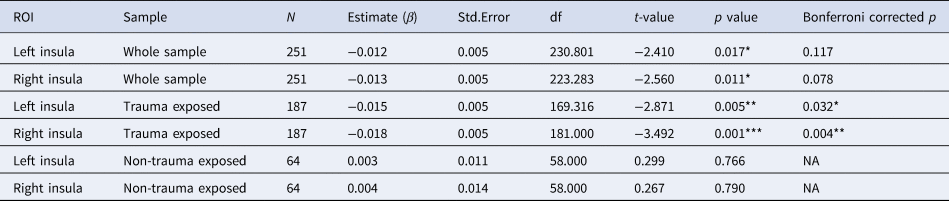
Linear mixed models results of the associations between the anterior insula ROIs and the COMPAS-W scores from the sustained attention contrast

ROI, Region of interest; N, Sample size; df, degrees of freedom; COMPAS-W, composite measure of wellbeing.
p values were derived via the Satterthwaite's degrees of freedom method (Luke, Reference Luke2017).
Heritability analysis
To estimate the heritability of the significant ROIs, we extracted the average beta contrast estimates using the Volumes toolbox (http://sourceforge.net/projects/spmtools) and conducted genetic and environment twin analyses on complete twin pairs using the OpenMx package (version 2.17.2) implemented in R. We also estimated the heritability of resilience, as well as the log plus one transformed DASS-42. First, we undertook univariate genetic modelling using the classic twin design (Neale & Maes, Reference Neale and Maes1998) to estimate the heritability of each significant ROI. For these models, A refers to additive genetic effects, D to non-additive genetic (or dominance) effects, C to shared (common) environment and E to the non-shared (unique) environment. When the intra-class correlation between monozygotic twins was double or more than the intra-class correlation between dizygotic twins, an ADE model was tested, otherwise, the ACE model was tested (Verweij, Mosing, Zietsch, & Medland, Reference Verweij, Mosing, Zietsch and Medland2012). Full ACE or ADE models were fitted to each variable using maximum likelihood estimation, and model fit was assessed by dropping parameters. The significance of each component (A, C or D, and E) was determined by comparing the significant change in the log-likelihood (−2LL) of each nested model which assessed whether dropping that component resulted in a significant decrease in the model fit, as well as the overall Akaike information criterion (AIC) of each model. Age and sex were included as covariates.
Multivariate twin modelling
A correlated factors model was fitted to the COMPAS-W scores and the specific ROIs that were associated with wellbeing/resilience to assess genetic and environmental covariance between the variables. Because the anterior insula was associated with resilience bilaterally, we included both the left and right anterior insula in the model. We also included the log-transformed DASS-42 scores in the model. The model was informed by the cross-twin, cross-trait correlations and covariance matrix (Posthuma, Reference Posthuma and Kim2009). The statistical significance of the genetic and environmental correlations between the variables was tested by constraining them to zero in a new model, which was then compared to the previously best-fit model using a chi-square difference test. A significant reduction in model fit resulting from constraining a correlation to zero indicated its significance.
Results
Demographic characteristics
We found no significant differences between monozygotic and dizygotic twins for age (t (251) = 0.877, p = 0.382), sex (χ2 = 0.876, p = 0.349), wellbeing (t (251) = −0.693, p = 0.489), depression/anxiety scores (t (251) = −0.661, p = 0.509), number of childhood trauma events (t (251) = 1.749, p = 0.081) or presence/absence of childhood trauma (χ2 = 1.720, p = 0.190) (Table 1). Using a linear mixed model controlling for relatedness, age, sex and zygosity, we found a significant positive association between depression/anxiety scores and a number of ELS events (t (244.44) = 3.347, p < 0.001), indicating that participants who had been exposed to more traumatic events in early life had greater depression/anxiety symptoms as adults. As expected, we found a large negative association between wellbeing and depression/anxiety scores (t (247.07) = −9.563, p < 0.001). More detailed demographic characteristics, including the breakdown of ELS types, are presented in the Online Supplementary Tables S2 and S6.
Brain activity associations with wellbeing and resilience
We used linear mixed models to investigate potential associations between neural activity in each of the seven ROIs and the COMPAS-W scores in the whole sample (for wellbeing) as well as in the trauma-exposed sub-sample (for resilience). We excluded two additional participants with outlier beta weight values (i.e. >3 sd above the mean). In the whole sample, we found significant negative associations between the left and right insula activity and wellbeing, although this association was not significant after correcting for seven tests (Table 2). These associations were stronger in the trauma-exposed sub-sample and remained significant after Bonferroni correction (Table 2, Fig. 2). To determine if these associations were exclusive to the trauma-exposed sub-sample, we also performed the same analysis in the non-trauma exposed sub-sample. This latter analysis showed no relationships between the anterior insula activity and the COMPAS-W scores, indicating that that the anterior insula activity might be related to resilience specifically (the ability to adaptively recover following trauma exposure) rather than overall wellbeing as a state. This is unlikely to be due to the smaller sample as the effect size estimates are also close to zero, whereas the trauma sub-sample effect size estimates are moderate (Table 2).
We also ran additional linear mixed models to test the interaction between COMPAS-W scores and categorical presence/absence of early-life stress in order to formally test whether the link between insula activity and wellbeing was specific to the trauma group, indicating resilience. The analyses showed that there was a significant interaction between wellbeing and trauma exposure supporting our conclusions (see Online Supplementary Table S7, Fig. S1). In addition, because the most common trauma in our sample was birth complications, which is common in twins, we also performed an analysis in the trauma-exposed sub-sample excluding participants with only birth complications as trauma exposure. The association between the insula activation and COMPAS-W scores within this new sub-sample remained significant after Bonferroni correction in the right insula (p = 0.028) but not in the left insula (p = 0.142; uncorrected p = 0.020) (Online Supplementary Table S8). Moreover, we found that poorer performance (indexed by accuracy) was also positively associated with insula activity, as well as the right anterior inferior parietal cortex, the msPFC and the right precuneus in the trauma-exposed sample and the whole sample, but not in the non-trauma exposed sample (see Online Supplementary Tables S4, S5). No associations were found between neural activity in regions related to cognitive control and wellbeing or resilience from the working memory contrast. The linear mixed models for all 14 ROIs are presented in the Online Supplementary (Tables S9 and S10).
Univariate twin modelling
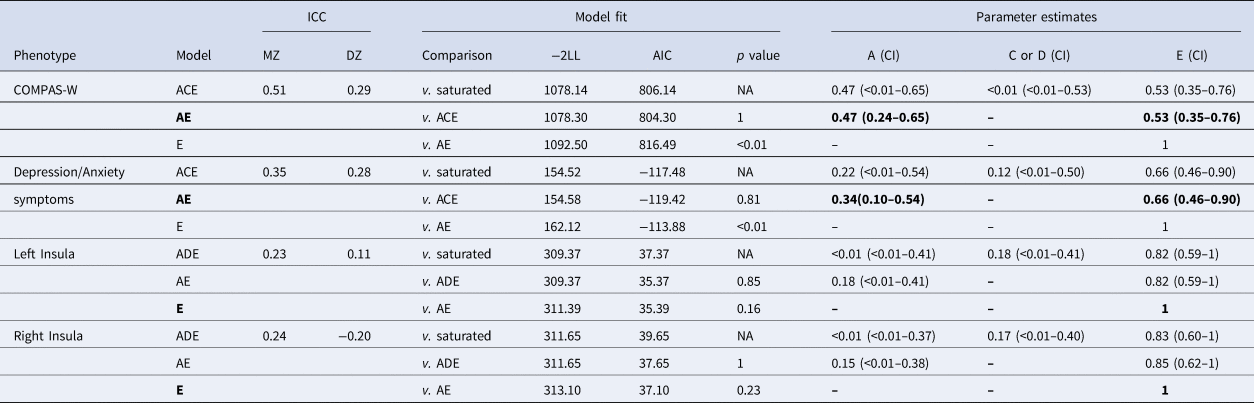
We performed heritability analysis specifically on the twin pairs of the trauma-exposed sub-sample (n = 142), due to the significant associations between the left and right insula and resilience. Estimates and intra-class correlation coefficients for resilience, depression/anxiety, and the left and right anterior insula activity are presented in Table 3.
Intra-class correlations, models comparison and heritability estimates in the trauma sample

ICC, intra-class correlation; MZ, monozygotic twins; DZ, dizygotic twins; −2LL, minus twice the log-likelihood; AIC, Akaike's information criterion; CI, 95% confidence intervals. Starting models were either ADE or ACE, where A, additive genetic; D, dominant genetic; C, common environment; E, unique environment.
The ADE starting model was used if the ICC for MZ twins was greater than double the ICC for DZ twins. Squared model components indicate their contribution as a percentage of the total variance. Models in bold letters represent the best fit. Wellbeing was measured using the COMPAS-W and depression/anxiety symptoms was measured using the Depression Anxiety Stress Scale (DASS-42).
Intra-class correlation coefficients suggested that an ACE starting model was most appropriate to test for resilience and depression and anxiety symptoms because monozygotic correlation was less than double the dizygotic correlation while an ADE model was the best model for the bilateral anterior insula activity because monozygotic correlation was more than double the dizygotic correlation.
Univariate modelling suggested that an AE model was the best fitting model for resilience and depression and anxiety symptoms based on AIC and −2LL values and because there was no significant change of fit when an AE model was compared against an ACE model. An E model was the most parsimonious model for the left and right anterior insula as there was no significant change of fit when an E model was compared against an AE model, although AIC favoured the AE model for the left anterior insula (Kirkpatrick, McGue, & Iacono, Reference Kirkpatrick, McGue and Iacono2015). The heritability of wellbeing in the trauma group was estimated at 47%, the heritability for depression/anxiety scores was estimated at 34%, and the heritability for the left and right anterior insula activity was estimated at 18% and 15%, respectively. We also calculated heritability estimates for the remaining 12 ROIs which ranged from 0% to 33% heritability (see Online Supplementary Table S11).
Multivariate twin modelling
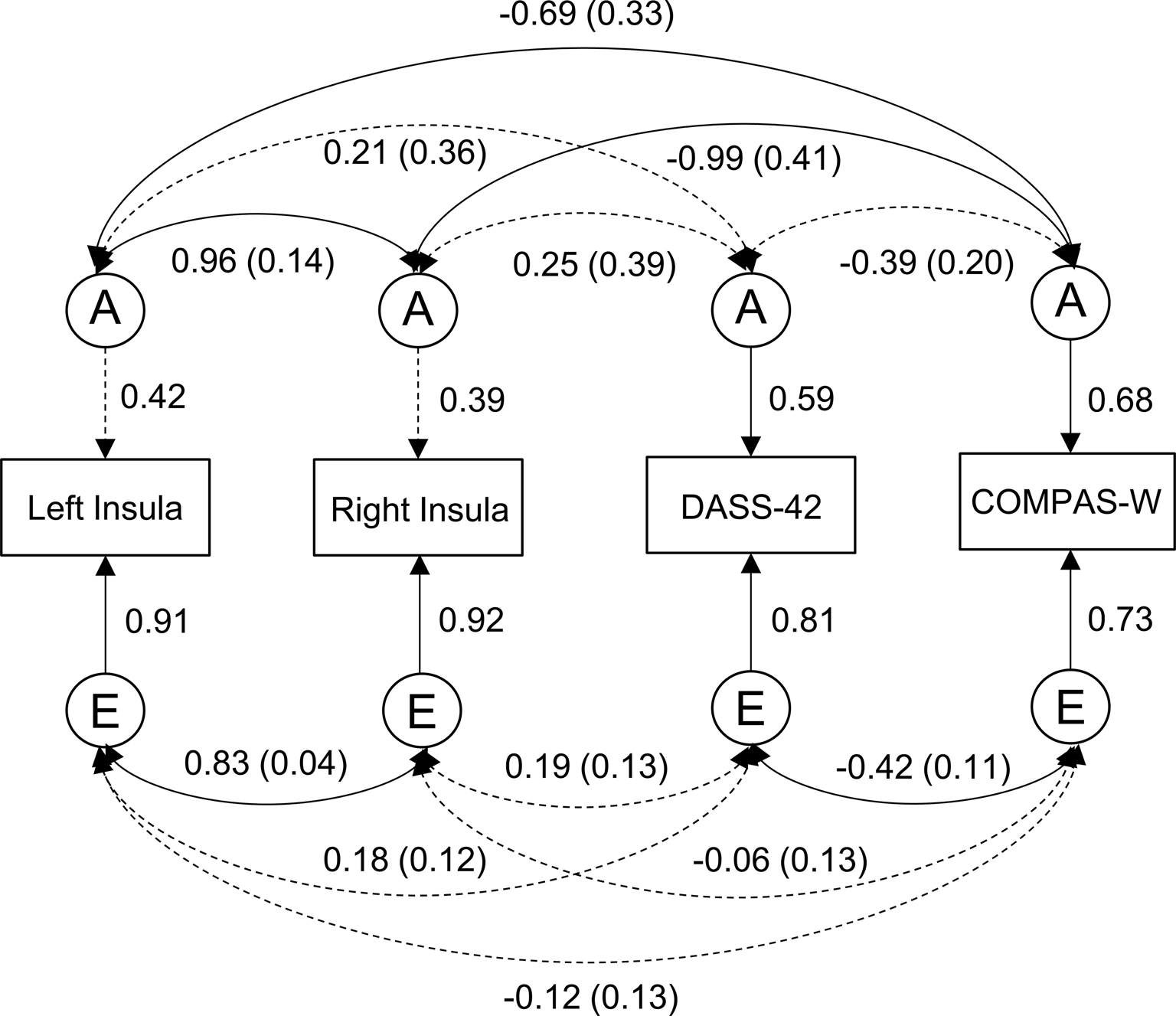
We conducted a correlated factors twin model to examine whether the genetic and environmental variances were shared between the left and right anterior insula activation and resilience (Fig. 3). We also included the log total depression/anxiety scores in the model due to their phenotypic association with wellbeing. Because AE was the best model for two of our variables, we tested an AE model, accounting for both genetic and environmental variance between pairs of variables.
Correlated factors model for resilience (levels of wellbeing measured with the COMPAS-W given trauma exposure), log DASS-42 total scores and the left and right anterior insula activity in twin pairs with corresponding standardised path estimates. We fitted an AE correlated factors model to the four variables across both twin pairs. The rectangles indicate the observed variables and the circles indicate unobserved latent factors (A or E). Single-headed arrows indicate the effect of one latent factor on an observed variable, and double-headed arrows indicate correlations or covariances between latent factors (with standard errors in parentheses). Dashed lines represent non-significant correlations. Results suggest a significant negative genetic correlation between resilience and the bilateral anterior insula activity, significant positive genetic and environmental correlations between the left and the right anterior insula activity and a significant negative environmental correlation between resilience and depression/anxiety scores. A, additive genetics; E, unique environment; DASS-42, Depression, Anxiety, Stress Scale; COMPAS-W: composite measure of wellbeing. This information is also provided in table format in the Online Supplementary (Table S13).

Setting the additive genetic correlation between the left and the right anterior insula cluster to zero resulted in significant deterioration of the model fit, indicating a significant genetic correlation between the left and the right anterior insula ROIs (r = 0.96; p = 0.04), accounting for 18% of the total phenotypic correlation between these two variables. To calculate the total phenotypic correlation, we first multiplied the genetic correlation (0.96) by the genetic path coefficients (0.42 and 0.39) for the two variables. We next multiplied the environmental correlation (0.83) by the environmental path coefficients for the two variables (0.91 and 0.92). Then, we added these scores together to obtain the total phenotypic correlation. To calculate the contribution of the genetic correlation to the total phenotypic correlation, we divided the product of the genetic correlation (0.96) and the genetic path coefficients (0.42 and 0.39) by the total phenotypic correlation.
Setting the additive genetic correlation between resilience and the left and the right anterior insula activity to zero resulted in significant deterioration of the model fit, indicating a significant genetic correlation between resilience and the left anterior insula activity (r = −0.69; p = 0.03) and the right anterior insula (r = −0.99; p = 0.003), accounting for 71% and 87% respectively of the total phenotypic correlation between these variables.
Setting the unique environment correlation between the left and the right anterior insula to zero resulted in significant deterioration in the model fit, indicating a significant correlation (r = 0.83; p < 0.001), accounting for 82% of the phenotypic correlation between these two variables. Setting the unique environment correlation between wellbeing and depression/anxiety scores to zero resulted in significant deterioration in the model fit, indicating a significant correlation (r = −0.42; p < 0.001), accounting for 61% of the phenotypic correlation between these two variables.
No other genetic or environmental correlations were significant. Thus, the best model for the data was a correlated factors model with correlations between additive genetic factors contributing to variance in scores on resilience and the bilateral anterior insula activity, as well as between the left and right anterior insula, and correlations between unique environmental factors contributing to variance in resilience and depression/anxiety scores, as well as between the left and right anterior insula.
Discussion
This study was the first to examine how the neural correlates that underpin sustained attention and working memory updating may be associated with varying levels of composite wellbeing and resilience in adult twins. To this end, we ran linear mixed models using averaged beta values extracted from ROIs involved in attention and working memory. We observed negative associations between the neural activity in the left and right anterior insula in the sustained attention contrast with resilience scores (defined by wellbeing scores in a trauma-exposed sub-sample), which remained significant after correcting for seven tests. The heritability of the left and right anterior insula activity was small, estimated at 18% and 15% respectively. Yet, the multivariate model indicated significant genetic correlations between resilience scores and the left (r = −0.69) and the right (r = −0.99) anterior insula, accounting for 71% and 87% respectively of the total correlation between the two variables.
The insula is implicated in a wide range of conditions and behaviours, including cognition, emotion, processing the context of a potential threat, pain and interoception (Craig, Reference Craig2009; Wiech et al., Reference Wiech, Lin, Brodersen, Bingel, Ploner and Tracey2010; Xu et al., Reference Xu, Larsen, Baller, Scott, Sharma, Adebimpe and Satterthwaite2020). It has also been associated with attention in independent studies and systematic reviews (Menon & Uddin, Reference Menon and Uddin2010; Nelson et al., Reference Nelson, Dosenbach, Cohen, Wheeler, Schlaggar and Petersen2010; Trautwein, Singer, & Kanske, Reference Trautwein, Singer and Kanske2016; Williams, Reference Williams2016). Additionally, deactivation in the right insula and increased activation in the left insula have been associated with better-sustained attention performance using a rapid visual information processing task (Lawrence, Ross, Hoffmann, Garavan, & Stein, Reference Lawrence, Ross, Hoffmann, Garavan and Stein2003). Moreover, higher resilience has been associated with insula activity in positron emission tomography and fMRI studies (van der Werff, van den Berg, Pannekoek, Elzinga, & van der Wee, Reference van der Werff, van den Berg, Pannekoek, Elzinga and van der Wee2013), including higher regional cerebral metabolic rate of glucose at rest in the right anterior insula (Jeong et al., Reference Jeong, Chung, Ma, Kim, Hong, Oh and Lyoo2019) and lower regional homogeneity in the bilateral insula using resting-state fMRI (Kong, Wang, Hu, & Liu, Reference Kong, Wang, Hu and Liu2015). In one study, Waugh, Wager, Fredrickson, Noll, and Taylor (Reference Waugh, Wager, Fredrickson, Noll and Taylor2008) reported that individuals with lower levels of trait resilience exhibited prolonged activation in the anterior insula to aversive and neutral pictures, whereas high resilience individuals exhibited insula activation only to the aversive pictures and at a lower level compared to the low resilience individuals. This showed that resilient people flexibly adjust the level of emotional resources required to meet the demands of particular situations. Another resting-state fMRI study revealed an association between childhood trauma severity and executive dysfunction in adults, which was mediated by weaker functional connectivity in cognitive control-related regions including the bilateral dorsal anterior cingulate cortex and the right anterior insula (Silveira et al., Reference Silveira, Shah, Nooner, Nagel, Tapert, de Bellis and Mishra2020). However, the mediators were not limited to differences in connectivity strength within cognitive control networks, but also included sensory-motor networks, including the pre- and postcentral gyri, showing the importance of integrating higher-level cognitive and lower level sensory-motor processes to achieve optimal executive functions. In our study, we focused mostly on higher-level attention and cognitive control-related regions of interest, but future work could focus on other regions such as the postcentral gyri.
Insula activation has also been associated negatively with emotional intelligence in adolescents (Killgore & Yurgelun-Todd, Reference Killgore and Yurgelun-Todd2007), an ability closely related to resilience (Sarrionandia, Ramos-Díaz, & Fernández-Lasarte, Reference Sarrionandia, Ramos-Díaz and Fernández-Lasarte2018). This finding has been interpreted in terms of the Neural Efficiency Hypothesis (Dunst et al., Reference Dunst, Benedek, Jauk, Bergner, Koschutnig, Sommer and Neubauer2014; Haier et al., Reference Haier, Siegel, Nuechterlein, Hazlett, Wu, Paek and Buchsbaum1988; Nussbaumer, Grabner, & Stern, Reference Nussbaumer, Grabner and Stern2015) which posits that neural activity becomes more efficient (decreases during the task) and focused as individuals acquire greater skills and experience. Although the anterior insula has been previously associated with resilience (Jeong et al., Reference Jeong, Chung, Ma, Kim, Hong, Oh and Lyoo2019; van der Werff et al., Reference van der Werff, van den Berg, Pannekoek, Elzinga and van der Wee2013) and with sustained attention (Lawrence et al., Reference Lawrence, Ross, Hoffmann, Garavan and Stein2003; Williams, Reference Williams2016), our study is the first to show an association between resilience and the anterior insula activation in the context of a sustained attention task. The negative direction of this association could indicate a pattern of neural efficiency in people who may be more resilient to trauma. The heightened anterior insula activity in less resilient individuals might also, or alternatively reflect heightened sensitivity to errors during the task, as the insula has been associated with error monitoring (Billeke et al., Reference Billeke, Ossandon, Perrone-Bertolotti, Kahane, Bastin, Jerbi and Fuentealba2020), in light of the finding that poorer performance was associated with increased activity in the anterior insula in our trauma-exposed sub-sample, but not in the non-trauma exposed sub-sample. The absence of association with wellbeing in the non-trauma sample in contrast to the trauma-exposed sample indicates that less activity in the insula during CPT is related to higher resilience (the ability to adaptively recover following trauma exposure) and not to higher overall wellbeing as a state. This requires confirmation in future studies.
Although hypothesised, we did not find significant associations between neural activity and wellbeing or resilience using the working memory contrast of the CPT. This could be due to the nature of the working memory component of the task which required participants to passively keep track of the yellow letters (i.e. no responses were required), and is arguably easier than the sustained attention component of the task which required participants to actively respond to the target stimuli. It is possible that, with a more difficult task load, significant associations with wellbeing or resilience and working memory would become more apparent.
Our univariate twin analysis on the regions involved with sustained attention (i.e. the left and right anterior insula) suggests that the anterior insula activation is mostly due to environmental factors as indicated by relatively low heritability estimates and by the fact that, although AIC favoured the AE model for the left anterior insula, there was no significant change of fit when an E model was compared against an AE model in both the right and the left anterior insula. This could be due to the sample size which, despite being large for an fMRI study, is small for a twin study. However, our heritability estimates for the left anterior insula (18%) and right anterior insula (15%) activity are similar in magnitude to the previous task-related fMRI twin studies (Blokland et al., Reference Blokland, McMahon, Hoffman, Zhu, Meredith, Martin and Wright2008, Reference Blokland, McMahon, Thompson, Martin, de Zubicaray and Wright2011; Matthews et al., Reference Matthews, Simmons, Strigo, Jang, Stein and Paulus2007) and resting-state fMRI family studies (Adhikari et al., Reference Adhikari, Jahanshad, Shukla, Glahn, Blangero, Reynolds and Kochunov2017; Glahn et al., Reference Glahn, Winkler, Kochunov, Almasy, Duggirala, Carless and Blangero2010). It was also close to the estimated heritability of sustained attention behavioural performance (19%) using a similar CPT task (Routledge et al., Reference Routledge, Burton, Williams, Harris, Schofield, Clark and Gatt2017). Further, our multivariate twin model showed a significant genetic correlation between resilience and the left and right anterior insula activity (r = −0.69 and r = −0.99, respectively), indicating the presence of common genetic factors that accounts for the correlation between these variables. This is in contrast with previous findings that report no significant genetic correlations between wellbeing and sustained attention behavioural performance (Routledge et al., Reference Routledge, Burton, Williams, Harris, Schofield, Clark and Gatt2017). This discrepancy might be due to differences in genetic mechanisms underlying neural circuits related to sustained attention, compared to behavioural performance measures of sustained attention. Genetic correlations among traits can arise from the pleiotropic effects of genes on multiple traits (one gene or set of genes might influence both resilience and brain activity) and/or linkage disequilibrium among distinct loci, whereby two traits may have a genetic correlation because alleles at two tightly linked loci have become nonrandomly associated (Cheverud, Reference Cheverud and Wagner2001; Falconer & Mackay, Reference Falconer and Mackay1996). Future genetic studies could focus on the identification of these specific genes accounting for this common variance. To the best of our knowledge, this is also the first study showing that the left and right anterior insula activity is genetically and environmentally correlated, indicating that a mix of common genetic and environmental factors influence the anterior insula activity in both brain hemispheres.
The new findings discussed in this study offer implications worth noting in the field of mental health research. We established a relationship between resilience in trauma-exposed individuals and sustained attention neural activity, which could serve as a potential biomarker of resilience. Biomarkers can have clinical implications and can be used to improve prognostic and diagnostic processes (Strimbu & Tavel, Reference Strimbu and Tavel2010; Williams, Reference Williams2016). There are some legitimate concerns about the use of fMRI results as biomarkers due to the low reliability of group-level, voxelwise and whole-brain analyses (Elliott et al., Reference Elliott, Knodt, Ireland, Morris, Poulton, Ramrakha and Hariri2020). However, it has been shown that the n-back task, similar to our CPT, has high-within subject reliability when using established ROIs (Holiga et al., Reference Holiga, Sambataro, Luzy, Greig, Sarkar, Renken and Dukart2018). In the present study, we used a within-subjects, ROI approach established by our author's prior work (Goldstein-Piekarski et al., Reference Goldstein-Piekarski, Ball, Samara, Staveland, Keller, Fleming and Williams2021; Keller et al., Reference Keller, Ball and Williams2020; Williams, Reference Williams2016). For example, Goldstein-Piekarski et al. (Reference Goldstein-Piekarski, Ball, Samara, Staveland, Keller, Fleming and Williams2021) showed that this within-subject approach is reproducible across different samples and thus, might offer a foundation for identifying biomarkers for mental health and wellbeing and resilience. This study also creates new avenues for future research studies. The cross-sectional nature of these analyses does not confirm the directionality of the effects; that is, whether higher resilience leads to less neural activation in the insula, or whether less activation leads to higher resilience. Longitudinal studies can help to understand the direction of this association. In addition, future studies could investigate how resilience and wellbeing are associated with attention-related brain activity in the context of neural networks rather than independent ROIs using connectivity analysis.
Limitations
Some limitations inherent to twin studies are worth noting, such as the assumption of equal environments and random mating, which might not always be met (Keller et al., Reference Keller, Medland, Duncan, Hatemi, Neale, Maes and Eaves2009; Richardson & Norgate, Reference Richardson and Norgate2005; Vinkhuyzen, van der Sluis, Maes, & Posthuma, Reference Vinkhuyzen, van der Sluis, Maes and Posthuma2012). However, molecular genetic studies and replicated findings have shown the usefulness and validity of twin studies as an important tool, whether or not these assumptions are exactly met (Boomsma, Busjahn, & Peltonen, Reference Boomsma, Busjahn and Peltonen2002; Evans & Martin, Reference Evans and Martin2000; Felson, Reference Felson2014; Sahu & Prasuna, Reference Sahu and Prasuna2016). For example, Barnes and Boutwell (Reference Barnes and Boutwell2013) compared results of twin and non-twin samples for a variety of traits related to antisocial behaviours (including drug-use, verbal IQ, GPA and depression symptoms) and found no systematic differences between the groups for most outcomes, therefore concluding that twin studies are likely to generalise to the non-twin population. Other studies report lower cognitive performance in twins compared to singletons in childhood (e.g. Ronalds, De Stavola, & and Leon, Reference Ronalds, De Stavola and Leon2005), but these differences seem to vanish in adulthood (Barnes & Boutwell, Reference Barnes and Boutwell2013; Nilsen, Bergsjø, & Nome, Reference Nilsen, Bergsjø and Nome1984; Posthuma, De Geus, Bleichrodt, & Boomsma, Reference Posthuma, De Geus, Bleichrodt and Boomsma2000). Additionally, although our sample size is large for an fMRI study, it is small for a twin study, as exemplified by the large confidence intervals around our heritability estimates as well as the genetic correlation between the right anterior insula and resilience (−0.99), which is unlikely but possible with smaller datasets. This is a common limitation for functional and structural MRI twin studies (Jansen, Mous, White, Posthuma, & Polderman, Reference Jansen, Mous, White, Posthuma and Polderman2015), mainly due to the costs involved with MR imaging in twin studies (i.e. double the sample), so future twin studies with larger sample sizes are required to confirm our estimates. Finally, the TWIN-E sample (including the sub-sample presented in the current study) is a healthy cohort without current or past psychiatric history. Therefore, we might expect the rates of wellbeing to be higher compared to other studies that may not exclude participants with past mental illness history. For example, using the COMPAS-W, Chilver and Gatt (Reference Chilver and Gatt2021) and Cheng, Park, and Gatt (Reference Cheng, Park and Gatt2021) examined wellbeing in the general population and found average wellbeing scores between 88.48 (sd = 14.28) (Cheng et al., Reference Cheng, Park and Gatt2021) and 94.97 (sd = 12.46) (Chilver & Gatt, Reference Chilver and Gatt2021). Future research with population samples that include symptomatic and clinical subjects is needed to fully understand these associations and whether associations between the anterior insula and resilience are also present in healthy or clinical subjects who may have lower wellbeing.
In conclusion, this study reports a negative relationship between resilience and sustained attention-related activity in the bilateral anterior insula. The left and right anterior insula activity was mainly determined by non-shared environmental factors. The association between resilience, defined as a high level of wellbeing despite childhood trauma exposure, and the bilateral anterior insula activity was primarily driven by common genetic factors, as observed by the high genetic correlations. Future studies could incorporate a longitudinal component to investigate the directionality of these associations and focus on functional and anatomical connectivity to understand how brain regions interact as networks to give rise to higher levels of wellbeing and resilience.
Acknowledgements
The authors acknowledge training provided by Twins Research Australia and QIMR Twin Modelling Workshop to aid in some of the statistical analyses used in this paper.
Supplementary material
The supplementary material for this article can be found at https://doi.org/10.1017/S0033291721005262.
Data
The study reported in this article was not formally preregistered. The data and code used to analyse the data from this experiment will be made available upon reasonable request contacting the corresponding author (JMG).
Author contributions
AM is a Ph.D. student with JMG as his primary supervisor. This work forms a component of his Ph.D. dissertation. AM developed the statistical approach, conducted the statistical analyses pertaining to the univariate and multivariate modelling, and linear mixed models, and wrote the first draft of the article. HRPP co-supervised the MRI and statistical analyses, edited the first and subsequent drafts of the article, and contributed to data interpretation. JMG conceptualised the research focus on wellbeing and resilience biomarkers, guided statistical analysis and interpretation, and edited the first and subsequent drafts of the article. LMW conceptualised the twin study for funding by the Australian Research Council. LMW, PRS and JMG designed the twin study for implementation and acquired the data. All authors reviewed and edited manuscript revisions and approved the final version of the paper.
Financial support
This project was supported by an Australian Research Council (ARC) Linkage grant (LP0883621), with Brain Resource Ltd as an industry partner. JMG, HRPP and AM were supported by a National Health and Medical Research Council (NHMRC) Project Grant (1122816). AM was also supported by UNSW Tuition Fee Scholarship (TFS). MRC was supported by the Australian Government Research Training Program Scholarship. MRC and AM also received the Neuroscience Research Australia top-up scholarship. JJ was supported by the UNSW Scientia Ph.D. Scholarship Scheme. PRS was supported by an NHMRC Program Grant (1037196) and Investigator Grant (1176716). This research was facilitated through access to Twins Research Australia, a national resource supported by the NHMRC Centre of Research Excellence Grant (1079102).
Conflicts of interest
JMG was a stockholder in MAP Biotech Pty Ltd. LMW has received advisory board fees from One Mind Psyberguide and the Laureate Institute for Brain Research unrelated to this study. There are no other conflicts of interest to report.
Ethical standards
The authors assert that all procedures contributing to this work comply with the ethical standards of the relevant national and institutional committees on human experimentation and with the Helsinki Declaration of 1975, as revised in 2008.