





Extended abstract
Project description and rationale
Artistic Systems Modeling is my practice-based framework for translating patterns, behaviors, and mathematical relationships from scientific research into generative systems for music, movement, and visual design, while also portraying the science through emotional and sensory experience. The framework situates this work within traditions of practice-based research in the arts, where artistic creation functions as a mode of knowledge production (Candy and Edmonds Reference Candy and Edmonds2018).
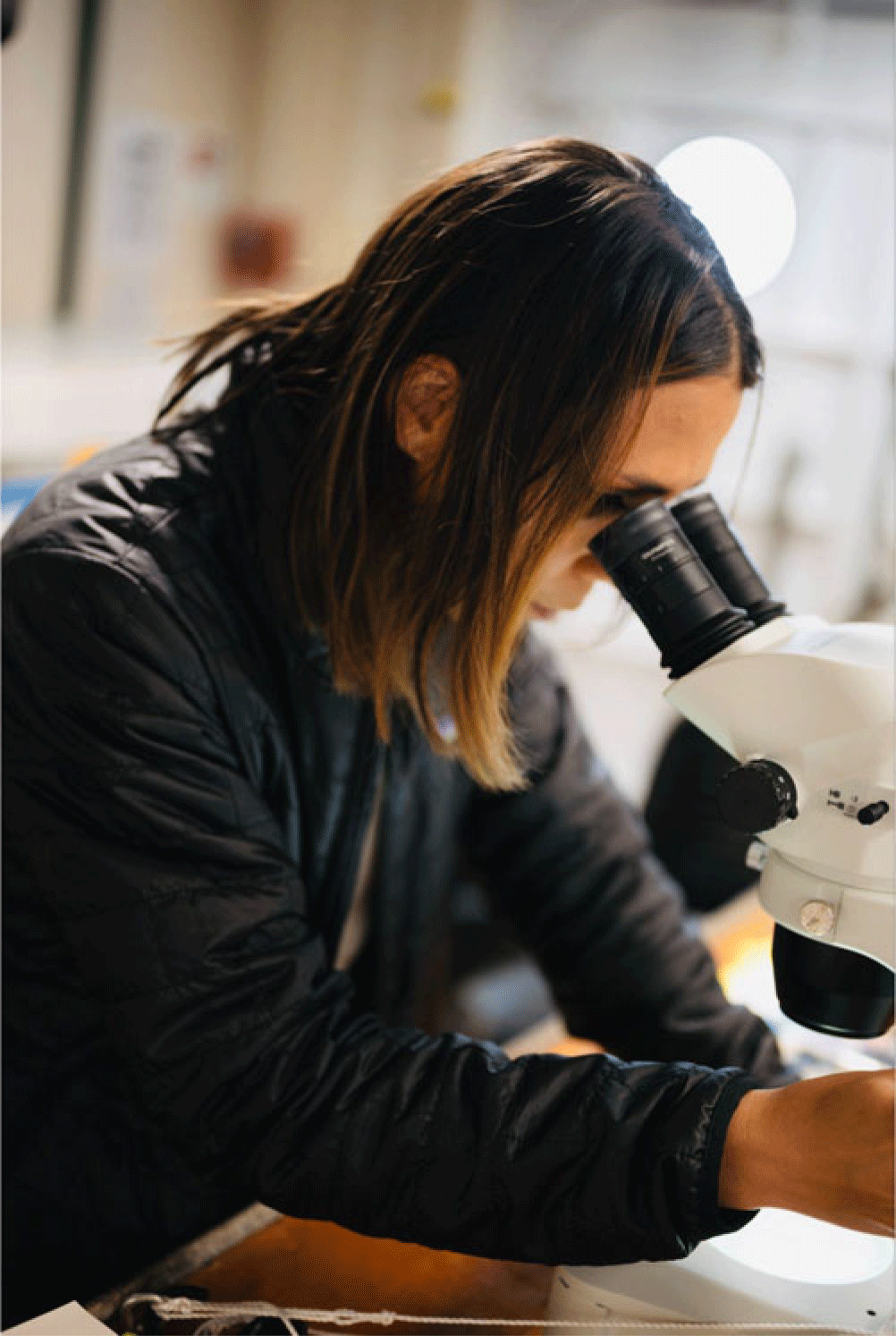
In my practice, I collaborate with scientists to translate scientific systems into artistic form through music and interdisciplinary performance. This work began during my participation in the 2022 Artist at Sea program through the Sitka Center for Art and Ecology aboard an NSF-supported research vessel studying marine ecosystems and plankton, where I worked alongside more than twenty scientists from multiple laboratories (Figure 1). During this residency, I began collaborating with plankton scientist Dr. Kelly Sutherland, whose research continues to inform my projects.
(left) Observing plankton samples under a microscope aboard an NSF-supported research vessel.

The framework emerged from earlier attempts to address environmental themes in my music. Rather than communicating ideas through lyrics alone, I began to embed scientific concepts directly within musical structure. My album Carbon initiated this approach by translating environmental research into my musical composition and production (Sirintip 2022). Later projects, including Mycelium and my ongoing immersive research project Nanomia, expanded this method through collaborations with scientists and artists.
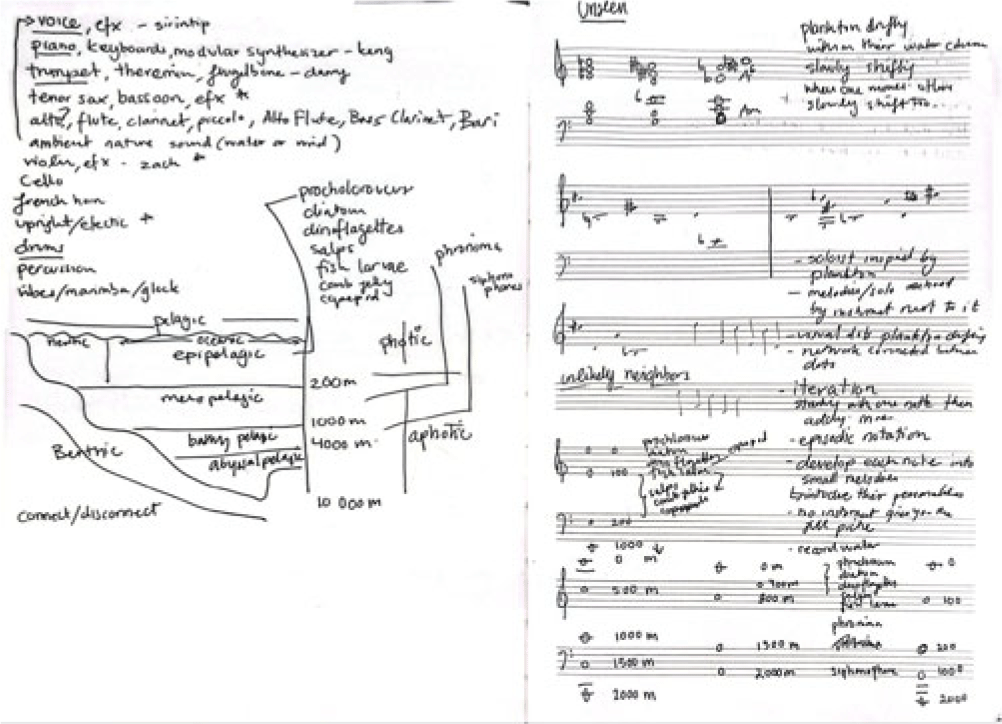
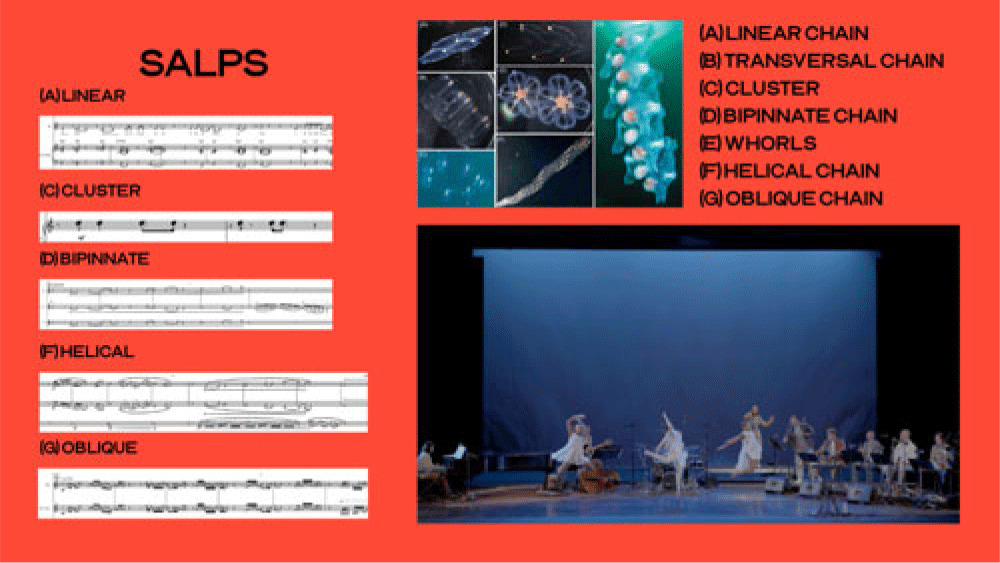
I created the term Artistic Systems Modeling to describe my process of using scientific systems as generative structures for musical composition and interdisciplinary work. The framework emerged through my artistic experimentation, grounded in pattern recognition rather than established creative methodologies (Mattson Reference Mattson2014). Within this approach, mathematical and biological patterns inform parameters such as pitch organization, rhythm, musical form, choreography, and visual design. For example, plankton distribution in the water column informs pitch placement in Drifting (Figure 2), salp colony formations inform compositional and choreographic structures in Salps (Figure 3; Damian-Serrano and Sutherland Reference Damian-Serrano and Sutherland2023), and mycelial growth models generate compositional parameters in Mycelium Growth Equation (Dzulkefli and Zainol Reference Dzulkefli and Zainol2018).
(right) Early musical compositional sketch from my Artistic Systems Modeling process, translating the vertical distribution of plankton in the water column into pitch placement on the musical staff.

Chain formations of salp colonies, which informed compositional structures and choreographic movement in my musical composition, Salps.

Unlike typical data sonification and other approaches that primarily illustrate scientific information, my framework embeds scientific research within the creative process while taking artistic liberties to express the subject’s emotional character, allowing audiences to develop a felt experience, rather than a purely intellectual understanding.
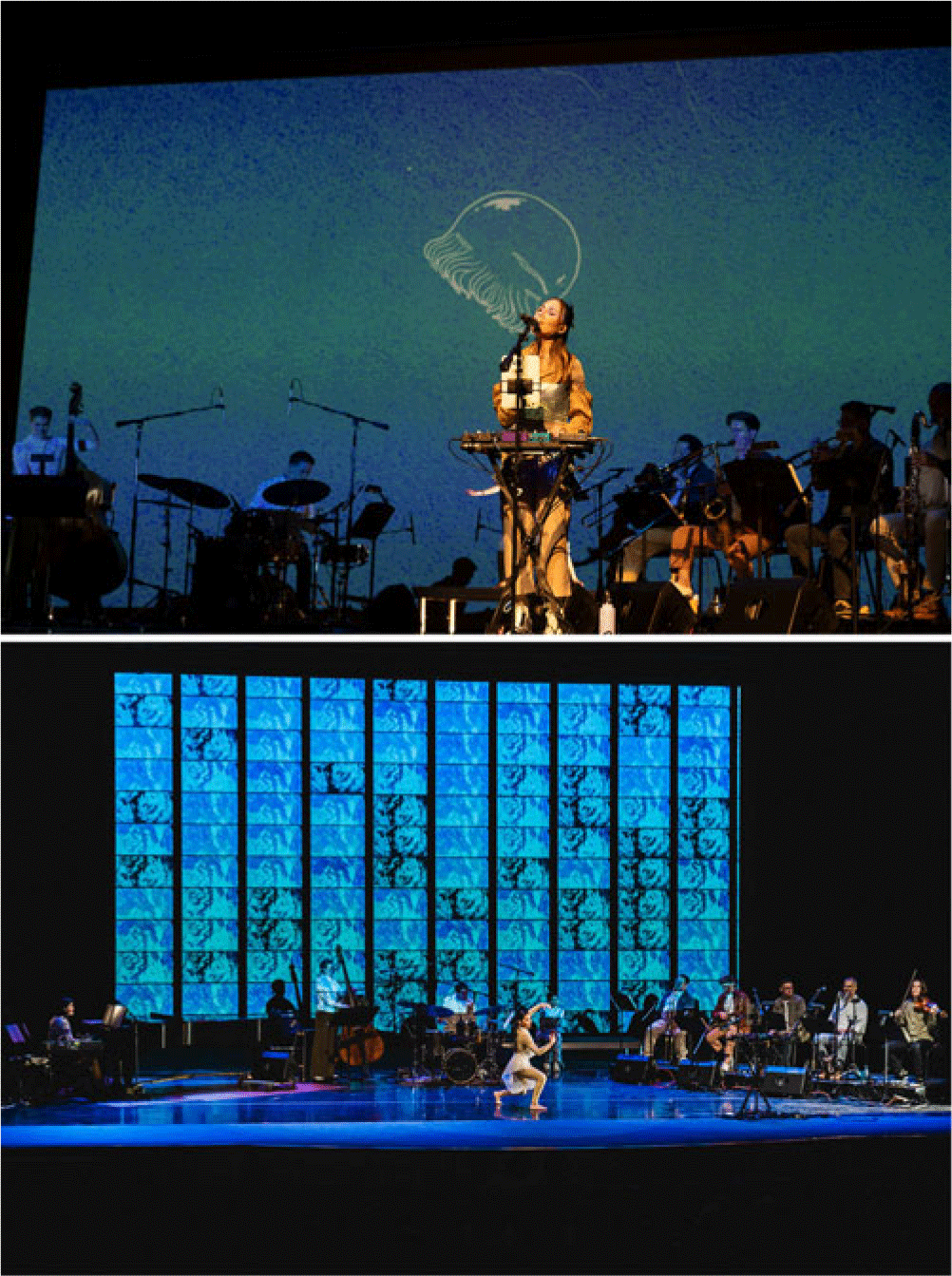
Integrating music, choreography, and visual design further provides multiple entry points into scientific understanding, allowing audiences to engage with scientific ideas through different sensory and cognitive pathways (Figure 4).
Performance of Mycelium at the Montgomery Cultural Arts Center, Maryland, integrating music, choreography, scientist interviews, and visual projections.

Outcomes and future perspectives
Artistic Systems Modeling shifts the starting point of composition from musical ideas to scientific inquiry. Biological and mathematical systems guide compositional decisions, producing musical structures that would not have emerged through conventional songwriting methods.
This approach has expanded my practice toward interdisciplinary performance and immersive environments that allow audiences to experience scientific systems through artistic form. Audience responses suggest that these encounters foster curiosity, wonder, and greater awareness of ecological systems that are often invisible or overlooked.
Looking forward, my framework has potential applications in interdisciplinary research collaborations, museum and science center installations, educational environments, and artist residencies within scientific institutions. By translating scientific systems into sensorial artistic experiences, the framework offers new possibilities for science communication, creative education, and interdisciplinary exploration (Dahlstrom, Reference Dahlstrom2014).
Creative science reflection
For me, creative science expands the ways scientific knowledge can be experienced and communicated. Many scientific systems, from microscopic organisms to climate processes, are difficult to comprehend. Creative practice allows these systems to be encountered through emotional, sensory, and embodied experience. By translating scientific systems into music, movement, and visual form, creative work can make complex ideas accessible in new ways. Creative science, therefore, offers an alternative mode of engagement with research, one that complements analytical understanding with curiosity, imagination, and emotional resonance.
Data availability statement
No datasets were generated or analyzed for this study.
Acknowledgements
I thank Elizabeth Henaff for mentorship through the NEW INC Creative Science program. This work began during my 2022 Artist at Sea residency with the Sitka Center for Art and Ecology. I am grateful to Dr. Kelly Sutherland and collaborating scientists for sharing research that informed the development of Artistic Systems Modeling, and to my artistic collaborators on Mycelium – Danny Jonokuchi, Nitcha Tothong, and Marie Lloyd Paspe.
Author contributions
The author conceived the project, conducted the research, and wrote the manuscript.
Financial support
Grants from NYFA, LMCC, STIM, South Arts Jazz Road Creative Residency, NYSCA, Chamber Music America, Oregon Sea Grant, American Scandinavian Society, and New Music USA supported the artistic research and creative development related to my framework.
Competing interests
The authors have no conflicts of interest to declare for this publication.
Ethical standards
This research did not involve human or animal subjects requiring ethical approval.
AI assistance
AI-assisted tools were used for language editing during manuscript preparation. All ideas, analyses, and conclusions are the author’s own.

 Open access

