I began studying Soviet photography in the early 2000s. To be more specific, I began studying Soviet photographers, most of whom had “Jewish” written on their internal passports, as I sought to understand how it was possible that a large number of photographers creating images of World War II were members of an ethnic group that was soon to be persecuted by the highest levels of the state. I ended up uncovering the social history of Soviet Jews and their relationship to photography, as I also explored how their training in the 1920s and 1930s shaped the photographs they took during World War II.
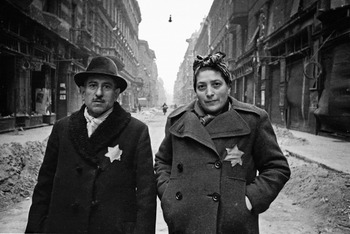
When I began presenting my research, I remember the challenges I faced presenting photography to a diverse public. I was a postdoctoral fellow at the US Holocaust Memorial Museum in 2004 where fellows present works-in-progress. As part of my talk, I showed a series of five unattributed photographs narrating the history of the Budapest ghetto that editors of the Soviet Yiddish wartime newspaper Eynikayt decided to publish in March 1945.Footnote 1 I researched “archaeologically,” moving backwards in time as I started with a widely exhibited photograph by the Soviet war photographer Evgenii Khaldei and one of his most famous photographs, that in the 1990s he titled “Jewish Couple” (in English).
Evgenii Khaldei, “Jewish Couple.” Courtesy of Evgenii Khaldei Archive and Fotosoyuz.

Through research in the Khaldei family archive in Moscow, I learned that he was the photographer of the five Budapest ghetto photographs that appeared in Eynikayt and that he took them when Budapest and its ghetto were being liberated in mid-/late- January 1945. It is not clear if he knew at the time that his Budapest ghetto photographs, taken for his employer, the Telegraph Agency of the Soviet Union (TASS), appeared in the Soviet Yiddish newspaper in March, more than a month later and without attribution.Footnote 2
A version of the “Jewish couple” appeared in the wartime Eynikayt issue that published a story and images of the Budapest ghetto. Since the editors only included a short narrative of the Budapest ghetto with the five images, the individual captions had to do more work describing what the viewer was seeing. Eynikayt editors ran the Jewish couple photograph with the following caption: “Jews with yellow Stars of David that the fascists forced them to wear on their chests” [Yidn mit gele mogndovids, velkhe di fashistn hobn getsvungen tsu trogn af der brust].
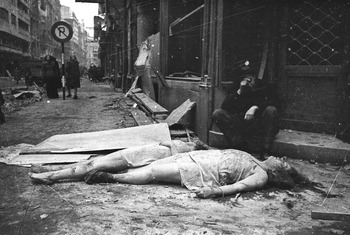
But for this forum, I am interested in a different photograph that appeared in Eynikayt. Figure 2 is an alternate version of the photograph under discussion in the forum that I found in Khaldei’s archive. It depicts a man looking at two dead women. That is all we see in the picture. Its caption then tells us a way to interpret what we see: “A mother and daughter whom the fascists dragged out from a cellar, raped in the middle of the street, and then shot them. Next to them sits their husband and father” [A muter mit a tokhter velkhe di fashistn hobn arufgeshlept fun eynem a keler, fargvaltikt zey in mitn gas un dernokh dershosn. Lebn zey zitst der man un foter].
Evgenii Khaldei, “Untitled,” 1945. Scanned from archival negative. Courtesy of the Evgenii Khaldei Archive and Fotosoyuz.

At the time, I focused on the photograph with the Jewish couple, because Khaldei used that one frequently in his post-Soviet photographic life. After the collapse of the Soviet Union, he went back to his archive to create powerful exhibition photographs that would speak to a 1990s world fascinated by what took place behind the “Iron Curtain” and by Soviet photographs of what we now call the Holocaust. Eynikayt published one version of the Jewish couple. In it, they wear heavy winter coats, onto which were sewn Jewish stars (presumably in yellow, although black and white photographs render the color hard to determine). I did not use the photograph in question—of the man, his wife, and daughter—because Khaldei did not use it as part of his post-Soviet photographic life. It was not the story I was aiming to tell, but it will be where this essay ends up.
I also did not use the photograph of the Jewish couple with Stars of David as documentary evidence of Budapest or its ghetto, even though for Khaldei it was precisely about documenting the horror that “peaceful citizens,” including Budapest’s Jews, lived through under fascism. I talked about how Khaldei may or may not have known they were published; how I understood him to carefully choose the word “fascists,” because in that January moment when he was on the scene talking to people to learn what had happened, he did not know whether it was members of the Hungarian Arrow Cross or the German SS still in the city doing the killing. (In Soviet parlance, like Nazi Germany, the Hungarian Arrow Cross would have been considered fascists. The Soviet interpretation of wartime atrocities understood intent behind violence to be based on politics and ideology, rather than race.) He then sent his photographs back to his TASS editors in Moscow, who used his notes to create the captions. They then put them on the wires, before they ended up in the Soviet Yiddish newspaper.
I presented the various ways Khaldei narrated the photograph’s story to diverse audiences and reminded the audience that we do not even really know if the couple pictured in the photograph identified as Jewish. We only know that the clothing they wear signifies an externally imposed Jewish identity. (The Jewish couple photograph is one of the few Budapest ghetto photographs in which we see the externally imposed marker of Jewish identity.) Finally, I demonstrated what happened when I played the role of photo editor and cropped the picture to remove the Stars of David, rendering a haunting picture of a Jewish couple’s tragedy into a staid image of a couple on a wartime street in some European city. (The stars identified the subjects as Jews and that they were likely in Budapest, which had the last large Jewish ghetto in Europe, one of the few places under German occupation in the East where one would find groups of living Jews.)
As I fielded questions, someone in the assembled seminar asked me on what street Khaldei photographed the couple. As a native of Budapest, he thought he recognized some of the streets. I had no idea. The set of questions he brought to the photograph was different from mine. He also had a different understanding of a photograph’s ontology—as that which mimetically documents external reality, rather than as a representation of reality needing interpretation. His concerns were those of a historian interested in material to the extent that it served as evidence of a crime and revealed facts about the past, and his question was not isolated. Many others to whom I have presented my historical research on photography, are interested in the story told within the photograph, the narrativeness of a photographic image and its evidentiary potential, which according to some art critics is what differentiates photography from other media that can be considered fine art.
We historians hold ourselves to a higher evidentiary standard than scholars working in other disciplinary traditions. We tend to write about new discoveries in archives, that in a more critical light might be a form of “fetishization.” Although I have read Leopold von Ranke, E. H. Carr, and many classics of the historical profession, I subscribe to a newer model of historical writing that focuses on the creation of meaning through narrative, rather than the quest to unearth new facts.
But this forum includes not only historians with different approaches to their work, but also artists, cultural critics, and philosophers who each have their own epistemology. Jacek Frąś is an artist. He was moved to use a wartime image he saw in a book as part of his graphic novella about the 1944 Warsaw Uprising, the Polish national story not to be confused with the Warsaw Ghetto Uprising in 1943, part of the Jewish national story. The book to which he refers, Wyzwolenie (Liberation), first appeared in Moscow as Osvobozhdenie in 1974 and then in Polish and German (Befreiung) translations in 1975. It opens with a series of gruesome images taken from a variety of places and times during the war. These images and the accompanying text introduce the reader to the horrors of war (and the dangers of fascism) as seen at moments of liberation. Following the introduction, the book is organized by nation-state, appearing sequentially in the order in which the Red Army liberated them. The Khaldei photograph in question appears in the Hungary section without attribution.
I say all of this not to accuse Frąś, or the editors of Wyzwolenie for that matter, of playing loose with facts. That is an artist’s craft. My historian’s instinct brought me back to his original sources to see what Frąś the artist saw and better understand how he used photographic material for his/her work. I am compelled by the fact that he used images outside of their anchors in time and place to make a broader statement about how Poland remembers its past. As a cultural critic, Stanczyk interpreted his art, not the source base of his art. Did she make a mistake in following the artist’s lead by labelling the photograph a Warsaw ghetto photograph? Yes, she did. But that is less important to me than what she says about Frąś’s work, which I find compelling.
All of that said, I do not think the issues at stake in this roundtable about the afterlives of photographs are just about disciplinary “rigor” (or lack thereof). The Budapestian, United States Holocaust Memorial Museum (USHMM) fellow was responding to the fact that we were all claiming the mantle of being Holocaust scholars. Much of what scholars, not to mention the broader public, react to is the use of the word “Holocaust” as an adjective in front of the word “photograph.” And nowhere are the stakes higher than presenting research about Holocaust photography at the guardian of global Holocaust history and memory, the USHMM.
When scholars ask me about the facts in the photograph (and it is indeed generally historians), the ones asking those questions are invariably trained to use photographs as evidence of the Holocaust. But when the Holocaust becomes an adjective—as in Holocaust literature, Holocaust museum, or Holocaust photograph—it becomes much more than a description of historical events. It becomes a heuristic device prescribing (and proscribing) what the noun following it aims or claims to do.
Photographs taken during World War II that visualized Nazi crimes against Jews and others is today often called Holocaust photography. (If we go back to Khaldei’s original “photographic moment”—as photo theorist Ariella Azoulay would refer to the time when the encounter between the photographer and the subject on the streets of Budapest reached its audience on the pages of Eynikayt—neither Khaldei, the editors, nor the readers would have used the word “Holocaust” to describe the image produced. They would have called it a fascist war crime photo against Jews.) The adjective predisposes how we approach the noun that follows. Because of fears of Holocaust denial, which began immediately after liberating armies discovered sites of atrocities and accused Nazi Germany and its collaborators of committing crimes, there has been a presumption, in fact a need for photographs to be evidentiary, indexical, in other words, a mimetic representation of external reality to prove the crime.
And there is a good reason for this. As Roland Barthes writes, photography, unlike painting, is a medium that captures the material essence of that which it documents through the interaction of light and chemicals, as Olga Shevchenko’s essay reminds us. For this reason, from their origins in the mid-19th century, photographers (and not painters) have been hired to document crime scenes, whether a police photographer working for the New York Police Department in the early 1900s or Khaldei photographing for the Soviet press during World War II.Footnote 3 In both cases, because of the medium specificity of photography, both the police photographer and Khaldei were on site at the crime scene. They, and not painters, were there to produce photographs to serve as evidence of the crime. Those images would appear in the press to convince a disbelieving public that the rumors they had been hearing were true, and later be submitted as evidence in trials, assuming that the accused would deny the crime. One could say the same about any crime used as an adjective, like “genocide photograph” or even “rape photograph,” in which the noun-as-adjective predisposes one to see in the image evidence of the named crime.
When it comes to the work of Khaldei and other photographers working for the Red Army, the adjective “Holocaust” and the documentary, often forensic, impulse it encourages sits in uncomfortable tension with the other adjective applied to their photographs: “Soviet.” That label took on a whole world of meanings that came to suggest ideologically-driven artifice summarized in the word “propaganda.”Footnote 4 If a “Holocaust photograph” provides indexical evidence, as all photographs of crimes purport to do, a “Soviet photograph” obfuscates that which it purports to reveal. The phrase “Soviet Holocaust photography” becomes an oxymoron.
On the question of the afterlife of photographs, I have a confession: I do not believe in the afterlife. An afterlife, of a photograph or a human being, presumes that one had a life, then a death, then something that comes after. Unlike human beings, who die, photographs do not die. It is not even clear if a photograph is ever “born,” a singular moment when the “life” of a photograph begins. Let’s say for the sake of argument that a photograph is born when a photographer clicks the shutter on a camera and exposes the film. We can date the birth of Khaldei’s photograph to about January 18, 1945, when he photographed the aftermath of the Budapest ghetto’s liberation.
At least according to its original Eynikayt caption, which was based on his notes, Khaldei photographed rape in the ghetto. Who was committing the rape he does not say. But given who he was and for whom he photographed, we have to assume that it is not a photograph of Soviet rape in occupied eastern Europe, which has been a popular topic for scholars rethinking Soviet history since its fall in 1991. Why indeed would a Soviet (and Jewish) press photographer take pictures of his own army’s war crimes? More to the point, why would a Soviet newspaper publish them? We have to see the photograph as an image of the fascist rape of Jewish women on the streets of Budapest and the survivor husband/father’s response. These are stories rarely heard, images seldom seen. It is grim and revealing on its own terms without needing to reveal a dark Soviet truth that had been suppressed for many years, as many want to see in these photographs.
As a historian recounting the history of the photograph to you, I must admit that I am still not completely satisfied, because my understanding of the photograph is based on information from the creator of the photograph himself and the Eynikayt editors. My historian’s instinct urges me to find an additional source talking about the context of the photograph from a third party, perhaps a memo from a Soviet military attaché who granted permission to Khaldei to take pictures of the Budapest ghetto. Or maybe a first-person memoir—likely written in Hungarian, which I do not read—by the man in the picture, whose name I do not know, recalling the day of his liberation when he found his wife and daughter raped and murdered. In it, I might read a line about a passionate Soviet photographer documenting the scene, whose name he would not mention, because that would not have been important to the man recalling one of the great tragedies of his life.
But I am a historian of the Soviet experience, so my primary interest in these photographs was their relationship to Soviet wartime news and memory. To that end, I focused my research on following the photograph’s life back in the Soviet Union. I had presumed that his Budapest ghetto photographs, especially those in which the subjects are marked with the Star of David, did not circulate widely after the war, because many of them documented a particularly Jewish story. They may have worked in the Soviet Yiddish newspaper during the war and today serve as documents and even memorial devices of wartime destruction and the Holocaust in the contemporary period.
In the intervening period, when the Great Patriotic War became a rallying cry for Soviet national identity under Nikita Khrushchev and Leonid Brezhnev, the public Jewish story and images telling that story were meant to fade, at least for those visible marked as Jews. The subjects in the image in question, however, are not visibly marked as Jewish.
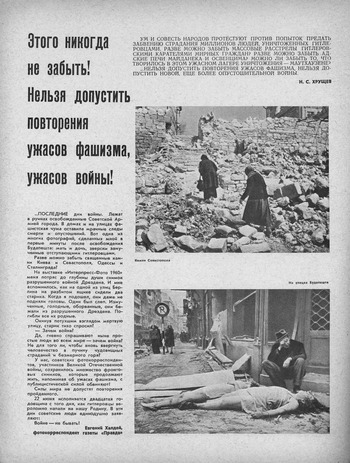
In June 1961, to commemorate the 20th anniversary of the day when “the Hitlerites treacherously attacked our motherland,” the magazine Sovetskoe foto, a magazine aimed at the burgeoning postwar readership of professional and amateur photographers, published a series of photographs attributed to Khaldei (see Figure 3). By 1961, he was a staff photographer for Pravda, a job he landed after a difficult period of more than ten years following his dismissal from his staff position at TASS in 1948. Khaldei’s name sits below the text next to the photographs. The magazine editors, however, wrote the headline: “This will not be forgotten! We must not allow the horrors of fascism and the horrors of war to repeat themselves (Etogo nikogda ne zabyt΄! Nel΄zia dopustit΄ povtoreniia uzhasov fashizma, uzhasov voiny).”
Evgenii Khaldei, “Kamni Sevastopolia” (The Stones of Sebastopol, top) and “Na ulitsakh Budapeshta” (On Budapest’s Streets, bottom), Sovetskoe foto 1961, no. 6.

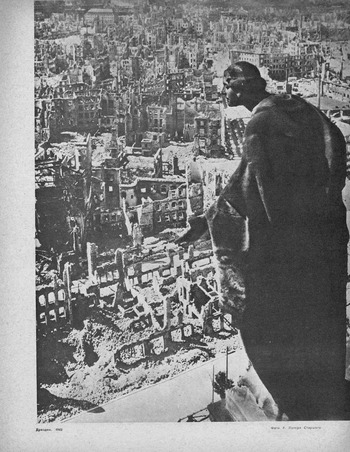
Khaldei’s short piece discusses his visit to the 1960 Interpress Photo exhibition in East Berlin and, more importantly, the wartime memories that visit awakened in him. The exhibition, as well as Sovetskoe foto’s coverage of it, featured an image of Dresden, in the then German Democratic Republic, lying in ruins after a February 1945 British and American bombing campaign. The photograph of Dresden’s bombing (see Figure 4), which some considered a war crime for the mass death of German civilians happening so late in the war, prompted Khaldei to reflect on his own experience as a witness to war crimes.
R. Peter, “Dresden, 1945,” Sovetskoe foto 1961, no. 6.”

He recalled a lonely, elderly couple on the streets of newly liberated, and completely ruined, Berlin, where he was in May 1945. He also remembered his time documenting the liberation of Sevastopol, in Crimea, which was “lying in ruins.” His final memory was of his photograph from the Hungarian capital: “This is one of the many photographs I took in the first minutes after the liberation of Budapest: a mother and daughter brutally tortured by the retreating Hitlerites” [Vot odna iz mnogikh fotografii sdelannykh mnoi v pervye minuty posle osvobozhdeniia Budapeshta: mat΄ i doch΄, zverski zamuchennye otstupaiushchimi gitlerovtsami].
In 1961, Khrushchevian politics projected an image of the Soviet Union as the biggest victim of fascism and therefore the nation best positioned to lead a worldwide peace movement that needed to be vigilant against persistent and recurrent fascism. Khaldei’s Budapest photograph and caption narrated that message and embedded it in early 1960s Soviet memory of the Great Patriotic War. Two details from its wartime appearance as news in the Yiddish-language Eynikayt were omitted, which radically altered the way a Russian-language reader of Sovetskoe foto understood the photograph in 1961. First, the murdered mother and daughter were Jewish, and second, they were victims of rape.
Khaldei himself contextualized the image within the first history—the story of this as a “Holocaust photograph”—only in the 1990s, after the fall of the Soviet Union. For Khaldei, in the post-Soviet period it was important that the two women were identified as Jewish and therefore as Holocaust victims, and the man a Holocaust survivor. In the second history, he died in 1997 and likely would have been loathe to remind post-Soviet viewers of the implied sexual violence in the photograph. He leaves that work for others to do.
The image also becomes a Holocaust photograph or a rape photograph when scholars like myself see it as such. We approach it not just as a document of these crimes on the streets of Budapest, although it can be used for that as well, but about how photographs recreate the past to make meaning in the present.