INTRODUCTION
Hardening by watering cycles (WCs) decreases leaf osmotic potential, stomatal conductance (gs) and growth (Ackerson and Hebert, Reference Ackerson and Hebert1981a; Reference Ackerson and Hebertb; Franco et al., Reference Franco, Cros, Bañón, González and Abrisqueta2002). Stomatal responses to leaf water potential (Ψleaf) can be modified when young plants are subjected to WCs (Ackerson, Reference Ackerson1980; Brown et al., Reference Brown, Jordan and Thomas1976; Jones and Turner Reference Jones and Turner1978). Hardening improves tolerance to lower values of Ψleaf and increases water use efficiency (WUE) (Bãnon et al., Reference Bãnon, Ochoa, Franco, Alarcon and Sanchez-Blanco2006; Sánchez-Blanco et al., Reference Sánchez-Blanco, Ferrández, Navarro, Bañon and Alarcón2004). The maintenance of autotrophy under low Ψleaf during WCs has been attributed mainly to osmotic adjustments, which prevent severe dehydration and leaf abscission in Prunus armeniaca grafted on P. domestica (Ruiz-Sánchez et al., Reference Ruiz-Sánchez, Domingo, Torrecillas and Pérez-Pastor2000). The imposition of three WCs on individuals of Cocos nucifera in Brazil culminated in accumulation of abscisic acid (ABA) in leaves and reduction of Ψleaf before dawn (Gomes et al., Reference Gomes, Oliva, Mielke, De Almeida, Leite and Aquino2009). In these plants, gs was controlled by ABA or by Ψleaf under mild or severe water deficit, respectively.
Saplings of C. arabica are often cultivated inside greenhouses under permanent watering and do not have attributes to tolerate reduced values of Ψleaf under water stress in field conditions (Pinheiro et al., Reference Pinheiro, DaMatta, Chaves, Loureiro and Ducatti2005). The majority of coffee plantations around the world belong to small producers in areas where the water availability is often insufficient and the irrigation costs are too high (DaMatta and Ramalho, Reference DaMatta and Ramalho2006). Indeed, dry seasons and spells are associated with high irradiance and high leaf temperature in Brazilian plantations of C. arabica (DaMatta et al., Reference DaMatta, Maestri, Mosquin and Barros1997). Transpiration (E) is strongly reduced due to stomatal pore narrowing of Coffea under drought (Gutiérrez and Meinzer, Reference Gutiérrez and Meinzer1994). It increases leaf temperature, contributing even more to a net drop in carbon assimilation (Ronquim et al. Reference Ronquim, Prado, Novaes, Fahl and Ronquim2006). Reductions of E, gs and net photosynthesis (PN) have been observed under water stress in C. arabica, C. liberica (Cai et al., Reference Cai, Chen, Guo and Cao2005) and C. canephora (Pinheiro et al., Reference Pinheiro, DaMatta, Chaves, Fontes and Loureiro2004) under field conditions and inside greenhouses (Praxedes et al., Reference Praxedes, Da Matta, Loureiro, Ferrão and Cordeiro2006). However, the behaviour of Coffea leaf gas exchange and Ψleaf after WCs has not yet been studied.
Coffea arabica Mundo Novo and Catuai cvs grafted on C. canephora confers higher capacity to explore soil resources, which could already be an advantage for acquiring water (Fahl et al., Reference Fahl, Carelli, Menezes, Gallo and Trevelin2001) and improve carbon gain (Novaes et al. unpublished data). Mundo Novo plants growing in a greenhouse are in appropriate conditions to test the effects of WCs on leaf gas exchange, Ψleaf and subsequent development. Our hypothesis is that previous WCs performed as a hardening process should confer more positive water and carbon balances on the Mundo Novo cultivar of C. arabica under field conditions. Hardening might be a suitable practice to produce C. arabica saplings with higher tolerance to low Ψleaf before transplanting to field. As a consequence, hardening probably promotes growth and biomass gain during the initial development of C. arabica in the field. Thus, the less interrupted initial growth in a changing environment should confer higher flowering intensity in hardened than in control plants.
The aim of this work was to verify if leaf gas exchange and Ψleaf behaviour of C. arabica saplings grafted on to C. canephora showed consistent alterations during hardening by WCs and if this was effective in improving the vegetative and reproductive growth under field conditions. The impacts of dry and wet periods were evaluated separately. Biomass partioning and shoot morphological traits were taken into account to verify if hardening changed the relations among plant compartments.
MATERIALS AND METHODS
Plant material and watering cycles
Three hundred plants of C. arabica cv. Mundo Novo grafted on C. canephora were used during the trial. Each plant grew in a 125 cm3 tube-shaped plastic pot. Seedlings grew on substrate composed of coconut fibre and vermiculite (4:1, v/v). For each 200 dm3 of substrate, 1.2 kg of fertilizer was used with nitrogen (16%), phosphorous (8%), potassium (12%), zinc (0.2%) and boron (0.2%). Plants were acclimated from 13 to 23 June 2005 under 75% solar irradiance in a greenhouse with average night and day temperatures at 18.0±3.2 and 25.0±3.0 °C, respectively. From 23 June to 4 July 2005 all individuals were acclimated under full solar irradiance in an open area.
The WCs started in the middle of the dry season (see below) in an open area on 4 July 2005, when experimental plants were four months old and ready for transplanting into the field. One WC consisted in watering the substrate up to field capacity on the first day and keeping without watering on subsequent days until the average value of net photosynthesis (PN) was close to zero, when values of leaf water potential (Ψleaf) were measured. The WCs were repeated until Ψleaf did not decrease any more, resulting in a total of seven WCs.
Field growing conditions
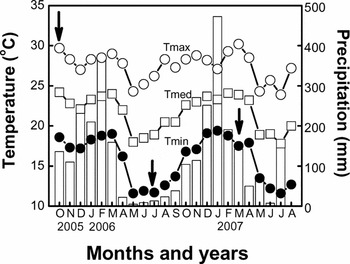
The experiment was carried out in southeast Brazil (21°58′59 S, 47°52′46 W; 843 m asl). Monthly air temperature and precipitation data were obtained at station number 83726 of the Instituto Nacional de Meteorologia (INMET), located 1 km from the site of the experimental plots. The field transplantation was performed in October 2005, when the climate was characterized by monthly average minimum and maximum temperatures of 18 and 30°C, respectively, and monthly average precipitation of 136 mm (Figure 1). From October 2005 to August 2007, plants grew in a field under subtropical climate with dry winter and warm-rainy summer, cwa type according to the Köppen classification (Monteiro and Prado, Reference Monteiro and Prado2006). The dry period was characterized by average monthly minimum temperature of 11 °C, maximum temperature of 26 °C and average precipitation lower than 20 mm (Figure 1). The first determination of shoot morphological traits was carried out when plants were 14 months old, during the dry period (July 2006). The wet period (March 2007) was characterized by monthly average minimum temperature of 17 °C, maximum temperature of 30 °C and monthly precipitation of 140 mm (Figure 1). The second determination of shoot morphological traits was performed during the wet period (March 2007).
Monthly average values (symbols) of maximum (Tmax), medium (Tmed), and minimum (Tmin) temperatures and the total rainfall (columns) during the initial development of hardened and control plants of C. arabica grafted on C. canephora cv. Mundo Novo under field conditions (October 2005–August 2008). The arrow at the left top of the panel indicates the time of field transplantation (October 2005) and the arrows at the bottom indicate when shoot morphological traits were measured in the dry (June 2006) and wet (March 2007) periods.

Leaf gas exchange, water potential, vapour pressure deficit and integrated PN values
The plants were separated in three groups (100 plants per group): groups 1 and 2 were kept in the same WC and environment conditions and group 3 was not submitted to WCs and kept as control, with daily watering. Groups 1 and 2 were used for leaf gas exchange and leaf water potential measurements, respectively. Values of PN, gs, sub-stomatal CO2 concentration (Ci) and E were determined daily on plants of group 1 using an infrared gas analyser, model LCA-4 (ADC, Hoddesdon, UK), under photosynthetic photon flux density (PPFD) sufficient to saturate C. arabica PN (1300 μmol m−2 s−1, Ronquim et al., Reference Ronquim, Prado, Novaes, Fahl and Ronquim2006). A dichroic light source (PLU-002, ADC, UK) mounted on the head of a broad Parkinson leaf chamber (PLCB-4, ADC) provided the PPFD. The LCA-4 worked as an open system during the leaf gas exchange measurements, with a tower collecting the reference air far from CO2 sources (Ronquim et al., Reference Ronquim, Prado, Novaes, Fahl and Ronquim2006). The leaf temperature (23 ± 0.5 °C) was maintained by a Peltier system (ADC) and measured by a copper-constantan thermocouple connected to PLCB-4. The relative air humidity inside the PLCB-4 was maintained by LCA-4 at 65 % using a gas column containing wetted FeSO4.7H2O. Instantaneous transpiration efficiency (ITE) was calculated as PN/E, and WUE as PN/gs (Nogueira et al., Reference Nogueira, Martinez, Ferreira and Prado2004). The average values (± s.e.) of leaf gas exchange were obtained on four different sunlit leaves. These leaves were expanded, totally green, free of damage, and each one was attached on a distinct individual plant in group 1.
The Ψleaf values were determined in group 2 using a pressure chamber (model 3005, Santa Barbara Soil Moisture, Santa Barbara, USA). Four expanded leaves of four different plants were used to obtain the average values (± s.e.) of Ψleaf. Plants growing on the edge of the support tray of plant pots were not considered for gas exchange or Ψleaf determinations, to avoid the extra influence of wind, temperature and vapour pressure deficit (VPD) on leaves near the boundary of plant tray. The values of air VPD outside the leaf chamber (VPD, kPa) during leaf gas exchange measurements were calculated by the procedure described by Jones (Reference Jones1992).
Shoot morphological traits, biomass allocation in plant compartments and flower number per plant after field transplantation
Fifty hardened and 50 control plants (without watering cycles) of Mundo Novo cultivar were transplanted for growing under field conditions when they were six months old. Hardened and control individuals were separated, with spacings of 20 × 20 cm on the plots. The substrate for transplanting was prepared previously with oxisol soil and animal dung in proportion of 4:1 (soil:animal dung, v/v). Lime was added previously as dolomitic calcareous mineral at 0.5 g per kg of soil for increasing soil pH value to 6.0. Calcareous application was done in February, May and November 2006. Chemical fertilization (nitrogen 4%, phosphorous 14%, potassium 8%) was carried out after 30 days of calcareous applications. Daily watering on the plots was done only during the first month (October 2005) after field transplantation.
Measurements of shoot morphological traits and biomass allocation in plant compartments were carried out in the dry (July 2006) and wet periods (March 2007), when plants were 14 and 22 months old, respectively. Five hardened and five control plants were used to obtain the shoot morphological traits: plant height, number of leaves and branches, total leaf area per plant and basal stem diameter. The plant height was measured from the soil surface to the apical meristem of the main stem using a 1.0 m ruler. The branches were counted as those on the stem or on a parental branch previously produced. The total leaf area per plant was measured by detaching and then scanning all leaves of five plants in hardened and in control treatments using Image-Pro software (Media Cybernetics version 4.0, USA). The basal stem diameter was measured using callipers just above the soil surface.
Biomass was determined for 10 hardened and 10 control plants. Plants were separated in to three compartments: leaves, stem plus branches and roots. Each plant compartment was dried in an oven at 60 °C to constant mass. The sum of leaves, stem and branches biomass gave above-ground biomass (AB) and roots were considered as below-ground biomass (BB). The ratio AB/BB was calculated in each plant, individually.
The leaf area ratio was calculated by dividing the total biomass of a plant (g) by the corresponding total leaf area (m2). The number of flowers was counted in the main blossoming event in the dry period (August 2007) in five hardened and five control plants.
Survivorship and statistical analyses
The survivorship was determined in two steps. First it was obtained as the percentage of plants alive at the end of the WCs in relation to the number of plants at the beginning of the cycles (October 2005). Later, it was determined as the percentage of plants alive at the end of field growth period in relation to the 50 plants transplanted at the beginning of the experiment (August 2007) in hardened and control plants. Values of biomass, above-ground traits and number of flower were not normally distributed and therefore significant differences of average values were tested by non-parametric analysis (Mann-Whitney) with significant level (α) at p < 0.05. The values of leaf area ratio were normally distributed and, therefore, were analysed by Student t-test at p < 0.05.
RESULTS
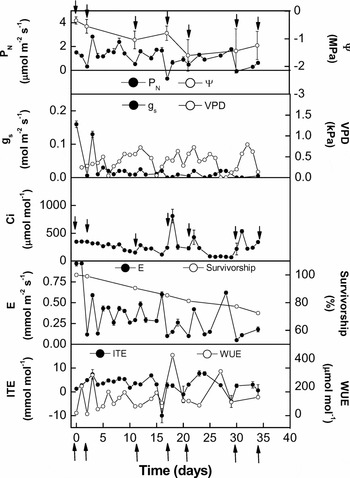
An adjustment of leaf gas exchange pattern was observed after the third WC (about 15 days of hardening) (Figure 2). The most affected variable was gs, whose average was reduced consistently (from 0.15 to 0.01 mol m−2 s−1) after the second WC (Figure 2). Low values of gs were maintained even in subsequent WCs. Average values of E and PN decreased between the first and seventh WCs. Increase in gs occurred just after watering until the fourth WC (Figure 2). For instance, the average values of gs increased from near zero to 0.13 mol m−2 s−1 after the second watering and from 0 to 0.004 mol m−2 s−1 after the fourth watering. Between the first and third WCs, PN recovered simultaneously with gs after watering, but after the fourth WC the corresponding PN recovery was delayed and lower. For example, the average values of PN increased from 0.32 to 2.83 μmol m−2 s−1 after the second watering and from 0.09 to 1.24 μmol m−2 s−1 after the fourth watering.
Average values (symbols) and s.e. (bars) of net photosynthesis (PN), leaf water potential (Ψ), stomatal conductance (gs), vapour pressure deficit (VPD), sub-stomatal CO2 concentration (Ci), transpiration (E), survivorship, instantaneous transpiration efficiency (ITE) and water use efficiency (WUE) during seven watering cycles in four-months-old plants of C. arabica grafted on C. canephora cv. Mundo Novo growing in 125 ml pots during watering cycles. Arrows indicate the days of watering (beginning of each cycle).

Values of PN, WUE and ITE were positive until the third WC. Afterwards, PN was zero or negative at the end of each WC, when WUE, ITE and Ci showed greater amplitude of variation (Figure 2). The Ci values increased after the third WC immediately after each watering (Figure 2). Values of Ψleaf were higher than −1.5 MPa throughout the seven WCs (Figure 2). Vapour pressure deficit was usually lower than 1.0 kPa throughout the seven WCs (Figures 2). Survivorship during the first three WCs was over 90% (Figure 2). After three more WCs the survivorship was about 80%, and after seven WCs it was around 70% (Figure 2). Low survivorship occurred in plants growing at the edge of each plant tray (data not shown).
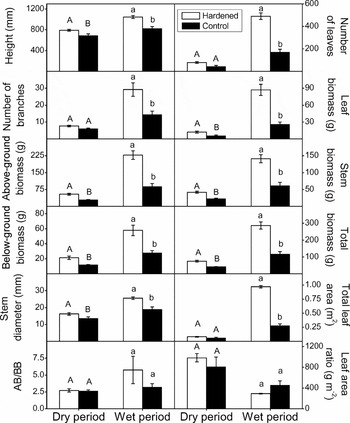
During the dry period, the average values of plant height, biomass allocation among different plant components (leaves, stem, branches and root system), total plant biomass (above-ground plus below-ground systems), and stem diameter were significantly (p < 0.05) higher in hardened than in control plants (Figure 3). The number of leaves, number of branches, total leaf area, AB/BB ratio and leaf area ratio did not differ significantly (p ≥ 0.05) between treatments during the dry period (Figure 3).
Average (columns) and s.e. (bars on columns) of shoot morphological traits (n = 5) and biomass (n = 10) determined in hardened (white columns) and in control (black columns) plants of C. arabica grafted on C. canephora cv. Mundo Novo growing under field conditions during the dry and the wet periods. Significant differences (p < 0.05) between hardened and control plants in each period are indicated by different letters above columns. AB/BB = ratio of aerial/below-ground biomass.

The differences between hardened and control plants in the wet period were, in most traits, two times higher than in the dry season. During this wet period, the average values of plant height, number of leaves, number of branches, biomass allocation of different plant compartments (leaves, stem, branches and root system), total biomass, stem diameter and total leaf area were significantly (p < 0.05) higher in hardened than in control plants (Figure 3). On the other hand, the number of branches and the total leaf area were significant higher (p < 0.05) in hardened than control plants only in the wet period (Figure 3). The difference between hardened and control plants in the number of branches and total leaf area were 2 and 3.5 times higher, respectively, at this period. The AB/BB ratio and the leaf area ratio were not significantly different (p ≥ 0.05) between treatments in the dry period as well as in the wet period (Figure 3). Survivorship was 94% in both hardened and control plants at the end of the experiment in March 2007.
The number of flowers was recorded when plants were 27 months old (August 2007), which was characterized by average monthly minimal temperature about 12 °C and maximum temperature between 23 and 27 °C. The average precipitation in the month of flower recording was close to zero and in the previous month was 147 mm (Figure 1). The average number of flowers in hardened plants (80.28, s.e. ± 19.68) was significantly higher (p < 0.05) than the number in control plants (13.20, s.e. ± 5.57).
DISCUSSION
A permanent alteration was observed in leaf gas exchange behaviour during hardening by WCs. The most affected variable was gs, which was reduced from 0.15 to 0.01 mol m−2 s−1 after two WCs (10 days) in all cultivars, despite subsequent watering. After the imposition of three WCs in C. nucifera plants in Brazil, the adjustment in PN and gs behaviour was not permanent but recovered slowly to 80% from the control values (Gomes et al., Reference Gomes, Oliva, Mielke, De Almeida, Leite and Aquino2009). Nevertheless, these authors showed that ABA concentration remained high in leaves even after rewatering for eight days. Therefore, the permanent adjustment of leaf gas exchange behaviour, as gs and E, could be due to increased concentration of ABA in coffee leaves.
Damage in the photosynthetic machinery was indicated after three WCs by the momentary increase of gs without proportional rise in PN. This allowed accumulation of CO2 in the sub-stomatal chamber and therefore, short-term elevations of Ci. The PN values could be more limited by mesophyll conductance (gm) than by gs as observed by Araujo et al. (Reference Araujo, Dias, Moraes, Celin, Cunha, Barros, Da Matta and Barros2008). These authors described gm substantially lower than gs, implying that gm disproportionately limited PN in C. arabica growing as hedgerows. Araujo et al. (Reference Araujo, Dias, Moraes, Celin, Cunha, Barros, Da Matta and Barros2008) observed that short-term high values of Ci stimulated PN by overcoming the physical, rather than the metabolic component of gm. In our study, the limited values of PN after three WCs should be not only due to damage in physical but also in metabolic factors, since there was a corresponding decrease in photosynthesis due to short-term high values of Ci. Therefore, three WCs (15 days) were sufficient to modify leaf gas exchange pattern without damage in photosynthetic machinery.
Because lower survivorship was brought about during initial watering suspension, it is necessary to carry out as few WCs as possible. The permanent adjustment of gs behaviour without injury to the photosynthetic machinery and survivorship higher than 80% indicated that three WCs is the limit for successful hardening of saplings of C. arabica grafted on C. canephora. Also, higher percentage survivorship during WCs could occur when seedlings are growing on benches with hundreds of plant trays side by side, producing a relative reduction in the board effect.
The shoot morphological variables and the biomass accumulation were significantly higher in hardened than in control plants in the dry and the wet periods. Reduced gs allowed higher WUE in Rosmarinus officinalis (Sánchez-Blanco et al., Reference Sánchez-Blanco, Ferrández, Navarro, Bañon and Alarcón2004) and Nerium oleander (Bãnon et al., Reference Bãnon, Ochoa, Franco, Alarcon and Sanchez-Blanco2006) hardened to water deficits. Barros et al. (Reference Barros, Mota, Da Matta and Maestri1997) showed a relation between gs and vegetative growth of C. arabica. Therefore, the lower values of gs and the positive values of PN, WUE and ITE for up to three WCs, suggest the hardened coffee plants were probably able to sustain greater photosynthetic area, resulting in higher accumulation of biomass compared to control plants under field conditions. Higher susceptibility of control plants to water stress was probably the conducer of the reduction of the rates of shoot extension, number of nodes and leaf area (Fisher and Browning, Reference Fisher and Browning1979). Coffea arabica individuals submitted to 84 and 48 days of drought and then rewatered, produced 70% more lateral shoots and formed leaves faster than plants regularly irrigated, respectively, and this compensatory vegetative growth following drought may be due to a reduction in root resistance to water uptake after a stress-induced increase in ABA (Browning and Fisher, Reference Browning and Fisher1975). Thus, in hardened plants a large amount of carbon could be fixed per unit of water lost in transpiration, even in the dry periods. The hardened plants were capable of producing more intense flowering at the end of the dry period with greater biomass accumulation in the autotrophic and heterotrophic compartments, and more branches than control individuals. Hardening is therefore an adequate technique to increase flower number and, even more, could be a potential solution to concentrate the opening of flower buds.
Higher flower production could result in more fruits produced per branch, increasing the whole plant productivity. Besides, higher basal stem diameter as obtained in hardened plants reflects the more intense traffic of mass flow via xylem between root and shoot. Indeed, there is a well-fitted sigmoid function between water transport and the basal stem diameter in 23 tree species growing in temperate sites of North America and tropical sites of South America (Meinzer et al., Reference Meinzer, Bond, Warren and Woodruff2005). Therefore, the larger the basal stem diameter is the higher the water transport could be to support plant growth and reproduction.
On the other hand, the carbon partitioning among plant compartments was maintained in hardened and control plants as highlighted by the AB/BB ratio and by the leaf area ratio. Despite significant differences in many variables in favour of hardened plants, the biomass partitioning was equivalent between treatments. Therefore, hardening by WCs did not disrupt the original relationships between shoot and root or between autotrophic and heterotrophic plant parts. Hence, the increased carbon net assimilation on a more developed canopy associated with a greater root system resulted in favourable conditions for increasing the number of flowers and, consequently, the potential for fruit production in hardened plants.
In conclusion, three WCs (about 15 days) are recommended as a protocol for practical purposes in Mundo Novo cultivars of C. arabica for modifying leaf gas exchange pattern without damaging photosynthetic machinery. Higher values of shoot morphological traits – total leaf area, biomass accumulation pattern and number of flowers in hardened plants – clearly indicate the improvements on initial development of C. arabica under field conditions. Hardening should be adopted in C. arabica cv. Mundo Novo, because it is a simple, quick and low-cost process, which could improve the vegetative development and grain production under a changing environment such as in field conditions during the course of the day and the year.
Acknowledgments
This work was supported by FAPESP (scholarship to PN). We are grateful to COOPEMAR and GARCAFE for supplying plant materials and to Carlos A. Casali for assisting on gas exchange measurements. CHBA acknowledges a research fellowship from CNPq.