Reflecting on the diverse attitudes to environmental stewardship held by adults, the researcher explored what relation these attitudes may have to adults’ childhood experiences in nature. Drawing on literature in the field, such as that of significant life experiences (Chawla, Reference Chawla2006a), the author researched young Canadian adults’ views of nature and these young adults’ perceptions of their experiences of nature as children. Connections were found between positive perceptions of experiences in nature as children and positive attitudes to nature as adults, thus providing support for the value of positive ecological or environmental education experiences for children.
Literature Review
Ecological Consciousness
Ecological consciousness (Broom, Reference Broom2011), closely tied to ecological identity, encompasses individuals’ knowledge of, reverence for, and actions towards the environment. It may be actualised through deep and reflective explorations of one's views of and connections to nature (Thomashow, Reference Thomashow1996). Individuals with an ecological consciousness connect their personal identities to nature, demonstrate care of nature, and value sustainability. The concept is also closely related to that of biophilia (Rice & Torquati, 2012; E. Wilson, Reference Wilson1984), which is theorised as an innate love of nature, a biological need related to survival. While biophilia is wired within us (E. Wilson, Reference Wilson1984), it develops through childhood experiences in nature, among other factors, including proximity to nature and parental views towards nature (Rice & Torquati, 2012). People come to value living creatures in greater depth, including themselves, through understanding them (E. Wilson, Reference Wilson1984). Nature is vital to us, as it satisfies human physical needs, and aesthetic and spiritual needs.
In contrast to those individuals who value and care for nature, other individuals may have a limited ecological consciousness or identity. They may focus on the economy and view the natural environment as a resource to be exploited for profit (Wente, Reference Wente2013). This study explores why these differing perspectives may be present, and — significantly — how perspectives do or do not align with actions. The article concludes with recommendations that aim to improve the effectiveness of environmental education for children. If it is the case that early, positive experiences in nature can influence our attitudes and behaviours towards nature as adults, it is important to reflect on what experiences in nature we design and implement for children in order to have the most effective chance of developing positive attitudes and behaviours in adults. Adults’ attitudes to nature may influence behaviours and thus may affect the amount and quality of environmental stewardship we have in the future.
The Impact of Childhood Experiences
This article adds to a small but growing literature exploring how our childhood experiences in nature may affect how we view and interact with nature as adults (Bixler, Carlisle, Hammitt, & Floyd, Reference Bixler, Carlisle, Hammitt and Floyd1994; Carson, Reference Carson1998; Chawla, Reference Chawla1998, Reference Chawla1999; Cheng & Monroe, Reference Cheng and Monroe2012; Kahn, Reference Kahn and Kellert2002; Kellert, Reference Kahn and Kellert2002; Pike, Reference Pike2011; Tanner, Reference Tanner1980, Reference Tanner1998; Ward Thompson, Aspinall, & Montarzino; Reference Ward Thompson, Aspinall and Montarzino2008). It adds a new dimension, however, by exploring how consciousness may not be sufficient in and of itself to develop environmentally friendly behaviours.
Tanner (Reference Tanner1980) initiated much interest and work in this area by discussing significant life experiences and their possible relationship to environmental consciousness (Chawla, Reference Chawla2006a). With due consideration of concerns over significant life experiences research, such as its ‘post positivist’ method that ‘extracts simple categories from autobiographical accounts’ (Chawla, Reference Chawla2001, p. 456), researchers (e.g., Chawla, Reference Chawla2001; Cheng & Monroe, Reference Cheng and Monroe2012) have expanded the field by investigating significant life experiences in relation to other factors and concluded that some factors (such as family and relationships) can influence attitudes towards the environment. Cheng and Monroe (Reference Cheng and Monroe2012) found a positive correlation between children's views of and association with nature and their families’ views, as well as the children's previous experiences in and knowledge of nature and their proximity to nature. Further, Ward Thompson et al. (Reference Ward Thompson, Aspinall and Montarzino2008) studied the correlation between childhood time in nature and later attitudes and behaviours in the United Kingdom and found a positive correlation across varied social classes and/or neighbourhoods. They concluded childhood time in nature led to more positive views of nature and more time spent in nature as adults. Wells and Lekies (Reference Wells and Lekies2006) also found an association between spending time in nature, particularly wild nature, and pro-environment attitudes and behaviours in the United States. They found, however, that time in domesticated nature had little effect on adult behaviours. Both Moore and Cooper (Reference Moore, Cooper, Kellert, Heerwagen and Mador2008) and Moore and Cosco (Reference Moore and Cosco2000) concluded that students must first develop care for the environment before they can take care of it. Chawla (Reference Chawla2006b) added that children need a mentor to foster their love of nature and disapproval of destructive environmental practices.
Thus, previous work has found connections between childhood experiences in nature and adult attitudes towards the environment. However, our knowledge is still incomplete. For example, which factors are most important? What are the connections between attitudes and behaviours? Are the findings true for the general population and for youth living in rural versus urban environments? The researcher conducted a study with Canadian young adults that addressed some of these gaps in knowledge. The findings comment on Cheng and Monroe's (Reference Cheng and Monroe2012) conclusions and Chawla (Reference Chawla1999), who focused her research on environmental educators. The article's recommendations connect to childhood environmental education literature (e.g., Barnett et al., Reference Barnetta, Houle Vaughn, Strauss and Cotter2011; Çobana, Akpınara, Küçükcankurtaranb, Yıldızc, & Ergina, Reference Çobana, Akpı nara, Küçükcankurtaranb, Yı ldı zc and Ergina2011; Davis, Reference Davis2010; Kennelly, Taylor, & Serow, Reference Kennelly, Taylor and Serow2012; Pike, Reference Pike2011; Reinfrieda, Aeschbacherb, & Rottermann, Reference Reinfrieda, Aeschbacherb and Rottermann2012).
Method
Research Design
The researcher explored how childhood experiences in nature (i.e., how they were perceived by individuals, or how they were developed into concepts) influenced later attitudes and actions towards the environment, and considered the implications of this for environmental education through a survey study with quantitative and qualitative questions. The quantitative questions had youth select one option from five choices regarding an attitude or to select all the options that applied to them regarding their behaviours or actions. The qualitative questions were optional, open-ended questions that allowed the youth to add to, elaborate on, or clarify their quantitative answers. For example, they could add more categories if theirs were not listed. Participants were given one final, open-ended question where they could add any information they wanted to add. Few youth filled out the optional, open-ended questions, so analysis focused on the quantitative questions, which the participants did complete.
Participants
University students, ranging in age from 18 to 25, at a public place at a large, Canadian university were invited to participate. Individuals were able to enter a raffle to win a prize in exchange for participating in the study, which led to a high participation rate: of the students who were invited to take the survey, more than 50% agreed to fill out the survey. The youth were in varied programs, primarily in undergraduate programs in arts, sciences, and business at the university. Participants were invited to fill out the survey until the number of 50 participants was reached. Young adults from diverse educational backgrounds were the focus of this study, as previous work has focused on environmentalists and activists (Chawla, Reference Chawla2001), and young adults are old enough to reflect on their previous experiences. They are also becoming responsible for managing their own behaviours and actions. Surveys were chosen as they provide youth with more opportunities to privately reflect on their thoughts without having to share these thoughts with another person and because more research could be collected than would be the case if interviews were used. The surveys provided open spaces for students to write their own thoughts and comments if they wanted to do so.
Setting
The students were invited to fill out the survey at university cafeterias at lunch time during the regular school term. The university is found in a city of 160,000 people that is surrounded by nature (mountains, lakes, and forests). The region has excellent farming lands. Many recreational sports occur in the natural environment, and a number of small, rural communities are not far from the city. Some communities are agricultural; others are resource-extraction based (particularly logging and mining). The university is ranked one of the best in Canada, so the youth cannot be considered to be representative of youth in general in the nation.
Instrumentation
After providing some background information on themselves, the survey asked participants to select, using a 5-point rating scale, their attitudes of care towards nature (refer to Appendix for the survey tool). ‘Nature’ was not specifically defined, but was used in the generic sense of ‘the natural environment’, after which participants were asked to identify how much time they spent playing in nature when they were children. They were provided with a checklist and asked to select which activities they most engaged in as children (e.g., played outside in nature, played sports, watched TV, or played computer games). If they selected the ‘played outside in nature option,’ they were asked whether their memories of these experiences were mostly positive, negative, or both. Certainly, other life experiences, such as school and friendships, shaped individuals’ development; however, this study was specifically focused on exploring experiences in nature (how these experiences were perceived or conceptualised) and their relationships to later attitudes and actions towards nature or the environment. Next, participants were provided with another 5-point rating scale question that required them to select how much of a priority they ascribed to taking care of the natural environment. They supplemented this answer by selecting actions they engaged in (on a checklist) that demonstrated environmental care. Options included buying local or organic food, taking public transport or biking, engaging in actions that minimise energy consumption, recycling, and composting. Participants could also add their own actions to the list.
Peers reviewed and provided feedback on the survey, suggesting some additional questions and categories to add to the checklist categories and recommending some features to increase the survey's legibility (such as more spacing). The survey was also pilot tested. Questions were checked for clarity, validity, and reliability. The questions were written in order to build on participants’ previous answers. That is, individuals began by describing themselves, their thoughts and feelings to nature today, and then their childhood experiences in nature and their families. They concluded the survey by reflecting on their attitudes in the present and their actions. Open-ended questions allowed respondents to provide additional details or clarification to their answers. The questions were designed to be straightforward for the students to answer, thus including checklists and optional written responses so that the students would complete and hand in the surveys. Likert-scale questions aimed to identify the number of respondents who identified themselves as valuing nature, having had positive experiences in nature as children, and engaging in environmental behaviours. Open-ended questions provided the respondents with opportunities to add to or change the focus of the answer if they felt the need to do so.
Procedures
After ethics clearance, the researcher conducted the anonymous survey study with youth, with the aim of the answering the research questions: (a) What are the correlations between young adults’ experiences in nature as children and their adult attitudes and actions towards it? (b) What are the influences of some other factors (such as gender and family) and which factors are most significant?
After reading the consent forms, participants filled out the pen-and-paper surveys on the spot. They were entered in a draw when they returned their completed surveys. The draw information was kept separate from the data and data analysis. Participants were informed that confidentiality and anonymity would be maintained and that they could withdraw from the study at any time without penalty. They were also given space to add their comments to the questions on the survey.
Analysis
The researcher analysed the 5-point scale responses by summing up the participants’ answers and then carrying out percentage correlations between factors. For example, the researcher summed up the number of respondents who identified themselves as loving nature. The researcher then identified how many of these respondents selected the option that they loved nature and calculated the percentage.
The higher the percentage correlation between the two or three factors, the higher the interpreted strength of the relationship between the factors was assumed to be. The researcher found that the answers were both negatively and positively correlated to the key research question. That is, individuals who selected the ‘loves nature’ option had a high percentage correlation with having positive experiences in nature as children, while individuals who selected the ‘neutral’ option had a high correlation with not having had positive experiences in nature as children.
The study was conducted with university students of varied ages and in varied programs, and so it may add insights to our understanding of young adults’ views towards the environment. Many of the studies conducted so far have been conducted with individuals associated with environmental studies or with children and teens. However, the study was only conducted at one university, and university students cannot be considered to be representative of the general population as a whole. Future studies can be conducted to address these limitations.
Findings
The research identified connections between positive childhood experiences in nature and a nurturing stance to the environment in adulthood. The findings are presented thematically next.
Gender and Love of Nature
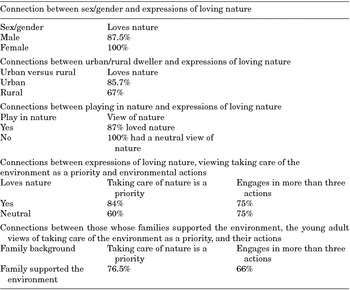
A total of 87.5% of males and 100% of females stated they loved or somewhat loved nature. The rest of the male participants selected the ‘neutral’ option. No male or female participants were somewhat indifferent or did not care about nature. Thus, the majority of participants stated that they loved or somewhat loved nature, with females being slightly higher than males in their expressed love for nature. This finding supports and adds to that of previous work, such as Cheng and Monroe's (Reference Cheng and Monroe2012) findings, as they did not consider gender, by showing females express a more caring stance to nature than males.
Class and Love of Nature
There was no significant difference across social classes regarding participants’ expressed love of nature. All students who labelled themselves as ‘other’ or ‘working class’ stated that they loved or somewhat loved nature. The majority of participants labelled themselves as middle or upper middle class and the majority of these (89.2%) stated they loved or somewhat loved nature.
Urban/Rural Experience and Love of Nature
Living in a city does not seem to prejudice individuals against nature. The opposite seems to be the case, for 85.7% of urban dwellers loved or somewhat loved nature. However, only 67% of rural dwellers stated that they loved or somewhat loved nature. Thus, individuals who live in a city stated that they loved or somewhat loved nature more often than rural dwellers did. This finding adds to our knowledge of the field by highlighting possible differences in the perceptions of rural and urban youth to the environment.
Play in Nature — Positive View of Nature
There was an 87% correlation between having positive experiences playing in nature as a child and identifying themselves as loving nature as adults. There was a 100% correlation between not playing in nature and having a neutral view of nature. Thus, young adults who played in nature selected the options that they loved nature often, and those adults who selected the option that they did not play in nature as children did not identify themselves as lovers of nature. Further, the more positive the experience in nature was selected to be, the stronger the participants identified themselves as adults who loved nature. This finding reinforces those of Wells and Lekies (Reference Wells and Lekies2006) and Ward Thompson et al. (Reference Ward Thompson, Aspinall and Montarzino2008) by associating childhood experiences in nature with care for nature as adults. However, to be effective, these experiences should be positive experiences: the more positive the experience was perceived to be by youth, the more youth stated they cared about nature.
Loves Nature — View Taking Care of the Environment as a Priority
There was an 84% correlation between loving nature and considering it a priority. Those who had a neutral view of nature did not choose the option that the environment was a priority as often. Those who loved nature stated they were more likely to want to take care of it. However, there was only a 75% correlation between viewing the environment as a priority and engaging in more than three actions (such as taking public transport, recycling, biking, or minimising energy consumption) for the environment. Further, those who labelled themselves as being neutral towards the environment engaged in similar actions. Considering the environment to be a priority does not necessarily mean that an individual's actions focus on taking care of the environment more than the actions of someone who did not identify themselves as a lover or nature or who did not view environmental stewardship as a priority, also supporting Wells and Lekies, Reference Wells and Lekies2006. It is thus hypothesised that actions do not necessary follow from stated beliefs.
Family Background and Seeing Taking Care of Nature as a Priority
Participants whose family advocated taking care of the environment (76.5%) and sustainability stated that taking care of the environment was a priority. However, only 66% of these individuals then stated that they engaged in more than three actions aimed at taking care of the environment. Thus, the correlation between family backgrounds and views of nature as a priority were lower than those between positive experiences in nature as a child and loving nature (87%).
Discussion
The findings are summarised in Table 1. Recommendations to address the findings are given after discussing the findings. In the data summarised in the table, the two positive response options were combined together, as were the negative response options. The neutral or middle variable is presented separately. For example, love nature and somewhat love it were combined; neutral was analysed alone, and somewhat indifferent and don't care were combined. As the general trend in answers explored positive versus negative answers, providing the five separate categories did not provide for more clarity for the reader. The findings present the percentage correlations between two items.
Summary of Findings

Playing in Nature and Loving Nature
A correlation was found between positive experiences of playing in nature during childhood and positive views towards nature in young adults. Those who expressed stronger views of loving nature also expressed stronger perceptions of enjoying their experiences of playing in nature as children. Those who did not play in nature as children had neutral views of the environment as adults. Thus, it appears that early and positive childhood experiences in nature may provide formative opportunities for individuals to develop positive adult views of nature. This finding supports that of other studies, including Cheng and Monroe (Reference Cheng and Monroe2012), Wells and Lekies (Reference Wells and Lekies2006), and Ward Thompson et al. (Reference Ward Thompson, Aspinall and Montarzino2008), with the addition that females expressed more care for the environment. Spending time in nature may provide individuals with the possibility of developing relationships with nature, but these experiences must be perceived to be positive experiences. Thus, educators should give attention in their planning to ensuring that activities in nature are positively perceived by children. A relationship is understood as a positive connection through which individuals value nature and feel a sense of engagement, care, and responsibility for protecting it: we take care of the things we value and feel connected to (Noddings, Reference Noddings2012).
Urban Versus Rural Contexts
The study's findings added to our knowledge of youth attitudes and behaviours by illustrating that a lack of love for nature or a view that does not prioritise it is not necessarily associated with living in an urban environment. Indeed, those who lived in an urban environment had more positive views of nature than those who grew up in rural surroundings. The lower correlation between rural dwellers and loving nature may be associated with those who work in small, resource-extraction towns (mining and logging) or who see a number of environmental issues such as garbage dumps or mining scars in their communities (Mittelstaedt, Reference Mittelstaedt2012). It is also possible that less positive experiences in nature are planned in small rural communities, as nature may be taken for granted.
Beliefs and Action
One finding of concern to arise from this study is the correlation between those who state that they love the environment and that it is an area of priority for them and their environmental actions. The study identified that those who state they love nature and consider it a priority do not necessarily engage in more environmentally friendly actions than their peers who have less caring views of nature, or who do not prioritise it. This may be because young adults may not be clear about what actions they should engage in to take care of the environment or on why these actions matter, or they may not relate their beliefs with action. This may also be related to the findings of Wells and Lekies (Reference Wells and Lekies2006) in the United States, who found that the type of nature (wild vs. domesticated) made a difference. It was experiences in wild nature, and not domesticated nature, which led to environmental actions later in life. Further reasons may be explained by Kals, Schumacher, and Montada (Reference Kals, Schumacher and Montada1999) and Chawla and Derr (Reference Chawla, Derr and Clayton2012), who found that time in nature is not enough and should include developing knowledge of the environment and caring actions through reflection and mentorship. Our sense of wonder for nature grows with our knowledge of nature (E. Wilson, Reference Wilson1984) — and this can increase our desire to care for nature through our actions.
Philosophers, further, have long discussed what it means for people to engage in certain actions over others, distinguishing between those actions that have conscious aim or purpose and those actions that do not, as well as the factors that influence both aims and actions. In the case of environmental actions, we are considering people's conscious aims of caring for the environment and their behaviours, connecting individuals’ sense of agency, knowledge, and aims. It is possible that youth's aims and actions are rationally intentioned (Bratman, Reference Bratman1987) and do express care of nature; however, youth's actions may be limited by environmental factors or conditions that are perceived to be outside of individuals’ control, such as limited opportunities to engage in more environmentally friendly behaviours. For example, youth may care about the environment but they may feel that they have a sense of limited agency due to factors such as the high costs of organic food. It is not that youth do not care, but that their self or self-efficacy or their beliefs in their options are limited.
Implications
The findings imply that providing positive childhood experiences in nature, such as Outdoor School programs or the types of activities found in Girl Guides, Boy Scouts, or the Duke of Edinburgh program, may help to develop care for the environment in adults. However, these may not be sufficient unless they are both perceived to be positive by youth as well as include attention to building youth's beliefs in their self-efficacy and their knowledge of actions that promote environmental stewardship. Schools and early childhood classroom activities ought to be structured as education for (not just about but also in order to promote) the environment in order to develop knowledge, attitudes, and behaviours related to sustainability with children (Davis & Macleod, Reference Davis and Macleod2006). This education, to be most effective, should unite experience with reflection on experience, critical engagement, and empowerment (Bruner, Reference Bruner1997; Davis, Reference Davis2010; Dewey, Reference Dewey1916).
Education can engage students in discussions about the connections between aims and actions. Drawing from traditional Greek thought, teachers and students can explore what it means to be a ‘good environmentalist’ in relation to environmental stewardship, and how actions can emerge from environmental aims and our characters and ethics. Discussions can occur about how we can manage challenges such as the cost of healthier products through innovative thinking and practices, such as growing our own food. These discussions can connect moral qualities to the character and actions necessary for environmental stewardship.
A second implication to arise from this study is that growing up surrounded by nature (i.e., in rural communities) may not be sufficient to foster environmental stewardship. Children need to spend positive and quality time in nature as children and to be nurtured through environmental care discussions about aims, beliefs, and actions. Otherwise, lack of attention to environmental education in children may inhibit the development of a positive lifelong relationship with nature as adults (Louv, Reference Louv2008; R. Wilson, Reference Wilson1994, Reference Wilson1996). Even more concerning, not spending time perceived to be positive in nature as children can lead to a fear of nature, or ‘biophobia’, in adults (Bixler et al., Reference Bixler, Carlisle, Hammitt and Floyd1994). These children may also miss out on a number of benefits derived from spending time in nature, including cognitive, physical, emotional, and spiritual growth (Rice & Torquati, 2012).
Educational activities can include reflective activities that invite individuals to explore their views of and relations with nature, such as brainstormed maps, meditations, interpretative activities, genograms, and questions such as ‘What do I know about the place where I live? Where do things come from? How do I connect to the Earth? What is my purpose as a human being?’ (Thomashow, Reference Thomashow1996, p. xvii).
Training in environmentally friendly actions during childhood — such as recycling, turning off lights, doing energy-use inventories, and using alternative transportation methods — can be combined with discussions about why these actions matter, reflection, and critical thinking. Further, we can include formal and informal learning, the latter of which can include the media, such as movies (Chawla, Reference Chawla2001). Additional methods include place-based learning (Barnett et al., Reference Barnetta, Houle Vaughn, Strauss and Cotter2011; Howley, Howley, Camper, & Perko, Reference Howley, Howley, Camper and Perko2011; Pike, Reference Pike2011), such as studying and protecting local streams or habitats, or studying water and its importance in depth (Çobana et al., Reference Çobana, Akpı nara, Küçükcankurtaranb, Yı ldı zc and Ergina2011), and engaging in solution-based activities (Smith, 2011), and group-based activities such as councils and individual reflection (Seed, Fleming, & Macy, Reference Seed, Fleming and Macy2007). These classroom activities can promote ‘active cognitive learning’, with the aim of fostering conceptual understanding (Reinfrieda et al., Reference Reinfrieda, Aeschbacherb and Rottermann2012).
Environmental education can occur at all ages, including in the early years when such methods and aims as care, relationship building, and place-based learning are important (Dalli, Rockel, Duhn, Craw, & Doyle, Reference Dalli, Rockel, Duhn, Craw and Doyle2011), acknowledging that education encompasses both the mind and the heart. Teacher education programs can provide leadership in this area by including more sustainability education for their teacher candidates, as this appears to improve teacher confidence and efficacy in this area (Kennelly et al., Reference Kennelly, Taylor and Serow2012). These initiatives can work to build students’ environmental knowledge and belief in self-efficacy (Chawla & Derr, Reference Chawla, Derr and Clayton2012) — as well as conscious understanding of the connections between aims and actions, and how the decisions we make each day influence our environment, such as where we buy our food and how we use the Earth's natural resources.
Limitations
The findings both supported other research studies and were positively and negatively correlated to the research questions. Shortcomings, however, relate to the interpretative nature of the terms used (Chawla, Reference Chawla2001). For example, ‘nature’ can be more specifically defined. In addition, the study was only conducted with university youth at one institution.
Further limitations relate to criticisms of significant life experiences research, which question the validity of research that aims to explore adults’ childhood experiences: How have these experiences been coloured by time and how reliable are memories? However, the author argues, along with Gough (Reference Gough1999), that — notwithstanding the above — it is the stories we believe about our past and that we tell ourselves that are powerful in shaping our current beliefs and actions. Categorisation of previous life experiences is argued to be an interpretative act and not a description of truth (Chawla, Reference Chawla2001, Reference Chawla2006a; Tanner, Reference Tanner1980). The author argues that actions arise from aims, and that these aims are constructed from the perceptions of lived experiences and knowledge gained over our childhood and youth. However, as this article found, to be effective, environmental aims should be connected to more conscious education about the actions individuals choose to engage in, about efficacy, and about innovative thinking and possibilities.
Recommendations for Future Work
Future work can define ‘nature’ more specifically, such as by distinguishing between ‘wild’ and ‘domesticated’ nature (Wells & Lekies, Reference Wells and Lekies2006), particularly as Wells and Lekies (Reference Wells and Lekies2006) found that the type of nature one experiences affects future actions. Also, future studies can expand on the conception of what it means to have a caring view of nature by considering the categories developed by Cheng and Monroe (Reference Cheng and Monroe2012), including enjoying nature, having empathy for living things, and feeling connected to and responsible for nature. As ‘love’ can also be understood and lived in different ways (e.g., from utilitarian to aesthetic to interconnected ways), further research can include questions that have participants describe how they understand ‘love’ for nature, providing more understanding of the complexity of lived experiences and perceptions. Future work can compare ecoaffinity and ecoawareness (Larson, Green, & Castleberry, Reference Larson, Green and Castleberry2011) by exploring the relations between environmental attitudes and behaviours and participants’ knowledge or education of nature. Further research can also expand upon the categories included in the checklist of options. For example, options for environmental actions at the institutional or group level such as lobbying could be included, which would provide opportunities for exploring how love of nature may influence the types of environmental actions individuals engage in. Further questions could ask participants to explain why they engage in these behaviours and not others, providing opportunities to explore which factors, such as self-efficacy, peer pressure and time, influence actions. Future studies can also expand the pool of youth participants by including a larger cross-section of participants from varied classes, ethnicities, and ages in order to see if the general population holds the same environmental attitudes and behaviours as those found in this study.
Appendix
Survey Tool
Thank you for agreeing to take part in this study. The study is anonymous. Please do not write your name on this paper. Circle your answers to the questions below. You can circle as many options as you need to.

Author Biography
Catherine Broom is an Assistant Professor in the Faculty of Education at UBC Okanagan, Canada. Her work focuses on the areas of local and global citizenship, history of education, and environmental and social studies education. She is the journal editor of Citizenship Education Research Journal (CERJ).