Introduction
Ascariasis is one of the world's most common parasitosis, being widely distributed in tropical and temperate regions (Dold & Holland, Reference Dold and Holland2011; Pullan et al., Reference Pullan, Smith, Jasrasaria and Brooker2014). This helminthiasis is more frequent in poor regions, with an estimated global prevalence of approximately 25% – that is, around 1.4 billion people are infected worldwide (Khuroo et al., Reference Khuroo, Rather, Khuroo and Khuroo2016; Parija et al., Reference Parija, Chidambaram and Mandal2017). The literature demonstrates that the biological cycles of swine and human Ascaris species (Ascaris suum and Ascaris lumbricoides, respectively) can be completed in both hosts (da Silva Alves et al., Reference Da Silva Alves, Conceição and Leles2016), there is molecular similarity between the two species (Anderson, Reference Anderson1995) and the former has been extensively used in experimental human ascariasis (Nogueira et al., Reference Nogueira, Gazzinelli-Guimarães and Barbosa2016; Yoshida et al., Reference Yoshida, Kikuchi, Nakagaki and Maruyama2016).
Morbidity depends on the intensity of the infection. Individuals with low parasitic load are usually asymptomatic; however, high-worm-burden infections can lead to liver, lung and intestinal lesions (Parija et al., Reference Parija, Chidambaram and Mandal2017). During larval migration from the lungs to the alveoli, several haemorrhagic foci may occur in the organ leading to pulmonary infections such as hypersensitivity pneumonitis, referred to as Loeffler syndrome (Bharti et al., Reference Bharti, Bharti and Khurana2018). The presence of a large number of parasites in the intestine may have a ‘scavenging’ action in which adults consume large amounts of the host's nutrients, leading to malnutrition (Li et al., Reference Li, Zhao, Qu and Zhou2014). The risk of intestinal obstruction is ten times higher in individuals with high worm burden, in which case urgent surgical treatment is required (Andrade et al., Reference Andrade, Perez, Lopez, Collazos, Andrade, Ramirez and Andrade2015; Parija et al., Reference Parija, Chidambaram and Mandal2017). In addition, chronic and intense infections can affect physical and mental growth in children (Claus et al., Reference Claus, Ceuppens, Cool and Alliet2018).
Currently, ascariasis diagnosis is performed by optical microscopy through observation of eggs in stool samples (Claus et al., Reference Claus, Ceuppens, Cool and Alliet2018). However, stool examination is not useful in the pulmonary and early intestinal phase, since eggs will only appear in the faeces about 60 days after infection due to the prepatent period (Bharti et al., Reference Bharti, Bharti and Khurana2018). Furthermore, in disease control programmes, when the intensity of infection is low and mild infections may not be detected after treatment (Nikolay et al., Reference Nikolay, Brooker and Pullan2014), more sensitive tools are needed for an accurate diagnosis. This would ensure these programmes do not end before the infection is eliminated, as these individuals can act as reservoirs (Werkman et al., Reference Werkman, Wright and Truscott2018). In this scenario, the use of serological methods can have a role in ascariasis diagnosis, through antigen, antibody or immune complex detection by immunological assays. However, these tests still have some limitations such as cross-reaction with other nematodes (Khurana & Sethi, Reference Khurana and Sethi2017) due to antigenic similarity between these parasites.
Immunoglobulin Y (IgY) is the major antibody produced by chickens (Gallus gallus domesticus). In addition to being present in the blood of the animals, it is transferred to the egg yolk via viable ovarian follicles, where it accumulates, conferring passive immunity to embryos and neonates (Warr et al., Reference Warr, Magor and Higgins1995). IgY, like mammalian IgG, is a reasonably stable protein. When diluted in saline containing substances that preserve the protein structure and lyophilized, IgY activity is not diminished even after several months of storage (Shimizu et al., Reference Shimizu, Nagashima, Hashimoto and Suzuki1994; Dias da Silva & Tambourgi, Reference Dias da Silva and Tambourgi2010). Chicken Y antibodies have already been used in different diagnostic applications, showing effectiveness against parasites such as Toxoplasma gondii (Ferreira-Júnior et al., Reference Ferreira-Júnior, Santiago and Silva2012), Taenia solium (Manhani et al., Reference Manhani, Ribeiro, Cardoso, Ueira-Vieira, Goulart and Costa-Cruz2011) and Schistosoma japonicum (Lei et al., Reference Lei, Guan, Xu, Chen, Su, Zhou, Wang, Li and Liu2012). Furthermore, IgY antibodies have advantages when compared to IgG production, such as low cost and high yield (Larsson et al., Reference Larsson, Carlander and Wilhelmsson1998; Carlander et al., Reference Carlander, Kollberg, Wejáker and Larsson2000; Ferreira-Júnior et al., Reference Ferreira-Júnior, Santiago and Silva2012). In addition, due to the evolutionary distance between IgY and IgG, there is an absence of immunological cross-reactivity since IgY does not react with mammalian receptors (Dias da Silva & Tambourgi, Reference Dias da Silva and Tambourgi2010; Zhang et al., Reference Zhang, Calvert, Sutton and Doré2017), reinforcing the advantage of using the former in these assays.
In order to improve ascariasis diagnosis, we aimed to produce IgY antibodies against A. suum using economically viable and reproducible methods. The immunoglobulins were extracted from egg yolk, fractionated, purified and characterized by dot-blot, production kinetics, avidity, recognition of antigenic proteins and life stages of the parasite, along with immune complex detection in serum samples for applicability in immunological diagnosis.
Materials and methods
Ethical statement
This study was approved by the Ethical Committee on Human Research of Comitê de Ética em Pesquisas com Seres Humanos of the Universidade Federal de Uberlândia (CEP/UFU – protocol number 48492315.8.0000.5152). All procedures using experimental animals (hens, G. gallus domesticus) were conducted after being approved by the Ethical Committee on the Use of Animals of Universidade Federal de Uberlândia (CEUA/UFU – protocol number 097/14). Adult life forms of A. suum were obtained from a particular pig breeder from Marzagão, state of Goiás, Brazil and were kindly donated for use in this research.
Serum samples
Serum samples consisted of a panel of 90 human serum samples divided into three groups with 30 single infection samples each (positive samples for ascariasis, negative samples and other parasites). These were obtained from immunocompetent patients previously diagnosed by the parasitological methods of Baermann–Moraes (Baermann, Reference Baermann1917; Moraes, Reference Moraes1948) and Lutz (Reference Lutz1919). The other group with parasite infections included patients diagnosed with hookworm (n = 5), Strongyloides stercoralis (n = 5), Schistosoma mansoni (n = 5), Taenia sp. (n = 5), Enterobius vermicularis (n = 4), Entamoeba histolytica/dispar (n = 3) and Giardia lamblia (n = 3). The majority of the serum samples were obtained from the Biological Samples Bank of the Laboratory of Parasitosis Diagnosis from Universidade Federal de Uberlândia, Minas Gerais, Brazil and the remainder of the Ascaris sp. samples were kindly provided by Professor Lilian Lacerda Bueno from the Universidade Federal de Minas Gerais, Minas Gerais, Brazil.
Ascaris suum total saline extract
Production of A. suum total saline extract (SE) was carried out according to Gonzaga et al. (Reference Gonzaga, Vila-Verde, Nunes, Ribeiro, Cunha-Júnior and Costa-Cruz2013), with some modifications. Approximately 2 cm of the posterior region of the adult parasite female was cut with a scalpel, transferred to a tube containing 5 ml of phosphate-buffered saline (PBS; 0.01 mol/l, pH 7.2) supplemented with protease inhibitors (cOmplete ULTRA mini, Roche, Germany) and ruptured with five cycles of manual grinding with the use of liquid nitrogen. The suspension was centrifuged (12,400×g, 30 min, 4°C) and the supernatant was collected. Protein in the SE was quantified according to Lowry et al. (Reference Lowry, Rosebrough, Farr and Randall1951), characterized by 12% sodium dodecyl sulphate-polyacrylamide gel electrophoresis (SDS-PAGE) (Laemmli, Reference Laemmli1970) and stored at −20°C until use.
Immunization of hens
Isa Brown laying hens (G. gallus domesticus), 25 weeks old, were used for immunization protocols. Hens were kept in individual suspended cages and received commercial poultry meat and water ad libitum. Two groups of immunizations were performed: one with A. suum SE (n = 2, G1) and the other with PBS (n = 2, control group). Immunizations were intramuscular, in the pectoral muscle and performed five times, with 14-day intervals between each dose. In the first group, immunization was carried out with 100 µg SE per animal, dissolved in 250 µl of PBS and an equal volume of Freund's complete adjuvant (Sigma-Aldrich Co., USA). The remaining immunizations were performed with 100 µg SE plus Freund's incomplete adjuvant (Sigma-Aldrich Co., USA) (Schwarzkopf et al., Reference Schwarzkopf, Staak, Behn, Erhard, Schade, Behn, Erhard, Hlinak and Staak2001). The same procedure was performed for immunization of the control group. Blood samples were collected every two weeks for seroconversion observation. Eggs were collected weekly and stored at 4°C until processing.
IgY fractionation and purification
Egg collections started one week before the first immunization (pre-immune) and continued for another ten weeks. IgY was fractionated by the water-dilution method as previously described (Akita & Nakai, Reference Akita and Nakai1993), but with some modifications. Briefly, egg yolks from each week were separated from egg whites and diluted 15-fold in ultrapure water, adjusted to pH 5.5 with sodium acetate buffer 0.06 M (pH 4.8) and homogenized overnight at 4°C. Afterwards, they were centrifuged (800×g, 45 min, 4°C), the lipid-free supernatant was collected, adjusted to pH 7.4 with 0.1 M sodium hydroxide (NaOH) and precipitated with 20% ammonium sulphate (Sigma-Aldrich Co., USA) under slow stirring for 45 min at 4°C. After centrifugation (2000×g, 25 min, 4°C) the IgY-enriched pellet (fractionated antibody) was recovered and resuspended in PBS (1:10 initial volume).
To obtain the purified anti-A. suum IgY, the fractionated antibodies were washed with 0.02 M sodium phosphate buffer in an ultrafiltration system (Amicon YM 30, Sigma-Aldrich Co., USA) with a 30 kDa (kilodaltons) cut-off membrane and purified in an affinity chromatography column (HiTrap IgY Purification HP 5 ml, GE Healthcare, USA) at a flow rate of 1 ml/min. IgY antibodies were eluted using a linear gradient of 200 mM sodium phosphate buffer, pH 7.5, at the flow rate of 0.5 ml/min in an ÄKTA prime liquid chromatography plus system (Amersham Biosciences, UK). The eluted fractions were dialysed with ultrapure water to eliminate residual salt. The protein concentration was determined at 280 nm (BioDrop, UK), lyophilized and maintained at −20°C until use. Presence of the purified IgY antibodies was confirmed by dot-blot assays.
Kinetic ELISA for detection of specific IgY anti-A. suum
For detection of anti-A. suum IgY production, an indirect enzyme-linked immunosorbent assay (ELISA) was used. Seroconversion of specific IgY antibodies produced by the immunized hens was also evaluated.
After preliminary experiments, optimal conditions for the test were determined. Briefly, low-affinity polystyrene 96-well microplates (Greiner Bio-One, Austria) were coated with A. suum SE (5 µg/ml) in carbonate–bicarbonate buffer (0.06 M, pH 9.6) and incubated overnight at 4°C. Plates were washed three times (5 min each) with PBS containing 0.05% Tween 20 (PBS-T) and blocked with PBS-T plus 1% skimmed-milk powder (PBS-T-M 1%) for 1 h (IgY) and 30 min (serum) at 37°C. Fractionated samples of anti-A. suum IgY (2 µg/ml) and serum samples from hens (1:200) were diluted in PBS-T-M 1%, added in duplicates and incubated for 1 h at 37°C. After washing three times (5 min each) with PBS-T, secondary antibody anti-chicken IgY, produced in rabbit, peroxidase conjugated (Sigma-Aldrich Co., USA), was diluted 1:20,000 in PBS-T-M 1% and incubated for 1 h at 37°C. After washing (three times, 5 min), the reaction was developed by adding o-phenylenediamine (Sigma-Aldrich Co., USA) with 0.03% hydrogen peroxide (Merck, Brazil) diluted in 0.1 M citrate phosphate buffer (pH 5.5), for 10 min. The reaction was stopped by adding 25 µl of 2N H2SO4 (Vetec, Brazil). Optical density (OD) was determined at 492 nm in an ELISA reader (Biotek, USA). Data were expressed as follows: ELISA Index (EI) = OD/cut-off of negative controls plus three standard deviations (SDs). To establish the cut-off, the ODs from the first six weeks of the control group hens (immunized with PBS) were used. To establish those for serum, the ODs from the control group hens (immunized with PBS) were used. Values of EI > 1.0 were considered positive.
Avidity ELISA
Avidity maturation of the IgY antibodies was examined by ELISA, as described above. After the IgY incubation step, one duplicate was rinsed with 6 M urea (Synth, Brazil) in PBS-T, and the remaining replicate rinsed with PBS-T for 5 min at room temperature (RT). The reaction was revealed, stopped and measured as described for the regular indirect ELISA. Avidity results were expressed as avidity index (AI), calculated as the ratio between the OD obtained from the wells treated with urea (U+) and those without urea (U−) according to the formula: AI% = OD U+/OD U− × 100. Values were determined as low (AI < 75%) and high (AI > 75%) avidity, according to Gonzaga et al. (Reference Gonzaga, Ribeiro, Feliciano, Manhani, Silva, Ueta and Costa-Cruz2011).
Cross-reactivity assay
Cross-reactivity with other geo-helminths (Ancylostoma ceylanicum and Strongyloides venezuelensis) was also verified by ELISA. Low-affinity polystyrene 96-well microplates (Greiner Bio-One, Austria) were coated with SE of A. ceylanicum and S. venezuelensis infective filariform larvae (5 µg/ml). After washing, the blocking solution was added and washed five times with PBS-T. Fractionated samples of anti-A. suum IgY (2 µg/ml) were diluted in 1% PBS-T-M, added and incubated for 1 h at 37°C. After washing, secondary antibody anti-chicken IgY, produced in rabbit, peroxidase conjugated (Sigma-Aldrich Co., USA), was diluted 1:20,000 in PBS-T-M 1% and incubated for 1 h at 37°C. The following steps were performed as described in the previous topics.
Immunoblotting
Antigenic profile recognition by specific IgY antibodies was investigated via immunoblotting assays. Ascaris suum adult life form SE was resolved on 12% SDS-PAGE and transferred to 0.45 µm nitrocellulose membranes (GE-Osmonics Inc., USA). Membrane strips were blocked with PBS-T plus 5% skimmed milk powder (PBS-T-M 5%) for 2 h at RT. Samples of purified anti-A. suum IgY (25 µg) diluted in PBS-T-M 1% were incubated with respective strips overnight, under agitation, at 4°C. After six cycles of washing, 5 min each, with PBS-T, strips were incubated with rabbit anti-chicken IgY conjugated with peroxidase (Sigma-Aldrich Co., USA) before diluting (1:15,000) in PBS-T-M 1% for 2 h at RT. Reactions were revealed by the addition of 10 mg of 3.3′-diaminobenzidine tetrahydrochloride hydrate (DAB-Sigma Fast tablets, Sigma-Aldrich Co., USA), tris-buffered saline (TBS 0.02 M, pH 7.4) and 30% hydrogen peroxide (H2O2, Merck, Brazil). The reaction was stopped by adding distilled water and positive reactions were determined by the appearance of defined bands. Relative molecular weights of the recognized protein bands were determined by comparison with a protein standard marker (Real Biotech, RECOM™ Blue Wide Range Prestain Marker, Taiwan) and analysed by Image J version 1.50i software (National Institutes of Health, USA).
Antigenic profile recognition kinetics were also assessed by kinetic immunoblotting using fractionated antibodies from pre-immune and two, four, six, eight and ten weeks after immunizations.
Indirect immunofluorescence assay
Purified IgY antibodies were used to detect antigens in tissue sections of A. suum female adult life forms by indirect immunofluorescence. The posterior portion of female adults was embedded in Tissue-Tek (Sakura Finetek, Netherlands), frozen at −25°C, sectioned at 2 µm with a cryomicrotome (Leica CM 1850 UV, Germany) and placed on microscope slides. The parasite sections were incubated with specific anti-A. suum IgY (19 µg) diluted in PBS for 30 min at 37°C. Following this, sections were incubated with secondary antibody produced in rabbit anti-chicken IgY conjugated with fluorescein isothiocyanate (FITC; Sigma-Aldrich Co., USA) (1:300) and counterstained with 3% Evans blue (Vetec, Brazil) at 37°C for 30 min. Between each step, six washes (5 min) were performed with PBS. To evaluate cross-reactivity of purified IgY antibodies, the same conditions were applied to sections of A. ceylanicum and S. venezuelensis infective filariform larvae. Slides were assembled with glycerol/PBS (pH 9.0) and coverslips. The reaction was analysed using a LSM 510 confocal microscope (Meta, Carl Zeiss, Germany).
Detection of immune complexes in serum samples
The anti-A. suum purified antibodies were evaluated for their ability to detect circulating immune complexes present in the serum of patients with ascariasis. Preliminary tests were carried out to determine optimal signal/noise ratio conditions for immune complexes detection by ELISA. Briefly, high-affinity polystyrene 96-well microplates (Corning-Costar, USA) were coated with the purified IgY (30 µg/ml) in carbonate–bicarbonate buffer (0.06 M, pH 9.6), incubated overnight at 4°C and plates were washed three times (5 min) with PBS containing 0.05% Tween 20 (PBS-T). Afterwards, single-infection human serum samples (positive for ascariasis, other parasites or negative) were added in duplicates at a 1:100 dilution in PBS-T and incubated for 45 min at 37°C. After washing with PBS-T, secondary antibody anti-human IgG, Fc-specific, produced in goat, peroxidase conjugated (Sigma-Aldrich Co., USA), was diluted 1:2000 in PBS-T-M 1%, added and incubated for 45 min at 37°C. The following steps of incubation, washing and development were performed as previously described.
The results were expressed as EI, according to the formula: EI = OD/cut-off. The cut-off was established by the receiver operating characteristic (ROC) curve by using the OD values from the negative and other parasite groups as a negative control. Values of EI > 1.0 were considered positive.
Statistical analysis
Mean and SD values were calculated for the avidity ELISA. Differences among parasite detection in the cross-reactivity ELISA were analysed by one-way analysis of variance (ANOVA) followed by Tukey's multiple comparisons test. The EI values of the serum samples from each group of patients were analysed by using the same statistical tests as above. The area under the curve (AUC) and the diagnostic values of sensitivity (Se) and specificity (Sp) were obtained by the ROC curve in order to determine the diagnostic accuracy of the ELISA test for immune complex detection. Data analysis was performed using GraphPad Prism 6.0 software (GraphPad Software Inc., USA). Statistical significance was set at P < 0.05.
Results
Production and yield of antibodies
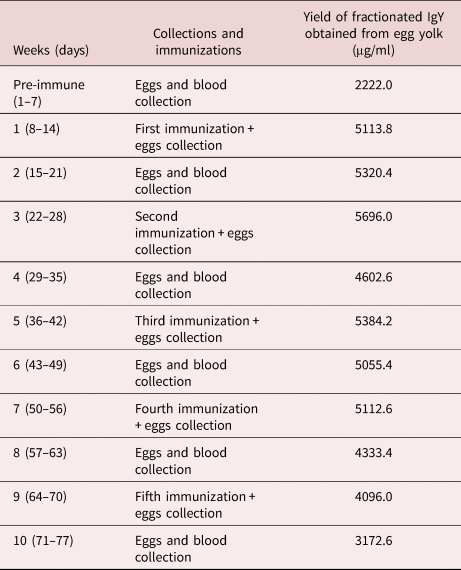
Chickens were immunized with SE of A. suum female adult life form and monitored daily. Immunizations were well tolerated and experiments lasted 11 weeks (77 days) (table 1). Each group, G1 and control, had a laying rate of 6–12 eggs per week. Egg yolks were pooled according to the week and underwent fractionation. IgY specific antibodies were obtained and dosed for concentration, as shown in table 1. Each millilitre of fractionated egg yolk yielded between 2.2 and 5.6 mg of IgY.
Duration of animal experimentation with chickens, eggs and blood collection from hens, chicken immunizations with Ascaris suum total SE (n = 2) or PBS (n = 2), and concentrations of fractionated antibodies produced per week.

Production kinetics and cross-reactivity assessment
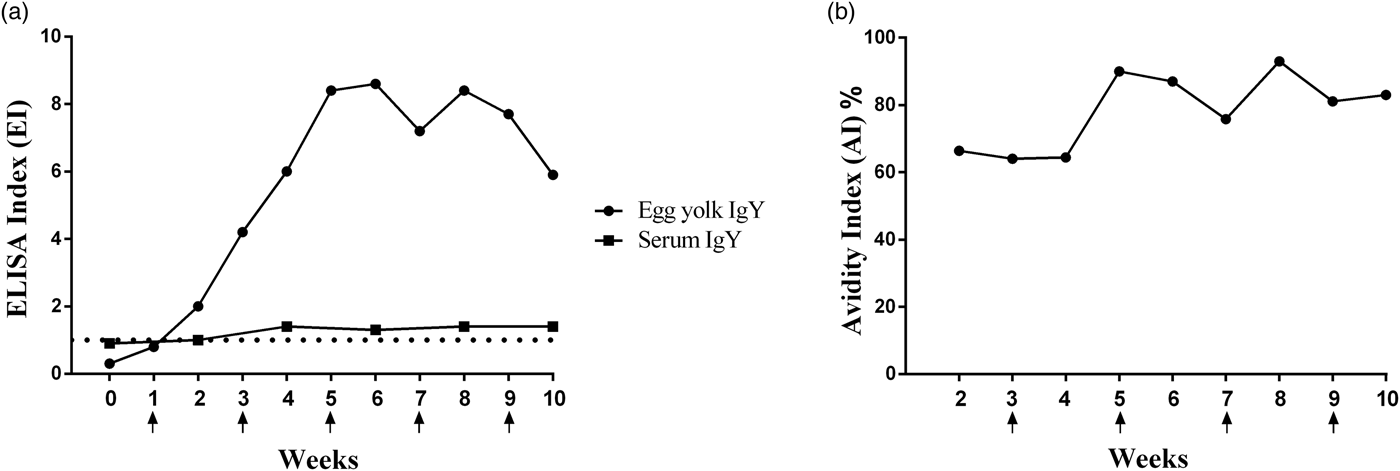
Kinetics of specific antibodies and seroconversion were monitored by indirect ELISA. One week after the first immunization, antibodies obtained from egg yolks were detected with a rapid increase in the titre, with peaks at weeks 6 and 8 (fig. 1a). Although low, seroconversion showed positive reactivity, with serum from week 2 at the border line of the cut-off. It also showed a mild increase in titre after the second dose of immunization, with values remaining stable throughout the entire immunization period.
Production kinetics and avidity of anti-Ascaris suum IgY antibodies. (A) Monitoring of fractionated IgY antibodies from egg yolk and serum production kinetics by indirect ELISA. (B) Avidity ELISA of egg-yolk-fractionated IgY treated with 6 M urea. Dashed line denotes the cut-off (EI = 1), which is positive when EI > 1. Values were determined as low (AI < 40%) and high (AI > 60%) avidity. Arrows represent immunizations.

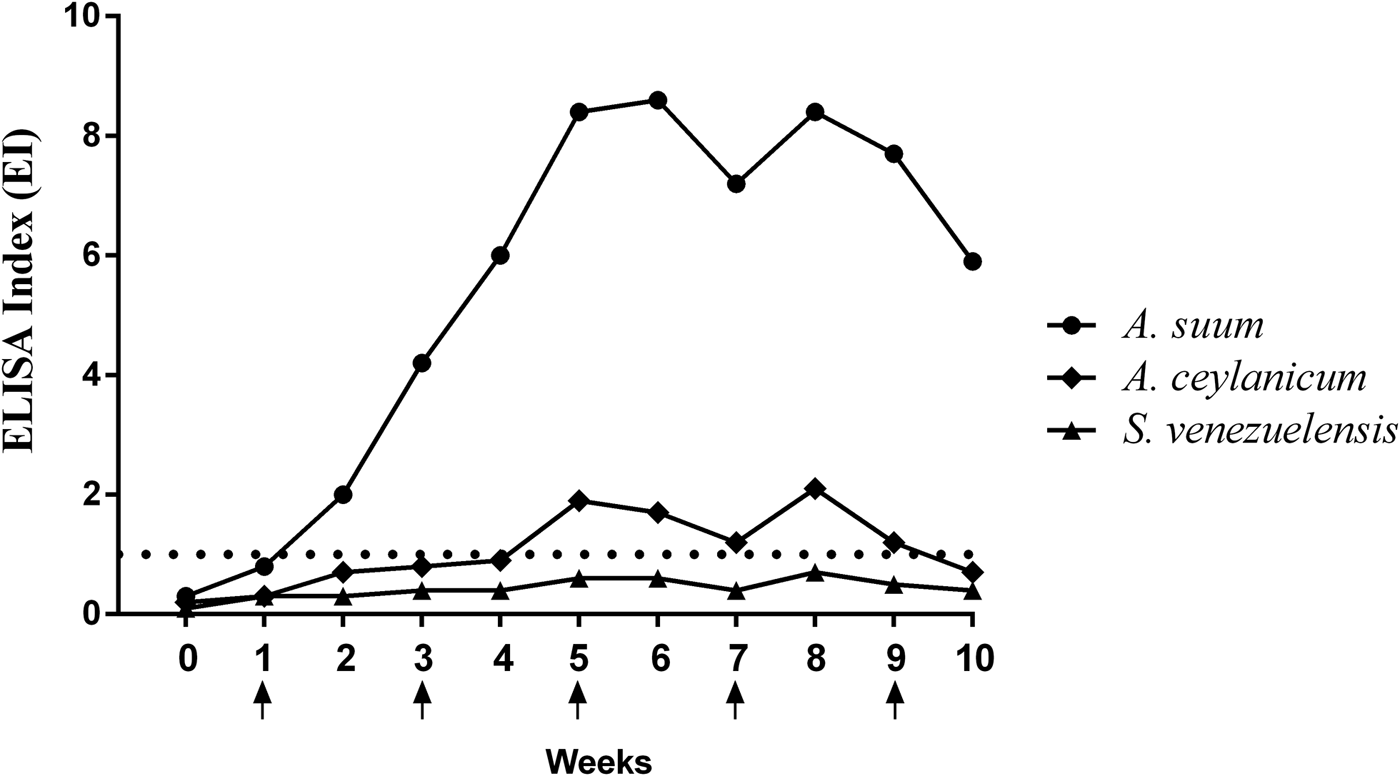
Cross-reactivity of the purified IgY antibodies was also evaluated. Figure 2 shows that the reactivity of IgY against S. venezuelensis extracts remained below the cut-off value. On the other hand, mild reactivity was observed against A. ceylanicum extracts with IgY from weeks 5 to 9. Still, results showed that anti-A. suum IgY antibodies in egg yolks were highly specific against A. suum when comparing reactivity against the other geohelminths antigens by ELISA (F = 30.85; P = 0.0002).
Cross-reactivity of anti-Ascaris suum IgY from egg yolk by kinetic ELISA against antigens of Ancylostoma ceylanicum and Strongyloides venezuelensis. Dashed line denotes the cut-off (EI = 1), which is positive when EI > 1. Arrows represent immunizations.

Maturation avidity of IgY
Avidity of antibodies was evaluated from week 2 (EI > 1.0) to the last week of egg collection. ELISA showed high-avidity antibodies throughout the entire immunization period, with AI values ranging from 64% to 93%, and mean AI showing high avidity of 78.30% (SD 11.20). Antibodies reached AI peaks in weeks 5 (90%) and 8 (93%), with greater values after the second immunization (fig. 1b).
Recognition of antigenic proteins by immunoblotting
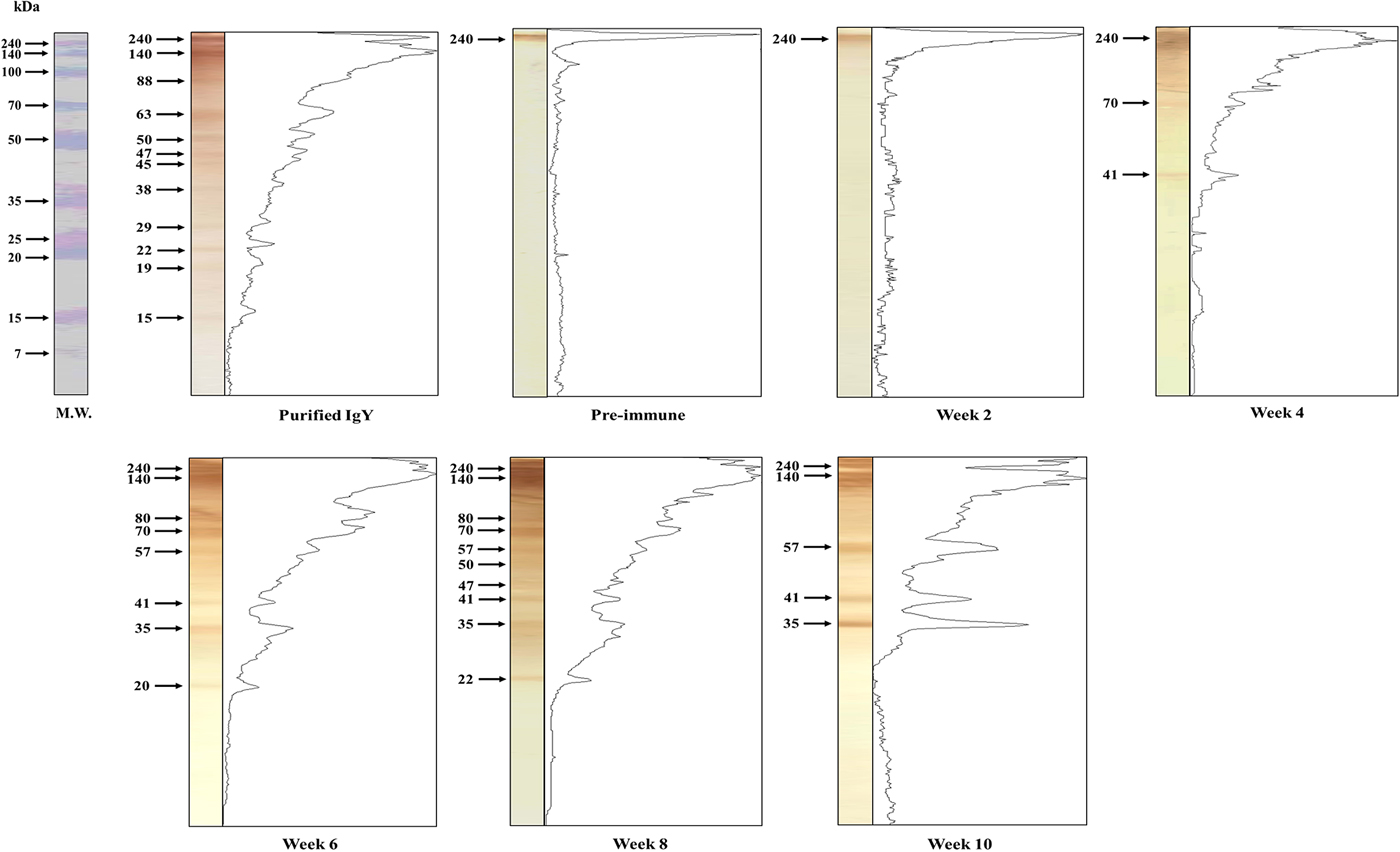
The IgY antibodies from week 8 were chosen to be purified due to their higher levels of EI and AI. After purification, they were evaluated for recognition of A. suum proteins using an immunoblotting assay. Purified IgY recognized a broad range (12 bands) of proteins with approximate molecular weights in regions of 240, 140, 88, 63, 50, 47, 45, 38, 29, 22, 19 and 15 kDa (fig. 3).
Immunoblotting results presenting protein profile recognition of Ascaris suum total extract by purified IgY from week 8; and the kinetics of the immunoblotting reaction of A. suum total extract with six fractionated IgY (pre-immune, week 2, week 4, week 6, week 8 and week 10). M.W., molecular weight. Band intensities and plots were analysed using Image J 1.50i.

The potential of fractionated antibodies to recognize A. suum proteins was evaluated through a kinetic immunoblotting assay and compared to the results of the purified IgY. Figure 3 shows that antibodies from the initial weeks only recognized the 240 kDa protein. There was an increase in reactivity in weeks 6 and 8, with antibodies recognizing a greater antigenic profile; however, this declined in week 10.
Application of purified IgY in tissue sections of helminths
To investigate the binding of anti-A. suum purified IgY antibodies to parasite tissue sections, immunofluorescence assays were performed (fig. 4). Posterior regions of A. suum adult female were stained with FITC and counterstained with Evans blue (control). In these experiments, parasite eggs presented an intense fluorescence in the membrane alongside the female uterine portion and cuticle.
Indirect immunofluorescence assay using purified anti-Ascaris suum IgY in sections of A. suum, Ancylostoma ceylanicum and Strongyloides venezuelensis. Column A (green): secondary antibody anti-chicken IgY FITC; B (red): Evans blue counterstained; C (merged): from column A to B. IgY from chickens immunized with PBS was used as a negative control in sections of A. suum. Triangle indicates A. suum cuticle. U, uterine portion; E, eggs. Scale bars: 200 µm.

The cross-reaction assay with sections of A. ceylanicum and S. venezuelensis filariform larvae showed no fluorescence, which indicated that there was no recognition of parasites by the purified IgY. As a negative control, IgY antibodies from chickens immunized with PBS (which were unable to recognize targets of A. suum), were used.
Serological diagnosis
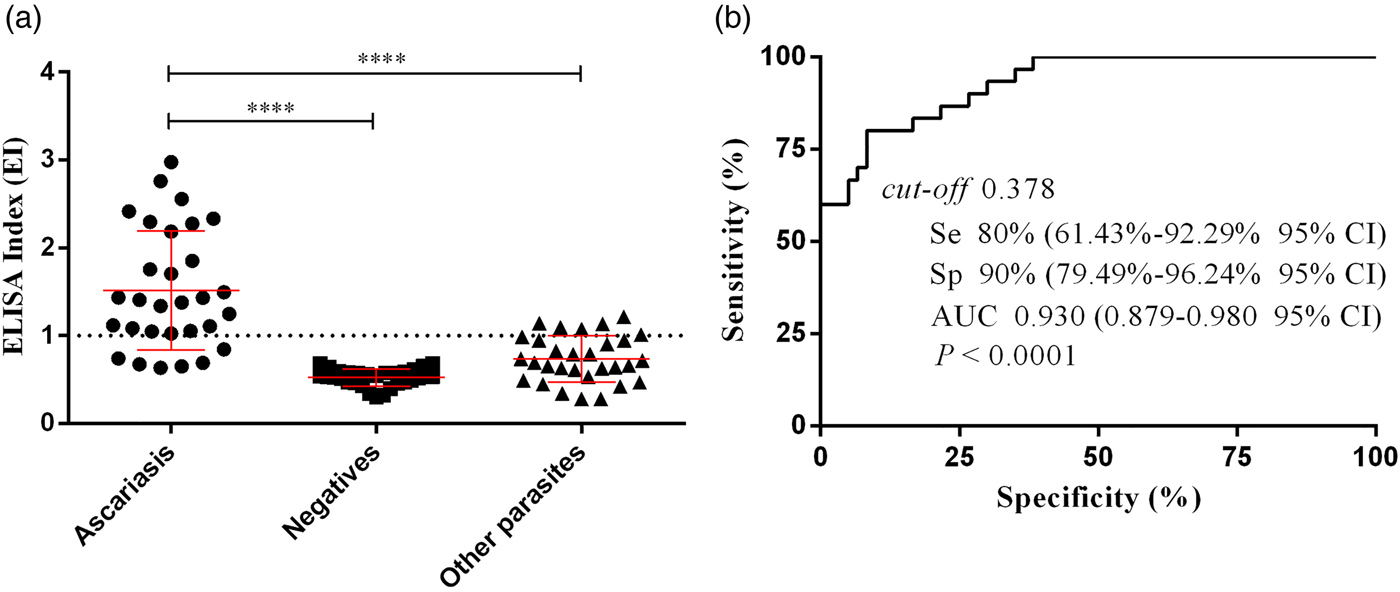
The purified antibodies were applied in sandwich ELISA assays to detect circulating immune complexes in single-infection sera from patients with Ascaris sp., other parasites or negative samples. The EI values analysed among the three groups presented significant differences (F = 45.41; P < 0.0001). The Tukey's multiple comparisons test showed that there was a statistical difference when the mean of the positive group (m = 1.517) was compared with the negative (m = 0.525) and the other parasite (m = 0.737) groups (P < 0.0001). There was no difference between the means of the negative group with other parasites (fig. 5A).
(A) Sandwich ELISA for immune complex detection by purified anti-Ascaris suum IgY in serum samples from individuals infected with Ascaris sp. (n = 30), negative samples (n = 30) and other parasites (n = 30). ***one-way ANOVA followed by Tukey's multiple comparisons test (P < 0.0001); dashed line denotes the cut-off (EI = 1), considered positive when EI > 1; horizontal bars indicate the mean and vertical bars the SDs. (B) ROC curve indicating the cut-off value, Se, Sp and AUC. 95% CI indicates 95% confidence interval.

The purified anti-A. suum IgY detected the presence of immune complexes in 80% (24/30) of the positive individuals. No complexes were detected within negative individuals; however, 20% (6/30) of the individuals with other parasites did contain complexes, with 3/30 (10%) infected with Enterobius vermicularis and one case each (1/30; 3.3%) of hookworm, Entamoeba histolytica/dispar and G. lamblia. The diagnostic values of Se and Sp were 80% (61.43%–92.29%) and 90% (79.49%–96.24%), respectively. The test performance, indicated by the AUC, was 0.930 (0.879–0.980) (fig. 5B).
Discussion
Chicken egg yolk IgY has attracted considerable attention throughout the years. The general structure of the IgY molecule consists of two light chains and two heavy chains, has an approximate molecular weight of 180 kDa and, similarly to mammalian IgG, the Fc region of IgY is the site with the highest biological function (Warr et al., Reference Warr, Magor and Higgins1995; Kovacs-Nolan & Mine, Reference Kovacs-Nolan and Mine2012). Compared to IgG, IgY has a number of advantages, including: it is not invasive, does not activate the mammalian complement system, does not bind to mammalian rheumatoid factors and presents cost-effectiveness and high yields (Carlander et al., Reference Carlander, Kollberg, Wejáker and Larsson2000). With these advantages, IgY has been used widely in veterinary science and presents potential application for disease diagnosis, control and treatment (Salemi et al., Reference Salemi, Markovic, Martini and D'Amelio2015; Borges et al., Reference Borges, Silva and Santiago2018).
In this study, IgY antibodies against pig helminth A. suum were produced, fractionated, purified, recognized for the first time and applied in the diagnosis of human ascariasis. This was done with the aim of developing a new biotechnological tool that can be implemented in experimental studies, immunodiagnosis and therapy of this parasite.
Chicken eggs immunized with different antigens represent an excellent source of polyclonal IgY antibodies (Borges et al., Reference Borges, Silva and Santiago2018). This study obtained around 2.2–5.6 mg of IgY in each millilitre of fractionated egg yolk. Comparing the yield of IgY and IgG, acquired by conventional immunization methods, 200 mg of the latter can be obtained monthly, with approximately 5% constituting the specific antibody. Whereas for IgY, 1500 mg can be obtained each month, with 2−10% of this value corresponding to specific IgY (Tini et al., Reference Tini, Jewell, Camenisch, Chilov and Gassmann2002).
Compared to antibody production in rabbits, IgY technology requires low quantities of antigen to obtain high and long-lasting IgY titres in the yolk from immunized hens (Gassmann et al., Reference Gassmann, Thömmes, Weiser and Hübscher1990). This study shows an increase in levels of IgY after the first immunization, which remained detectable throughout the study period. This is in accordance with the literature, since IgY can be detected in egg yolk roughly 4–6 days after the first immunization, and the immunization booster can strongly increase the concentration of antibodies, maintaining a long-lasting IgY high-titre detection (Gassmann et al., Reference Gassmann, Thömmes, Weiser and Hübscher1990; Müller et al., Reference Müller, Schubert, Zajac, Dyck and Oelkrug2015). In addition, antigen injection via the intramuscular route frequently results in higher antibody levels by day 28 after first immunization (Munhoz et al., Reference Munhoz, Vargas, Fischer, Lima, Esteves and Hübner2014). This corroborates the results found in this study, showing a peak in IgY detection in week 5.
It is well known that the use of mammalian IgG in immunological tests and in the diagnosis of geohelminths may cause false-positive results/cross-reactivity (Yoshihara et al., Reference Yoshihara, Ova, Furuya and Goto1993; Müller et al., Reference Müller, Schubert, Zajac, Dyck and Oelkrug2015; Khurana & Sethi, Reference Khurana and Sethi2017). In order to assess if this limitation would occur with IgY, the fractionated antibodies were also evaluated in a cross-reactivity ELISA against different geohelminths – that is, A. ceylanicum and S. venezuelensis. No cross-reaction was observed with the latter parasite, although the former showed mild reactivity during detection between weeks 5 and 9. IgY antibodies of these same weeks were the most reactive against A. suum extracts, and the presence of similar antigens in geohelminths (Kennedy et al., Reference Kennedy, Qureshi, Fraser, Haswell-Elkins, Elkins and Smith1989) may explain the low reactivity that was observed against A. ceylanicum.
Avidity maturation of an antibody represents an increasing affinity interaction between antibodies and antigens (Ferreira-Júnior et al., Reference Ferreira-Júnior, Santiago and Silva2012). Considering AI > 60% as high avidity (Vilibic-Cavlek et al., Reference Vilibic-Cavlek, Barbic, Stevanovic, Petrovic and Mlinaric-Galinovic2016), throughout the stages of the chicken's immune response, only high-avidity antibodies were produced. A high mean AI of 78.30% was observed, therefore demonstrating that A. suum-immunized hens produce large amounts of high-avidity polyclonal-specific IgY antibodies just one week after the first immunization. This result was expected since chicken antibodies show high avidity (109 mol/l) after the first immunization, while in order to reach these same values, a sheep, for example, must receive a further four boosters (Dias da Silva & Tambourgi, Reference Dias da Silva and Tambourgi2010).
When purified IgY antibodies are desired, immune-affinity chromatography can be used. Studies have showed the half-life of purified IgY is of several months, with activity retainment for up to six months at RT. Moreover, affinity-purified IgY retain high activity after five years of storage at 4°C (Pereira et al., Reference Pereira, van Tilburg, Florean and Guedes2019). Week 8 antibodies were chosen to be purified due to their higher levels of EI and AI, when compared with antibodies from other weeks. Therefore, they were purified in a HiTrap IgY HP column, dialysed, lyophilized and used in characterization and applicability tests.
Applicability of IgY antibodies in immunoblotting assays is known (Ferreira-Júnior et al., Reference Ferreira-Júnior, Santiago and Silva2012) and represents a possibility in the field of ascariasis immunodiagnosis. The purified IgY from week 8 was able to recognize a broader range of A. suum antigenic proteins when compared with the fractionated antibodies. Analysing the protein pattern recognition by the fractionated antibodies, it was observed that IgY from weeks 6 and 8 showed more protein reactivity. This result was expected since it corroborates with data acquired in the kinetic and avidity ELISA. This shows the importance of purifying IgY through chromatography, since these specific antibodies displayed the characteristic of recognizing a larger protein profile when compared with antibodies that did not undergo this process. This antigen protein recognition analysis by immunoblotting assays may be a useful tool (through proteomic studies) to determine different virulence factors of A. suum, for future vaccine or diagnostic development (Ferreira-Júnior et al., Reference Ferreira-Júnior, Santiago and Silva2012).
A reliable method for characterizing IgY is through antigen identification by immunofluorescence techniques (Dias da Silva & Tambourgi, Reference Dias da Silva and Tambourgi2010). The purified IgY recognized tissue sections of the posterior region of a female A. suum. Cross-reactivity with A. ceylanicum and S. venezuelensis was also assessed, showing no reactivity of IgY. In this way, the affinity-purified IgY was successfully used in indirect immunofluorescence, showing no signs of IgY cross-reactivity with other geohelminths. This result showed that the specific IgY is able to recognize antigenic targets of the parasite, representing a possibility of using the specific IgY in alternative diagnostic methods, such as immunohistochemical assays, as was already demonstrated by Ferreira-Júnior et al. (Reference Ferreira-Júnior, Santiago and Silva2012) for the detection of T. gondii forms in brain tissue sections of mice.
Immune complexes are formed from the binding of parasitic antigens to specific antibodies produced by the host (Gonçalves et al., Reference Gonçalves, Silva, Ueta and Costa-Cruz2012). After antigenic stimulus, the produced antibodies combine with antigenic determinants, forming, then circulating immune complexes. This process is an important defence mechanism of the organism, since it allows the neutralization, elimination and inactivation of antigens, preventing them from being deposited and causing damage to tissues of the host (Marzocchi-Machado & Lucisano-Valim, Reference Marzocchi-Machado and Lucisano-Valim1997). Diagnostic tests with high Se and Sp are extremely important as we are moving towards discontinuation of the transmission of neglected tropical diseases, in which ascariasis is included. However, there are currently no ‘gold standard’ methods for the detection of these infections, in addition to microscopic parasitological methods, which have several limitations (Werkman et al., Reference Werkman, Wright and Truscott2018).
In the present study, purified IgY antibodies were evaluated as a diagnostic tool in the detection of circulating immune complexes in samples of single-infection sera from individuals with Ascaris sp., negative controls and with other parasites. The test presented high values of Se (80%) and Sp (90%), and the purified antibody detected 80% of samples from positive individuals, with only 6/30 individuals showing low immune complex titres. However, 6/30 false-positive individuals were recognized in the group of other parasites, four of which were samples from patients infected with helminths and two from individuals with protozoal infections. Nonetheless, the statistical results showed that the anti-A. suum IgY were still highly specific for the detection of immune complexes in samples from positive individuals when compared to the other two groups. The lack of detection of immune complexes in serum from ascariasis positive individuals may be justified, since very small or very large immune complexes are easily eliminated, whereas those of intermediate size may, depending on the antigen and/or antibody, be more susceptible to tissue deposition and are not in circulation (Marzocchi-Machado & Lucisano-Valim, Reference Marzocchi-Machado and Lucisano-Valim1997). Thus, in any of these situations, the immune complexes will not be detectable in the serum.
Human ascariasis is one of the most prevalent parasitic diseases distributed worldwide. It belongs to the class of soil-transmitted helminths, which are classified as neglected tropical diseases by the World Health Organization. Due to low sensitivity of diagnostic tests, the reported prevalence of this parasite is relatively low (Claus et al., Reference Claus, Ceuppens, Cool and Alliet2018). Production of IgY is an alternative to current methods. Avian antibodies have many immunological advantages over IgG antibodies: the keeping of chickens is inexpensive, the animals are easily handled and it is also very effective (Dias da Silva & Tambourgi, Reference Dias da Silva and Tambourgi2010).
Polyclonal antibodies are cheaper to produce than monoclonal antibodies (Carlander et al., Reference Carlander, Kollberg, Wejáker and Larsson2000). When compared to polyclonal IgY antibodies, the development of a monoclonal is more time-consuming, requires higher technical skills and demands the removal of the animal's spleen for isolation of B-lymphocytes, a completely invasive procedure. Also, in one year a hen lays about 300 eggs and produces an average of 18–25 g of IgY (Pauly et al., Reference Pauly, Dorner, Zhang, Hlinak, Dorner and Schade2009). Due to the low cost of animal maintenance, the considerable amount of antibody production and the absence of animal suffering, this is considered an economically feasible method when compared to the production of monoclonal antibodies by mammals. Furthermore, the immunization of hens and automated collection and processing of eggs has already been produced on an industrial scale, making the large-scale production of IgY technically viable (Kovacs-Nolan & Mine, Reference Kovacs-Nolan and Mine2012).
As was shown in this study, the IgY showed specificity and high yield for a long period of time. This technology proved to be a reliable tool in human ascariasis diagnosis, with optimal results regarding cross-reactivity with other parasites. Moreover, prospective studies are required in order to potentially apply this biotechnological tool in epidemiological surveys and therapy.
In conclusion, we showed for the first time the fractionation and purification of anti-A. suum IgY antibodies and its applicability as a diagnostic tool for ascariasis. Fractionated antibodies presented high avidity and purified antibodies detected a broad antigenic protein profile, recognized tissue sections of parasite with no cross-reaction with other geohelminths and presented high Se and Sp in the detection of immune complexes in human serum samples. Therefore, specific IgY is an excellent diagnostic tool for ascariasis.
Financial support
This study was supported by the Fundação Coordenação de Aperfeiçoamento de Pessoal de Nível Superior (CAPES; C.A.L., L.S.F., J.E.N.S., grant number 3200601004 M-8), Fundação de Amparo à Pesquisa do Estado de Minas Gerais (FAPEMIG; J.M.C.-C., grant numbers CBB-PPM 00396-13 and CDS-RED-00013-14), Conselho Nacional de Desenvolvimento Científico e Tecnológico (CNPq; J.M.C.-C., grant numbers 303843/2015-2 and 404816/2016-9). The founders had no role in the study, data collection and analysis, decision to publish or preparation of the manuscript.
Conflict of interest
None.