1. Introduction
Motion-assisting devices have been developed and are generally used for rehabilitation of individuals, who have suffered and are suffering from disabling pathologies or the effects of accidents, especially with regard to the consequences of strokes. In recent decades, various robotic systems have been developed to help physiotherapy rehabilitation activities both in terms of versatility and precision and in the regularity of motion exercises, as outlined in refs. [Reference Rupal, Rafique, Singla, Singla, Isaksson and Virk1–Reference Sá de Paiva, Sales Goncalves, Carbone and Marco Ceccarelli6]. Automated and robotic systems have been also proposed for patients in order to carry out rehabilitation by themselves like in the example presented in ref. [Reference Rodríguez-León, Chaparro-Rico, Russo and Cafolla7]. By planning rehabilitation exercises at home and in familiar environments, these assisting systems give an economic advantage and let patients also recover their autonomy since commuting time to therapy centers and physiotherapists’ individual assistance are saved. Examples of robotic rehabilitation systems can be found since the early 2000s, mainly as robot-assisted rehabilitation for stroke patients like those that are presented in refs. [Reference Kwakkel, Kollen and Krebs8–Reference Rosati, Gallina, Masiero and Rossi14]. An illustrative example can be the robot FRIEND [Reference Pang, Wang, Wang, Yu, Sun and Liu15] of University of Bremen that provides assisted exercises for upper limb movements using a manipulator that is installed on a wheelchair similarly to the case of BIT wheelchair that is designed at Beijing Institute of Technology for leg-assisted wheelchair motion [Reference Huang, Ceccarelli, Zhang and Huang16]. These early robotic systems can be considered successful in automating rehabilitation treatments, but their size, complexity and price are not suitable for home rehabilitation exercising also because they are designed for being operated in clinical centers. Nevertheless, from these solutions, wearable rehabilitation systems were also developed in recent years with the aim to provide portable solutions that can be even used at home and with certain autonomy by the users. In refs. [Reference Rupal, Rafique, Singla, Singla, Isaksson and Virk1–Reference Maciejasz, Eschweiler, Gerlach-Hahn, Jansen-Troy and Leonhardt3], surveys of those wearable robotic exoskeletons/devices are discussed in terms of advantages and open issues that leave space for a new specific attention for motion-assisting device for elderly people.
Motion assistance of elderly people is generally focused on the limbs with specific differences in treating upper or lower limbs. Only recently, in the last decade, great attention has been addressed to these motion-assistance devices with applications referring to geriatric therapies whose aims are to maintain elderly people in a sufficient level of good physiological health. This is also in consideration of the fact that there is a longer life expectancy that requires a need of a regular motion exercise in the more advanced years of individuals. Thus, specific attention is expected to being paid to the development and use of specific motion-assisting devices for elderly people with specific characteristics that can ensure their use in autonomy and comfort by these users.
In this paper, an outline of the technical-medical frameworks is proposed within which conception and construction of new motion-assisting devices for limbs of elderly people can be conceived and designed specifically since the first steps of development of these specific applications. Therefore, an examination of the typical characteristics of the conditions of elderly people is proposed with reference to the physiological motion conditions that allows to outline requirements and constraints useful for the definition and then use of adequate motion- assisting device for the elderly people. Thus, main challenges can be identified for servicing applications of robotic systems with features of exercising limbs of elderly people in motion daily practice and in rehabilitation therapies. Challenges for service robotic systems in motion assistance of elderly people are discussed in design and operation activities reconsidering existing solutions but developing new systems with proper features mainly in portability, user-friendly use, exercising functionality with clinical efficiency, and low cost.
2. Service robots as assisting medical devices
A service robot is a robot that operates semi or fully autonomously to perform services useful to the operation of humans and non-industrial equipment, excluding manufacturing operations (according to technical standards), and a service operation can be understood as set of actions and behaviors toward a service task with much more articulated actions that in industrial-like operations [Reference Ceccarelli17, Reference Ceccarelli18].
A rapidly expanding field of application for service robotic systems can be recognized in biomedical applications and especially in those referring to motion assistance for rehabilitation and sport exercises. Furthermore, considering the aging of the population, we can plan and are also indeed planned developments of systems that can help the elderly people to maintain a healthy physiological condition with solutions that can be even adaptations of biomedical systems for rehabilitation and sport exercise. However, specific applications for elderly users can better predict and require new solutions that can be designed specifically for these needs. The robotic functionality of these medical systems for assisting elderly people can be designed with solutions well oriented to user’s requirements and needs in terms of motion skills, especially in the limbs, with particular attention to all their articulations/joints.
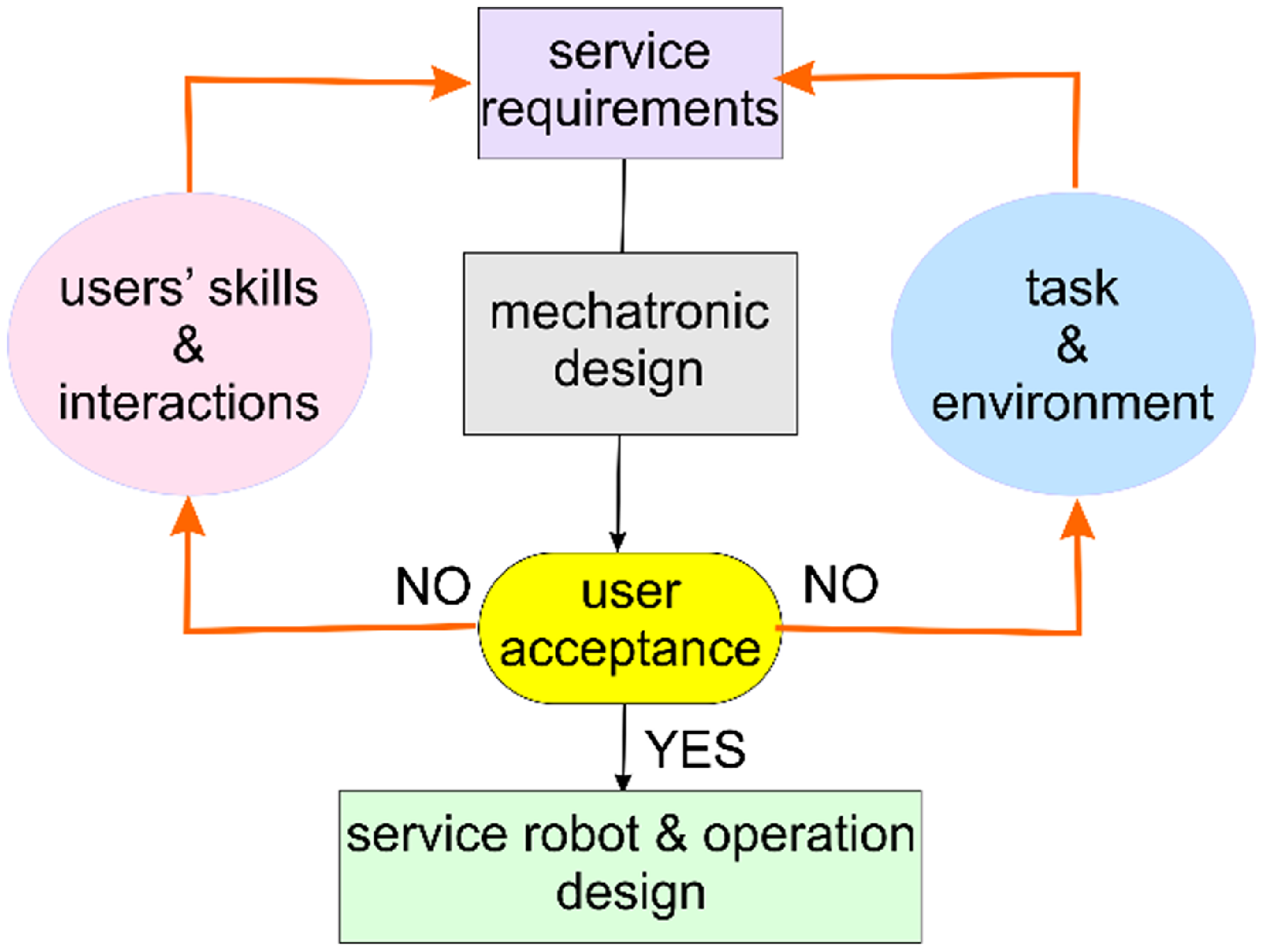
Figure 1 summarizes how to reformulate or readjust design procedures for service robotic systems considering multidisciplinarity, especially in nontechnical aspects, that can be required for the specificity of the service in biomedical environments for mobility assistance of elderly people. Therefore, the typically technical design process is outlined by the central trajectory of the diagram in Figure 1 as referring to the technical definition of requirements and constraints which, if appropriately formulated, allow the definition of a mechatronic solution. The feasibility of a solution that can satisfy those technical aspects will be verified in practical implementation through the acceptance by potential users. The two lateral blocks in Figure 1 refer to the application characteristics with interaction of human users and their ability to manage the service system (left block) and to the peculiarities of the operational purposes and operational environment in which the service activities must be carried out (right block). The diagram in Figure 1 emphasizes that these two areas of multidisciplinarity, including non-technical ones, which can involve not only clinical and medical aspects but also social and psychological aspects, can be decisive and binding in the process of defining a feasible solution of a service system aimed at specific motion assistance solution for elderly people.
Multidisciplinary character of service robot devices.

Therefore, a general first challenge that must be considered in the conception and design of a motion-assisting system for elderly people consists, indeed, in considering the peculiarities and characteristics of the problem to be solved with those aspects of multidisciplinarity that often do not allow a technical evaluation and even less a useful formulation for a traditional design process. Among other things, the multidisciplinarity indicated by the two lateral blocks in Figure 1 must be considered in envisaging a synergy also among the actors of the design process, including operators from the clinical-medical area and even potential users, to appropriately focus on problems to be solved and on suitable expected results. Main challenges can be considered in achieving a successful interaction and collaboration among technical and medical operators in the definition of the design issues and exercise protocols. A first major challenge can be even the cultural difference that can be experienced as a cultural barrier preventing successful discussion and understanding of different perspectives.
3. Needs for elderly people assistance
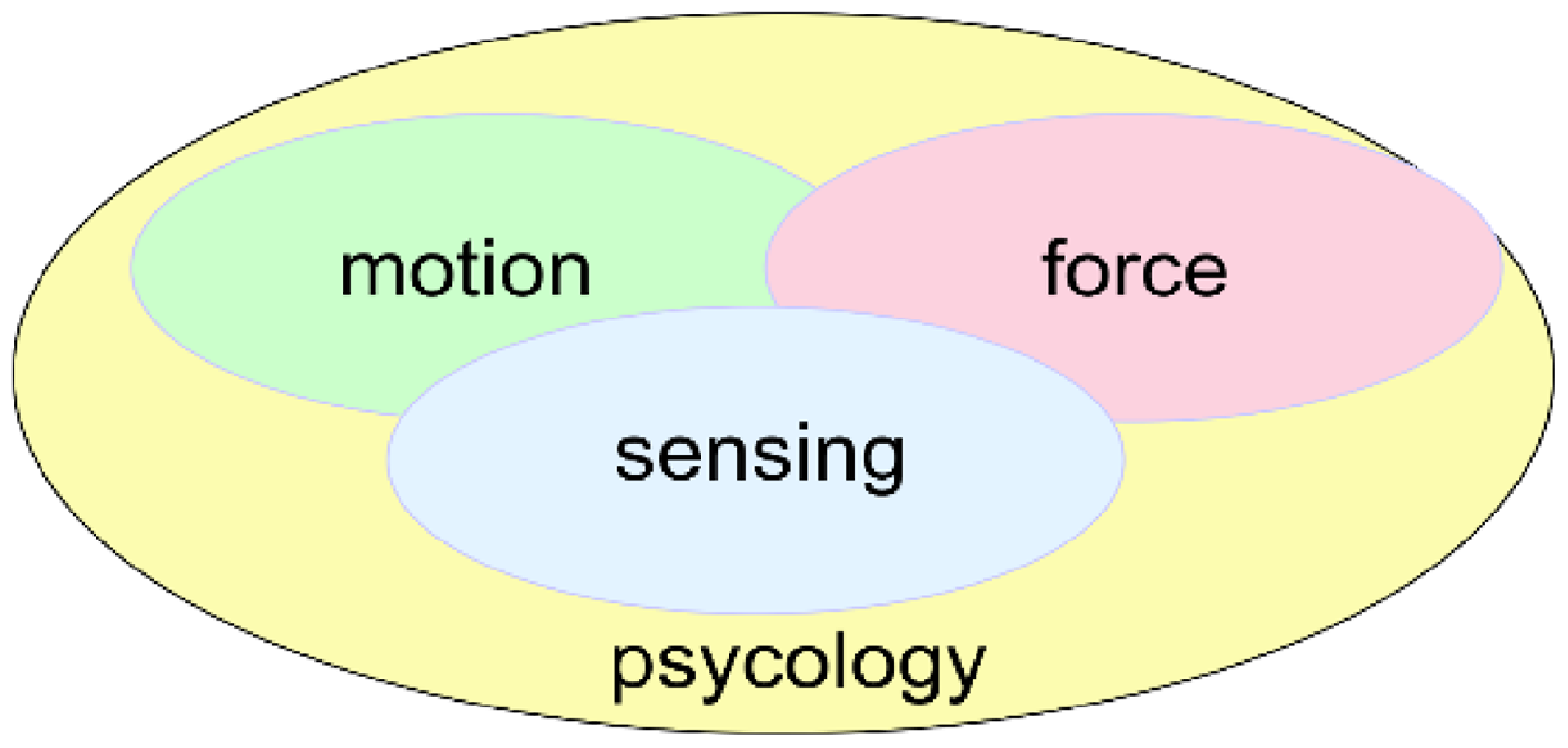
Figure 2 summarizes the aspects that require assistance for an elderly person with particular reference to the physiological health condition. The health condition of elderly people is generally characterized by reductions or deficiencies in physiological capabilities in terms of movement, muscular power, and sensoriality. These aspects also produce and/or are influenced by a psychological state which can be equally significant in the need for assistance.
Aspects for elderly people assistance.

In the scheme in Figure 2 it is emphasized the fact that the physiological condition is determined by the combination and overlap of conditions in motion skills, muscular power, and sensoriality which can generally affect each other. Therefore, the healthcare requirements for elderly people require multidisciplinary attention to obtain benefits from both physiological and psychological points of view such as to allow the assisted elderly person to have good general health. In this work, focus is addressed to requirements for physiological conditions while being aware of the effects and consequences that a psychological state can also determine with fundamental importance in motion assistance activities although they can be centered on aspects of muscular power and sensoriality. More specifically, the effects of aging can be examined in physiological terms to better identify the needs and peculiarities of motion assistance in physiotherapeutic exercises and motion exercise for elderly people. They can be identified in suitable type and range of movements, frequency of the exercises, therapeutic additional means, and specific medical prescriptions.
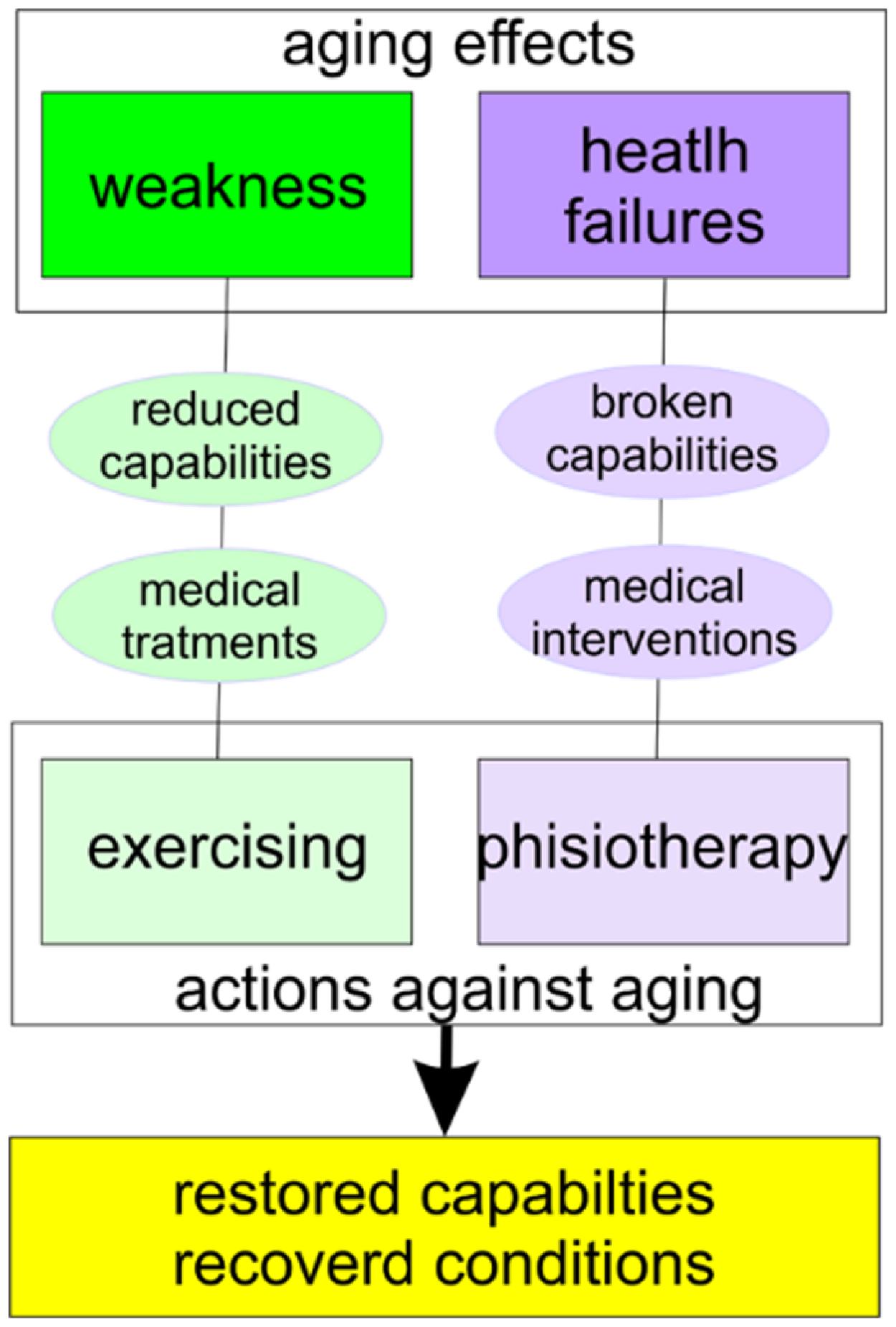
Figure 3 summarizes main aspects linked to aging such as reduction of physiological capabilities identifiable with the general term of weakness and predisposition to defects or lack of health. Regarding physiological weakness with reference to the left column in Figure 3, the effect of aging can be evaluated in terms of reduction of motion skills in both kinematic and dynamic aspects as well as the need for medical treatments to maintain acceptable levels of general physiological well-being but also specific attention to the health of individual organs. In general, this condition of weakness can be improved if not even completely solved, by a motion practice with exercises recommended specifically for elderly people as a continuous therapy that can counteract the effect of weakness thanks to continuous reactivity and activity of the organism. For example, it is good medical practice to suggest that elderly people take long walks every day, even if not at a high speed.
Aging effects and needs for their mitigation.

With regard to the effects due to health defects with reference to the right column in Figure 3, the effects of aging can lead to situations involving the loss of good health conditions with even traumatic events which cause the loss of physiological well-being and consequently require medical interventions at both a pharmacological and physiological level in order to prevent or solve these conditions of loss of capacity. Also in this case, physiological activities are indicated and suggested as an aid that can help prevent or restore physiological capabilities lost due to health loss events. For example, it is quite common for elderly people to suffer traumatic events with broken bones of the legs and arms following simple falls that can be caused by physiological and sensory weakness. Then surgical interventions are also required to restore the physiological integrity of the individual.
In both aspects outlined in the diagram in Figure 3 referring to weakness and/or loss of health conditions, motion exercise interventions are proposed and suggested to elderly people, whether in terms of regular motion activity or physiotherapy. All those motion activities have aims to maintain proper levels of physiological and motion health and/or attempting to re-establish conditions and abilities in better levels of good general health. Therefore, the diagram in Figure 3 can be understood as that physical exercise in elderly people is fundamental to counteract the effects of aging and to stay in good general health, whether it is carried out as a daily practice of a simple sporting-like activity or whether it is carried out with physiotherapy exercises for rehabilitation and restoration of physiological capabilities. Obviously, while recognizing the common frame of a motion activity, the functions and therefore the requirements must be distinguished between motion exercises for the practice of quasi-sporting activities and movements for rehabilitation physiotherapy.
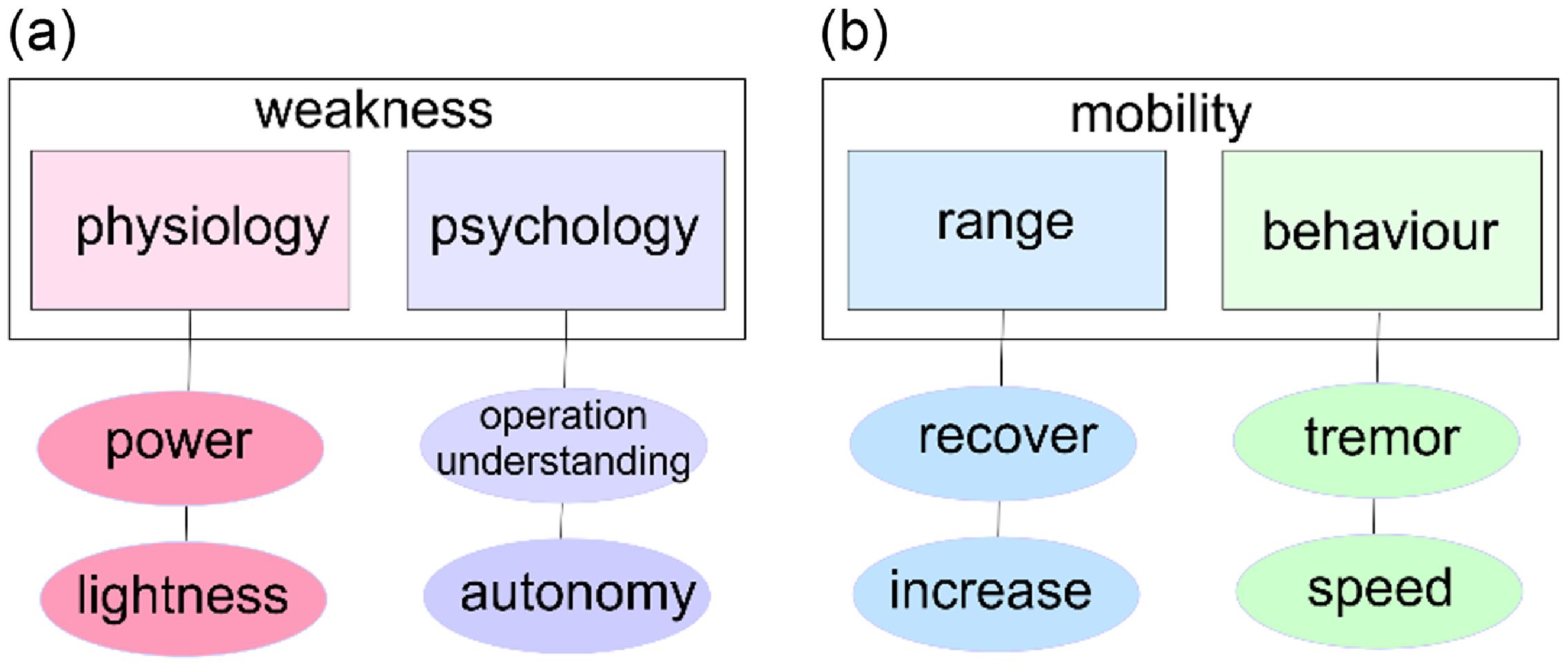
Figure 4 pays even more specific attention to the aspects that must be taken into consideration for a definition of technical and functional requirements in developing motion assistance systems and techniques for elderly people. In the left column of the diagram of Figure 4(a) which reflect the interaction between aspects of physiology and psychology, it is emphasized the need to qualitatively and quantitatively evaluate the physiological aspects in terms of physiological power which requires adequately light solutions with reduced/limited actuation power by an elderly user. A solution may be contrasted or integrated by requirements from psychological conditions of the elderly user as determined also by the need to understand the systems and their programming for motion/ physiological exercise activities with the aim of allowing and even ensuring a certain level of autonomy of the elderly user, as outlined in the right column of the diagram of Figure 4(a). Therefore, referring to Figure4(a), aspects of physiological or psychological weakness require assisting systems with challenges satisfying requirements for formal and quantitative solutions with adequate levels in terms of required power as opposed to an adequate lightness of the devices whose operation can be adequately comprehensible for the capabilities and autonomy of an elderly user.
Main requirement areas for elderly people motion assistance in: (a) Weakness; (b) Mobility.

In Figure 4(b) more specifically, we refer to the need for motion exercise for legs and arms with very specific physiological characteristics which must be taken as reference for the functionality of the motion assistance. In particular, one of the fundamental aspects is to take care of the capacity for the range of motion of the limbs as indicated in the left column of Figure 4(b), by referring to aspects in restoring the natural ranges as much as possible by also acting on the exercise for a restoration also partial of these levels. The effects of aging are felt mainly at the level of possible motion excursions of the joints in the limbs and therefore these motion exercises must be calibrated to the current condition of the joints with the possibility of restoring or at least improving their range of mobility. The right column of Figure 4(b) refers to the complementary aspect of motion exercises as generally considered in the physiotherapy treatment of elderly people when considering the fact that an effect of aging is the slowing down of movement speed and motion skills. Therefore, a constraint and indeed a fundamental requirement is to consider the kinematics of the movement included in the characteristics of the motion exercises while keeping in mind the limitations that are dictated by the aging conditions. Tremor of the limbs in their movement is typical, especially in conditions of stress and fatigue such that it must be taken into consideration as an important constraint and an alert condition in the definition and practice of motion exercises of the limbs.
Summarizing challenges can be considered also in a proper analysis and diagnosis of the needs for motion exercise of elderly people either in diary sport-like practice or in a rehabilitation therapy. These challenges that can be even shared with the elderly user/patient, including also the development and usage of proper equipment in conjunction with proper medical expertise.
4. Requirements for motion assistance
The requirements that must be considered for the conception, design, and functionality of motion assistance devices for elderly people will have to be identified following the considerations that are discussed above in terms of the three physiological areas, that is, motion skills, muscle power, and sensoriality. For each of these aspects, parameters can also be identified with direct numerical evaluations that can characterize the variability to be kept in mind for the purpose of adequate adaptability to a specific elderly user.
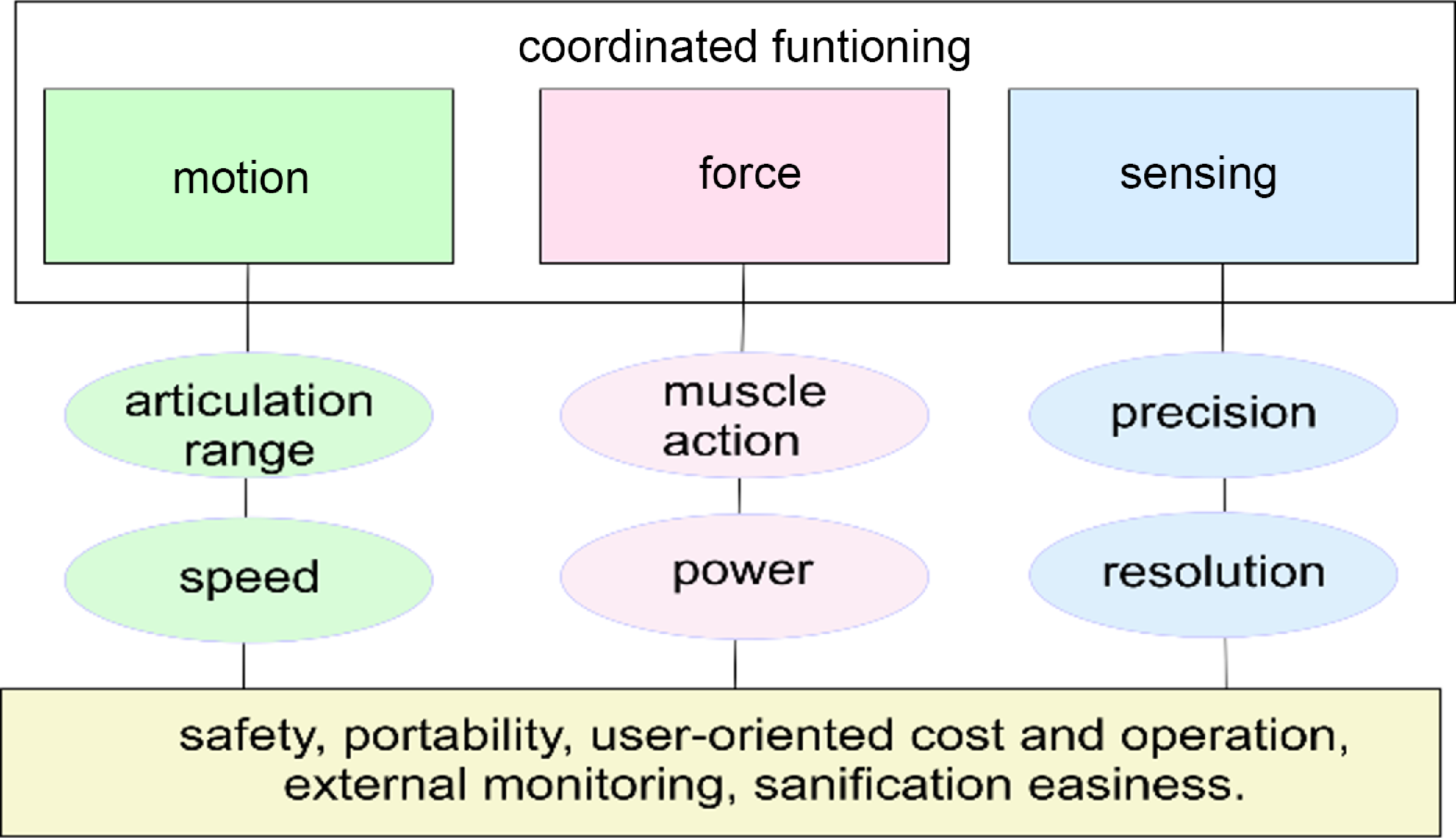
Figure 5 summarizes this attention in the definition of requirements, emphasizing the attention on the main aspects that can contribute to adequate solutions, especially in terms of portability, adaptability, and capacity for autonomous use for elderly users. In Figure 5, it is highlighted that the purposes of the requirements and therefore also their definitions must be finalized to feasible solutions that have characteristics of safety, portability, functionality oriented to the capabilities of a user and her/his economic possibilities, monitoring even with an external supervisor, and simplicity in sanification and cleaning before and after use.
Main requirements for design and operation of motion assistance devices.

Portability implies that the device must meet requirements not only in lightness and compactness but also in simplicity of application which recalls the functionality oriented to the user’s capabilities. Challenges can be recognized in developing a device that is easy to transport and to be installed home with proper sizes, weight, and operation performance. Portability may also include a cost affordable by potential elderly users. The medical and health aspects that are also an obligation on a legal level imply a functionality avoiding risks for a user as well as having a structure that is easily manageable in healthcare cleaning and sanification treatments. Safety issues are challenges in matching the medical and legal regulations, besides providing solutions that are considered safe by elderly users even as consequence of such an understanding of design and operation of the assisting device.
In particular, with reference to Figure 5, in terms of motion characteristics, the main aspects to be considered are certainly to be identified in the range of movement of the articulations and in the corresponding speed of movement which contribute to the functionality and speed of the entire assisted limb. The numerical reference parameters can be those of the average standard evaluations also reported in anatomy manuals but for an adequate development toward usage by specific elderly users it must be kept in mind that these values can be significantly modified and reduced by aging effects. Therefore, in the functionality of the developed device, the operation parameters must rather carefully be defined with values suitable for the application for a specific user. It can be noted that the greatest reductions of motion capabilities due to age can be determined in the elbow and knee joints even in a disabling manner. Equally nonnegligible and significant can be the reductions in the motion of the joints in the fingers. With regard to speed, as already observed, the reduction in muscular power also induces a reduction in the speed of execution of movements and the requirements to which reference must be made are the values of muscular power of each articulation and the limb in its overall anatomy. These values should take into account the age of the user and the effects of age that the user suffers.
In terms of muscular power capacity referring to force in the second column of the diagram of Figure 5 it can be observed that the fundamental aspects of the requirements to be identified, also with direct evaluations on a user, can refer to the muscular action of single muscles but also of parts of the limb as well as the entire anatomical structure of a limb. In physiotherapy practice very often, a physiotherapist acts on a single muscle and therefore the requirement that must be considered, which refers to capability to develop a system with functioning that can also be specific to single muscles that activate the articulations or parts of the limb in simple movements and actions up to complex exercises. A generally significant parameter is limb power that is considered in evaluating the power in its complexity of the limb as an index of the physiological condition and well-being of the limb, and therefore it should be considered as a functional design requirement that can be used also as a fundamental element of exercise monitoring and effect.
In terms of sensoriality as per the third column in Figure 5, the requirements that can be considered, include the ability to manage movements and muscle forces with adequate resolution and precision by an elderly user. The numerical quantification of these requirements remains in the medical field and in any case requires the identification of adequate sensory monitoring systems that refer to the main physiological characteristics. Therefore, challenges can be recognized in the sensoriality than can be necessary for linear and local movements as well as to the monitoring of muscular activities, also through indirect measurements such as those of body temperature and blood pressure. The numerical values of these sensory parameters must still refer to current condition of an elderly user and can include preparatory activities of anamnesis and medical analysis which can be included as preparatory and preliminary requirements for the use of motion-assisting devices.
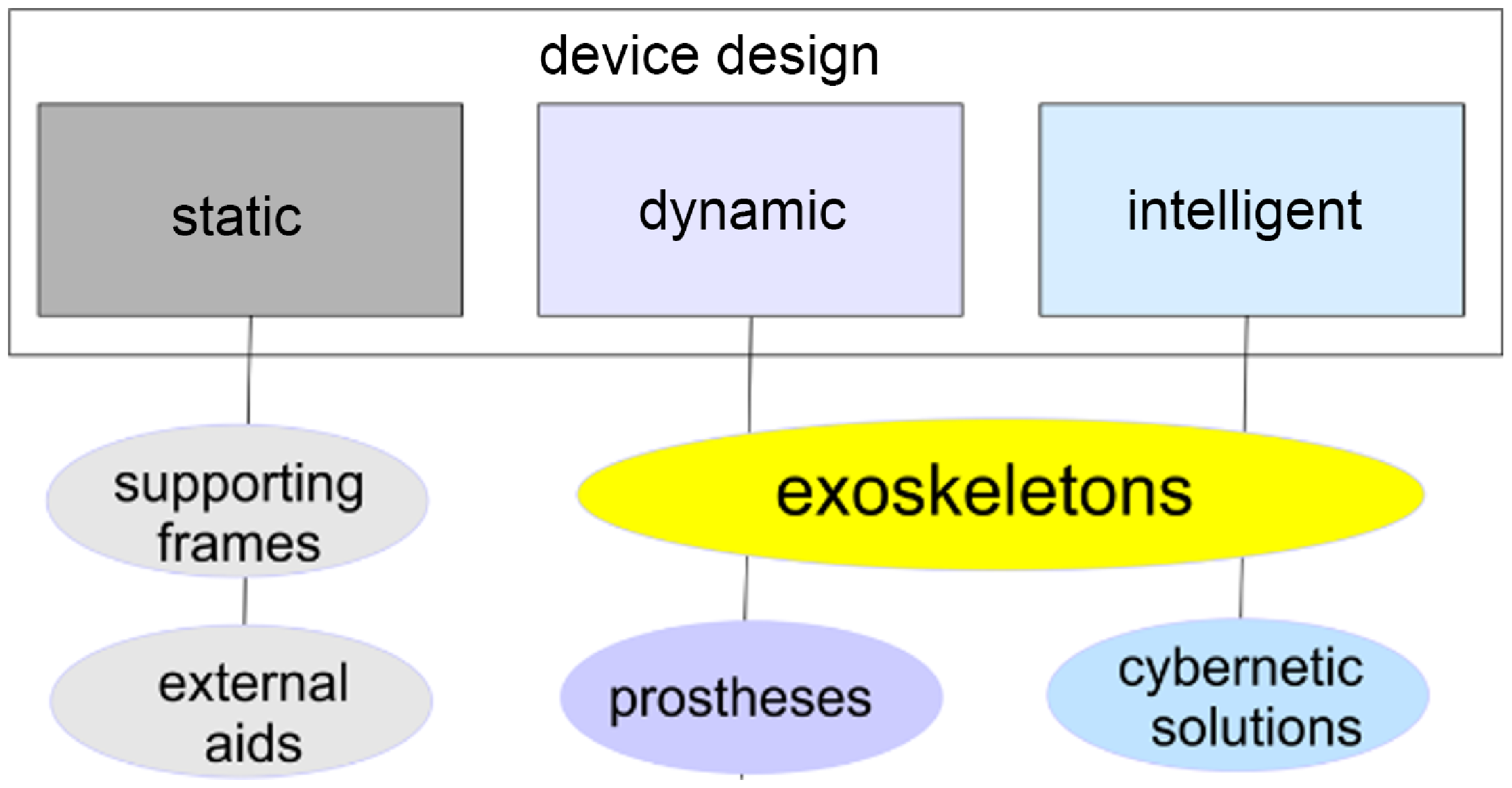
Among the requirements we can also consider the choice of the structural type of the motion-assisting devices also as function of the requirements for the requested assistance and the anatomical specificity of the limb or its part to be assisted. Figure 6 proposes a summary diagram of the topological possibilities of the structures for motion-assisting devices currently available or developable.
Types of current existing devices for motion assistance.

Static devices can be considered those medical supports whose functioning, even by interacting with the functionality of a limb, has characteristics of nonactive support in the dynamics of motion. The term “support systems” refers for example to external systems such as a walking stick and those devices with various structures which help for example locomotion by unloading the weight from the legs and therefore facilitating the movement of the legs. External help systems can be those that create support possibilities such as a handle or a cable that helps the human arm in its action. Much more interesting and of modern attention for development of new systems are the systems referring to dynamic intelligent devices which can be identified in the great variety of exoskeletons with even intelligent operation for user interaction. The exoskeleton solutions can be very complex as the cybernetic ones that integrate sensoriality and cognitive abilities for intelligent motion assistance in instantaneous adaptation to the needs and condition of a user during motion exercises. However, these extremely sophisticated solutions which, although they are being developed, are contradictory to the capacity needs for user-oriented operation and mainly to solutions with affordable costs for elderly users, especially for usage with complete autonomy. It can be said that these device structures are the ultimate and main challenges to fully satisfy all the characteristics of the requirements discussed above.
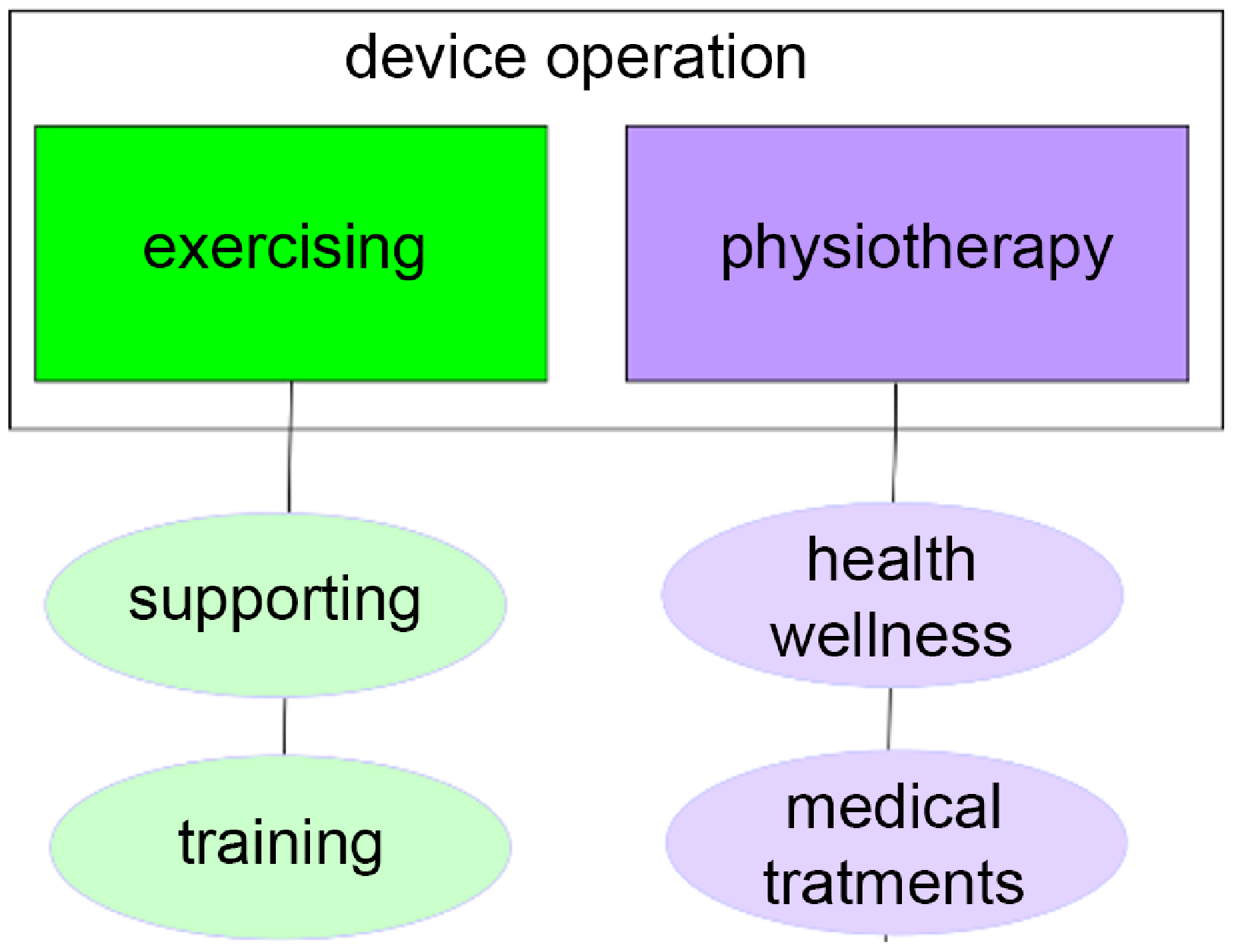
More specifically, requirements in design and functionality of motion-assisting devices must respond to the main purposes as defined in the two modes of sport-type motion exercise and physiotherapeutic exercise for the recovery of physiological capabilities. Figure 7 emphasizes this differentiation between exercises for simple motion health maintenance and for recovery physiotherapy activities. Therefore, it can be specified that in devices for simple motion exercise of a sporting type or for daily activity, structures can be provided as support to the exercise such as for example the sticks used in Nordic Walking, or those that help motion exercise how a treadmill can do in a gym or at home. In terms of physiotherapy, the devices that can be considered with adequate characteristics to be requirements for the device can refer to the applications of physiotherapy sessions both for the management of the well-being of the limb and in more specific medical treatments with the help of distribution of well-defined supports and structures such as those exoskeletons mentioned above. In any case, the purpose of the motion exercise in daily exercise or physiotherapy determines specific and differentiated requirements both in the structure and in the functionality of the motion-assisting devices for elderly users in consideration of the fact that the two modalities can have well-differentiated activity ranges and purposes.
Type of operations for motion assistance.

In summary, the challenges for the development of motion-assisting systems with adequate functionality for elderly users require attention and definition of requirements that take into account the specificity of the health status and conditions of elderly people with a variety of parameters and possible solutions which enable broad development of robotic systems and devices in a wide range of structures and functionalities. But the same requirements in their qualitative and quantitative definition represent a challenge as due to the multidisciplinary implication that requires cooperation between professional figures who are generally far apart in their work practice, like the engineers and medical operators.
Referring to expected main features as indicated in Figure 5, challenges on design and operation of assisting devices for limb motion of elderly people can be recognized mainly in the aspects of multidisciplinarity between technical and clinical medicine as perceived by users who, in the operational sequence, can be identified in technicians, doctors, nurses, and finally elderly users. In particular, as for any medical system, patient safety is the main objective in structural and operational definition of devices which in the case of motor assistance systems for the elderly can mean adequate human–machine interaction at a local level in wearing and then in functionality. The device functionality must also include adequate warning systems and procedures for reduced functioning up to the operational stop in case of device malfunctioning or user inconvenience. Portability, as already mentioned above, represents an important challenge for the purpose of developing such motion assistance systems that can be managed by elderly users in their usual habitat within family environments with adequate ease of transport, installation, and adjustment to specific user needs. The challenges for adequate portability can be linked to size, weight, operating power, cost, such that they require particular attention with constraints that can also be contradictory to the operational purposes of the device. Equally relevant can be considered the challenge in developing such motion assistance devices with adequate characteristics of user-oriented functionality linked to the abilities of elderly users as well as their understanding of the device and the therapy/exercise. This problem may require design activities in creating the motion assistance device equipped with adequate exercise procedures that can be adjusted to the current needs of elderly users. Furthermore, these procedures must be able to be managed by the users themselves, even if under the supervision of a medical operator. The cost, both of the device and of its operation, as already observed, is a decisive constraint for the success of the device in terms of acceptance and use by elderly users, who, generally, in addition to having limited budgets, are reluctant to purchase something considered not necessary. The need for monitoring, even remotely, for supervision by medical operators, can be a considerable operational challenge as it must include not only adequate sensoriality on the instrument and on elderly users but also adequate devices for the acquisition, processing, and transmission of data to medical supervisors both in real time and in post processing. The safety of the device against the elderly users is to be considered fundamental and as such, it can be a challenge to ensure it with adequately simple procedures to be carried out by elderly users, also with the aim of allowing confidence with the device and its functionality in terms of clinical safety. Last aspect in the list of challenges in Figure 5, but no less important, is indicated in both the structural and operational easiness of the motion assistance device which will have to satisfy all the needs and challenges to achieve what is necessary for assistance in terms of motion, force, and sensoriality during assisted motion exercise.
5. Examples from author’s experience
Examples from the direct experience of the author with his team are presented and discussed to better explain how those characteristics and binding aspects in motion assistance for elderly people can be taken into consideration for the development of useful devices in motion-assisting activities for the human limbs either in their specific articulation or parts, still presenting limitations in terms of design and functional challenges for adequately achieving the specific purposes of healthcare for elderly people.
In particular, the activities with the related prototypes are briefly presented referring to the CADEL device, [Reference Ceccarelli, Ferrara and Petuya19–Reference Ceccarelli, Riabtsev, Fort, Russo, Laribi and Urizar22], for motion assistance of the elbow, Figs. 8 and 9, and the ExoFinger exoskeleton, [Reference Carbone, Gerding, Corves, Cafolla, Russo and Ceccarelli23–Reference Damarla, Russo and Ceccarelli25] for rehabilitation exercises of fingers, Figure 10, as examples of solutions developed in a progressive manner with the requirements and attention to the aspects discussed above with however open issues for complete adaptability in applications for elderly people.
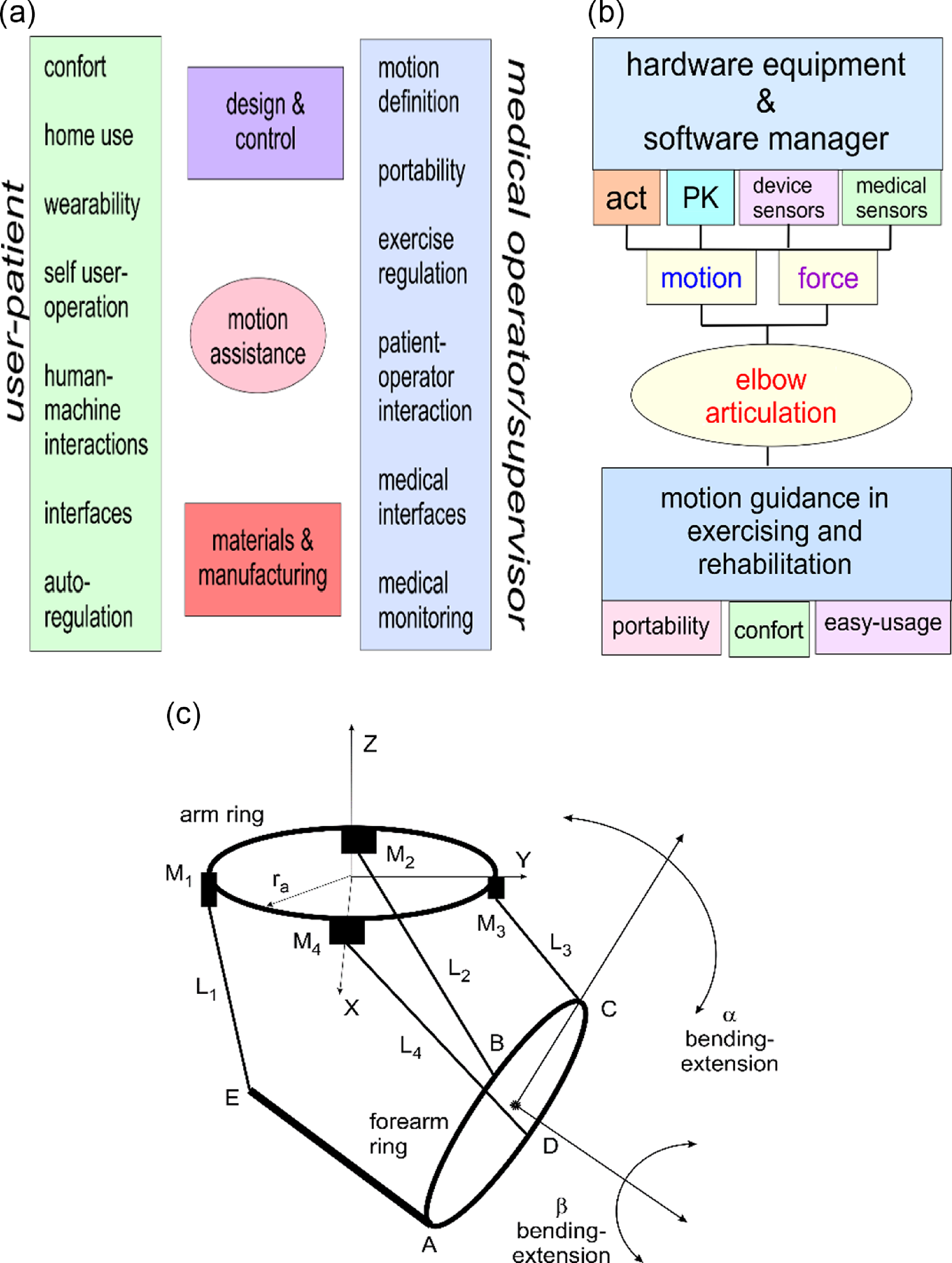
Development of an elbow-assisting device: (a) Requirements; (b) design concepts; (c) conceptual kinematic design.

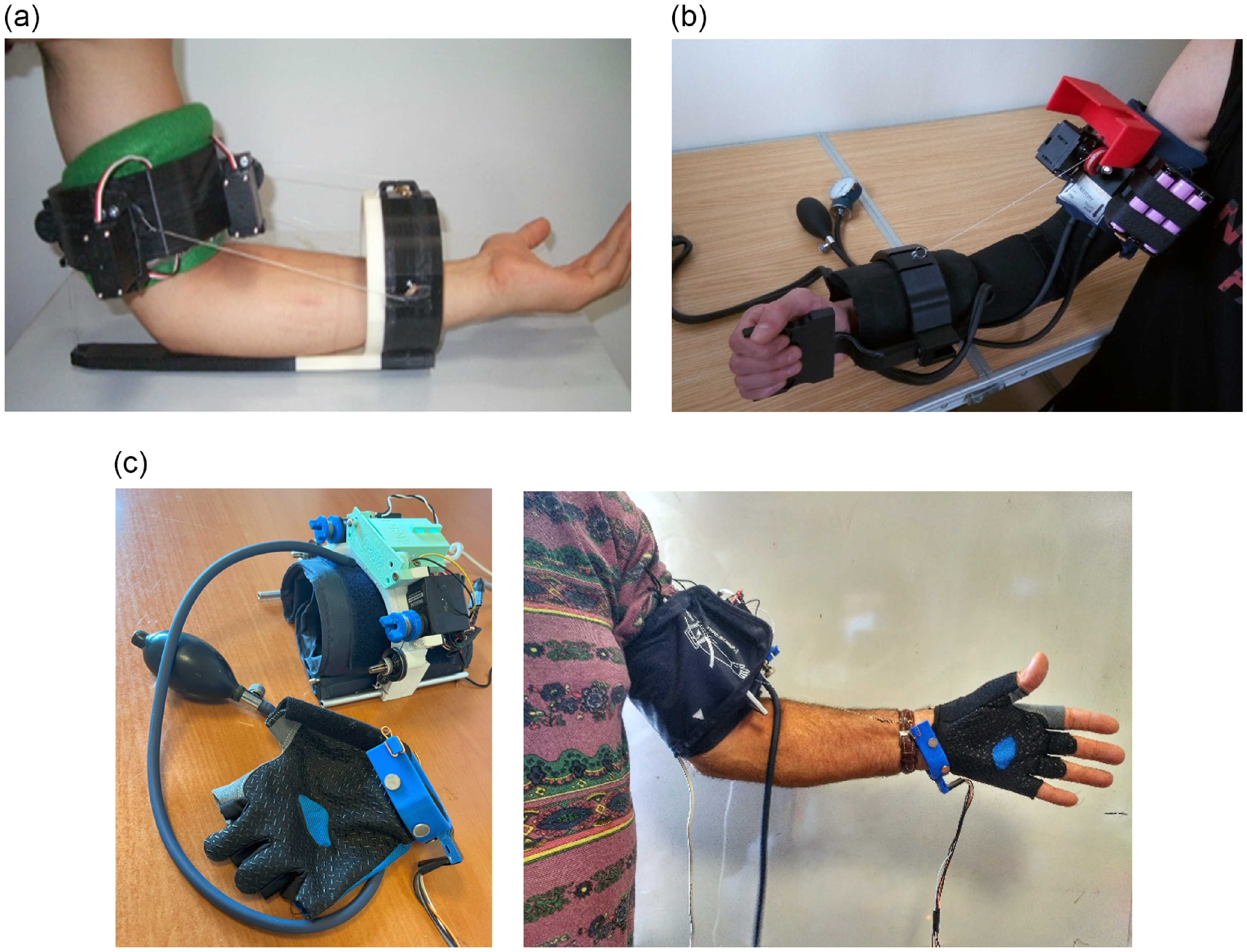
CADEL device and its evolution: (b) Original design in 2017, [Reference Zuccon, Bottin, Ceccarelli and Rosati20]; (c) Improved version in 2019, [Reference Laribi and Ceccarelli21]; (c) fnal version in 2022, [Reference Ceccarelli, Riabtsev, Fort, Russo, Laribi and Urizar22].

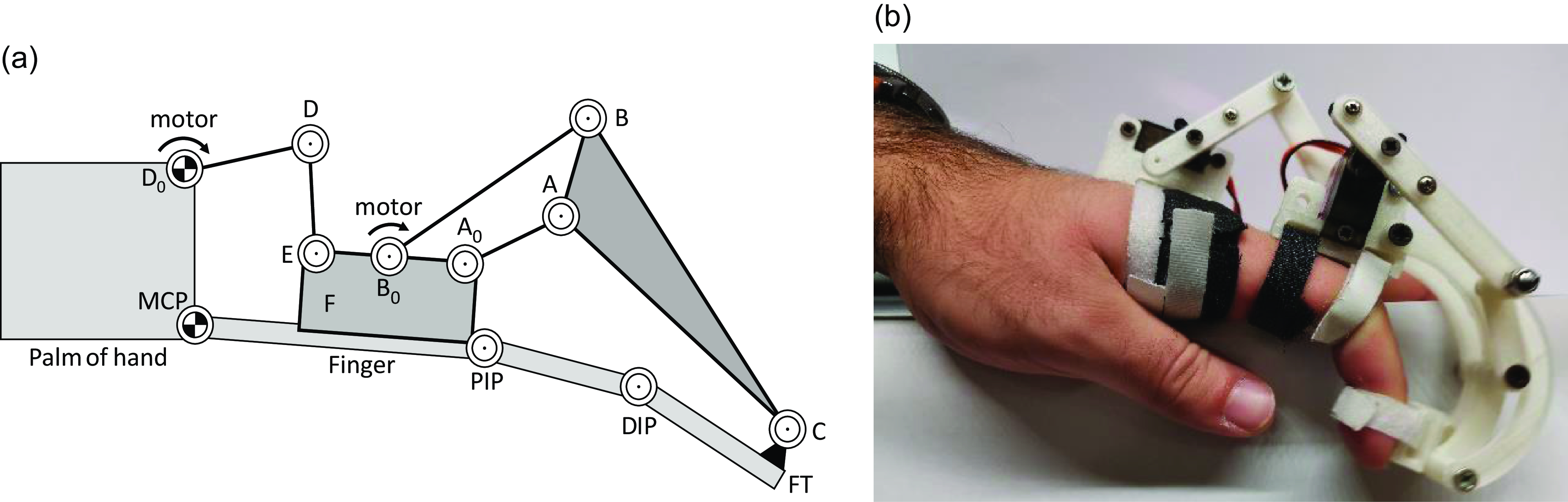
EXOFinger exoskeleton for finger motion assistance, [Reference Carbone, Gerding, Corves, Cafolla, Russo and Ceccarelli23–Reference Pang, Wang, Wang, Yu, Sun and Liu15]: (a) Conceptual design; (b) Lab prototype.

The development activities of each system up to the construction of a prototype for validation and characterization in laboratory testing were carried out in accordance with what was discussed above, paying attention to the specific requirements for the planned applications and to the expectations in innovative design and functional solutions. In particular, these systems have recently been revised and are still under further development referring to the challenges for adequate structure and functionality of use by elderly users especially in daily sport-like motion exercise activities. The activities were carried out with collaborations which saw the participation of students of various levels and of various nationalities also in a context of research projects with multidisciplinary skills. The interactions and collaborations with medical environments, although limited to consultancy activities in the initial stages of development of the devices, were significant in the laboratory testing phases for the validation and adjustment of the prototypes and their functioning until a satisfactory characterization, as reported in the publications produced (those mentioned are those of main reference for the purpose of this paper).
The challenges that were faced are linked to multidisciplinarity and internationalization with different cultural bases which have required even long periods of adequate understanding and sharing of the problems and objectives in the development of those motion assistance devices. Other significant challenges have been experienced in sourcing suitable components, especially commercial ones, for the needs of low cost and user-oriented functionality. This solution strategy with the use of commercial components and structural parts produced by 3D printing has posed and still poses challenges to obtain satisfactory functionality and adequate design solutions for the motion assistance requirements for elderly users. These approaches have required searches of components in commercial areas and activities to adapt them to the requirements and vice versa, leading to continuously evolving solutions as discussed in the here-in reported examples. Another problem was experienced in the testing activities which required the definition of adequate experimental campaigns according to medical-clinical protocols which require authorization from ethics committees. This activity required further multidisciplinary activity for the definition of the requests for authorization by the ethics committee as well as for the definition of the adequate procedures for recruiting volunteers for the laboratory tests within the available student population. The activities carried out for each device were planned by paying attention to the challenges that characterize the development of motion assistance devices for the elderly people as outlined in the scheme in Figure 5, especially referring to the characteristics of portability, user-oriented operation and low cost, monitoring also for medical (tele)supervision, and operational simplicity. Both medical and functional safety aspects were taken care of by referring to direct experiences with the volunteers during the tests and with consultations with medical operators. The problems referring to the disinfection of the devices were considered in the design solutions, taking care to use easy-to-maintain components for easy disinfection procedures. Despite having adopted a strategy with general aspects as outlined above, each motion assistance device has been developed with specificities referring to its specific structural and functional characteristics as briefly reported in the examples described below.
Figure 8 shows the schemes that were used to analyze and define the requirements and the conceptual solution for a motion-assisting device for the elbow with the fundamental characteristics of a light and easily wearable structure with a functionality that can be performed autonomously by a user. The peculiarity of the application for elderly people was considered during next developments by re-examining characteristics and requirements that this consideration modifies and particularizes. In the scheme of Figure 8(a) one can note the generality of the approach in considering the service and user aspects that are focused on medical-physiotherapeutic and technical-planning issues by referring to blocks for the patient user side as opposed to the medical operator user side. Each side block indicates the main aspects that the central design flow must consider despite being based on design technical procedures for the control structure with the choice of materials and production processes linked to the strategies and operational planning for motion assistance. It should be noted that some of the aspects highlighted in the two side blocks may not allow deterministic formulations useful for design technical procedures including modeling and formulations of the kinematic and dynamic problems that can determine the sizing of the solution and its operation. In Figure 8(b) the conceptual structure with device components is characterized by the fact that the device responds to the needs of assistance in movement and forces as indicated in the diagrams of Figs. 2-5, since it is completed by sensors that are not only of technical nature but also for medical measurements as to take into account the third aspect of sensoriality in the execution of motion exercises.
In the scheme of Figure 8(b) referring to the initial design of the CADEL device, the versatility expected from the device for elbow motion assistance is indicated for daily exercise both of a sporting type and a rehabilitation type as function of the solution characteristics in terms of portability, comfort, and easy functionality. The conceptual solution, shown in the scheme in Figure 8(c) consisting of the kinematic structure of a parallel manipulator actuated by cables with two rings as platforms in relative motion, was conceived keeping in mind the requirements and aspects of the schemes in Figure 8(a) and b) using experience and knowledge in parallel manipulators with cable actuation which can ensure a solution easily portable and comfortable for a user, even if elderly person.
Figure 9 shows illustrations of the CADEL prototypes that were developed during an evolutionary process that led the initial design conceived for rehabilitative applications of the elbow joint in all its motion capacities, that is both in the sagittal plane and in the possibilities of torsional motion, up to the conception of more functional solutions with characteristics of easy wearability, portability, user -oriented operation. The last design shows evident characteristics that can also be considered useful in applications for elderly users both in the daily exercise mode of sport type and in rehabilitation physiotherapy strategies. In particular, Figure 9(a) shows the initial prototype as characterized by two bulky heavy rigid rings that are actuated by four cables which allow complete mobility of the elbow or even better ensure its functioning in the sagittal plane. From the beginning, this solution presented problems of wearability and comfort which made its use somewhat inefficient for autonomous applications by users.
The prototype in Figure 9(b) was developed with a better attention to easy wearability that was achieved with a wearable sleeve on which the two platform rings in relative motion are installed, while still having the fixed platform with a structure to accommodate both the actuators and necessary batteries. To facilitate wearability, it was also decided to opt for fixing this platform on the arm using an inflatable band that is commonly used for measuring blood pressure, thus making the device also equipped with components generally known by potential users. The mobile ring worn at the wrist is still a fairly rigid ring which has resulted in some very uncomfortable conditions.
Therefore, in examining the requirements and conditions also thinking about use for elderly users, the system was redesigned with the solution presented in Figure 9(c) which shows the elements of the device in two parts that are based on easy-to-wear supports such as that of a glove for the wrist ring unit and the inflatable blood pressure cuff for the arm unit. The mechanical components and servoactuators have been remodulated in terms of lightness and dimensions in order to have a light and easy to wear autonomous system as represented in Figure 9(c) with the prototype worn.
The CADEL prototypes shown in Figure 9 were all sensorized to monitor the mechanical functioning and the effect on the motion of the elbow articulation, providing in any case room for additional medical-type sensors such as EMG and temperature sensors on the limb of a user. The latest prototype as represented in Figure 9(c) shows satisfactory structural and functional characteristics as a motion-assisting device with characteristics discussed with reference to Figs. 2-7, even if problems and possibilities for improvement can still be identified to achieve structure and optimal functionality as a device specific for elderly users.
Figure 10 refers to design experiences that were carried out for the development of a motion-assisting system for fingers with the fundamental characteristic of easy wearability in contrast to the many devices available both on the market and at laboratory prototype level. The device was conceived after an analysis of the requirements and peculiar characteristics of potential applications with considerations similar to those reported in the schemes of Figure 8(a) and (b). In addition, experimental analyses were worked out for the definition of motion and force characteristics in the action of the fingers of a hand. The scheme in Figure 10(a) shows the conceptual design that is focused on the wearability of the device consisting of planar mechanisms that are actuated by adequately sized servomotors. They can guide the movement of the assisted finger in the activation of its joints both in an overall manner and/or in a differentiated manner by two independent servomotors. The prototype in Figure 10(b) clearly shows those structural and functional characteristics that satisfy the requirements and expectations mainly in terms of aspects of portability, user-oriented operation, easiness in a general approach as discussed referring to Figure 5. In fact, the prototype is easily wearable thanks to the tear-off straps that make the device easily adaptable to different conditions and sizes of fingers. It also shows a light structure with an operation oriented toward autonomous use by a user and available for sensing not only the various elements of the device but also on the finger to which it is installed. The structural and functional feasibility is proven in Figure 10(b) by the protype fairly easy installation on a finger and shows the device useful in both the two modes described above with a functionality well useful for the targets indicated in Figure 7. The protype is used in tests with characteristics of a system that can be operated by a user even at home environments without the need for technician or physiotherapist assistance.
The examples shown with the prototypes in Figs. 9 and 10 are intended to represent examples of solutions that can be considered for the motion assistance of limbs of elderly people as adjustments or improvement of previously developed designs, with the characteristics discussed above referring to Figs. 2-7. In addition, these examples want to present how existing solutions present characteristics that, although with challenges in design and operation, may still be useful for design and functional definitions in specific motion-assisting devices for elderly people.
6. Conclusions
The paper contribution can be recognized in reviewing and motivating requirements and challenges for design and operation of motion-assisting devices for elderly people as per the growing needs corresponding to the aging of the population. In this paper, we attempt to give an overview of the aspects that determine challenges in the development of systems and devices for motion assistance aimed at elderly users. The peculiarity of the application and used by elderly users determines requirements and constraints both in technical and physiological terms such as to require and suggest specific solutions for the motion assistance of the limbs both in their full anatomy and/or in their joints or parts of them with main aspects in portability, user-oriented operation, and cost. Service Robotics can play a decisive role in meeting these increasingly pressing needs considering the longer life expectancy that will require devices that can help the elderly people to maintain a good physiological state of health that can also help them in psychological terms. The paper discusses the challenges in general terms in such a way as to suggest guidelines for approaching the problems that can define efficient and innovative solutions of limb-assisting devices for elderly people with satisfaction of this increasingly pressing need in the future.
Author contribution
As the sole author, MC conceived and designed the study and wrote and revised the paper.
Financial support
This research received no specific grant from any funding agency, commercial, or not-for-profit sectors.
Competing interests
The author declares no conflicts of interest exist.
Ethical approval
None.